

解説 / Description
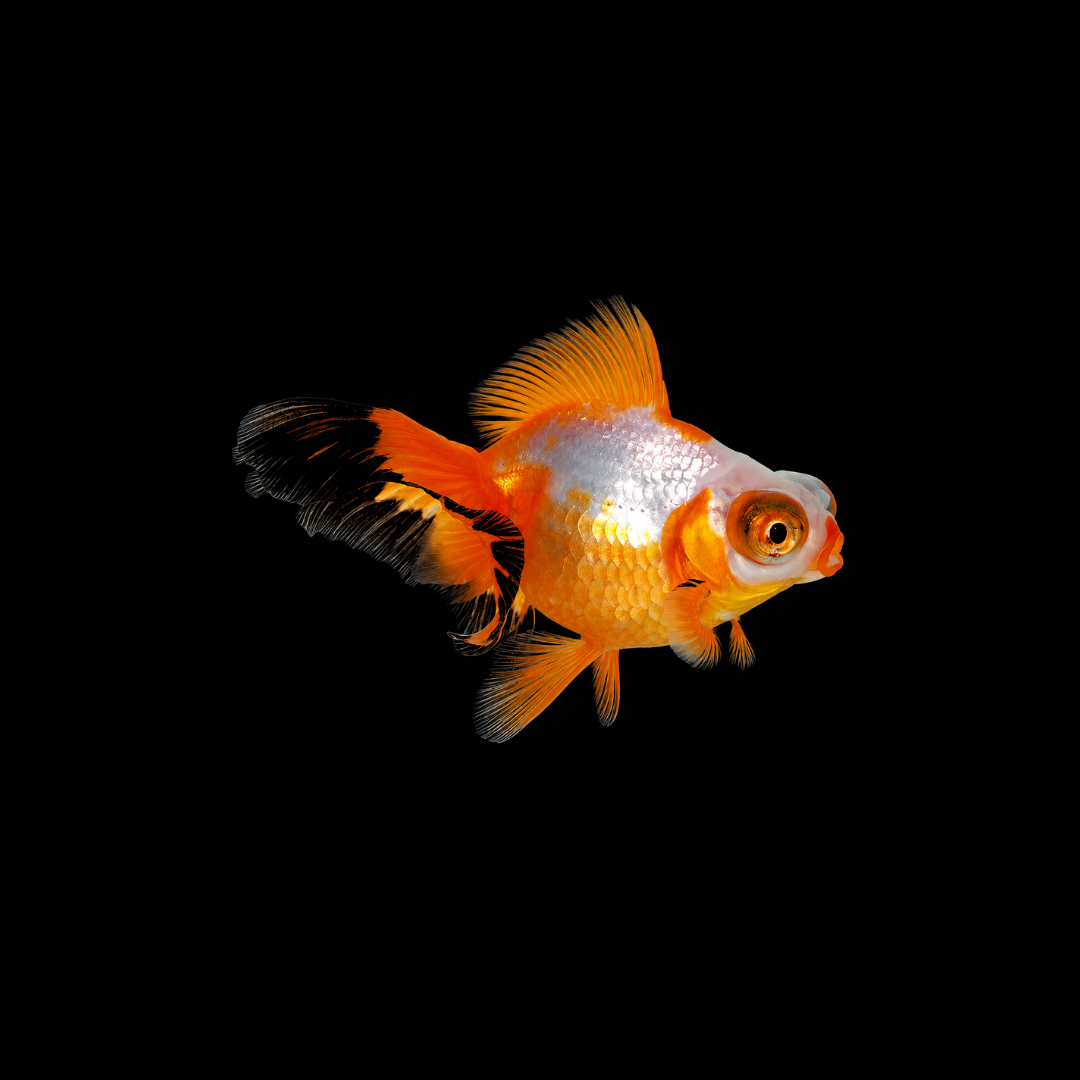
トリカラー蝶尾は、中国で発達した蝶尾系金魚のうち、赤・黒・白に浅葱色や青灰色が交じるキャリコ表現を持つタイプです。左右に突出した眼球、上から見たときに蝶が翅を広げたように見える大きな尾びれ、一匹ごとに異なるモザイク状の体色が特徴です。一般には「三色蝶尾」「キャリコ蝶尾」「五花蝶尾」などの名でも流通します。大きな尾びれを持つため俊敏な泳ぎには向かず、突出した眼球も傷つきやすいので、十分な底面積、穏やかな水流、角のないレイアウトで飼育すると負担を減らせます。 The Tricolor Butterfly Tail is a calico form of the Chinese-developed butterfly-tail goldfish. Its defining features are protruding telescope eyes, a broad caudal fin that resembles an open butterfly when viewed from above, and an individually unique mosaic of red, black, white, and blue-gray or asagi tones. In Japan it may also be sold as Sanshoku Chobi, Calico Chobi, or Goka Chobi. Its large tail is not suited to fast swimming, and the protruding eyes are vulnerable to injury, so a wide footprint, gentle flow, and smooth, obstacle-free décor help reduce physical stress.
基本情報 / Basic Information
| 学名 / Scientific Name | Carassius auratus |
|---|---|
| 通称 / Common Name | トリカラー蝶尾、三色蝶尾、キャリコ蝶尾、五花蝶尾Tricolor Butterfly Tail, Calico Butterfly Tail, Calico Butterfly Telescope |
| 分類 / Family | コイ目・コイ科・フナ属。金魚はフナ類から家畜化された観賞用品種群で、トリカラー蝶尾は独立した野生種ではありません。Order Cypriniformes, family Cyprinidae, genus Carassius. Goldfish are domesticated ornamental forms derived from crucian-carp lineages; the Tricolor Butterfly Tail is a breed form rather than a separate wild species. |
| 英名 / English Name | Calico Butterfly Telescope Goldfish / Tricolor Butterfly Tail Goldfish |
| 分布 / Distribution | 野生分布はありません。金魚そのものの家畜化は中国で進み、蝶尾も中国で作出・発達した品種です。日本には1980年前後から輸入されたとされ、現在は輸入個体と国内繁殖個体の双方が流通しています。There is no natural wild distribution. Goldfish domestication developed in China, and the butterfly-tail form was also created and refined there. It is generally reported to have reached Japan around 1980, and both imported and domestically bred fish are now available. |
| 最大体長 / Max Size | 全長20cm前後に達することがあります。一般的な飼育下では12〜18cm程度の個体が多いものの、系統や飼育条件によって差があります。They can reach around 20 cm in total length. Many aquarium-kept adults remain around 12–18 cm, although final size varies with lineage and husbandry. |
| 寿命 / Lifespan | 10年前後がひとつの目安で、適切な環境では15年以上生きる例もあります。蝶尾だけを対象にした寿命データは限られており、個体差や飼育条件による差が大きいと考えてください。Around 10 years is a useful general expectation, and well-kept goldfish can live for 15 years or longer. Lifespan data specific to butterfly tails are limited, so individual and husbandry differences are substantial. |
飼育環境 / Aquarium Environment
| 水槽サイズ / Tank Size | 成魚1匹なら少なくとも60cm規格水槽(約60Lクラス)を目安とし、余裕を持たせるなら60cmワイド水槽が扱いやすいです。2〜3匹なら90cm規格水槽(約150〜180Lクラス)など、さらに底面積と水量を確保できる容器が向きます。上見や育成で浅めの容器が使われることもありますが、浅水は必須条件ではありません。水位を下げる場合は、その分だけ幅と奥行きで水量を確保してください。For one adult, a standard 60 cm aquarium of roughly the 60 L class is a practical minimum target, while a 60 cm wide aquarium provides more comfortable capacity. For two or three adults, a standard 90 cm aquarium in roughly the 150–180 L class, or another container with comparable or greater footprint and volume, is more suitable. Shallow containers are sometimes used for top-view appreciation and rearing, but shallow water is not an absolute requirement. If the water level is reduced, compensate with greater width and depth of the container to preserve adequate total volume. |
|---|---|
| 水温 / Temperature | 18〜24℃前後を中心に、急変させず安定させるのが基本です。金魚はより広い温度域に耐えますが、蝶尾では高温時の溶存酸素低下や急な温度変化を避けます。繁殖では春先の緩やかな水温上昇が産卵のきっかけになります。 A stable range around 18–24°C is a good everyday target. Goldfish tolerate a broader range, but butterfly tails benefit from avoiding low dissolved oxygen during hot weather and abrupt temperature changes. In breeding programs, a gradual spring rise in water temperature can help trigger spawning. |
| 水質 / Water Quality | 弱酸性〜弱アルカリ性まで適応しますが、pH6.5〜8.5程度の範囲で安定させることを優先します。アンモニアと亜硝酸は検出されない状態を保ち、硝酸塩もできるだけ低く管理します。20mg/L以下はひとつの管理目安ですが、数値だけを追うより急変を避けることが重要です。金魚は排泄量が多いため、十分な生物ろ過と定期換水が欠かせません。They tolerate mildly acidic to mildly alkaline water, but stability within roughly pH 6.5–8.5 is more important than targeting a narrow number. Ammonia and nitrite should remain undetectable, and nitrate should be kept as low as practical. About 20 mg/L or less is a useful management target, but avoiding sudden parameter changes is equally important. Because goldfish produce heavy waste loads, adequate biological filtration and regular water changes are essential. |
| レイアウト / Layout | ベアタンク、細かな砂、角の丸い砂利など、眼球と尾びれを傷つけにくい構成が向きます。尖った石、硬く鋭い人工水草、狭い穴のある飾りは避けます。フィルターの吸水口にはスポンジを付け、排水は壁面へ当てるか拡散させて弱い水流にします。水草を使う場合も、硬い葉先や固定材が眼球に触れないよう配置してください。A bare bottom, fine sand, or smooth rounded gravel helps protect the eyes and fins. Avoid sharp rocks, stiff pointed artificial plants, and ornaments with tight openings. Fit a sponge prefilter over intakes and diffuse filter outflow against a wall or through a spray bar to keep flow gentle. If live plants are used, arrange them so rigid leaf tips, weights, or anchoring materials cannot contact the eyes. |
| 注意点 / Precautions | 突出した眼球と大きな尾びれのため、障害物との接触、強い水流、俊敏な同居魚との給餌競争に注意します。浅水飼育は上見や一部の育成で用いられますが、「深い水の水圧が尾を変形させる」とする因果関係は一般的な飼育根拠としては確認しにくいため、必須条件とは考えません。水位を低くする場合は、水量の減少と夏季の温度上昇に注意してください。Because of the protruding eyes and large tail, pay particular attention to collisions with décor, strong current, and feeding competition from much faster tank mates. Shallow-water keeping is used for some top-view and rearing practices, but the claim that deeper-water pressure directly deforms the tail is not well established as a general husbandry rule. Shallow water should therefore be treated as an optional management choice rather than a requirement. If the water level is reduced, watch for reduced total volume and faster summer warming. |
餌と給餌 / Feeding
| 餌の種類 / Diet | 主食は金魚用の良質なペレットやゲルフードを中心にし、補助的に冷凍赤虫、ブラインシュリンプ、柔らかくした植物質の餌などを組み合わせます。浮上性の餌そのものが転覆症状を起こすと断定はできませんが、浮力異常を起こしやすい個体では、沈下性または中性浮力に近い餌へ替えることで状態が安定する場合があります。個体が確実に摂餌できる方法を選んでください。Use a good-quality goldfish pellet or gel food as the staple, with frozen bloodworms, brine shrimp, and softened plant-based foods as supplements. Floating food itself cannot be assumed to cause buoyancy disorders, but fish that repeatedly develop buoyancy problems may improve when switched to sinking or near-neutrally buoyant foods. Choose a feeding method that lets the individual fish eat reliably. |
|---|---|
| 給餌のポイント / Feeding Tips | 一度に大量に与えず、少量を1日1〜3回に分け、数分で食べ切れる量にします。出目個体では餌取りに時間がかかることがあるため、毎回同じ場所へ与える、給餌皿を使うなど、確実に食べられているか観察します。冷凍赤虫は必要量だけ別容器で解凍し、食べ残しを水槽に残さないようにします。低水温時は消化が遅くなるため、給餌量を控えます。Offer small portions once to three times daily rather than one large meal, limiting each feeding to what can be eaten within a few minutes. Telescope-eyed fish may take longer to feed, so offer food in a consistent location or use a feeding dish and confirm that each fish is eating. Thaw only the amount of frozen bloodworms you need and remove uneaten food promptly. Reduce feeding as water temperature drops and digestion slows. |
性格と混泳 / Temperament and Tank Mates
| 性格 / Temperament | 基本的には温和で、攻撃性の低い金魚です。底や水槽内をついばむように探餌する行動がよく見られます。繁殖期の雄は雌を追尾するため、その時期は尾びれや眼球に傷がないか観察してください。They are generally peaceful, low-aggression fish and commonly forage by picking at the bottom and around the aquarium. During the breeding season, males may chase females, so monitor the eyes and long fins for injuries at that time. |
|---|---|
| 混泳の相性 / Compatibility | 同じように泳ぎがゆっくりな出目金、琉金、オランダ獅子頭などの丸手金魚と相性を取りやすいです。和金、コメット、朱文金などの俊敏な長手金魚は給餌競争で蝶尾が不利になりやすく、ヒレをつつく魚や高水温を必要とする熱帯魚との混泳もおすすめしません。小型のエビや稚貝は餌として認識されることがあります。They usually pair best with similarly slow fancy goldfish such as other telescope forms, ryukins, and orandas. Fast single-tail goldfish such as commons, comets, and shubunkins can outcompete them for food, while fin-nipping species and tropical fish requiring consistently warm water are poor choices. Small shrimp and tiny snails may be treated as food. |
病気と対策 / Diseases and Prevention
| かかりやすい病気 / Common Diseases | 丸い体型の金魚で起こりやすい浮力異常、いわゆる転覆症状に注意します。これは単一の病気ではなく、浮袋の形態異常、消化管のガスや内容物、低水温、水質悪化、感染症、腫瘤など複数の原因で生じます。ほかに白点病、尾ぐされ・カラムナリス症などの細菌性疾患、エロモナス症、外傷後の二次感染が問題になります。蝶尾では突出した眼球の擦り傷、角膜の白濁、片眼だけが急に腫れる病的な眼球突出にも注意が必要です。Fancy goldfish are predisposed to buoyancy disorders, often called “capsizing” problems. This is a clinical sign rather than one single disease and may involve swim-bladder anatomy, gastrointestinal gas or contents, low temperature, poor water quality, infection, masses, or other causes. Ich, fin rot and columnaris, Aeromonas-associated disease, and secondary infection after injury are also concerns. Butterfly tails additionally require close monitoring for abrasions of the exposed eyes, corneal cloudiness, or sudden one-sided swelling that indicates pathological popeye rather than normal telescope-eye anatomy. |
|---|---|
| 対策と予防 / Prevention | アンモニア・亜硝酸を0に保ち、過密を避け、定期換水と十分な酸素供給を続けることが最重要です。新しい魚は可能なら別容器で2〜4週間ほど観察してから合流させます。浮力異常が出たらまず水質と水温を確認し、給餌量を抑えて沈下性の消化しやすい餌へ見直します。浅めの隔離容器は姿勢維持の補助になることがありますが、長引く症状、腹部膨満、充血、潰瘍、食欲低下を伴う場合は感染症や内科的疾患を疑います。塩水浴や抗菌薬は万能ではないため、原因を見極め、観賞魚用医薬品の用法または魚類診療に詳しい獣医師の指示に従って使用します。The most important prevention is to keep ammonia and nitrite at zero, avoid crowding, perform regular water changes, and maintain strong oxygenation. When practical, observe new fish in a separate system for about two to four weeks before introduction. If buoyancy changes appear, first test water quality and temperature, reduce feeding, and consider a digestible sinking diet. A shallower hospital container can sometimes help the fish maintain posture, but persistent signs, abdominal swelling, redness, ulcers, or loss of appetite warrant concern for infection or internal disease. Salt baths and antimicrobials are not universal cures; use them only when appropriate and according to ornamental-fish medication labels or advice from a veterinarian experienced with fish. |
増やし方(繁殖) / Breeding
| 雌雄の判別 / Sexing | 成熟した雄は繁殖期になると、エラ蓋や胸びれ前縁に白い粒状の追星が出やすく、雌を追尾します。雌は抱卵すると腹部がふっくらし、総排泄孔がやや突出して見えることがあります。通常期の外見だけでは判別しにくいため、繁殖期の行動と追星を合わせて見ると判別しやすくなります。During the breeding season, mature males often develop small white breeding tubercles on the gill covers and leading rays of the pectoral fins and actively chase females. Gravid females become fuller through the abdomen and may show a slightly protruding vent. Outside the breeding season, sexing by appearance alone can be difficult; seasonal behavior and breeding tubercles make identification easier. |
|---|---|
| 繁殖形態 / Reproduction | 卵生で、水草や産卵モップなどへ粘着性の卵をばらまくタイプです。春の水温上昇や日長変化が刺激になり、雄が雌を追って放卵・放精します。親魚は卵を食べるため、産卵後は親を分けるか、卵の付いた産卵床を別容器へ移します。水温によりますが数日で孵化し、卵黄を吸収して遊泳を始めた稚魚には微細飼料や孵化直後のブラインシュリンプなどを与えます。They are egg-laying broadcast spawners that scatter adhesive eggs onto plants, spawning mops, or similar media. Rising spring temperatures and longer daylight can stimulate spawning, with males chasing females as eggs and milt are released. Adults readily eat the eggs, so remove the parents or transfer the egg-covered spawning medium. Hatching occurs within several days depending on temperature; once fry absorb the yolk and become free-swimming, offer very fine fry foods and newly hatched brine shrimp. |
| 繁殖のポイント / Breeding Tips | 親魚は尾の左右対称性、尾筒と背骨の健全性、左右の眼球バランス、泳ぎ、体色を総合して選びます。キャリコのモザイク透明鱗は不完全優性として古くから研究されており、モザイク同士の交配では理論上、金属光沢の強い普通鱗系が約1/4、モザイク透明鱗が約1/2、マットな透明鱗系が約1/4に分かれます。ただし赤・黒・浅葱の配置そのものは単純な一遺伝子では固定できないため、目的のトリカラー表現を得るには多数の稚魚からの選別が必要です。初期は重い脊椎変形や遊泳異常など明らかな形成不良を除き、その後に尾の開き、左右対称性、眼の発達、色柄を段階的に評価します。観賞価値だけでなく、正常に摂餌・遊泳できる健康性を最優先にしてください。Select broodstock by considering tail symmetry, a sound caudal peduncle and spine, balanced eyes, normal swimming, and color. The nacreous or mosaic-transparent scale trait has long been studied as an incompletely dominant trait. A nacreous × nacreous mating is expected to produce roughly one-quarter metallic-scaled offspring, one-half nacreous offspring, and one-quarter matte offspring. The actual distribution of red, black, and blue-gray patterning is far more complex and cannot be fixed by a single gene, so many fry must be evaluated to obtain strong tricolor examples. Early selection removes single tails, severe spinal deformity, and abnormal swimmers; later rounds assess tail spread and symmetry, eye development, and color. Functional health and the ability to feed and swim normally should always take priority over ornament alone. |
雑学と豆知識 / Trivia and Fun Facts
| 1. 金魚の家畜化は「一度の突然変異」では終わらなかった / 1. Goldfish domestication was not a single mutation event | 金魚の祖先は東アジアのフナ類で、観賞魚としての本格的な選抜は中国・宋代、特に長江下流域で進んだと考えられています。赤い体色だけでなく、双尾、背びれの消失、短い体型、出目、透明鱗など、互いに異なる発生経路を持つ変異が何世代にもわたって組み合わされ、現在の多様な金魚が形づくられました。トリカラー蝶尾は、その長い人工選抜の歴史の中で「尾・眼・鱗・色」という複数の形質が一匹に集約された品種と見ることができます。Goldfish descend from East Asian crucian-carp lineages, and intensive ornamental selection is thought to have accelerated in China during the Song dynasty, particularly around the lower Yangtze region. The modern goldfish was not created by one mutation: red coloration, twin tails, dorsal-fin loss, shortened body form, telescope eyes, and transparent-scale traits arose through different developmental pathways and were recombined by breeders over many generations. The Tricolor Butterfly Tail is therefore a striking convergence of several independently selected traits in a single fish. |
|---|---|
| 2. 日本への金魚伝来「1502年説」は有名だが、史料には幅がある / 2. The famous “1502 arrival in Japan” date should be read with historical caution | 日本では、文亀2年(1502年)に明から堺へ金魚が渡来したという説が広く知られています。この説は1748年刊の飼育書『金魚養玩草』に記されていますが、1502年当時の記録で裏付けられているわけではないため、初渡来年を確定した史実として扱うのは慎重であるべきです。一方、江戸中期には『金魚養玩草』のような専門的な飼育書が刊行されており、その頃までに金魚の飼育文化が広く定着していたことは確かです。Japan commonly cites 1502 as the year goldfish arrived from Ming China at the port of Sakai. The account appears in the 1748 husbandry book Kingyo Sodategusa, but it is not corroborated by a surviving contemporary record from 1502, so the date should not be treated as conclusively established. What is clear is that by the mid-Edo period, specialized goldfish husbandry books were being published and goldfish keeping had become firmly established in Japanese culture. |
| 3. 蝶尾は「横見」より「上見」で完成するデザイン / 3. The butterfly tail is a design completed by top-view appreciation | 蝶尾は中国原産で、日本では1980年前後から知られるようになった比較的新しい導入品種です。横から見ると大きな双尾を持つ出目金に近く見えますが、真上から見ると尾びれの前縁が左右へ大きく張り、四つの尾葉が蝶の翅のような輪郭をつくります。そのため、品種の評価では尾の大きさだけでなく、尾の左右対称性、尾芯の向き、停止時にも広がりを保てる張りが重視されます。現在の日本では中国由来の輸入個体に加え、国内繁殖の蝶尾も流通しています。埼玉県加須市には埼玉県養殖漁業協同組合の観賞魚流通市場があり、県の振興計画でも東日本の観賞魚流通の中核と位置づけられています。The butterfly-tail form originated in China and became familiar in Japan only around 1980, making it a comparatively recent introduction. From the side it can resemble a telescope goldfish with an oversized twin tail, but from directly above the leading edges spread laterally and the four lobes create the outline of an open butterfly. Quality therefore depends not only on tail size but also on left-right symmetry, the orientation of the central tail structure, and the ability to hold a broad spread even when the fish pauses. In Japan today, imported Chinese-origin fish coexist with domestically bred butterfly tails. Kazo in Saitama Prefecture is home to the ornamental-fish market operated by the Saitama Aquaculture Cooperative, which the prefecture identifies as a major hub for ornamental-fish distribution across eastern Japan. |
| 4. 双尾を生んだchordin変異 / 4. The chordin mutation behind the twin tail | 金魚の代表的な双尾形質では、胚の背腹軸形成に関わるchordin遺伝子の一つ、現在chdSと呼ばれる遺伝子座(旧称chdA)のE127X変異が重要です。この変異によって127番目のアミノ酸位置でタンパク質の合成が途中で止まり、Chordinの働きが弱まることで、胚の尾部に左右へ分かれた軸構造が形成されます。つまり、成長後の尾びれだけが二つに割れるのではなく、双尾は発生の早い段階から尾部骨格のつくられ方そのものが変化した形質です。研究者は、金魚がゲノム重複によって近縁の遺伝子コピーを持つことが、この大きな形態変化を生存可能な形で保持する一因になった可能性を指摘しています。A key genetic feature of classic twin-tail goldfish is the E127X mutation in a chordin locus now commonly called chdS, formerly chdA. The mutation introduces a premature stop at amino-acid position 127, weakening Chordin function during dorsal-ventral embryonic patterning and causing the posterior axial structures to bifurcate. In other words, the tail does not simply split late in growth; the underlying caudal skeleton develops differently from an early embryonic stage. Researchers have suggested that duplicated related genes in the goldfish genome may have helped make such a major developmental change compatible with survival. |
| 5. 出目と頂天眼は似ていても「同じ変異の途中段階」とは限らない / 5. Telescope and celestial eyes look related, but are not simply stages of one mutation | 出目金の眼球は成長とともに突出し、望遠鏡のような形へ発達します。2020年のゲノム研究では、出目形質にLRP2A遺伝子の機能を失わせる複数の変異が関係することが示されました。さらに2025年には、頂天眼でも同じLRP2遺伝子に別の変異が見つかっています。つまり、出目と頂天眼は見た目や発達のしかたに共通点があっても、「出目がそのまま上を向くまで進んだ形」と単純には説明できません。同じ遺伝子に別々の変化が生じ、似た眼球突出へ至った例として理解する方が、現在の遺伝学的知見に合っています。Telescope eyes protrude progressively as the fish grows. Genomic work published in 2020 linked the telescope-eye phenotype to several loss-of-function mutations in LRP2A, while a 2025 study identified a different mutation in the same LRP2 gene in celestial-eye goldfish. The two eye types therefore share genetic and developmental similarities, but a celestial eye cannot be explained simply as a telescope eye that continued rotating upward. Different mutations in the same gene have produced related protruding-eye phenotypes under artificial selection. |
| 6. キャリコの「青」は青色素を塗った色ではない / 6. Calico “blue” is not produced by a simple blue pigment | トリカラー蝶尾の浅葱色や青灰色は、単純に青い色素細胞が表面へ並んでできる色ではありません。キャリコ系のモザイク透明鱗では、グアニンによる反射の強さや鱗の透明度が場所によって異なり、皮膚の深い位置にある黒色素胞が透けて見える部分では、黒が青灰色や浅葱色に見えることがあります。愛好家向けには「チンダル現象」と一言で説明されることもありますが、実際の見え方は色素細胞の位置、鱗や皮膚の透明度、反射組織の状態が組み合わさったものと考える方が正確です。The blue-gray or asagi areas of a Tricolor Butterfly Tail are not simply produced by a surface layer of blue pigment cells. In calico nacreous scales, reflectivity from guanine and scale transparency vary from place to place. Where melanophores lie deeper in the skin beneath translucent tissue, black pigmentation can appear blue-gray or pale blue to the observer. Hobby explanations sometimes reduce this to a “Tyndall effect,” but the visible color is better understood as the combined result of pigment-cell depth, tissue transparency, and reflective structures. |
| 7. モザイク透明鱗同士から同じ模様は再現できない / 7. Two nacreous parents cannot reproduce the same pattern predictably | モザイク透明鱗の基本的な鱗タイプは比較的分かりやすいメンデル比で分離しますが、「どこに赤が入り、どこに黒が残り、どの範囲が青く見えるか」は多数の遺伝要因と発生中の色素細胞分布に左右されます。そのため、優れた親魚を組み合わせても、親と同じ模様の子をコピーすることはできません。繁殖家はまず健全な双尾と体型を選び、その後に尾の開き、眼の左右差、模様、黒の残り方などを何度も見直します。この再現不能性こそが、トリカラー蝶尾を一匹ずつ選ぶ楽しさにつながっています。The basic scale-type segregation of nacreous goldfish can follow a relatively simple Mendelian pattern, but the actual placement of red, black, white, and blue-gray areas depends on many genetic modifiers and on how pigment cells develop and migrate. Even excellent parents therefore cannot “copy” their own pattern into the next generation. Breeders first select for healthy twin-tail anatomy and body form, then repeatedly reassess tail spread, eye symmetry, pattern balance, and retention of black pigment. This biological unpredictability is one reason individual Tricolor Butterfly Tails are so rewarding to select and appreciate. |
| 8. 「転覆病」は病名というより、原因を探すためのサイン / 8. “Capsizing disease” is better treated as a sign that needs a cause | 丸手の金魚が横倒しになったり、浮き続けたり、沈んだまま上がれなくなったりすると、まとめて「転覆病」と呼ばれがちです。しかし魚類診療では、まず「浮力異常」という症状として捉え、原因を分けて考えます。浮袋の形や機能、消化管内のガス、水質、感染、体内の腫瘤など、見た目が似ていても原因は一つではありません。まず水質と水温を確認し、過食を避け、姿勢を保ちやすい穏やかな環境へ移します。症状が続く、または腫れ・充血・潰瘍・食欲不振を伴う場合は、単純な消化不良と決めつけず、別の病気も考えることが大切です。When fancy goldfish float, sink, roll onto one side, or remain upside down, hobbyists often group the problem under one name: “capsizing disease.” In fish medicine, it is more useful to treat this first as a buoyancy abnormality and then consider the underlying cause. Swim-bladder structure or function, intestinal gas, poor water quality, infection, and internal masses can produce similar outward signs for different reasons. Begin by checking water quality and temperature, avoiding overfeeding, and moving the fish to a calm environment where it can maintain posture. If the problem persists or is accompanied by swelling, redness, ulcers, or loss of appetite, do not assume it is merely indigestion. |
まとめ / Conclusion
トリカラー蝶尾は、出目、水平に広がる蝶尾、モザイク透明鱗によるキャリコ模様という、複数の改良形質が一匹に重なった金魚です。真上から見たときに際立つ左右対称の尾形と、一匹ごとに異なる赤・黒・浅葱の配色が大きな魅力です。同じ「トリカラー蝶尾」という名で流通する個体でも、尾の張りや色柄によって一匹ずつ異なる印象を見せます。 The Tricolor Butterfly Tail combines several selectively bred traits in one fish: telescope eyes, a horizontally spreading butterfly tail, and a calico pattern produced by nacreous scales. From above, the bilateral symmetry of the tail contrasts with the individually variable mosaic of red, black, and blue-gray. Even under the same variety name, differences in tail carriage and color pattern give each fish a distinct appearance.
飼育では、十分な底面積と水量、弱い水流、安定した水質、眼球や尾びれを傷つけないレイアウトを整えることが大切です。俊敏な魚に合わせるのではなく、蝶尾のゆったりした泳ぎに環境を合わせることで、特徴的な尾形を落ち着いて観賞できます。形態上の弱点を理解して無理のない環境を整えれば、一匹ごとの色柄と姿を長く楽しめる金魚です。 Successful care means adapting the aquarium to the fish rather than expecting it to compete with faster swimmers. Provide adequate footprint and water volume, gentle flow, stable water quality, and surroundings that cannot damage the eyes or fins. With husbandry suited to its distinctive anatomy, a Tricolor Butterfly Tail can be enjoyed for its individual color pattern and characteristic tail form over many years.

気になる道具や飼い方を見つけてみませんか?
 アイのアクアグッズ案内海水魚の底砂の選び方|サンゴ砂・ライブサンドとおすすめ商品道具の特徴や使い方、選ぶときのポイントをアイが紹介します。記事はコチラ →
 アイのアクアグッズ案内プレコ飼育に必要なもの|餌・流木・ろ過・隠れ家・掃除用品道具の特徴や使い方、選ぶときのポイントをアイが紹介します。記事はコチラ →
さまざまな飼育テーマをご紹介。リンク先の記事には広告・商品紹介が含まれます。
案内・紹介記事一覧へ →分布マップ
野生分布はありません。金魚は中国で家畜化され、蝶尾も中国で作出・発達した観賞用品種です。日本には1980年前後から導入され、現在は輸入個体と国内繁殖個体の双方が流通しています。地図では中国から日本を含む地域を概略表示しています。
※この地図は分布・由来地域を把握するための概略表示です。野生の採集地点を示すものではありません。マーカーは座標情報がないため中国内に設定した代表地点であり、実際の採集地点・産地・作出地点を示すものではありません。
参考文献
-
Froese, R. & Pauly, D. (eds.). FishBase. Carassius auratus, Goldfish.対応:分類、種としての自然分布・生息環境、食性、産卵生態FishBase: Carassius auratus参照日:2026年8月31日
-
Chen, D. et al. (2020). The evolutionary origin and domestication history of goldfish (Carassius auratus). Proceedings of the National Academy of Sciences, 117(47), 29775–29785.対応:金魚の家畜化起源、中国由来の観賞用品種群、品種分化の背景DOI: 10.1073/pnas.2005545117
-
RSPCA Australia. (2024). How should I care for my goldfish?対応:水槽容量、水温、水質、ろ過・酸素供給、水流、レイアウト、給餌、混泳上の注意RSPCA Knowledgebase更新:2024年5月1日/参照日:2026年8月31日
-
Petty, B. D., Francis-Floyd, R. & Yanong, R. P. E. Management of Aquarium Fish. MSD Veterinary Manual.対応:水質管理、隔離・バイオセキュリティ、浮力異常、外傷、薬剤使用時の考え方MSD Veterinary Manual最終更新:2024年9月/参照日:2026年8月31日
-
Yanong, R. P. E. Fish Health Management Considerations in Recirculating Aquaculture Systems—Part 2: Pathogens. UF/IFAS Extension, FA100.対応:カラムナリス症、エロモナス属細菌、白点病などの病原体、隔離、器具・水を介した感染拡大の予防UF/IFAS Extension: FA100参照日:2026年8月31日
-
Kobayashi, M., Iwata, E. & Sorensen, P. W. (2026). Environmental and Physiological Regulation of Reproduction in the Goldfish: Gonadal Development, Maturation, and Spawning Behavior: A Review. Animals, 16(5), 775.対応:成熟、季節性、水温と繁殖活動、雄の追尾を含む産卵行動DOI: 10.3390/ani16050775
-
Chen, S. C. (1928). Transparency and Mottling, a Case of Mendelian Inheritance in the Goldfish Carassius auratus. Genetics, 13(5), 434–452.対応:透明鱗・モザイク表現の遺伝、繁殖時に見られる鱗タイプの分離DOI: 10.1093/genetics/13.5.434




コメント