

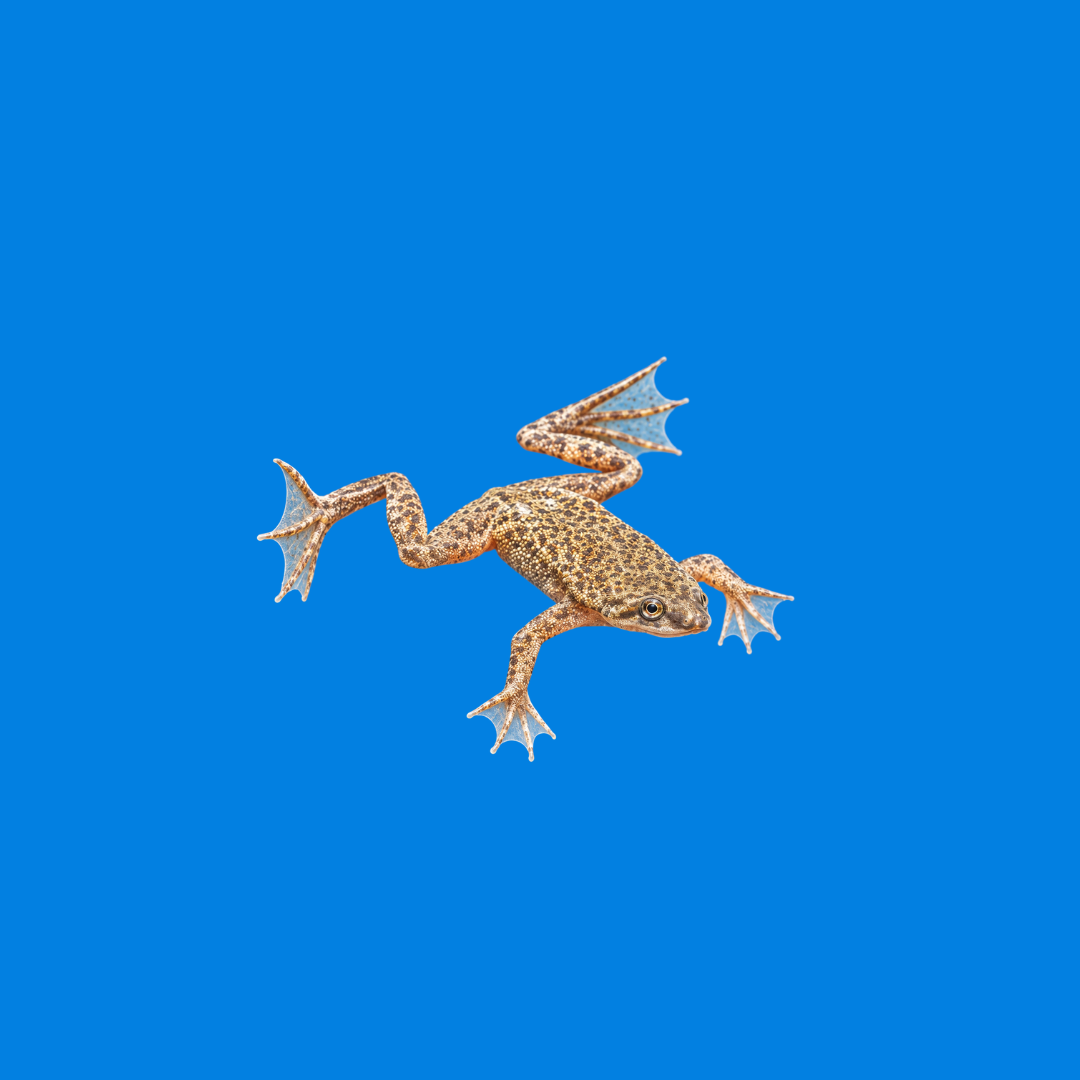
解説Description
ヒメツメガエルは、アフリカ中西部の熱帯域に分布するピパ科ヒメツメガエル属(Hymenochirus)の小型カエルです。一般的な流通個体は頭胴長(SVL)3〜4cmほどで、幼生期から成体まで水中生活に強く適応しています。日本では「ヒメツメガエル」「コンゴツメガエル」などの流通名でアクアリウムショップに並び、小型の水棲両生類として親しまれてきました。 African dwarf frogs are small aquatic frogs of the genus Hymenochirus in the family Pipidae, native to tropical western and central Africa. Commonly traded animals are roughly 3–4 cm in snout–vent length (SVL), and both larvae and adults are strongly adapted to aquatic life. They are widely kept as small aquarium amphibians and are commonly sold under names such as African dwarf frog or dwarf clawed frog.
小さな体には、完全水棲に近い生活へ適応した特徴が数多く見られます。舌や歯を持たず、水流を利用して獲物を吸い込む吸引摂餌、前肢にも発達した水かき、水中の振動を感じ取る側線器官、水中で行われる求愛の発声などは、その代表例です。一方、呼吸では肺を使うため定期的に水面へ浮上する必要があり、水質の悪化、強すぎる水流、誤飲しやすい底床などは負担になります。小型で身近なカエルですが、その特殊な水中生活を理解して環境を整えることが長期飼育の基本です。 Their small bodies show many adaptations to an almost entirely aquatic life. These include suction feeding without a tongue or teeth, webbing on the forelimbs as well as the hind limbs, a lateral-line system for detecting water movement, and underwater courtship calls. They still breathe with lungs, however, and must regularly reach the surface. Poor water quality, excessive current, and substrate that can be swallowed with food can therefore become important husbandry problems. Long-term success depends on understanding these specialized aquatic adaptations.
基本情報Basic Information
| 学名Scientific Name | Hymenochirus sp.(一般的な飼育・流通個体群。種同定が明確な場合を除く)Hymenochirus sp. for the common captive-trade population, unless a specimen has been reliably identified to species. |
|---|---|
| 通称Common Name | ヒメツメガエル、コンゴツメガエルなど。一般的な飼育個体は長年 Hymenochirus boettgeri として扱われてきましたが、近年の細胞遺伝学・系統学的研究では、広く流通する飼育個体群を真正の H. boettgeri と同一視しないほうがよい可能性が示されています。そのため、由来が明確でない流通個体については Hymenochirus sp. とするのが慎重です。African dwarf frog and dwarf clawed frog. Common captive frogs have long been identified as Hymenochirus boettgeri, but recent cytogenetic and phylogenetic work indicates that the widespread captive population should not automatically be treated as true H. boettgeri. For animals of undocumented origin, Hymenochirus sp. is therefore a cautious designation. |
| 分類Classification | 無尾目(Anura)・ピパ科(Pipidae)・ヒメツメガエル属(Hymenochirus)。現在、H. boettgeri、H. boulengeri、H. curtipes、H. feaeの4種が認められています。Order Anura, family Pipidae, genus Hymenochirus. Four species are currently recognized: H. boettgeri, H. boulengeri, H. curtipes, and H. feae. |
| 英名English Name | African Dwarf Frog / Dwarf Clawed Frog |
| 分布Distribution | 属としては西〜中部アフリカの森林性熱帯域に分布し、ナイジェリア、カメルーンからガボン、コンゴ盆地にかけて見られます。種ごとに分布域は異なりますが、流れの緩い浅い水域、森林内の池や冠水域などを利用します。As a genus, Hymenochirus occurs in forested equatorial western and central Africa, from Nigeria and Cameroon south through Gabon and east across the Congo Basin. Ranges differ among species, but they are associated with shallow, slow or still waters, forest pools, and seasonally flooded habitats. |
| 成体サイズAdult Size | 頭胴長(SVL)約3〜4cm。種や性別によって差があり、一般的な流通個体ではメスがオスよりやや大型になる傾向があります。Approximately 3–4 cm in snout–vent length (SVL), with variation among species and sexes. In the common captive population, females generally become somewhat larger than males. |
| 寿命Lifespan | 飼育下ではおおむね5年前後がひとつの目安です。個体差や導入時の健康状態、飼育環境による幅が大きく、最大寿命について一律に示せる確かな値はありません。Around five years is a useful general expectation in captivity. Longevity varies with individual condition, health at acquisition, and husbandry, and there is no single well-established maximum lifespan that applies to all captive frogs. |
飼育環境Enclosure Environment
| 飼育容器・サイズEnclosure and Size | 完全水棲なので、陸地を設けたテラリウムではなくアクアリウムで飼育します。少数飼育でも30〜40Lクラスの横長水槽を基準にすると、水温や水質を安定させやすく管理に余裕が生まれます。肺呼吸のため水面へ繰り返し浮上するので、深さよりも水面へ無理なく到達できることが重要です。水深20〜30cm程度は扱いやすく、より深い場合は水面近くに休める水草や足場を設けます。These frogs are fully aquatic and should be kept in an aquarium rather than a terrestrial terrarium. For a small group, a horizontally oriented aquarium in roughly the 30–40 L class provides useful stability in temperature and water quality. Because the frogs repeatedly surface to breathe air, easy access to the surface matters more than a rigid depth limit. A water depth of about 20–30 cm is easy to manage; in deeper setups, provide plants or other resting places close to the surface. |
|---|---|
| 温度Temperature | 水温22〜26℃程度を安定して維持します。急激な温度変化を避け、室温だけでは低くなる季節には観賞魚用ヒーターを使用します。長時間の低温や高温にさらすことは避け、とくに高温時は水中の溶存酸素量が低下し、水質も悪化しやすくなる点に注意します。Maintain a stable water temperature of approximately 22–26°C. Avoid abrupt fluctuations and use an aquarium heater when room temperature is insufficient. Prolonged exposure to unusually low or high temperatures should be avoided; warmer water also holds less dissolved oxygen and can allow water quality to deteriorate more quickly. |
| 環境管理Environmental Management | アンモニアと亜硝酸が検出されない、十分に立ち上がった水槽を使用します。pHはおおむね6.5〜7.8の範囲で急変させず、数値そのものより安定性を重視します。水道水を使う場合は塩素・クロラミンを適切な水質調整剤で処理します。濾過はスポンジフィルターなど穏やかなものが向き、強い水流は避けます。定期的な部分換水を行い、食べ残しや排泄物をこまめに除去します。洗剤、殺虫剤、芳香剤などが飼育水へ混入しないようにすることも重要です。Use a mature, biologically established aquarium in which ammonia and nitrite remain undetectable. A pH around 6.5–7.8 is generally workable, but stability is more important than chasing a precise number. Treat tap water appropriately for chlorine and chloramine. Gentle filtration such as a sponge filter is suitable, and strong currents should be avoided. Perform regular partial water changes, remove uneaten food and waste, and keep detergents, insecticides, aerosols, and similar household chemicals away from the aquarium. |
| レイアウトLayout | 餌と一緒に飲み込める大きさの砂利は避けます。底床を敷かないベアタンク、細かな砂、口に入らない大きさの滑らかな砂利など、誤飲と清掃のしやすさを考えて選びます。水草や滑らかな流木、シェルターは休息場所になりますが、水面までの移動を妨げない配置にします。尖った石や粗い装飾品も皮膚を傷つけるおそれがあるため避けます。Avoid gravel that is small enough to be swallowed together with food. A bare bottom, fine sand, or smooth gravel clearly too large to ingest can all be used when chosen with both impaction risk and ease of cleaning in mind. Aquatic plants, smooth wood, and shelters provide resting places, but they should not obstruct access to the surface. Sharp or abrasive decorations should also be avoided. |
| 注意点Precautions | 水槽には確実なフタを設置し、コード穴や配管周辺の隙間も塞ぎます。水槽外へ出ると乾燥によって短時間でも深刻なダメージを受ける可能性があります。また、生体を野外へ放さないことはもちろん、使用済みの飼育水や濡れた器具を池・川など自然の水系へ直接持ち込まないようにします。新しい個体は可能であれば別容器で経過観察し、器具の共用を避けるなど、カエルツボカビを含む病原体を広げない衛生管理も大切です。Use a secure lid and close gaps around cables and plumbing. An escaped frog can suffer severe dehydration in a short time. Never release animals outdoors, and do not introduce used aquarium water or wet equipment directly into natural ponds, streams, or other waterways. When possible, observe new arrivals separately and avoid sharing wet equipment between amphibian enclosures to reduce the spread of pathogens, including amphibian chytrid fungi. |
餌と給餌Feeding
| 餌の種類Diet | 肉食性で、冷凍アカムシ、ブラインシュリンプ、ミジンコ類などの小型動物性餌をよく食べます。これらだけに偏らせず、食べられる大きさの沈下性ペレットなど、栄養バランスを考えた人工飼料にも慣らすと管理しやすくなります。特定の餌だけを長期間与え続けず、複数の餌を組み合わせます。They are carnivorous and readily take small animal foods such as frozen bloodworms, brine shrimp, and daphnia. Rather than relying on one item alone, it is useful to train them to accept appropriately sized sinking formulated foods and to provide dietary variety. |
|---|---|
| 給餌のポイントFeeding Tips | 餌を探すときは視覚だけでなく嗅覚や水中の振動も利用しますが、素早い魚との給餌競争には弱い傾向があります。混泳水槽ではスポイトや長いピンセットでカエルの近くへ餌を運ぶターゲットフィーディングが有効です。給餌量と頻度は幼体・成体、体型、食欲に合わせ、腹部の状態を確認しながら少量ずつ調整します。食べ残しは水質悪化につながるため、速やかに取り除きます。They use smell and water movement as well as vision to locate food, but they are often poor competitors against fast-feeding fish. In community aquaria, target feeding with a pipette or long forceps can help ensure each frog receives food. Adjust amount and frequency according to age, body condition, and appetite rather than following a rigid schedule, and promptly remove leftovers. |
行動と同居Behavior and Cohabitation
| 行動・性質Behavior | 温和で、水底を歩くように移動したり、後肢を強く蹴って水面まで浮上したりします。休息時には水面付近で四肢を広げ、ほとんど動かず浮かぶ姿も見られ、飼育者の間で「バーブリング(burbling)」と呼ばれることがあります。こうした静止だけで衰弱と判断する必要はありませんが、食欲低下、姿勢の崩れ、皮膚の発赤、異常な膨満などを伴う場合は注意が必要です。また、薄い膜状の皮膚を脱ぎ、その皮を食べる正常な脱皮行動も見られます。These are generally peaceful frogs that often walk along the bottom and then kick strongly toward the surface to breathe. At rest they may float almost motionless near the surface with the limbs spread, a posture often called “burbling” among keepers. Stillness alone does not necessarily indicate illness, but loss of appetite, abnormal posture, skin redness, or marked swelling requires attention. Normal shedding may also be seen, and the shed skin is often eaten. |
|---|---|
| 同居の相性Compatibility | 同種同士は比較的穏やかで、十分なスペースと隠れ家があれば複数飼育できます。温和な小型魚との混泳例もありますが、餌を横取りされやすいため、各個体が確実に食べているか確認する必要があります。大型魚、攻撃性の強い魚、皮膚をつつく魚との混泳には向きません。異なる両生類との同居は、環境要求の違いや病原体の移動を考えると避けるのが無難です。給餌と健康状態を把握しやすいのは、ヒメツメガエルだけの単独種水槽です。Conspecifics are usually peaceful and can be maintained together when sufficient space and shelter are available. They are sometimes kept with small peaceful fish, but food competition must be watched carefully. Large, aggressive, or persistent nipping fish are unsuitable companions. Mixing different amphibian species is best avoided because of differing husbandry needs and pathogen-transfer risks. A species-only aquarium makes feeding and health monitoring easiest. |
病気と対策Diseases and Prevention
| かかりやすい病気・不調Common Diseases and Health Problems | 水質悪化や輸送ストレスに続いて、食欲不振、皮膚の発赤や潰瘍、異常な脱皮、浮腫や腹部膨満などが見られることがあります。飼育者が「腹水」と呼ぶ膨満は単一の病名ではなく、感染症、臓器障害、体液調節の異常など複数の原因で起こり得ます。また、両生類ではカエルツボカビ菌(Batrachochytrium dendrobatidis:Bd)などの感染症にも注意が必要です。一方、薄い皮を脱いで食べる通常の脱皮は、それだけでは病気ではありません。Poor water quality and transport stress can be followed by loss of appetite, skin redness or ulceration, abnormal shedding, edema, or abdominal swelling. The bloating often called “dropsy” by keepers is not a single disease and may have several underlying causes, including infection, organ dysfunction, or disturbed fluid regulation. Amphibians are also susceptible to infectious diseases including chytridiomycosis caused by Batrachochytrium dendrobatidis (Bd). Normal shedding of a thin skin layer, sometimes followed by eating it, is not by itself a disease sign. |
|---|---|
| 対策と予防Prevention and Care | 安定した水温と水質、適切な給餌、過密を避けた環境を維持することが基本です。異常が見られた個体は必要に応じて隔離し、水温、アンモニア、亜硝酸、pH、食欲、排泄、皮膚の状態を確認します。観賞魚用の抗菌薬や塩水浴が紹介されることもありますが、魚類と両生類では薬剤への反応が異なり、症状だけで原因を特定することもできません。自己判断で薬品濃度を決めず、重症例や症状が続く場合は両生類を診療できる獣医師へ相談します。Prevention begins with stable temperature and water quality, appropriate feeding, and avoiding overcrowding. If a frog becomes abnormal, isolate it when appropriate and check temperature, ammonia, nitrite, pH, appetite, feces, and skin condition. Aquarium-fish medications and salt treatments are sometimes discussed in the hobby, but amphibians can respond differently to drugs and the underlying cause cannot be diagnosed from symptoms alone. Avoid selecting drug concentrations by guesswork, and consult an amphibian-experienced veterinarian for severe or persistent problems. |
増やし方(繁殖)Breeding
| 雌雄の判別Sexing | 成熟したメスはオスより一回り大きく、腹部に丸みが出やすい傾向があります。オスでは、前肢の付け根の後方に白〜淡いピンク色の腺状隆起が見られます。これは後腋窩皮下腺(post-axillary subdermal gland)と呼ばれ、繁殖活動に伴って目立ちやすくなる器官です。幼体では雌雄差が分かりにくいため、成熟後に複数の特徴を合わせて判断します。Mature females are generally larger and develop a fuller abdomen. Males have a whitish to pale-pink glandular swelling behind each forelimb, the post-axillary subdermal gland, which becomes more conspicuous during reproductive activity. Juveniles are difficult to sex reliably, so several traits should be considered after maturity. |
|---|---|
| 繁殖形態Reproduction | 卵生で体外受精を行います。繁殖行動中のオスは水中でクリック音が連続するような求愛音を発し、メスの腰部を抱接します。ペアは水面へ向かって泳ぎ、仰向けに反転するような姿勢で少数ずつ卵と精子を放出し、これを繰り返します。一晩に多数の卵が散らばることがあり、親が卵を食べる場合もあるため、繁殖を狙う場合は産卵後に親と卵を分けます。Reproduction is oviparous with external fertilization. During breeding, males produce underwater calls composed of repeated clicks and clasp females around the waist. Pairs swim toward the surface and release small batches of eggs and sperm while rolling into an inverted position, repeating the sequence many times. Numerous eggs may be scattered in a single night, and adults may eat them, so breeders commonly separate the parents from the spawn. |
| 繁殖のポイントBreeding Tips | まず成熟した健康な雌雄の栄養状態を整え、安定した環境で飼育することが重要です。飼育下では季節を問わず繁殖する例があり、水換えや水温などの環境変化だけを必須の繁殖トリガーと考える必要はありません。卵は適温では数日で孵化します。幼生は一般的な濾過摂食型のオタマジャクシとは異なり、個々の餌を追って吸い込む捕食型の摂餌を行います。自由遊泳を始めたら、口に入る微細な餌を切らさないことが重要で、ワムシやインフゾリア、細かな粉末飼料などから始め、成長に合わせて孵化直後のブラインシュリンプなどへ移行できます。順調な個体はおおむね5〜7週間ほどで変態しますが、幼生期は餌不足と水質悪化の双方に弱いため、少量の給餌と清掃をこまめに行います。Begin with healthy, mature frogs in good nutritional condition and maintain them under stable husbandry. Captive breeding can occur at different times of year, so changes in water level or temperature should not be treated as mandatory spawning triggers. Eggs hatch within a few days under suitable conditions. Unlike the suspension-feeding tadpoles of many frogs, Hymenochirus larvae track individual food items and capture them by suction. Once free-swimming, they need a continuous supply of very small food; rotifers, infusoria, fine powdered fry food, and later newly hatched brine shrimp can be used as they grow. Well-growing larvae commonly complete metamorphosis in roughly five to seven weeks, and careful feeding and cleaning are important because they are vulnerable to both starvation and deteriorating water quality. |
雑学と豆知識Trivia and Fun Facts
| 1. 「ヒメツメガエル」の正体は意外に複雑1. The identity of captive African dwarf frogs is surprisingly complicated | ペットとして世界中で飼育されてきたヒメツメガエルは、長い間 Hymenochirus boettgeri とされることが一般的でした。ところが、コンゴ共和国北西部で形態的に H. boettgeri と同定された野生個体では36本の染色体が確認された一方、同じ研究で調べられた飼育個体群は20本のA染色体と1本のB染色体を持っていました。形態や分子データも合わせると、少なくともその飼育個体群を真正の H. boettgeri と同一種として扱うことには問題があると考えられています。古い研究では飼育個体から異なる染色体数も報告されており、属全体の分類整理にはまだ研究が必要です。つまり、非常に身近なペットでありながら、その正確な種名は今も研究途上にあります。African dwarf frogs in the pet trade were long treated as Hymenochirus boettgeri. A recent study, however, found 36 chromosomes in a wild frog from northwestern Republic of the Congo that was morphologically identified as H. boettgeri, whereas the captive frogs examined in the same study had 20 A chromosomes plus one B chromosome. Together with morphological and molecular evidence, this indicates that at least that captive population should not simply be treated as true H. boettgeri. Older captive studies have also reported different chromosome counts, so the genus still requires taxonomic revision. In other words, the exact species identity of one of the world’s most familiar aquarium frogs remains an active research question. |
|---|---|
| 2. アフリカツメガエルとの識別に役立つ前足の水かき2. Forelimb webbing helps distinguish them from African clawed frogs | ヒメツメガエル属では、後肢だけでなく前肢の指の間にも水かきが発達しています。これに対し、よく混同されるアフリカツメガエル属(Xenopus)の前肢には水かきがありません。さらにアフリカツメガエルは成長するとヒメツメガエルよりはるかに大型になります。幼い Xenopus が流通時に混同される可能性を考えると、体色だけでなく前肢の指間を確認することが有効な識別点になります。Species of Hymenochirus have webbing between the fingers of the forelimbs as well as on the hind feet. In contrast, the forelimbs of the commonly confused African clawed frogs, genus Xenopus, lack webbing, and Xenopus grows much larger. Because juveniles can be confused in the pet trade, checking the forelimb webbing is a useful identification feature rather than relying on color alone. |
| 3. 舌を使わず、一瞬で獲物を吸い込む3. They capture prey without a tongue | ヒメツメガエルは舌も歯も持たず、口を開くと同時に口腔を急速に広げて水流を生み、獲物を吸い込みます。成体を対象にした研究でも吸引による捕食が確認されており、幼生では高速度撮影によって、獲物を視覚的に追跡してから一気に吸い込む行動が詳しく調べられています。見た目にはゆっくり餌を探していても、捕食の瞬間だけは非常に速いのが特徴です。魚類とは系統的に遠いカエルが、水中で獲物を捕らえるために似た仕組みへ到達した点も興味深いところです。African dwarf frogs have neither a tongue nor teeth and capture prey by rapidly expanding the mouth and oral cavity to generate suction. Suction-based prey capture has been demonstrated in adults, while high-speed studies of the larvae show them visually tracking individual prey before drawing it into the mouth. They may look slow while searching, yet the actual strike is extremely rapid. The resemblance to suction feeding in fishes is an intriguing example of distantly related aquatic vertebrates arriving at similar functional solutions. |
| 4. 水の中で「歌う」カエル4. A frog that sings underwater | 繁殖期のオスは、水中で小さなクリックが連続するような求愛音を発します。ピパ科の多くは一般的なカエルのような発声用の鳴嚢を持たず、空気を送り出して声帯を震わせる方式とも異なる、特殊化した喉頭で音を作ります。ヒメツメガエルでは前肢後方の後腋窩皮下腺も性差のある器官として知られており、繁殖時の化学的シグナルへの関与が研究されています。小さな体でも、音と化学的な情報を使って水中で相手とコミュニケーションしていると考えると、その行動の見え方が変わります。Breeding males produce underwater courtship calls made up of repeated clicks. Like many pipids, Hymenochirus lacks the typical vocal-sac system of many terrestrial frogs and uses a highly specialized laryngeal mechanism rather than ordinary airflow-driven vocal-cord vibration. The male post-axillary glands are also sexually dimorphic and have been studied for a role in chemical reproductive signaling. Even these tiny frogs therefore communicate underwater through more than one sensory channel. |
| 5. 脱いだ皮を自分で食べる5. They often eat their own shed skin | 健康なヒメツメガエルも定期的に脱皮します。古い角質層が薄い半透明の膜のように剥がれると、四肢を使って脱ぎ、その皮をそのまま食べることがあります。脱皮した皮を食べる皮膚食(dermatophagy)はカエル類で見られる正常な行動です。ただし、脱皮と同時に皮膚の発赤、ただれ、食欲低下などが見られる場合は、単なる生理的な脱皮ではなく、水質や健康状態を確認する必要があります。Healthy frogs shed the outer skin layer periodically and may use their limbs to remove the thin translucent sheet before eating it. Consumption of shed skin, or dermatophagy, is a normal behavior in frogs. Shedding accompanied by redness, sores, poor appetite, or other abnormalities, however, warrants investigation of water quality and health rather than being dismissed as routine sloughing. |
| 6. オタマジャクシのころから小さなハンター6. The tadpoles are tiny predators | ヒメツメガエルの幼生は、多くのカエルのオタマジャクシのように水中の細かな有機物を濾し取って食べるのではなく、個々の餌を追跡して吸い込む捕食型の摂餌を行います。巨大な眼を使って獲物を追い、口を突き出すようにして吸引する姿は、幼生のころから成体につながる水中捕食への適応が始まっていることを示します。飼育では「生き餌だけでなければ育たない」と決めつける必要はなく、非常に細かな餌を確実に口へ届けることが重要です。微小な生き餌や粉末飼料から始め、成長に合わせてブラインシュリンプなどへ切り替えていきます。Unlike the suspension-feeding tadpoles of many frogs, Hymenochirus larvae track individual food particles or prey and capture them by suction. Their large eyes and protrusible mouth reveal an aquatic predatory specialization that begins well before metamorphosis. In captivity, this does not mean that only live prey can ever be used; the important point is that newly feeding larvae receive food fine enough to capture. Microscopic live foods or very fine powdered diets can be used initially, followed by foods such as newly hatched brine shrimp as the larvae grow. |
| 7. 小さなカエルの皮膚が生命科学の研究対象に7. Their skin peptides have attracted biomedical interest | ヒメツメガエルの皮膚分泌物からは、ヒメノキリン(hymenochirin)と呼ばれる宿主防御ペプチド群が見つかっています。ヒメノキリン-1Bは細菌に対する作用に加え、複数の培養腫瘍細胞株に対する細胞毒性が研究されてきました。さらに、分解されにくさや標的選択性を改善するため、分子を架橋する「ステープル化」や糖鎖付加を組み合わせた人工誘導体も実験されています。ここで重要なのは、これらが薬として確立されたという意味ではなく、ヒメツメガエル由来ペプチドを手掛かりにした基礎・創薬研究だという点です。小さな観賞用カエルの皮膚が、新しい分子設計を考える材料にもなっています。Skin secretions associated with dwarf clawed frogs have yielded a family of host-defense peptides known as hymenochirins. Hymenochirin-1B has been studied for antimicrobial activity and for cytotoxic effects against several cultured tumor-cell lines. Researchers have also tested modified analogues using molecular stapling and glycosylation to improve stability and selectivity. These findings do not mean that a frog-derived cancer drug is established; they represent basic and preclinical drug-design research using the peptide as a molecular starting point. |
| 8. 飼育者の衛生管理が野生の両生類を守る8. Good biosecurity can help protect wild amphibians | カエルツボカビ菌(Bd)は世界的な両生類減少に関わる病原体のひとつで、飼育個体や濡れた器具の移動によって地域を越えて運ばれる可能性があります。ヒメツメガエルを含むペット両生類の飼育では、生体を逃がさないだけでなく、飼育水や器具を自然の水系へ直接持ち込まないことが重要です。水槽内の健康管理と、野外へ病原体を広げないバイオセキュリティは、同じ飼育管理の一部として考える必要があります。The amphibian chytrid fungus Bd is one of the pathogens associated with global amphibian declines and can potentially be moved between places with captive animals or wet equipment. Responsible amphibian keeping therefore means not only preventing escape or release, but also keeping aquarium water and equipment out of natural waterways. Animal health inside the aquarium and biosecurity for wild amphibians are two parts of the same husbandry responsibility. |
まとめConclusion
ヒメツメガエルは、わずか数センチの体に、水中生活へ特化した多くの特徴を備えたカエルです。前肢の水かき、側線による感覚、舌を使わない吸引摂餌、水中での求愛音、捕食型の幼生などは、陸上のカエルとは異なる暮らしをよく表しています。飼育では、その特殊さを難しく考えすぎるよりも、安定した水質と水温、穏やかな水流、誤飲しにくい底床、水面へ容易に到達できる環境を整えることが大切です。 African dwarf frogs pack a remarkable set of aquatic specializations into a body only a few centimeters long. Forelimb webbing, lateral-line sensation, tongue-free suction feeding, underwater courtship calls, and predatory larvae all reflect a life very different from that of a typical terrestrial frog. In captivity, their specialized biology is best respected through stable water quality and temperature, gentle flow, safe substrate, and easy access to the surface.
身近なペットとして長く飼われてきた一方で、一般的な流通個体群の正確な分類には今も検討すべき点が残されています。皮膚のペプチドや染色体、摂餌の仕組みまで研究対象になっていることを知ると、水槽の中で静かに暮らす小さなカエルにも、進化と生物学の豊かな背景があることが見えてきます。毎日の動きや食べ方を丁寧に観察し、その生態に合った環境を維持することが、ヒメツメガエルの魅力を長く楽しむための基本です。 Although these frogs have been familiar pets for decades, the exact taxonomic identity of the common captive population still requires clarification. Research on their chromosomes, skin peptides, and feeding mechanics also shows how much biological complexity is hidden in a tiny aquarium animal. Careful observation and husbandry that matches their aquatic ecology allow that complexity—and the frogs themselves—to be appreciated over the long term.

気になる道具や飼い方を見つけてみませんか?
 アイのアクアグッズ案内ベタの一匹飼いを楽しむ|水槽・ヒーター・ふた・フィルターの選び方ベタの一匹飼いに向く水槽容量、ふたと空気層、ヒーターと水温計、弱い水流のフィルターを、コタロウとアイの会話で分かりやすく解説します。記事はコチラ →
 アイのアクアグッズ案内バルブの仲間に合わせる飼育用品|チェリーバルブ・スマトラ・中型種の水槽とろ過道具の特徴や使い方、選ぶときのポイントをアイが紹介します。記事はコチラ →
 アイのアクアグッズ案内プレコ飼育に必要なもの|餌・流木・ろ過・隠れ家・掃除用品道具の特徴や使い方、選ぶときのポイントをアイが紹介します。記事はコチラ →
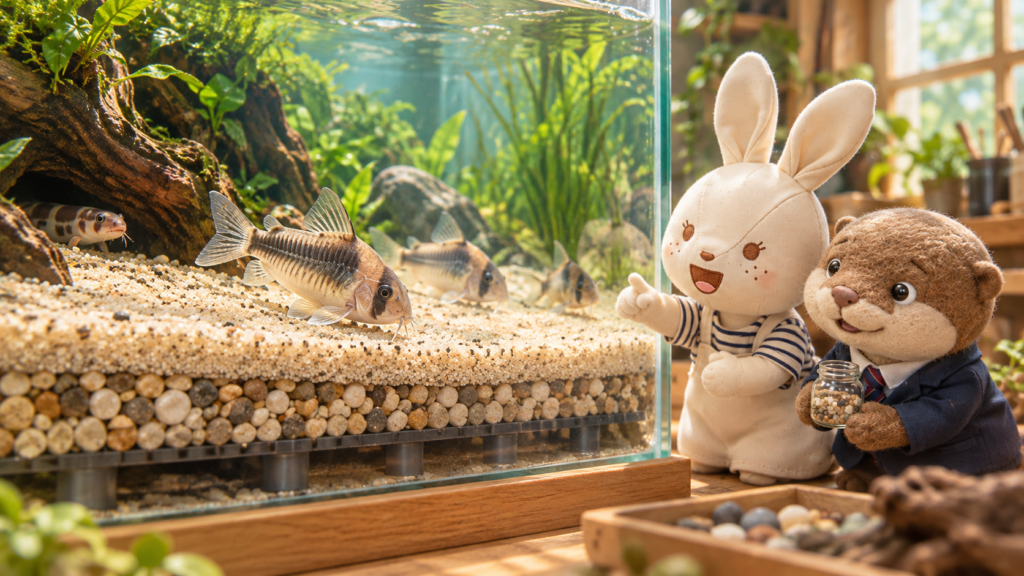 アイのアクアグッズ案内水槽の底砂の選び方|砂・砂利の違いとおすすめ商品道具の特徴や使い方、選ぶときのポイントをアイが紹介します。記事はコチラ →
さまざまな飼育テーマをご紹介。リンク先の記事には広告・商品紹介が含まれます。
案内・紹介記事一覧へ →分布マップ
ヒメツメガエル属(Hymenochirus)は、西〜中部アフリカの森林性熱帯域に分布し、ナイジェリア、カメルーンからガボン、コンゴ盆地にかけて見られます。種によって分布域は異なります。
※この地図は記事中の分布情報をもとに、西〜中部アフリカにおける分布域を概略的に示したものです。マーカーは分布域を把握しやすくするために設定した代表地点であり、実際の採集地点や特定個体群の生息地点を示すものではありません。
参考文献
- 分類・分布: Frost, D. R. 2026. “Hymenochirus Boulenger, 1896.” Amphibian Species of the World 6.2: An Online Reference. American Museum of Natural History, New York, USA. Amphibian Species of the World (2026年9月18日閲覧)
- 流通個体群の分類: Gvoždík, V., Knytl, M., Zassi-Boulou, A.-G., Fornaini, N. R. & Bergelová, B. 2024. “Tetraploidy in the Boettger’s dwarf clawed frog (Pipidae: Hymenochirus boettgeri) from the Congo indicates non-conspecificity with the captive population.” Zoological Journal of the Linnean Society 200(4): 1034–1047. https://doi.org/10.1093/zoolinnean/zlad119
- 自然分布・生息環境: Badjedjea, G., Masudi, F. M., Akaibe, B. D. & Gvoždík, V. 2022. “Amphibians of Kokolopori: an introduction to the amphibian fauna of the Central Congolian Lowland Forests, Democratic Republic of the Congo.” Amphibian & Reptile Conservation 16(1): 35–70 (e301). https://doi.org/10.5281/zenodo.12761585
- 飼育環境・水質・給餌: Carvalho, T., Si, C., Clemons, R. A., Faust, E. & James, T. Y. 2023. “Housing and Care for Hymenochirus boettgeri.” protocols.io. https://doi.org/10.17504/protocols.io.ewov1qxdpgr2/v1
- 繁殖・卵と幼生の管理: Carvalho, T. & James, T. Y. 2023. “Protocol for breeding Hymenochirus boettgeri in captivity.” protocols.io. https://doi.org/10.17504/protocols.io.x54v9pzrqg3e/v1
- カエルツボカビ症・飼育下での健康管理: Carvalho, T., Si, C., Clemons, R. A., Faust, E. & James, T. Y. 2023. “Amphibian Hymenochirus boettgeri as an experimental model for infection studies with the chytrid fungus Batrachochytrium dendrobatidis.” Virulence 14(1): 2270252. https://doi.org/10.1080/21505594.2023.2270252
- カエルツボカビ症・病原体管理: World Organisation for Animal Health (WOAH). “Chytridiomycosis (Batrachochytrium dendrobatidis).” World Organisation for Animal Health (2026年9月18日閲覧)




コメント