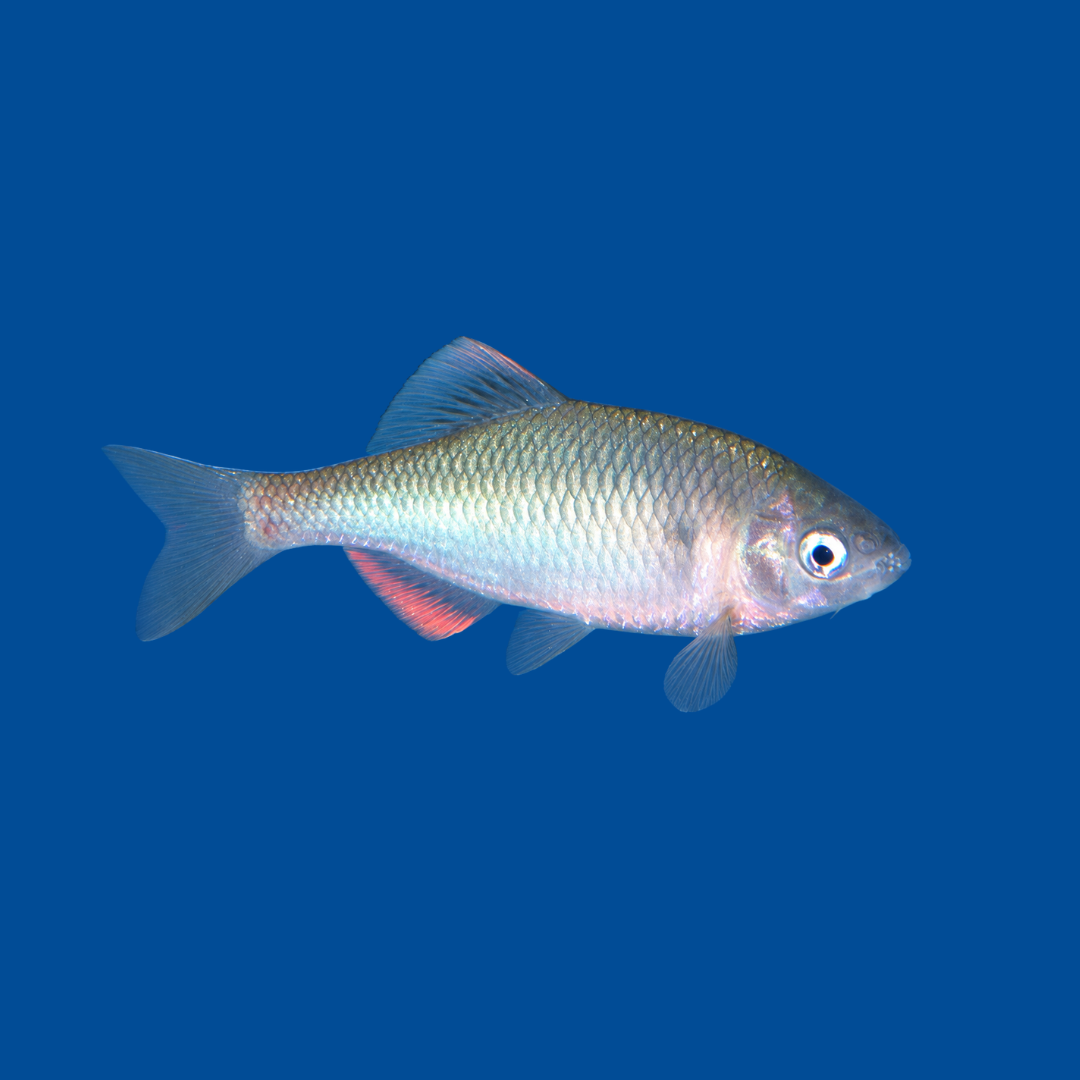
ヤリタナゴは、銀白色の細長い体と長い一対の口ひげを持つ、日本産タナゴ類の代表的な一種です。普段は端正で控えめな色合いですが、春から夏の繁殖期を迎えたオスは、頬と腹を朱色に染め、体側に淡い緑色の光沢をまといます。流れのある河川や農業用水路にも暮らす活発な魚で、十分な遊泳空間と酸素に富む清潔な水を用意すると、その軽快な泳ぎと季節ごとの変化をじっくり観察できます。飼育自体は比較的取り組みやすい一方、繁殖には生きた淡水二枚貝が関わり、地域個体群の保全にも配慮が必要な奥深い魚です。The slender bitterling is a representative Japanese bitterling with a streamlined, silvery body and a conspicuously long pair of barbels. Its everyday colors are restrained, but during the spring-to-summer breeding season, males develop vermilion cheeks and bellies with a pale green sheen along the flanks. This active fish also inhabits flowing rivers and agricultural channels, and shows its best swimming behavior and seasonal changes in clean, well-oxygenated water with ample open space. Routine care is relatively approachable, but breeding involves living freshwater mussels and responsible husbandry must also respect the conservation of distinct regional populations.
基本情報 / Basic Information
学名 / Scientific Name
Tanakia lanceolata (Temminck & Schlegel, 1846)
通称 / Common Name
ヤリタナゴ。地域によっては「ボテ」「ボテジャコ」と呼ばれることがありますが、これらはほかのタナゴ類にも使われる混称です。Slender bitterling; in parts of Japan it may be called “bote” or “bote-jako,” local names also used for other bitterlings.
分類 / Family
条鰭綱・コイ目・タナゴ科・アブラボテ属。分類体系によってはコイ科タナゴ亜科として扱われます。Class Actinopterygii, order Cypriniformes, family Acheilognathidae, genus Tanakia. Some classifications treat this group as the subfamily Acheilognathinae within Cyprinidae.
英名 / English Name
Slender bitterling
分布 / Distribution
日本では北海道と九州南部を除く本州・四国・九州北部を中心に分布し、国外では朝鮮半島西岸にも見られます。国内では平野部の河川、農業用水路、浅い湖沼や池などに生息し、タナゴ類の中では比較的流れのある砂礫底にも現れます。In Japan, the species is widely distributed across Honshu, Shikoku, and northern Kyushu, excluding Hokkaido and southern Kyushu. Outside Japan, it also occurs along the western Korean Peninsula. It inhabits lowland rivers, agricultural channels, shallow lakes, and ponds, and is often found over sand and gravel in relatively flowing water compared with many other bitterlings.
最大体長 / Max Size
全長8〜10cmほどが目安で、大型個体では10cmを超えることがあります。Usually about 8–10 cm in total length, with large individuals sometimes exceeding 10 cm.
寿命 / Lifespan
本種の寿命を一律の年数で示せる、信頼性の高い種別資料は限られています。飼育下では導入時の年齢や水温、餌、水質によって経過が変わるため、確定的な寿命は不明です。Reliable species-specific data supporting a single lifespan figure are limited. In captivity, longevity varies with age at acquisition, temperature, diet, and water quality, so a definitive lifespan is unknown.
飼育環境 / Aquarium Environment
水槽サイズ / Tank Size
少数飼育でも60cm規格水槽(実水量の目安50〜60L)以上を推奨します。複数のオスを含む群れや繁殖を考える場合は、90cm規格水槽(実水量の目安150L前後)以上にすると、遊泳域と縄張りを分けやすくなります。A standard 60 cm aquarium with roughly 50–60 L of actual water volume or larger is recommended even for a small group. For a group containing several males or for breeding, a standard 90 cm aquarium with roughly 150 L of actual water volume or more makes it easier to provide separate swimming areas and territories.
水温 / Temperature
日常管理では10〜25℃程度を目安とします。日本の季節変化に適応した温帯魚なので、安定した室内では無加温飼育も可能ですが、急激な温度変化は避けてください。特に夏は水温上昇と酸欠が重なりやすいため、28℃を超えないように冷却とエアレーションを調整します。繁殖を狙う場合は、冬の低水温から春に緩やかに水温が上がる環境が成熟のきっかけになります。For routine care, about 10–25°C is a practical target. As a temperate fish adapted to Japan’s seasonal cycle, it can be kept without a heater in a stable indoor setting, but abrupt temperature changes should be avoided. In summer, adjust cooling and aeration to keep the water from exceeding 28°C because heat and oxygen depletion often occur together. For breeding, a natural transition from cool winter water to gradual spring warming helps stimulate maturation.
水質 / Water Quality
中性付近の清浄な淡水を基本とし、アンモニアと亜硝酸が検出されない状態を保ちます。本種について厳密な最適pHや硬度を一つの数値で示すよりも、十分な溶存酸素を確保し、導入時や換水時の急変を避けることが重要です。Use clean freshwater near neutral pH and maintain undetectable ammonia and nitrite. Rather than treating one exact pH or hardness value as a proven species-specific optimum, prioritize abundant dissolved oxygen and avoid abrupt changes during introduction or water changes.
レイアウト / Layout
中央から前面に広い遊泳空間を取り、細かな砂利や砂を敷きます。水草、石、流木を水槽の側面や背面にまとめると、追われた個体の退避場所になります。ろ過器の水流は弱〜中程度にし、水面を揺らすかエアレーションを加えて酸素を確保します。驚くと跳ねることがあるため、ふたも用意します。Leave broad open swimming space across the center and front over fine gravel or sand. Group plants, stones, and driftwood along the sides and back to provide retreats for chased fish. Use gentle to moderate filtration flow and maintain oxygen through surface agitation or additional aeration. A secure lid is advisable because startled fish may jump.
注意点 / Precautions
高水温時の酸欠、過密、餌の与えすぎによる水質悪化に注意します。野外採集は場所ごとの条例、漁業調整規則、土地の管理規則を事前に確認し、合法的に流通している由来の明確な個体を選んでください。地域ごとに遺伝的な違いがあるため、産地の異なる個体同士を混ぜず、アブラボテとも同居させないことが大切です。飼育個体を自然へ放流してはいけません。Watch for oxygen depletion during hot weather, overcrowding, and water deterioration caused by overfeeding. Before collecting wild fish, check all applicable local conservation ordinances, fisheries rules, and land-use restrictions, and choose legally traded fish of documented origin. Because regional populations can be genetically distinct, do not mix fish from different localities or keep them with Tanakia limbata. Never release captive fish into the wild.
餌と給餌 / Feeding
餌の種類 / Diet
雑食性です。小粒の観賞魚用人工飼料を主食に、冷凍赤虫、ミジンコ、ブラインシュリンプ、イトミミズなどの動物質と、藻類成分を含む飼料を組み合わせます。野生では付着藻類や小型の底生動物、水生昆虫などを食べます。Omnivorous. Use a high-quality small pellet or flake as the staple, supplemented with animal foods such as frozen bloodworms, daphnia, brine shrimp, or tubifex, along with foods containing algal ingredients. In the wild it feeds on attached algae, small benthic animals, and aquatic insects.
給餌のポイント / Feeding Tips
1日1〜2回、数分で食べ切れる量を少しずつ与えます。中層用の餌に底へ沈む餌も混ぜると、底層で餌を探す自然な行動を観察できます。残餌は取り除き、冬の低水温期には活動量と消化力に合わせて回数と量を減らします。Feed once or twice daily in small portions that are consumed within a few minutes. Combining mid-water food with some sinking food encourages natural foraging near the bottom. Remove leftovers, and reduce both frequency and quantity during cool winter periods as activity and digestion slow.
性格と混泳 / Temperament and Tank Mates
性格 / Temperament
通常は温和で、仲間と緩やかな群れをつくる活発な魚です。ただし繁殖期のオスは二枚貝の周囲に縄張りを持ち、同種のオスを追うことがあります。複数飼育では、視線を遮る水草や石と十分な横幅を確保してください。Usually peaceful and active, forming loose groups with its own kind. During the breeding season, however, males may defend territories around mussels and chase rival males. When keeping several fish, provide ample horizontal space and break lines of sight with plants and stones.
混泳の相性 / Compatibility
同程度の大きさで、本種と同じような水温を好む温和な日本産淡水魚と混泳させやすい魚です。モロコ類や小型のドジョウ類などが候補になりますが、個体数と遊泳層の重なりを見て調整します。攻撃的な魚、大型の捕食魚、動きの遅い長いひれの魚、口に入る稚魚や稚エビとの混泳は避けます。産地保全と交雑防止のため、ほかのアブラボテ属魚類とは別に飼育するのが安全です。It can share an aquarium with peaceful Japanese freshwater fishes of similar size and temperature requirements, including suitable minnows and small loaches, provided stocking level and swimming zones are considered. Avoid aggressive or predatory fish, slow long-finned fish, and fry or juvenile shrimp small enough to be swallowed. To protect locality integrity and prevent hybridization, keeping it separately from other Tanakia species is safest.
病気と対策 / Diseases and Prevention
かかりやすい病気 / Common Diseases
本種に特有の好発疾患は明確になっていません。飼育下では一般的な淡水魚と同様に、白点病、尾ぐされ病などの細菌性感染症、水カビ病、体表や鰓の外部寄生虫に注意します。呼吸が速い、ひれをたたむ、体を物にこすりつける、食欲が落ちるといった変化が早期発見の手掛かりです。No characteristic disease known to occur especially often in this species has been clearly established. In captivity, as with other freshwater fishes, watch for white spot disease, bacterial infections such as fin rot, fungal disease, and external parasites affecting the skin or gills. Rapid breathing, clamped fins, rubbing against objects, and loss of appetite are useful early warning signs.
対策と予防 / Prevention
新しい魚は別容器で2〜4週間観察し、器具の共用を避けます。適正な密度、強すぎない水流、十分な酸素、定期的な部分換水を保ち、温度やpHを急変させないことが基本です。異常時はまず水温、アンモニア、亜硝酸、酸素供給を確認し、病名を決めつけずに隔離します。薬浴は製品の対象魚・用量を確認し、必要に応じて魚病に詳しい専門家へ相談してください。Observe new fish in a separate system for 2–4 weeks and avoid sharing equipment. Preventive care centers on sensible stocking, moderate flow, abundant oxygen, regular partial water changes, and avoiding abrupt temperature or pH shifts. At the first sign of trouble, check temperature, ammonia, nitrite, and aeration, then isolate the fish without assuming a diagnosis. Confirm species suitability and dosage before using medication, and consult an aquatic animal health specialist when needed.
増やし方(繁殖) / Breeding
雌雄の判別 / Sexing
繁殖期のオスは頬と腹部が朱色になり、背部は暗色、体側は淡い緑色に輝きます。背びれと尻びれには朱色の帯と細い黒縁が現れ、吻の周囲には白い追星が出ます。メスは婚姻色が目立たず、成熟すると腹部が丸みを帯び、総排泄孔付近から赤みのある産卵管が伸びます。In breeding condition, males develop vermilion cheeks and bellies, a darker back, and a pale green sheen on the sides. The dorsal and anal fins show vermilion bands with narrow black margins, while white breeding tubercles appear around the snout. Females lack the conspicuous nuptial colors; mature females become fuller in the abdomen and extend a reddish ovipositor near the vent.
繁殖形態 / Reproduction
春〜夏に繁殖する卵生魚で、生きたマツカサガイやニセマツカサガイなど淡水二枚貝の鰓内へ産卵します。メスが出水管から卵を送り込み、オスの精子は入水管から水流とともに取り込まれて受精します。卵は数日で孵化し、仔魚は貝内で成長したのち、地域や水温による差はありますが、およそ3〜4週間後に全長約1cmで泳ぎ出ます。This egg-laying species breeds from spring into summer and deposits its eggs inside the gills of living freshwater mussels such as Pronodularia japanensis and Nodularia douglasiae nipponensis. The female places eggs through the mussel’s exhalant siphon, while the male’s sperm enters with the inhalant water current. The eggs hatch within a few days, and the larvae continue developing inside the mussel before emerging at about 1 cm long, usually after roughly 3–4 weeks depending on locality and temperature.
繁殖のポイント / Breeding Tips
冬の低水温を経験させ、春に水温と日長が自然に上がる環境を整えると成熟を促しやすくなります。十分に状態を整えた親魚と、合法的に入手され、由来を確認できる二枚貝を用意します。ただし二枚貝は植物プランクトンなどの微細な餌を必要とし、透明度の高い一般的な水槽では長期維持が難しいうえ、死亡すると急激な水質悪化を招きます。母貝の状態を毎日確認し、異常時には直ちに隔離してください。野生の二枚貝の採集や水系間移動は保全上の問題と法的制限を伴うことがあるため、安易に行ってはいけません。人工授精は親魚を傷つける危険がある高度な技術なので、専門施設や十分な経験を持つ繁殖者向けです。Allowing a cool winter period followed by naturally increasing spring temperature and day length helps stimulate maturation. Use well-conditioned broodfish and mussels that were legally obtained and have a documented origin. Freshwater mussels require microscopic foods such as phytoplankton, however, and are difficult to maintain long-term in a conventionally filtered clear-water aquarium; a dead mussel can cause a sudden and severe decline in water quality. Check each mussel daily and isolate it immediately if its condition worsens. Collecting wild mussels or moving them between watersheds can create conservation problems and may be legally restricted, so it should not be undertaken casually. Manual stripping and artificial fertilization can injure broodfish and are advanced techniques best left to specialist facilities or highly experienced breeders.
雑学と豆知識 / Trivia and Fun Facts
1. 和名と学名が同じ姿を描く / 1. The Japanese and scientific names describe the same silhouette
1846年、テミンクとシュレーゲルは本種をCapoeta lanceolataとして記載しました。種小名lanceolataは「槍のような」「披針形の」という意味を持ち、体高の低い細長い輪郭を表しています。日本語の「ヤリタナゴ」も同じ姿を槍になぞらえた名です。言語の異なる二つの名前が、ともに本種の体形を捉えているのは興味深いところです。その後、属の扱いは変遷し、現在はTanakia lanceolataが広く用いられています。In 1846, Temminck and Schlegel described the species as Capoeta lanceolata. The epithet lanceolata means “lance-like” or “lanceolate,” referring to its low, elongated outline. The Japanese name yaritanago also compares the fish to a spear. It is notable that names from two languages capture the same body shape. Its generic placement later changed, and Tanakia lanceolata is now widely used.
2. 長い口ひげは見分けるための大切な手掛かり / 2. Long barbels provide a valuable identification clue
ヤリタナゴの口角には、よく発達した一対の口ひげがあります。この口ひげと、背びれの条間膜に見られる紡錘形の暗色斑は、近縁のタナゴ類と見分ける際の大切な手掛かりです。ただし、交雑個体では親種の中間的な特徴や幅広い形態変異が現れるため、外見だけで確実に判定できない場合があります。The slender bitterling has a well-developed pair of barbels at the corners of its mouth. These barbels and the spindle-shaped dark mark in the membrane of the dorsal fin are valuable clues when distinguishing it from related bitterlings. Hybrids can show intermediate or widely variable traits, however, so appearance alone does not always allow a certain identification.
3. 二枚貝との関係は、単純な「助け合い」ではない / 3. The relationship with mussels is not simple mutual assistance
ヤリタナゴは卵と仔魚を守る場所として、生きた二枚貝を繁殖に欠かせません。一方、多くの淡水二枚貝も、グロキディウムと呼ばれる幼生期に適合する魚の鰓やひれへ一時的に付着し、水流に逆らえない幼生を別の場所へ運んでもらいます。ただし、どの貝にもどの魚にも同じ組み合わせが成立するわけではなく、宿主適合性は種ごとに異なります。水辺で魚と貝が結ぶ関係は、「互いに得をする」という短い言葉だけでは表し切れない、緊密で選択的な進化の積み重ねなのです。The slender bitterling cannot reproduce without living mussels that shelter its eggs and larvae. Many freshwater mussels, in turn, have a larval stage called a glochidium that temporarily attaches to the gills or fins of suitable fish, gaining transport that the larva could not achieve against the current alone. Yet not every mussel can use every fish; compatibility differs among species. Their connection is therefore more selective and evolutionarily intricate than the simple phrase “mutual help” suggests.
4. 貝が減ると、魚同士の境界まで揺らぐ / 4. When mussels decline, even species boundaries can weaken
愛媛県松山平野では、在来のヤリタナゴと人為的に移入されたアブラボテの交雑が確認されています。2019年の遺伝解析では、採集された成魚211個体のうち22個体、約10.4%が交雑個体と判定されました。この割合は松山平野の調査地点で得られた値であり、全国の個体群に当てはまる数値ではありません。2020年の研究では、産卵場所となる二枚貝の密度が低い地点ほど交雑した卵や仔魚が生じやすく、限られた貝に複数種が集中することが交雑を促すと示されました。つまり、ヤリタナゴを守るには、魚だけでなく、産卵を支える貝とその生息環境を一体として保全する必要があります。On the Matsuyama Plain in Ehime Prefecture, hybridization has been documented between the native slender bitterling and introduced Tanakia limbata. A 2019 genetic study classified 22 of 211 sampled adults, about 10.4%, as hybrids. This figure applies to the surveyed sites on the Matsuyama Plain and is not a nationwide rate. A 2020 study found that hybrid eggs and larvae were more likely where spawning mussel density was low, indicating that several bitterling species crowding around the remaining mussels can promote hybridization. In practical terms, conserving the slender bitterling requires protection not only of the fish but also of the mussels and habitat that support its reproduction.
5. 地域の履歴を受け継ぐ魚 / 5. A fish carrying the history of its watershed
海水域を越えて移動しにくい純淡水魚では、水系の分断が地域ごとの系統の形成につながります。ヤリタナゴでも、ミトコンドリアDNAに基づく研究によって複数の地域集団が確認されています。見た目がよく似ていても、すべての産地の個体を同じ一群として扱うことはできません。産地の異なる個体を混ぜたり、飼育魚を別の川へ放したりすると、長い時間をかけて形成された地域固有の遺伝的特徴を乱すおそれがあります。放流は魚を自然へ戻す行為ではなく、その水系の生物学的な履歴を変える可能性があるため、行ってはいけません。In primary freshwater fishes that cannot readily cross marine waters, separation among drainages can contribute to the formation of distinct regional lineages. Mitochondrial DNA research has identified several regional population groups in the slender bitterling. Although fish from different localities may look very similar, they should not be treated as a single interchangeable population. Mixing localities or releasing captive fish into another river may disturb genetic characteristics formed over long periods. Release should therefore never be regarded as simply returning a fish to nature; it can alter the biological history of the receiving watershed.
まとめ / Conclusion
ヤリタナゴは、普段の落ち着いた銀白色と、繁殖期に現れる鮮やかな婚姻色の両方を季節の移ろいの中で観察できる日本産淡水魚です。広い遊泳空間、清潔で酸素に富む水、夏の高水温対策を整えることで、流れの中を軽快に泳ぐ本来の姿を見せてくれます。The slender bitterling shows two seasonal faces: restrained silver-white in ordinary months and vivid nuptial colors during breeding. With broad swimming space, clean oxygen-rich water, and careful summer temperature control, it displays the agile swimming behavior characteristic of life in flowing water.
その美しさを守るためには、魚だけでなく、産卵を支える二枚貝と水辺の環境、水系ごとに受け継がれてきた系統を尊重することが欠かせません。由来の明確な個体を適切に飼育し、異なる産地を混ぜず、決して放流しないことまで含めて向き合うことで、ヤリタナゴ本来の魅力を長く楽しめます。Protecting that beauty requires respect not only for the fish, but also for the mussels that support its reproduction, the surrounding waterside habitat, and the lineages inherited within each drainage. By keeping traceable fish properly, avoiding the mixing of localities, and never releasing captive individuals, aquarists can enjoy the species’ natural character for years to come.
Fricke, R., Eschmeyer, W. N. & Van der Laan, R. (eds.). Eschmeyer’s Catalog of Fishes: Genera, Species, References. California Academy of Sciences. 資料ページ 学名、命名者、記載年、原記載時の学名、現在の分類上の扱い。
Kitamura, J. (2007). “Reproductive ecology and host utilization of four sympatric bitterling (Acheilognathinae, Cyprinidae) in a lowland reach of the Harai River in Mie, Japan.” Environmental Biology of Fishes, 78, 37–55. DOI 繁殖期、繁殖場所、淡水二枚貝の利用、産卵管を含む繁殖生態。
Tominaga, K., Nagata, N., Kitamura, J., Watanabe, K. & Sota, T. (2020). “Phylogeography of the bitterling Tanakia lanceolata (Teleostei: Cyprinidae) in Japan inferred from mitochondrial cytochrome b gene sequences.” Ichthyological Research, 67, 105–116. DOI 日本国内の系統地理、地域集団の遺伝的構造、産地間の個体移動に関する保全上の論点。
Hata, H., Uemura, Y., Ouchi, K. & Matsuba, H. (2019). “Hybridization between an endangered freshwater fish and an introduced congeneric species and consequent genetic introgression.” PLOS ONE, 14(2), e0212452. DOI 松山平野におけるヤリタナゴとアブラボテの交雑、交雑個体の割合、形態だけによる判別の限界。
Hata, H., Uemura, Y. & Ouchi, K. (2021). “Decline of unionid mussels enhances hybridisation of native and introduced bitterling fish species through competition for breeding substrate.” Freshwater Biology, 66(1), 189–201. DOI 繁殖における二枚貝への依存、二枚貝の減少と産卵場所をめぐる競争、交雑との関係。
飼育管理・病気・導入時の注意
Francis-Floyd, R., Stilwell, N. K. & Yanong, R. P. E. “Introduction to Fish Health Management.” UF/IFAS Extension, CIR921/FA004(参照 2026年9月12日)。資料ページ 水質、栄養、衛生による疾病予防、異常行動の観察、寄生虫・細菌・水カビなどの疾病区分、異常時の水質確認。
Francis-Floyd, R., Watson, C., Petty, D. & Pouder, D. B. “Ammonia in Aquatic Systems.” UF/IFAS Extension, FA16/FA031(参照 2026年9月12日)。資料ページ アンモニアと亜硝酸の毒性、ろ過と酸素の役割、給餌量と水質悪化の関係、定期的な水質測定。
Hadfield, C. A. & Clayton, L. A. (2011). “Fish quarantine: current practices in public zoos and aquaria.” Journal of Zoo and Wildlife Medicine, 42(4), 641–650. DOI 新規導入魚の隔離検疫、既存個体群へ感染症を持ち込む危険を抑えるための管理。






コメント