

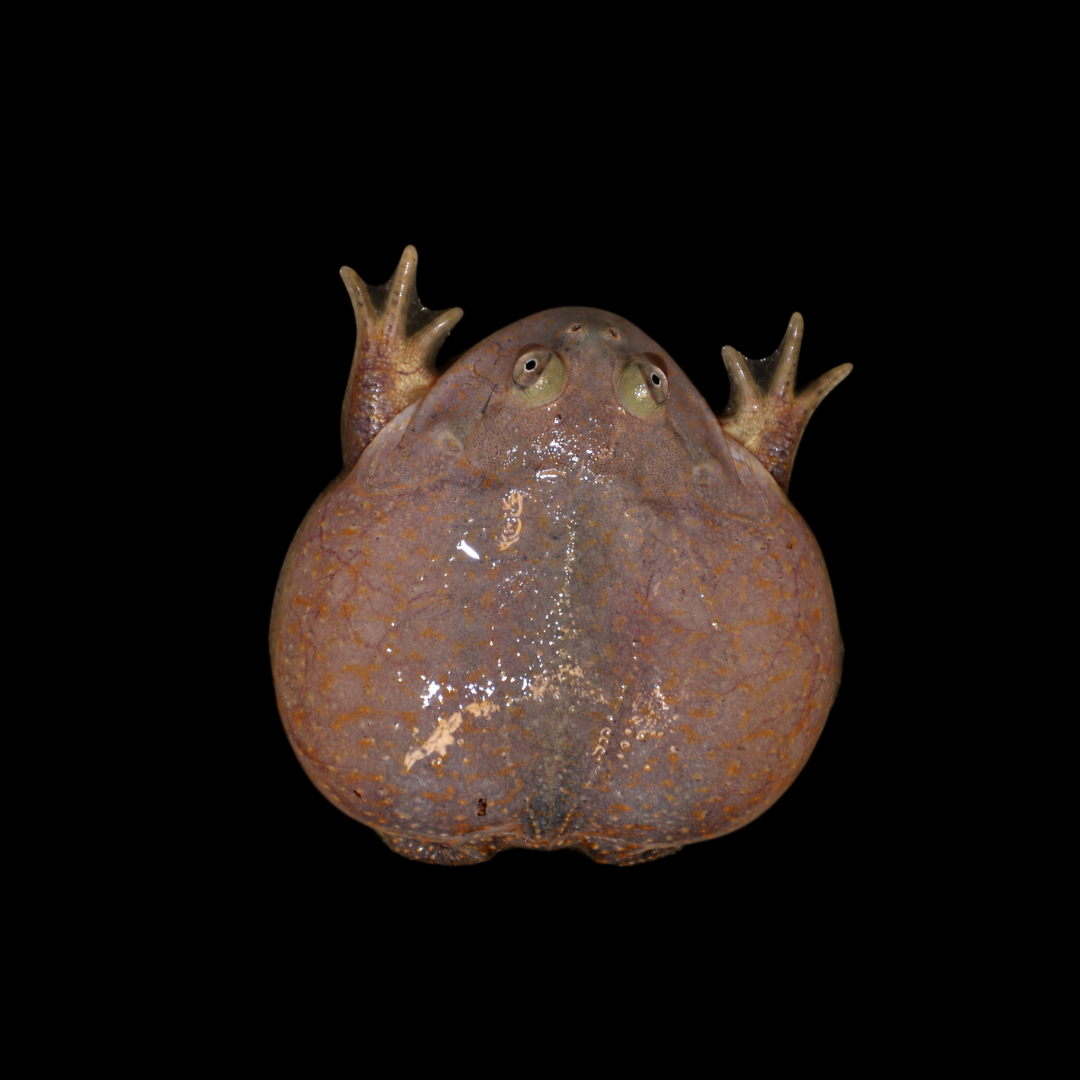
解説Description
バジェットガエルは、南米のグランチャコに暮らすタピオカガエル属の大型種で、日本では「マルメタピオカガエル」の名でも知られています。平たく幅広い頭、上向きについた目、大きく裂けた口という姿は一度見たら忘れにくく、のんびり水面に浮かぶ外見とは対照的に、近づいた獲物を一気に吸い込む待ち伏せ型の捕食者です。水生傾向が非常に強く、後肢の水かき、泥へ潜るための硬い内中足突起、変態後も残る側線器官など、その暮らしに適応した特徴を備えています。飼育では丈夫という印象だけに頼らず、水質の悪化、長時間の高温、過食、異物の誤飲を避けることが大切です。 Budgett’s frog is a large species of Lepidobatrachus native to the Gran Chaco of South America and is also known in Japan as the Marume Tapioca Frog. Its flattened head, upward-facing eyes, and extraordinarily wide mouth make it instantly recognizable. Despite its comical appearance at the water surface, it is an ambush predator that can engulf nearby prey with a rapid suction-assisted strike. Its highly aquatic lifestyle is reflected in features such as well-developed webbing on the hind feet, hardened metatarsal spades for burrowing into mud, and a lateral-line system retained after metamorphosis. In captivity, good long-term care depends on preventing deteriorating water quality, prolonged overheating, overfeeding, and accidental ingestion of foreign material.
基本情報Basic Information
| 学名Scientific Name | Lepidobatrachus laevis |
|---|---|
| 通称Common Name | バジェットガエル、マルメタピオカガエルBudgett’s frog |
| 分類Classification | 無尾目(Anura)・ツノガエル科(Ceratophryidae)・タピオカガエル属(Lepidobatrachus)Order Anura, family Ceratophryidae, genus Lepidobatrachus |
| 英名English Name | Budgett’s frog |
| 分布Distribution | アルゼンチン北部、パラグアイ西部〜北部、ボリビア南東部を中心とするグランチャコ地方。雨季に形成される一時的な水場などで活動します。The Gran Chaco of northern Argentina, western to northern Paraguay, and southeastern Bolivia. The species is active in temporary bodies of water formed during the rainy season. |
| 成体サイズAdult Size | 成体の頭胴長(SVL)はおおむね6〜13 cm。メスの方が大型になる傾向があり、野外個体の計測例でもオスよりメスの方が大きな範囲を示しています。Adult snout–vent length (SVL) is approximately 6–13 cm. Females tend to be larger than males, a pattern also seen in measurements of wild adults. |
| 寿命Lifespan | 飼育下で長期間飼育される種類ですが、標準的な寿命を示す信頼性の高いデータは限られ、資料によって年数に幅があります。年数だけを目安にせず、水質、温度、給餌量、個体の状態を継続して管理することが重要です。This species can be maintained for many years in captivity, but reliable data defining a standard lifespan are limited and published husbandry sources give varying figures. Rather than relying on a single lifespan estimate, long-term care should focus on water quality, temperature, feeding, and the condition of the individual frog. |
飼育環境Enclosure Environment
| 飼育容器・サイズEnclosure and Size | 成体はアクアリウムを使った水生飼育が基本です。45 cmクラス以上を目安とし、余裕を持たせるなら60×30 cm程度の底面があると管理しやすくなります。水深は一律の数値で決めるより、個体が底で休んだ状態から無理なく水面へ出られる深さを優先します。水を深くする場合は、安定した足場や浅場を設けます。Adults are best maintained in an aquarium-style aquatic enclosure. A tank in the 45 cm class or larger is a practical starting point, while a footprint of about 60 × 30 cm offers easier management and more room. Rather than using one fixed water depth for every frog, set the depth so the animal can rest on the bottom and reach the surface without difficulty. If deeper water is used, provide a stable resting platform or shallower area. |
|---|---|
| 温度Temperature | 研究施設での飼育例では、水温25〜28℃前後が用いられています。飼育でもこの範囲をひとつの目安とし、急な温度変化と長時間の高温を避けて安定させます。室温だけでは不安定になる場合は、水中ヒーターや冷却手段を温度計と併用します。Research colonies have maintained this species at water temperatures of about 25–28°C. This range is a useful husbandry reference, with sudden changes and prolonged overheating avoided. Where room temperature alone is unstable, use an aquarium heater or cooling method together with a reliable thermometer. |
| 環境管理Environmental Management | 水質管理はとくに重要です。排泄量が多いため、十分な濾過を行い、飼育規模や水質の状態に応じて換水します。新しい水は必ずカルキ抜きを行い、水温差を小さくして交換します。アンモニアや亜硝酸の蓄積は皮膚をはじめ全身に大きな負担となるため、食べ残しや糞は早めに除去します。フィルターを使う場合は、強い水流を常に受けないよう吐出口を調整してください。Water quality is especially important. These frogs produce substantial waste, so provide adequate filtration and perform water changes according to enclosure size and measured water condition. Always dechlorinate replacement water and minimize temperature differences during changes. Accumulated ammonia and nitrite can place severe stress on the skin and the animal as a whole, so remove feces and uneaten food promptly. If filtration is used, diffuse the outflow so the frog is not exposed to constant strong current. |
| レイアウトLayout | 誤飲と清掃性を考えると、底床を敷かないベアタンクが扱いやすい方法です。砂利、小石、水苔など飲み込みやすい素材は避けます。視線を遮れる大きめのシェルター、動かない流木や石、丈夫な人工水草などを使う場合は、口に入らない大きさと転倒しない安定性を優先します。鋭い角のある装飾は皮膚を傷つけるため不向きです。A bare-bottom setup is often the easiest option because it reduces ingestion risk and simplifies cleaning. Avoid gravel, small stones, sphagnum moss, and other materials that may be swallowed. If shelters, driftwood, rocks, or sturdy artificial plants are used, choose pieces too large to ingest and secure them so they cannot shift or collapse. Decorations with sharp edges should be avoided because amphibian skin is easily damaged. |
| 注意点Precautions | 大きな口と下顎の骨質突起を持ち、防衛時には強く噛みつくことがあります。掃除や移動の際も直接つかむことはできるだけ避け、接触は必要最小限にとどめます。また、水生傾向が非常に強い種類でも「水を張ればよい」わけではありません。水質の悪化や長時間の高温が続かないよう管理し、新規導入個体はしばらく単独で観察して、食欲、皮膚、排泄、浮き方に変化がないか確認します。The species has an enormous mouth and bony mandibular projections and can bite forcefully when defending itself. Avoid directly grabbing the frog during cleaning or transfer whenever possible, and keep handling to a minimum. Although it is highly aquatic, simply providing water is not enough. Prevent deteriorating water quality and prolonged overheating, and observe newly acquired frogs individually at first so appetite, skin condition, feces, and buoyancy can be monitored closely. |
餌と給餌Feeding
| 餌の種類Diet | 肉食性で、自然下では他のカエルやオタマジャクシ、昆虫、巻貝などを捕食します。飼育下では、市販のカエル用人工飼料を利用する場合も、昆虫やミミズなど適切な大きさの餌を組み合わせ、単一の餌だけに偏らないようにします。人工飼料やサプリメントは製品ごとの成分と使用量を確認し、過不足のない栄養管理を心がけます。Budgett’s frogs are carnivorous and in the wild prey on other frogs and tadpoles, insects, snails, and other suitable animal prey. In captivity, prepared frog diets may be used alongside appropriately sized foods such as insects and earthworms rather than relying on a single item. Follow the formulation and directions of prepared diets and supplements so that nutrition is neither deficient nor excessive. |
|---|---|
| 給餌のポイントFeeding Tips | 幼体は成長が速いため成体より頻度を高めますが、成長に合わせて回数を落としていきます。成体は週1〜2回程度を出発点とし、体型と消化の様子を見て調整します。非常に食欲旺盛で、与えれば食べ続ける個体も多いため、肥満や脂肪肝を防ぐには「食べるだけ与えない」ことが大切です。人工飼料に反応しにくい場合は、ピンセットで小刻みに動かして獲物らしく見せると餌付くことがあります。大きすぎる餌や硬い異物の混入は避けてください。Juveniles grow rapidly and generally need more frequent meals than adults, but feeding frequency should be reduced as growth slows. For adults, roughly one to two feedings per week is a reasonable starting point, adjusted according to body condition and digestion. Many individuals will continue eating whenever food is offered, so avoiding overfeeding is essential for reducing obesity and fatty-liver risk. Frogs reluctant to accept prepared diets may respond if the food is gently wiggled with feeding tongs. Avoid oversized prey and any hard foreign material that could be swallowed. |
行動と同居Behavior and Cohabitation
| 行動・性質Behavior | ふだんは水底や物陰でじっと待ち伏せし、獲物が近づくと一気に口を開いて吸い込むように捕食します。後肢にはよく発達した水かきがあり、必要なときは力強く泳ぎます。驚いたり追い詰められたりすると、体を膨らませ、口を大きく開けて甲高い威嚇音を出すことがあります。さらに刺激が続くと噛みつくこともあるため、観察中心で接するのが基本です。They usually remain still on the bottom or beside cover, waiting for prey to approach before striking with a rapid, suction-assisted gape. Their strongly webbed hind feet allow powerful swimming when needed. When frightened or cornered, they may inflate the body, open the mouth widely, and produce a piercing defensive call. Continued disturbance can lead to biting, so they are best appreciated primarily through observation rather than handling. |
|---|---|
| 同居の相性Compatibility | 基本は単独飼育が安全です。口に入る大きさの生き物は餌と認識されやすく、同種間でもサイズ差があると共食いの危険があります。近いサイズ同士でも、給餌時の誤咬、ストレス、水質悪化の速度が上がるため、繁殖目的など明確な理由がない限り常時同居は勧められません。他種との混泳も避けます。Solitary housing is the safest approach. Any animal small enough to fit in the mouth may be treated as prey, and size differences between conspecifics create a real risk of cannibalism. Even similarly sized frogs can injure one another during feeding, experience increased stress, and foul the water more rapidly. Permanent cohabitation is therefore best avoided unless there is a specific breeding purpose and close supervision. Mixed-species housing is not recommended. |
病気と対策Diseases and Prevention
| かかりやすい病気・不調Common Diseases and Health Problems | とくに注意したいのは、水質悪化に伴うアンモニア・亜硝酸の影響、皮膚の発赤や潰瘍を伴う細菌性疾患、食餌バランスの乱れに関連する代謝性骨疾患、異物誤飲や大きすぎる餌による消化管トラブル、総排泄腔脱などです。食欲低下、浮き方の異常、皮膚の赤み、むくみ、脱力、排泄の停止などは体調不良のサインになり得ます。Important problems include ammonia or nitrite exposure from poor water quality, bacterial disease associated with reddened or ulcerated skin, metabolic bone disease linked to nutritional imbalance, gastrointestinal problems caused by swallowed foreign material or oversized prey, and cloacal prolapse. Loss of appetite, abnormal floating, reddened skin, swelling, weakness, or failure to defecate can all indicate illness. |
|---|---|
| 対策と予防Prevention and Care | 清潔で安定した水、適正温度、過不足のない給餌、誤飲しにくいレイアウトが予防の基本です。異常が見られた場合は、まず水温と水質、直近の給餌内容、排泄の有無を確認し、状態が続く・悪化する・出血や脱腸がある場合は両生類を診療できる獣医師へ早めに相談します。抗菌薬や消毒薬を自己判断で水槽へ投入すると皮膚や腎機能へ負担をかけることがあるため、治療は診断に基づいて行います。Prevention begins with clean, stable water, appropriate temperature, controlled feeding, and an enclosure that minimizes ingestion hazards. If abnormalities appear, first check water temperature and quality, recent feeding, and whether the frog has been defecating. Persistent or worsening signs, bleeding, or prolapse warrant prompt consultation with a veterinarian experienced in amphibians. Avoid adding antibiotics or disinfectants to the enclosure without professional guidance, as inappropriate treatment can further stress the skin and internal organs. |
増やし方(繁殖)Breeding
| 雌雄の判別Sexing | 成熟するとメスの方が明らかに大型になりやすく、オスは繁殖期に喉が濃い青黒色を帯び、鳴嚢が発達します。前肢の指には婚姻瘤が目立つようになり、抱接時にメスを保持するのに役立ちます。若い個体では外見だけでの判別が難しいことがあります。Mature females are usually much larger than males. During the breeding season, males develop a darker bluish-black throat associated with the vocal sac, and nuptial pads become prominent on the forelimbs to help grip the female during amplexus. Juveniles can be difficult to sex reliably from external appearance alone. |
|---|---|
| 繁殖形態Reproduction | 自然下では雨季にできる一時的な水場で繁殖する季節性の強いカエルです。オスの鳴き声に引かれてペアが形成され、水中で抱接・産卵します。1回に多数の卵を産み、条件が整うと幼生は急速に成長します。オタマジャクシの時点ですでに強い肉食性を示し、同腹個体を含む他の幼生を捕食することもあります。This is a strongly seasonal breeder that reproduces in temporary bodies of water formed during the rainy season. Females are attracted to calling males, and amplexus and egg laying take place in the water. A single spawning can contain a large number of eggs, and the larvae grow rapidly when conditions are favorable. Tadpoles are already highly carnivorous and may prey on other larvae, including siblings. |
| 繁殖のポイントBreeding Tips | 飼育下繁殖は、単に雌雄を同居させるだけでは安定しにくく、季節変化を意識したコンディショニングや十分な栄養状態の調整が必要です。産卵後は親と卵・幼生を分け、孵化後の幼生は共食いを前提に過密を避け、サイズ差が出た個体を分けて管理します。成長が非常に速いため、水質悪化と餌不足の両方が起こりやすく、幼生飼育は成体以上にこまめな観察が求められます。Captive breeding is not consistently achieved simply by placing a male and female together. Seasonal conditioning and careful preparation of adult body condition are important. After spawning, separate adults from the eggs and larvae. Because cannibalism is expected among the rapidly growing tadpoles, avoid overcrowding and separate individuals as size differences develop. Their fast growth makes both water deterioration and food shortages possible within a short period, so larval rearing requires especially close observation. |
雑学と豆知識Trivia and Fun Facts
| 1. 「Budgett’s frog」の名を残した探検家1. The explorer behind the name “Budgett’s frog” | 英名は、19世紀末に南米を調査したイギリスの動物学者・発生学者ジョン・サミュエル・バジェットに由来します。バジェットは肺魚など初期脊椎動物の発生を研究するためグランチャコへ赴き、その調査の中でタピオカガエル属の新種を記載しました。彼自身は31歳で早世しましたが、この独特なカエルには今もその名が残っています。The English name honors British zoologist and embryologist John Samuel Budgett, who explored South America in the late nineteenth century. Budgett traveled to the Gran Chaco while studying the development of lungfish and other early vertebrate lineages, and during those expeditions he described new species of Lepidobatrachus. He died at only 31 years of age, but his name remains permanently attached to this remarkable frog. |
|---|---|
| 2. 下顎の「牙」は本当の歯ではない2. Its lower-jaw “fangs” are not true teeth | 大きな口の奥には、獲物を捕らえて保持するための仕組みがあります。下顎に見える鋭い二本の「牙」は、哺乳類の犬歯のような真正の歯ではなく、下顎の骨が突起状に発達したものです。獲物へ素早く口を開いて水とともに吸い込み、こうした骨質突起と顎で保持する形態は、大きな獲物を丸ごと扱う本種の捕食に適しています。Behind its enormous mouth is a specialized system for capturing and retaining prey. The two sharp “fangs” visible in the lower jaw are not true teeth like mammalian canines; they are bony projections of the lower jaw. A rapid gape draws prey in with the surrounding water, and the jaws and odontoid projections help retain the unusually large prey this species can swallow whole. |
| 3. 大人になっても残る「水流センサー」3. A water-motion sensor retained into adulthood | 多くのカエルでは変態に伴って失われる側線器官を、バジェットガエルは成体になっても保持します。濁った水の中では視覚だけに頼らず、水中の振動や流れの変化を感じ取れることが待ち伏せ捕食に役立つと考えられています。背面に並ぶ特徴的な感覚器官は、水生生活への強い適応を物語る部分です。Many frogs lose the lateral-line system during metamorphosis, but Budgett’s frog retains it into adulthood. In turbid water, the ability to detect vibration and subtle changes in water movement is thought to complement vision during ambush feeding. The sensory structures visible along the back are a striking reminder of how strongly this species is adapted to aquatic life. |
| 4. 乾季を「繭」に包まれてやり過ごす4. Surviving the dry season inside a cocoon | グランチャコの一時的な池が乾き始めると、バジェットガエルは後肢の硬い突起を使って泥へ潜り、休眠状態に入ります。その際、脱落する角質層を何層も体表へ残し、水分の蒸発を抑える「繭」をつくります。雨が戻るまで活動を抑え、再び水場が形成されると地上へ現れて採餌と繁殖を再開します。水の豊富な季節と乾燥の厳しい季節を行き来する土地だからこそ生まれた、劇的な生存戦略です。When temporary ponds of the Gran Chaco begin to dry, Budgett’s frogs burrow into the mud using the hardened structures on their hind feet and enter estivation. Layers of shed outer skin remain around the body and form a cocoon that reduces water loss. Activity remains suppressed until rains return, when the frogs emerge to feed and breed again. It is a dramatic survival strategy shaped by a landscape that alternates between flooding and severe seasonal dryness. |
| 5. オタマジャクシの時点ですでに「肉食ハンター」5. Tadpoles that are already carnivorous hunters | 多くのカエルでは幼生と成体で食性や消化管のつくりが大きく変わりますが、本種の幼生は早い段階から強い肉食性を示します。大きな顎で生きた獲物を丸ごと飲み込み、同じ水場の他の幼生を捕食することもあります。さらに、幼生の時点ですでに成体に近い胃を備えているため、変態時に消化管を大きく作り替える必要がありません。一時的な水場で短期間に成長する生活と結びついた、非常に特徴的な発生様式です。In many frogs, diet and gut structure change markedly between the larval and adult stages, but Budgett’s frog tadpoles are strongly carnivorous from early development. They swallow live prey whole and may consume other larvae sharing the same pool. Their larvae also possess a stomach that is already structurally similar to that of the adult, so the digestive tract does not undergo the abrupt remodeling seen in many other frogs at metamorphosis. This unusual developmental pattern is closely associated with rapid growth in temporary aquatic habitats. |
| 6. 発生生物学の「次世代モデル」としての注目6. Growing interest as a developmental-biology model | バジェットガエルは、巨大な卵と細胞、急速な成長、独特な消化器官の発達などから、発生生物学・進化発生学の研究対象として注目されています。アフリカツメガエルとは異なる発生プログラムを比較できるため、「なぜ同じカエル類でも体のつくられ方がこれほど違うのか」を探る材料になります。奇妙な外見のペットというだけでなく、脊椎動物の器官形成や進化を考えるうえでも興味深い存在です。Budgett’s frog has attracted growing interest in developmental and evolutionary biology because of its large eggs and cells, rapid growth, and unusual development of the digestive system. Comparing its developmental program with that of established models such as Xenopus can help researchers ask why closely related vertebrates build their bodies in such different ways. It is therefore not only an unusual pet but also a valuable organism for studying organ formation and evolutionary change. |
| 7. 化石が語る、かつてのタピオカガエル属7. Fossils reveal a broader past for the genus | 現生のタピオカガエル属はグランチャコ周辺に分布しますが、南米では中新世後期から鮮新世にかけての化石記録も知られています。2023年に公表された化石種 Lepidobatrachus dibumartinez は、大きな凧形の背面骨板などを特徴とする保存状態のよい骨格から記載されました。この化石は、タピオカガエル属の祖先的な分布が現在より広かった可能性を考える手がかりになっています。種小名はアルゼンチン代表のサッカー選手エミリアーノ・“ディブ”・マルティネスにちなみ、生物学と現代文化が交差したユニークな命名例でもあります。Living Lepidobatrachus species are concentrated around the Gran Chaco, while fossils of the group are known from the Late Miocene into the Pliocene of South America. The fossil species Lepidobatrachus dibumartinez, published in 2023, was described from a well-preserved skeleton characterized in part by a large kite-shaped dorsal dermal shield. The find provides evidence relevant to the possibility that the ancestral distribution of the genus was broader than it is today. Its species name honors Argentine footballer Emiliano “Dibu” Martínez, an unusual intersection of paleontology and modern popular culture. |
| 8. 追い詰められると「叫ぶ」カエル8. A frog that “screams” when threatened | 防衛時のバジェットガエルは、肺へ空気を入れて体を大きく見せ、口を開きながら甲高い音を発することがあります。この威嚇音は人の悲鳴のように聞こえることがあり、動画などを通じて本種が広く知られる一因にもなっています。可愛らしい表情との落差は大きいものの、これは「これ以上近づくな」という切実な防衛反応です。鳴かせるために刺激するのではなく、見られたら距離を取って落ち着かせるのが飼育者としての正しい対応です。When threatened, Budgett’s frogs may inflate their lungs to appear larger, gape widely, and produce a high-pitched defensive call. The sound can resemble a human scream and is one reason the species has become widely recognized through online videos. Although the contrast with its comical face is striking, the call is a genuine warning that the animal wants the disturbance to stop. It should never be provoked for entertainment; if the display occurs, reduce the stressor and allow the frog to settle. |
まとめConclusion
バジェットガエルの幅広い口と平たい体には、季節変化の大きいグランチャコで暮らすための特徴が凝縮されています。水中で獲物を待ち伏せする体つき、乾燥期に泥中で形成する繭、幼生期から続く肉食性は、雨季に現れる水場を利用して成長し、繁殖する生活と深く結びついています。 The broad mouth and flattened body of Budgett’s frog reflect a suite of adaptations to the strongly seasonal Gran Chaco. Its anatomy as an aquatic ambush predator, the cocoon formed underground during dry periods, and carnivory that begins in the larval stage are all closely tied to a life cycle that uses seasonal waters for growth and reproduction.
飼育下で大切なのは、複雑な設備をそろえることよりも、清潔で安定した水、無理のない温度、誤飲しにくい環境、そして食べさせ過ぎない給餌を保つことです。水面から目と鼻だけをのぞかせて静かに獲物を待つ姿と、捕食や防衛の瞬間に見せる力強さ。その両方が、バジェットガエルならではの存在感を形づくっています。 In captivity, what matters most is not elaborate equipment but maintaining clean, stable water, sensible temperatures, an ingestion-safe environment, and controlled feeding. The contrast between the frog resting quietly with only its eyes and nostrils above the surface and the power it shows while feeding or defending itself is central to the distinctive presence of Budgett’s frog.

気になる道具や飼い方を見つけてみませんか?
 アイのアクアグッズ案内おとひめ物語|養殖生まれの餌を、わが家の魚に合う一粒へ道具の特徴や使い方、選ぶときのポイントをアイが紹介します。記事はコチラ →
 アイのアクアグッズ案内水槽のろ材の選び方|ウール・リング・活性炭の違いとおすすめ商品フィルターの中の綿や石は何をしている? アイとコタロウが、ウール・スポンジ・セラミック・焼結ガラス・活性炭・ゼオライトを比較。機種との相性、入れ方、洗い方と交換まで商品とともに紹介します。記事はコチラ →
 アイのアクアグッズ案内水槽の底砂の選び方|砂・砂利の違いとおすすめ商品道具の特徴や使い方、選ぶときのポイントをアイが紹介します。記事はコチラ →
 アイのアクアグッズ案内水槽のエアーポンプの選び方|水深・音・泡で選ぶおすすめ用品道具の特徴や使い方、選ぶときのポイントをアイが紹介します。記事はコチラ →
さまざまな飼育テーマをご紹介。リンク先の記事には広告・商品紹介が含まれます。
案内・紹介記事一覧へ →分布マップ
バジェットガエル(Lepidobatrachus laevis)は、アルゼンチン北部、パラグアイ西部から北部、ボリビア南東部を中心とするグランチャコ地方に分布します。
※この地図は、知られている分布地域を把握しやすくするための概略表示です。マーカーは分布域のおおよその中心を示す代表地点であり、実際の採集地点や個体の確認地点を示すものではありません。
参考文献
- Frost, Darrel R. “Pelodryas caerulea (White, 1790).” Amphibian Species of the World: an Online Reference. American Museum of Natural History.
- Donnellan, S. C., Mahony, M. J., Esquerré, D., et al. 2025. “Phylogenomics informs a generic revision of the Australo-Papuan treefrogs (Anura: Pelodryadidae).” Zoological Journal of the Linnean Society, 204(2), zlaf015.
- Australian Museum. “Green Tree Frog.”
- Queensland Government. “Common green tree frog.”
- Smithsonian’s National Zoo & Conservation Biology Institute. “White’s tree frog.”
- Harper, Brad. 2008. “Amphibian Husbandry Manual – Litoria caerulea.” Australasian Society of Zoo Keeping Husbandry Manuals 掲載資料.
- Poole, V. A. & Grow, S. (eds.). 2012. “Amphibian Husbandry Resource Guide, Edition 2.0.” Association of Zoos and Aquariums, Amphibian Taxon Advisory Group.
- Whitaker, B. R. & Yaw, T. J. “Noninfectious Disorders of Amphibians.” Merck Veterinary Manual. Updated 2026.
- Holmes, M. L., Shine, R. & Waddle, A. W. 2024. “Spontaneous reoccurrence of Batrachochytrium dendrobatidis infections in Australian green tree frogs (Litoria caerulea) following apparently successful heat therapy: Case report.” Veterinary Research Communications, 48, 3229–3237.




コメント