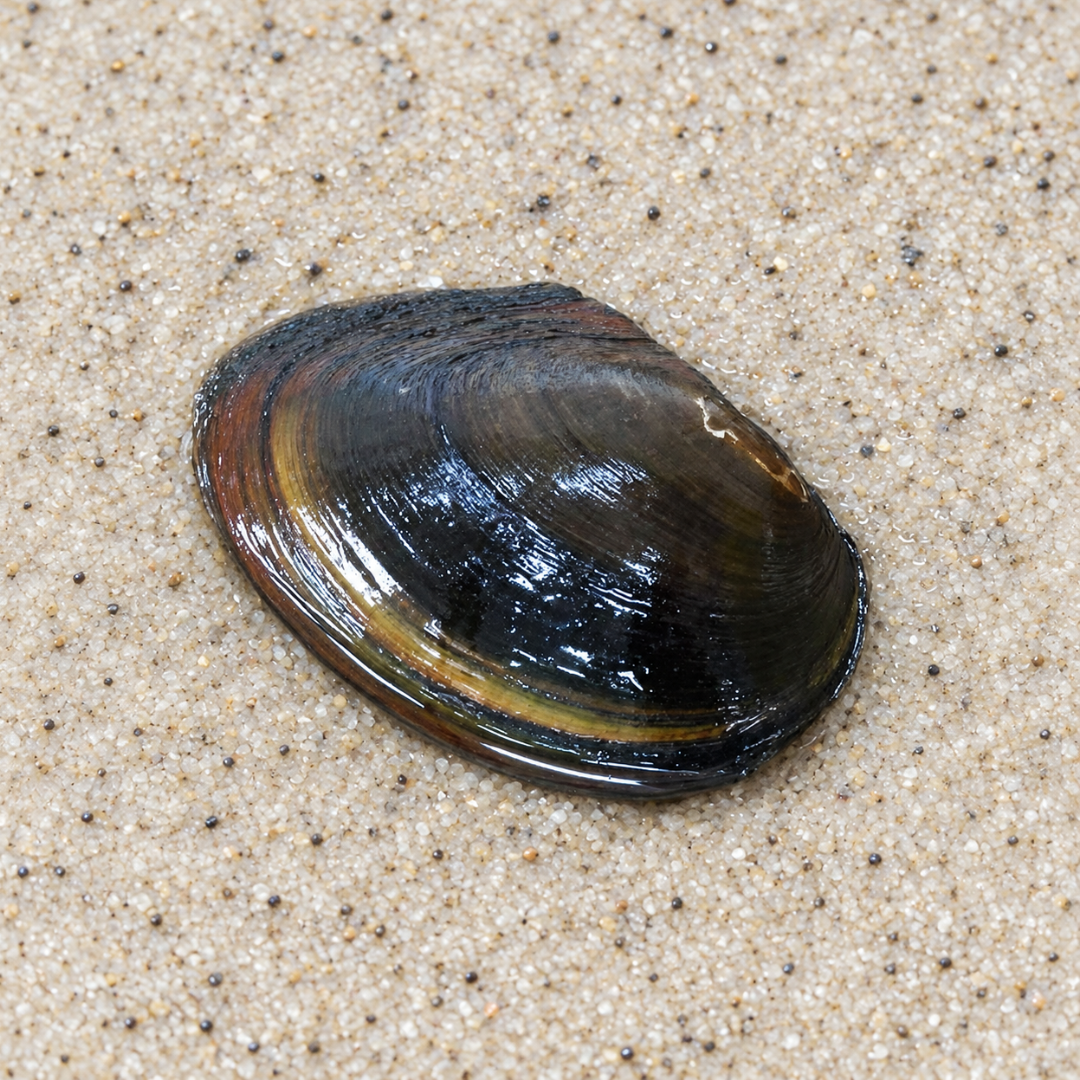
ドブガイ類は、池や水路、流れの緩い河川の底で暮らす、イシガイ科ドブガイ属の大型淡水二枚貝です。暗褐色から黄褐色の殻を砂泥に半分ほど埋め、入水管から取り込んだ水に含まれる植物プランクトンや微細な有機物を濾し取って生活します。水槽ではほとんど動かないように見えますが、斧足を使って底床をゆっくり移動し、一晩で居場所を変えることもあります。タナゴ類の産卵母貝として知られる一方、一般的な室内水槽では餌となる微細な粒子が不足しやすく、長期飼育には安定した水質と継続的な給餌が欠かせません。なお、日本で「ドブガイ」と呼ばれてきた貝には複数種が含まれ、殻の形だけで正確に種を判別することは困難です。Pond mussels of the genus Sinanodonta are large freshwater bivalves in the family Unionidae. They live partly buried in the mud or sand of ponds, canals, and slow-flowing rivers, filtering phytoplankton and fine organic particles from the water. Although they may appear motionless in an aquarium, they can move slowly through the substrate with their muscular foot and may change position overnight. They are well known in Japan as spawning mussels for bitterlings, but ordinary indoor aquariums often contain too little microscopic food. Long-term care therefore depends on stable water quality and regular feeding. The traditional Japanese name “dobugai” has been applied to several species, and reliable identification is difficult from shell shape alone.
基本情報 / Basic Information
学名 / Scientific Name
Sinanodonta spp.
通称 / Common Name
ドブガイ(広義)、ドブガイ類Pond mussels
分類 / Family
軟体動物門・二枚貝綱・イシガイ目・イシガイ科・ドブガイ属Phylum Mollusca, Class Bivalvia, Order Unionida, Family Unionidae, Genus Sinanodonta
英名 / English Name
Pond mussels of the genus Sinanodonta
分布 / Distribution
日本を含む東アジア。日本産の在来ドブガイ属として、オグラヌマガイ、ヒラヌマガイ、マルドブガイ、ヌマガイ、キュウシュウヌマガイの5種が認識されています。日本では外来系統のSinanodonta pacificaも確認されています。ドブガイ属の一部系統は、養殖魚などの移動に伴ってヨーロッパ、中央アジア、中東、南北アメリカなどにも侵入しています。East Asia, including Japan. Five native Sinanodonta species are currently recognized in Japan: S. tumens, S. plana, S. calipygos, S. lauta, and S. kyushuensis. The introduced S. pacifica has also been recorded in Japan. Some lineages of the genus have spread with transported aquaculture fish and become established in Europe, Central Asia, the Middle East, and the Americas.
最大体長 / Max Size
一般的な流通個体の殻長は6〜15cmほどです。種や生息環境によっては20cmを超え、Sinanodonta woodianaでは30cmに達する例も報告されています。Most specimens in the aquarium trade have a shell length of about 6–15 cm. Some species and populations exceed 20 cm, and individuals of Sinanodonta woodiana have been reported to reach 30 cm.
寿命 / Lifespan
寿命は種や環境によって大きく異なり、野外では数年から10年以上生きると考えられています。Sinanodonta woodianaでは12〜14年という報告がありますが、ドブガイ属の全種に当てはまる数字ではありません。飼育下では、餌不足や水質悪化によって本来の寿命を迎える前に死亡することがあります。Lifespan varies considerably among species and habitats and is thought to range from several years to more than a decade in the wild. A lifespan of 12–14 years has been reported for Sinanodonta woodiana, but this figure does not apply to every species in the genus. Captive individuals may die before reaching their natural lifespan because of inadequate food or deteriorating water quality.
飼育環境 / Aquarium Environment
水槽サイズ / Tank Size
生物学的な最小水槽サイズは定められていませんが、水質と餌の量を安定させるため、殻長10cm前後の1個体には60cm規格水槽(約60L)以上を目安とします。大型個体や複数飼育では、90cm規格水槽(約180L)以上、または十分な容量の屋外容器が適しています。殻長だけでなく、総水量と濾過能力を基準に選んでください。No biological minimum tank size has been established. As a practical guide, use at least a standard 60 cm aquarium of about 60 L for one mussel around 10 cm in shell length so that water quality and food availability remain manageable. Larger specimens or groups are better kept in a standard 90 cm aquarium of about 180 L or a spacious outdoor container. Choose the system by total water volume and filtration capacity as well as shell length.
水温 / Temperature
適温は種や系統、順応状態によって異なるため、属全体に共通する一律の数値はありません。日本で流通する温帯性の個体は5〜25℃を安全側の目安とし、急変を避けます。夏は高水温そのものだけでなく溶存酸素の低下にも注意し、必要に応じて冷却とエアレーションを行います。Temperature requirements vary among species, lineages, and acclimation histories, so there is no single range for the entire genus. For temperate specimens traded in Japan, 5–25°C is a cautious working range, with sudden changes avoided. In summer, monitor falling dissolved oxygen as well as rising temperature and provide cooling and aeration when needed.
水質 / Water Quality
pH 6.5〜8.0程度の中性から弱アルカリ性を飼育上の目安とします。アンモニアと亜硝酸は検出されない状態を保ち、十分な溶存酸素を確保します。極端な軟水や酸性水では、炭酸カルシウムを主成分とする殻が傷みやすくなります。導入時は、水温だけでなくpHや硬度も時間をかけて合わせてください。As a husbandry guide, maintain neutral to slightly alkaline water at about pH 6.5–8.0, with undetectable ammonia and nitrite and ample dissolved oxygen. Extremely soft or acidic water can damage the calcium-carbonate shell. During acclimation, match pH and hardness gradually as well as temperature.
レイアウト / Layout
角の鋭くない細砂や砂泥を5〜10cmほど敷き、貝が殻の半分ほどを埋められる場所を作ります。入出水管を塞がない開けた底面と、緩やかな水流を用意します。強い吸い込み口にはスポンジを付け、底床全体を過度に掃除せず、餌となる微生物相を残します。ただし嫌気化した黒い底床や硫化水素臭がある場所には置かないでください。Provide 5–10 cm of smooth fine sand or sandy mud so the mussel can bury roughly half of its shell. Leave open substrate around the inhalant and exhalant siphons and provide gentle water movement. Fit a sponge to powerful filter intakes and avoid sterilizing the entire substrate, because its microbial community contributes food. Do not place the mussel in black, anaerobic substrate or any area that smells of hydrogen sulfide.
注意点 / Precautions
最大の注意点は、長期的な餌不足と死亡後の急激な水質悪化です。殻が大きく開いたまま刺激しても閉じない、強い腐敗臭がする、軟体部が崩れているといった状態が確認されたら、直ちに個体を取り出し、アンモニアを測定して必要な換水を行います。銅を含む魚病薬や、無脊椎動物への安全性が確認できない薬剤は使用せず、魚の治療は別容器で行います。産地や種が不明な個体を自然水域へ放すと、外来系統の拡散や在来種との交雑につながるおそれがあるため、決して放流しないでください。The greatest risks are long-term food shortage and a rapid decline in water quality after death. Remove the mussel immediately if its shell remains widely open and does not close when gently stimulated, if a strong decay odor is present, or if the soft tissues are breaking down. Test ammonia and perform the necessary water change. Do not use copper-containing fish medications or treatments whose safety for invertebrates is unknown; medicate fish in a separate container. Never release a mussel of unknown origin or identity into natural waters, as this may spread introduced lineages or promote hybridization with native species.
餌と給餌 / Feeding
餌の種類 / Diet
植物プランクトン、珪藻、細菌を含む微生物群、微細な有機懸濁物を濾過して食べます。屋外で培養した良質なグリーンウォーター、生きた淡水性植物プランクトン、淡水二枚貝に使用できる微粒子飼料を利用します。魚用フレークを砕いただけの餌は粒が大きく、水を汚しやすいため主食には向きません。They filter phytoplankton, diatoms, microbial communities including bacteria, and fine suspended organic matter. Suitable foods include healthy cultured green water, live freshwater phytoplankton, and fine particulate diets formulated for freshwater bivalves. Crushed fish flakes are generally too coarse and can foul the water, so they should not be used as the staple diet.
給餌のポイント / Feeding Tips
透明な水を、それだけで「餌が十分で健康な状態」と判断しないことが重要です。適切な給餌間隔は水量、個体数、餌の種類や濃度によって変わるため、一律には決められません。まずは少量をこまめに与え、入水管の近くへ静かに分散させます。水が短時間で澄んでも、濁りが濾過されたのか、フィルターに吸着したのかは外見だけでは判断できません。アンモニアと亜硝酸を測りながら、食べ残しによる水質悪化を起こさない範囲で調整します。Clear water alone does not show that food is adequate or that the mussel is healthy. Feeding frequency cannot be fixed universally because it depends on water volume, mussel number, food type, and concentration. Begin with small, frequent portions and disperse them gently near the inhalant siphon. Even if the water clears quickly, appearance alone cannot show whether particles were consumed or simply trapped by the filter. Adjust the ration while testing ammonia and nitrite and avoid amounts that deteriorate water quality.
性格と混泳 / Temperament and Tank Mates
性格 / Temperament
おとなしく、他の生体を攻撃しません。普段は砂泥に潜って濾過摂食を続けますが、斧足を使って移動することもあります。何度も底床から這い出す場合は環境が合っていない可能性があるため、底床の酸欠、水流、餌の状態、水質を順に確認します。ただし、この行動だけで原因を特定することはできません。Peaceful and non-aggressive. They usually remain partly buried while filter-feeding but may also move with their muscular foot. Repeated emergence from the substrate can indicate unsuitable conditions, so check the substrate for oxygen depletion, then review flow, food availability, and water quality. This behavior alone cannot identify the cause.
混泳の相性 / Compatibility
温和な日本産淡水魚やタナゴ類と混泳できますが、貝をつつく魚や大型のザリガニ類は避けます。タナゴの繁殖に用いる場合は、産卵が一個体へ集中すると貝の鰓に負担がかかるため、産卵状況を観察し、必要に応じて母貝を交代させます。ドブガイ類のグロキディウム幼生が魚の鰓や鰭に一時的に付着する生活史も理解し、飼育した魚や貝を野外へ移さないでください。They can be kept with peaceful Japanese freshwater fishes and bitterlings, but avoid fishes that peck at the shell and large crayfish. When mussels are used for bitterling breeding, concentrated spawning in one individual can burden its gills, so observe spawning and rotate mussels when necessary. Their glochidium larvae temporarily attach to fish gills or fins; for this reason, never move aquarium fish or mussels into natural waters.
病気と対策 / Diseases and Prevention
かかりやすい病気 / Common Diseases
観賞飼育下で病名まで確定できる症例情報は限られています。実際には、微細餌料不足による衰弱、アンモニア・亜硝酸中毒、高水温と低酸素、酸性水による殻の浸食、嫌気化した底床による軟体部や鰓の損傷が問題になります。殻が閉じたままでも長期の餌不足が進行するため、外見だけでは健康を判断できません。Few aquarium cases are diagnosed to a specific disease. In practice, the major problems are weakness from inadequate microscopic food, ammonia or nitrite poisoning, heat combined with low oxygen, shell erosion in acidic water, and damage to the gills or soft tissues from anaerobic substrate. A mussel may remain closed while gradually starving, so appearance alone is not a reliable health check.
対策と予防 / Prevention
十分に立ち上がった大容量水槽へ導入し、アンモニア、亜硝酸、pH、水温を定期測定します。微細餌料を継続して与え、夏は冷却と酸素供給を強化します。新しい貝は別容器で状態を観察し、急な温度・水質変化を避けて導入します。魚病薬を本水槽へ直接入れず、底床から異臭が出る前に部分的な掃除を行うことが予防の基本です。Introduce mussels only to a mature, high-volume system and test ammonia, nitrite, pH, and temperature regularly. Supply microscopic food consistently and increase cooling and aeration in summer. Observe new mussels separately and acclimate them without abrupt changes in temperature or chemistry. Do not add fish medication directly to the main mussel aquarium, and clean sections of the substrate before anaerobic odors develop.
増やし方(繁殖) / Breeding
雌雄の判別 / Sexing
外見からの確実な判別は困難です。繁殖期に雌の鰓が幼生を保育して膨らむことがありますが、貝を無理に開いて確認すると致命的な損傷につながります。専門的には鰓内の幼生、配偶子、組織などを調べて判定します。Reliable external sexing is difficult. The female’s gills may become enlarged while brooding larvae, but forcing the shell open for inspection can cause fatal injury. Specialist identification examines larvae within the gills, gametes, or tissue.
繁殖形態 / Reproduction
繁殖様式の細部は種や個体群によって異なります。雌は水中の精子を取り込み、受精卵から生じた幼生を鰓の保育部で育てます。放出されたグロキディウム幼生は、適合する魚の鰓や鰭へ一時的に付着し、変態後に稚貝となって底へ降ります。通常は、宿主となる魚を介さずに世代を完結させることはできません。Details of reproduction vary among species and populations. Females take in sperm from the water and brood the resulting larvae in specialized areas of the gills. Released glochidium larvae temporarily attach to the gills or fins of a compatible fish, then metamorphose and drop to the bottom as juvenile mussels. They normally cannot complete the life cycle without a host fish.
繁殖のポイント / Breeding Tips
飼育下繁殖は難しく、種ごとに適合する宿主魚、季節、水温をそろえる必要があります。殻だけで種を決めつけず、採集地情報が明確な親貝を用い、由来の異なる系統を混ぜないことが重要です。幼生を魚へ過剰に付着させると魚の呼吸を妨げるおそれがあるため、研究・保全目的の繁殖は淡水二枚貝に詳しい専門家の指導下で行います。増えた個体や宿主魚は、元の採集地を含め自然水域へ放流しません。Captive propagation is difficult because each species requires a compatible host fish as well as appropriate season and temperature. Do not identify parents from shell shape alone; use animals with reliable locality records and never mix lineages of different origin. Heavy glochidium infestation can impair fish respiration, so propagation for research or conservation should be conducted with guidance from a freshwater mussel specialist. Never release propagated mussels or their host fish into natural waters, including the original collection site.
雑学と豆知識 / Trivia and Fun Facts
1. 「ドブガイ」は一種とは限らない / 1. “Dobugai” Is Not Necessarily One Species
日本の池や水路で、蝶番に明瞭な歯を持たない大型の淡水二枚貝が見つかると、長いあいだ広く「ドブガイ」と呼ばれてきました。しかし、殻の形は生息環境の影響を受けるため、外見だけを手掛かりにした分類には限界があります。DNA解析と標本の再検討が進み、2025年にはヒラヌマガイとキュウシュウヌマガイが新種として正式に記載され、日本在来のドブガイ属は5種として整理されました。つまり、店頭で同じ名前が付いた個体でも、実際には別種である可能性があります。For many years, large freshwater mussels without prominent hinge teeth found in Japanese ponds and canals were broadly called “dobugai.” Shell shape is influenced by habitat, however, which limits identification by appearance alone. Following DNA analysis and reassessment of museum specimens, Sinanodonta plana and S. kyushuensis were formally described in 2025, and five native Sinanodonta species are now recognized in Japan. In practical terms, mussels sold under the same market name may belong to different species.
2. 魚を育て、魚に育てられる / 2. A Mussel That Shelters Fish and Depends on Fish
タナゴの雌は細長い産卵管を貝の出水管へ差し込み、卵を鰓の中へ送り込みます。卵は外敵から守られた場所で成長する一方、ドブガイ類の子どもであるグロキディウム幼生は、今度は魚の鰓や鰭に一時付着しなければ稚貝へ変態できません。一見すると互いに助け合う物語ですが、タナゴの卵が多すぎれば貝の呼吸を妨げ、幼生が多すぎれば魚へ負担をかけます。自然界の結びつきは、単純な友情ではなく、互いの利益と負担が揺れ動く繊細な関係です。A female bitterling inserts a slender ovipositor into a mussel’s exhalant siphon and places her eggs among its gills, where they develop in relative safety. Later, the mussel’s own glochidium larvae must temporarily attach to fish gills or fins before becoming juveniles. It sounds like a perfect exchange, but too many bitterling eggs can obstruct the mussel’s gills, while too many glochidia can burden the fish. The relationship is therefore not a simple friendship but a delicate balance of benefits and costs.
3. 透明な水でも餌不足は起こる / 3. Clear Water Can Still Lack Food
ドブガイ類は水中の細かな粒子を取り込むため、「入れておけば水を浄化してくれる」と紹介されることがあります。確かに濁りを減らす働きはありますが、閉じた水槽では餌となる粒子も減っていきます。そのため、水が透明であることと、貝に十分な餌があることは同じではありません。また、濾し取った栄養分のすべてが水槽外へ消えるわけではなく、排泄物や死亡後の分解によって再び水中へ戻ることもあります。ドブガイ類を濾過装置の代わりにせず、給餌が必要な一個体として管理することが長期飼育の出発点です。Because pond mussels capture fine suspended particles, they are sometimes advertised as animals that “purify” water. They can reduce cloudiness, but in a closed aquarium the particles that serve as food also decline. Clear water therefore does not necessarily mean that adequate food is available. Filtered nutrients do not all leave the system; some return through waste and decomposition after death. Long-term care begins by treating the mussel as an animal that requires feeding, not as a substitute for filtration.
4. 静かな侵入者を運んだのは魚だった / 4. Fish Carried a Silent Invader
ドブガイ属の一部系統が大陸を越えて広がった背景には、グロキディウム幼生の生活史があります。養殖などのためにコイ科魚類が別の国へ運ばれたとき、その鰓に小さな幼生が付着していれば、貝も気づかれないまま新しい水域へ到着します。多様な魚を宿主にできる侵入系統は各地で定着し、在来二枚貝との餌の競合や、宿主魚を介した繁殖への影響が報告されています。水槽の一個体を野外へ放さないという判断は、地域の淡水生態系を守ることにつながります。The glochidium stage helps explain how some Sinanodonta lineages spread across continents. When cyprinid fishes were transported internationally for aquaculture, larvae attached to their gills could reach new waters unnoticed. Invasive lineages able to use a variety of fish hosts have become established in many regions, where competition for food and effects on native mussel reproduction through shared host fish have been reported. Never releasing an aquarium specimen helps protect local freshwater ecosystems.
5. 貝殻加工から真珠核へ受け継がれた技術 / 5. Shell-working Skills Passed on to Pearl Nuclei
日本の貝ボタン産業では、高瀬貝や蝶貝などの海産貝が主な原料として使われてきました。一方、養殖真珠の核には、厚い真珠層を持つ淡水二枚貝の殻が適しており、中国産や北米産の淡水貝が利用されてきました。兵庫県洲本市では、貝ボタン加工の技術と設備を生かして真珠核製造へ転業した業者が多く、殻を切り、丸く研磨する技術が受け継がれました。ドブガイ類と日本の装身具産業とのつながりは、貝ボタンそのものよりも、淡水貝から作る真珠核の歴史に見ることができます。Japanese shell-button makers mainly used marine shells such as trochus and mother-of-pearl. Freshwater mussel shells, on the other hand, have thick nacre suitable for nuclei used in cultured pearls, and shells from China and North America have been used for this purpose. In Sumoto, Hyogo Prefecture, many button makers adapted their skills and equipment to pearl-nucleus production, preserving techniques for cutting and rounding shell. The clearest link between pond mussels and Japan’s adornment industries lies in the history of freshwater-shell pearl nuclei rather than in the buttons themselves.
6. 殻の開閉が水の異変を知らせる / 6. Shell Movements Can Warn of Water Pollution
二枚貝は普段、呼吸と摂食に合わせて殻を開閉しています。ところが刺激性のある化学物質などにさらされると、殻を閉じる動きや開閉のリズムが変わります。この反応をセンサーで連続記録し、複数個体が同時に異常な動きを示したときに警報を出す生物早期警報の研究と運用が行われてきました。言葉を発しない貝が、日々の小さな動きによって水の変化を知らせる生きた監視役になるという、濾過摂食者ならではの応用です。Bivalves normally open and close their shells as they breathe and feed. Exposure to irritating chemicals can alter both shell closure and the rhythm of valve movement. Biological early-warning systems have therefore been studied and operated by recording these movements continuously and triggering an alert when several mussels behave abnormally at the same time. A silent animal can become a living water monitor simply through the small movements of its shell.
まとめ / Conclusion
ドブガイ類は、静かな姿の内側に、微細な餌を濾し取る仕組みと、魚を必要とする独特の生活史を備えています。十分な水量、安定した水温、酸素に富む水、潜ることのできる底床、そして植物プランクトンを中心とした継続的な給餌が、長期飼育の基本になります。Pond mussels combine a specialized filtering system with a life cycle that depends on fish. Long-term care requires adequate water volume, stable temperature, oxygen-rich water, suitable burying substrate, and a continuing supply of phytoplankton-based food.
タナゴの卵を受け入れる産卵母貝でありながら、自らの幼生期には魚を宿主として必要とします。その複雑な関係を理解し、産地の異なる個体を安易に混ぜず、飼育個体を野外へ放さないことまで含めて向き合えば、水槽の底で静かに暮らす姿を長く見守ることができます。They receive bitterling eggs within their gills yet require fish hosts during their own larval stage. By understanding this relationship, avoiding careless mixing of animals from different localities, and never releasing captive specimens, aquarists can observe these quiet bottom-dwellers over the long term.
Patterson, M. A., Mair, R. A., Eckert, N. L., Gatenby, C. M., Brady, T., Jones, J. W., Simmons, B. R. and Devers, J. L., eds. (2018). Freshwater Mussel Propagation for Restoration. Cambridge University Press.(飼育設備・水質管理・餌料培養・宿主魚を用いた繁殖)






コメント