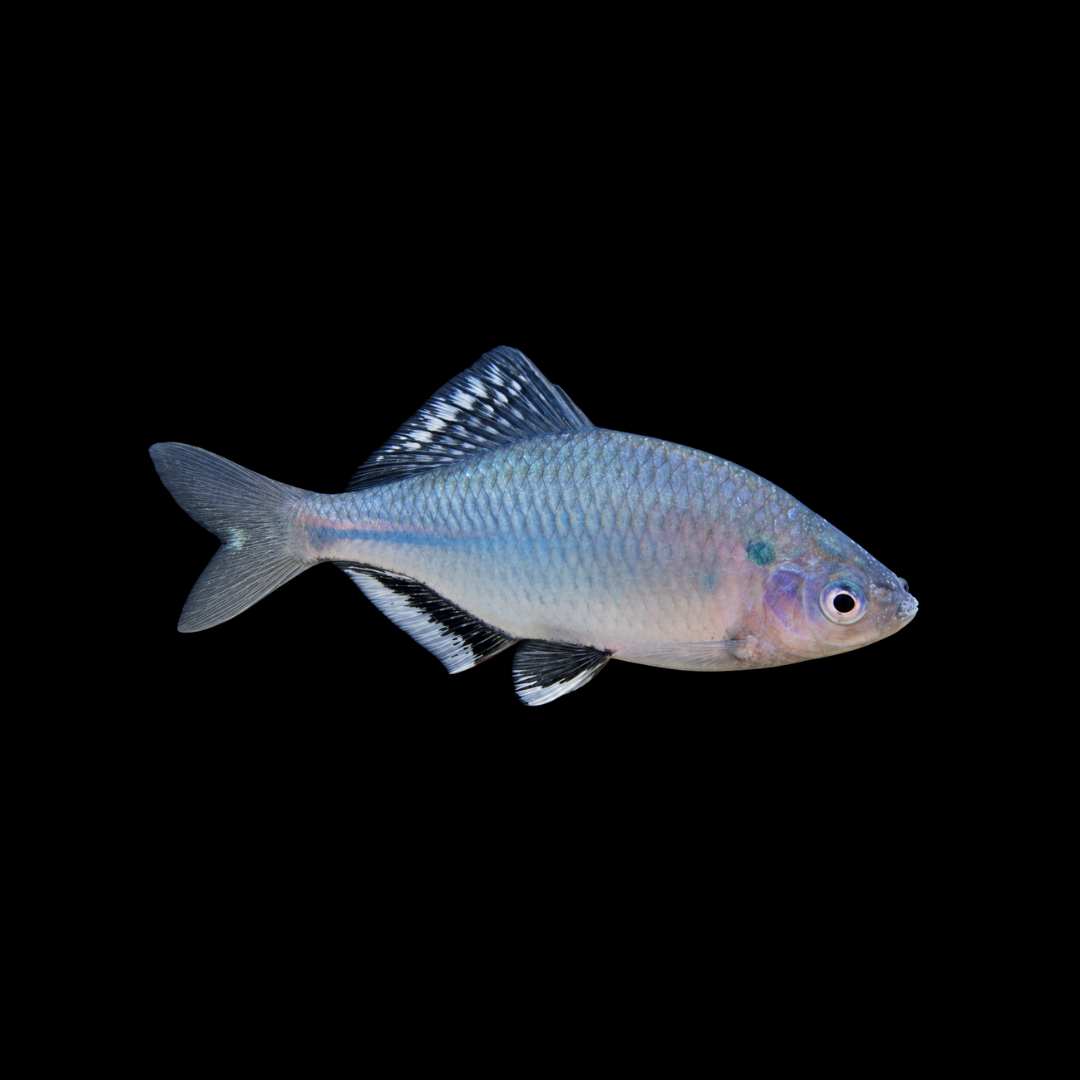
シロヒレタビラは、濃尾平野、琵琶湖・淀川水系、山陽地方、四国北東部などを自然分布域とする、日本固有のタナゴ類です。タビラ類の中でも体高が高く、側扁した体には、一対の短い口ひげ、肩部の暗青色斑、体側の暗色縦条が見られます。繁殖期の雄は青紫から濃青色の金属光沢を帯び、腹鰭の前縁と臀鰭の外縁が鮮やかな白色に縁取られます。この白い縁取りが和名の由来で、日本産淡水魚らしい落ち着きと華やかさを併せ持っています。生きた淡水二枚貝の鰓内に卵を産み込む特殊な繁殖生態を持つ一方、生息環境の改変や二枚貝の減少、人為的な移入による遺伝的撹乱の影響を受けています。環境省レッドリスト2020では絶滅危惧IB類に評価されており、飼育する場合は由来の明らかな個体を選び、野外へ決して放さない責任ある管理が求められます。The White tabira bitterling is a Japanese endemic bitterling whose natural range includes the Nobi Plain, the Lake Biwa–Yodo River system, parts of the Sanyo region, and northeastern Shikoku. Its deep, laterally compressed body bears a short pair of barbels, a dark bluish shoulder blotch, and a dark longitudinal stripe. During the breeding season, males develop a metallic blue-purple to deep-blue sheen, while the leading edges of the pelvic fins and the outer edge of the anal fin become sharply bordered in white. These white fin margins give the fish its Japanese name, and the subdued yet vivid coloration is characteristic of Japan’s native freshwater fauna. The fish has an unusual breeding strategy in which eggs are deposited inside the gills of living freshwater mussels. Habitat alteration, mussel decline, and genetic disturbance caused by human-mediated introductions have placed it at risk. It is classified as Endangered, category IB, on Japan’s Ministry of the Environment Red List 2020. Keep only fish of documented origin, manage them responsibly, and never release them into the wild.
基本情報 / Basic Information
学名 / Scientific Name
Acheilognathus tabira tabira Jordan & Thompson, 1914
通称 / Common Name
シロヒレ、ボテ、ボテジャコなどの呼称があるWhite tabira bitterling; regional Japanese names include Shirohire, Bote, and Botejako
分類 / Family
条鰭綱・コイ目・コイ科・タナゴ亜科・タナゴ属。分類体系によってはタナゴ科として扱われるClass Actinopterygii, order Cypriniformes, family Cyprinidae, subfamily Acheilognathinae, genus Acheilognathus; some classification systems recognize Acheilognathidae as a separate family
英名 / English Name
White tabira bitterling
分布 / Distribution
日本固有の亜種。自然分布は濃尾平野、琵琶湖・淀川水系、岡山県高梁川水系以東の山陽地方、四国北東部。青森県や島根県などでは、人為的に持ち込まれた個体群が確認されているA subspecies endemic to Japan. Its natural range covers the Nobi Plain, the Lake Biwa–Yodo River system, the Sanyo region eastward from the Takahashi River system in Okayama, and northeastern Shikoku. Human-introduced populations have also been recorded in areas including Aomori and Shimane
最大体長 / Max Size
一般的には全長6〜8cmほど。大きな個体では10cmほどに達することがあるGenerally about 6–8 cm in total length; large individuals may reach approximately 10 cm
寿命 / Lifespan
野外では2〜3年程度とされる。飼育下の寿命には個体差があり、詳しい統計は確認されていないReported to live for approximately 2–3 years in the wild. Captive lifespan varies among individuals, and detailed statistics have not been established
飼育環境 / Aquarium Environment
水槽サイズ / Tank Size
少数飼育でも60cm規格水槽(約60L)以上。複数の雄を含む群れや混泳では、縄張りと遊泳空間を確保しやすい90cm規格水槽(約180L)以上が望ましいUse at least a standard 60 cm aquarium of about 60 L even for a small group. A standard 90 cm aquarium of about 180 L or larger is preferable for a group containing several males or for a community setup, as it provides adequate swimming space and separate territories
水温 / Temperature
飼育の目安は10〜27℃。ただし範囲の上限や下限に近い水温を常用せず、季節と導入元の水温に合わせて急変を避ける。夏はエアレーションや冷却で高水温と酸欠を防ぐA practical aquarium guideline is approximately 10–27°C. Do not maintain the fish near either limit continuously; match seasonal conditions and the temperature from which the fish was transferred, avoiding abrupt changes. In summer, use aeration or cooling to prevent overheating and oxygen depletion
水質 / Water Quality
中性前後の清浄で安定した淡水が適する。特定のpH値に急いで合わせるより、導入元の水質から急変させないことを優先する。アンモニアと亜硝酸が蓄積しないよう管理し、十分な溶存酸素と緩やかな水流を確保するClean, stable freshwater around neutral is suitable. Avoiding sudden change from the fish’s previous water conditions is more important than rapidly adjusting to a particular pH value. Prevent the accumulation of ammonia and nitrite, maintain ample dissolved oxygen, and provide a gentle current
レイアウト / Layout
中央に十分な遊泳空間を残し、両側や背面に石、流木、丈夫な水草を配置して視線を遮る。底床には、清掃しやすい大磯砂などが使いやすい。驚いて水槽面へ衝突することがあるため、隠れ場所を設け、照明は急に点灯・消灯しない。葉の硬い水草はレイアウトに取り入れやすいが、柔らかな水草は食害されることがあるLeave ample open swimming space in the center and use rocks, driftwood, and robust plants along the sides and back to break lines of sight. An easy-to-clean substrate such as coarse river gravel is practical. Provide retreats and avoid abrupt lighting because startled fish may collide with the glass. Tough-leaved plants are easier to incorporate, while soft plants may be grazed
注意点 / Precautions
環境省レッドリスト2020の絶滅危惧IB類です。2026年9月時点の環境省「国内希少野生動植物種一覧」には掲載されていませんが、採集や移動を規制する自治体条例、漁業調整規則、保護区域の指定が別に存在する場合があります。野外採集は事前に地域の最新規則を確認し、購入時は由来の明らかな繁殖個体を選んでください。地域集団間の交雑や病原体の拡散を招くため、飼育個体と繁殖個体は水系を問わず絶対に放流してはいけませんThis fish is listed as Endangered, category IB, on Japan’s Ministry of the Environment Red List 2020. As of September 2026 it does not appear on the Ministry’s national list of Domestic Endangered Species, but collection or movement may still be restricted by prefectural or municipal ordinances, fisheries regulations, or protected-area rules. Check the latest local requirements before any collection and obtain only captive-bred fish of documented origin. Never release captive or captive-bred fish into any waterway, as this can cause genetic mixing among regional populations and spread pathogens
餌と給餌 / Feeding
餌の種類 / Diet
付着藻類を主に食べる、植物食性の強い雑食性。植物質を含む小粒の顆粒飼料やフレークを主食にし、冷凍アカムシ、イトミミズ類、ミジンコなどの動物質を補助的に与えるAn omnivore with a strong herbivorous tendency that naturally feeds mainly on attached algae. Use small pellets or flakes containing plant material as the staple, supplemented with frozen bloodworms, tubificid worms, or daphnia
給餌のポイント / Feeding Tips
1日1〜2回、数分で食べ切る量を与える。活発に食べるため過給餌になりやすく、残餌と排泄物は水質を急速に悪化させる。植物質と動物質を偏らせず、繁殖期前は少量ずつ栄養価を高める。個体ごとの腹部の張りを観察し、餌を取れない弱い個体がいないか確認するFeed once or twice daily in amounts consumed within a few minutes. Their vigorous feeding response can encourage overfeeding, and uneaten food and waste quickly impair water quality. Balance plant and animal ingredients, modestly enrich the diet before the breeding season, and check each fish’s body condition to ensure subordinate individuals are feeding
性格と混泳 / Temperament and Tank Mates
性格 / Temperament
遊泳力が強く、タナゴ類の中ではやや気が強い。通常は群れで行動するが、繁殖期の雄は二枚貝の周囲に縄張りを持ち、同種の雄や近づく魚を追う。人影や急な光に驚きやすいため、落ち着ける環境が必要A powerful swimmer and somewhat assertive for a bitterling. It is normally social, but breeding males defend territories around mussels and may chase rival males or approaching fish. It can be startled by sudden movement or light and benefits from a calm environment
混泳の相性 / Compatibility
同程度の大きさと遊泳力を持ち、同じ水温帯で飼育できる温和な日本産淡水魚が候補になる。小型魚、長い鰭を持つ魚、動きの遅い魚、口に入る大きさの生き物との混泳は避ける。タナゴ類同士でも繁殖期には争うため、過密を避けて逃げ場を多くする。繁殖を目指す場合は地域系統を混ぜず、単独種で管理するSuitable candidates are peaceful Japanese freshwater fishes of similar size and swimming ability that can be kept within the same temperature range. Avoid very small fish, long-finned or slow-moving species, and animals small enough to be swallowed. Bitterlings may also fight during the breeding season, so avoid crowding and provide multiple retreats. For breeding, maintain a single-species group and never mix regional lineages
病気と対策 / Diseases and Prevention
かかりやすい病気 / Common Diseases
本種だけが特にかかりやすいと確認された病気はないが、一般的な淡水魚と同様に、白点病、尾ぐされ病などの細菌性感染症、寄生虫症に注意する。驚いて水槽面へ衝突した際の吻端の擦れや外傷から、二次感染を起こすこともある。体表の白点、鰭の濁りや欠損、呼吸の速さ、食欲低下、物に体をこすり付ける行動は、異常を見つける手掛かりになるNo disease has been confirmed as uniquely prevalent in this subspecies, but as with other freshwater fishes, watch for white spot disease, bacterial infections such as fin rot, and external parasites. Snout abrasions or other injuries caused by collisions with the glass may develop secondary infections. White spots, cloudy or eroding fins, rapid breathing, appetite loss, and flashing against objects are useful signs of a developing problem
対策と予防 / Prevention
新規個体は別容器で十分に観察してから合流させ、急な水温・水質変化、過密、酸欠を避ける。定期的な部分換水と底床清掃を行い、外傷の原因になる鋭利な石は使わない。異常個体は早めに隔離し、症状を見極めて観賞魚用医薬品の用法・用量に従う。二枚貝やエビは魚病薬や塩分に弱い場合があるため、薬浴は原則として別の治療容器で行うObserve new fish in a separate quarantine container before introduction, and avoid sudden changes in temperature or water chemistry, crowding, and oxygen depletion. Perform regular partial water changes and substrate cleaning, and avoid sharp stones that can cause injury. Isolate affected fish promptly and use approved ornamental-fish medicines exactly as directed after identifying the likely condition. Because mussels and shrimp may be highly sensitive to medications or salt, treat fish in a separate hospital container
増やし方(繁殖) / Breeding
雌雄の判別 / Sexing
繁殖期の雄は体側が青紫〜濃青色に輝き、腹部が黒くなり、腹鰭前縁と臀鰭外縁の白色帯が明瞭になる。雌は銀褐色を基調とし、産卵期には腹部から白い産卵管が伸びる。産卵管は長く伸びても尾鰭を越えないDuring the breeding season, males become metallic blue-purple to deep blue, the belly darkens, and the white borders on the pelvic and anal fins become conspicuous. Females remain mostly silvery brown and develop a long white ovipositor during the spawning season; even when fully extended, it does not project beyond the caudal fin
繁殖形態 / Reproduction
卵生。繁殖期はおおむね春から夏で、地域や水域によって幅がある。雌は長い産卵管を使い、生きたイシガイ目二枚貝の鰓内へ卵を産み込む。雄が放出した精子は貝の吸水流とともに取り込まれ、貝内で受精する。仔魚は孵化後もしばらく貝内で卵黄を吸収し、遊泳できる段階になると外へ出る。利用する二枚貝は地域により異なるOviparous. Breeding occurs mainly from spring into summer, with timing varying among regions and habitats. The female uses her elongated ovipositor to place eggs inside the gills of a living freshwater mussel of the order Unionida. Sperm released by the male is drawn in with the mussel’s inhalant current, and fertilization takes place inside. After hatching, larvae remain within the mussel while absorbing their yolk and later emerge when capable of swimming. The mussel species used varies among local populations
繁殖のポイント / Breeding Tips
繁殖群は地域系統を混ぜず、十分な広さの専用水槽で管理する。雄同士の争いを分散できるよう遮蔽物を設け、親魚の状態を整えたうえで、適合する健康な二枚貝を用意する。ただし淡水二枚貝は濾過食者で長期飼育が難しく、餌となる微細藻類や有機粒子が乏しい水槽では衰弱しやすい。二枚貝にも採集規制や希少種があるため、野外から安易に持ち帰らず、合法かつ由来の明らかな個体だけを使用する。母貝の衰弱や死亡は急激な水質悪化を招くので、状態を毎日確認する。人工採卵・授精は親魚を傷つける危険があるため、十分な技術と管理体制のない家庭飼育では勧められないKeep each regional lineage separate and use a spacious dedicated breeding aquarium. Break lines of sight to distribute male aggression, condition the adults carefully, and provide healthy mussels known to be suitable hosts. Freshwater mussels are filter feeders that are difficult to maintain long term and may weaken in aquaria lacking the microscopic algae and organic particles on which they feed. Some mussels are protected or subject to collection restrictions, so never collect them casually; use only legally obtained specimens of documented origin. Inspect the hosts daily because a weakened or dead mussel can rapidly foul the water. Manual stripping and artificial fertilization can seriously injure adults and are not recommended in home aquaria without appropriate expertise and controlled facilities
雑学と豆知識 / Trivia and Fun Facts
1. 白い縁取りが完成させる婚姻色 / 1. White Edges Complete the Breeding Dress
繁殖期の雄は、体側の青紫色だけで人目を引くわけではありません。腹部と鰭の基部が深い黒色へ沈み、その暗い背景の上で腹鰭前縁と臀鰭外縁の白帯が輪郭を描きます。光の角度によって青から紫へと表情を変える体色に、明瞭な白黒の境界が重なることで、シロヒレタビラらしい精悍な姿が生まれます。幼魚の背鰭に、ほかのタビラ類で見られる黒斑が現れないことも、近縁亜種を見分ける手掛かりの一つです。A breeding male attracts attention with more than a blue-purple body. The belly and fin bases deepen toward black, creating a dark field against which the white edges of the pelvic and anal fins trace a sharp outline. Body color that shifts in appearance from blue to violet with the angle of light combines with a crisp black-and-white contrast to produce the subspecies’ characteristically resolute appearance. Juveniles also lack the dark dorsal-fin blotch seen in other Tabira forms, providing another clue for identification.
2. 「タビラ」に残る水田の言葉 / 2. A Name Rooted in Rice-field Landscapes
「タビラ」は、田にいる平たい魚を表す「田平」に由来するという説や、側扁した姿を手のひらになぞらえたという説があります。いずれも、名前の奥に水田や用水路でこの魚を見てきた人々のまなざしが残っています。JordanとThompsonが1914年に記載した際、種小名には日本語名を写したtabiraが採用され、基亜種では同じ語が二度続く学名になりました。日本の土地の言葉が、そのまま分類学の記録に刻まれているのです。The Japanese name tabira may derive from characters meaning a flat fish of the rice fields, while another explanation compares its compressed body with the palm of a hand. Both interpretations preserve the viewpoint of people who encountered these fish in paddies and irrigation channels. When Jordan and Thompson described the species in 1914, the Japanese name entered zoological nomenclature as the species epithet tabira. In the nominate subspecies, the word appears twice, preserving a fragment of local language within its scientific name.
3. 二枚貝の中で始まる命 / 3. Life Begins Inside a Mussel
シロヒレタビラの雌は二枚貝へ近づき、産卵管を使って鰓内へ卵を産み込みます。孵化した仔魚はすぐに泳ぎ出さず、貝の中で卵黄の栄養を使いながら成長します。しかし、貝は単なる容器ではありません。産み込まれた卵や仔魚によって換水を妨げられることがあり、胚を外へ排出する場合もあります。貝による排出と、仔魚が内部に留まろうとする適応のせめぎ合いは、長い共進化の歴史を映しています。A female approaches a mussel and uses her ovipositor to place eggs inside its gills. The newly hatched larvae do not immediately swim away; they develop within the mussel while consuming their yolk. Yet the mussel is not a passive container. Eggs and larvae may interfere with ventilation, and the mussel may eject developing embryos. The tension between host ejection and larval adaptations for remaining inside reflects a long history of coevolution.
4. 卵の形に映る宿主選び / 4. Host Choice Written into Egg Shape
タビラ類では、地域集団が利用する二枚貝の分類群と卵形、産卵管の長さに関連があることが研究されています。ドブガイ亜科を利用する集団では卵がより細長く、産卵管も長い傾向がある一方、イシガイ亜科を利用する集団では卵がより球形に近づく傾向が示されました。一匹の小魚が持つ卵の輪郭にも、限られた産卵場所をめぐる競争と、地域ごとに異なる二枚貝との関係が積み重なっています。Studies of Tabira bitterlings have linked the type of mussel used by a regional population with egg shape and ovipositor length. Populations using anodontine mussels tend to possess more elongated eggs and longer ovipositors, whereas those using unionine mussels tend toward more rounded eggs. Even the outline of a tiny egg can therefore carry the accumulated history of competition for breeding sites and relationships with different local mussel communities.
5. DNAが示した地域ごとの歴史 / 5. Regional Histories Revealed by DNA
2024年に公表されたミトコンドリアDNAの研究では、自然分布域に主な3系統が認められ、瀬戸内海集水域の系統内にはさらに5つの遺伝的分化グループが示されました。古い水系の分断や山地の隆起が地域差を育てたと考えられる一方、吉野川水系の個体群が琵琶湖・淀川水系と同じグループに属することから、人為的移入も示唆されています。同じ和名で呼ばれる魚でも、地域集団は交換可能な存在ではありません。産地を記録し、交雑と放流を避けることは、目に見えない進化の履歴を守る行為でもあります。A mitochondrial-DNA study published in 2024 identified three principal lineages across the natural range and five more finely differentiated groups within the Seto Inland Sea drainage lineage. Ancient drainage fragmentation and mountain uplift are thought to have fostered regional differences. In contrast, the Yoshino River population belonged to the same group as fish from the Lake Biwa–Yodo system, suggesting human-mediated introduction. Fish sharing one common name are therefore not interchangeable. Recording provenance and preventing crossbreeding or release also protects an otherwise invisible evolutionary history.
6. 魚と二枚貝をつなぐ水辺のネットワーク / 6. A Waterside Network Linking Fish and Mussels
タナゴ類が繁殖に二枚貝を必要とする一方、イシガイ目の二枚貝の多くは、グロキディウム幼生の時期に魚の鰭や体表へ一時的に付着して移動します。ただし、どの魚がどの貝の適切な宿主になるかは種ごとに異なり、シロヒレタビラと特定の二枚貝が常に一対一で助け合う単純な関係ではありません。それでも、魚が行き来できる流れ、二枚貝が暮らせる底質、清浄な水がそろって初めて双方の生活史がつながります。この魚を守るということは、水辺全体のつながりを守ることでもあるのです。Bitterlings depend on mussels for reproduction, while many freshwater mussels in the order Unionida temporarily attach their glochidia larvae to the fins or body surfaces of fishes for dispersal. Host compatibility differs among mussel and fish species, so this is not a simple one-to-one exchange in which the White tabira bitterling and a particular mussel always benefit each other. Even so, both life cycles can continue only where fish passage, suitable substrate for mussels, and clean water remain connected. Protecting this fish therefore means protecting the integrity of the entire waterside network.
まとめ / Conclusion
シロヒレタビラは、青紫の光沢と白く縁取られた鰭を見せる繁殖期だけでなく、群れで機敏に泳ぐ普段の姿にも奥深い魅力があります。十分な遊泳空間、酸素に富む安定した飼育水、植物質を含む餌を整えることで、力強い体形と自然な行動をじっくり観察できます。The White tabira bitterling is captivating not only when breeding males display blue-purple iridescence and white-edged fins, but also in the agile everyday movement of the group. With ample swimming room, stable oxygen-rich water, and food that includes plant matter, its robust form and natural behavior can be appreciated at their best.
その美しさの背後には、二枚貝と結び付いた繁殖、生息水系ごとに刻まれた遺伝的な歴史、そして変化し続ける里山の水辺があります。由来の確かな個体を大切に飼い、地域系統を混ぜず、決して放流しないことが、この魚と長く向き合うための基本です。水槽の中で白い鰭がひるがえるたび、日本の淡水域が育んだ精緻な生命のつながりを感じさせてくれます。Behind that beauty lies a breeding life tied to mussels, a genetic history written separately in different drainage systems, and the changing waters of Japan’s satoyama countryside. Caring for fish of known origin, keeping regional lineages separate, and never releasing captives are the foundations of a lasting relationship with this species. Each flash of a white-edged fin offers a glimpse of the intricate living connections shaped in Japan’s fresh waters.
Ito, G., Koyama, N., Noguchi, R., Tabata, R., Kawase, S., Kitamura, J. and Koya, Y. (2024). Phylogeography and genetic population structure of the endangered bitterling Acheilognathus tabira tabira Jordan & Thompson, 1914 (Cyprinidae) in western Honshu, Japan, inferred from mitochondrial DNA sequence analysis. Nature Conservation, 56, 19–36. https://doi.org/10.3897/natureconservation.56.111745
Kitamura, J., Nagata, N., Nakajima, J. and Sota, T. (2012). Divergence of ovipositor length and egg shape in a brood parasitic bitterling fish through the use of different mussel hosts. Journal of Evolutionary Biology, 25(3), 566–573. https://doi.org/10.1111/j.1420-9101.2011.02453.x






コメント