

解説 / Description
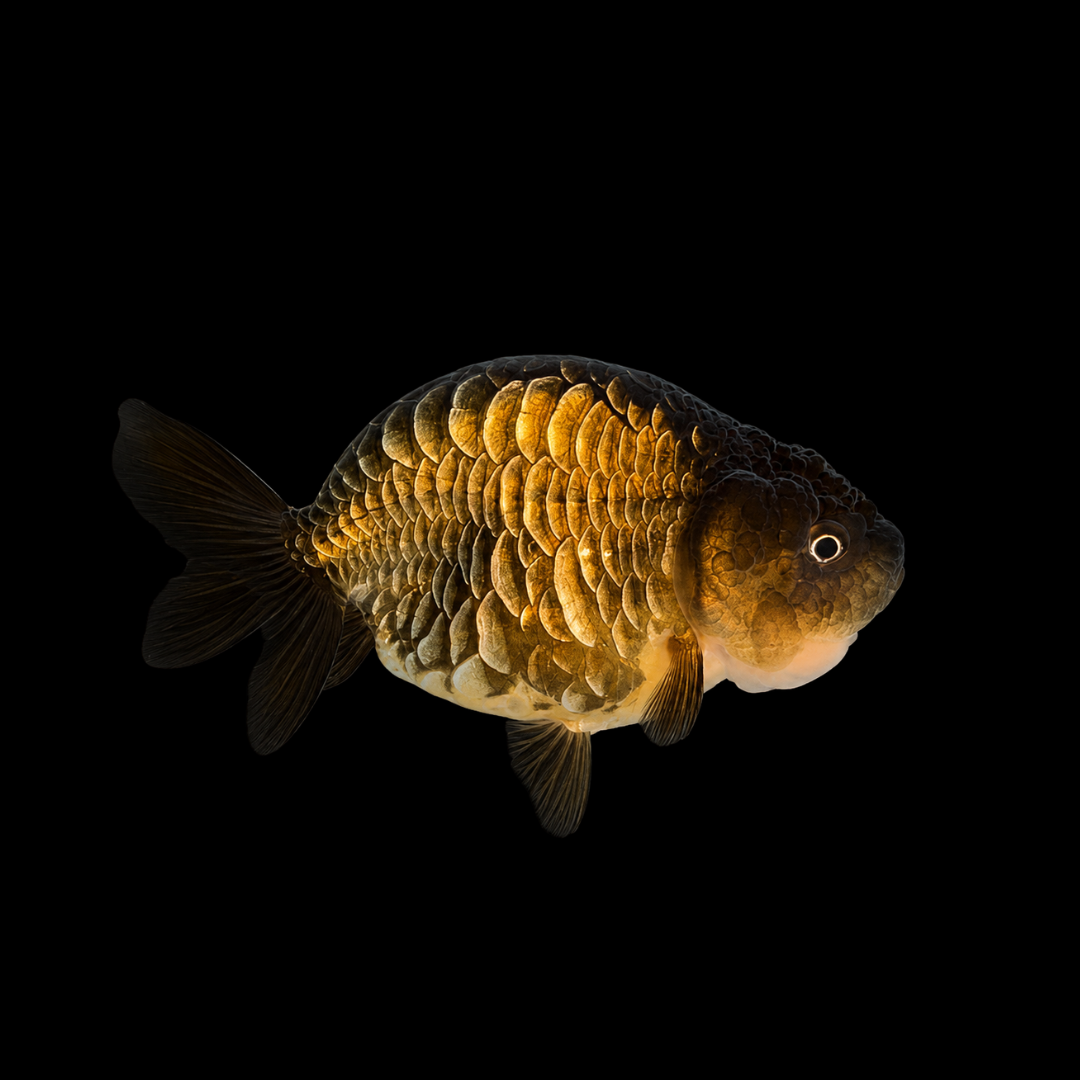
龍鱗らんちゅうは、背びれを持たない卵型の体、頭部に発達する肉瘤、そして一般的ならんちゅうとは印象の異なる大判の鱗を併せ持つ改良金魚です。一枚一枚の鱗が大きく見え、個体によっては光を強く反射するため、「龍の鱗」を思わせる立体的で重厚な表情が生まれます。日本の伝統的ならんちゅうでは上見による体型や尾の美しさが重視されてきましたが、龍鱗らんちゅうは横から眺めることで体側の鱗の配列や質感をより楽しめる点も特徴です。背びれを欠く丸手の体型は泳ぎの安定性で不利になりやすいため、強い水流や急激な環境変化を避け、体表を擦らせない穏やかな環境で飼育します。 Dragon Scale Ranchu is a selectively bred goldfish that combines the classic ranchu form—an egg-shaped body without a dorsal fin and prominent head growth—with unusually large-looking scales. In some individuals these scales reflect light strongly, creating a three-dimensional, armor-like appearance reminiscent of a dragon. Traditional Japanese ranchu culture has long emphasized top-view body form and tail quality, whereas Dragon Scale Ranchu is especially rewarding from the side, where the arrangement and texture of the flank scales are easier to appreciate. Because the rounded, dorsal-finless body is less stable in the water than a streamlined goldfish form, strong currents, abrupt environmental changes, and abrasive décor should be avoided.
基本情報 / Basic Information
| 学名 / Scientific Name | Carassius auratus |
|---|---|
| 通称 / Common Name | 龍鱗らんちゅう、ドラゴンスケールらんちゅうDragon Scale Ranchu |
| 分類 / Family | コイ目コイ科フナ属(金魚・らんちゅう系統の改良品種)Order Cypriniformes, family Cyprinidae, genus Carassius; an ornamental ranchu strain of goldfish |
| 英名 / English Name | Dragon Scale Ranchu |
| 分布 / Distribution | 人為的に作出された観賞用品種のため自然分布はありません。龍鱗形質の育種は中国・福建省福州市周辺で発展し、現在は日本を含む観賞魚市場で流通しています。As a selectively bred ornamental variety, it has no natural distribution. Breeding of the dragon-scale phenotype was developed around Fuzhou, Fujian Province, China, and the variety is now traded in ornamental fish markets including Japan. |
| 最大体長 / Max Size | おおむね15〜20cm前後。系統、飼育密度、給餌、飼育年数によって差があります。Usually around 15–20 cm, with variation depending on strain, stocking density, feeding, and age. |
| 寿命 / Lifespan | 数年以上にわたる長期飼育が可能で、適切な環境では10年以上生きる個体もいます。寿命は個体差や水質、給餌、飼育密度などの影響を受けます。Fancy goldfish can be kept for many years, and well-cared-for individuals may live for more than a decade. Lifespan varies with the individual and with factors such as water quality, feeding, and stocking density. |
飼育環境 / Aquarium Environment
| 水槽サイズ / Tank Size | 成魚1尾を長期飼育する場合は、水量100L前後を確保できる60cmワイド水槽(約100〜110L)程度を一つの目安とし、複数飼育では90cm規格水槽(約157L)以上を検討します。一般的な60cm規格水槽(約57L)は成魚の常設環境としては余裕が少なく、成長に応じた水槽の拡張が必要です。上見を重視する場合は、水深20〜30cm程度の広いFRP容器やトロ舟も利用されます。水量と水面積に余裕を持たせるほど、水質や溶存酸素を安定させやすくなります。For long-term housing of one adult, a wide 60 cm aquarium holding roughly 100–110 L is a more appropriate starting point, while a standard 90 cm aquarium of about 157 L or larger should be considered for multiple adults. A standard 60 cm aquarium of about 57 L offers limited room for a fully grown fish and may need to be upgraded as the fish matures. For top-view appreciation, broad shallow FRP tubs or traditional goldfish tubs with a water depth of roughly 20–30 cm are also used. Greater water volume and surface area make water quality and oxygen conditions easier to stabilize. |
|---|---|
| 水温 / Temperature | 通常の観賞飼育では15〜23℃程度を目安にし、数値そのものより急激な水温変化を避けることを重視します。高水温では水中の酸素が不足しやすく、低水温では代謝と消化が低下するため、季節に応じて給餌量やエアレーションを調整します。屋外で越冬させる場合も、水温に合わせて給餌を減らし、低水温期には無理に食べさせません。 For routine aquarium keeping, about 15–23°C is a useful working range, with stability being more important than targeting a single exact value. Warm water holds less oxygen, while low temperatures slow metabolism and digestion, so feeding and aeration should be adjusted with the season. Outdoor overwintering is possible, but feeding should be reduced as the water cools and should not be forced during cold periods. |
| 水質 / Water Quality | pH6.5〜8.0前後を目安に、急激な変動を避けます。硬度はGH8〜18°dH程度の中硬水〜硬水が一つの目安ですが、「GH200ppm以上」を必須条件と考える必要はありません。より重要なのは、アンモニアと亜硝酸を検出させず、硝酸塩や有機物の蓄積を定期換水で抑えることです。ろ過は十分な生物ろ過能力を確保しつつ、排水を拡散して強い水流を作らない方式が向いています。A stable pH around 6.5–8.0 is a practical target, with sudden shifts avoided. Medium-hard to hard water, roughly 8–18°dH, is a reasonable general range; there is no need to treat GH of 200 ppm or more as a mandatory threshold. More important is keeping ammonia and nitrite at zero and limiting the accumulation of nitrate and organic waste through regular water changes. Provide adequate biological filtration while diffusing the outlet so that the current remains gentle. |
| レイアウト / Layout | 大判鱗を傷つけないことを最優先に、鋭い石や枝状の流木、狭い隙間を作る装飾は避けます。鑑賞性と安全性を両立するなら、底砂や障害物を置かないベアタンクが扱いやすい方法です。横見では黒いバックスクリーンや暗色の背景を用いると、赤白の体色と龍鱗の反射が際立ちます。排水口は壁面へ向けるなどして流れを拡散させ、魚が常に水流に逆らわなくて済む環境を作ります。Protecting the enlarged scales from injury should be the priority. Avoid sharp rocks, branching driftwood, and narrow gaps that can scrape the body. A bare-bottom aquarium without abrasive decorations is often the safest and easiest setup. For side-view display, a black background or other dark backdrop can emphasize red-and-white coloration and the reflective dragon-scale texture. Filter outlets should be directed toward a wall or otherwise diffused so the fish does not have to swim continuously against a strong current. |
| 注意点 / Precautions | 最も注意したいのは、急な環境変化、消化不良、転覆症状、大判鱗の剥離です。網で追い回す移動は避け、必要に応じて容器ですくうなど体表を擦らない方法を選びます。新しい個体は既存魚へすぐ合流させず、別容器で健康状態を確認する検疫期間を設けると病原体の持ち込みを減らせます。輸送直後や水温低下時は特に給餌量を抑え、食欲と排泄、泳ぎ方を確認しながら調整します。The main concerns are sudden environmental changes, digestive trouble, buoyancy disorders, and physical loss of the enlarged scales. Avoid prolonged net chasing; when practical, transfer the fish with a smooth container to minimize abrasion. New fish should be quarantined separately before being introduced to established stock to reduce the risk of pathogen transfer. Feeding should be conservative after transport or during falling temperatures, with appetite, feces, and swimming posture observed closely. |
餌と給餌 / Feeding
| 餌の種類 / Diet | 金魚用の良質な沈下性人工飼料を主食とし、冷凍赤虫などを補助的に利用できます。体色を整えたい場合は、アスタキサンチン、スピルリナ、ファフィア酵母などを配合した色揚げ飼料が利用されます。繁殖期や育成期は栄養価を高めますが、脂質やタンパク質の過剰摂取にならないよう全体量を調整します。A high-quality sinking goldfish pellet makes a suitable staple diet, with foods such as frozen bloodworms used as supplements. Color-enhancing diets may contain astaxanthin, spirulina, or Phaffia yeast. Nutrient density can be increased during conditioning and growth, but total intake should still be controlled to avoid chronic overfeeding. |
|---|---|
| 給餌のポイント / Feeding Tips | 金魚は胃を持たない無胃魚ですが、給餌回数を増やせばよいという意味ではありません。成魚では1日1〜2回程度を目安にし、数分で食べ切れる量に抑えます。育成期などで回数を増やす場合も、1日の総量が過剰にならないよう少量ずつ与えます。丸手の金魚では水面の餌と一緒に空気を取り込み、一時的な浮力異常を示すことがあるため、沈下性またはゆっくり沈む餌が扱いやすい場合があります。水温低下時や体調不良時は給餌量を落とし、残餌は速やかに取り除きます。Goldfish are agastric fish, but this does not mean that they should simply be fed more often. For adults, one or two modest feedings per day are a practical starting point, with only as much food as can be eaten within a few minutes. When juveniles are fed more frequently, each meal should remain small so that the total daily ration is not excessive. Rounded fancy goldfish may gulp air while feeding at the surface and show temporary buoyancy problems, so sinking or slow-sinking foods can be easier to manage. Reduce feeding during cooling periods or illness, and remove uneaten food promptly. |
性格と混泳 / Temperament and Tank Mates
| 性格 / Temperament | 基本的には温和で、他魚を積極的に攻撃する性質は強くありません。ただし、体高があり背びれを欠く体型のため泳ぎはゆっくりしており、餌取り競争や強い水流には不利です。個体同士が密集すると接触で鱗を傷める可能性もあるため、過密飼育は避けます。It is generally peaceful and not strongly aggressive toward other fish. However, its deep body and lack of a dorsal fin make it a slow swimmer, placing it at a disadvantage in feeding competition and strong currents. Crowding should also be avoided because repeated body contact can damage the enlarged scales. |
|---|---|
| 混泳の相性 / Compatibility | 同程度の遊泳力を持つらんちゅう、江戸錦、桜錦、丸手タイプのオランダ獅子頭などとは比較的合わせやすい一方、和金、コメット、朱文金など泳ぎの速い長手型金魚との混泳は避けた方が安全です。速い魚に餌を奪われたり、接触や追尾で大判鱗を傷めたりするおそれがあります。体格差が大きい個体同士の同居も慎重に判断します。It is generally more compatible with similarly slow-swimming fancy goldfish such as ranchu, Edonishiki, Sakuranishiki, and rounded-bodied Oranda. Fast, long-bodied goldfish such as common-type wakin, comets, and shubunkins are poor companions because they can outcompete ranchu for food and may cause scale damage through repeated contact or chasing. Large size differences between tank mates should also be avoided. |
病気と対策 / Diseases and Prevention
| かかりやすい病気 / Common Diseases | 丸みの強い体型では浮き袋や消化管の位置関係が影響し、浮いたまま姿勢を戻せない、あるいは沈んだままになるなどの浮力異常が起こることがあります。これは一つの病名だけで説明できる症状ではなく、消化状態や体型、浮き袋の異常など複数の原因が関わります。ほかに、白点病(ウオノカイセンチュウ感染)、尾ぐされ病などの細菌感染症、松かさ状の症状、水カビ病などにも注意します。龍鱗らんちゅうでは大判鱗が物理的に剥がれ、傷口から二次感染を起こすことも重要なリスクです。Buoyancy disorders deserve particular attention in rounded fancy goldfish because the relationship between the digestive tract, body shape, and swim bladder can contribute to abnormal floating or sinking. These signs are symptoms rather than a single disease and may have several underlying causes. Other concerns include ich caused by Ichthyophthirius multifiliis, bacterial problems such as fin rot, dropsy-like signs, and fungal infections. Dragon Scale Ranchu also has the distinctive risk of physically losing enlarged scales, leaving the injured skin more vulnerable to secondary infection. |
|---|---|
| 対策と予防 / Prevention | 基本は水温と水質を急変させず、過密と過剰給餌を避け、毎日の泳ぎ方と食欲を観察することです。転覆症状の初期には給餌を止めて消化管を休ませ、水温を急に上げず段階的に安定させる管理が行われます。白点病や細菌感染が疑われる場合は病魚を隔離し、対象疾患に適合する観賞魚用治療薬を製品表示どおりに使用します。鱗が剥離した個体は清浄な別容器で管理し、傷口の悪化や水カビの付着がないかを確認します。新規導入魚の検疫も重要な予防策です。Prevention begins with stable temperature and water quality, moderate stocking, careful feeding, and daily observation of posture and appetite. In the early stages of buoyancy trouble, withholding food to rest the digestive tract and stabilizing temperature gradually are common management steps. If white spot disease or bacterial infection is suspected, the affected fish should be isolated and an aquarium medication appropriate to the diagnosed problem should be used exactly according to the product label. Fish that lose scales should be kept in exceptionally clean water and monitored for worsening wounds or fungal growth. Quarantine of new arrivals is also an important preventive measure. |
増やし方(繁殖) / Breeding
| 雌雄の判別 / Sexing | 繁殖期のオスは胸びれの前縁やエラ蓋に白い粒状の「追い星」が現れ、メスを追尾する行動が見られます。成熟したメスは産卵期に腹部がふっくらし、上から見ると体幅が増して見えます。平常時は外見だけでの確実な判別が難しい個体もいます。During the breeding season, males often develop small white breeding tubercles on the leading edges of the pectoral fins and on the gill covers, and they actively chase females. Mature females become fuller through the abdomen as the ovaries develop and can appear broader from above. Outside the breeding season, reliable visual sexing may be difficult in some individuals. |
|---|---|
| 繁殖形態 / Reproduction | 卵生で、自然条件では春の水温上昇に伴って繁殖期を迎えます。ホテイアオイの根や人工産卵床などに粘着性の卵を産み付けます。親魚は卵を食べるため、産卵後は卵または親魚を別容器へ移します。卵の管理は20〜22℃前後を一つの目安とし、4〜5日程度で孵化することがあります。水温を高くすると孵化は早まりますが、急がせるために高温へ寄せるより、安定した適温を保つことを優先します。This is an egg-laying fish, and under natural seasonal conditions breeding activity increases as the water warms in spring. Adhesive eggs are deposited on spawning mops, floating plant roots, or similar substrates. Because adults may eat the eggs, the eggs or parent fish should be separated after spawning. Around 20–22°C, hatching often takes roughly four to five days. Warmer water can shorten incubation, but stable appropriate temperature is preferable to deliberately accelerating development with high heat. |
| 繁殖のポイント / Breeding Tips | 孵化した仔魚が自由遊泳を始めたら、ブラインシュリンプの幼生(アルテミア)など小さく栄養価の高い初期飼料を少量ずつ複数回与えます。龍鱗らんちゅうの繁殖では、単に育て上げるだけでなく、尾の開き、体軸、背の滑らかさ、尾筒、肉瘤、そして最終的な龍鱗の配列まで成長段階ごとに選別します。幼魚期には表現が確定していない部分も多く、理想的な体型と鱗を併せ持つ個体が得られる割合は高くありません。Once the fry become free-swimming, feed small, frequent portions of highly nutritious live food such as newly hatched brine shrimp. Breeding Dragon Scale Ranchu involves more than simply raising fry: selection is performed repeatedly as the fish grow, judging tail spread, straightness of the body axis, smoothness of the back, tail peduncle, head growth, and finally the arrangement of the dragon scales. Many traits are not fixed in very young fish, and only a small proportion will ultimately combine the desired body form with high-quality scale expression. |
雑学と豆知識 / Trivia and Fun Facts
| 1. 「体型」から「鱗」へ広がったらんちゅうの改良 / 1. Ranchu Breeding Expanded from Body Form to Scale Form | らんちゅうの改良では、背なり、尾筒、尾の開き、頭部の肉瘤といった全身の調和が長く重視されてきました。龍鱗らんちゅうの特徴は、そこへ「鱗そのものの大きさや並び」という強い鑑賞要素が加わったことです。現在「龍鱗らんちゅう」として知られる表現の発展には、中国・福建省福州市長楽区の董氏漁業による長期の選択育種が大きく関わっています。同社は特異な鱗を持つ個体を起点に16年にわたって選抜を続け、全身に龍鱗が現れる系統を育成したと報じられています。伝統的ならんちゅうの姿を土台にしながら、体表の質感まで主要な鑑賞対象にした点が、この表現の大きな特徴です。Ranchu breeding has long emphasized whole-body harmony, including the smooth back, tail peduncle, tail spread, and head growth. Dragon Scale Ranchu adds another conspicuous feature: the size and arrangement of the scales themselves. The development of the form now widely called Dragon Scale Ranchu is closely associated with long-term selection by Dong’s fish-breeding operation in Changle, Fuzhou, Fujian Province. Chinese local reporting states that the breeders selected from an unusual scaled individual for 16 years until the dragon-scale expression extended consistently across the body. The result retains a recognizable ranchu framework while making surface texture a major part of its visual identity. |
|---|---|
| 2. 大判鱗は「鎧」ではなく生きた組織 / 2. The Large Scales Are Living Tissue, Not Armor | 龍鱗は見た目こそ鎧のようですが、魚の鱗は単なる硬い板ではありません。真皮に形成される石灰化組織で、骨芽細胞や破骨細胞に相当する細胞が働き、体内のカルシウム代謝とも関わります。表面には成長に伴って形成される鱗紋があり、魚類研究ではその模様から年齢や成長履歴を推定する手掛かりが得られることもあります。龍鱗らんちゅうを眺めるとき、一枚一枚の大判鱗は装飾ではなく、成長し、傷つき、再生する生体組織であることを知ると、その存在感はさらに奥深く感じられます。Although the enlarged scales resemble armor, fish scales are not inert plates. They are mineralized tissues formed in the dermis, containing cells involved in bone-like remodeling and contributing to calcium metabolism. Their surfaces also develop growth markings that can provide researchers with clues about age and growth history. Seen in this context, each dramatic Dragon Scale Ranchu scale is not merely decoration; it is living tissue that grows, can be injured, and can regenerate, giving the fish’s appearance a deeper biological dimension. |
| 3. 鱗が再生しても「同じ一枚」に戻るとは限らない / 3. A Regrown Scale May Not Look Exactly the Same | 金魚の鱗には再生能力があり、剥離後は早い段階から新しい鱗の形成が始まります。ただし、再生の進み方は季節や個体の状態によって変わり、再生直後は周囲の鱗と構造や色調が異なって見えることがあります。龍鱗らんちゅうでは一枚の鱗が目立つため、わずかな剥離でも観賞上の変化が分かりやすくなります。このため、最も確実なのは「剥がれた後に元どおりにする」ことを期待するより、最初から擦らせない環境を作ることです。障害物を減らしたベアタンクは、大判鱗を物理的な損傷から守りやすい方法の一つです。Goldfish scales can regenerate, and new scale formation begins relatively early after loss. The pace of regeneration varies with season and condition, however, and newly regenerated scales may initially differ in structure or appearance from their neighbors. Because each enlarged scale is conspicuous in Dragon Scale Ranchu, even minor loss can be easy to notice. Prevention is therefore more reliable than assuming a damaged scale will quickly return to exactly the same appearance. A bare-bottom aquarium with few obstacles is one practical way to reduce abrasion to the scales. |
| 4. 上見文化のらんちゅうが、横見で別の表情を見せる / 4. A Traditionally Top-Viewed Fish Gains a New Side-View Identity | 日本のらんちゅう文化では、浅い洗面器や池を使い、真上から背なりや尾を評価する上見が長く中心でした。ところが龍鱗らんちゅうでは、最大の特徴である体側の大判鱗は真上からだけでは十分に見えません。透明なガラス水槽で横から眺めると、鱗の立体感、光の反射、体色との重なりが一気に現れます。つまり龍鱗らんちゅうは、伝統的ならんちゅうの形を受け継ぎながら、飼育者に「どの角度から金魚を見るか」まで考え直させた品種とも言えます。Japanese ranchu culture traditionally centers on top-view appreciation, using shallow bowls or ponds to judge the curve of the back and the structure of the tail. Dragon Scale Ranchu changes that visual experience because its defining feature—the enlarged scales along the flanks—cannot be fully appreciated from above. Viewed through the side of a clear glass aquarium, the relief of the scales, reflected light, and body coloration become much more prominent. In that sense, the variety inherited the ranchu form while also encouraging keepers to reconsider the very angle from which ranchu should be appreciated. |
| 5. 「龍鱗」は一種類の見た目ではない / 5. Dragon Scale Is Not a Single Visual Expression | 龍鱗という呼び名から、一様に大きな鱗だけを想像しがちですが、育種現場ではさまざまな見え方が選別されています。国内の一部ブリーダーでは、大きな鱗を「大鱗」、小さめの龍鱗が整って並ぶものを「石垣鱗」、刃文のような模様を持つものを「刃龍鱗」、鱗の並びが乱れるものを「乱鱗・乱龍鱗」、強い反射を示すものを「銀龍鱗」「輝鱗」などと呼び分ける例があります。これらは分類学上の正式名称ではなく、個々の育種現場で使われる表現名です。体色や体型との組み合わせによって一尾ごとの印象が大きく変わるため、龍鱗だけでなく全身の調和を見ることが大切です。The term “dragon scale” can suggest a single uniform appearance, but breeders select a range of visual expressions. Some Japanese breeders use descriptive names such as “large scale,” “stone-wall scale,” “blade dragon scale,” “irregular dragon scale,” “silver dragon scale,” and “brilliant scale” for particular appearances. These are breeder terminology rather than formal taxonomic categories. Because scale expression also interacts with body color and overall ranchu form, two fish sold under the same variety name can look very different, and the whole fish should be judged rather than the scales alone. |
| 6. 金魚の多様性を支えた古いゲノムの出来事 / 6. An Ancient Genome Event Helped Set the Stage for Goldfish Diversity | 金魚が、出目、長いヒレ、背びれの欠損など驚くほど多様な姿へ改良できた背景には、祖先系統で起きた全ゲノム重複が関係すると考えられています。遺伝情報に冗長性が生まれたことで、一方の遺伝子が本来の役割を保ちながら、もう一方に変化が蓄積しやすくなり、多様な形態が生まれる余地が広がったという見方です。らんちゅうの背びれ欠損も発生学や遺伝学の研究対象となっており、金魚は美しい観賞魚であるだけでなく、脊椎動物の形態形成を考えるうえでも興味深い存在です。The extraordinary variety of goldfish forms—including telescope eyes, elongated fins, and dorsal-fin loss—is thought to have been facilitated in part by an ancient whole-genome duplication in the ancestral lineage. Gene duplication can create redundancy, allowing one copy to preserve an essential function while another accumulates changes that may contribute to novel traits. The dorsal-fin loss seen in ranchu has therefore become a subject of developmental and genetic research. Goldfish are not only ornamental animals but also intriguing models for understanding how vertebrate body forms can diversify. |
| 7. 良い個体は「鱗だけ」で決まらない / 7. A Fine Specimen Is Judged by More Than Its Scales | 龍鱗らんちゅうを見ると、どうしても最初に目を奪われるのは大判鱗です。しかし繁殖では、孵化後の早い段階から尾の開きや体軸を見て選別し、成長とともに背中の曲線、腹の丸み、尾筒の太さ、肉瘤、色柄へと評価点を増やしていきます。そして最後に、龍鱗がどの大きさで、どの方向に、どれだけ整って並んでいるかが重なります。印象的な一尾が生まれるまでには、目立つ形質だけでなく全身の調和を何段階にもわたって見続ける育種の積み重ねがあります。The enlarged scales naturally attract attention first, but high-quality Dragon Scale Ranchu are not judged on scales alone. Breeders begin selection early by examining tail spread and the straightness of the body axis, then add criteria such as the curve of the back, abdominal form, tail peduncle strength, head growth, and color as the fish mature. Only after these features develop can the size, direction, and overall arrangement of the dragon scales be assessed in full. A memorable specimen is therefore the result of repeated selection for whole-body harmony, not simply one spectacular trait. |
まとめ / Conclusion
龍鱗らんちゅうは、背びれのない滑らかな体型と肉瘤というらんちゅうの特徴に、大判の鱗という強い個性が加わった金魚です。横から眺めると、鱗の並びや光の反射がよく分かり、体型と体表の質感を同時に楽しめます。その魅力を長く保つには、十分な水量と穏やかな水流を確保し、食べさせすぎず、体表を傷つけない環境を整えることが大切です。 Dragon Scale Ranchu combines the dorsal-finless ranchu form and developed head growth with the strong visual character of enlarged scales. Viewed from the side, the arrangement and reflection of the scales become especially clear, allowing the body form and surface texture to be appreciated together. Long-term care depends on adequate water volume, gentle flow, restrained feeding, stable water conditions, and an aquarium free from abrasive hazards.
飼育には体型と大判鱗への配慮が必要ですが、健康な個体がゆっくりと泳ぐ姿には、この品種ならではの落ち着いた存在感があります。体型、肉瘤、尾、体色、そして鱗の表現が調和した個体は、らんちゅうが培ってきた造形美と、近年の選択育種による新しい表現をあわせ持っています。日々の泳ぎ方や食欲、鱗の状態を丁寧に観察しながら育てることで、成長とともに変化していく姿を長く楽しめます。 The variety requires particular care for its rounded body form and enlarged scales, but a healthy fish moving calmly through the water has a distinctive presence. When body form, head growth, tail, coloration, and scale expression are in balance, the fish reflects both the established aesthetics of ranchu and a newer direction in selective breeding. Careful daily observation of swimming, appetite, and scale condition makes it possible to enjoy the gradual changes in form as the fish matures.
気になる道具や飼い方を見つけてみませんか?
 アイのアクアグッズ案内アフリカンシクリッドの飼育用品|水槽・ろ過・底砂・岩組み・餌の選び方道具の特徴や使い方、選ぶときのポイントをアイが紹介します。記事はコチラ →
 アイのアクアグッズ案内水草の肥料の選び方|底床用・液肥・メネデールの使い分け道具の特徴や使い方、選ぶときのポイントをアイが紹介します。記事はコチラ →
さまざまな飼育テーマをご紹介。リンク先の記事には広告・商品紹介が含まれます。
案内・紹介記事一覧へ →分布マップ
龍鱗らんちゅうは人為的に作出された観賞用品種のため、自然分布はありません。龍鱗形質の育種が発展した中国・福建省福州市周辺を代表地点とし、日本を含む東アジアでの流通地域が把握できる範囲を概略表示しています。
※この地図は記事に記載された地域をもとにした概略表示です。マーカーは福州市周辺を示す代表地点であり、実際の採集地点や自然生息地点を示すものではありません。
参考文献
-
FishBase. Carassius auratus (Linnaeus, 1758)
金魚の分類、自然分布、生息環境、食性、産卵生態などの基礎情報。
-
Ornamental Aquatic Trade Association (OATA). How to look after fancy goldfish
丸手の改良金魚における水温、pH、硬度、水槽容量、水流、給餌、混泳、繁殖などの飼育条件。
-
Kobayashi M, Iwata E, Sorensen PW. Environmental and Physiological Regulation of Reproduction in the Goldfish: Gonadal Development, Maturation, and Spawning Behavior: A Review. Animals. 2026;16(5):775.
金魚の成熟、環境条件と繁殖、生殖行動に関する総説。
-
Motta JHS, Glória LS, Radael MC, et al. Effect of temperature on embryonic development and first exogenous feeding of goldfish Carassius auratus (Linnaeus, 1758). Brazilian Journal of Biology. 2023;83:e270943.
受精卵から仔魚期までの発生速度、孵化、初期給餌と水温の関係。
-
Merck Veterinary Manual. Management of Aquarium Fish
観賞魚の水質管理、体表損傷、検疫、バイオセキュリティなどの健康管理。
-
Merck Veterinary Manual. Parasitic Diseases of Fish
白点病の原因となるウオノカイセンチュウを含む、観賞魚の寄生虫感染症の診断・管理。
-
Merck Veterinary Manual. Bacterial Diseases of Fish
Aeromonas属やFlavobacterium columnareなど、淡水観賞魚で問題となる細菌感染症と発症リスク。




コメント