

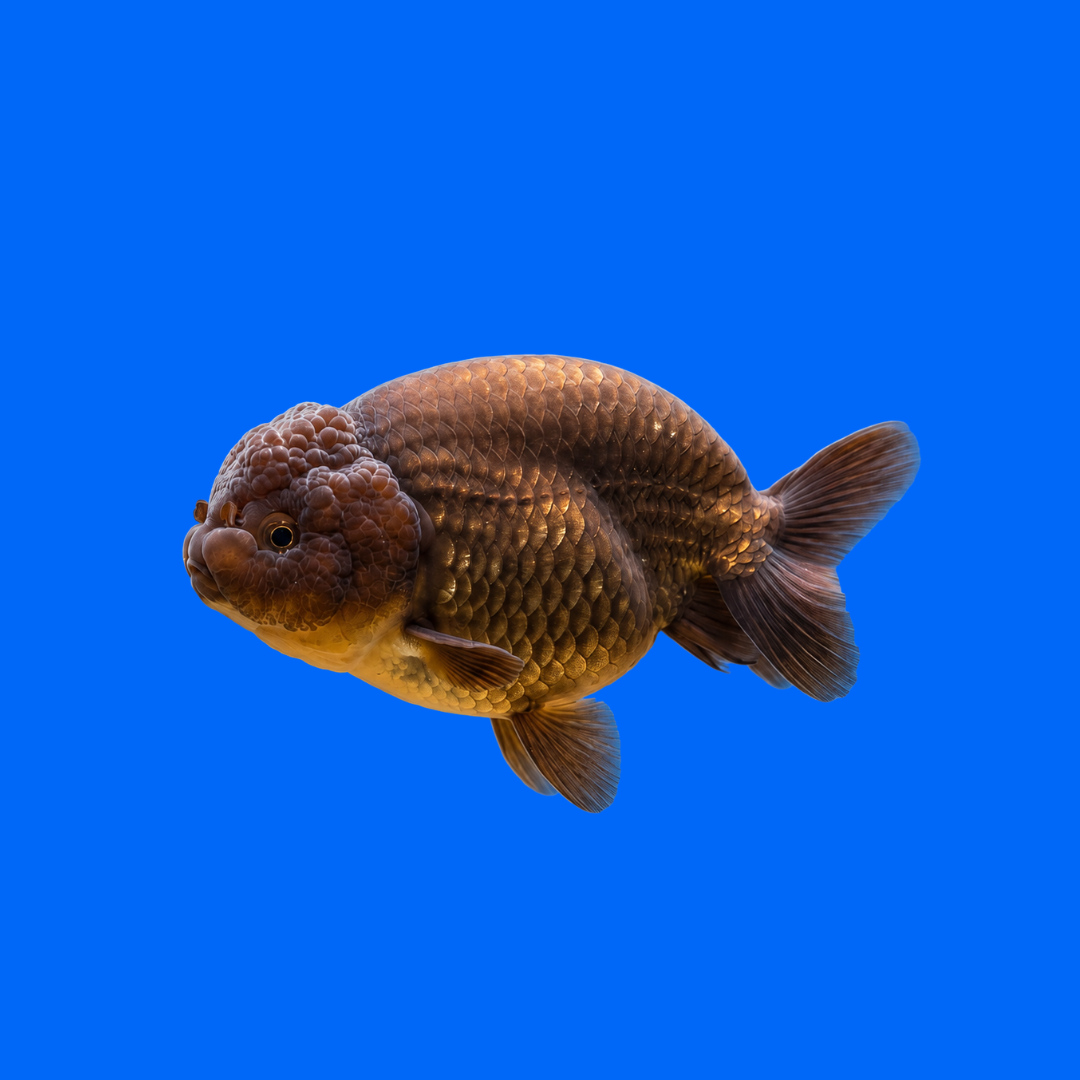
解説 / Description
茶ランチュウは、ランチュウ特有の背びれを持たない丸みのある体型、頭部に発達する肉瘤、そして黒みを帯びた茶褐色からチョコレート色の体色をあわせ持つ金魚の改良品種です。自然界に独立した種として存在する魚ではなく、長い金魚の品種改良史の中で生まれたランチュウ型の形態と、茶系金魚に見られる深い色彩表現が重なった観賞魚です。赤や白を基調とする一般的なランチュウとは印象が大きく異なり、落ち着いた体色とゆったりした泳ぎが水槽内に独特の存在感を与えます。茶褐色の見え方は、メラノフォアなど複数の色素細胞と鱗による光の反射、それらを調節する遺伝的・生理的要因の組み合わせで生まれます。成長に伴う長期的な色変わりに加え、照明や背景、生理状態によって一時的に濃淡が違って見えることもあります。飼育そのものは金魚の基本に沿いますが、背びれがなく遊泳が得意ではないこと、丸い体型で給餌量の影響を受けやすいことから、強い水流を避け、安定した水質と過不足のない給餌を心がけることが大切です。 Chocolate Ranchu is a domesticated goldfish variety that combines the dorsal-finless, rounded Ranchu body form and developed head growth with a deep brown to chocolate coloration. It is not a separate wild species, but an ornamental form created through selective breeding, bringing together the Ranchu body type and the unusual brown color expression found in certain goldfish lines. Compared with the familiar red-and-white Ranchu, its subdued coloration and slow, deliberate swimming create a very different presence in the aquarium. Its brown appearance results from the combined effects of several pigment-cell systems, light reflection from the scales, and genetic and physiological regulation. In addition to longer-term changes that occur with growth, the fish can temporarily look darker or lighter depending on lighting, background, and physiological condition. Its basic husbandry follows general goldfish care, but the lack of a dorsal fin and the compact body make it less efficient at swimming and more sensitive to excessive current and overfeeding. Stable water quality, gentle flow, and careful feeding are therefore especially important.
基本情報 / Basic Information
| 学名 / Scientific Name | Carassius auratus |
|---|---|
| 通称 / Common Name | 茶ランチュウ、チョコレートランチュウChocolate Ranchu, Brown Ranchu |
| 分類 / Family | コイ目・コイ科・フナ属。金魚の改良品種で、ランチュウ型の体形と茶褐色系の体色を持つ系統。Order Cypriniformes, family Cyprinidae, genus Carassius. A domesticated goldfish variety with the Ranchu body form and a brown color phenotype. |
| 英名 / English Name | Chocolate Ranchu Goldfish / Brown Ranchu Goldfish |
| 分布 / Distribution | 改良品種のため自然分布はありません。金魚は中国のフナ属集団から家畜化されたことがゲノム研究で支持されており、茶ランチュウも人為選択によって維持されている観賞魚の品種・系統です。日本国内では、国内繁殖個体に加えて輸入個体も流通しています。As a domesticated variety, it has no natural wild distribution. Genomic research supports the domestication of goldfish from Chinese Carassius populations, and Chocolate Ranchu is likewise maintained through selective breeding rather than as a wild population. In Japan, both domestically bred and imported fish are available in the aquarium trade. |
| 最大体長 / Max Size | 一般的に15〜20cm前後。系統、飼育スペース、給餌、成長年数によって差があります。Generally around 15–20 cm, with variation depending on lineage, available space, feeding, and age. |
| 寿命 / Lifespan | 10年以上。家庭飼育では10〜15年程度がひとつの目安ですが、良好な環境では20年以上生きる例もあります。10 years or more. Around 10–15 years is a practical expectation in home aquariums, although some well-kept goldfish live for more than 20 years. |
飼育環境 / Aquarium Environment
| 水槽サイズ / Tank Size | 成魚1匹でも90L前後以上、2匹なら120〜180L程度以上をひとつの管理目安にすると、水質を安定させやすくなります。日本の規格では60cmワイド水槽〜90cm規格水槽相当が目安です。ランチュウは高さよりも底面積を確保しやすい容器と相性がよく、伝統的な上見飼育では水深20〜30cm程度の浅い池や舟がよく用いられます。ただし、この水深が水槽飼育の必須条件というわけではありません。匹数が増える場合は、水量と底面積の両方に余裕を持たせてください。For an adult, around 90 L or more is a useful management target, while two adults are easier to manage in roughly 120–180 L or more. In Japanese aquarium sizes, this corresponds roughly to a wide 60 cm tank through a standard 90 cm tank. Ranchu benefit from generous floor area, and shallow ponds or tubs around 20–30 cm deep are commonly used in traditional top-view keeping. This depth is not a strict requirement for aquarium keeping. Increase both water volume and floor space as stocking density rises. |
|---|---|
| 水温 / Temperature | 18〜25℃前後を安定した管理の目安にします。屋外や季節飼育では15〜28℃程度の範囲を経験することもありますが、温度そのものより急激な変化を避けることが重要です。特に秋から冬にかけて水温が下がる時期は、活動量に合わせて給餌量も調整します。 For stable long-term management, around 18–25°C is a useful target. Outdoor or seasonal systems may pass through roughly 15–28°C, but avoiding abrupt temperature changes is more important than holding a single exact value. As temperatures fall in autumn and winter, adjust feeding to the fish’s activity level. |
| 水質 / Water Quality | 弱酸性から弱アルカリ性まで適応しますが、pH6.5〜8.0程度の安定した淡水が扱いやすいです。アンモニアと亜硝酸は常に検出されない状態を目標とし、硝酸塩も低く保ちます。金魚は排泄量が多いため、ろ過能力に余裕を持たせ、週1回を基本に3分の1前後を目安として水質に応じた部分換水を行います。新水は必ず塩素を中和し、水温差をできるだけ小さくしてください。They tolerate mildly acidic to mildly alkaline water, but stable freshwater around pH 6.5–8.0 is practical. Ammonia and nitrite should remain undetectable, and nitrate should be kept low. Because goldfish produce a heavy bioload, provide generous biological filtration and perform regular partial water changes, often around one-third weekly depending on test results and stocking. Always dechlorinate replacement water and keep temperature differences small. |
| レイアウト / Layout | 排泄物を確認しやすいベアタンクは、ランチュウ飼育と非常に相性のよい方法です。底床を使う場合は、口に入れても事故につながりにくい細かな砂を薄く敷き、尖った石や枝状の流木は避けます。ろ過はスポンジフィルターや流量を抑えた投げ込み式フィルターなど、酸素を確保しながら強い水流を作らない方式が向いています。水草を入れる場合は、金魚にかじられることを前提に丈夫な種類を選び、遊泳空間を広く残してください。A bare-bottom setup works particularly well for Ranchu because waste is easy to see and remove. If substrate is used, a thin layer of fine sand is safer than coarse gravel, and sharp rocks or branching wood should be avoided. Sponge filters or gently adjusted air-driven filters are suitable because they provide oxygenation without creating strong current. If live plants are used, choose hardy species that can tolerate grazing and keep plenty of open swimming space. |
| 注意点 / Precautions | 背びれがなく丸い体型のため、細身の金魚より泳ぎが遅く、強い水流では体力を消耗しやすい傾向があります。過密飼育、急な水温変化、過剰給餌は避けてください。肉瘤が発達した個体は視界が狭くなることもあるため、餌が全個体に行き渡っているかを確認します。茶褐色は成長や環境によって変化することがあり、明るい体色に変わった個体が必ずしも元の濃色へ戻るとは限りません。Because Ranchu lack a dorsal fin and have a compact body, they swim more slowly than streamlined goldfish and may tire in strong current. Avoid overcrowding, sudden temperature changes, and excessive feeding. Heavy head growth can also reduce vision, so confirm that every fish receives enough food. Brown coloration may change with age and environment, and a fish that permanently loses dark pigmentation may not return to its former deep color. |
餌と給餌 / Feeding
| 餌の種類 / Diet | 雑食性です。主食には消化性のよい金魚・ランチュウ用の沈下性ペレットを使い、補助的に冷凍赤虫、ミジンコ、ブラインシュリンプ、茹でた葉野菜などを組み合わせます。屋外の青水では植物プランクトンも補助的な栄養源になります。カロテノイドを含む餌は赤・黄系色素の維持を助けますが、茶褐色を必ず固定できるものではありません。They are omnivorous. Use an easily digested sinking goldfish or Ranchu pellet as the staple, supplemented with foods such as frozen bloodworms, daphnia, brine shrimp, and blanched leafy vegetables. In outdoor green-water systems, phytoplankton can also provide supplemental nutrition. Carotenoid-rich foods can support red and yellow pigments, but they cannot guarantee permanent retention of the brown coloration. |
|---|---|
| 給餌のポイント / Feeding Tips | 1回量を控えめにし、短時間で食べ切れる量を複数回に分ける方法が安全です。春は水温の上昇に合わせて少量から増やし、成長期は水質を確認しながら十分な栄養を与えます。秋は水温低下に合わせて量を減らし、屋外無加温で10℃前後を下回る低温期は活動と消化の状態を見ながら大幅に減餌するか給餌を休止します。丸い体型の金魚では過食後に浮力異常が目立つことがあるため、「肉瘤を育てたいから多く与える」という考え方は避け、体型・糞・泳ぎ・水温を見ながら調整してください。Feed modest portions that can be finished quickly, divided into several small meals when growth and temperature allow. In spring, increase food gradually as the water warms; during the growing season, provide adequate nutrition while closely monitoring water quality. Reduce feeding as temperatures fall in autumn. In unheated outdoor systems near or below 10°C, feeding may need to be greatly reduced or suspended depending on activity and digestion. Because compact-bodied goldfish can show buoyancy problems after overeating, do not overfeed simply to promote head growth; adjust portions according to body condition, feces, swimming behavior, and temperature. |
性格と混泳 / Temperament and Tank Mates
| 性格 / Temperament | 温和で、他魚を積極的に攻撃するタイプではありません。人にも慣れやすく、飼育者が近づくと餌を期待して寄ってくることがあります。一方で泳ぎはゆっくりしており、背びれを持つ細身の金魚に比べて方向転換や加速が苦手です。Peaceful and generally non-aggressive. They often become accustomed to their keeper and may approach when a person comes near the aquarium. Their swimming is slow, however, and they are less efficient at accelerating and turning than streamlined goldfish with a dorsal fin. |
|---|---|
| 混泳の相性 / Compatibility | ランチュウ、オランダシシガシラ、ピンポンパールなど、泳ぎの速さや餌を取る能力が近い丸手の金魚との混泳が基本です。和金、コメット、朱文金などの速い金魚と一緒にすると、餌を先に取られやすくなります。ヒレをつつく魚や高水温を必要とする熱帯魚との混泳も避けた方が安全です。混泳時は種類名だけで判断せず、実際に各個体が十分に食べられているか、追い回しがないかを観察してください。Best kept with other slow, rounded fancy goldfish that have similar feeding ability, such as Ranchu, Oranda, and Pearlscale. Fast varieties such as Common Goldfish, Comets, and Shubunkins can outcompete them for food. Avoid fin-nipping species and tropical fish that require persistently high temperatures. Compatibility should be judged by actual behavior as well as species name, with attention to whether each fish can feed properly and rest without harassment. |
病気と対策 / Diseases and Prevention
| かかりやすい病気 / Common Diseases | 丸い体型の金魚で見られやすい浮力異常・転覆症状、水質悪化に伴うエラの不調、白点病、尾ぐされ・赤斑などの細菌性疾患、松かさ症状などに注意します。茶ランチュウだけに特有の病気というより、ランチュウ型の体形、排泄量の多さ、給餌量、水質変動が重なったときに不調が出やすいと考えると分かりやすいでしょう。肉瘤が大きい個体では、表面の擦れや炎症にも注意します。Watch for buoyancy disorders and capsizing signs common in compact fancy goldfish, gill problems associated with poor water quality, ich, bacterial conditions such as fin rot or hemorrhagic lesions, and dropsy-like symptoms. These are not unique to Chocolate Ranchu; risk often increases when compact body shape, heavy waste production, excessive feeding, and unstable water quality occur together. Fish with heavy head growth should also be checked for abrasions and inflammation around the wen. |
|---|---|
| 対策と予防 / Prevention | 最も重要なのは、症状が出る前からアンモニア・亜硝酸を検出させない水質管理を続けることです。新しい魚は可能であれば別容器で状態を観察してから合流させ、器具の共用にも注意します。浮力異常が出た場合は、まず水質と水温を確認し、給餌直後や過食が疑われる場合は一時的な減餌または絶食を検討し、十分なエアレーションを確保します。ただし、浮力異常は消化管の状態だけでなく、浮袋の異常、感染、内臓疾患など複数の原因で起こり得るため、改善しない場合は原因を切り分けて対処する必要があります。塩水浴が補助的に用いられることもありますが、原因によって適否は異なります。薬剤を使用する場合は対象となる病気を確認し、観賞魚用医薬品の用法・用量と対象魚種を守ってください。The most effective prevention is maintaining water in which ammonia and nitrite remain undetectable before symptoms appear. When possible, observe new fish separately before introducing them and avoid careless sharing of equipment between tanks. If buoyancy problems occur, first check water quality and temperature; when signs follow feeding or overeating is suspected, a temporary reduction or pause in feeding may be appropriate while adequate aeration is maintained. Buoyancy disorders can also result from swim-bladder abnormalities, infection, internal disease, or other causes, so persistent cases require the cause to be assessed rather than treated as simple indigestion. Salt baths are sometimes used as supportive care, but their suitability depends on the cause. If medication is used, identify the likely condition and follow the labeled dosage and species instructions for ornamental fish medicines. |
増やし方(繁殖) / Breeding
| 雌雄の判別 / Sexing | 繁殖期になると、成熟したオスのエラぶたや胸びれの前縁に白い粒状の追星が現れることがあります。メスは抱卵すると腹部がふっくらし、総排泄孔がやや目立つ傾向があります。非繁殖期の外見だけで確実に判別することは難しく、成熟個体を複数比較すると判断しやすくなります。During the breeding season, mature males often develop small white breeding tubercles on the gill covers and leading edges of the pectoral fins. Females become fuller through the abdomen when carrying eggs, and the vent may appear more prominent. Outside the breeding season, visual sexing can be unreliable, so comparison among mature fish is helpful. |
|---|---|
| 繁殖形態 / Reproduction | 卵生で、粘着性のある卵を水草や産卵床にばらまくタイプです。親魚は卵や稚魚を保護せず、産卵後に卵を食べることもあります。春の水温上昇が繁殖のきっかけになりやすく、成熟したオスがメスを追尾する行動が見られます。An egg-laying, egg-scattering fish that deposits adhesive eggs on aquatic plants or spawning media. Parents do not guard the eggs or fry and may eat the eggs after spawning. Rising temperatures in spring commonly stimulate reproductive behavior, including males actively chasing females. |
| 繁殖のポイント / Breeding Tips | 健康な成熟魚を十分にコンディショニングし、ホテイアオイや産卵モップなど卵が付着できる場所を用意します。産卵を確認したら親魚を分け、卵には弱い通水と十分な酸素を与えます。20℃前後では4日ほどで孵化する例があり、水温によって孵化までの日数は変わります。ヨークサックを吸収して泳ぎ始めた稚魚には、ブラインシュリンプ幼生などの小さな餌を少量ずつ複数回与えます。茶褐色の発色には複数の色素細胞と関連遺伝子が関わりますが、茶ランチュウの色を単純な一遺伝子形質として予測できる遺伝様式が確立されているわけではありません。狙った色と体型を残すには、複数世代にわたる選別と系統管理が重要です。Condition healthy mature breeders well and provide spawning plants or artificial mops for adhesive eggs. Once spawning is complete, separate the adults and keep the eggs gently aerated in clean water. At around 20°C, goldfish eggs may hatch in about four days, with development time varying according to temperature. After the yolk sac is absorbed and the fry become free-swimming, offer small foods such as newly hatched brine shrimp in several small meals per day. Several pigment-cell systems and related genes contribute to brown coloration, but no simple single-gene inheritance pattern is established that reliably predicts Chocolate Ranchu color. Retaining a desired combination of color and body form therefore depends on selection and line management across generations. |
雑学と豆知識 / Trivia and Fun Facts
| 1. 金魚の千年以上の品種改良史の先にある姿 / 1. A Form Shaped by More Than a Millennium of Goldfish Breeding | 金魚の物語をたどると、茶ランチュウの姿が突然生まれたものではないことが分かります。中国では古くから、野生型のフナに現れた赤色や金色の個体が人の目に留まり、池や容器の中で選び残されてきました。長い年月の中で、尾が二つに分かれるもの、体が丸くなるもの、背びれを失うもの、頭部の肉瘤が発達するものなど、自然界では不利になり得る特徴まで「美しさ」として受け継がれていきました。現在のゲノム研究でも、金魚は中国のフナ属集団を祖先とし、千年以上にわたる強い人為選択を受けてきたことが支持されています。茶ランチュウの丸い背なりと背びれのない輪郭を眺めることは、東アジアで続いてきた品種改良の歴史そのものを眺めることでもあります。The history of goldfish shows that the Chocolate Ranchu did not appear as a single sudden invention. In China, unusual red or golden individuals arising from wild-type crucian carp populations were noticed and preserved in ponds and containers. Over centuries, breeders retained traits that could be disadvantageous in nature but visually attractive in captivity: divided tails, shortened bodies, loss of the dorsal fin, and elaborate head growth. Modern genomic studies support an origin from Chinese Carassius populations followed by more than a thousand years of intense artificial selection. The rounded back and dorsal-finless silhouette of a Ranchu can therefore be viewed as a living expression of a long East Asian breeding tradition. |
|---|---|
| 2. 日本では「茶」、英語では「チョコレート」、中国では「紫」 / 2. Brown in Japan, Chocolate in English, and Purple in China | 茶系金魚の面白さは、よく似た深い褐色でも地域によって色の呼び方が異なることです。日本では「茶金」、英語圏では Chocolate Oranda、中国系統では「紫高頭」「紫獅子頭」などの名称が見られます。ここでいう「紫」は必ずしも鮮やかな紫色を意味するのではなく、茶褐色から紫褐色に見える深い色調を表す呼び名として使われています。茶金は昭和30年代に中国から日本へ導入されたとされ、それまで日本の金魚では目立たなかった茶褐色が大きな特徴として受け止められました。茶ランチュウは、こうした茶系の色彩をランチュウ型で楽しむ魚と捉えると分かりやすいでしょう。One of the most intriguing aspects of brown goldfish is that very similar deep coloration is named differently across regions. In Japan the name Chakin is used, English-speaking aquarists use names such as Chocolate Oranda, and Chinese lines are known by names including Zi Gaotou and Zi Shizitou. In this context, the Chinese term associated with purple does not necessarily describe a vivid purple fish; it is used for deep brown-to-purplish tones. Chakin is generally described as having been introduced from China to Japan during the Showa 30s, when its unusual brown coloration stood out among Japanese goldfish. Chocolate Ranchu can be understood as a Ranchu-form fish that expresses this brown color tradition. |
| 3. 背びれがない理由を遺伝子から見る / 3. Looking at the Dorsal-Finless Form Through Genetics | ランチュウの「背びれがない」という特徴は、飼育中にヒレを失ったものではなく、品種として遺伝的に固定された形質です。実験研究では、発生時の背腹軸形成に関わる chordin に相当する金魚の遺伝子 chdS の変異が、二つに分かれた尾と背びれ欠損の両方に関わることが示されています。ただし、同じ chdS 変異を持ちながら背びれを備える金魚品種もあり、ランチュウのように背びれのない形を安定して表すには、ほかの遺伝要因も関与すると考えられています。つまり、chdS は重要な土台の一つですが、「この一つの遺伝子だけでランチュウの背中が決まる」と理解するのは正確ではありません。見慣れたなめらかな背なりは、発生生物学から見ても興味深い形質なのです。The absence of a dorsal fin in Ranchu is not the result of injury; it is a genetically fixed breed characteristic. Experimental work has shown that a mutation in chdS, a goldfish homolog of chordin involved in dorsal-ventral development, contributes to both the bifurcated tail and the dorsal-finless phenotype. The relationship is not a simple one-gene explanation, however. Some goldfish varieties carry the same chdS mutation while retaining a dorsal fin, indicating that additional genetic factors are involved in stabilizing the dorsal-finless Ranchu form. In other words, chdS is an important part of the developmental basis, but it should not be understood as the only gene that determines the Ranchu back. The familiar smooth dorsal profile is therefore also a fascinating subject in developmental biology. |
| 4. 茶褐色は「黒の上に赤と黄が重なる」だけでは終わらない / 4. Brown Color Is More Than Simply Black Over Red and Yellow | 茶褐色は肉眼では一色に見えますが、皮膚の中では複数の色素細胞が働いています。黒から褐色を担うメラノフォア、黄から橙色に関わるキサントフォア、赤系のエリスロフォア、光を反射するイリドフォアなどが組み合わさり、鱗の性質や光の当たり方も最終的な見え方に影響します。白・黄・褐色の頂天眼系金魚の皮膚を比較したトランスクリプトーム研究では、褐色群でメラニン生成関連遺伝子の発現が高く、メラニン生成、チロシン代謝、Wntシグナル、MAPKシグナルなどに関わる遺伝子群の差が報告されています。これは茶ランチュウそのものを対象にした研究ではありませんが、金魚の褐色発現が単一の色素だけではなく、複数の色素細胞と分子経路の組み合わせで成り立つことを理解する手掛かりになります。A Chocolate Ranchu may look uniformly brown to the eye, but several pigment-cell systems contribute to the appearance. Melanophores contribute black to brown tones, xanthophores yellow to orange, erythrophores red hues, and iridophores reflected light; scale structure and illumination also affect what the eye sees. A transcriptome study comparing white, yellow, and brown skin in Celestial Eye goldfish found higher expression of melanogenesis-related genes in the brown group and reported differences involving melanogenesis, tyrosine metabolism, Wnt signaling, and MAPK signaling. The study did not examine Chocolate Ranchu specifically, but it provides a useful clue that brown coloration in goldfish reflects multiple pigment-cell and molecular pathways rather than a single pigment alone. |
| 5. 同じ個体でも色の「見え方」は動く / 5. Even the Same Fish Can Look Different From Day to Day | 魚の体色には、比較的短時間で起こる生理的な変化と、成長に伴って長期的に進む形態的な変化があります。メラノフォアの中では色素顆粒が細胞内で集まったり広がったりし、背景の明暗や光環境、ストレス、生理状態などによって魚が濃く見えたり淡く見えたりします。一方、成長の過程でメラノフォアそのものの数や状態が変われば、より長期的な色変わりになります。金魚でよく知られる「褪色」はこの後者に関係し、一度大きく色素細胞を失った部分は、単に背景を暗くしただけで元の濃色に戻るとは限りません。茶ランチュウを観察するときは、今日の色だけを固定された答えとして見るのではなく、成長する魚が見せる変化の一場面として捉えると、その奥行きがよく分かります。Fish coloration includes both rapid physiological changes and longer-term morphological changes. Within melanophores, pigment granules can aggregate or disperse, making a fish appear darker or lighter in response to background, light, stress, and physiological condition. Over a longer period, the number and state of pigment cells themselves can change during growth. The well-known fading process in goldfish is related to this more persistent form of color transformation. Once dark pigment cells have been substantially lost, simply moving the fish to a darker background may not restore the former color. Watching a Chocolate Ranchu is therefore less like observing a fixed paint color and more like following one stage in the changing appearance of a living animal. |
| 6. 伝統的な「上見」と現代水槽の「横見」で評価が変わる / 6. Top View and Side View Create Different Standards of Beauty | 日本の伝統的ならんちゅう文化では、浅い池の上から魚を見る「上見」が重視され、頭、背なり、尾筒、尾の開き、そして泳ぎの総合的な調和が評価されてきました。その美意識では赤や更紗が中心で、茶色は伝統的な品評会の基準から外れることがあります。一方、家庭のガラス水槽では横から観賞する機会が多く、肉瘤や体高、茶褐色の濃淡など、上見とは異なる特徴が目に入りやすくなります。茶ランチュウは、上から見れば背なりと尾の構成が際立ち、横から見ればチョコレート色と肉瘤、丸い体型が印象に残ります。見る角度によって魅力の中心が変わるところも、この魚ならではの面白さです。Traditional Japanese Ranchu culture places great value on uwami, viewing the fish from above in shallow ponds. Under that aesthetic, the head, curve of the back, caudal peduncle, tail spread, and overall swimming balance are judged together, with red and red-and-white coloration forming the traditional core. Brown fish may therefore fall outside conventional show standards. Home aquariums, however, are often viewed from the side, which makes head growth, body depth, and subtle variations in brown coloration more noticeable. From above, the back line and tail construction of Chocolate Ranchu stand out; from the side, the chocolate coloration, head growth, and rounded body become more prominent. The way its appeal shifts with the viewing angle is part of the variety’s distinctive character. |
まとめ / Conclusion
茶ランチュウは、背びれのないなめらかな背なり、発達する頭部の肉瘤、そして赤や白とは異なる深い茶褐色をあわせ持つ金魚です。体色の基礎には遺伝的な背景がありますが、実際の見え方は成長や光環境、生理状態によっても変化します。濃いチョコレート色だけを基準にするのではなく、体型、泳ぎ、健康状態まで含めて一匹の変化を見守ることで、この品種らしい奥行きを感じられます。 Chocolate Ranchu combine a smooth dorsal-finless back, developing head growth, and a deep brown coloration unlike the familiar red and white of many goldfish. Genetics provides the basis for the coloration, while growth, lighting, and physiological condition can also change how that color appears. Rather than judging the fish only by how dark its chocolate tone is, its body form, swimming, health, and gradual development can be appreciated together over time.
広い底面積、穏やかな水流、清潔で安定した水を用意し、季節と水温、活動量に合わせて適量を給餌することが、健康に長く付き合うための基本です。日々の泳ぎや体調に目を配りながら、色調や肉瘤が少しずつ変化していく姿を観察することで、茶ランチュウならではの落ち着いた美しさを長く楽しめるでしょう。 Generous floor space, gentle current, clean and stable water, and feeding adjusted to season, temperature, and activity form the basis of long-term care. By watching daily swimming and condition while the coloration and head growth change gradually, the subdued beauty that distinguishes Chocolate Ranchu can be enjoyed over many years.

気になる道具や飼い方を見つけてみませんか?
 アイのアクアグッズ案内水草トリミングの道具とやり方|ハサミ・ピンセットを水草に合わせて選ぼう伸びすぎた水草は切っていい? 有茎草の差し戻し、前景草の絨毯、流木のモスを整える場面から、水草用ハサミ・ピンセット・ゴミ取りネットの選び方と片付けを紹介します。記事はコチラ →
 アイのアクアグッズ案内水槽の流木の選び方|枝・マングローブ・アク抜きとおすすめ商品水槽に小さな森を作る流木。枝流木やマングローブという名前の違いから、魚の隠れ家、水草の取り付け、浮く・水が茶色くなるときの準備まで、アイとコタロウが商品とともに案内します。記事はコチラ →
さまざまな飼育テーマをご紹介。リンク先の記事には広告・商品紹介が含まれます。
案内・紹介記事一覧へ →分布マップ
茶ランチュウ(Carassius auratus)は改良品種のため自然分布を持ちません。金魚は中国のフナ属集団から家畜化されたとされ、茶ランチュウも人為選択によって維持され、日本を含む各地で観賞魚として飼育・流通しています。
※この地図は、記事中の分布情報をもとに中国から日本を含む東アジアを概略表示したものです。マーカーは分布の目安として設定した代表地点であり、実際の採集地点・生息地点を示すものではありません。
参考文献
-
California Academy of Sciences, Eschmeyer’s Catalog of Fishes: Carassius auratus (Linnaeus, 1758)Online Version, 2026. 分類、学名、コイ科フナ属としての位置づけ、東アジアの分布、淡水魚であること、栽培・改良品種の存在を確認する資料。
-
Chen, D. et al. “The evolutionary origin and domestication history of goldfish (Carassius auratus).”Proceedings of the National Academy of Sciences, 117(47), 29775–29785, 2020. 金魚が中国のフナ属集団から長期の人為選択を経て成立した家畜化魚であること、背びれを欠くEgg goldfish系統を含む品種分化を支える資料。
-
FishBase. Carassius auratus (Linnaeus, 1758), Goldfish.分類、東アジアを中心とする原種レベルの分布、止水・緩流域や植生のある水域という生息環境、食性、pH範囲、繁殖期の追星、植物などに付着する粘着卵といった生態・繁殖情報を確認する資料。
-
Petty, B. D., Francis-Floyd, R. & Yanong, R. P. E. “Fish Taxonomy.” Merck Veterinary Manual.Last updated June 2026. 金魚を含むコイ科魚類の解剖学的特徴、二室性の浮袋、丸手の観賞金魚で起こりやすい浮力調節上の問題と沈下性飼料の利用を支える獣医学資料。
-
Petty, B. D., Francis-Floyd, R. & Yanong, R. P. E. “Management of Aquarium Fish.” Merck Veterinary Manual.Last updated September 2024. 水温が魚の生理機能に及ぼす影響、ろ過、水質検査、アンモニア・亜硝酸管理、換水、隔離飼育、器具の分離など、飼育条件と疾病予防の基本を支える獣医学資料。
-
Francis-Floyd, R., Yanong, R. P. E. & Petty, B. D. “Environmental Diseases of Aquatic Animals in Aquatic Systems.” Merck Veterinary Manual.Last updated September 2024. 淡水でアンモニアと亜硝酸を検出させない管理、塩素・クロラミンの除去、溶存酸素、水温変動、過剰給餌やろ過不良に伴う水質悪化など、記事内の注意点を支える資料。
-
Petty, B. D., Francis-Floyd, R. & Yanong, R. P. E. “Bacterial Diseases of Fish.” Merck Veterinary Manual.Last updated September 2024. 水質悪化、過密、輸送、温度変化などが細菌性疾患の誘因になり得ること、金魚で問題となるAeromonas属感染と出血・潰瘍性病変を支える資料。
-
Petty, B. D., Francis-Floyd, R. & Yanong, R. P. E. “Parasitic Diseases of Fish.” Merck Veterinary Manual.Last updated September 2024. 淡水魚の白点病を起こすIchthyophthirius multifiliis、皮膚・エラ・ヒレの症状、感染拡大、衛生管理と隔離の重要性を支える資料。
-
Motta, J. H. S. et al. “Effect of temperature on embryonic development and first exogenous feeding of goldfish Carassius auratus (Linnaeus, 1758).”Brazilian Journal of Biology, 83, e270943, 2023. 受精卵の発生速度、孵化、仔魚が最初に外部の餌を摂り始める時期と水温の関係を実験的に検討した、繁殖・初期育成を支える資料。





コメント