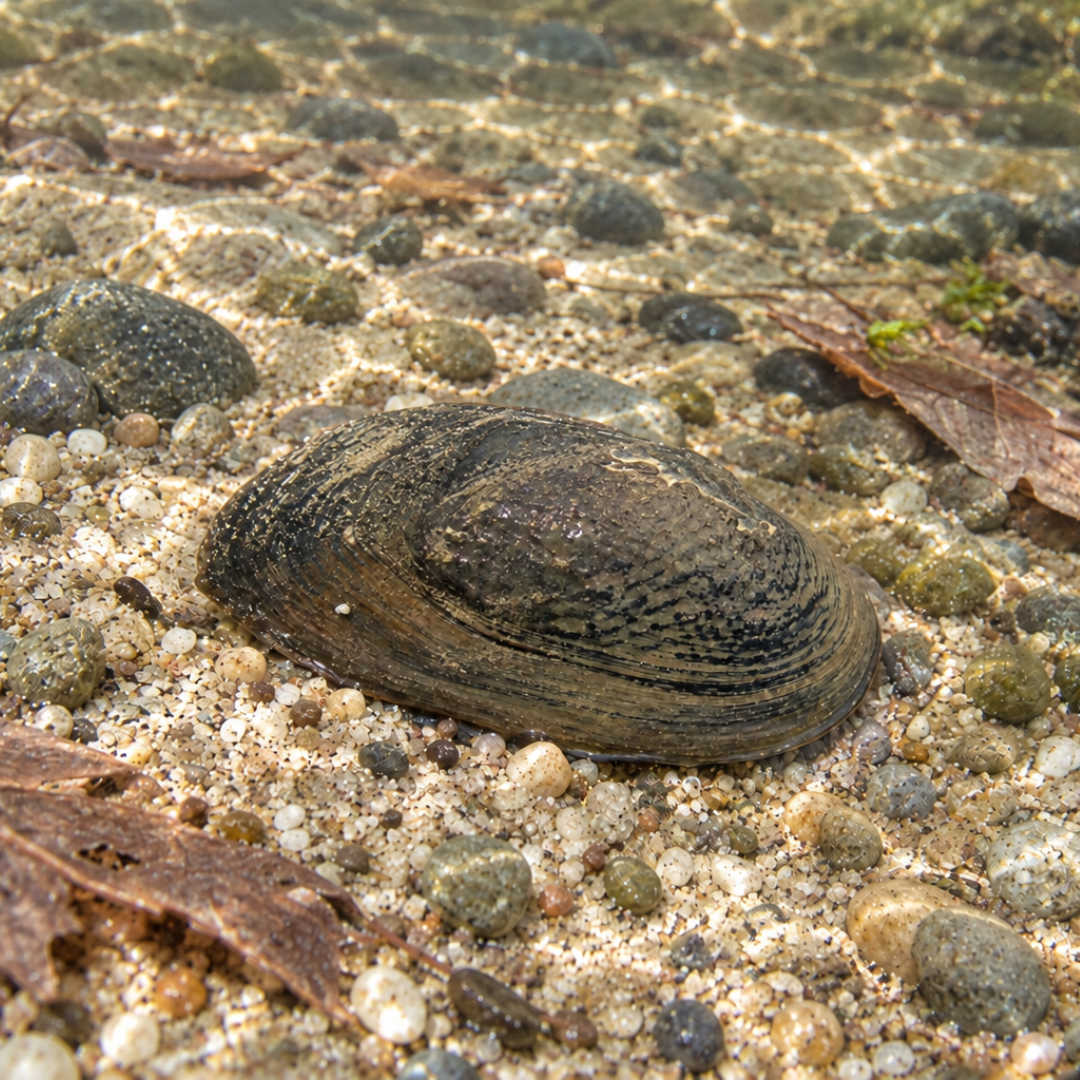
イシガイは、湖沼、流れの緩い河川、農業用水路などの砂泥底で暮らす淡水二枚貝です。褐色から黒褐色の厚い殻を持ち、底床に体の一部を埋めながら、入水管から取り込んだ水に含まれる植物プランクトンや微細な有機物などを濾し取ります。水を澄ませる働きで知られますが、水槽の汚れを無制限に処理する生体ではありません。清澄すぎる水槽ではかえって餌不足になりやすいため、安定した水質、十分な酸素、継続的な微粒子餌の供給が長期飼育の鍵になります。斧足で底砂の中を移動する姿と、魚を宿主として成長する幼生期を持つ独特な生活史は、淡水生態系の奥深さを感じさせます。Ishigai is a freshwater mussel found on sandy or muddy bottoms in lakes, slow-flowing rivers, and agricultural channels. Its thick shell is brown to dark brown, and the animal normally remains partly buried while drawing water through its inhalant siphon and filtering phytoplankton and fine organic particles. Although it is known for clarifying water, it is not an unlimited waste processor. An overly clean aquarium may instead leave it short of food, so stable water quality, ample oxygen, and a continuing supply of fine suspended food are essential for long-term care. Its movement through the substrate with a muscular foot and its fish-dependent larval stage reveal the complexity of freshwater ecosystems.
基本情報 / Basic Information
学名 / Scientific Name
Nodularia douglasiae (J. E. Gray, 1833) 旧来の属名を用いた Unio douglasiae も文献や流通情報に見られます。The older combination Unio douglasiae also appears in literature and trade information.
通称 / Common Name
イシガイ。流通名だけでは近縁種との区別が曖昧な場合があるため、産地情報も確認します。Ishigai. Trade identification may be ambiguous among closely related mussels, so locality information is also important.
分類 / Family
軟体動物門・二枚貝綱・イシガイ目・イシガイ科・イシガイ属Phylum Mollusca, Class Bivalvia, Order Unionida, Family Unionidae, Genus Nodularia
東アジアから東南アジアに広く分布し、日本では本州と九州の水系に記録されています。近年の分類研究では、日本産のイシガイ属に複数種が認められているため、殻形だけでなく産地情報も同定の重要な手掛かりになります。Widely distributed across East and Southeast Asia, with Japanese records from river systems in Honshu and Kyushu. Recent taxonomic work recognizes more than one Nodularia species in Japan, so locality information is an important aid to identification in addition to shell shape.
最大体長 / Max Size
殻長はおおむね9cmほど。地域や生育条件によって殻形と大きさに差が見られます。Approximately 9 cm in shell length, although shell proportions and size vary with locality and habitat.
寿命 / Lifespan
本種に限定した信頼できる飼育寿命の情報は十分に確認されていません。Reliable species-specific information on captive lifespan has not been adequately established.
飼育環境 / Aquarium Environment
水槽サイズ / Tank Size
少数飼育では、水質を安定させやすい60cm規格水槽(約57L)以上を実用上の目安とします。これは本種の生物学的な最小水量ではなく、複数個体では餌量と底床面積を確保できる、より大きな水槽が管理しやすくなります。For a small number, a standard 60 cm aquarium of about 57 L is a practical starting point because it is easier to keep stable. This is a husbandry guideline rather than a proven biological minimum; a larger aquarium is easier to manage for a group because it provides more feeding capacity and substrate area.
水温 / Temperature
温帯の淡水環境に生息しますが、本種に固有の最適水温と限界水温は十分に整理されていません。急激な温度変化を避け、夏は水温上昇と溶存酸素の低下を防ぎます。The species inhabits temperate fresh waters, but its species-specific optimum and thermal limits have not been adequately defined. Avoid rapid temperature changes, and prevent both overheating and falling dissolved oxygen in summer.
水質 / Water Quality
アンモニアと亜硝酸が検出されず、酸素を十分に含む安定した淡水を維持します。極端な酸性水は殻の維持に向かないため避けます。本種について一律に適用できるpH、硬度、カルシウム濃度の最適値は確認されていないため、数値だけでなく急変を起こさないことを優先します。Maintain stable, well-oxygenated freshwater with no detectable ammonia or nitrite. Avoid strongly acidic water, which is unsuitable for shell maintenance. Uniform optimum values for pH, hardness, and calcium have not been established for this species, so preventing abrupt change is more important than pursuing a single number.
レイアウト / Layout
角の鋭くない細粒の川砂や珪砂を、貝が体の一部を埋めて姿勢を立て直せる深さに敷きます。成貝では5cm程度が実用上の目安ですが、殻の大きさに合わせて調整します。嫌気化した泥を厚くため込まず、底床にも緩やかな水流が届くようにします。斧足で移動するため、浅植えの水草や繊細な前景草は掘り返されることがあります。Provide smooth, fine river sand or silica sand deep enough for the mussel to bury part of its shell and right itself. About 5 cm is a practical guide for adults, but depth should be adjusted to shell size. Do not allow a thick layer of anoxic sludge to accumulate, and let gentle circulation reach the substrate. Because the muscular foot is used for movement, shallow-rooted or delicate carpeting plants may be uprooted.
注意点 / Precautions
立ち上げ直後ではなく、水質と餌環境が安定した水槽へ導入します。夏は必要に応じて冷却とエアレーションを強化します。殻が開いたまま刺激に反応せず、悪臭もある個体は死亡を疑い、隔離してアンモニアを測定します。濾過能力を期待して過密にせず、魚病薬は無脊椎動物への安全性を確認してから使用してください。野外採集には地域の規則や漁業権が関係する場合があり、飼育個体を別の水域へ放してはいけません。Introduce the mussel only to an established aquarium with stable water quality and food availability. Strengthen cooling and aeration in summer when necessary. If an animal remains open, does not respond to touch, and smells foul, suspect death, isolate it, and test for ammonia. Do not overstock in the hope of gaining more filtration, and verify that any fish medication is safe for invertebrates before use. Wild collection may be regulated locally, and captive mussels must never be released into another watershed.
餌と給餌 / Feeding
餌の種類 / Diet
水中の植物プランクトンや微細な懸濁有機物を濾過して食べます。飼育下では、培養した淡水性微細藻類や、二枚貝など濾過摂食性の無脊椎動物向けに作られた微粒子飼料が候補になります。ただし、本種に最適な製品や配合は確立されていません。It filters phytoplankton and fine suspended organic matter from the water. Cultured freshwater microalgae and fine-particle foods made for suspension-feeding invertebrates are possible captive foods, although no particular commercial product or formulation has been established as optimal for this species.
給餌のポイント / Feeding Tips
透明な水は、十分な餌があることを意味しません。少量をこまめに与え、食べ残しによる腐敗臭やアンモニア上昇が起こらない量を水槽ごとに探します。粉末飼料は別容器の水でよく分散させ、一度に多量を入れないようにします。自然発生する微粒子だけで必要量を満たせるとは限らないため、貝の反応と水質の両方を観察してください。Clear water does not mean that sufficient food is present. Offer small amounts frequently and determine a tank-specific dose that does not leave decaying food, odor, or rising ammonia. Disperse dry food thoroughly in a separate container of aquarium water and do not add a large amount at once. Naturally occurring particles may not meet the mussel’s needs, so observe both the animal’s response and the water quality.
性格と混泳 / Temperament and Tank Mates
性格 / Temperament
ほかの生体を追うことのない温和な底生動物です。普段は静かですが、斧足を砂へ差し込み、体を引き寄せながら意外な距離を移動します。底床を掘り返す行動は自然なもので、異常行動とは限りません。This is a peaceful bottom-dwelling animal that does not pursue tank mates. It often appears still, yet can travel a surprising distance by anchoring its muscular foot in the substrate and pulling the shell forward. Disturbing the substrate in this way is natural behavior, not necessarily a sign of distress.
混泳の相性 / Compatibility
水温と水質が合い、入出水管や軟体部をつつかない温和な日本産小型魚とは同居できます。フグ類、大型のドジョウ類、ザリガニ類など、貝をかじる・こじ開ける可能性がある生体は避けます。タナゴ類は貝を産卵場所として利用しますが、狭い水槽での過密な産卵行動は貝の負担になります。また、タナゴが必ずイシガイ幼生の適合宿主になるとは限りません。It can live with peaceful native small fishes that share its temperature and water requirements and do not nip the siphons or soft tissues. Avoid puffers, large loaches, crayfish, and other animals capable of biting or prying open the shell. Bitterlings use living mussels as spawning sites, but repeated spawning in a confined tank can burden the mussel. A bitterling is also not automatically a suitable host for the mussel’s larvae.
病気と対策 / Diseases and Prevention
かかりやすい病気 / Common Diseases
観賞飼育下で、本種の病名として整理された感染症の情報は多くありません。実際に注意したいのは、餌不足による慢性的な衰弱、アンモニア・亜硝酸による水質障害、高水温時の酸欠、酸性水による殻の侵食です。吸虫類による繁殖への悪影響や寄生去勢は淡水二枚貝で知られていますが、本種における寄生率や影響の程度は、一般的なイシガイ科の知見だけでは判断できません。Few infectious diseases have been clearly defined for this species in ornamental care. The main practical concerns are chronic starvation, water-quality injury from ammonia or nitrite, oxygen shortage at high temperature, and shell erosion in acidic water. Trematode-related reproductive impairment and parasitic castration are known in freshwater mussels, but general unionid findings do not establish their prevalence or severity in this species.
対策と予防 / Prevention
導入個体は隔離容器で観察し、急な水質変化を避けて時間をかけて水合わせします。定期的にアンモニア、亜硝酸、pH、水温を測り、給餌量と水換え量を記録すると変調を早く見つけられます。殻が開いたまま閉じず、悪臭があり、刺激にも反応しない場合は死亡を疑い、直ちに取り出して換水と水質検査を行います。寄生の有無は外観だけでは確実に判定できないため、繁殖用個体は由来を確認し、新規個体をすぐに繁殖群へ加えないようにします。Observe new mussels in quarantine and acclimate them slowly to avoid abrupt changes in water chemistry. Regularly measure ammonia, nitrite, pH, and temperature; recording feeding and water changes helps reveal deterioration early. If a mussel remains open, smells foul, and does not react to touch, remove it immediately and perform a water change and water tests. Parasites cannot be diagnosed reliably from shell appearance alone, so verify the origin of breeding stock and do not add new animals directly to an established colony.
増やし方(繁殖) / Breeding
雌雄の判別 / Sexing
雌雄異体ですが、殻の外見だけによる確実な判別は困難です。繁殖期の鰓内に卵や幼生を保育している個体は雌と判断できますが、むやみに殻を開く観察は傷害につながるため行いません。The sexes are separate, but reliable sexing from shell appearance alone is difficult. During the reproductive season, an individual brooding eggs or larvae in the gills can be identified as female, but the shell should never be forced open for inspection.
繁殖形態 / Reproduction
雄が水中へ放出した精子を雌が入水管から取り込み、鰓の保育部で受精卵から幼生までを育てます。放出されたグロキディウム幼生は、適合する魚の鰓や鰭などへ一時的に付着し、変態後に稚貝となって底へ降ります。岡山県産のイシガイを用いた実験では、ヨシノボリ属の一種、オイカワ、カワムツ、ミナミメダカなど複数の魚で稚貝への変態が確認されています。ただし、宿主適合性は貝の産地や魚種によって異なる可能性があります。The male releases sperm into the water; the female draws it in through the inhalant siphon and broods the fertilized eggs and larvae in specialized regions of the gills. Released glochidia temporarily attach to the gills or fins of a compatible fish, transform, and later detach as juvenile mussels. In an experiment using mussels from Okayama Prefecture, successful transformation was confirmed on several fishes, including a Rhinogobius goby, pale chub, dark chub, and Japanese rice fish. Host suitability may nevertheless vary with mussel locality and fish species.
繁殖のポイント / Breeding Tips
家庭水槽での繁殖は非常に難しく、親貝の成熟、適合宿主魚、季節的な水温変化、幼生放出の同期、脱落後の微小な稚貝を育てる餌環境が必要です。魚へ幼生を大量感染させると健康を損なうおそれがあるため、実施には専門的な管理が欠かせません。魚血漿などを用いる試験管内培養は一部のイシガイ類で研究されていますが、種ごとの培地最適化と衛生設備を要する研究・増殖施設向け技術であり、現時点で本種の一般的な家庭繁殖法とはいえません。Breeding in a home aquarium is exceptionally difficult. It requires mature broodstock, a proven host fish, seasonal temperature cues, synchronization with larval release, and a suitable food environment for microscopic juveniles after detachment. Heavy experimental infestation can harm fish and therefore requires expert management. In-vitro culture using fish plasma and other components has been studied in some unionid mussels, but it demands species-specific medium optimization and aseptic facilities. It is currently a research or conservation-hatchery technique rather than a routine home method for this mussel.
雑学と豆知識 / Trivia and Fun Facts
1. 学名が複数見つかる理由 / 1. Why More Than One Scientific Name Appears
イシガイは古くから Unio douglasiae と記載されてきましたが、現在は属の整理により Nodularia douglasiae が用いられます。さらに、日本産のイシガイ属には、かつて亜種として扱われた集団を含む別種 Nodularia nipponensis も認められています。これは N. douglasiae の新しい名前ではなく、現在は区別される分類群です。殻形は生息環境によって変わりやすいため、古い学名や流通名と現在の分類を単純に一対一で置き換えず、産地情報と合わせて判断する必要があります。Ishigai was long recorded as Unio douglasiae, but the current generic placement is Nodularia douglasiae. Japanese Nodularia also includes the distinct species Nodularia nipponensis, encompassing populations that were formerly treated at subspecies level. This is not simply a new name for N. douglasiae; the two are now distinguished. Because shell form changes readily with habitat, older names and trade labels should not be converted one-for-one without also considering locality.
2. 動かないようで、夜には旅をする / 2. A Quiet Animal That Travels at Night
二枚の殻に閉じこもる姿から、イシガイは石のように動かないと思われがちです。実際には、舌のように見える筋肉質の斧足を砂へ差し込み、それを縮めて殻を引き寄せます。水槽では夜のうちに移動し、砂面に筋状の跡を残すことがあります。底床を浅くかき混ぜるこの行動は、水底で暮らす二枚貝が周囲の環境へ働きかけていることを目に見える形で教えてくれます。Its closed shell makes Ishigai look as immobile as a stone. In reality, the mussel pushes a tongue-like muscular foot into the sand, contracts it, and pulls the shell forward. In an aquarium it may move overnight and leave a track across the substrate. This shallow mixing makes the mussel’s interaction with its bottom habitat visible to the observer.
3. 水を澄ませても、汚れが消えるわけではない / 3. Clearer Water Does Not Mean Waste Has Vanished
イシガイが濾し取った粒子の一部は栄養として吸収され、残りは糞や偽糞となって底へ移ります。つまり、濁りを水中から底床へ移し替える働きも含まれています。排泄された窒素やリンは微生物や植物に再利用され、水中と底生環境を結びつけますが、閉鎖水槽では蓄積した有機物を換水や底床管理で外へ出す必要があります。「生きたフィルター」という魅力的な呼び名は、機械式濾過や水換えを不要にするという意味ではありません。Some filtered particles are assimilated, while others become feces or pseudofeces and settle to the bottom. Part of the apparent cleaning process therefore transfers suspended matter into the sediment. Excreted nitrogen and phosphorus can be reused by microbes and plants, linking open water with the benthic food web. In a closed aquarium, however, accumulated organic matter still has to be exported through water changes and careful substrate maintenance. The appealing phrase “living filter” never means that mechanical filtration and water changes are unnecessary.
4. タナゴと貝は互いの生活史に関わる / 4. Bitterlings and Mussels Share Intertwined Life Cycles
タナゴの雌は長い産卵管を使い、生きた二枚貝の出水管から鰓の内部へ卵を送り込みます。卵と仔魚は貝の中で成長します。一方、イシガイ類のグロキディウム幼生は適合する魚に付着し、変態と分散の機会を得ます。ただし、タナゴがその貝の幼生に適した宿主とは限らず、同じ組み合わせの生物が直接助け合っているとは限りません。水槽ではタナゴの産卵が繰り返されると貝の負担になり得るため、貝の開閉や出入水の様子を観察し、過密を避けます。Female bitterlings use a long ovipositor to place eggs through a living mussel’s excurrent opening and into its gills, where the eggs and larvae develop. Unionid glochidia, in turn, attach to compatible fishes and gain the conditions needed for metamorphosis and dispersal. A bitterling is not necessarily a suitable host for that mussel’s larvae, so the same pair of organisms is not always directly helping one another. Repeated bitterling spawning may burden a mussel in an aquarium; avoid crowding and observe shell movement and water flow through the siphons.
5. アオコを食べても安全装置にはならない / 5. Filtering a Bloom Does Not Make It Harmless
イシガイ属を用いた研究では、アオコを形成するシアノバクテリアを濾過し、その一部を栄養として利用できることが示されています。一方、別の実験では、シアノバクテリアが作るミクロキスチンが軟体部へ蓄積しました。つまり、水が澄んだことと、有害物質がなくなったことは同じではありません。アオコの対策は栄養塩や水の滞留など発生原因の管理を基本とし、貝だけに解決を任せないことが大切です。また、観賞用として入手した個体を食用にしてはいけません。Studies of Nodularia mussels show that they can filter bloom-forming cyanobacteria and assimilate some of that material. Other experiments have found microcystin accumulation in their soft tissues. Clearer water therefore does not necessarily mean that harmful substances have disappeared. Bloom control should focus on underlying causes such as nutrient loading and water stagnation rather than relying on mussels alone. Mussels obtained for ornamental use must not be treated as food.
6. 真珠層と貝ボタンを混同しない / 6. Nacre Does Not Prove a Direct Button-Making Link
イシガイ科の殻の内側には真珠光沢があります。また、日本では明治期以降に貝ボタン加工が発展し、奈良県川西町が主要な産地になりました。ただし、貝ボタンには高瀬貝や白蝶貝などさまざまな原料が使われており、この産業史をイシガイ一種の利用史として説明することはできません。殻に光沢があることと、その種が主要な工業原料だったことは分けて考える必要があります。The inner shell of unionid mussels has a nacreous sheen. Japan’s shell-button industry developed from the Meiji period onward, and Kawanishi in Nara Prefecture became a major production center. Button makers, however, used several kinds of shell, including trochus and white-lipped pearl oyster. This industrial history cannot be presented as the history of Ishigai alone. A lustrous shell does not by itself show that a species was a principal industrial raw material.
まとめ / Conclusion
イシガイは、水中の微細な粒子を濾し取り、魚を宿主とする幼生期を経て次世代へつながる淡水二枚貝です。水を澄ませる働きはありますが、水槽を自動的に掃除する生体ではありません。餌となる微粒子、水質、底床、同居する魚の状態が互いに関わることを理解して飼育する必要があります。Ishigai is a freshwater mussel that filters fine particles from the water and depends on a fish-host larval stage to reach the next generation. Although it can clarify water, it is not an automatic aquarium cleaner. Successful care requires an understanding that suspended food, water quality, substrate, and tank mates all affect one another.
体を埋められる底砂、十分な酸素、急変のない水質、そして目に見えにくい餌を切らさないことが、長く付き合うための基本です。由来の分かる個体を選び、異なる水域へ放さずに飼い切ることも欠かせません。条件を丁寧に整えるほど、イシガイは水底で静かに暮らす姿を通して、身近な淡水環境の複雑さを見せてくれます。Substrate deep enough for partial burial, ample oxygen, stable water chemistry, and a continuous supply of nearly invisible food are the foundations of long-term care. Choosing animals of known origin, never releasing them into another watershed, and committing to their full care are equally important. With those conditions in place, the mussel’s quiet life on the aquarium floor reveals the complexity of familiar freshwater habitats.
分類・系統・分布
Lopes-Lima, M. et al. (2020). Freshwater mussels (Bivalvia: Unionidae) from the rising sun (Far East Asia): phylogeny, systematics, and distribution. Molecular Phylogenetics and Evolution, 146, 106755. DOI: 10.1016/j.ympev.2020.106755
東・東南アジアの分布・保全
Zieritz, A. et al. (2018). Diversity, biogeography and conservation of freshwater mussels (Bivalvia: Unionida) in East and Southeast Asia. Hydrobiologia, 810, 29–44. DOI: 10.1007/s10750-017-3104-8
繁殖・宿主魚
Itoh, T., Someya, A. and Kakino, W. (2021). Record of Four New Host Species for Glochidia of the Freshwater Unionid Mussel Nodularia douglasiae in Experimental Tanks. Venus, 79(1–4), 29–33. DOI: 10.18941/venus.79.1-4_29
グロキディウム幼生・生活史
Nikishchenko, V. E., Sayenko, E. M. and Dyachuk, V. A. (2022). First Immunodetection of Sensory and Nervous Systems of Parasitic Larvae (Glochidia) of Freshwater Bivalve Nodularia douglasiae. Frontiers in Physiology, 13, 879540. DOI: 10.3389/fphys.2022.879540
濾過摂食・給餌
Sugawara, K. et al. (2021). Assimilation of Cyanobacteria by the Freshwater Bivalve Nodularia douglasiae: Insights from Long-Term Laboratory and Field Feeding Experiments. Journal of Water and Environment Technology, 19(2), 74–84. DOI: 10.2965/jwet.20-148
有毒アオコ・ミクロキスチン
Kim, M.-S. et al. (2017). Accumulation of Microcystin (LR, RR and YR) in Three Freshwater Bivalves in Microcystis aeruginosa Bloom Using Dual Isotope Tracer. Marine Drugs, 15(7), 226. DOI: 10.3390/md15070226
水質管理・毒性(イシガイ科稚貝)
Wang, N. et al. (2007). Chronic toxicity of copper and ammonia to juvenile freshwater mussels (Unionidae). Environmental Toxicology and Chemistry, 26(10), 2048–2056. DOI: 10.1897/06-524R.1
寄生虫・繁殖への影響(イシガイ科他種)
Brian, J. I., Dunne, S. E., Ellis, C. L. and Aldridge, D. C. (2021). Population-level effects of parasitism on a freshwater ecosystem engineer, the unionid mussel Anodonta anatina. Freshwater Biology, 66, 2240–2250. DOI: 10.1111/fwb.13828
試験管内培養(イシガイ科他種)
Lima, P., Kovitvadhi, U., Kovitvadhi, S. and Machado, J. (2006). In vitro culture of glochidia from the freshwater mussel Anodonta cygnea. Invertebrate Biology, 125(1), 34–44. DOI: 10.1111/j.1744-7410.2006.00037.x






コメント