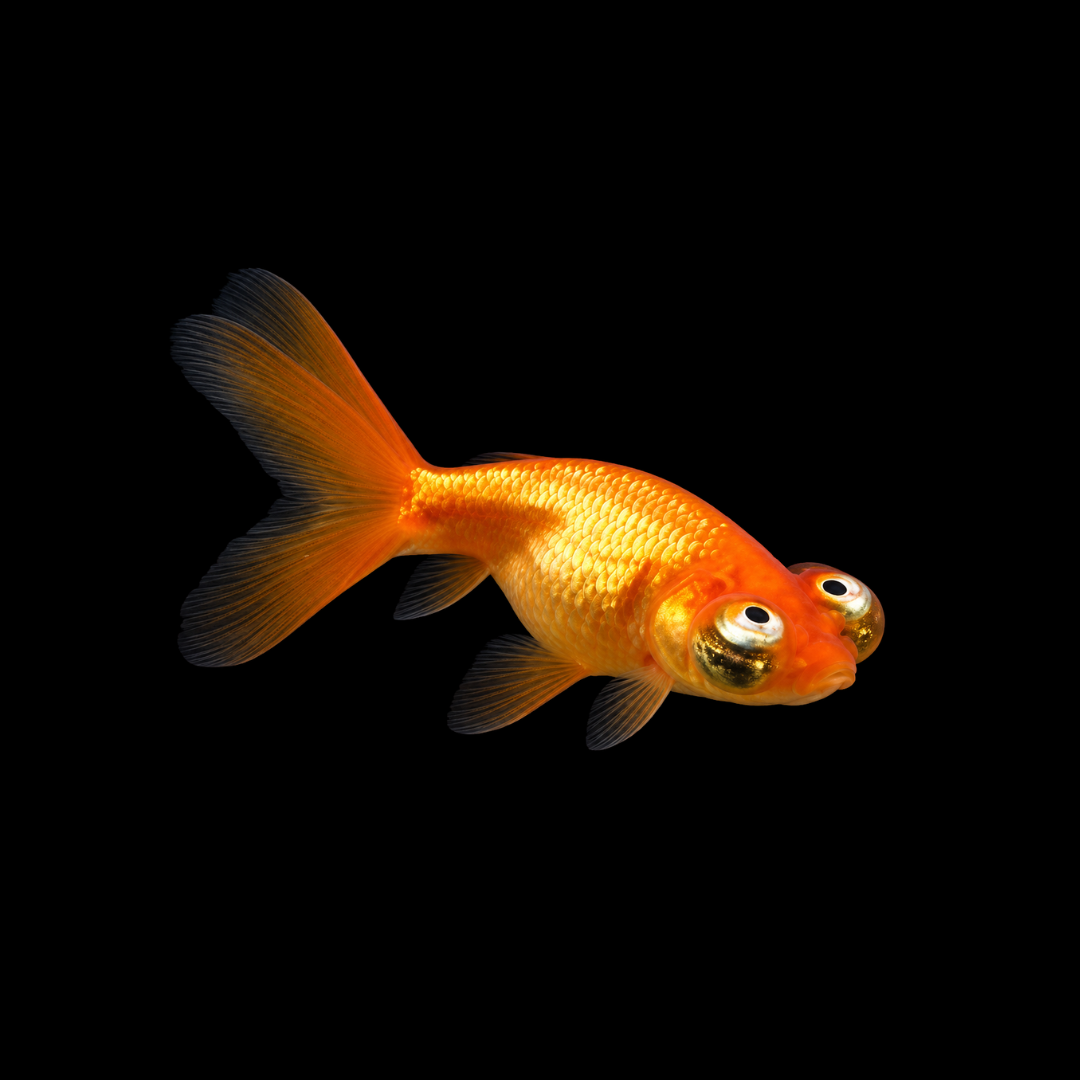
頂天眼(チョウテンガン)は、大きく突出した左右の眼が上方を向き、背びれを欠く滑らかな背中を持つ金魚の一品種です。中国の金魚文化の中で成立した伝統品種で、英語ではCelestial Eye GoldfishやSky Gazerと呼ばれます。稚魚の眼は孵化時から上を向いているわけではなく、成長に伴って突出し、徐々に上方へ回転します。赤や更紗がよく知られるほか、系統によって黒、茶、キャリコ調などの色彩も見られ、日本では2020年に愛知県の弥富で開発されたサクラチョウテンガンも流通しています。突出した眼は傷つきやすく、研究では視覚機能の低下や網膜変性も報告されています。背びれを欠く体型も含め、一般的な金魚より採餌や遊泳に配慮が必要なため、強い水流や尖ったレイアウトを避け、餌を確実に食べられる環境を整えることが大切です。The Celestial Eye Goldfish, known in Japan as Chotengan, is a fancy goldfish variety characterized by enlarged protruding eyes that turn upward and a smooth back without a dorsal fin. It arose within the traditional goldfish culture of China and is also known in English as the Celestial Eye or Sky Gazer. The eyes are not upward-facing at hatching; they protrude and gradually rotate dorsally as the fish develops. Red and red-and-white forms are common, while black, brown and calico-like colors also occur in some strains. In Japan, the Sakura Chotengan developed in Yatomi, Aichi Prefecture, was first released in 2020. The protruding eyes are vulnerable to injury, and research has documented reduced visual function and retinal degeneration in this variety. Together with its dorsal-finless body form, these traits make gentle water movement, safe furnishings and reliable access to food especially important.
基本情報 / Basic Information
学名 / Scientific Name
Carassius auratus (Linnaeus, 1758)
通称 / Common Name
頂天眼、朝天眼、望天眼Celestial Eye Goldfish, Sky Gazer, Heavenward Star Gazer, Chotengan
分類 / Family
コイ目・コイ科・フナ属。頂天眼は独立した種ではなく、キンギョ Carassius auratus の家畜化品種です。Order Cypriniformes, family Cyprinidae, genus Carassius. The Celestial Eye is a domesticated variety of Carassius auratus, not a separate species.
英名 / English Name
Celestial Eye Goldfish
分布 / Distribution
野生分布を持つ品種ではありません。家畜化されたキンギョは、中国南部、とくに長江下流域の野生フナ類に近い系統との強い遺伝的つながりが示されています。頂天眼は中国の観賞魚文化の中で成立し、現在は日本を含む各国で飼育・繁殖されています。This variety has no natural wild range. Genetic studies link domesticated goldfish closely with wild crucian-carp lineages from southern China, particularly the lower Yangtze region. The Celestial Eye arose within Chinese ornamental breeding culture and is now maintained and bred in Japan and many other countries.
最大体長 / Max Size
全長15cm前後が一つの目安で、良好な環境では20cm近くまで育つ個体もいます。成長には系統、年齢、飼育密度、給餌量などが影響します。Around 15 cm in total length is a useful general guide, although well-grown individuals may approach 20 cm. Final size varies with strain, age, stocking density and nutrition.
寿命 / Lifespan
頂天眼だけを対象にした寿命の統計は乏しいものの、金魚は適切な環境では10年以上飼育できる魚で、15年以上生きる例もあります。寿命は水量、水質、食事、疾病管理などの影響を大きく受けます。Robust lifespan statistics specific to the Celestial Eye are limited, but goldfish can live for more than 10 years under suitable care, with some individuals exceeding 15 years. Lifespan is strongly influenced by water volume, water quality, nutrition and disease management.
飼育環境 / Aquarium Environment
水槽サイズ / Tank Size
成魚1匹でも75L前後以上を目安にし、日本の規格水槽なら60cmワイド水槽など、底面積と水量に余裕のある容器が扱いやすいです。2匹以上を長期飼育する場合は、90cm規格水槽(約150L)前後または同等以上を一つの目安にします。頂天眼は速く泳ぎませんが、金魚は排泄量が多いため、小水量ほど水質管理が難しくなります。背の高い水槽より、横幅と底面積を確保できる水槽が向いています。For one adult, aim for roughly 75 L or more; in Japan, a wide 60 cm aquarium or another tank with generous footprint and volume is a practical starting point. For two or more adults kept long term, a 90 cm standard aquarium of about 150 L or an equivalent volume is a useful guide. Celestial Eyes are slow swimmers, but goldfish produce a heavy bioload, so smaller volumes are harder to keep stable. A broad tank is preferable to a tall, narrow one.
水温 / Temperature
16〜24℃を目安に、急変を避けて管理します。室内飼育では18〜23℃前後が扱いやすく、夏に高水温が続く場合は酸素不足を防ぐため十分なエアレーションを行い、必要に応じて冷却ファンなどを利用します。低温そのものよりも、短時間での大きな温度変化を避けることが重要です。A working range of about 16–24°C is suitable, with 18–23°C being convenient for many indoor aquaria. Avoid rapid temperature swings. During hot weather, increase aeration because warm water holds less oxygen, and use cooling measures such as fans when necessary.
水質 / Water Quality
pH6.5〜8.0程度の極端でない水質が適します。アンモニアと亜硝酸は検出されない状態を維持し、硝酸塩は低く保ちます。金魚は排泄量が多いため、十分な生物ろ過に加えて定期的な水質検査と部分換水が欠かせません。換水量や頻度は、飼育数、給餌量、ろ過能力、測定値に合わせて調整します。Moderate water conditions around pH 6.5–8.0 are suitable. Ammonia and nitrite should remain undetectable, and nitrate should be kept low. Because goldfish produce substantial waste, effective biological filtration must be combined with regular water testing and partial water changes. The amount and frequency of water changes should be adjusted to stocking, feeding, filtration and test results.
レイアウト / Layout
突出した眼を守るため、流木の尖端、角張った石、硬く鋭い人工水草などは避けます。ベアタンク、または丸みのある細かな底砂を薄く敷く構成が安全です。水草を使う場合は柔らかな葉を持ち、根元や固定器具に鋭い部分がないものを選びます。吸水口にはスポンジなどのガードを付け、ろ過器の吐出口は壁面に向けるなどして水流を弱めます。Protect the protruding eyes by avoiding pointed driftwood, sharp rocks and rigid artificial plants. A bare-bottom aquarium or a thin layer of smooth, fine substrate is safest. If plants are used, choose soft-leaved species and make sure anchors or hardscape have no sharp edges. Cover filter intakes with sponge guards and diffuse or redirect the return flow to keep current gentle.
注意点 / Precautions
頂天眼では、眼球の突出と上向き化に加え、研究によって網膜変性が報告されており、視覚機能は通常の金魚より制限されます。餌や障害物への反応が遅いこと自体は品種特性の範囲でも見られるため、普段の行動との違いで判断します。一方、急に底で動かなくなる、呼吸が速い、鰭を畳む、片眼だけ白濁・充血するなどの変化は体調不良や外傷の可能性があります。新しく迎えた個体は隔離観察して感染症の持ち込みを防ぎ、眼の外傷はレイアウトや網の扱いを安全にすることで予防します。In addition to protrusion and upward rotation of the eyes, retinal degeneration has been documented in research on this variety, so visual function is more limited than in ordinary goldfish. Slow reactions to food or obstacles can fall within normal breed behavior and should be judged against the fish’s usual pattern. Sudden bottom-sitting, rapid breathing, clamped fins, or cloudiness and redness affecting one eye may indicate illness or injury. Quarantine new arrivals to reduce infectious-disease risk, and prevent physical eye trauma through safe furnishings and careful handling.
餌と給餌 / Feeding
餌の種類 / Diet
主食には金魚用の沈下性またはゆっくり沈む小粒ペレット、あるいはゲル状飼料が使いやすく、冷凍赤虫やブラインシュリンプ、柔らかくした野菜類などを補助的に組み合わせます。丸い体型の金魚では、浮上性フードを食べた後に浮力異常が目立つ個体がいるため、そのような場合は沈下性や水分の多い餌を中心にします。Sinking or slow-sinking goldfish pellets, or an appropriate gel diet, work well as staples. Frozen bloodworms, brine shrimp and small amounts of softened vegetables can add variety. Some round-bodied fancy goldfish show more obvious buoyancy problems after surface feeding, so sinking or moisture-rich foods are preferable for affected individuals.
給餌のポイント / Feeding Tips
視覚に頼りにくいため、毎回ほぼ同じ場所へ少量ずつ与えると餌場を覚えやすくなります。1回に大量に与えるより、短時間で食べ切れる量を1日1〜2回程度に分け、残餌は取り除きます。浮力異常が出やすい個体では、沈下性フードや水分の多いゲル状・冷凍餌へ切り替えます。乾燥ペレットをふやかす場合も長時間放置せず、食べ残しによる水質悪化を防ぎます。Because vision is limited, offering small portions in nearly the same location each time helps the fish learn a reliable feeding area. Rather than giving one large meal, provide an amount that can be consumed promptly once or twice per day and remove leftovers. Fish prone to buoyancy problems may benefit from sinking pellets or moisture-rich gel and frozen foods. If dry pellets are pre-moistened, do so only briefly and avoid leaving softened food to spoil.
性格と混泳 / Temperament and Tank Mates
性格 / Temperament
基本的には温和で、他魚を積極的に追い回すタイプではありません。ただし泳ぎは遅く、眼の向きと視覚の制限から餌への到達も遅れやすいため、性格だけでなく「泳ぐ速度と採餌能力」が混泳可否を左右します。Generally peaceful and not inclined to chase other fish aggressively. However, its slow swimming and limited visual field make feeding competition a major concern, so compatibility depends as much on swimming speed and feeding ability as on temperament.
混泳の相性 / Compatibility
最も管理しやすいのは頂天眼同士です。水泡眼、らんちゅうなど同程度に泳ぎが遅い丸物金魚も候補になりますが、個体差があるため餌取りと眼への接触を観察します。出目金など眼が突出する品種との同居は必ずしも不可能ではありませんが、狭い水槽や障害物の多い環境では眼同士やレイアウトへの接触リスクが高くなります。和金、コメット、朱文金のような俊敏な長物金魚は餌を先に食べやすく、頂天眼が慢性的に痩せることがあるため避けたほうが安全です。熱帯魚や肉食性・つつき癖のある魚との混泳も適しません。The easiest arrangement is a group of Celestial Eyes. Bubble Eyes, Ranchu and other similarly slow fancy goldfish may also work, but feeding competition and physical contact around the eyes must be monitored. Telescope-eyed varieties are not automatically incompatible, yet crowded tanks and complex hardscape increase the chance of eye injury. Fast single-tailed goldfish such as Common Goldfish, Comets and Shubunkins usually outcompete Celestials for food and are best avoided. Tropical species and fish that nip or peck at tank mates are also unsuitable.
病気と対策 / Diseases and Prevention
かかりやすい病気 / Common Diseases
品種特有の問題として、突出した眼の擦り傷、角膜の白濁や炎症、眼球損傷が起こりやすく、丸い体型の金魚では浮力異常も見られます。一般的な金魚と同様に、白点病、エラや体表の寄生虫、尾ぐされなどの細菌性疾患、消化不良にも注意が必要です。Breed-specific concerns include abrasions to the protruding eyes, corneal cloudiness or inflammation, ocular trauma and buoyancy disorders associated with compact fancy-goldfish body forms. Like other goldfish, Celestial Eyes may also develop white spot disease, gill and skin parasites, bacterial fin or skin infections and digestive problems.
対策と予防 / Prevention
最優先は水質と物理的安全性です。アンモニア・亜硝酸を出さず、急激な水温変化を避け、酸素量を確保します。眼の外傷予防のため鋭利な装飾を置かず、ネットですくう回数も最小限にします。新魚は隔離観察を行い、異常が出た場合は水質検査を先に実施します。浮力異常は単一の病名ではなく、食餌、体型、水質、感染症など複数の原因で起こり得るため、長引く場合や体表の潰瘍、食欲低下、異常呼吸を伴う場合は魚類を診療できる獣医師への相談が望まれます。Water quality and physical safety are the first lines of prevention. Keep ammonia and nitrite at zero, avoid rapid temperature changes and provide adequate oxygenation. Remove sharp decor and minimize netting to protect the eyes. Quarantine new fish and test water promptly when abnormal behavior appears. Buoyancy problems are a clinical sign rather than a single disease and may reflect diet, body conformation, water quality or infection; persistent cases, especially those with ulcers, appetite loss or abnormal breathing, should be evaluated by a veterinarian experienced with fish when possible.
増やし方(繁殖) / Breeding
雌雄の判別 / Sexing
繁殖期のオスでは、エラ蓋や胸びれ前縁に白い追星が現れ、メスを追う行動が目立ちます。メスは成熟すると腹部がふくらみ、産卵前には左右非対称に見えることもあります。非繁殖期の若魚では外見だけの判別は難しく、総排泄孔の形状も補助的な判断材料に留めます。During the breeding season, males often develop white breeding tubercles on the gill covers and leading edges of the pectoral fins and actively chase females. Mature females become fuller in the abdomen and may look slightly asymmetrical before spawning. Outside the breeding season, especially in juveniles, visual sexing is unreliable, and vent shape should be treated only as a supporting clue.
繁殖形態 / Reproduction
卵生で、水草や産卵床に粘着性の卵をばらまく典型的な金魚の繁殖形態です。春に水温が上昇する時期に繁殖行動が起こりやすく、親魚は産卵後に卵を食べるため、卵を残したい場合は親を分けます。An egg-scattering species. Adhesive eggs are released onto plants or spawning media, as in other goldfish. Spawning is often stimulated as water warms in spring. Adults readily eat the eggs, so breeders separate the parents after spawning when eggs are to be raised.
繁殖のポイント / Breeding Tips
健康な親魚を冬から春にかけて十分に養い、繁殖水槽には柔らかな産卵モップや人工産卵藻を用意します。孵化仔魚の眼は当初は通常の位置にあり、成長してから突出・回転が現れるため、頂天眼らしい左右対称の眼位や滑らかな背なりを評価できるのは一定期間育ててからです。近年の研究では、同腹個体でも眼の回転開始や完了時期に大きなばらつきが確認されています。品種の固定を目的とする場合は、眼の角度だけでなく、左右差、背びれの痕跡、尾の開き、体型、健康状態まで見て親魚候補を選びます。Condition healthy broodstock well from winter into spring and provide soft spawning mops or artificial spawning media. Fry hatch with normally oriented eyes; protrusion and rotation become evident only later, so symmetry of the celestial eye position and the smooth dorsal profile cannot be judged immediately. Recent studies confirm substantial variation among siblings in the timing and completion of eye rotation. When maintaining a strain, select not only for eye angle but also for bilateral symmetry, absence of dorsal-fin remnants, tail balance, body form and overall health.
雑学と豆知識 / Trivia and Fun Facts
1. 金魚の家畜化は千年以上にわたる選抜の積み重ね / 1. More than a millennium of selective breeding
金魚の祖先を単純に「ギベリオブナだけ」と決めつけるのは、現在の遺伝学から見ると慎重であるべきです。大規模なゲノム研究では、家畜化金魚は中国南部、とくに長江下流域の野生フナ類に近い系統と結び付けられています。中国では晋代に赤いフナの記録があり、唐代には珍しい色の個体が池で保護され、宋代以降に人為選択がさらに強まりました。体型、尾、背びれ、眼という本来なら生存に直結する形質まで大胆に変化したのは、自然界ではなく人の保護下で世代ごとに「残したい形」を選び続けられたからです。頂天眼は、その長い選抜の歴史が眼球の向きという極端な形にまで到達した象徴的な品種といえます。It is overly simplistic to identify a single modern subspecies such as the gibel carp as the sole ancestor of all goldfish. Genomic studies link domesticated goldfish most closely with wild crucian-carp lineages from southern China, particularly the lower Yangtze region. Red crucian carp were recorded in early Chinese history, unusual colors were protected in ponds during the Tang period, and selective breeding intensified from the Song dynasty onward. Such drastic alterations of body shape, tail structure, dorsal fins and eyes became possible because humans repeatedly protected and bred fish with desired traits. The Celestial Eye is one of the most striking outcomes of that long process.
2. 上見文化と「皇帝を仰ぐ」という解釈 / 2. A fish that looks toward the emperor
中国の伝統的な金魚鑑賞では、鉢や池を上から眺める「上見」が重要でした。頂天眼の上向きの眼はこの鑑賞法と相性がよく、清代の宮廷で珍重され、「皇帝を仰いでいるように見える」という象徴的な解釈も近年の研究論文で紹介されています。ただし、これは形態の生物学的な起源を説明するものではなく、品種に与えられた文化的な意味づけです。現代でも上から見ると、背びれのない背中の輪郭や左右の眼の対称性を確認しやすくなります。Traditional Chinese goldfish culture placed great value on viewing fish from above in bowls and ponds. The upward-facing eyes of the Celestial Eye suit this viewing style, and recent research papers also describe the Qing-court interpretation that the fish appeared to be gazing up toward the emperor. This is a cultural meaning attached to the form, not a biological explanation for how the trait arose. Top viewing still makes the smooth dorsal outline and bilateral eye symmetry especially easy to appreciate.
3. 暗い壺で育てたから眼が上を向いた、という有名な伝承 / 3. The famous narrow-jar legend
頂天眼には「口の細い暗い壺に入れ、わずかな光を見上げさせ続けたため、何代もかけて眼が上を向いた」という有名な伝承があります。現在の遺伝学では、この説明を獲得形質の遺伝として受け入れることはできません。稚魚を普通の明るさで育てても、遺伝的背景を持つ個体では成長に伴って眼球の突出と回転が起こります。とはいえ、この伝承が長く残ったこと自体が、初めて頂天眼を見た人々にとってその姿が「普通の魚の発達だけでは説明できない」と感じられるほど驚異的だったことを物語っています。A famous legend claims that Celestial Eyes were kept for generations in narrow-necked dark jars, forcing them to look toward a small source of light until the eyes became permanently upturned. Modern genetics does not support this as inheritance of an acquired trait. Fish with the appropriate genetic background develop eye protrusion and rotation under ordinary rearing conditions. The persistence of the story is still culturally revealing: the morphology was so unusual that earlier observers felt an extraordinary environmental explanation was necessary.
4. 眼は孵化時から上を向くのではない / 4. The eyes rotate during juvenile development
頂天眼の稚魚は、孵化直後から完成形の眼を持つわけではありません。2025年1月の研究で同腹84個体を追跡したところ、20日齢で軽い側方突出、60日齢で出目金のような突出が見られ、70日齢から一部で回転が始まり、280日齢までにその観察群では全個体が上向き眼になりました。一方、2025年後半の別研究では、別の飼育集団で10か月まで回転が完了しない個体や、24か月でも90度まで上を向かない個体が確認されています。つまり、発達の順序は共通していても、完成時期や角度には系統差・個体差があり、「何か月で必ず完成する」とは言えません。Celestial Eye fry do not hatch with the adult eye position. In a January 2025 study following 84 full siblings, slight lateral protrusion appeared by 20 days post-hatch, a telescope-like form by 60 days, and rotation began in some fish at about 70 days; all fish in that observed group had upward-facing eyes by 280 days. A separate study published later in 2025 documented a different population in which some fish did not complete rotation until around 10 months, while others still failed to reach a full 90-degree angle at 24 months. The developmental sequence is therefore broadly consistent, but the timing and final angle vary among strains and individuals.
5. 2025年の遺伝解析でLRP2が最有力候補に / 5. LRP2 emerged as the leading genetic candidate in 2025
2025年後半に公表された遺伝解析では、頂天眼のLRP2遺伝子のエクソン38に、タンパク質合成を途中で終わらせる未成熟終止コドンが見つかり、最有力の原因候補として示されました。正常型では4529アミノ酸からなるLRP2タンパク質が、この変異では約2204アミノ酸で途切れると予測されています。つまり、LRP2が本来の形で作られなくなることが、頂天眼の眼の形態に強く関わっている可能性が高いという意味です。同じ研究では角膜に関係する細胞機能や脂肪酸代謝、炎症反応、細胞外マトリックスに関わる変化も確認されました。ただし、現段階では「頂天眼のすべてを一つの変異だけで説明できる」と断定するのではなく、強い証拠を持つ最有力候補として捉えるのが適切です。A genetic study published later in 2025 identified a premature stop codon in exon 38 of LRP2 as the strongest candidate mutation for the Celestial Eye phenotype. The normal LRP2 protein is predicted to contain 4,529 amino acids, whereas the mutant protein would stop at about 2,204. In practical terms, this means that failure to produce a complete LRP2 protein is strongly implicated in the unusual eye morphology. The same study also found changes involving corneal cell functions, fatty-acid metabolism, inflammatory responses and extracellular-matrix pathways. The evidence is strong, but LRP2 should still be described as the leading candidate rather than as a complete explanation for every aspect of the phenotype.
6. 出目金と頂天眼は「同じ遺伝子、別の変異」 / 6. Telescope and Celestial eyes: the same gene, different mutations
出目金と頂天眼はいずれも大きく突出した眼を持ちますが、2025年の遺伝解析では、両者でLRP2が関与する一方、同じ変異を共有していないことが示されました。つまり、人が似た「突出眼」を選抜してきた別々の系統で、同じ遺伝子に異なる変異が生じ、似た形態につながった可能性があります。研究では、この現象が人為選択下の分子レベルの平行進化として位置づけられています。Telescope Eyes and Celestial Eyes both have enlarged protruding eyes, but a 2025 genetic study found involvement of LRP2 without the two phenotypes sharing the same mutation. This suggests that separate lineages selected for a similar protruding-eye appearance acquired different mutations in the same gene, leading toward similar morphology. The study interprets this as molecular parallel evolution under artificial selection.
7. 網膜変性は古くから研究されてきた / 7. Retinal degeneration has been studied for decades
頂天眼の眼は、現代のゲノム研究より前から眼科学の研究対象になっていました。1982年の発生学的研究では、若い時期には網膜がいったん成熟した構造を形成するものの、眼球の突出が始まる時期から色素上皮の異常や視細胞の損傷が現れ、食細胞の侵入を伴って変性が進むことが報告されています。近年の遺伝子発現解析やタンパク質解析は、こうした組織学的変化を分子レベルから調べ直す役割を担っています。観賞形質としての「上向きの眼」は、発生と網膜変性、人工選択の関係を研究する材料にもなっています。The Celestial Eye attracted ophthalmic research well before the genomic era. A 1982 developmental study found that the retina initially formed a mature structure, but abnormalities in the pigment epithelium and damage to photoreceptors appeared around the onset of eye protrusion, with degeneration progressing alongside invasion by phagocytic cells. Recent gene-expression and proteomic studies revisit these tissue-level changes from a molecular perspective. The ornamental upward gaze therefore also provides a model for studying the relationship among development, retinal degeneration and artificial selection.
8. 日本への導入は1902〜1903年ごろとする専門書の記録 / 8. Specialist histories place the Japanese introduction around 1902–1903
金魚の品種史をまとめた専門書では、箕作佳吉が1902年または1903年に広東から約30尾を輸入し、1904年に「出目らんちゅう」と名付けたと記されています。したがって、「箕作佳吉が『頂天眼』という和名を命名した」とする説明はそのままでは正確ではありません。同書では「Chotengan」という呼称は中国語名に近い名称として扱われています。日本ではその後に繁殖と選抜が進み、20世紀前半には海外へ渡る系統にもつながっていきました。A specialist handbook on goldfish varieties records that zoologist Kakichi Mitsukuri imported about 30 fish from Guangdong in 1902 or 1903 and named them “deme-ranchu” in 1904. It is therefore inaccurate to state simply that Mitsukuri coined the Japanese name Chotengan. The same handbook describes Chotengan as a name close to the original Chinese term. Breeding and selection continued in Japan, and Japanese stock later contributed to the variety’s early twentieth-century spread overseas.
9. 1960年の中国切手にも「望天魚」として登場 / 9. Featured as Wangtianyu on a 1960 Chinese stamp
中華人民共和国は1960年6月1日、12種類の金魚を描いた「金魚」特種切手を発行しました。その7番目に描かれた「望天魚」は頂天眼にあたり、額面は8分、発行枚数は800万枚と記録されています。金魚が単なるペットではなく、中国の長い育種文化を象徴する存在として公的なデザインに採用された例であり、頂天眼が文化史の中でも特別な位置を占めてきたことが分かります。On 1 June 1960, the People’s Republic of China issued a special set of twelve stamps depicting notable goldfish varieties. The seventh design, labeled Wangtianyu, represents the Celestial Eye; records list an 8-fen denomination and a print run of eight million. The set demonstrates how goldfish had become not merely pets but public symbols of a long Chinese breeding tradition, with the Celestial Eye occupying a distinctive place within that cultural history.
10. 弥富が生んだサクラチョウテンガン / 10. Sakura Chotengan from Yatomi
愛知県水産試験場は2015年から、頂天眼とサクラニシキの交配による新品種開発に取り組み、両品種の特徴を併せ持つサクラチョウテンガンを育成しました。上向きの眼と背びれを欠く体型に、サクラニシキ由来のきらめくサクラ模様が組み合わされています。2020年10月19日に弥富金魚卸売市場へ初出荷されました。伝統的な頂天眼の形態を保ちながら、日本で親しまれてきたサクラ系の色彩表現を重ねた品種です。Beginning in 2015, the Aichi Fisheries Research Institute crossed Celestial Eyes with Sakura Nishiki and developed the Sakura Chotengan by selecting fish that combined traits of both varieties. It retains the upward-facing eyes and dorsal-finless body of the Celestial Eye while adding the shimmering sakura pattern associated with Sakura Nishiki. The variety was first shipped through the Yatomi Goldfish Wholesale Market on 19 October 2020. It is a Japanese color development built on the traditional Celestial Eye body form.
まとめ / Conclusion
頂天眼は、上向きの眼と背びれのない体型によって、金魚の長い選抜の歴史を強く感じさせる品種です。近年は眼球の発達過程や網膜変性に加え、LRP2を有力候補とする遺伝学的な背景も明らかになりつつあります。その独特な姿は観賞上の特徴であると同時に、通常の金魚とは異なる身体的な制約を伴うことも理解しておく必要があります。The Celestial Eye, with its upward-facing eyes and dorsal-finless body, is a striking product of the long history of goldfish selection. Recent research has clarified aspects of its eye development and retinal degeneration and has identified LRP2 as a strong genetic candidate associated with the phenotype. Its unusual appearance is therefore both an ornamental feature and a set of physical limitations that need to be considered in everyday care.
飼育では、十分な水量と安定した水質を確保し、眼を傷つけないレイアウトと穏やかな水流を整えることが基本です。さらに、餌を確実に取れているかを日々確認し、混泳相手も泳ぐ速さや採餌能力が近い金魚から選びます。こうした身体的な特徴に合わせた環境を用意することで、頂天眼らしい上向きの眼と落ち着いた泳ぎを無理なく楽しむことができます。Good care begins with generous water volume, stable water quality, gentle current and furnishings that cannot injure the eyes. Feeding should be observed closely to make sure each fish is actually eating, and tank mates should be chosen for similar swimming speed and feeding ability. An aquarium designed around these physical traits allows the Celestial Eye’s distinctive gaze and calm movement to remain the focus without placing unnecessary demands on the fish.
Wang, S.-Y., Luo, J., Murphy, R. W., Wu, S.-F., Zhu, C.-L., Gao, Y., et al. (2013). Origin of Chinese Goldfish and Sequential Loss of Genetic Diversity Accompanies New Breeds. PLoS ONE, 8(3), e59571.家畜化金魚の起源・中国南部および長江下流域との遺伝的関係https://doi.org/10.1371/journal.pone.0059571
Matsumura, M., Ohkuma, M. & Honda, Y. (1982). Retinal degeneration in celestial goldfish. Developmental study. Ophthalmic Research, 14(5), 344–353.頂天眼の眼球突出に伴う網膜変性と眼の発達上の注意点https://doi.org/10.1159/000265212
Li, R. & Sun, Y. (2025). A Comparative Transcriptome and Proteome Analysis of the Molecular Mechanism Underlying Anterior to Dorsal Eye Rotation in the Celestial-Eye Goldfish (Carassius auratus). International Journal of Molecular Sciences, 26(2), 466.稚魚期の眼球突出・回転の発達過程と、繁殖後の形質評価時期https://doi.org/10.3390/ijms26020466






コメント