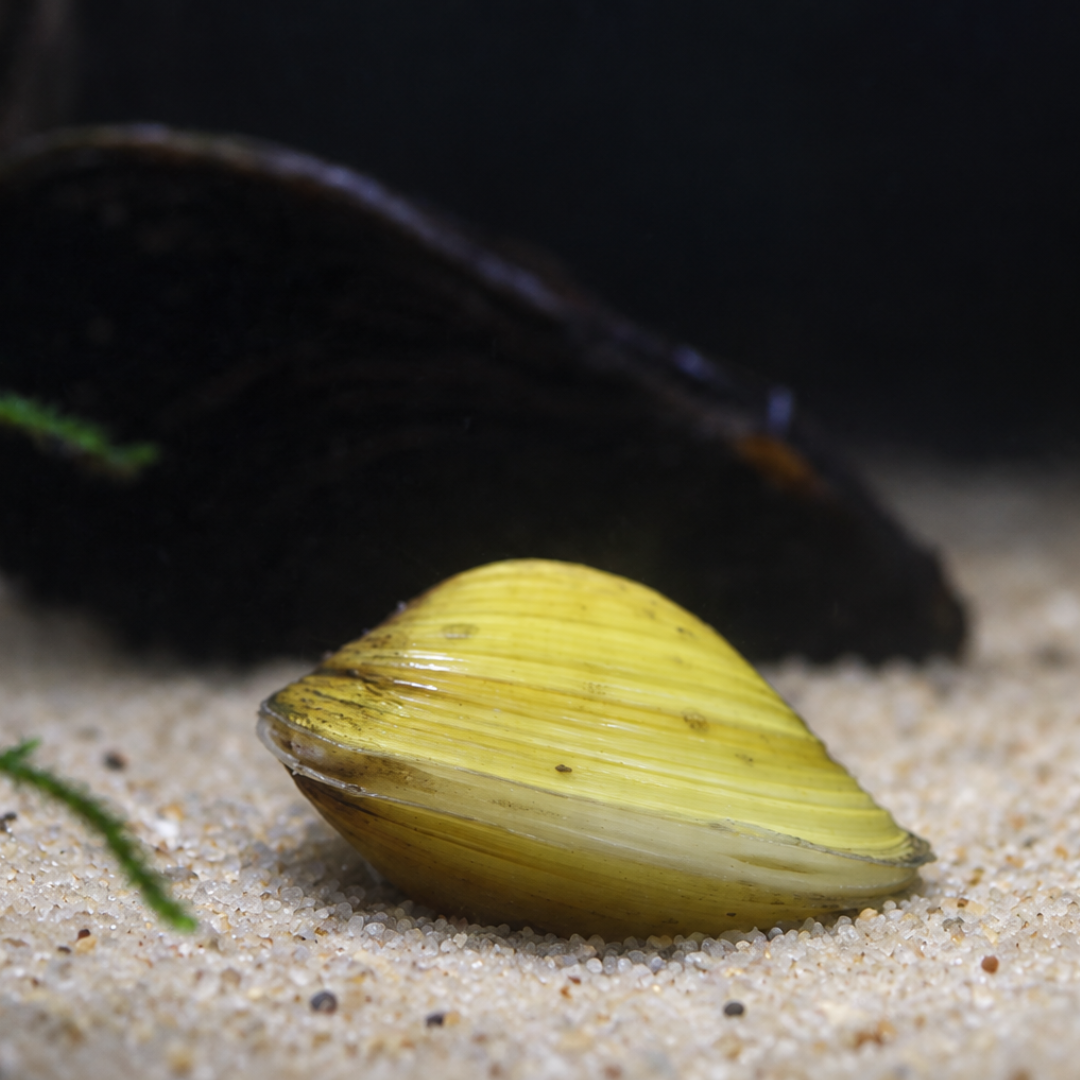
マシジミは、日本の平野部を流れる小河川や用水路などの砂泥底・砂礫底に暮らす小型の淡水二枚貝です。丸みのある三角形の殻には細かな成長肋が並び、黄褐色から黒紫色まで色彩に幅があります。ふだんは底床に潜り、水管から取り込んだ水に含まれる植物プランクトンや微細な有機物をえらで濾し取ります。足を使って底床内をゆっくり移動する、静かで観察しがいのある生き物です。ただし、流通名の「淡水シジミ」には外来のタイワンシジミ種群が含まれることがあり、殻の色や形だけでマシジミと確定できない場合があります。入手経路が明確な個体を選び、水質浄化の道具ではなく、継続的な給餌を必要とする生き物として飼うことが大切です。Mashijimi, Corbicula leana, is a small freshwater bivalve native to Japan. It inhabits muddy, sandy, and gravelly bottoms in lowland streams and irrigation channels. Its rounded triangular shell has fine concentric growth ribs and varies from yellowish brown to dark purple-black. The clam normally remains buried, filtering phytoplankton and fine organic particles from water drawn through its siphons. It also moves slowly through the substrate with its muscular foot. In the Japanese aquarium trade, however, the label “freshwater clam” may include invasive lineages of the C. fluminea complex, and shell color or shape alone may not confirm an animal as C. leana. Choose specimens of documented origin and treat each clam as a living animal requiring a continuing food supply, not simply as a device for clarifying water.
基本情報 / Basic Information
学名 / Scientific Name
Corbicula leana
通称 / Common Name
マシジミMashijimi, Japanese freshwater clam
分類 / Family
軟体動物門・二枚貝綱・マルスダレガイ目・シジミ科・Corbicula属Phylum Mollusca, Class Bivalvia, Order Venerida, Family Cyrenidae, Genus Corbicula
英名 / English Name
Mashijimi / Japanese Freshwater Clam
分布 / Distribution
日本に分布し、本州から九州を中心とする平野部の小河川や用水路で見られてきました。主な生息場所は、流れが比較的穏やかな場所の砂泥底や砂礫底です。各地で生息地の改変や水質変化の影響を受けているほか、外来のタイワンシジミ種群に置き換わったと考えられる水域もあります。The species occurs in Japan and has historically been found mainly in lowland streams and irrigation channels from Honshu to Kyushu. It typically inhabits muddy, sandy, or gravelly bottoms where the current is relatively gentle. Its populations have been affected by habitat alteration and changes in water quality, and in some waters they are considered to have been displaced by introduced lineages of the C. fluminea complex.
最大体長 / Max Size
最大殻長は約4cmです。通常は3cm以下の個体が多く、成長や最終的な大きさは、水温、餌、生息環境によって変わります。Maximum shell length is about 4 cm, although most individuals are no more than about 3 cm. Growth and final size vary with temperature, food availability, and habitat conditions.
寿命 / Lifespan
飼育下で8年2か月生存した記録があります。ただし、野外や一般的な水槽での寿命を一律に示すものではなく、水温、餌、底床の状態によって大きく変わります。One captive individual was recorded as living for 8 years and 2 months. This does not establish a uniform lifespan in the wild or in ordinary aquariums, where longevity varies substantially with temperature, food supply, and substrate condition.
飼育環境 / Aquarium Environment
水槽サイズ / Tank Size
少数の飼育でも、水質と微細な餌の供給を安定させやすい45cm規格水槽相当の約30L以上がおすすめです。必要な水量は個体数だけでなく、水槽の成熟度、濾過能力、餌の量によって変わります。マシジミの適正密度を一律に示せる根拠は乏しいため、初めはごく少数にとどめ、殻の開閉や底床上へ出る頻度、水質の変化を観察しながら管理します。Even for a small number of C. leana, a 45 cm standard aquarium of about 30 L or larger is recommended because it is easier to stabilize water quality and the supply of microscopic food. The required volume depends not only on the number of clams but also on aquarium maturity, filtration, and food availability. Evidence does not support one universal stocking density for this species, so begin with very few individuals and monitor shell-closing responses, repeated surfacing, and water quality.
水温 / Temperature
日本の温帯域に暮らす種として、飼育水温は15〜25℃を管理上の目安とし、急変を避けます。この範囲は厳密な生理的適温を示すものではありません。夏は水温の上昇に伴って水中の酸素が不足しやすくなるため、30℃を超える高温が続かないように管理します。As a species from temperate Japan, C. leana can be managed at 15–25°C while abrupt changes are avoided. This range is a practical husbandry guide rather than a precisely established physiological optimum. In summer, prevent prolonged temperatures above 30°C because warmer water holds less oxygen and increases the risk of oxygen shortage.
水質 / Water Quality
中性〜弱アルカリ性のpH7.0〜8.0を目安とし、殻を維持できる適度な硬度とカルシウムを確保します。アンモニアと亜硝酸は検出されない状態に保ち、硝酸塩の蓄積も定期換水で抑えます。酸性に傾きすぎる軟水では殻が侵食されやすくなります。Aim for neutral to mildly alkaline water around pH 7.0–8.0, with moderate hardness and sufficient calcium for shell maintenance. Ammonia and nitrite should remain undetectable, while regular water changes control nitrate accumulation. Very soft, acidic water can erode the shell.
レイアウト / Layout
自然下の砂泥底や砂礫底を参考に、角の取れた田砂や川砂、細目の大磯砂などを、マシジミが殻全体を潜らせられる厚さに敷きます。潜砂できる開けた場所を確保し、底床を必要以上に厚くしたり、汚れをためたりして嫌気化させないことが大切です。繁殖が起きた場合に備え、吸水口には目の細かなスポンジを取り付けます。To resemble its natural muddy, sandy, or gravelly habitat, use smooth sand or fine rounded gravel deep enough for C. leana to bury its entire shell. Provide open burrowing space and prevent anaerobic conditions by avoiding unnecessarily deep or dirty substrate. Fit a fine sponge prefilter to the intake in case juveniles are produced.
注意点 / Precautions
マシジミは水中の懸濁物を濾し取りますが、アンモニアや亜硝酸を処理する生物ろ過の代わりにはなりません。微細な餌が少ない水槽では気づかないうちに衰弱し、死亡個体を放置すると水質が急速に悪化することがあります。殻が開いたまま刺激に反応しない個体は、すぐに状態を確認してください。銅など貝類への毒性が懸念される成分を含む薬剤は、安全性を確認できない限り使用しません。流通個体や採集個体にはタイワンシジミ種群が混在する可能性もあるため、個体、幼貝、飼育水、底砂を野外へ絶対に放流しないでください。C. leana removes suspended particles, but it does not replace biological filtration that processes ammonia and nitrite. In aquariums with too little microscopic food, it may weaken unnoticed, and an undetected death can rapidly degrade water quality. Promptly inspect any clam that remains gaping and does not respond to gentle stimulation. Do not use medications containing copper or other ingredients potentially toxic to mollusks unless their safety is established. Because traded or collected specimens may be confused with members of the invasive C. fluminea complex, never release the clams, their juveniles, aquarium water, or substrate into natural waterways.
餌と給餌 / Feeding
餌の種類 / Diet
マシジミは、植物プランクトン、珪藻、細菌を含む微細な懸濁有機物、底床表面のデトリタスを食べます。飼育下では観賞用二枚貝向けの液体植物プランクトン、微粉末の藻類飼料、十分に細かく溶いた無脊椎動物用フードを利用できます。C. leana consumes phytoplankton, diatoms, bacteria-rich suspended organic particles, and detritus at the sediment surface. In captivity, suitable foods include liquid phytoplankton for ornamental bivalves, finely powdered algal diets, and invertebrate foods dispersed into particles small enough to remain suspended.
給餌のポイント / Feeding Tips
飼育水で薄く溶いた餌を、スポイトで水管の少し上流へ少量ずつ流します。給餌量と頻度は個体数や水量によって変わるため、ごく少量から始め、数時間後も水が濁る場合は減らします。フィルターを短時間弱めると餌が届きやすくなりますが、酸欠を避けるためエアレーションは保ちます。立ち上げ直後の水槽は微生物量が乏しく、水質も変化しやすいため、導入を避けます。Dilute the food in aquarium water and use a pipette to release a small amount just upstream of the siphons. Feeding amount and frequency depend on the number of clams and water volume, so begin with a very small dose and reduce it if cloudiness persists for several hours. Briefly reducing filter flow can improve access to food, but aeration should continue to prevent oxygen depletion. Avoid adding clams to a newly established aquarium, where microbial food is sparse and water conditions remain unstable.
性格と混泳 / Temperament and Tank Mates
性格 / Temperament
マシジミは非常に温和で、通常は底砂に潜り、足を使ってゆっくり移動します。魚やエビを襲うことはありません。居場所を変えるために底床上へ出ることがありますが、長時間露出したままなら底質、水質、酸素量、餌不足を確認します。C. leana is extremely peaceful, normally remaining buried and moving slowly with its muscular foot. It does not attack fish or shrimp. A clam may surface while relocating, but prolonged exposure above the substrate warrants checks of substrate condition, water quality, oxygen, and food supply.
混泳の相性 / Compatibility
マシジミは、小型の温和な魚、ヌマエビ類、貝を食べない巻貝と同居できます。フグ類、大型シクリッド、ドジョウ類の一部、大型甲殻類など、貝を割る、つつく、掘り返す生体との混泳は避けます。薬浴が必要な魚とは分けて飼うと安全です。C. leana can live with small peaceful fish, freshwater dwarf shrimp, and non-predatory snails. Avoid pufferfish, large cichlids, some loaches, large crustaceans, and other animals likely to crush, nip, or excavate clams. Separate housing is safest when tank mates require medication.
病気と対策 / Diseases and Prevention
かかりやすい病気 / Common Diseases
観賞飼育下のマシジミでは、外見だけから特定の病名を判断できる例は多くありません。問題になりやすいのは、餌不足による消耗、酸欠、高温、急な水質変化、酸性の軟水による殻の侵食、底床の嫌気化による衰弱です。採集個体では、飼育水へ寄生生物や汚染物質を持ち込む可能性にも注意します。In aquarium-kept C. leana, few specific diseases can be identified reliably from appearance alone. More common problems are wasting from insufficient food, oxygen shortage, overheating, abrupt water-quality changes, shell erosion in soft acidic water, and stress caused by anaerobic substrate. Wild-collected specimens may also introduce parasites or contaminants into the aquarium.
対策と予防 / Prevention
十分に立ち上がった水槽へ少数ずつ導入し、温度合わせと水合わせをゆっくり行います。底床を部分的に清掃しながら嫌気化を防ぎ、溶存酸素と適度な水流を確保します。定期的に殻の開閉反応と異臭の有無を確認し、死亡個体は直ちに取り出します。治療薬を自己判断で本水槽へ入れず、特に銅系薬剤や塩分処理は対象種への安全性を確認できない限り使用しません。Introduce only a few clams to a mature aquarium, acclimating temperature and water chemistry gradually. Clean portions of the substrate in rotation to prevent anaerobic conditions, and maintain strong oxygenation with moderate flow. Regularly check shell-closing responses and odor, removing dead individuals immediately. Do not medicate the display aquarium without a diagnosis; in particular, avoid copper-based products or salt treatments unless safety for the identified species is established.
増やし方(繁殖) / Breeding
雌雄の判別 / Sexing
マシジミでは雌雄同体の個体がよく知られていますが、雄だけの個体が多く見つかった個体群も報告されています。いずれも殻の外見だけで性を確実に判別することはできません。よく似た別種が混在している場合は繁殖様式も異なる可能性があるため、流通名だけで判断しないことが大切です。Hermaphroditic individuals of C. leana are well known, but a population containing many male-only individuals has also been reported. In either case, sex cannot be determined reliably from shell appearance alone. If a similar-looking species is mixed in, its reproductive system may differ, so the trade name alone is not sufficient for identification.
繁殖形態 / Reproduction
雌雄同体のマシジミは卵胎生で、雄性発生という特徴的な繁殖を行います。自家受精が可能で、受精後には卵由来の核染色体が排除され、子には精子由来の核DNAが伝わります。一方、細胞質にあるミトコンドリアDNAは卵側から受け継がれます。受精卵は親のえらの中で育ち、微小な稚貝として放出されます。雄個体が野外個体群で果たす役割については、単純には説明できない部分が残っています。Hermaphroditic C. leana are ovoviviparous and reproduce through an unusual form of androgenesis. They can self-fertilize. After fertilization, the egg-derived nuclear chromosomes are expelled, so the offspring inherits its nuclear DNA from the sperm, while mitochondrial DNA in the cytoplasm comes from the egg. Embryos develop within the parent’s gills and are released as minute juveniles. The role of male individuals in wild populations is not yet explained by a simple, complete account.
繁殖のポイント / Breeding Tips
特別な刺激で繁殖を促すよりも、安定した水質、十分な微細餌料、酸素が行き渡る砂底を長期間保つことが先決です。雌雄同体の個体は自家受精できるため、1個体だけでも繁殖する可能性があります。微小な稚貝はフィルターや換水ホースへ入り込むため、吸水口を目の細かなスポンジで覆い、排水は細かなネットなどを通してから処理します。入手した個体が確実にマシジミであるとは限らないため、親貝も稚貝も河川や水路へ放流しません。Rather than attempting to trigger reproduction with a special stimulus, first maintain stable water quality, adequate microscopic food, and an oxygenated sand bed over time. A hermaphroditic individual can self-fertilize, so even one clam may reproduce. Minute juveniles can enter filters and water-change hoses, so cover intakes with fine sponge and strain wastewater through fine mesh before disposal. Because an acquired specimen may not be securely identified as C. leana, never release adults or juveniles into rivers or canals.
雑学と豆知識 / Trivia and Fun Facts
1. 精子側の核DNAを受け継ぐ雄性発生 / 1. Androgenesis and a Sperm-Derived Nuclear Genome
ふつうの有性生殖では、卵と精子がそれぞれの核DNAを次世代へ渡します。ところがマシジミでは、受精後に卵側の核染色体が極体として細胞外へ排出され、精子側の核DNAが子に伝わります。雌雄同体なので「父親だけから受け継ぐ」というより、精子をつくった側の核ゲノムが残る仕組みと考えると分かりやすいでしょう。一方、細胞質にあるミトコンドリアDNAは卵側から受け継がれます。この珍しい雄性発生は、マシジミの繁殖を理解するうえで中心となる特徴です。In ordinary sexual reproduction, egg and sperm both pass nuclear DNA to the next generation. In C. leana, however, the egg-derived nuclear chromosomes are expelled as polar bodies after fertilization, leaving the sperm-derived nuclear genome to be inherited by the offspring. Because the clam is hermaphroditic, this is better understood as inheritance from the sperm-producing side than simply as inheritance from a father. Mitochondrial DNA in the egg cytoplasm is still maternally transmitted. This unusual androgenesis is central to understanding the species’ reproductive biology.
2. 二つの食べ方を使い分ける / 2. Two Ways of Feeding
水管から水を吸い込み、えらで微粒子を集める濾過摂食がよく知られていますが、マシジミの仲間にはもう一つの食べ方があります。筋肉質の足を底床へ伸ばし、砂粒の間にたまった細菌や微細藻類、デトリタスを取り込む足部摂食です。水中と底床の両方から食物を得る暮らしは、単なる「水を濾す貝」という印象よりもはるかに立体的です。清潔すぎて微生物の乏しい水槽よりも、適切に管理された成熟底床のある水槽が向くのは、この食生活と深く関係しています。Filter feeding through the siphons and gills is well known, but C. leana and related Corbicula clams have another way to feed. They extend the muscular foot into the substrate and gather bacteria, microalgae, and detritus between the grains, a behavior called pedal feeding. Drawing food from both the water column and the bottom makes their life more complex than the image of a clam that merely filters water. This feeding ecology helps explain why a managed, mature substrate suits them better than an immaculate but biologically barren aquarium.
3. 透明な水と良い水質は同じではない / 3. Clear Water Is Not Necessarily Healthy Water
マシジミが懸濁物を取り込むと、水は見た目に澄むことがあります。しかし、取り込んだ物質の一部は排泄物などとして水槽内に残り、アンモニアや亜硝酸を無害化するわけではありません。さらに、餌となる微粒子が少ない環境では、マシジミ自身が飢えてしまいます。水が透明に見えることと、マシジミが健康に暮らせることは別の問題です。濾過装置の代用品としてではなく、餌と酸素を必要とする二枚貝として扱う必要があります。When C. leana removes suspended particles, the water may look clearer. Some captured material nevertheless remains in the aquarium as waste, and the clam does not detoxify ammonia or nitrite. In water with too few edible particles, the clam itself can starve. Visually clear water and conditions that keep C. leana healthy are therefore not the same thing. It should be cared for as a bivalve requiring food and oxygen, not as a substitute for filtration.
4. 殻だけでは見分けにくい近縁種 / 4. Close Relatives That Shells May Not Distinguish
マシジミの殻は黄褐色から黒紫色まで変化し、雲状の模様が現れることもあります。しかし、殻の色や輪郭には個体差があり、外来のタイワンシジミ種群と見分けにくい個体もいます。似た殻を持つからといって、同じ種とは限りません。確実な同定には殻の特徴だけでなく、繁殖様式や遺伝情報まで必要になる場合があります。この難しさがあるため、「マシジミ」という販売名だけを根拠に野外へ戻すことはできません。The shell of C. leana varies from yellowish brown to dark purple-black and may show cloud-like markings. Shell color and outline also vary among individuals, and some can be difficult to distinguish from introduced members of the C. fluminea complex. Similar shells do not necessarily indicate the same species. Secure identification may require reproductive or genetic evidence in addition to shell characters. For this reason, a retail label reading “Mashijimi” can never justify releasing a specimen into the wild.
5. 在来のマシジミを取り巻く変化 / 5. Changes Surrounding Native C. leana
かつて各地の身近な水路や小河川で見られたマシジミは、生息環境の変化に加え、外来のタイワンシジミ種群の侵入によって姿を消したと考えられる地域があります。外見のよく似た貝が残っていても、それが在来のマシジミとは限らないところに問題の難しさがあります。飼育個体を善意で川へ戻す行為も、別系統を持ち込む原因になり得ます。マシジミを守るうえでは、飼育下の個体と自然の個体群を混ぜないことが基本です。C. leana was once familiar in small rivers and irrigation channels across Japan, but it is considered to have disappeared from some localities following habitat change and the arrival of introduced C. fluminea lineages. Even where similar-looking clams remain, they are not necessarily native C. leana. Releasing a captive clam with good intentions can therefore introduce a different lineage. Keeping captive animals separate from wild populations is a basic part of conserving the species.
まとめ / Conclusion
マシジミは、砂泥底や砂礫底に潜り、水中の微細な餌を濾し取りながら暮らす日本在来の二枚貝です。中性付近で安定した水、酸素が行き渡る細かな底床、継続して得られる微細餌料を整えることで、水管を伸ばし、潜り、ゆっくり移動する本来の行動を観察できます。C. leana is a freshwater bivalve native to Japan that burrows in muddy, sandy, or gravelly bottoms and filters microscopic food from the water. Stable near-neutral water, an oxygenated fine substrate, and a continuing supply of microscopic food allow its natural behavior—extending the siphons, burrowing, and slowly relocating—to be observed.
小さな殻の内側には、雄性発生という珍しい繁殖機構が隠されています。外来の近縁種と見分けにくいことも心に留め、静かな観察対象として丁寧に飼い、幼貝や飼育水を含めて最後まで責任を持って管理すれば、魚とは異なる時間の流れを感じさせてくれる存在になります。Within its small shell lies the unusual reproductive mechanism of androgenesis. When its resemblance to invasive relatives is kept in mind, and the animal, its juveniles, and aquarium water are responsibly contained, C. leana becomes a quiet presence whose pace of life feels very different from that of fish.






コメント