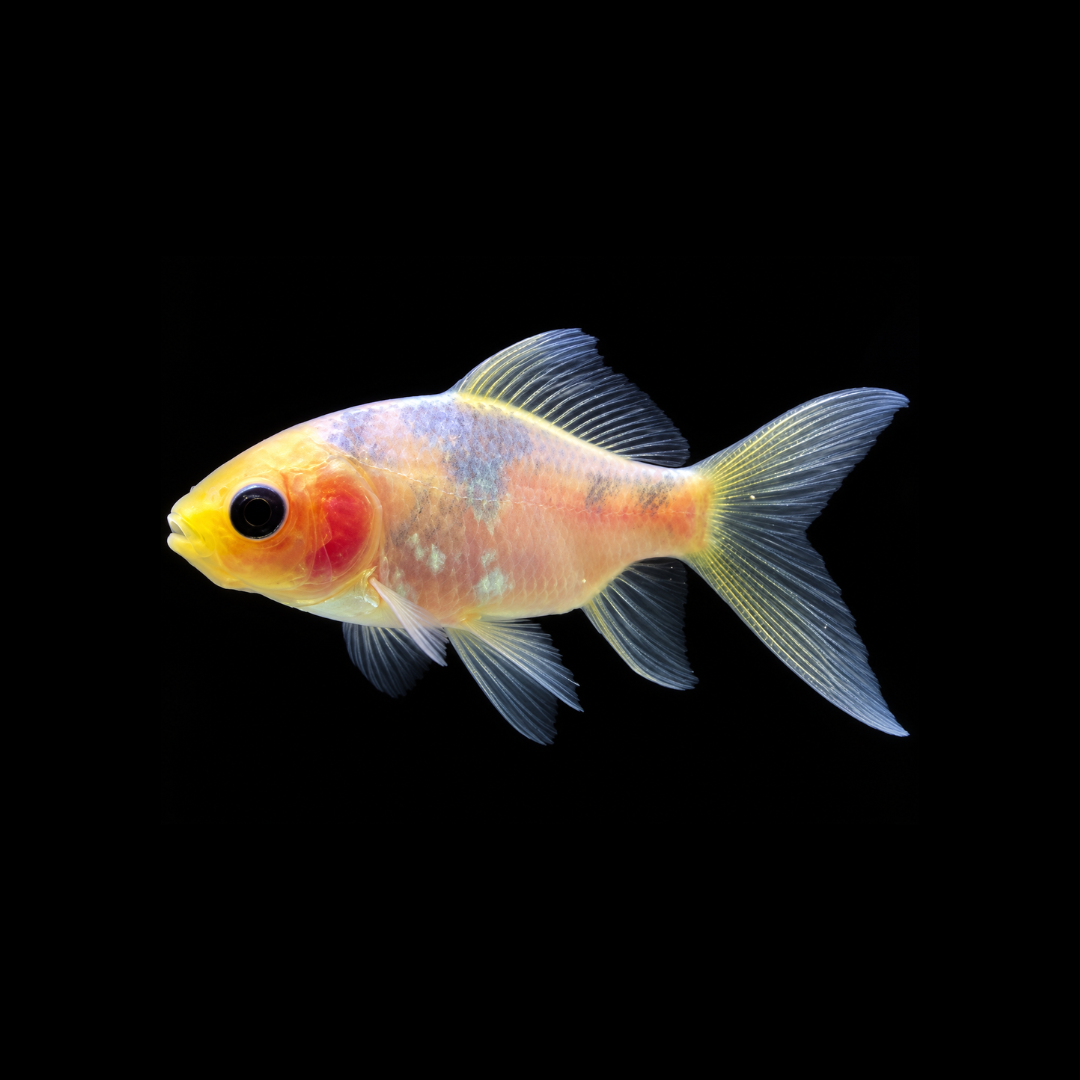
ミルク朱文金は、日本の観賞魚流通で、朱文金型の体型・尾型に「ミルク」と呼ばれる全透明鱗の表現を組み合わせた品種名・流通名として扱われる長物金魚です。朱文金らしい和金型のすらりとした体と吹き流し尾を持ちながら、全身の銀白色の反射が少ないため、乳白色から淡い桃色に透けるような地色、赤く見えやすい鰓蓋周辺、際立つ黒い眼が独特の印象をつくります。透明鱗は鱗そのものがない状態ではなく、銀白色の反射に関わるグアニンが少ないことで、体の内側の色や血流が見えやすくなる表現です。体型は遊泳力のある朱文金系で、長期飼育では十分な水量、生物ろ過、安定した酸素供給を確保することが重要です。In the Japanese aquarium trade, the Milk Shubunkin is used as a variety or trade name for a long-bodied Shubunkin-type goldfish that combines the typical body and tail form with the fully transparent-scale expression known as “milk.” It retains the streamlined wakin-type body and flowing single tail of a Shubunkin, while the reduced silvery reflection across the body gives it a milky white to pale pink, translucent appearance. The reddish gill-cover area and dark eyes can therefore stand out strongly. Transparent scales are not absent scales; the appearance is associated with reduced guanine responsible for silvery reflection, allowing deeper body coloration and blood flow to show through more readily. As an active long-bodied goldfish, it requires ample water volume, biological filtration, and reliable aeration for long-term care.
基本情報 / Basic Information
学名 / Scientific Name
Carassius auratus (Linnaeus, 1758)
通称 / Common Name
ミルク朱文金、ミルクシュブンキン。英語では Milk Shubunkin と表記されますが、学術上の分類名ではなく流通上の呼称です。Milk Shubunkin. This is a practical trade rendering of the Japanese variety name, not a taxonomic name.
分類 / Family
コイ目・コイ科・フナ属。ミルク朱文金だけの独立した種ではなく、金魚の品種・表現型として扱われます。Order Cypriniformes, family Cyprinidae, genus Carassius. The Milk Shubunkin is not a separate species, but a variety or phenotype of the goldfish.
英名 / English Name
Milk Shubunkin
分布 / Distribution
観賞魚として作出・維持される品種のため、ミルク朱文金としての自然分布はありません。日本国内では国産個体が流通し、金魚そのものは東アジアで長い家畜化と品種改良の歴史を持ちます。As a selectively bred ornamental variety, the Milk Shubunkin has no natural distribution of its own. Captive-bred fish are traded in Japan, while the goldfish itself has a long history of domestication and selective breeding in East Asia.
最大体長 / Max Size
ミルク朱文金だけを対象とした信頼できる最大体長の統計は確認されていません。金魚は品種や飼育環境による成長差が大きいため、小型で販売されている時の体長を成魚サイズと考えず、成長する長物金魚として余裕のある飼育設備を計画します。No reliable maximum-size statistics specific to the Milk Shubunkin have been established. Because growth varies with goldfish variety and husbandry conditions, its small retail size should not be treated as its adult size; plan the aquarium with room for a growing, long-bodied goldfish.
寿命 / Lifespan
ミルク朱文金だけを対象とした寿命統計は確認されていません。金魚では30年に達した記録もあるため、短期間の小型魚ではなく、10年以上付き合う可能性もある魚として長期的な飼育計画を立てるのが適切です。No lifespan statistics specific to the Milk Shubunkin have been established. Goldfish have documented records reaching around 30 years, so they should be approached as potentially long-term pets, with care planned for the possibility of well over a decade.
飼育環境 / Aquarium Environment
水槽サイズ / Tank Size
長期飼育では90~120cm級を目安にし、成魚や複数飼育では120cm規格水槽または池の方が余裕を確保しやすくなります。一般的な金魚の飼育情報には最低水槽長100cmという目安もあるため、90cm規格水槽(90×45×45cm、約180L級)は個体サイズ、匹数、ろ過能力に十分な余裕があるかを確認して選びます。幼魚の販売サイズだけで設備を決めないことが大切です。For long-term care, plan around the 90–120 cm class, with a 120 cm standard aquarium or pond offering more practical space for adults or groups. General goldfish references also give a minimum aquarium length of about 100 cm, so a 90 cm standard tank (approximately 90 × 45 × 45 cm, around 180 L) should be chosen only after considering fish size, stocking level, and filtration capacity. Do not base the final setup only on juvenile retail size.
水温 / Temperature
18~24℃を管理の中心とし、急激な温度変化を避けます。屋外飼育では季節変化そのものより、短時間の急変と高水温時の酸欠に注意します。Maintain the aquarium mainly around 18–24°C and avoid rapid temperature changes. In outdoor systems, gradual seasonal changes are less problematic than sudden shifts, while oxygen depletion becomes a major concern during hot weather.
水質 / Water Quality
pHは中性付近を目安とし、特定の数値に合わせることより急変を避けることを優先します。家庭用試薬ではアンモニアと亜硝酸が検出されない状態を管理目標とし、溶存酸素は5mg/L以上を確保できる環境が望まれます。十分な生物ろ過と定期的な換水で、水質の変動を小さく保ちます。Aim for water near neutral pH, prioritizing stability rather than forcing the aquarium to a narrow numerical target. With home test kits, use undetectable ammonia and nitrite as the management goal, and provide conditions that can maintain dissolved oxygen at about 5 mg/L or higher. Strong biological filtration and regular water changes help minimize fluctuations.
レイアウト / Layout
遊泳力のある長物金魚なので、中央部に広い遊泳空間を確保します。底床はベアタンク、または汚れを回収しやすい薄敷きが管理しやすく、排泄物が溜まりにくい構成が向いています。強い生物ろ過に加えてエアレーションを行い、体や尾を傷つける鋭い装飾は避けます。Because this is an active, long-bodied goldfish, leave broad open swimming space through the center of the aquarium. A bare-bottom tank or a thin, easy-to-clean substrate is practical and helps prevent waste accumulation. Combine strong biological filtration with aeration and avoid sharp decorations that can damage the body or tail.
注意点 / Precautions
丈夫な金魚でも、小水量で安定して長期飼育できるとは限りません。新規導入魚は可能なら別容器で数週間観察し、2~4週間程度を一つの目安としながら、体調や水温条件に応じて期間を判断します。ネットやホースも分け、異常がないことを確認してから既存魚と合流させると、流通段階から疾病を持ち込むリスクを抑えやすくなります。Even hardy goldfish are not guaranteed to remain healthy long term in a small volume of water. Whenever possible, observe new fish separately for several weeks, using roughly two to four weeks as a practical guide rather than an absolute rule, and adjust according to health and temperature conditions. Separate nets and hoses also help reduce the chance of introducing disease from the distribution chain into an established group.
餌と給餌 / Feeding
餌の種類 / Diet
主食には、金魚向けに栄養設計された良質な配合飼料を用います。金魚は雑食性で、養殖・育成資料では育成期にタンパク質25~32%程度の飼料が使われる例がありますが、家庭飼育では数値だけを追うのではなく、成長段階に合った金魚用飼料を選ぶことが大切です。必要に応じて補助飼料を組み合わせ、過不足のない給餌を心がけます。Use a high-quality formulated diet designed for goldfish as the staple. Goldfish are omnivorous, and aquaculture and grow-out references describe diets containing roughly 25–32% protein during growth, but home keepers do not need to chase that figure alone. Choose a goldfish food appropriate for the fish’s growth stage and add suitable supplementary foods only as needed.
給餌のポイント / Feeding Tips
一度に大量に与えるより、1日1~3回を目安に少量ずつ与え、残餌を出さないことを優先します。高水温期は代謝が上がる一方で酸素不足や水質悪化も速く進むため、給餌量を増やす場合は換水と酸素供給も同時に強化します。食欲が急に落ちたときは、餌を替える前に水温、アンモニア、亜硝酸、呼吸状態を確認します。Rather than giving one large meal, offer small portions about one to three times per day and prioritize leaving no uneaten food. During warm periods, metabolism rises, but oxygen depletion and water-quality deterioration also accelerate, so any increase in feeding should be matched by stronger aeration and water maintenance. If appetite suddenly drops, check temperature, ammonia, nitrite, and breathing before simply changing foods.
性格と混泳 / Temperament and Tank Mates
性格 / Temperament
活発に泳ぐ長物金魚です。ミルクという透明鱗表現そのものが性格を変えるという根拠は確認されておらず、基本的には朱文金系の遊泳力を前提に扱います。十分な水量がある環境では、広い範囲をよく泳ぎ回る姿が魅力になります。It is an active, long-bodied goldfish. There is no established evidence that the milk or transparent-scale phenotype changes temperament, so its behavior should generally be understood in the same context as other Shubunkin-type goldfish. In a spacious aquarium it makes full use of the available swimming area.
混泳の相性 / Compatibility
ミルク朱文金だけを対象とした混泳研究は確認されていません。実際の管理では、泳力と給餌速度が近い朱文金、コメット、和金などの長物金魚と合わせると観察しやすくなります。泳ぎの遅い丸物金魚と同居させる場合は、餌を先取りしていないか、追尾で相手を消耗させていないかを確認し、水槽の広さと給餌方法を調整します。No compatibility studies focused specifically on the Milk Shubunkin have been established. In practice, it is generally easier to manage with long-bodied goldfish of similar swimming and feeding speed, such as Shubunkins, Comets, and wakin-type fish. When kept with slower, deep-bodied fancy goldfish, watch for food competition or excessive chasing and adjust tank space and feeding methods accordingly.
病気と対策 / Diseases and Prevention
かかりやすい病気 / Common Diseases
金魚では白点病などの原生動物性疾患、吸虫類、イカリムシ、ウオジラミなどの寄生虫症、細菌性の赤斑や潰瘍、尾ぐされ、真菌性病変、ウイルス病が問題になります。ミルク朱文金だけに特有の代表的疾病は確認されていません。日本の流通ではキンギョヘルペスウイルス病が重要なリスクの一つです。Goldfish may be affected by protozoan diseases such as ich, flukes, anchor worms, fish lice, bacterial reddening and ulcers, fin rot, fungal lesions, and viral diseases. No major disease unique to the Milk Shubunkin has been established. In Japan, cyprinid herpesvirus 2 disease is one of the important biosecurity concerns in the goldfish trade.
対策と予防 / Prevention
不調時は薬を先に入れるのではなく、まず隔離し、水温、pH、アンモニア、亜硝酸、呼吸状態を確認します。新規魚は別容器、別ネット、別ホースで数週間観察し、2~4週間程度を一つの目安にすると持ち込みリスクを下げやすくなります。0.5%前後の塩水浴は金魚の体調管理や治療補助として用いられますが、食塩だけで治療できない病気も多いため、万能な治療法とは考えません。原因不明の大量死では他水槽との器具共用を止め、専門機関への相談を優先します。When a fish becomes unwell, do not begin by adding medication blindly. Isolate the fish and first check temperature, pH, ammonia, nitrite, and respiration. Observe new fish separately for several weeks, using roughly two to four weeks as a practical guide, and keep containers, nets, and hoses separate. Salt baths around 0.5% are used in goldfish care as supportive treatment, but salt alone cannot treat every disease and should not be regarded as a universal cure. In unexplained mass mortality, stop sharing equipment between aquariums and seek professional diagnostic support.
増やし方(繁殖) / Breeding
雌雄の判別 / Sexing
ミルク朱文金だけに固有の雌雄判別法は確認されていません。金魚一般では繁殖期になると、雄は鰓蓋や胸鰭に追星が現れやすく、雌を追尾する行動が強まります。雌は成熟すると腹部がふくらみやすくなりますが、個体差があるため一つの特徴だけで決めつけず、複数の徴候を合わせて判断します。No sexing method unique to the Milk Shubunkin has been established. As in goldfish generally, breeding males often develop breeding tubercles on the gill covers and pectoral fins and show stronger chasing behavior, while mature females may become fuller in the abdomen. Because individuals vary, sex should be judged from several signs rather than from a single feature.
繁殖形態 / Reproduction
卵生で、水草や産卵床に粘着性の卵を多数産み付けます。自然な繁殖は春の水温上昇期、約20℃前後で起こりやすく、親魚は産み付けた卵を食べるため産卵後の分離が必要です。It is an egg-laying fish that deposits many adhesive eggs on plants or spawning media. Natural spawning is most likely during the spring warming period at around 20°C. Because adults will eat their own eggs, the eggs or parents must be separated after spawning.
繁殖のポイント / Breeding Tips
可能なら2歳以上の健康な親魚を選び、雌1尾に対して複数の雄を産卵槽へ入れ、人工産卵藻やブラシを用意します。産卵後は卵と親魚をすぐ分け、弱いエアレーションで管理します。養殖資料では、21~24℃付近で卵がおおむね5~7日で孵化し、仔魚は孵化後2~3日頃からアルテミア・ノープリウスや200~300µm程度の微粒子飼料を利用できるとされています。ミルク表現を狙う繁殖では、透明鱗だけでなく体型、尾の形、左右バランス、色素配置、成長力まで数段階で選別します。古典的な単純モデルでは、モザイク透明鱗同士から普通鱗、モザイク透明鱗、全透明鱗が約1対2対1で分離すると説明されますが、これはミルク朱文金専用の確定的なDNAマーカーを示すものではありません。When possible, select healthy broodstock at least around two years old. Place one female with several males in a spawning tank and provide spawning mops or brushes. Separate the eggs from the adults immediately after spawning and use gentle aeration. Aquaculture references describe hatching in roughly five to seven days at around 21–24°C, with fry beginning to feed around two to three days after hatching on Artemia nauplii or fine feeds of roughly 200–300 µm. When breeding for the milk phenotype, selection should consider not only scale transparency but also body form, tail structure, bilateral balance, pigment placement, and growth. In the classical simplified model, nacreous parents may produce metallic, nacreous, and matte offspring in an approximate 1:2:1 ratio, but this should not be mistaken for a confirmed DNA marker unique to the Milk Shubunkin.
雑学と豆知識 / Trivia and Fun Facts
1. 「ミルク」は白色ではなく、全透明鱗を表す言葉 / 1. “Milk” describes a transparent-scale phenotype, not simply a white color
ミルク朱文金を初めて見ると、乳白色の魚だから「ミルク」と呼ばれているように感じます。しかし核心は単なる白さではありません。透明鱗とは鱗が消えている状態ではなく、鱗や皮膚で銀色を生む反射性のグアニン層が乏しい表現です。そのため体の内側が透け、鰓蓋の赤みや黒い眼が強調されます。赤や橙、黒の色素細胞は別の要素として働くため、全透明鱗でも色斑が残る個体があります。つまり「白っぽい魚」ではなく、光の反射構造そのものが一般的な金魚と違って見えることが、ミルク朱文金らしさの中心です。At first glance, the name “Milk Shubunkin” seems to refer simply to a milky white fish. The key feature, however, is not whiteness alone. Transparent scales are still physically present; what is reduced is the reflective guanine layer that normally creates a silvery sheen in the scales and skin. This makes the interior of the fish more visible, emphasizing reddish gill covers and dark eyes. Red, orange, and black pigment cells act separately, so patches of color may still remain even in fully transparent-scale fish. The defining impression therefore comes from an altered reflective structure, not merely from pale coloration.
2. 朱文金の歴史は明治時代の日本につながる / 2. The Shubunkin story reaches back to Meiji-era Japan
朱文金の成立をたどると、明治期に金魚改良へ取り組んだ初代秋山吉五郎と、名称を付けたとされる松原新之助の名が現れます。成立年には資料差があり、日本では1892年頃の作出、1900年の命名、1902年の公表という説明が広く見られる一方、文献によっては作出時期の記載も一致しません。そのため細かな年を一つに固定するより、明治期の日本で成立した朱文金が海外にも広がり、やがてブリストル型など異なる尾型へ展開した流れを押さえる方が確実です。ミルク朱文金は、その系譜の中で全透明鱗の表現そのものに観賞価値が見いだされ、選抜・維持されるようになったものと捉えると分かりやすくなります。The history of the Shubunkin is associated with Kichigoro Akiyama I, a breeder active in Meiji-era Japan, and with Shinnosuke Matsubara, who is credited with naming the variety. Dates differ among published sources. A commonly repeated Japanese account gives development around 1892, naming in 1900, and public introduction in 1902, while some literature differs even on the development date. It is therefore safer to focus on the broader history: the Shubunkin emerged in Meiji-era Japan, later spread abroad, and gave rise to forms such as the Bristol type. The Milk Shubunkin can be understood within that lineage as a form in which the fully transparent-scale expression itself came to be selected and maintained for ornamental value.
3. 1対2対1の遺伝モデルは便利だが、DNA検査そのものではない / 3. The classic 1:2:1 ratio is useful, but it is not a DNA test
金魚の透明鱗遺伝には古くから有名な説明があります。モザイク透明鱗同士を交配すると、普通鱗、モザイク透明鱗、全透明鱗が概ね1対2対1で分離するという古典的な単純モデルです。1930年代にはすでに日本で遺伝学的に研究され、現在でも表現型の分離を理解する手掛かりになります。ただし、鱗の透明性と赤、黒、黄、浅葱などの色柄が一つの遺伝子だけで一括して決まるわけではありません。近年は透明体色とグアニン代謝の関係について分子レベルの研究も進んでいますが、そこで示された仕組みを、そのままミルク朱文金だけに固有の「ミルク遺伝子」や確定的なDNA検査と同一視することはできません。古典的な遺伝モデルと現代の分子研究は、説明している階層が異なると理解することが大切です。Goldfish scale inheritance has long been described with a classical simplified model: crossing two nacreous fish may produce metallic, nacreous, and matte offspring in an approximate 1:2:1 ratio. Japanese genetic studies were already examining these phenotypes in the 1930s, and the model remains useful for understanding visible segregation. However, scale transparency and the final distribution of red, black, yellow, or bluish pigments are not all determined by one simple gene. Recent molecular studies have advanced understanding of the relationship between transparent coloration and guanine metabolism, but those findings should not be equated with a Milk-Shubunkin-specific “milk gene” or a definitive commercial DNA test. Classical inheritance models and modern molecular studies describe different levels of the biology.
4. ミルク朱文金とミルクブリストル朱文金は尾を見れば違いが分かる / 4. Milk Shubunkin and Milk Bristol Shubunkin are separated by tail form
日本の流通では「ミルク朱文金」と「ミルクブリストル朱文金」の両方が見られますが、同じ名称の言い換えではありません。「ミルク」は全透明鱗という色・鱗表現を示し、ブリストル朱文金は英国で発達した大きなハート形の尾を代表的な特徴とします。日本市場の「ミルクブリストル朱文金」は、そのブリストル型の尾とミルク表現を組み合わせた流通名として理解すると整理しやすくなります。一般的なミルク朱文金は和金型の体に吹き流しの単尾を持つため、購入時は色だけでなく尾の形まで確認すると誤認を避けやすくなります。Both “Milk Shubunkin” and “Milk Bristol Shubunkin” appear in the Japanese aquarium trade, but they are not interchangeable names. “Milk” refers to the fully transparent-scale expression, while the Bristol Shubunkin is a British-developed form whose representative feature is a large, heart-shaped tail. In the Japanese trade, “Milk Bristol Shubunkin” is best understood as a name combining that Bristol-type tail with the milk expression. A typical Milk Shubunkin has a wakin-type body and a flowing single tail, so checking tail structure as well as color helps prevent misidentification.
5. かつての「ハネ」が、いまでは独立した魅力になっている / 5. A phenotype once discarded can become a valued variety
キャリコ模様を狙った繁殖では、全透明鱗の個体は狙った朱文金の模様から外れるため、かつては選別で外されることが多い存在でした。しかし観賞魚の評価基準は固定されたものではありません。乳白色の透明感、赤く透ける頬、黒い眼のコントラストに独自の美しさが見いだされると、全透明鱗の魚そのものが「ミルク」として選抜・維持されるようになりました。現在の日本では卸売段階でもミルク朱文金が独立商品として扱われており、偶然に現れる珍魚というより、定着した改良金魚の一つとして見る方が実態に近い存在です。In breeding programs aimed at calico Shubunkins, fully matte offspring once fell outside the desired pattern and were often removed during selection. Ornamental standards, however, are not fixed forever. Once breeders and keepers began to appreciate the milky translucence, reddish cheeks, and dark-eye contrast, the fully transparent-scale fish itself became something worth preserving and selecting under the “milk” name. In modern Japan, Milk Shubunkins are handled as distinct products even at the wholesale level, making them better understood as an established ornamental form rather than a chance rarity.
6. 幼魚の色柄は完成形とは限らない / 6. A juvenile’s pattern is not necessarily its final appearance
ミルク朱文金の魅力は一尾ごとの色素配置にもありますが、幼魚期に見えている赤や黒の面積が、そのまま成魚まで固定されるとは限りません。成長に伴って体厚や色素密度が変わり、同じ個体でも印象が変化することがあります。ミルク朱文金だけを長期間追跡した定量研究は確認されていないため、「この模様は何歳で必ずこう変わる」と断定することはできません。完成形を予言するより、成長とともに色柄がどう移ろうかを見守ること自体が、この金魚を育てる楽しみの一つです。Part of the Milk Shubunkin’s appeal lies in the unique pigment placement of each individual, but the amount of red or black visible in a juvenile does not necessarily remain unchanged into adulthood. Body depth and pigment density can shift with growth, changing the fish’s overall impression. Because no long-term quantitative study focused specifically on pattern development in Milk Shubunkins has been established, claims that a certain juvenile marking will inevitably transform in a precise way at a certain age should be treated cautiously. Rather than trying to predict a fixed final pattern, watching the colors evolve over time is part of the pleasure of raising the fish.
まとめ / Conclusion
ミルク朱文金は、朱文金らしい伸びやかな泳ぎと、全透明鱗が生み出すやわらかな透明感をあわせ持つ金魚です。黒く際立つ眼や赤く透けて見える鰓蓋、個体ごとに異なる色素の入り方が、一般的なキャリコ朱文金とは異なる表情を見せます。The Milk Shubunkin combines the open, active swimming style of a Shubunkin with the soft translucence created by fully transparent scales. Its prominent dark eyes, reddish gill covers, and individually variable pigment placement give it a distinctly different appearance from a typical calico Shubunkin.
丈夫な長物金魚ですが、その力強い泳ぎを生かすには、成長後まで見据えた十分な遊泳空間と、ろ過・酸素供給・安定した水質が欠かせません。環境を整えてゆっくり育てることで、透明感のある体色と伸びやかな泳ぎ、そして成長に伴う一尾ごとの変化を長く楽しめます。It is a hardy long-bodied goldfish, but its strong swimming style still requires adequate space planned for adult growth, along with effective filtration, aeration, and stable water quality. With those conditions in place, its translucent coloration, open swimming style, and the individual changes that appear with growth can be enjoyed over the long term.
Fricke, R., Eschmeyer, W. N. & Van der Laan, R. (eds.). Eschmeyer’s Catalog of Fishes: Carassius auratus.
California Academy of Sciences. 主に支える内容:学名、コイ科・フナ属としての分類、東アジアの分布、淡水魚としての位置づけ。 Eschmeyer’s Catalog of Fishes
Froese, R. & Pauly, D. (eds.). Carassius auratus (Linnaeus, 1758). FishBase.
FishBase. 主に支える内容:河川・湖沼・池・水路などの生息環境、止水~緩流域での生態、沈水植物への産卵、観賞魚としての飼育情報。 FishBase
Watson, C. A., Hill, J. E. & Pouder, D. B. (2004). Species Profile: Koi and Goldfish. SRAC Publication No. 7201.
Southern Regional Aquaculture Center. 主に支える内容:18~24℃を中心とする飼育水温、溶存酸素、水質管理、ろ過、親魚の成熟と選抜、約20℃での産卵、粘着卵、孵化・仔魚育成、寄生虫・細菌・真菌・ウイルス性疾病。 Southern Regional Aquaculture Center
Francis-Floyd, R., Yanong, R. P. E. & Petty, B. D. Environmental Diseases of Aquatic Animals in Aquatic Systems.
MSD Veterinary Manual. Last updated June 2026. 主に支える内容:アンモニア・亜硝酸・pH・溶存酸素などの水質管理、低酸素や窒素化合物による障害、不調時に水質を確認する重要性。 MSD Veterinary Manual
Francis-Floyd, R. & Petty, B. D. Disorders and Diseases of Fish.
MSD Veterinary Manual. Last updated April 2026. 主に支える内容:水質悪化・過密・ストレスと疾病の関係、新規魚や病魚を隔離する意義、細菌・原生動物・ウイルス・真菌・寄生虫による感染症の基本的な考え方。 MSD Veterinary Manual






コメント