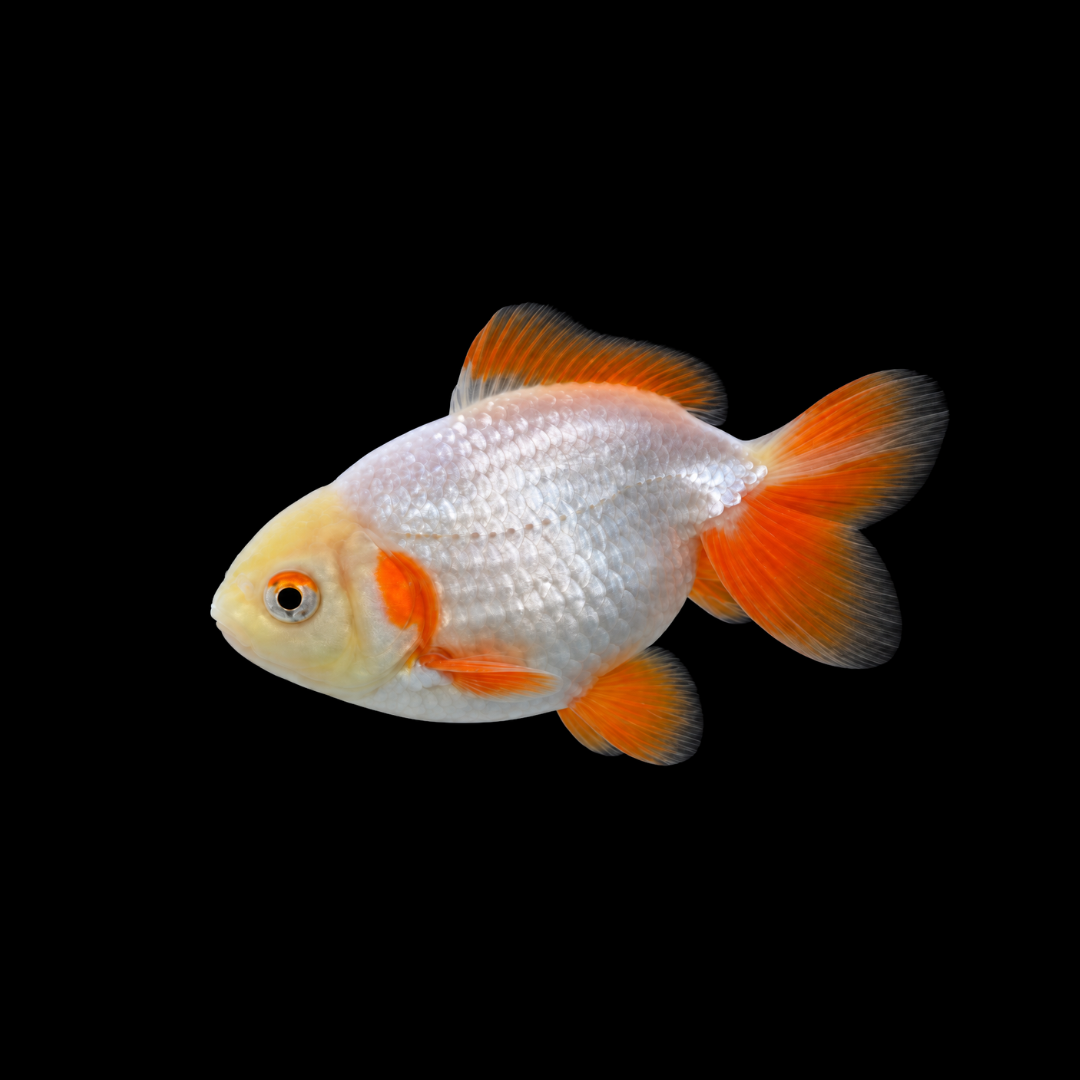
三州錦(さんしゅうきん)は、愛知県三河地方で地金とらんちゅうを交配して作出された、日本生まれの希少な金魚です。らんちゅう型の丸みのある体形に背びれを備え、地金系の尾形と、口や各ひれの赤が白い体に映える六鱗柄をあわせ持つ姿が大きな魅力です。流通量は多くなく、体形、尾の開き、肉瘤の発達、色柄には個体差があります。らんちゅうの血を引きますが、三州錦の典型的な姿は背びれを持つ点が重要な特徴です。Sanshu Nishiki is a rare Japanese goldfish variety developed in the Mikawa region of Aichi Prefecture by crossing Jikin and Ranchu. It combines a rounded Ranchu-like body with a dorsal fin, a Jikin-influenced divided tail, and a Rokurin-style red-and-white pattern in which red is concentrated on the mouth and fins. The variety remains uncommon in the trade, and body shape, tail spread, head growth, and coloration vary between individuals. Although Ranchu is part of its ancestry, the typical Sanshu Nishiki retains a dorsal fin.
基本情報 / Basic Information
学名 / Scientific Name
Carassius auratus (Linnaeus, 1758)
通称 / Common Name
三州錦(さんしゅうきん)Sanshu Nishiki
分類 / Family
コイ目・コイ科・フナ属Order Cypriniformes, family Cyprinidae, genus Carassius
英名 / English Name
Sanshu Nishiki
分布 / Distribution
日本・愛知県三河地方で作出された飼育品種。野生の自然分布はなく、国内の金魚専門店、養魚場、観賞魚流通を通じて少数が流通します。A captive ornamental variety developed in the Mikawa region of Aichi Prefecture, Japan. It has no natural wild distribution and is traded in limited numbers through specialist goldfish breeders, wholesalers, and aquarium retailers.
最大体長 / Max Size
三州錦に限定した、信頼できる最大体長の資料は確認されていません。成長は系統、年齢、飼育環境によって異なるため、本品種の最大値として一律の数値を示すことは避けた方が適切です。No reliable breed-specific maximum size has been established for Sanshu Nishiki. Growth varies with lineage, age, and husbandry, so a single numerical maximum should not be presented as a confirmed value for this variety.
寿命 / Lifespan
三州錦だけを対象にした信頼できる寿命統計は確認されていません。金魚は長期飼育が可能な魚ですが、三州錦固有の寿命として年数を断定することはできません。No reliable lifespan statistics specific to Sanshu Nishiki have been established. Goldfish can be long-lived under suitable care, but a fixed lifespan in years cannot be stated specifically for this variety.
飼育環境 / Aquarium Environment
水槽サイズ / Tank Size
成魚1尾なら60cm規格水槽(約57L)以上を最低限の目安とし、2〜3尾をゆったり育てるなら90cm規格水槽(約150L)クラスが扱いやすくなります。金魚は排泄量が多いため、単純な体長だけでなく水量とろ過能力に余裕を持たせることが重要です。For one adult, a standard 60 cm aquarium of roughly 57 L is a practical minimum guideline. For two to three adults, a standard 90 cm aquarium of roughly 150 L is easier to manage. Goldfish produce substantial waste, so generous water volume and filtration are more important than body length alone.
水温 / Temperature
18〜24℃前後を安定させると管理しやすくなります。金魚自体はより広い温度帯に適応しますが、急激な水温変化は体調不良のきっかけになります。夏季は高水温と酸欠に注意し、必要に応じて送風やエアレーションを強化します。A stable range around 18–24°C is easy to manage. Goldfish tolerate a broader range, but rapid temperature swings can trigger stress and illness. During hot weather, watch for overheating and low dissolved oxygen, and increase aeration when necessary.
水質 / Water Quality
中性付近から弱アルカリ性を中心に、pH6.5〜8.0程度の安定した淡水が扱いやすいでしょう。アンモニアと亜硝酸は検出されない状態を維持し、硝酸塩の蓄積も定期換水で抑えます。新しい水槽では生物ろ過が完成するまで特に慎重な測定が必要です。Stable freshwater near neutral to mildly alkaline conditions, roughly pH 6.5–8.0, is suitable. Ammonia and nitrite should remain undetectable, while nitrate accumulation should be controlled through regular water changes. New aquariums require especially careful testing until biological filtration is established.
レイアウト / Layout
泳ぐ空間を広く取り、底砂を薄く敷くかベアタンクにすると清掃しやすくなります。飾りは角のないものを選び、尾や体表を傷つける鋭利な石や流木は避けます。ろ過は強めに確保しつつ、吐出口を壁面に向けるなどして局所的な強い水流を和らげると落ち着きやすくなります。Provide a broad open swimming area. A thin substrate layer or bare-bottom setup makes cleaning easier. Use smooth décor and avoid sharp rocks or wood that could damage fins and skin. Filtration should be substantial, but strong localized flow can be softened by directing the outlet toward a wall or using a spray bar.
注意点 / Precautions
導入直後は既存魚とすぐ混ぜず、別容器で状態を観察してから合流させます。丸みのある体形と大きく開く尾を持つため、過密や強すぎる水流を避け、餌が十分に行き渡る環境を整えます。水質悪化や急激な水温変化を重ねないことが、体調を安定させる基本です。Newly acquired fish should be observed separately before introduction to an established group. Because of the rounded body and broad divided tail, avoid crowding and excessively strong current, and make sure each fish can feed adequately. Stable water quality and avoidance of sudden temperature changes are the foundations of good condition.
餌と給餌 / Feeding
餌の種類 / Diet
金魚用の良質な沈下性ペレットを主食にし、冷凍アカムシ、ミジンコ類、ブラインシュリンプなどを少量の副食として使えます。植物質も摂る雑食性なので、金魚用の植物質配合フードや柔らかい水草・青菜類を補助的に取り入れる方法もあります。Use a high-quality sinking goldfish pellet as the staple diet. Small amounts of frozen bloodworms, daphnia, or brine shrimp can be offered as supplements. Goldfish are omnivorous, so plant-containing goldfish foods and occasional soft aquatic plants or leafy greens can also be incorporated.
給餌のポイント / Feeding Tips
一度に大量に与えず、短時間で食べ切れる量を1〜2回に分けます。水温が低く活動量が落ちる時期は給餌量も控えます。水面の餌を勢いよく食べて空気を飲み込む個体では、沈下性フードへの変更が食後の浮力異常を軽減する場合があります。ただし、転覆や浮上は餌だけで起こる症状ではなく、慢性化する場合は別の原因も考える必要があります。Avoid large meals; offer an amount that is consumed promptly, divided into one or two feedings. Reduce feeding when lower water temperatures reduce activity. In fish that gulp air while feeding at the surface, switching to a sinking diet may reduce post-feeding buoyancy problems. Persistent floating or rolling, however, should not automatically be attributed to food alone, because other causes may be involved.
性格と混泳 / Temperament and Tank Mates
性格 / Temperament
基本的には温和で、人にも慣れやすい金魚です。丸みのある体形ですが、泳ぎ方には個体差があり、比較的活発に動く個体もいます。餌の時間に前へ出てくるなど、飼育者の動きに反応する様子も楽しめます。It is generally peaceful and readily becomes accustomed to its keeper. Although it has a rounded body, swimming ability varies between individuals, and some can be comparatively active. Many also learn to respond to the keeper’s approach, especially around feeding time.
混泳の相性 / Compatibility
同程度の大きさで、泳力と給餌速度が極端に違わない金魚同士が無難です。非常に速い和金・コメット類と、極端に泳ぎの遅い品種を同じ水槽にすると餌の取り合いに差が出ることがあります。熱帯魚との混泳は適温や食性、病原体管理が異なるため、基本的には金魚同士でまとめる方が管理しやすいでしょう。Tank mates are best limited to similarly sized goldfish with comparable swimming and feeding speed. Very fast common or comet-type goldfish can outcompete slower fancy varieties, while extremely slow varieties may also be disadvantaged. Mixing with tropical fish is generally less convenient because temperature, feeding, and disease-management requirements differ.
病気と対策 / Diseases and Prevention
かかりやすい病気 / Common Diseases
金魚全般と同様に、白点病、鰓や体表の寄生虫症、細菌性の体表炎・尾ぐされ、浮力異常などに注意します。いわゆるポップアイは病名というより眼球突出という症状で、外傷、感染、体液調節の異常、水質問題など複数の原因が考えられます。片目だけか両目か、充血や白濁があるか、他の魚にも症状があるかを観察することが重要です。As with other goldfish, watch for white spot disease, gill or skin parasites, bacterial skin and fin infections, and buoyancy disorders. “Popeye” is better understood as a clinical sign of protruding eyes rather than a single disease; possible causes include trauma, infection, impaired fluid regulation, and water-quality problems. Note whether one or both eyes are affected and whether redness, cloudiness, or similar signs occur in tank mates.
対策と予防 / Prevention
最も重要なのは、成熟したろ過、十分な酸素、過密回避、アンモニア・亜硝酸の管理、定期的な換水です。新規導入魚は別容器で観察し、網やホースの共用にも注意します。転覆や浮上が続く場合は、沈下性フードへの変更や給餌量の見直しで改善する例がありますが、慢性的な症状は浮袋そのもの、内臓、骨格、感染など複数の原因があり得ます。症状が進行する場合は水生動物を診られる獣医師に相談し、見た目だけで抗菌薬を漫然と使用しないことが大切です。The foundation of prevention is mature biological filtration, good oxygenation, low stocking density, control of ammonia and nitrite, and regular water changes. Observe new fish separately and avoid careless sharing of nets and hoses. Persistent floating or rolling sometimes improves with a sinking diet and adjusted feeding, but chronic buoyancy problems can also involve the swim bladder, internal organs, skeletal conformation, or infection. If signs progress, consult a veterinarian experienced with aquatic animals rather than using antibiotics solely on appearance.
増やし方(繁殖) / Breeding
雌雄の判別 / Sexing
繁殖期の雄は鰓ぶたや胸びれ前縁に白い追星が現れやすく、雌は抱卵すると腹部がふっくらします。ただし若魚や繁殖期外では判別が難しく、体型だけでの断定は避けます。During the breeding season, males often develop white breeding tubercles on the opercula and leading edge of the pectoral fins, while gravid females become fuller through the abdomen. Juveniles and out-of-season adults can be difficult to sex, so body shape alone should not be treated as definitive.
繁殖形態 / Reproduction
卵生で、水草や産卵モップなどに粘着性の卵をばらまくタイプです。春の水温上昇期に繁殖行動が活発になります。親魚は卵を食べるため、採卵後は親を分けるか、卵の付いた産卵床を別容器へ移します。It is an egg-scattering spawner that deposits adhesive eggs on aquatic plants or spawning mops. Spawning activity commonly increases as water warms in spring. Adults may eat the eggs, so the parents or the egg-covered spawning medium should be separated after spawning.
繁殖のポイント / Breeding Tips
三州錦らしい姿を安定して残すには、単に地金とらんちゅうを一代交配するだけでなく、三州錦として選抜されてきた系統から、体形、背びれ、尾の開き、色柄、肉瘤のバランスを見ながら次世代を選ぶ必要があります。尾形や六鱗柄には個体差があるため、多くの稚魚の中から特徴の整った個体を残していく選別が重要です。調色は魚体に負担をかける伝統技法であり、一般的な観賞飼育に必要な作業ではありません。Maintaining a stable Sanshu Nishiki form requires more than simply making a first-generation Jikin × Ranchu cross. Breeding stock must be selected from established Sanshu lines for balanced body shape, dorsal fin, tail spread, coloration, and head growth. Tail form and Rokurin pattern vary between individuals, so breeders select the best-balanced fish from many juveniles. Traditional artificial color adjustment places stress on the fish and is not required for ordinary ornamental keeping.
雑学と豆知識 / Trivia and Fun Facts
1. 三州錦の成り立ちと背びれ / 1. Origin of Sanshu Nishiki and Its Dorsal Fin
三州錦は愛知県三河地方で、地金とらんちゅうを交配して作出された金魚です。体形はらんちゅう型の丸みを帯び、六鱗柄を基本としながら、背びれを備える姿が一般的です。作出年や系統固定の詳しい経緯を公的資料だけで追うことは難しいため、特定の年代を断定するよりも、地金とらんちゅうの特徴を交配後の選抜で組み合わせてきた品種として理解するのが適切です。とくに「背びれがある」という点は、らんちゅうとの違いを見分けるうえで分かりやすい特徴です。Sanshu Nishiki was developed in the Mikawa region of Aichi Prefecture by crossing Jikin and Ranchu. It has a rounded Ranchu-like body, typically shows a Rokurin pattern, and generally retains a dorsal fin. Because the exact creation date and stabilization history are not well documented in public primary sources, it is more accurate to describe the variety as the result of crossing and subsequent selection than to assign it a specific year of origin. The presence of a dorsal fin is also one of the clearest features distinguishing it from Ranchu.
2. 双尾の発生研究とchordin遺伝子 / 2. Chordin and Research on Twin-Tail Development
金魚の双尾では、胚の背腹軸形成に関わるchordin遺伝子の重複コピーの一つにあるE127Xナンセンス変異が、尾部骨格の分岐に重要であることが実験的に示されています。2014年の研究ではこの遺伝子をchdAと呼び、後の研究では主にchdSという名称が使われています。変異によってChordinタンパク質の機能が弱まり、胚の背腹方向を決めるBMPシグナルとのバランスが変化することで、尾部の正中構造が左右に分かれやすくなります。つまり、双尾は成魚の尾だけに起きた局所的な変化ではなく、初期発生の仕組みの変化から生じる形質です。主要研究ではらんちゅう、琉金、オランダなどの双尾系統が解析されていますが、三州錦自体は解析対象に含まれていません。そのため、三州錦の遺伝型まで同じであると断定せず、双尾金魚全体の発生機構を理解する研究として捉えるのが正確です。In twin-tail goldfish, an E127X nonsense mutation in one duplicated chordin gene has been experimentally shown to play a key role in bifurcation of the caudal skeleton. The 2014 study called this locus chdA, while later work mainly uses the name chdS. The mutation reduces Chordin function and changes the balance of BMP signaling that helps establish the embryo’s dorsal–ventral axis, making the midline structures of the tail more likely to divide. In other words, the twin tail is not merely a local change in the adult fin; it arises from altered early development. Major studies have examined twin-tail strains including Ranchu, Ryukin, and Oranda, but Sanshu Nishiki itself was not among the analyzed strains. The findings should therefore be used to explain twin-tail development in goldfish generally, not to assign a confirmed genotype to Sanshu Nishiki.
3. 背びれ欠損の遺伝学は「親品種らんちゅう」を理解する鍵 / 3. Dorsal-Fin Genetics Explains the Ranchu Parent, Not the Typical Sanshu Nishiki
2022年の研究では、野生型のchdSアレルが、らんちゅう系統に見られる背びれ欠損の現れ方を抑える働きを持つことが、交配実験と機能解析から示されました。双尾型のchdS変異が固定された集団では、背びれ形成に関わるほかの遺伝的要因が表現されやすくなり、その後の人為選択によって背びれのない系統が安定したというモデルです。重要なのは、背びれ欠損がchdS変異だけで単純に決まるわけではない点です。この知見は、三州錦の背びれを説明するものではなく、背びれを持たない親品種であるらんちゅうがどのように成立したかを理解する背景として位置づけると分かりやすいでしょう。A 2022 study using crosses and functional experiments showed that the wild-type chdS allele can suppress expression of dorsal-fin defects found in Ranchu-group goldfish. In populations where the twin-tail chdS mutation became fixed, other genetic factors affecting dorsal-fin formation could be expressed more readily, after which artificial selection could stabilize dorsal-finless strains. Importantly, dorsal-fin loss is not determined by the chdS mutation alone. This research does not explain the dorsal fin of Sanshu Nishiki directly; rather, it helps clarify the developmental background of its dorsal-finless Ranchu parent.
4. 金魚の全ゲノム重複が生んだ「形を変えられる余地」 / 4. Genome Duplication and Developmental Flexibility in Goldfish
金魚の染色体数は2n=100で、コイ科の系統で起きた比較的新しい全ゲノム重複の影響を強く残しています。そのため、多くの遺伝子には似た働きを持つ重複コピーが存在します。chordinにも複数のコピーがあることが、双尾変異を持ちながら胚発生を成立させられる背景のひとつと考えられています。ただし「ゲノム重複があるから、どんな奇形でも安全に作れる」という単純な話ではありません。重複遺伝子の機能分担、発現量、ほかの遺伝子との組み合わせが関わり、人為選択によって生存と観賞価値を両立できる変異だけが長い時間をかけて残されてきました。三州錦は、そうした金魚という生物の発生上の柔軟さを、地金とらんちゅうという二つの育種文化の交点で見せてくれる存在です。Goldfish have 2n = 100 chromosomes and retain the strong signature of a relatively recent whole-genome duplication in the cyprinid lineage. Many genes therefore exist as duplicated copies with overlapping or partitioned functions. Multiple chordin copies are thought to be part of the developmental background that allows a viable embryo to form even when one copy carries the twin-tail mutation. This does not mean genome duplication makes every dramatic mutation harmless. Gene dosage, functional partitioning, and interactions with other loci still matter, and breeders have preserved only combinations that can sustain life while producing valued ornamental forms. Sanshu Nishiki sits at an especially vivid intersection of that biological flexibility and the separate breeding traditions of Jikin and Ranchu.
5. 六鱗と「調色」は、育種だけでは完成しない伝統美 / 5. Rokurin Color and the Traditional Practice of Artificial Color Adjustment
地金では、口や各ひれに赤を残し、体を白く整えた六鱗の色彩が重視されてきました。愛知県や民俗学的な資料には、若魚の鱗や頭部の表皮を除くなどして赤色を減らす「人工調色」が行われてきたことが記録されています。三州錦でも六鱗柄を整えるために調色された個体が流通することがあります。ただし、魚体へ直接手を加える技法であり、粘膜や鱗を傷めれば感染や衰弱につながるおそれがあります。一般の飼育者に必須の作業ではなく、伝統的な育成文化として理解することと、実際に施すことは分けて考えるのが適切です。In Jikin culture, the Rokurin pattern—red on the mouth and fins with a white body—has long been valued. Aichi Prefecture and ethnographic sources document traditional artificial color adjustment in which scales or parts of the head surface are removed from young fish to reduce unwanted red coloration. Sanshu Nishiki with a carefully finished Rokurin pattern may also have undergone such treatment. Because the technique directly alters the skin and scales, poor handling can lead to injury, infection, or debilitation. It is not necessary for ordinary keepers and is best understood separately as a traditional breeding practice.
6. 弥富は「産地」であると同時に全国へつなぐ流通拠点 / 6. Yatomi Is Both a Production Region and a Distribution Hub
愛知県西部の弥富市周辺は、木曽川下流の水郷環境を背景に明治期から金魚養殖が発展し、現在も全国有数の産地・流通拠点です。競りでは、金魚を入れた「かんこ」と呼ばれる木舟・木枠を水路に流し、仲買人が一尾当たりの価格を競る独特の仕組みが知られています。行政資料でも、弥富には多品種の金魚が集まり、全国から仲買人が訪れることが紹介されています。三州錦の作出地は三河地方ですが、弥富の市場文化を含む愛知県全体の金魚生産・流通の厚みは、希少品種が国内へ届く背景の一つになっています。The Yatomi area of western Aichi developed as a major goldfish-producing region from the Meiji period onward, supported by the water-rich lower Kiso River landscape, and it remains an important production and distribution center. Its distinctive auctions use wooden boats or frames called kanko, carrying fish through a channel while brokers bid on a per-fish price. Official local sources also describe Yatomi as a place where many varieties are gathered and buyers come from across Japan. Sanshu Nishiki originated in the Mikawa region, but the broader production and distribution network of Aichi, including Yatomi’s market culture, forms part of the background through which rare varieties reach specialist retailers.
7. 1994年、弥富の和金は宇宙へ行った / 7. In 1994, a Yatomi Goldfish Went to Space
1994年7月、向井千秋宇宙飛行士が搭乗したスペースシャトル「コロンビア」のSTS-65/IML-2ミッションでは、愛知県弥富産の和金がメダカやアカハライモリとともに宇宙へ運ばれました。三州錦そのものが宇宙へ行ったわけではありませんが、同じ愛知の金魚文化を語るうえで印象的なエピソードです。宇宙実験に選ばれた事実は「弥富産ならどの金魚も特別に丈夫」という証明ではなく、研究用生体の供給に地域の養殖技術が関わった歴史として受け取るのが正確です。伝統的な池と競りの町から宇宙実験へ――弥富金魚の物語の振れ幅を象徴する出来事といえるでしょう。In July 1994, during the Space Shuttle Columbia STS-65/IML-2 mission carrying astronaut Chiaki Mukai, a Wakin goldfish from Yatomi, Aichi, traveled to space together with medaka and Japanese fire-bellied newts. The fish was not a Sanshu Nishiki, but the story remains a memorable part of Aichi’s goldfish heritage. Its use in a space experiment does not prove that every Yatomi goldfish is unusually hardy; more accurately, it shows that regional aquaculture expertise contributed to the supply of research animals. From traditional ponds and auctions to a microgravity laboratory, the episode captures the remarkable breadth of Yatomi’s goldfish history.
まとめ / Conclusion
三州錦は、地金の六鱗柄や尾形と、らんちゅう型の丸い体形や頭部の特徴を組み合わせた、愛知県三河地方生まれの希少な金魚です。典型的な個体は背びれを備え、真上からは尾の広がりや色柄を、横からは丸みのある体形を楽しめます。体形、尾、肉瘤、色柄には個体差があるため、それぞれの魚が持つ全体のバランスを見ながら選ぶ楽しさがあります。Sanshu Nishiki is a rare goldfish from the Mikawa region of Aichi Prefecture, combining the Rokurin pattern and tail characteristics of Jikin with the rounded body and head traits associated with Ranchu. Typical individuals retain a dorsal fin; from above, the tail spread and coloration are prominent, while the rounded body form is easily appreciated from the side. Because body shape, tail, head growth, and pattern vary, choosing an individual is largely a matter of judging its overall balance.
飼育では、十分な水量と成熟したろ過を用意し、水質や水温の急変を避け、食べ方を見ながら無理のない給餌を続けることが基本です。伝統的な六鱗の美しさ、双尾金魚で明らかになってきた発生遺伝学、そして三河と弥富を含む愛知の金魚文化を背景に持つ三州錦は、姿だけでなく、その成り立ちまで含めてじっくり向き合いたくなる金魚です。Good care begins with generous water volume, mature filtration, stable water quality and temperature, and feeding adjusted to the way each fish eats. Sanshu Nishiki is especially compelling because its appearance is connected with the traditional Rokurin aesthetic, the developmental genetics revealed through research on twin-tail goldfish, and the wider goldfish culture of Aichi, including Mikawa and Yatomi.
Chen D, Zhang Q, Tang W, et al. The evolutionary origin and domestication history of goldfish (Carassius auratus). Proceedings of the National Academy of Sciences of the United States of America. 2020;117(47):29775-29785. doi:10.1073/pnas.2005545117.
https://doi.org/10.1073/pnas.2005545117金魚のドメスティケーション、ゲノム構造、品種形態の遺伝的背景の確認。
Abe G, Lee SH, Chang M, et al. The origin of the bifurcated axial skeletal system in the twin-tail goldfish. Nature Communications. 2014;5:3360. doi:10.1038/ncomms4360.
https://doi.org/10.1038/ncomms4360双尾金魚におけるchordin遺伝子変異と尾部骨格分岐の発生機構の確認。
Chen HC, Wang C, Li IJ, Abe G, Ota KG. Pleiotropic functions of chordin gene causing drastic morphological changes in ornamental goldfish. Scientific Reports. 2022;12:19961. doi:10.1038/s41598-022-24444-7.
https://doi.org/10.1038/s41598-022-24444-7双尾系統とらんちゅう系統の背びれ欠損に関するchdSの多面的作用の確認。
Kobayashi M, Iwata E, Sorensen PW. Environmental and Physiological Regulation of Reproduction in the Goldfish: Gonadal Development, Maturation, and Spawning Behavior: A Review. Animals. 2026;16(5):775. doi:10.3390/ani16050775.
https://doi.org/10.3390/ani16050775金魚の季節繁殖、水温上昇と成熟・産卵、植物への粘着卵の産み付け、産卵行動の確認。
Francis-Floyd R, Stilwell NK, Yanong RPE. Introduction to Fish Health Management. UF/IFAS Extension, University of Florida.
https://ask.ifas.ufl.edu/publication/FA004水質悪化や過密と疾病の関係、寄生虫・細菌性疾患、眼球突出(ポップアイ)が症状の一つであること、診断を前提とした治療の考え方の確認。






コメント