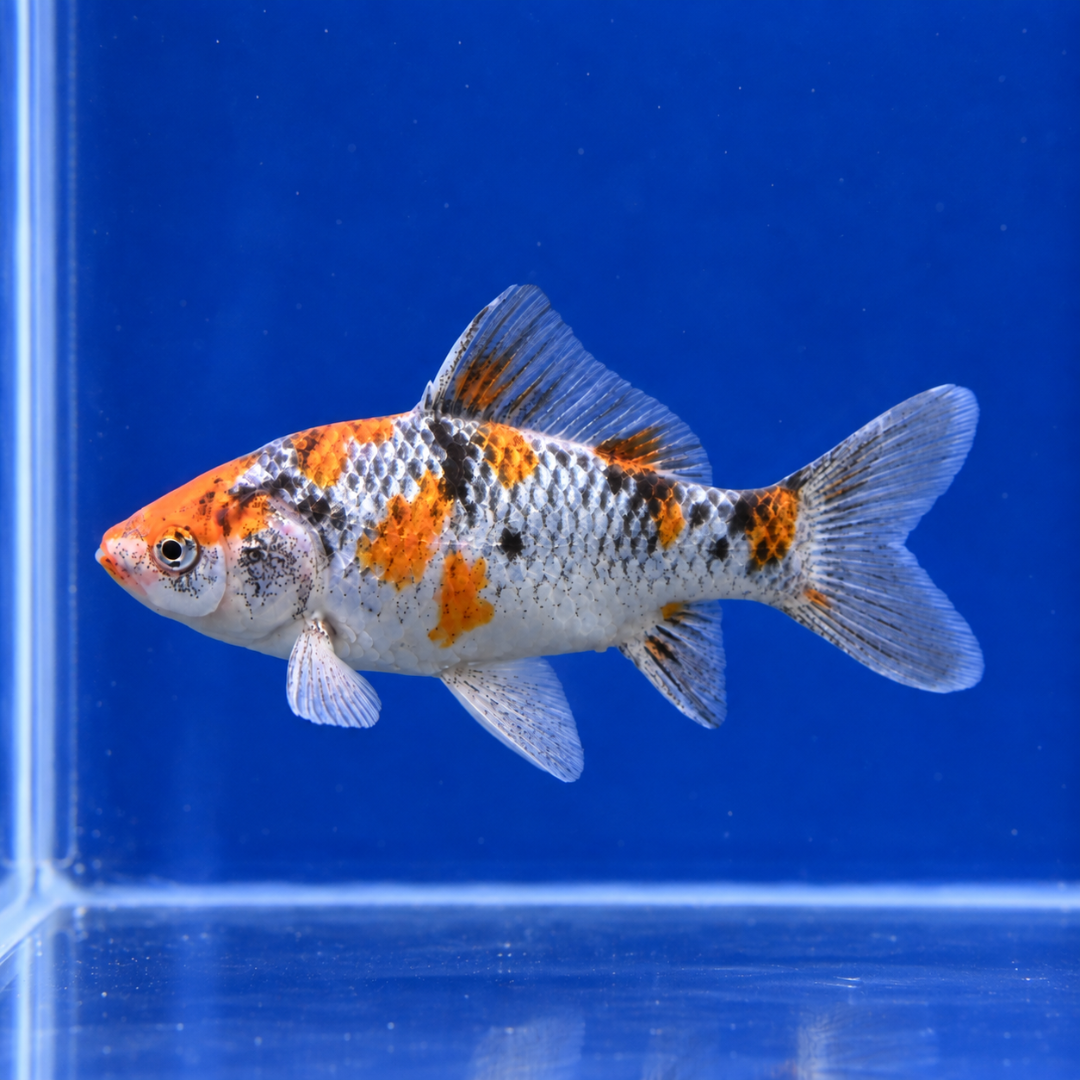
銀鱗キャリコ和金は、和金らしい細長く力強い体型に、キャリコ特有の赤・黒・浅葱などが入り混じる多彩な体色と、光を受けて銀色にきらめく鱗の表現をあわせ持つ金魚です。国内では「銀鱗キャリコ和金」「銀鱗キャリコ和金 フナ尾」などの名称で流通しており、独立した学術分類群というより、体型・体色・鱗の見え方を組み合わせた流通上の呼称として理解すると分かりやすいでしょう。和金型らしく遊泳力が高く丈夫な一方、成長すると20cmを超えることがあり、十分な水量と強力なろ過が長期飼育の鍵になります。銀白色の反射と浅葱、墨、赤が見る角度や成長によって表情を変えるため、若魚から成魚へ育っていく過程そのものを楽しめる金魚です。Ginrin Calico Wakin is a long-bodied goldfish with the strong swimming form of a Wakin, a calico pattern made up of red, black, pale blue and related tones, and highly reflective scales that can flash silver under light. In Japan, names such as “Ginrin Calico Wakin” and “Ginrin Calico Wakin, single-tail” are used in the aquarium trade. The name is best understood as a trade description combining body form, color pattern and reflective scale appearance rather than as a separately recognized taxonomic entity. Like other long-bodied goldfish, it is active and comparatively hardy, but adults may exceed 20 cm and therefore need generous water volume and strong filtration. Its appeal lies in the way silver reflections, blue-gray ground color, black markings and red patches can change in appearance as the fish grows and as the viewing angle changes.
基本情報 / Basic Information
学名 / Scientific Name
Carassius auratus (Linnaeus, 1758)
通称 / Common Name
銀鱗キャリコ和金、銀鱗キャリコ和金(フナ尾)など。販売名には生産者や尾型、色の出方を示す語が付くことがあります。Ginrin Calico Wakin, Ginrin Calico Wakin single-tail, and similar trade names. Seller or breeder names, tail type, or color descriptors may also be added.
分類 / Family
コイ目コイ科フナ属。金魚の一品種・改良系統として扱われます。Order Cypriniformes, family Cyprinidae, genus Carassius. It is treated as a domesticated goldfish variety or strain.
英名 / English Name
Ginrin Calico Wakin
分布 / Distribution
野生分布を持つ独立種ではなく、日本国内の養魚場や愛好家によって維持・流通する改良金魚です。金魚そのものは東アジアのフナ類を起源とし、中国で長い家畜化・品種改良の歴史を持ちます。This is not a separate wild species with its own natural range, but a domesticated goldfish form maintained and distributed by breeders and hobbyists, especially in Japan. Goldfish as a whole derive from East Asian crucian carp lineages and have a long history of domestication and selective breeding in China.
最大体長 / Max Size
飼育下では20~30cm前後まで成長することがあり、広い池や長期飼育ではさらに大型化する可能性があります。銀鱗キャリコ和金だけを対象にした最大体長の統計は乏しく、種としての金魚では全長48cmの記録があります。Often around 20–30 cm in captivity, with the potential to grow larger in spacious ponds and over many years. Reliable maximum-size statistics specific to Ginrin Calico Wakin are lacking; goldfish as a species have been reported at up to 48 cm total length.
寿命 / Lifespan
10年以上が十分に期待でき、良好な環境では15年以上生きる個体もいます。金魚全体では40年以上の長寿記録も知られていますが、一般家庭での寿命は水質、過密、給餌、疾病管理に大きく左右されます。A lifespan of more than 10 years is realistic, and well-kept individuals may live 15 years or longer. Goldfish as a species have exceptionally long records exceeding 40 years, although typical household lifespan depends heavily on water quality, stocking density, feeding and disease prevention.
飼育環境 / Aquarium Environment
水槽サイズ / Tank Size
成魚の長期飼育は90cm規格水槽以上を目安にし、複数の成魚をゆったり飼うなら120cm規格水槽や120cmワイド水槽、屋外の十分な容量を持つ池が適しています。60cm規格水槽は幼魚期や一時的な飼育には使えますが、成魚を長期維持するには水量と遊泳スペースが不足しやすいため注意が必要です。For long-term adult care, a 90 cm standard aquarium or larger is recommended. Several adults are better housed in a 120 cm standard or wide aquarium, or in a suitably sized outdoor pond. A 60 cm standard aquarium can be used for juveniles or temporary housing, but it tends to become inadequate for adults because of limited swimming space and water volume.
水温 / Temperature
日常管理では18~24℃前後が扱いやすい範囲です。金魚は低水温にも比較的適応しますが、急激な水温変化は体調を崩す原因になります。夏は高水温になるほど溶存酸素が低下するため、エアレーションを強めて過密を避けます。About 18–24°C is a practical range for routine care. Goldfish tolerate cool water relatively well, but rapid temperature changes should be avoided. In summer, warmer water holds less dissolved oxygen, so stronger aeration and conservative stocking are important.
水質 / Water Quality
弱酸性~弱アルカリ性の安定した水に適応しやすく、目安はpH6.5~8.0程度です。最も重要なのは数値を細かく追うことより、アンモニアと亜硝酸を検出されない状態に保ち、硝酸塩や有機物の蓄積を定期換水で抑えることです。カルキを除いた水を使い、急激なpH変化を避けます。Stable water from slightly acidic to slightly alkaline is generally suitable, with pH 6.5–8.0 as a practical guide. More important than chasing an exact pH is keeping ammonia and nitrite undetectable and controlling nitrate and organic waste through regular partial water changes. Always dechlorinate tap water and avoid sudden shifts in pH.
レイアウト / Layout
和金型はよく泳ぐため、中央から前面に広い遊泳空間を確保します。底床は細かな砂利またはベアタンクでも飼育でき、装飾物は体を傷つけない滑らかなものを選びます。水草はアヌビアス類など丈夫な種類を流木や石に活着させると使いやすい一方、柔らかな水草はついばまれたり抜かれたりすることがあります。ろ過器は水量に対して余裕のある上部式・外部式・大型スポンジフィルターなどを組み合わせ、十分なエアレーションを確保します。Because Wakin-type goldfish are strong swimmers, leave a broad open swimming area through the center and front of the aquarium. Fine gravel or a bare bottom can both work, and decorations should have smooth surfaces to prevent injury. Tough plants such as Anubias attached to wood or stone are easier to maintain, while soft plants may be nibbled or uprooted. Use filtration with ample capacity for the actual water volume, such as overhead, canister or large sponge filters, together with good aeration.
注意点 / Precautions
金魚は食欲が強く排泄量も多いため、「魚が元気だから水質も良い」とは限りません。過密を避け、ろ材の目詰まりや酸欠を防ぎ、定期的にアンモニア・亜硝酸・硝酸塩を確認すると安定しやすくなります。新魚は可能なら数週間の隔離観察を行い、体表や鰓、糞、泳ぎ方に異常がないか確認してから合流させます。飼えなくなっても河川や池へ放流せず、最後まで飼育するか適切な譲渡先を探してください。Goldfish have strong appetites and produce a large amount of waste, so an active appearance does not guarantee good water quality. Avoid overcrowding, keep filters from clogging, prevent oxygen depletion and periodically check ammonia, nitrite and nitrate. If possible, observe new fish in quarantine for several weeks before introducing them, watching the skin, gills, feces and swimming behavior for abnormalities. Never release unwanted fish into rivers or ponds; rehome them responsibly if necessary.
餌と給餌 / Feeding
餌の種類 / Diet
主食には品質の安定した金魚用配合飼料を使います。沈下性またはゆっくり沈むタイプは水面で空気を飲み込みにくく、底まで探餌する習性にも合います。副食として冷凍アカムシ、ミジンコ、ブラインシュリンプなどの動物質餌を少量与えたり、スピルリナや小麦胚芽など植物質を含む金魚用飼料を組み合わせたりすると栄養の偏りを抑えやすくなります。Use a consistent, high-quality formulated goldfish food as the staple. Sinking or slow-sinking pellets reduce surface gulping and suit the fish’s natural foraging behavior. Small amounts of frozen bloodworms, daphnia or brine shrimp can be offered as supplementary foods, while goldfish diets containing plant ingredients such as spirulina or wheat germ help provide a balanced intake.
給餌のポイント / Feeding Tips
水温と成長段階に合わせて、1日1~2回を基本に短時間で食べ切れる量を与えます。幼魚は少量を複数回に分けると成長を支えやすく、成魚は体型を見ながら過食を避けます。低水温期は消化が遅くなるため量と回数を減らし、食べ残しは早めに取り除きます。色揚げ飼料だけに偏らず、主食としての栄養バランスを優先してください。Feed according to temperature and growth stage, generally once or twice daily in an amount that is consumed quickly. Juveniles benefit from smaller, more frequent meals, while adults should be fed conservatively to avoid obesity and water pollution. Digestion slows in cold water, so reduce both portion size and frequency, and remove uneaten food promptly. Do not rely exclusively on color-enhancing foods; overall nutritional balance should come first.
性格と混泳 / Temperament and Tank Mates
性格 / Temperament
基本的には温和で人にも慣れやすい金魚ですが、和金型らしく活動量が多く、餌の時間には非常に積極的です。攻撃性よりも遊泳速度と食欲の強さが混泳相手への負担になりやすいため、性格だけでなく体型と泳力を合わせることが重要です。Generally peaceful and readily accustomed to people, but very active and especially competitive at feeding time. The main compatibility issue is not aggression but its speed and strong appetite, so body shape and swimming ability of tank mates matter as much as temperament.
混泳の相性 / Compatibility
同程度の大きさの和金、コメット、朱文金など、泳力の近い長物金魚との混泳が向いています。出目金やランチュウなど泳ぎの遅い丸手金魚は餌負けしやすく、長期的には分けた方が管理しやすい場合があります。熱帯魚との混泳は適温や餌、病気管理の条件が異なるため基本的にはおすすめしません。小型魚や小さなエビは口に入る大きさだと捕食される可能性があります。Best companions are similarly sized, long-bodied goldfish with comparable swimming ability, such as Wakin, Comet and Shubunkin. Slow fancy goldfish such as telescope-eye varieties and Ranchu can be outcompeted for food and are often easier to manage separately. Mixing with tropical fish is generally not recommended because temperature, diet and disease-management needs differ. Small fish and shrimp may be eaten if they fit in the goldfish’s mouth.
病気と対策 / Diseases and Prevention
かかりやすい病気 / Common Diseases
白点病、尾ぐされ・赤斑などの細菌性疾患、水カビ病、エラや体表に寄生する吸虫類、イカリムシやチョウなどの外部寄生虫が代表的です。多くは新魚の持ち込み、過密、酸欠、水質悪化、急な温度変化などをきっかけに表面化します。体をこすりつける、鰭をたたむ、呼吸が速い、底でじっとする、餌を急に食べなくなるといった変化は早期発見の手がかりです。Typical problems include ich, bacterial conditions such as fin rot or hemorrhagic lesions, water mold, gill and skin flukes, and external parasites such as anchor worm or fish lice. Many outbreaks are associated with newly introduced fish, overcrowding, low oxygen, poor water quality or sudden temperature changes. Flashing, clamped fins, rapid breathing, bottom-sitting and sudden loss of appetite are useful early warning signs.
対策と予防 / Prevention
最も有効な予防は、十分な水量、適切なろ過、定期換水、過密回避、新魚の隔離観察です。異常が出た場合は病魚を隔離し、水温・アンモニア・亜硝酸・pH・溶存酸素の状態を確認して原因を切り分けます。薬浴が必要なときは、観賞魚用として承認された薬剤を対象疾病と用法用量に従って使用し、自己判断で濃度を上げたり複数薬剤を混ぜたりしません。食塩浴は補助的に用いられることがありますが万能ではなく、病名や魚の状態に合わせた判断が必要です。高温の湯に入れるような処置は行わないでください。The most effective prevention is adequate water volume, appropriate filtration, regular water changes, conservative stocking and quarantine of new fish. When abnormalities appear, isolate the affected fish and check temperature, ammonia, nitrite, pH and oxygen conditions before choosing treatment. If medication is needed, use a product approved for ornamental fish and follow the labeled disease indication, dose and duration; do not increase concentrations or mix medicines casually. Salt may sometimes be used as supportive care, but it is not a universal cure and should be chosen according to the actual condition. Do not use dangerously hot-water treatments.
増やし方(繁殖) / Breeding
雌雄の判別 / Sexing
繁殖期の雄では、鰓ぶたや胸鰭の前縁に白い粒状の追星が現れやすくなります。雌は成熟すると腹部がふっくらし、産卵が近い時期には総排泄孔がやや突出して見えることがあります。ただし若魚や季節外では判別が難しく、1つの特徴だけで断定せず複数のサインを合わせて判断します。During the breeding season, males commonly develop small white breeding tubercles on the gill covers and the leading rays of the pectoral fins. Mature females often become fuller in the abdomen, and the vent may appear slightly more protruding near spawning. Sexing juveniles or fish outside the breeding season can be difficult, so several characteristics should be considered together rather than relying on a single sign.
繁殖形態 / Reproduction
卵生で、水草や産卵巣などに粘着性の卵をばらまくタイプです。春に水温が上昇する時期に繁殖行動が活発になり、雄が雌を追って産卵を促します。親魚は卵を保護せず、むしろ食べることがあるため、採卵後は親魚と卵を分けて管理します。Egg-laying and egg-scattering. Adhesive eggs are deposited on aquatic plants, spawning mops or similar surfaces. Breeding activity increases as water warms in spring, with males chasing females to stimulate spawning. The parents do not guard the eggs and may eat them, so adults should be separated from the eggs after spawning.
繁殖のポイント / Breeding Tips
健康で十分に成熟した親魚を用意し、春の18~24℃前後を目安に産卵用水槽へ移します。シュロや人工産卵巣を多めに入れ、産卵後は親魚を戻します。卵は水温によって数日で孵化し、仔魚が泳ぎ始めたらインフゾリアなどの微小餌から始め、成長に合わせて孵化直後のブラインシュリンプや稚魚用飼料へ切り替えます。銀色の反射、キャリコ体色、尾型はすべての仔に同じように現れるとは限らず、親魚の系統や形質の組み合わせによって幅広い表現が出るため、狙った外見を固定するには世代を重ねた選別が必要です。Use healthy, fully mature breeders and move them to a spawning aquarium when spring temperatures are around 18–24°C. Provide plenty of spawning material such as palm fiber or synthetic spawning mops, then remove the adults after spawning. Eggs usually hatch within several days depending on temperature. Once fry become free-swimming, begin with very small foods such as infusoria, then move to newly hatched brine shrimp and formulated fry diets as they grow. Silver reflectivity, calico coloration and tail form will not necessarily appear uniformly in every offspring; selective breeding over generations is needed to stabilize a desired appearance.
雑学と豆知識 / Trivia and Fun Facts
1. 「キャリコ」と「更紗」は同じではない / 1. Calico and Sarasa Are Not the Same Pattern
金魚の色柄を語るとき、似た言葉が混同されやすいのが「キャリコ」と「更紗」です。国内の金魚文化では、更紗は基本的に赤と白の二色模様を指し、キャリコは赤・黒・浅葱などが複雑に入り混じる多色表現を指します。朱文金や東錦のように、青みを帯びた地色の上に墨と赤が散る姿を思い浮かべると違いが分かりやすいでしょう。銀鱗キャリコ和金の魅力は、単なる紅白ではなく、このキャリコらしい多層的な色彩に銀色の反射が重なるところにあります。Two color terms that are often confused in goldfish keeping are “calico” and “sarasa.” In Japanese goldfish terminology, sarasa generally refers to a red-and-white pattern, while calico describes a more complex multicolor appearance including red, black and pale blue tones. Shubunkin and Azuma Nishiki are useful examples of calico coloration, where black and red markings appear over a bluish ground. The distinctive appeal of Ginrin Calico Wakin comes from adding bright silver reflection to this layered calico palette rather than simply combining red and white.
2. 銀色のきらめきは反射色素胞がつくる / 2. Silver Shine Comes from Reflective Pigment Cells
魚の銀色は、黒色色素のメラニンだけで説明できません。鱗や皮膚にある虹色素胞と呼ばれる細胞が、グアニンなどの結晶を利用して光を反射し、銀白色のきらめきを生み出します。金魚の透明鱗や反射性の研究でも、この銀色反射の有無には色素細胞の分布やプリン代謝が深く関わることが示されています。そのため「銀鱗=単一の銀鱗遺伝子」と単純化するより、反射組織と体色の組み合わせとして捉える方が現在の知見に近い表現です。A fish’s silver appearance cannot be explained by melanin alone. Reflective cells called iridophores use crystalline materials such as guanine to reflect light and create a silvery-white sheen. Research on transparent and reflective traits in goldfish indicates that pigment-cell distribution and purine metabolism are important parts of this system. For that reason, it is more accurate to think of “ginrin” in this context as a visible combination of reflective tissue and body coloration rather than assuming a single, universally defined “ginrin gene.”
3. 「銀鱗キャリコ和金」は実際に流通する名称 / 3. The Name Is Used in the Japanese Aquarium Trade
珍しい金魚では、愛好家だけが使う呼び名なのか、実際の流通で定着している呼び名なのかが曖昧なことがあります。銀鱗キャリコ和金は、国内の観賞魚流通で「国産銀鱗キャリコ和金」「フナ尾」などの表記で扱われていることが確認できます。ただし、全国統一の審査基準を持つ単独品種名とは限らず、生産者やロットによって鱗の反射、墨の入り方、浅葱の濃さ、尾型などにかなり幅があります。購入時は名称だけでなく、実際の個体写真や親魚・産地の情報まで確認すると好みに合う魚を選びやすくなります。With unusual goldfish, it is sometimes unclear whether a name exists only among hobbyists or is actually used commercially. “Ginrin Calico Wakin” is used in Japanese ornamental-fish distribution, including labels that specify domestic production or a single-tail form. However, it should not automatically be treated as a single standardized show variety with one nationwide judging standard. Reflectivity, black markings, blue-gray ground color and tail form can vary considerably among breeders and batches, so buyers should evaluate the actual fish rather than relying on the name alone.
4. 和金は日本の金魚文化を支える基本形 / 4. Wakin Is a Foundation of Japanese Goldfish Culture
和金は、現代の金魚の中でもフナに近い細長い体型を残す代表的な品種です。「和金」という呼び名は、江戸時代に新たに入ってきた金魚と区別するために使われるようになったと伝えられています。華やかな丸手品種が増えても、丈夫でよく泳ぐ和金型は途絶えることなく受け継がれ、現在では更紗、三色、透明鱗、銀色反射など多様な表現を載せる土台にもなっています。銀鱗キャリコ和金は、いわば古い基本体型の上に現代的な色彩表現を重ねた存在といえます。Wakin is one of the best-known goldfish forms retaining a long body shape close to the ancestral crucian-carp form. The name is traditionally said to have come into use in the Edo period to distinguish established Japanese goldfish from newly introduced forms. Even as round-bodied fancy varieties became popular, the hardy, fast-swimming Wakin form remained important and today serves as a base for many color and scale expressions, including sarasa, multicolor patterns, transparent scales and strong metallic reflection. Ginrin Calico Wakin can therefore be seen as a modern color treatment layered onto one of the classic body forms of Japanese goldfish culture.
5. 金魚の透明鱗研究は遺伝学の題材でもある / 5. Transparent-Scale Goldfish Are Also a Genetics Model
金魚の体色研究は、観賞魚の世界だけに閉じた話ではありません。透明鱗に関わる形質は古くから遺伝学の研究対象となり、近年のゲノム解析では透明鱗と強く関連する染色体領域や候補遺伝子が調べられています。さらに2026年には、透明な金魚の体色形成にプリン代謝の変化が関わることを示すトランスクリプトーム・メタボローム研究も報告されました。銀鱗キャリコ和金そのものの遺伝子が解明されたわけではありませんが、金魚の「透ける」「光る」「黒が残る」といった見た目の違いが、細胞や代謝のレベルで少しずつ説明され始めています。Goldfish coloration is not only a hobby topic; it has also been studied in genetics for decades. Transparent-scale traits have long served as experimental material, and modern genomic studies have identified chromosome regions and candidate genes associated with transparent-scale phenotypes. In 2026, transcriptomic and metabolomic research further linked transparent body coloration in goldfish with changes in purine metabolism. These findings do not mean that the exact genetics of Ginrin Calico Wakin have been solved, but they show how traits described by hobbyists as “transparent,” “shiny” or “black-marked” are gradually being explained at the cellular and metabolic level.
6. 海外から迎えるときは「観賞魚だから無検疫」ではない / 6. Ornamental Goldfish Imports Are Subject to Aquatic Animal Health Controls
金魚を海外から日本へ持ち込む場合、一般のペット輸入と同じ感覚で考えることはできません。金魚を含むフナ属魚類は水産動物の輸入防疫制度の対象で、対象疾病の侵入を防ぐため農林水産省の輸入許可手続が必要になります。また、国内で飼育している個体を野外へ放すことも避けなければなりません。見慣れた金魚であっても、病原体の持ち込みや地域生態系への影響につながる可能性があるため、「飼育を始めた場所で責任を持って最後まで管理する」ことが最も大切です。Importing goldfish into Japan cannot be treated like casually bringing in an ordinary pet. Goldfish and other Carassius species are covered by Japan’s aquatic animal import quarantine system, which requires import procedures intended to prevent the introduction of listed aquatic diseases. Likewise, captive fish should never be released into the wild. Even a familiar species such as goldfish can introduce pathogens or affect local ecosystems, so responsible ownership means keeping the fish contained and cared for throughout its life or arranging an appropriate rehome.
まとめ / Conclusion
銀鱗キャリコ和金は、和金型ならではの力強い泳ぎと丈夫さに、浅葱、墨、赤、そして銀色の反射が重なる個性的な金魚です。同じ名前で流通していても模様や鱗の見え方には幅があり、一尾ごとの違いを見比べる楽しみがあります。若魚のころに控えめだった色が成長とともに深まったり、逆に墨の入り方が変化したりすることもあり、時間をかけて付き合うほど表情の変化を感じられます。Ginrin Calico Wakin combines the powerful swimming ability and hardiness of the Wakin body form with layered pale blue, black and red coloration and bright silver reflection. Fish sold under the same trade name can differ greatly in pattern and scale appearance, making individual selection part of the enjoyment. Colors that seem subtle in juveniles may deepen with age, while black markings can also change, so the fish often develops a different visual character over time.
その魅力を長く保つためには、見た目の華やかさ以上に「十分な水量」「強いろ過」「安定した水質」を重視することが大切です。成魚の大きさを見越して90cm規格水槽以上を用意し、ゆったり泳げる環境で育てれば、和金らしい活発さと銀鱗キャリコならではの複雑な色彩を長い年月にわたって楽しめるでしょう。To keep that beauty for many years, water volume, filtration and water-quality stability matter more than visual decoration. Planning for adult size with a 90 cm standard aquarium or larger and providing generous swimming room allows the fish to show both the energetic character of a Wakin and the complex reflective coloration that makes Ginrin Calico Wakin distinctive.
Livengood, E. J. & Chapman, F. A. University of Florida IFAS Extension. The Ornamental Fish Trade: An Introduction with Perspectives for Responsible Aquarium Fish Ownership.
https://ask.ifas.ufl.edu/publication/fa124
Environmental and Physiological Regulation of Reproduction in the Goldfish: Gonadal Development, Maturation, and Spawning Behavior: A Review. Animals. 2026;16(5):775.
https://doi.org/10.3390/ani16050775






コメント