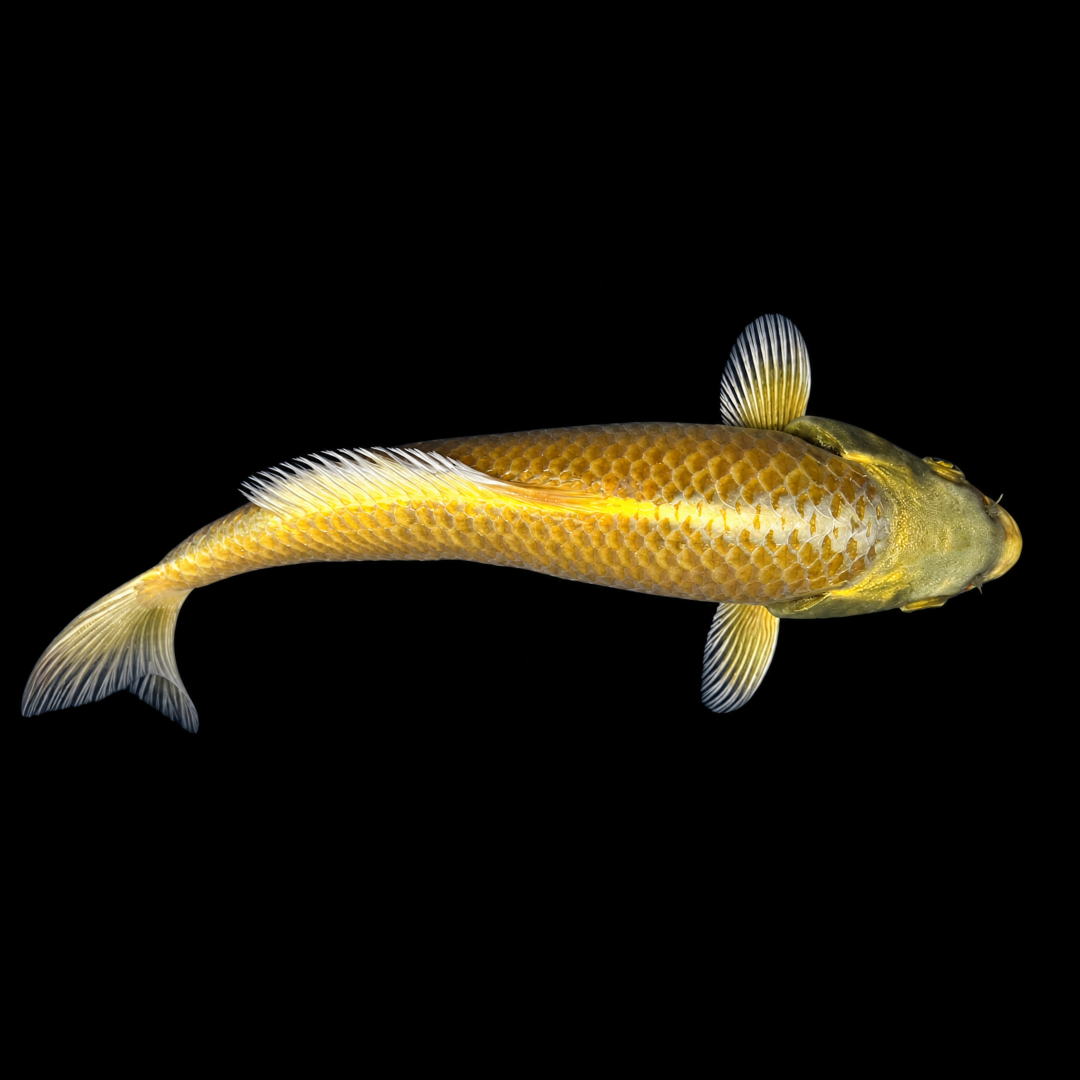
山吹黄金は、斑紋を持たず、全身が鮮やかな山吹色に光り輝く錦鯉です。金属光沢を持つ単色の錦鯉をまとめた「光り無地」の代表的な品種で、模様ではなく、体型、色の均一さ、肌の質、鱗の整い方そのものが見どころになります。成長すると60cmを超えることも珍しくない大型魚のため、長期飼育には庭池、または十分な水量と強力な濾過設備が必要です。一般的な室内水槽だけで生涯飼育する魚ではありません。Yamabuki Ogon is a nishikigoi variety with no markings, its entire body shining in the vivid golden yellow associated with yamabuki blossoms. It is one of the best-known varieties in the Hikari-muji group of single-colored metallic koi. Its appeal lies not in a pattern but in body conformation, even color, skin quality, and orderly scales. Because it is a large fish that commonly grows beyond 60 cm, lifelong care requires a pond or another exceptionally spacious system with powerful filtration. It is not suited to spending its entire life in an ordinary indoor aquarium.
基本情報 / Basic Information
学名 / Scientific Name
Cyprinus carpio(コイを観賞用に改良した錦鯉の一品種) (a domesticated ornamental variety of the common carp)
通称 / Common Name
山吹、ヤマブキ、山吹黄金Yamabuki, Yamabuki Ogon
分類 / Family
コイ目コイ科コイ属/錦鯉・光り無地Order Cypriniformes, family Cyprinidae, genus Cyprinus; Hikari-muji nishikigoi
英名 / English Name
Yamabuki Ogon, Yamabuki Koi
分布 / Distribution
自然分布を持たない改良品種。日本で作出・改良され、現在は世界各地で飼育・生産されています。A domesticated variety with no natural range. Developed in Japan and now kept and bred worldwide.
最大体長 / Max Size
一般に60〜90cmほど。血統と飼育環境に恵まれた大型個体では100cmを超えることがあります。Usually about 60–90 cm; exceptionally large fish from suitable bloodlines and environments may exceed 100 cm.
寿命 / Lifespan
飼育環境によって差があり、30〜40年ほど生きることもあります。Lifespan varies with husbandry conditions, and some koi live for about 30–40 years.
飼育環境 / Aquarium Environment
水槽サイズ / Tank Size
長期飼育は庭池が基本です。体長10cm前後の幼魚なら60cm規格水槽(約60L)でも一時的に観賞できますが、生涯飼育の設備にはなりません。成長に合わせて90cm規格水槽(約180L)、120cm規格水槽(約240L)などへ移し、最終的には十分な広さと水深を持つ池、または同等の大型設備を用意します。必要な水量は個体の大きさや尾数、濾過能力によって変わるため、固定した1尾あたりの水量だけで判断しないことが大切です。A pond is the standard choice for lifelong care. A juvenile of around 10 cm can be viewed temporarily in a Japanese 60-cm standard aquarium of about 60 L, but this is not a permanent home. As the fish grows, move it through larger facilities such as a 90-cm standard aquarium of about 180 L or a 120-cm standard aquarium of about 240 L, with a suitably spacious and deep pond or equivalent large-scale system as the eventual destination. Required water volume varies with fish size, stocking level, and filtration capacity, so it should not be judged by a single fixed volume-per-fish rule.
水温 / Temperature
季節による水温変化には適応しますが、急変は避けます。活発に成長する時期の管理水温は、おおむね18〜25℃が目安です。低水温では消化力が落ちるため、8℃以下では給餌を控えます。高水温期は溶存酸素が低下しやすいので、エアレーションを強化してください。Koi tolerate seasonal temperature changes, but abrupt shifts should be avoided. Roughly 18–25°C is a useful management range during active growth. Digestion slows in cold water, so withhold food at 8°C or below. Increase aeration during hot weather, when dissolved oxygen declines.
水質 / Water Quality
淡水。pHは6.8〜8.0程度を目安に、数値そのものよりも急変させないことを重視します。アンモニアと亜硝酸は検出されない状態を維持し、硝酸塩の蓄積を抑え、十分な溶存酸素を確保します。換水に使う水道水は必ず塩素を中和し、飼育水との温度差を小さくしてください。Freshwater. A pH of about 6.8–8.0 is a practical guide, but stability matters more than pursuing a particular number. Keep ammonia and nitrite undetectable, limit nitrate accumulation, and maintain ample dissolved oxygen. Always dechlorinate tap water used for water changes and minimize the temperature difference from the pond or aquarium.
レイアウト / Layout
広い遊泳空間を中心に、角や鋭い岩を避けた滑らかな構造にします。底はベアタンクまたは清掃しやすい仕上げが管理しやすく、砂利を使う場合も排泄物がたまらない構造が必要です。強力な物理・生物濾過、十分なエアレーション、日陰、飛び出し防止ネットを用意します。水草は掘り返したり食べたりするため、植栽区画を分けると安全です。Build the habitat around open swimming space and smooth surfaces, avoiding sharp rocks and tight corners. A bare or easily cleaned bottom is simplest; any gravel area must be designed so waste cannot accumulate. Provide strong mechanical and biological filtration, generous aeration, shade, and a secure jump-prevention net. Koi may uproot or eat plants, so separate planted zones are safer.
注意点 / Precautions
成長の速さと排泄量を小さく見積もらないことが重要です。濾過槽の点検と部分換水を定期的に行い、朝に水面で口をぱくつかせる「鼻上げ」、食欲低下、体表の充血、光沢のくすみを見逃さないようにします。新しい個体は既存魚とすぐに合流させず、別の飼育設備と器具を使って少なくとも4週間観察してください。屋外池では、サギやネコなどによる捕食への対策も必要です。Do not underestimate growth rate or waste production. Inspect the filtration system and perform partial water changes regularly, while watching for morning surface-gasping, reduced appetite, reddened skin, or a dulling sheen. Do not add new koi directly to an established collection; observe them for at least four weeks in a separate system with separate equipment. Outdoor ponds also need protection from herons, cats, and other predators.
餌と給餌 / Feeding
餌の種類 / Diet
主食は、成長段階と季節に合った錦鯉用の配合飼料です。低水温期には消化しやすい小麦胚芽配合飼料が使われます。色揚げ飼料にはスピルリナやアスタキサンチンなどを配合した製品がありますが、製品表示に従い、与えすぎないようにします。Use a formulated koi food suited to the fish’s growth stage and the season as the staple. Easily digested wheat-germ formulas are commonly used during cooler periods. Some color-enhancing foods contain ingredients such as spirulina or astaxanthin; follow the product directions and avoid overfeeding.
給餌のポイント / Feeding Tips
活動期は、数分で食べ切れる量を1日1〜3回に分けて与えます。水温が下がるほど量と回数を減らし、8℃以下では給餌を控えます。残餌はすぐに回収し、色揚げ飼料を使う場合も、体色の変化だけでなく、食欲、糞、水質を確認してください。急な増量は濾過槽の処理能力を超えるため避けます。During the active season, offer one to three small meals per day, limited to what the fish consume within a few minutes. Reduce both quantity and frequency as the water cools, and withhold food at 8°C or below. Remove leftovers promptly. When using color-enhancing food, monitor appetite, waste, and water quality as well as changes in body color. Avoid sudden increases that can overwhelm the biofilter.
性格と混泳 / Temperament and Tank Mates
性格 / Temperament
基本的に温和で、人にも慣れやすい社会性のある魚です。複数で泳ぐと落ち着きやすく、学習すると給餌時に人の姿へ寄ってきます。ただし底を探る力が強く、植物や柔らかなレイアウトを動かすことがあります。Generally peaceful, social, and capable of becoming very accustomed to people. Koi are often more settled in company and readily learn to approach a familiar person at feeding time. Their strong bottom-foraging behavior can, however, disturb plants and delicate decor.
混泳の相性 / Compatibility
同程度の大きさで、同じ水温帯を好む錦鯉同士が最も安全です。丈夫な和金型の金魚などと飼われる例もありますが、給餌競争、最終サイズ、病原体の持ち込みを考えると錦鯉中心の構成が管理しやすくなります。口に入る小魚や稚魚、動きの遅い観賞魚、ひれをかじる魚との混泳は避けてください。Other koi of similar size and temperature preference are the safest companions. They are sometimes kept with robust, single-tailed goldfish, but a koi-centered collection is easier to manage when feeding competition, adult size, and pathogen introduction are considered. Avoid tiny fish or fry that can be swallowed, very slow ornamental fish, and fin-nipping species.
病気と対策 / Diseases and Prevention
かかりやすい病気 / Common Diseases
白点病、吸虫類などの寄生虫症、エロモナス属細菌などが関わる潰瘍や鱗の逆立ち、カラムナリス症、水カビ病に注意します。錦鯉ではコイヘルペスウイルス病やコイ浮腫症候群も重要です。体を物にこすり付ける、ひれを閉じたままにする、底で動かない、えらの動きが速い、粘液が増える、潰瘍ができるといった変化が初期の手掛かりになります。Watch for white spot disease, flukes and other parasites, ulcers or raised scales associated with Aeromonas bacteria, columnaris disease, and water mold. Koi herpesvirus disease and carp edema virus disease are also important concerns in koi. Early clues include rubbing against objects, clamped fins, lethargy on the bottom, rapid gill movement, excess mucus, or skin ulcers.
対策と予防 / Prevention
水質と酸素を安定させ、過密と急な水温変化を避けることが基本です。新魚の隔離観察、網や容器の使い分け、毎日の行動と食欲の記録が感染拡大を防ぎます。症状だけでは寄生虫、細菌、ウイルスを区別できないため、異常魚は隔離し、可能であれば魚類を診られる獣医師や専門機関へ相談して、顕微鏡検査などで原因を確かめてから治療します。食塩や魚病薬も濃度、併用、対象病原体を誤ると魚や濾過バクテリアへ負担となるため、自己判断の一律処置は避けてください。Stable water quality and oxygen, sensible stocking, and avoidance of abrupt temperature changes are the foundations of prevention. Quarantine new fish, keep nets and containers separate, and record daily behavior and appetite. Because parasites, bacteria, and viruses cannot be reliably distinguished by outward signs alone, isolate affected fish and consult an aquatic veterinarian or qualified diagnostic service where possible; microscopic examination and other tests should guide treatment. Salt and fish medications can harm koi or biofilter bacteria when the concentration, combination, or target pathogen is wrong, so avoid one-size-fits-all treatment.
増やし方(繁殖) / Breeding
雌雄の判別 / Sexing
成熟魚では、雌は腹部に丸みと幅が出やすく、産卵期には生殖孔がやや大きく柔らかく見えます。雄は比較的細身で、繁殖期に胸びれやえらぶたへ白い追星が現れることがあります。ただし若魚や季節外では外見だけの判別が難しく、体型だけで断定はできません。In mature fish, females tend to become broader and rounder through the abdomen, and the vent may appear larger and softer during the spawning season. Males are often slimmer and may develop small white breeding tubercles on the pectoral fins and gill covers. Juveniles and out-of-season adults are difficult to sex, and body shape alone is not conclusive.
繁殖形態 / Reproduction
卵生のばらまき型です。春から初夏、水温の上昇をきっかけに、雄が雌を追って水草や産卵用ブラシへ粘着性の卵を産み付けます。親魚による卵や稚魚の保護はなく、むしろ食べてしまいます。An egg-scattering species. In spring to early summer, rising water temperature can trigger males to chase females, which deposit adhesive eggs on plants or spawning brushes. The parents provide no care and will eat eggs and fry.
繁殖のポイント / Breeding Tips
成熟した健康な親魚と、十分に広い専用池または繁殖槽、柔らかな産卵ブラシを用意します。産卵後は親魚または付着卵を速やかに分け、卵には穏やかな通水と酸素を確保します。ふ化後は口の大きさに合う微細な初期餌料へ段階的に切り替えます。山吹黄金らしい均一な色と光沢を得るには多数の稚魚から長期に選別する必要があり、家庭繁殖では親と同等の表現が必ず得られるわけではありません。Use mature, healthy broodstock, a spacious dedicated pond or spawning tank, and soft spawning brushes. After spawning, promptly separate the adults from the attached eggs, or move the eggs, and provide gentle water movement and oxygen. After hatching, introduce fine first foods suited to the fry’s mouth size and increase particle size gradually. Producing the even color and metallic quality expected of Yamabuki Ogon requires long-term selection from many fry; home-bred offspring will not necessarily equal their parents.
雑学と豆知識 / Trivia and Fun Facts
1. 「光り無地」という引き算の美学 / 1. The Restrained Beauty of Hikari-muji
全日本錦鯉振興会は、斑紋がなく全身が光り輝く錦鯉を「光り無地」としています。山吹黄金はその代表で、模様がないからこそ、ごく小さなシミや色むら、鱗列の乱れまで目に入りやすい品種です。見る人の視線は自然に、頭から尾びれの付け根までの体の流れ、肌の清らかさ、鱗の縁が網目状に見える覆鱗へ向かいます。華やかな色彩を持ちながら、評価の中心にあるのは、整った体と均一な質感です。The All Japan Nishikigoi Promotion Association places koi with no markings and an all-over metallic sheen in the Hikari-muji group. Yamabuki Ogon is a leading example. Precisely because there is no pattern, a tiny blemish, uneven color, or irregular scale row is easy to see. The eye is naturally drawn to the flow of the body from head to the base of the tail, the clarity of the skin, and the net-like fukurin edging around each scale. Despite its brilliant color, quality centers on balanced conformation and an even finish.
2. 金色は色素だけでは生まれない / 2. Gold Made by More Than Pigment
魚の金属的な輝きには、光を反射する細胞である虹色素胞と、その中に並ぶ板状のグアニン結晶が深く関わります。結晶とその周囲では光の屈折のしかたが異なり、層状に並んだ結晶が光を強く反射します。その反射に黄色の体色が重なることで、山吹黄金らしい金色に見えるのです。つまり、その輝きは色素だけでなく、鱗の中にある微細な構造によっても生み出されています。Metallic shine depends strongly on light-reflecting cells called iridophores and the plate-like guanine crystals arranged within them. Light bends differently through the crystals and the surrounding material, and the layered crystals produce strong reflection. Combined with the fish’s yellow coloration, that reflection appears as the gold of Yamabuki Ogon. In other words, its sheen is produced not only by color but also by microscopic structures within the scales.
3. 1947年の黄金が開いた新しい系譜 / 3. The 1947 Ogon That Opened a New Lineage
全日本錦鯉振興会の品種史には、1947年、新潟県古志郡竹沢村、現在の長岡市で、青木沢太氏が黄金鯉を作出したと記録されています。胸びれを金箔の扇のように輝かせた黄金鯉の系統は、その後、多くの光りものの改良に取り入れられました。山吹黄金の金属光沢には、戦後の育種家たちが新しい表現を磨き続けた歴史も重なっています。The All Japan Nishikigoi Promotion Association’s breed history records that Sawata Aoki produced an Ogon carp in 1947 in Takezawa Village, Niigata Prefecture, now part of Nagaoka City. The lineage of this Ogon, whose pectoral fins were likened to fans of gold leaf, was subsequently used in the development of many Hikarimono varieties. Yamabuki Ogon’s metallic sheen therefore also reflects the history of postwar breeders refining a new form of expression.
4. 山吹という名に宿る日本の色 / 4. A Japanese Color Carried in the Name Yamabuki
山吹は、春に鮮やかな黄橙色の花を咲かせる植物の名であり、その花色は古くから日本の伝統色として親しまれてきました。山吹黄金という名は、単に黄色い鯉という意味ではありません。少し赤みを含んだ、温かく深い黄色を一語で思い起こさせます。日の角度や水面の揺れで色が変わって見えるとき、その名と実物が見事に重なります。Yamabuki is the Japanese kerria, a shrub that produces vivid yellow-orange flowers in spring, and its flower color has long been recognized as a traditional Japanese hue. The name Yamabuki Ogon therefore conveys more than “yellow koi.” It evokes a warm, deep yellow with a touch of red. When sunlight and ripples make the fish’s tone appear to shift, the meaning of the name becomes visible in the living animal.
5. 長いひれへ受け継がれた黄金の光 / 5. Golden Light Inherited by Long Fins
1977年、当時皇太子だった上皇陛下が埼玉県水産試験場を視察した際、インドネシアのひれの長いコイと日本の錦鯉を交配する着想を示されました。埼玉県はその後に品種改良を進め、山吹やプラチナを含む光りもののヒレナガニシキゴイも生まれています。上見で面の光を味わう通常の山吹黄金に対し、ヒレナガでは横見の水槽でも光とひれの動きが重なり、同じ黄金系統に別の優雅さが加わりました。During a 1977 visit to the Saitama Prefectural Fisheries Experiment Station, the then Crown Prince, now Emperor Emeritus, suggested crossing long-finned Indonesian carp with Japanese nishikigoi. Saitama subsequently pursued the breeding program, producing long-fin Hikarimono types that include Yamabuki and Platinum forms. Standard Yamabuki Ogon offers broad planes of reflected light when viewed from above; in long-fin koi, that light combines with flowing fins and gains a different elegance when viewed from the side.
まとめ / Conclusion
山吹黄金の魅力は、華やかな金色と、模様に頼らない端正さが同居していることにあります。澄んだ水の中をゆったり進むとき、頭から尾までの均一な光沢と整った鱗が一枚の金属のようにつながり、池全体の印象まで明るく変えてくれます。Yamabuki Ogon’s appeal lies in the union of brilliant gold and disciplined simplicity. As it moves slowly through clear water, the even sheen and orderly scales join into a single metallic surface, brightening the character of the entire pond.
その輝きを長く保つには、色揚げ飼料よりも先に、余裕のある飼育空間、よく機能する濾過、十分な酸素、季節に合った給餌、毎日の観察を整えることが大切です。幼魚の愛らしさから大型魚の堂々とした姿へと成長する山吹黄金は、長く付き合うほど水辺の中心で確かな存在感を示してくれます。Preserving that shine begins not with color-enhancing food, but with ample living space, effective filtration, sufficient oxygen, seasonal feeding, and attentive daily observation. As Yamabuki Ogon grows from a charming juvenile into an imposing adult, it develops an increasingly assured presence at the heart of the water garden.






コメント