

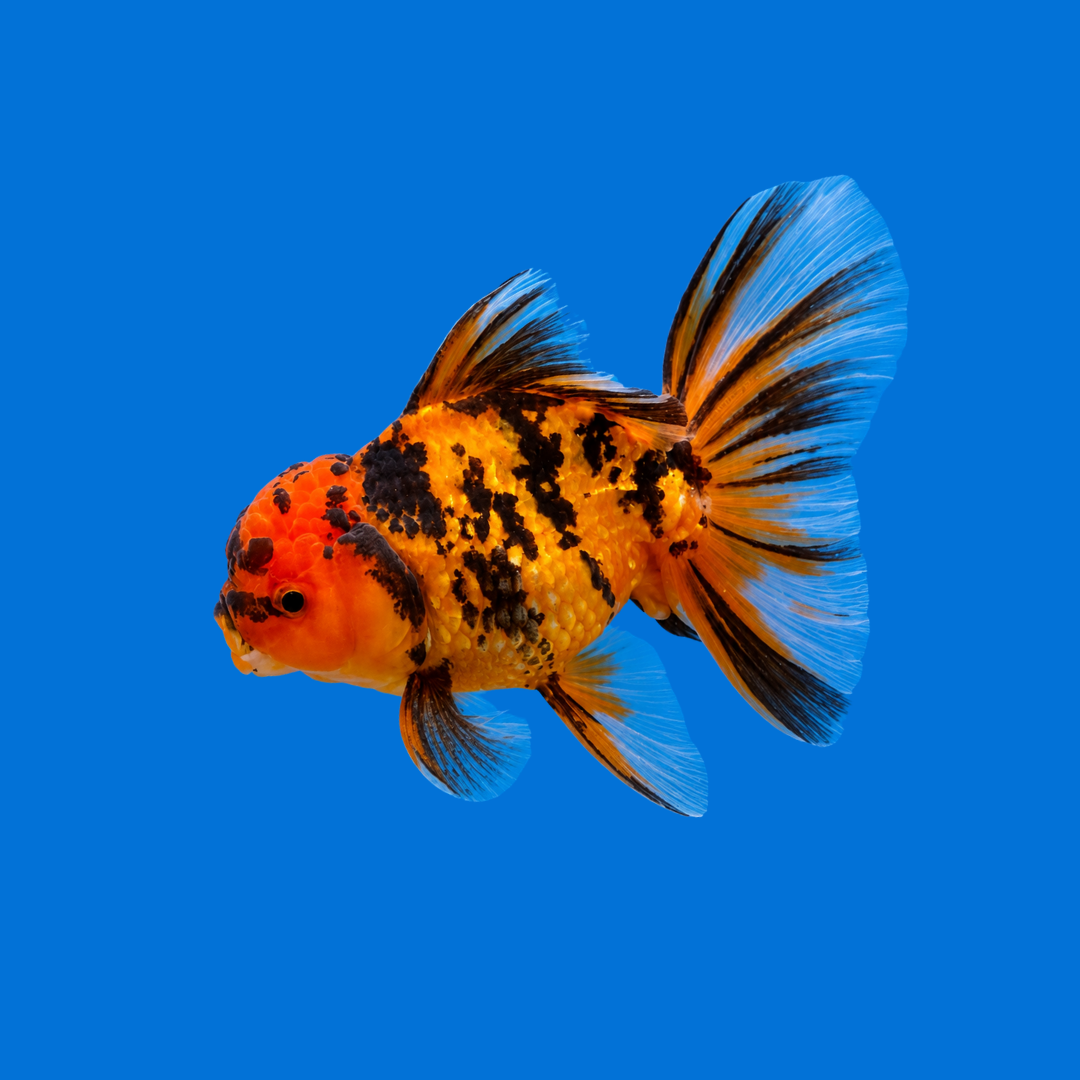
解説 / Description
タイガーオランダは、頭部に発達する肉瘤と背鰭を持つオランダ獅子頭の体型を基礎に、朱赤から橙色の地色へ黒い斑紋が不規則に入る「虎柄」を楽しむ金魚です。「タイガーオランダ」という呼称は独立した生物種や国際的に統一された固定品種名というより、国内外の観賞魚流通で用いられる色彩・系統名として理解すると分かりやすいでしょう。特にタイで選抜された個体には、丸く厚みのある体、豊かな肉瘤、花びらを重ねたように見えるローズテール、短く力強いショートテールなど、鑑賞性を重視した系統が多く見られます。黒斑は成長や飼育環境によって濃淡や面積が変化することがあり、購入時の模様が生涯そのまま固定されるとは限りません。その変化も含めて一匹ごとの個性を楽しめる一方、丸手の高級金魚らしく、水質悪化、過密飼育、急な水温変化、強すぎる水流には注意が必要です。 The Tiger Oranda is an ornamental goldfish based on the Oranda body type, with a dorsal fin and a prominent fleshy head growth known as a wen, combined with irregular black markings over a red to orange ground color that create a tiger-like pattern. “Tiger Oranda” is best understood as a trade and color-line name rather than a separate biological species or a universally standardized breed. Thai-selected lines are especially popular for their deep rounded bodies, substantial wen development, rose-tail forms with layered petal-like caudal fins, and powerful short-tail forms. The black markings may change in intensity and coverage as the fish grows or as its environment changes, so the juvenile pattern is not guaranteed to remain permanently unchanged. This variability is part of the appeal, but like other highly developed fancy goldfish, Tiger Orandas require careful management of water quality, stocking density, temperature stability, and water flow.
基本情報 / Basic Information
| 学名 / Scientific Name | Carassius auratus |
|---|---|
| 通称 / Common Name | タイガーオランダ、タイガー柄オランダ、タイ産タイガーオランダなど。流通上は尾型を示して「ローズテール・タイガーオランダ」「ショートテール・タイガーオランダ」と呼ばれることもあります。Tiger Oranda, tiger-pattern Oranda, Thai Tiger Oranda; trade names may also include Rose-tail Tiger Oranda and Short-tail Tiger Oranda. |
| 分類 / Family | コイ目・コイ科・フナ属。金魚はフナ類を祖先として千年以上にわたり家畜化・選択育種されてきた観賞魚で、タイガーオランダはそのオランダ獅子頭系統に属する観賞形質の一型です。Order Cypriniformes, family Cyprinidae, genus Carassius. Goldfish are domesticated ornamental descendants of crucian-carp lineages that have undergone more than a millennium of selective breeding; the Tiger Oranda belongs to the Oranda-type fancy goldfish group. |
| 英名 / English Name | Tiger Oranda Goldfish |
| 分布 / Distribution | 人為的に作出された観賞品種のため自然分布はありません。金魚そのものの家畜化は中国で始まり、オランダ獅子頭も中国系の金魚として発達しました。現在のタイガーオランダはタイ、中国、日本など複数地域で養殖・流通し、特にタイ産の選抜個体が日本の高級金魚市場でよく知られています。There is no natural distribution because this is a selectively bred ornamental form. Goldfish domestication began in China, and Oranda-type goldfish also developed from Chinese ornamental stocks. Tiger-pattern Orandas are now bred and traded in several countries including Thailand, China, and Japan, with selected Thai fish especially prominent in the Japanese premium market. |
| 最大体長 / Max Size | 一般的には全長15~25cmほど。大型の系統や十分な水量で長期飼育された個体では、尾鰭を含めて30cm前後に達することがあります。Commonly about 15–25 cm in total length. Large lines kept long-term in spacious systems may approach around 30 cm including the caudal fin. |
| 寿命 / Lifespan | 適切な環境では10年前後からそれ以上が期待でき、金魚全体では20年以上生きる例も知られています。強く改良された丸手個体では、体型や肉瘤の程度、日常管理によって健康寿命に大きな差が出ます。Around 10 years or more is achievable under good care, and goldfish in general are known to live beyond 20 years in exceptional cases. In highly selected deep-bodied fish, body conformation, wen development, and husbandry can strongly influence healthy lifespan. |
飼育環境 / Aquarium Environment
| 水槽サイズ / Tank Size | 若魚1匹でも60cm規格水槽の60Lクラスをひとつの最低目安とし、成魚をゆったり終生飼育するなら90cm規格水槽の150Lクラス以上が扱いやすくなります。複数飼育では体長だけでなく、濾過能力と水面積、換水頻度を含めて余裕を持たせてください。金魚鉢や小型容器での長期飼育には向きません。For a juvenile kept alone, a 60 cm standard aquarium in roughly the 60 L class can be considered a practical minimum starting point. For comfortable lifelong housing of an adult, a 90 cm standard aquarium around 150 L or larger is much easier to manage. When keeping multiple fish, allow extra capacity for filtration, surface area, and maintenance rather than relying only on body length. Small bowls are unsuitable for long-term care. |
|---|---|
| 水温 / Temperature | 18~24℃前後を安定して維持すると管理しやすく、十分に馴化した健康個体ではおおむね15~26℃程度の範囲に対応できます。重要なのは上限を攻めることではなく急変を避けることです。夏季に28℃を超える状態が続く場合は酸素不足と水質悪化に注意し、冬季の低水温では消化能力に合わせて給餌量を落とします。 A stable range around 18–24°C is easy to manage, while healthy acclimated fish can generally tolerate roughly 15–26°C. Avoiding sudden changes is more important than pushing the upper limit. Prolonged temperatures above 28°C increase the risk of low dissolved oxygen and rapid water deterioration, while feeding should be reduced as digestion slows in colder water. |
| 水質 / Water Quality | 中性から弱アルカリ性を基本とし、pH6.8~8.0程度の安定した水が扱いやすいでしょう。アンモニアと亜硝酸は検出されない状態を維持し、硝酸塩は定期換水によってできるだけ低く保ちます。目安として20~40mg/L未満を意識すると管理しやすいですが、数値だけでなく魚の呼吸、食欲、鰭の張り、粘膜の状態も観察してください。Stable neutral to mildly alkaline water is suitable, with roughly pH 6.8–8.0 being practical. Ammonia and nitrite should remain undetectable, and nitrate should be kept as low as practical through regular water changes. A working target below roughly 20–40 mg/L is useful, but behavior, respiration, appetite, fin posture, and skin condition should also be monitored rather than relying on a single number. |
| レイアウト / Layout | 掃除のしやすさを優先するならベアタンクが適しています。底床を使う場合は、誤飲しやすい中途半端な粒径や角の鋭い素材を避け、大粒で口に入らない砂利か、細かく滑らかな砂を選びます。肉瘤や長い尾鰭を傷つけないよう、尖った石や流木、狭い隙間は避けてください。濾過は十分な生物濾過量を確保しつつ、水流は強くしすぎず、エアレーションで酸素供給を補う設計が向いています。A bare-bottom setup is practical when ease of cleaning is the priority. If substrate is used, avoid sharp material and intermediate gravel sizes that can be swallowed; choose either particles too large to fit in the mouth or fine smooth sand. Avoid pointed rocks, rough wood, and tight gaps that may damage the wen or long fins. Provide strong biological filtration without excessive current and supplement oxygenation with gentle aeration. |
| 注意点 / Precautions | タイガー柄の黒斑は遺伝だけでなく、成長段階や背景色などの環境にも影響されます。黒い背景は短期から中期の体色を濃く見せる方向に働くことがありますが、黒抜けを永久に防げる保証はありません。体色維持だけを目的に極端な暗所飼育を行わず、1日8~10時間程度の規則的な照明と夜間の暗期を設けます。また、輸入個体や新規導入魚は最低でも数週間、可能なら3~4週間程度を目安に別水槽で観察し、食欲、白点、充血、鰭の傷み、異常な糞などがないことを確認してから合流させると安全性が高まります。Black patterning is influenced not only by genetics but also by growth stage and environmental factors such as background color. A dark background can promote a darker appearance over the short to medium term, but it cannot guarantee permanent prevention of black fading. Do not keep the fish in unnaturally dark conditions simply to preserve color; provide a regular photoperiod of about 8–10 hours of light with a true dark period at night. Newly imported or purchased fish are best observed in a separate quarantine aquarium for several weeks, ideally around three to four, before introduction to established stock. |
餌と給餌 / Feeding
| 餌の種類 / Diet | 主食は品質の安定した金魚用配合飼料を用います。丸手のオランダでは、水面で大量の空気を飲み込みにくい沈下性またはゆっくり沈むペレットが扱いやすい傾向があります。補助的に冷凍赤虫、ブラインシュリンプ、植物質を含む飼料などを少量組み合わせると食性に幅を持たせられます。朱赤を鮮やかにしたい場合は、アスタキサンチン、ゼアキサンチン、スピルリナなどカロテノイドを含む色揚げ飼料を適量利用できます。Use a reliable formulated goldfish diet as the staple. For deep-bodied Orandas, sinking or slowly sinking pellets are often convenient because they reduce frantic surface feeding and excessive air intake. Small amounts of frozen bloodworms, brine shrimp, and diets containing plant ingredients can be used as supplements. Color-enhancing foods containing carotenoids such as astaxanthin, zeaxanthin, or Spirulina may support red and orange coloration when used appropriately. |
|---|---|
| 給餌のポイント / Feeding Tips | 22℃前後で活発に泳ぐ時期は、1~2分程度で食べ切れる少量を1日2~3回に分ける方法が管理しやすく、成長期でも食べ残しを出さないことを優先します。低水温では消化が遅くなるため回数と量を減らし、急な冷え込みでは無理に与えません。肉瘤の大きさは遺伝的要因の影響が強く、高タンパク飼料を増やせば必ず大きくなるわけではありません。肥満や水質悪化を避けながら、成長に必要な栄養を継続的に供給することが重要です。色揚げ飼料も多用せず、白地の黄ばみや体調を見ながら調整します。At around 22°C during active growth, small portions that are consumed in roughly one to two minutes, offered two or three times per day, are easy to manage. Even during growth, avoiding leftovers should take priority over heavy feeding. Digestion slows in cold water, so reduce both frequency and amount and avoid forcing food during sudden temperature drops. Wen size is strongly influenced by genetics; simply increasing protein does not guarantee greater head growth. Provide balanced nutrition without promoting obesity or deteriorating water quality, and use color-enhancing diets moderately while watching for changes in pale or white areas. |
性格と混泳 / Temperament and Tank Mates
| 性格 / Temperament | 基本的には温和で、人に慣れると前面に寄って餌をねだる個体も多い金魚です。縄張り性は強くありませんが、餌の時間には押し合うことがあります。ローズテールや丸手のショートテールなど、体型が強く改良された個体は直線的な遊泳が得意ではなく、強い水流下では疲れやすい傾向があります。Generally peaceful and often very responsive to people, many individuals readily approach the front of the aquarium at feeding time. They are not strongly territorial, although they may jostle for food. Highly selected rose-tail and deep-bodied short-tail fish are not strong sustained swimmers and may tire in heavy current. |
|---|---|
| 混泳の相性 / Compatibility | 最も合わせやすいのは、オランダ獅子頭、琉金、東錦など泳力と餌の取り方が近い丸手の金魚です。和金、コメット、朱文金など細長く速く泳ぐ金魚と同居させると、タイガーオランダが餌を取り負けることがあります。肉瘤や尾鰭をつつく魚、吸着性の強い魚、温度要求が大きく異なる熱帯魚との混泳は避けるのが無難です。大きさに著しい差がある金魚同士も、追尾や接触事故を防ぐため分けた方が管理しやすくなります。The best companions are other fancy goldfish with similar swimming ability and feeding style, such as Orandas, Ryukins, and Azuma Nishiki-type fish. Fast single-tailed goldfish such as common goldfish, comets, and shubunkins may outcompete Tiger Orandas for food. Avoid species that nip fins or wen tissue, strongly attach to other fish, or require very different temperatures. Large size differences between goldfish also increase the risk of chasing and accidental injury. |
病気と対策 / Diseases and Prevention
| かかりやすい病気 / Common Diseases | 白点病、細菌性の体表炎・鰭腐れ・潰瘍、運動性エロモナス症に関連する松かさ症状、寄生虫症など、金魚で一般的な疾病に注意します。丸手の個体では、浮き袋そのものの病変だけでなく、消化管内容物、肥満、便秘、内臓疾患、水温変化などが関係する浮力異常も見られます。肉瘤では擦過傷、慢性的な炎症、過形成などが起こることがあり、極端に発達すると眼や鰓蓋周辺を覆って採餌や視認性に影響する場合があります。Watch for common goldfish problems such as ich, bacterial skin infections, fin rot, ulcers, dropsy-like signs associated with systemic disease including motile Aeromonas infections, and external parasites. In deep-bodied fish, buoyancy disorders may be associated not only with the swim bladder itself but also with gastrointestinal contents, obesity, constipation, internal disease, and temperature changes. The wen may suffer abrasions, chronic inflammation, or hyperplastic overgrowth, and extreme growth can interfere with vision or the opercular region. |
|---|---|
| 対策と予防 / Prevention | 最大の予防は、過密を避け、アンモニア・亜硝酸を出さず、定期換水と底部清掃を続けることです。新規導入魚は別水槽で観察し、器具の共用もできるだけ避けます。体調不良時はまず水温、水質、溶存酸素、外傷、糞、呼吸状態を確認し、病名を決めつけて複数薬剤を予防的に混用しないでください。塩水浴や観賞魚用治療薬が補助となる場合はありますが、濃度、対象疾病、使用期間は製品表示や獣医師・魚病に詳しい専門家の指示に従います。抗菌薬を無計画にローテーションする方法は薬剤耐性の観点から推奨できません。肉瘤が眼や鰓の動きを妨げるほど肥大した場合、切除は家庭で行わず、魚類診療に対応できる獣医師へ相談します。The most effective prevention is to avoid overcrowding, keep ammonia and nitrite at zero, and maintain regular water changes and bottom cleaning. Observe new arrivals separately and avoid sharing equipment where practical. When a fish becomes unwell, first check temperature, water chemistry, dissolved oxygen, injuries, feces, and respiration rather than immediately combining multiple medications. Salt support or approved ornamental-fish treatments may be useful in specific situations, but concentration, indication, and duration should follow the product label or advice from a veterinarian or qualified fish-health professional. Routine rotation of antibiotics is not recommended because of antimicrobial-resistance concerns. If excessive wen growth obstructs the eyes or opercular movement, surgical trimming should be left to a veterinarian experienced with fish. |
増やし方(繁殖) / Breeding
| 雌雄の判別 / Sexing | 平常時は外見だけで確実に見分けるのが難しい金魚です。繁殖期の成熟したオスでは、鰓蓋や胸鰭前縁に白い粒状の追星が現れやすく、メスを追尾する行動が増えます。成熟したメスは抱卵すると腹部がふっくらし、総排泄孔周辺がやや突出することがあります。ただし個体差が大きいため、ひとつの特徴だけで断定しないようにします。Sexing outside the breeding season can be difficult. Mature males commonly develop small white breeding tubercles on the opercula and leading rays of the pectoral fins and become more active in chasing females. Gravid females may appear fuller through the abdomen and may show a slightly protruding vent. Individual variation is considerable, so no single sign should be used as absolute proof. |
|---|---|
| 繁殖形態 / Reproduction | 卵生で、粘着性のある多数の卵を水草や産卵床へばらまくタイプです。親魚は卵や孵化仔魚を保護せず、むしろ食べてしまうため、採卵後は親魚と卵を分離します。繁殖期は一般に春から初夏にかけて起こりやすく、水温の上昇と日長の変化が刺激になります。They are egg-laying scatter spawners that release many adhesive eggs onto plants or spawning media. Parents do not guard the eggs or fry and may eat them, so adults should be separated from the eggs after spawning. Breeding activity is commonly strongest from spring into early summer, stimulated by rising temperature and seasonal changes in day length. |
| 繁殖のポイント / Breeding Tips | 繁殖を狙う場合は、冬から春にかけて親魚のコンディションを整え、十分な水量と酸素を確保した産卵水槽へ産卵モップなどを設置します。急激な昇温ではなく、季節に沿った緩やかな水温上昇を利用します。孵化仔魚は初期餌料から段階的に切り替え、成長差に応じて選別します。タイガー柄、肉瘤、体型、尾型は複数の遺伝要因と選抜の影響を受けるため、親魚が美しい虎柄でも同じ模様の仔が単純な比率で得られるわけではありません。特に黒斑は成長中に変化しやすいため、若魚期だけでなく継続的な選別が必要になります。For planned breeding, condition the broodstock through winter and spring and provide a spacious, well-oxygenated spawning aquarium with spawning mops or similar media. Use gradual seasonal warming rather than abrupt temperature increases. Feed fry appropriately through successive developmental stages and grade them as growth differences become apparent. Tiger patterning, wen development, body shape, and tail form are influenced by multiple genetic factors and selection, so two attractive parents will not produce identical offspring in a simple predictable ratio. Black markings can also change during growth, making repeated selection over time important. |
雑学と豆知識 / Trivia and Fun Facts
| 1. 「タイガーオランダ」は独立種ではない / 1. Tiger Oranda is not a separate species | タイガーオランダも普通のオランダ獅子頭も、生物学的には同じ金魚 Carassius auratus です。違いは、人が世代を重ねて選び続けた体型、尾型、肉瘤、鱗、色彩の組み合わせにあります。金魚では千年以上にわたる選択育種によって、野生のフナからは想像しにくいほど多彩な形態が生まれました。現代のゲノム研究でも、金魚の各系統が長い家畜化の中で複雑に分化してきたことが示されています。タイガーという言葉は、その巨大な遺伝的多様性の中から黒と朱赤のコントラストに価値を見いだした、観賞魚文化ならではの呼び名です。Tiger Orandas and conventional Orandas are biologically the same goldfish species, Carassius auratus. Their differences come from combinations of body shape, fin form, wen development, scale type, and pigmentation selected over generations. More than a thousand years of domestication have produced a remarkable range of forms far removed from the appearance of wild crucian carp. Modern genomic studies likewise show that goldfish lineages diversified through a long and complex history of artificial selection. The word “tiger” is therefore a hobby and trade description that celebrates the contrast of black with red-orange within this extraordinary domesticated diversity. |
|---|---|
| 2. なぜ中国生まれなのに「オランダ」なのか / 2. Why a Chinese goldfish is called “Oranda” | オランダ獅子頭は中国系の金魚として日本へ伝わったと考えられています。江戸時代の日本では、海外から来た珍しい品物に「オランダ」の名が付けられる例があり、異国的な外見を持つこの金魚も「オランダ獅子頭」と呼ばれるようになりました。つまり名前の「オランダ」は、現在の意味で生産国を示す産地表示ではありません。さらに面白いのは、日本語の「オランダ」がそのまま英語圏の品種名 Oranda として定着したことです。中国で育まれ、日本で名を与えられ、世界へ広がったという、金魚文化の国際交流を一語に閉じ込めたような名称です。The Oranda developed from Chinese goldfish stocks and was later introduced to Japan. During the Edo period, the word “Oranda,” literally Holland, could be associated with exotic imported goods, and this unusual lion-headed goldfish acquired the Japanese name Oranda-shishigashira. In other words, “Oranda” is not a modern country-of-origin label. The cultural twist is that the Japanese name was later adopted internationally as the English breed name “Oranda.” The name therefore carries a small history of ornamental-fish exchange: a Chinese-developed goldfish, named through Japanese cultural language, and then circulated around the world. |
| 3. 二ツ尾を生んだ遺伝子研究 / 3. The gene behind the twin-tail revolution | オランダの優雅な尾は、金魚史の中でも重要な「二ツ尾」系統の延長線上にあります。2014年の研究では、金魚の尾部骨格が左右に分岐する二ツ尾形質に、重複した chordin 遺伝子の一方に生じた終止コドン変異が深く関わることが示されました。歴史記録では二ツ尾金魚が明代に現れており、研究者は家畜化開始から数百年の間にこの珍しい変異が現れ、人の選択によって維持された可能性を論じています。ローズテールやショートテールはさらに後世の選抜で洗練された形ですが、その背景には、尾そのものの発生様式を変えた古い遺伝的出来事があります。The elegant Oranda tail belongs to the broader twin-tail tradition that transformed goldfish morphology. A 2014 study showed that bifurcation of the caudal axial skeleton is closely associated with a stop-codon mutation in one of the duplicated chordin genes of goldfish. Historical records place twin-tailed goldfish in the Ming period, and the researchers proposed that this rare mutation arose within several centuries after domestication began and was then preserved by human selection. Rose-tail and short-tail forms are much later refinements, but they ultimately stand on an ancient developmental change that altered how the tail region forms. |
| 4. 肉瘤は「脂肪のかたまり」ではない / 4. The wen is not simply a lump of fat | オランダの肉瘤は柔らかく見えるため、しばしば脂肪の塊のように説明されますが、組織学的にはもっと複雑です。2026年に掲載されたオランダなどの肉瘤組織の比較研究では、表皮の不規則な伸長、厚く疎な結合組織、コラーゲン線維、線維芽細胞、血管などから構成されることが示され、頭骨側にも形態変化が見つかりました。つまり肉瘤は、単なる「脂肪を付ければ大きくなる部分」ではなく、皮膚と結合組織の特殊な増殖形態です。大きさには遺伝的な素質が強く関わり、餌だけで理想の形へ自由に作り替えられるものではありません。Because the wen looks soft and fleshy, it is sometimes described as little more than stored fat, but histology shows a far more complex structure. A comparative study published in 2026 found irregular epidermal extensions, thick loose connective tissue, collagen fibers, fibroblasts, and blood vessels in Oranda-type wens, together with changes in underlying cranial morphology. The wen is therefore a specialized overgrowth of skin and connective tissue, not simply a fat deposit that can be enlarged at will through rich feeding. Genetic potential plays a major role in its final form. |
| 5. 虎柄の黒は環境で動くが、完全には支配できない / 5. Black pigment responds to the environment but cannot be fully controlled | 魚の体色には、黒色素胞の中でメラニン顆粒を広げるか集めるかという短期的な反応と、色素細胞や色素量そのものが変わる長期的な反応があります。金魚では黒い背景と白い背景で、α-MSHやMCHに関係する遺伝子発現が変化することが実験的に確認されています。このため暗い背景では黒が濃く見えやすく、明るい背景では淡く見えやすいという飼育上の経験には生理学的な裏付けがあります。ただし、タイガーオランダの成長に伴う恒久的な黒抜けを、背景色だけで必ず止められることまでは示されていません。ブラックタンクは「黒を維持するための補助条件」と考え、個体の遺伝的変化を尊重するのが現実的です。Fish color involves both rapid physiological responses, in which melanin granules disperse or aggregate within melanophores, and longer-term morphological changes in pigment cells and pigment abundance. In goldfish, experiments comparing black and white backgrounds have shown changes in expression of genes associated with α-MSH and MCH signaling. This supports the familiar observation that fish can appear darker against dark surroundings and paler against bright ones. What has not been demonstrated, however, is that background color alone can permanently stop age-related loss of black pattern in Tiger Orandas. A black tank is best treated as a supportive environmental factor rather than a guarantee that the original tiger pattern will be frozen for life. |
| 6. 2026年現在の日本の輸入防疫 / 6. Japanese import quarantine as of 2026 | 日本へ生きた金魚を輸入する場合、金魚その他のフナ属魚類は水産資源保護法に基づく輸入許可の対象です。2026年6月9日の制度改正後、金魚その他のフナ属で輸入防疫対象となる疾病は、コイ春ウイルス血症とレッドマウス病です。輸入者は原則として日本到着5日前までに、輸入許可申請書と輸出国政府機関発行の検査証明書を到着予定の空港・海港を管轄する動物検疫所へ提出します。タイ、中国などについては金魚を対象とする衛生条件が設定されています。なお、コイヘルペスウイルス病は現在の同表では「こい」の対象疾病で、金魚その他のフナ属の対象疾病としては列記されていません。一方、研究上は金魚でCyHV-3を検出した報告や媒介可能性を示した実験と、それを支持しない実験の両方があるため、飼育現場ではコイとの不用意な水系共有を避けるなど慎重な衛生管理が望まれます。Live goldfish imported into Japan fall under aquatic-animal import controls established under the Act on the Protection of Fishery Resources. Following the system revision effective June 9, 2026, the listed import-quarantine diseases for goldfish and other Carassius species are spring viremia of carp and enteric redmouth disease. In principle, importers submit an import permit application and an inspection certificate issued by the exporting country’s competent authority to the Animal Quarantine Service office responsible for the port of arrival at least five days before the fish reach Japan. Specific health requirements are established for goldfish from countries including Thailand and China. Koi herpesvirus disease is currently listed for carp, not for goldfish and other Carassius, in the Japanese target-disease table. Scientific studies on CyHV-3 in goldfish have produced conflicting evidence regarding infection and carrier potential, so cautious biosecurity and avoidance of unnecessary water sharing with koi remain sensible practices. |
| 7. ローズテールとショートテールは「分類名」より育種スタイル / 7. Rose-tail and short-tail are breeding styles rather than taxonomic ranks | タイ産オランダを探していると、ローズテール、ショートテール、ジャイアント、タイガーなど多くの呼称に出会います。これらは国際動物命名規約で定められた分類階級ではなく、ブリーダーや市場が鑑賞上の特徴を共有するための実用的な言葉です。ローズテールは尾鰭の分岐や重なりが豊かで、静止したときに花びらのようなボリュームを見せる個体を指すことが多く、ショートテールは短い尾と厚い尾筒、丸い体の力強さを評価します。同じ名前でもブリーダーごとに理想形が少しずつ異なるため、購入時は名称だけでなく、横見・上見の体型、尾筒の強さ、泳ぎ、肉瘤の左右差、黒斑の状態を実物で確認することが大切です。Anyone shopping for Thai Orandas will encounter terms such as rose-tail, short-tail, giant, and tiger. These are not formal taxonomic ranks governed by zoological nomenclature; they are practical breeding and trade terms used to communicate ornamental traits. Rose-tail usually refers to fish with richly divided and overlapping caudal fins that create a petal-like volume at rest, while short-tail lines emphasize a compact tail, strong caudal peduncle, and powerful rounded body. Because the ideal can vary from breeder to breeder, buyers should judge the actual fish rather than the label alone, checking side and top profile, peduncle strength, swimming balance, symmetry of the wen, and the present condition of the black pattern. |
まとめ / Conclusion
タイガーオランダの魅力は、獅子頭らしい豊かな肉瘤と丸い体、個性的な尾型、そして朱赤と黒が作る一匹ごとに異なる虎柄が同時に楽しめることにあります。とりわけタイ産の選抜個体は、ローズテールやショートテールといった現代的な育種スタイルによって、泳いでいるときだけでなく静止した姿にも強い存在感があります。黒斑は成長とともに変化する可能性がありますが、その変化を欠点としてだけ捉えず、遺伝と環境が形づくる生きた色彩として観察すると、この金魚ならではの奥深さが見えてきます。 The appeal of the Tiger Oranda lies in the combination of a substantial lion-like wen, rounded body, distinctive tail form, and an individual tiger pattern created by red-orange and black. Selected Thai fish in particular can show striking modern styles such as rose-tail and short-tail, giving them presence both in motion and at rest. Their black markings may change with age, but viewing that change not only as a defect but as living pigmentation shaped by genetics and environment reveals much of what makes these goldfish so fascinating.
長く美しく育てるために必要なのは、色を追いかける特殊な技法よりも、十分な水量、安定した水温、成熟した濾過、定期換水、過不足のない給餌、そして新しい魚を急いで混ぜない衛生管理です。こうした基本が整ってこそ、肉瘤も尾鰭も本来の魅力を保ちやすくなります。毎日の食欲や泳ぎ方、黒斑の濃淡まで小さな変化を眺めながら付き合うほど、タイガーオランダは水槽の中で唯一無二の個体へ育っていく金魚です。 The foundation for keeping a Tiger Oranda beautiful over the long term is not a special trick for forcing color, but generous water volume, stable temperature, mature filtration, regular water changes, balanced feeding, and careful quarantine of new fish. When these basics are in place, the wen and fins are far more likely to retain their best condition. Watching daily appetite, swimming balance, and even subtle changes in black markings allows the keeper to appreciate the fish as an individual that continues to develop throughout its life.

気になる道具や飼い方を見つけてみませんか?
 アイのアクアグッズ案内水槽のろ材の選び方|ウール・リング・活性炭の違いとおすすめ商品フィルターの中の綿や石は何をしている? アイとコタロウが、ウール・スポンジ・セラミック・焼結ガラス・活性炭・ゼオライトを比較。機種との相性、入れ方、洗い方と交換まで商品とともに紹介します。記事はコチラ →
 アイのアクアグッズ案内水槽用ヒーターの選び方|固定式・温度調節式と、水量に合うW数の考え方水槽の魚は冬に寒くない? アイとコタロウが水温計から固定式・温度調節式・分離式ヒーターまで比較。水量と室温に合うW数、設置場所、水換えや交換の注意点を、国内メーカーの商品とともに紹介します。記事はコチラ →
さまざまな飼育テーマをご紹介。リンク先の記事には広告・商品紹介が含まれます。
案内・紹介記事一覧へ →分布マップ
タイガーオランダ(Carassius auratus)は人為的に作出された観賞品種のため自然分布はありません。現在はタイ、中国、日本などで養殖・流通しており、地図ではこれらの主要地域を含む東アジア~東南アジアの概略範囲を示しています。
※この地図は記事内の分布情報をもとに、タイ・中国・日本などの養殖・流通地域を概略的に示したものです。表示範囲やマーカーは厳密な生息域を示すものではありません。また、マーカーの代表地点は実際の採集地点・養殖場・個体の産地を示すものではありません。
参考文献
- Chen, D. et al. (2020). “The evolutionary origin and domestication history of goldfish (Carassius auratus).” Proceedings of the National Academy of Sciences of the United States of America, 117(47), 29775–29785. DOI 分類、起源、家畜化、品種群の遺伝的関係。
- Froese, R. & Pauly, D. (eds.). FishBase. “Carassius auratus (Linnaeus, 1758).” FishBase 分類、分布、生息環境、食性、繁殖形態、体長・寿命に関する基礎情報。
- Royal Veterinary College, Exotics Service. “Goldfish Care.” Royal Veterinary College 水槽環境、水質、濾過、温度変化、給餌などの基本的な飼育管理。
- Kasagi, S., Mizusawa, K. & Takahashi, A. (2020). “The effects of chromatic lights on body color and gene expressions of melanin-concentrating hormone and proopiomelanocortin in goldfish (Carassius auratus).” General and Comparative Endocrinology, 285, 113266. DOI 背景色と体色変化、MCH・POMC系の反応に関する実験的知見。
- Kobayashi, M., Iwata, E. & Sorensen, P. W. (2026). “Environmental and Physiological Regulation of Reproduction in the Goldfish: Gonadal Development, Maturation, and Spawning Behavior: A Review.” Animals, 16(5), 775. DOI 成熟、産卵行動、水温・光周期など繁殖を支える環境・生理要因。
- Merck Veterinary Manual. “Management of Aquarium Fish.” Merck Veterinary Manual アンモニア・亜硝酸などの水質管理、濾過、検疫、導入時の衛生管理。
- Petty, B. D., Francis-Floyd, R. & Yanong, R. P. E. “Bacterial Diseases of Fish.” MSD Veterinary Manual. MSD Veterinary Manual エロモナス属を含む細菌性疾病、潰瘍、ストレス・水質悪化との関係、抗菌薬使用時の考え方。
- Mones, A., Schreeg, M., Sommer, S., Linder, K. & Lewbart, G. (2021). “Surgical management and histopathology of wen overgrowth and neoplasia in four oranda goldfish (Carassius auratus).” Veterinary Record Case Reports, 9(1), e27. DOI オランダ獅子頭の肉瘤過形成、腫瘍性病変、外科的管理に関する獣医学的症例報告。
- 農林水産省. 「水産輸入防疫制度について」. 農林水産省 2026年6月9日以降の対象水産動物・対象疾病。金魚その他のフナ属魚類におけるコイ春ウイルス血症、レッドマウス病の扱い。
- 動物検疫所. 「水産動物の検査について」. 動物検疫所 輸入許可申請、輸出国政府機関の検査証明書、到着前の申請期限、書類・現物検査などの現行手続。




コメント