

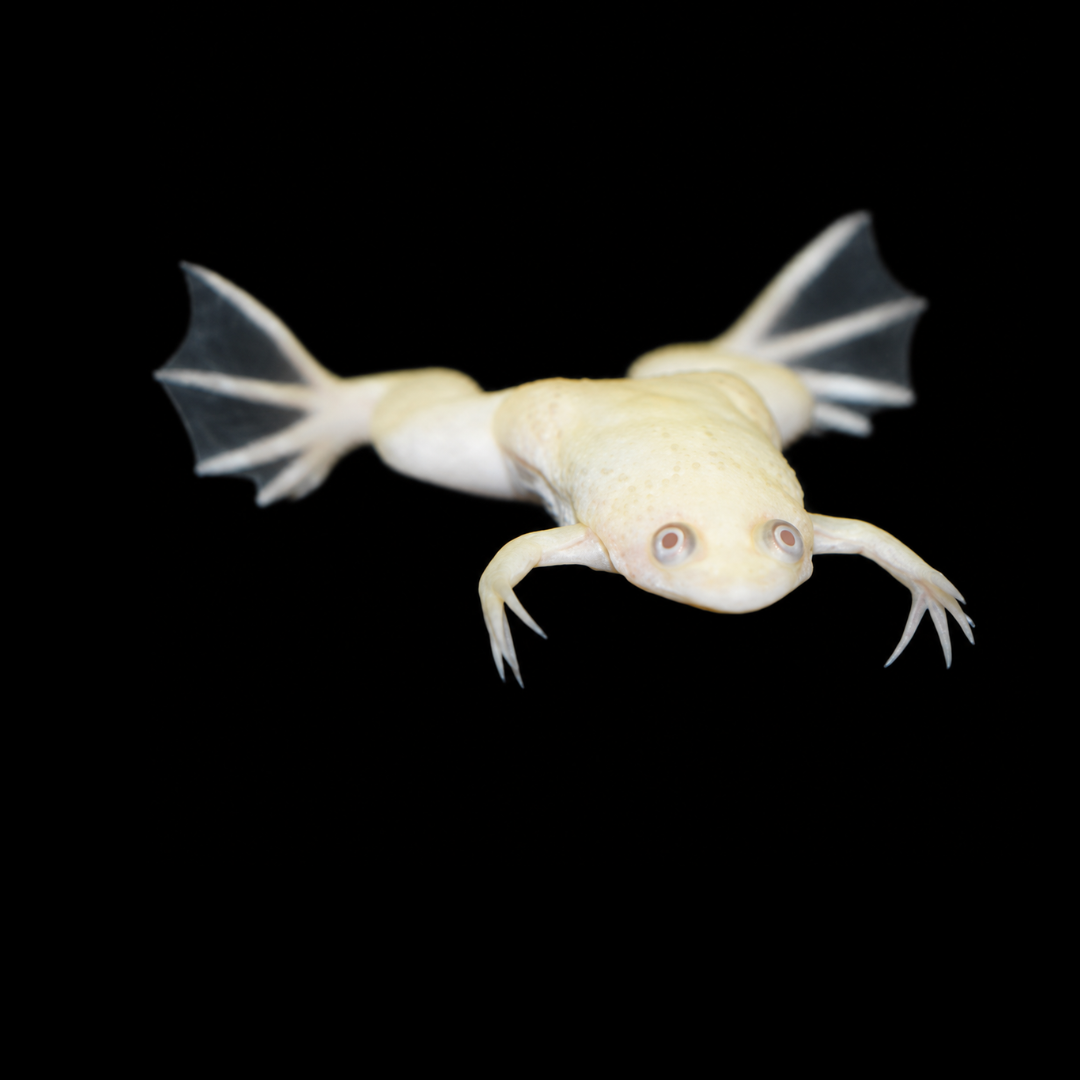
解説Description
アルビノツメガエルは、アフリカツメガエル Xenopus laevis に現れる白化型で、独立した種ではありません。乳白色から淡い桃色の体と赤みを帯びた眼が印象的ですが、その暮らしぶりは野生型と同じく徹底した水中生活です。平たい体、力強い後肢、後肢の内側3本の趾にある角質化した爪、成体まで残る側線器官など、水の中で生きるための特徴を全身に備えています。 The albino African clawed frog is a depigmented form of the African clawed frog, Xenopus laevis, rather than a separate species. Its milky-white to pale pink body and reddish eyes are striking, yet its lifestyle is the same highly specialized aquatic one seen in wild-type animals. A flattened body, powerful hind limbs, keratinized claws on the inner three toes, and a lateral-line system retained into adulthood are all adaptations to life in water.
丈夫で人工飼料にも慣れやすい一方、完全水生であるため「カエルらしい陸場」は必要なく、むしろ安定した水質、過度な高温を避けた水温、確実な脱走防止が飼育の中心になります。食欲は非常に旺盛で、小さな魚や水生動物を捕食する力も強いため、同居相手の選択には注意が必要です。また本種は、妊娠診断、発生学、クローン研究、ゲノム研究など生命科学の歴史を支えてきた代表的なモデル生物でもあります。かわいらしい外見の奥に、飼育動物としての扱いやすさと、研究史・進化史の奥深さが同居するカエルです。 Although hardy and readily trained to prepared foods, this species is fully aquatic, so it does not need the land area commonly associated with frogs. Stable water quality, avoidance of prolonged high temperatures, and secure escape prevention are the main priorities. Its appetite is strong and it can prey on small fish and other aquatic animals, so tankmates must be chosen with care. The species is also one of biology’s classic model organisms, contributing to the history of pregnancy testing, developmental biology, cloning, and genomics. Behind its gentle appearance lies an animal with both practical husbandry strengths and remarkable scientific significance.
基本情報Basic Information
| 学名Scientific Name | Xenopus laevis (Daudin, 1802) |
|---|---|
| 通称Common Name | アルビノツメガエル、アルビノアフリカツメガエル。流通上は単に「ツメガエル」「アルビノツメガエル」と呼ばれることもあります。Albino African clawed frog; albino form of the African clawed frog. |
| 分類Classification | カエル目(無尾目)・ピパ科・ツメガエル属。アルビノは Xenopus laevis の色彩変異で、分類学上の別種・別亜種ではありません。Order Anura, family Pipidae, genus Xenopus. The albino form is a color mutation of X. laevis, not a separate species or subspecies. |
| 英名English Name | Albino African Clawed Frog / African Clawed Frog |
| 分布Distribution | アフリカツメガエルはアフリカ中南部を原産とし、世界各地へ人為的に移入されています。アルビノ個体は主に飼育下で維持・流通しており、日本でも実験動物、観賞用、活餌用途などで扱われてきました。African clawed frogs are native to central and southern Africa and have been introduced by humans to many regions around the world. Albino individuals are maintained and distributed mainly in captivity and have also been used in Japan for research, pet keeping, and as feeder animals. |
| 成体サイズAdult Size | 吻端から総排泄口までの体長で、オスはおおむね5〜8cm前後、メスは8〜12cm前後が目安です。メスはオスより明らかに大型化し、よく育った個体ではさらに大きくなることがあります。Measured by snout-to-vent length, males are typically around 5-8 cm and females around 8-12 cm. Females are noticeably larger and well-grown individuals may exceed these typical sizes. |
| 寿命Lifespan | 長命なカエルで、飼育下では15年以上、条件に恵まれた個体では20年ほど生きる例が知られています。短期的なペットではなく、長く付き合う生き物として迎える必要があります。This is a long-lived frog. Captive individuals may live for 15 years or more, with some reaching around 20 years under favorable conditions. Keeping one should therefore be regarded as a long-term commitment rather than a short-term undertaking. |
飼育環境Enclosure Environment
| 飼育容器・サイズEnclosure and Size | 完全水生なので水槽で飼育します。成体1匹あたり7.5〜19L程度の水量を一つの目安としつつ、家庭飼育では水質を安定させやすい45cmクラス以上の水槽を単独飼育の目安にすると管理しやすくなります。複数飼育では60cmクラス以上を基準に、個体数と体格に合わせて余裕を持たせます。水深は成体が十分泳げ、容易に水面へ呼吸に上がれる20〜30cm程度が扱いやすい範囲です。必ず隙間の少ない蓋を使用してください。Because the species is fully aquatic, it should be kept in an aquarium. A water volume of roughly 7.5-19 L per adult can be used as a practical reference; for home husbandry, a tank around 45 cm long or larger is easier to keep stable for one adult. For groups, a 60 cm class aquarium or larger is a practical starting point, adjusted for body size and number of frogs. A water depth of about 20-30 cm gives adults room to swim while allowing easy access to the surface. Always use a secure, close-fitting lid. |
|---|---|
| 温度Temperature | 18〜22℃前後を中心に安定させると管理しやすく、16〜24℃程度を大きく外れない範囲が飼育の目安になります。急激な温度変化を避け、24℃を超える高温が長く続く環境はできるだけ避けます。夏季は室温管理、冷却ファン、必要に応じて水槽用クーラーなどで水温上昇を抑えます。A stable temperature around 18-22°C is a practical target, with roughly 16-24°C serving as a general husbandry range. Avoid abrupt temperature changes and prolonged exposure above 24°C. In summer, control room temperature and use fans or an aquarium chiller when necessary to limit heat buildup. |
| 環境管理Environmental Management | カルキ(塩素・クロラミン)を除去した水を使い、アンモニアと亜硝酸が蓄積しないよう生物ろ過と定期的な換水を行います。流れが強すぎると落ち着かないため、フィルターは穏やかな水流になるよう調整します。排泄量が多く食べ残しも水を汚しやすいので、底の汚れをこまめに吸い出す管理が有効です。銅を含む薬剤や重金属、洗剤・消毒剤の残留は両生類に有害になり得るため、水槽内に持ち込まないよう注意します。Use dechlorinated water with both chlorine and chloramine removed, and maintain biological filtration and regular water changes so ammonia and nitrite do not accumulate. Strong current can be stressful, so adjust filtration for gentle flow. These frogs produce substantial waste and uneaten food quickly fouls the water, making frequent siphoning useful. Avoid introducing copper-containing medications, heavy metals, soap, or disinfectant residues into the aquarium. |
| レイアウトLayout | 陸地は不要です。誤飲事故と掃除のしやすさを考えると、底砂を敷かないベアタンクが最も安全で管理しやすい方法です。レイアウトする場合は、口に入る大きさの砂利を避け、大きく滑らかな石や安定した隠れ家、丈夫な水草や人工植物などを使います。強い照明を直接当て続けるのは避け、陰になる場所や身を寄せられる場所を用意すると落ち着きやすくなります。鋭利な石や粗い装飾は皮膚を傷つけるため避けます。No land area is needed. A bare-bottom tank is the safest and easiest setup because it reduces substrate ingestion and simplifies cleaning. If decorating, avoid gravel small enough to swallow and use large smooth stones, stable shelters, and sturdy live or artificial plants. Avoid prolonged exposure to intense lighting and provide shaded or sheltered areas where the frogs can retreat. Avoid sharp or abrasive décor that can damage the skin. |
| 注意点Precautions | 脱走防止が最重要です。息継ぎの勢いで水面から飛び出したり、配線や器具のわずかな隙間を利用したりするため、蓋は確実に固定します。完全水生種なので、脱走後は短時間でも乾燥によって深刻なダメージを受けます。また、アフリカツメガエルは日本の外来種対策上も注意が必要です。2026年9月公表の環境省「生態系被害防止外来種リスト(第2版)」では「防除検討外来種」に位置づけられています。一方、外来生物法上の「特定外来生物」には指定されていません。野外への放逐・遺棄は行わず、飼育水や器具を介した病原体の拡散にも配慮してください。Escape prevention is critical. Frogs can launch themselves from the water while surfacing or exploit surprisingly small gaps around equipment, so the lid must be firmly secured. As a fully aquatic species, an escaped animal can suffer severe dehydration quickly. African clawed frogs also require care from an invasive-species management perspective in Japan. In the Ministry of the Environment’s September 2026 second edition of the Ecosystem Damage Prevention Alien Species List, the species is categorized as one for which control should be considered. It is not, however, designated as an Invasive Alien Species under Japan’s Invasive Alien Species Act. Never release or abandon captive frogs outdoors, and take care not to spread pathogens through wastewater or shared equipment. |
餌と給餌Feeding
| 餌の種類Diet | 主食はツメガエル用の完全栄養ペレットや、品質の良い沈下性の肉食魚用人工飼料が扱いやすいです。補助的にイトミミズ類、アカムシ、ミミズ、甲殻類などを利用できます。メダカや小魚、レバーなども食べますが、活魚は病原体持ち込みや栄養の偏り、レバー類は水質悪化と栄養バランスの偏りを招きやすいため、常用する主食には向きません。A complete pellet formulated for aquatic frogs, or a high-quality sinking carnivore pellet, makes the most practical staple. Earthworms, bloodworms, tubificid-type worms, and small crustaceans can be offered as variety. Small live fish and liver are readily eaten, but feeder fish may introduce pathogens or create nutritional imbalances, while liver fouls water quickly and is not a balanced staple. |
|---|---|
| 給餌のポイントFeeding Tips | 幼体は成長に合わせて少量を毎日〜1日おき、成体は週2〜4回程度を目安に、腹部や体つきを見ながら調整します。食欲が強く、与えれば食べ続けやすいので肥満に注意します。視力だけに頼らず水流や振動を感じて餌を探すため、沈む餌でもよく反応します。食べ残しは早めに回収し、給餌後に底の汚れを吸い出すと水質を保ちやすくなります。Juveniles can be fed small meals daily or every other day as they grow; adults are often maintained well on about two to four feedings per week, adjusted to body condition. Their appetite is strong and overfeeding can easily lead to obesity. Because they detect prey through water movement and vibration as well as vision, they readily find sinking foods. Remove leftovers promptly and siphon debris after feeding to protect water quality. |
行動と同居Behavior and Cohabitation
| 行動・性質Behavior | 水底で静止している時間が長い一方、給餌時や消灯後には活発に泳ぎます。肺呼吸のため定期的に水面へ上がり、すぐに水底へ戻る動きを繰り返します。舌を使って餌を捕ることはなく、側線器官で水の振動を捉え、前肢で餌を口へかき込む独特の摂餌行動を見せます。驚くと後肢の力で急加速し、後ろ向きに潜ることもあります。The frog often rests on the bottom for long periods but becomes much more active during feeding and after lights-out. Because it breathes air with lungs, it regularly rises to the surface and then returns to the bottom. It does not capture food with a tongue; instead, it detects water movement with its lateral-line system and uses the forelimbs to push food into the mouth. When startled it can accelerate powerfully and may dive backward. |
|---|---|
| 同居の相性Compatibility | 同種同士は、体格をそろえ、十分な水量と隠れ場所を確保すれば複数で飼育できます。単独飼育も可能ですが、複数飼育ではサイズ差と給餌時の競争に注意します。体格差が大きいと、噛みつき、餌の独占、小さい個体の捕食が起こることがあります。他種のカエル、小型魚、エビ、サンショウウオ類などとの混泳は、捕食、ストレス、病原体の持ち込みにつながるため勧められません。Conspecifics can be housed together when animals are similar in size and ample water volume and shelter are provided. Single housing is also possible, but groups require attention to size differences and competition at feeding time. Large size differences can lead to biting, food monopolization, or predation on smaller individuals. Mixed-species housing with other frogs, small fish, shrimp, or salamanders is not recommended because of predation, stress, and pathogen-transfer risks. |
病気と対策Diseases and Prevention
| かかりやすい病気・不調Common Diseases and Health Problems | 水質悪化に伴う皮膚炎や細菌感染、外傷、食べ過ぎによる肥満、異物誤飲による消化管障害などに注意します。ツメガエルでよく知られる重い症状の一つが、全身が風船のように膨らむ「鼓脹病」「むくみ」です。これは単一の病名というより、腎機能障害、循環不全、細菌感染などに伴う体液貯留の総称で、進行すると重篤です。また、カエルツボカビ Batrachochytrium dendrobatidis(Bd)を保有しても症状が目立ちにくい場合があり、他の両生類への感染源になり得る点にも注意が必要です。Watch for dermatitis and bacterial infections associated with poor water quality, injuries, obesity from overfeeding, and intestinal problems caused by swallowed foreign material. One serious syndrome in clawed frogs is generalized swelling, often called dropsy or balloon frog syndrome. This is not a single disease but a sign of abnormal fluid accumulation that may accompany kidney failure, circulatory problems, or bacterial infection. African clawed frogs may also carry the amphibian chytrid fungus Batrachochytrium dendrobatidis (Bd) with few obvious signs, creating a biosecurity risk for other amphibians. |
|---|---|
| 対策と予防Prevention and Care | 最大の予防は、安定した水温と清潔な水を維持し、過密・過食・急激な環境変化を避けることです。新しく迎えた個体は可能なら隔離期間を設け、網、スポイト、容器などの器具を他の両生類と共用しないようにします。皮膚の発赤や潰瘍、持続する食欲不振、異常な浮き沈み、急激な膨張が見られた場合は早めに隔離し、両生類を診療できる獣医師へ相談します。症状だけでは原因を特定しにくいため、自己判断で薬剤投与や塩浴を始めず、原因を見極めたうえで治療することが大切です。The strongest prevention is stable temperature, clean water, appropriate stocking density, moderate feeding, and avoidance of sudden environmental changes. Quarantine new frogs when possible and do not share nets, pipettes, containers, or other equipment with unrelated amphibians. Persistent redness, ulcers, loss of appetite, abnormal buoyancy, or rapid generalized swelling warrants prompt isolation and veterinary consultation with a clinician experienced in amphibians. Because these signs can have different causes, avoid starting medications or salt baths without a diagnosis and base treatment on the underlying problem. |
増やし方(繁殖)Breeding
| 雌雄の判別Sexing | 成熟するとメスの方が明らかに大型になり、総排泄口周辺の突起が目立ちます。オスは小柄で、繁殖期には前肢から指にかけて暗色の婚姻瘤が発達します。またオスは水中でクリック音のような求愛音を出します。若い個体では差が分かりにくいため、体格だけで断定しない方が安全です。Mature females are clearly larger and have a more conspicuous cloacal papilla. Males are smaller and develop dark nuptial pads along the forelimbs and fingers during breeding condition. Males also produce underwater clicking calls. Juveniles can be difficult to sex, so body size alone should not be treated as definitive. |
|---|---|
| 繁殖形態Reproduction | 水中でオスがメスを抱接し、メスが産む多数のゼリー層に包まれた卵へ体外受精します。自然下では降雨や水位変化などが繁殖のきっかけになり、飼育下でも大きめの換水や環境変化の後に繁殖行動が見られることがあります。卵は20〜25℃前後で2〜3日ほどで孵化し、幼生は成体とは異なって水中の微細な餌を濾し取るように食べます。変態にはおおむね6〜10週間ほどかかります。Breeding occurs underwater. The male clasps the female, and numerous jelly-coated eggs are externally fertilized as they are laid. In nature, rainfall and changes in water level can trigger reproduction, and captive frogs may also begin breeding after large water changes or other environmental shifts. At around 20-25°C, eggs hatch in roughly two to three days. Tadpoles feed very differently from adults, filtering fine suspended food from the water. Metamorphosis generally takes about six to ten weeks. |
| 繁殖のポイントBreeding Tips | 親は卵や幼生を食べることがあるため、産卵を確認したら親個体と卵を分けて管理します。孵化直後は卵黄を吸収するためすぐの給餌は不要で、自由遊泳を始めてから微細な人工飼料や適切な幼生用フードを少量ずつ与えます。高密度では水質が急変しやすいので、幼生期ほどこまめな換水と密度調整が重要です。研究施設ではゴナドトロピンを用いて排卵を誘発する方法が確立されていますが、家庭繁殖では薬剤投与を前提とせず、健康な種親と安定した環境を優先します。Adults may eat eggs and larvae, so once spawning is confirmed the parents and eggs should be separated. Newly hatched larvae rely on yolk reserves and do not need immediate feeding; begin small amounts of fine larval food once they become free-swimming. Crowded tadpoles can deteriorate water quality rapidly, making frequent water changes and density management especially important. Research facilities have established gonadotropin-based spawning protocols, but home breeding should focus on healthy adults and stable husbandry rather than injectable hormones. |
雑学と豆知識Trivia and Fun Facts
| 1. 白い姿は「別種」ではなく、遺伝子の働きで生まれる1. The white form is genetic, not a separate species | アルビノツメガエルには複数の系統が知られています。古くから研究に使われてきた「Periodic albino(周期性アルビノ)」では、色素顆粒の形成に関わる hps4 遺伝子の劣性変異が原因として特定されています。発生中には一時的に少量のメラニンが見られ、その後に色素が失われていくという、名前どおり少し変わった経過をたどります。現在は tyr(チロシナーゼ)遺伝子をゲノム編集したアルビノ系統も作られ、色素形成研究の目印として利用されています。Several albino lines are known. The classic “Periodic albino” line carries a recessive mutation in hps4, a gene involved in pigment-organelle biology. Small amounts of melanin can appear during development and then fade, giving the line its unusual name. Modern genome-editing methods have also produced albino lines by disrupting tyr (tyrosinase), allowing pigmentation itself to serve as a visible genetic marker. |
|---|---|
| 2. 1つの体に2組の祖先ゲノムを残す「異質四倍体」2. An allotetraploid frog with two ancestral subgenomes | アフリカツメガエルは36本の染色体を持つ異質四倍体として知られます。遠い祖先で近縁な2系統が交雑し、その後にゲノム全体が重複した結果、現在の細胞にはLとSと呼ばれる2つのサブゲノムが共存しています。同じ役割を持つ遺伝子が2組残ることも多く、「重複した遺伝子が進化の中でどう役割分担していくのか」を調べる格好の材料になっています。African clawed frogs are famous allotetraploids with 36 chromosomes. Their evolutionary history involved hybridization between two ancestral lineages followed by whole-genome duplication, leaving two subgenomes known as L and S. Many genes therefore remain in duplicated pairs, making the species a valuable system for studying how duplicated genes divide, retain, or change their functions over evolutionary time. |
| 3. 舌がないから、前足で餌を「口へ押し込む」3. No tongue: food is pushed into the mouth by hand | 多くのカエルのイメージに反して、ピパ科のツメガエルには飛び出す舌がありません。捕食時には、水の振動を捉えて獲物へ近づき、口へ吸い込みながら前肢でかき込む動作を組み合わせます。水槽で餌を食べるときに前足をせわしなく動かす姿は、完全水生生活に適応した独特の摂餌行動そのものです。Unlike the familiar image of a frog snapping out a tongue, pipid frogs such as Xenopus lack a protrusible tongue. During feeding they detect water movement, approach prey, draw it toward the mouth, and use the forelimbs to push it inward. The busy hand movements seen at feeding time are a characteristic part of this highly aquatic feeding strategy. |
| 4. かつて「妊娠検査をするカエル」だった4. The frog that once performed pregnancy tests | 20世紀半ば、アフリカツメガエルは妊娠診断に世界中で使われました。妊婦の尿に含まれるhCGに反応してメスが排卵・産卵する性質を利用した「ホグベン試験」です。結果が目で確認でき、同じ個体を繰り返し使えたことから広く普及しました。この医療利用が大量輸送と世界的な飼育拡大につながり、その後のモデル生物としての地位を押し上げる一因にもなりました。During the mid-20th century, African clawed frogs were used worldwide in pregnancy testing. In the Hogben test, females responded to human chorionic gonadotropin (hCG) in urine by ovulating and laying eggs. The result was easy to see and the same frog could be used again after recovery, which helped the method spread widely. This medical use also drove large-scale international transport and helped establish the species as a major laboratory animal. |
| 5. クローン研究からiPS細胞へつながる歴史5. From nuclear transfer to the age of iPS cells | ジョン・ガードンはツメガエルを使った核移植実験で、分化した体細胞の核にも個体全体をつくる遺伝情報が残っていることを示しました。この考え方は「細胞の状態は巻き戻せる」という再プログラム化研究へつながり、のちのiPS細胞研究と同じ大きな流れを形づくります。ガードンは2012年、山中伸弥博士とともにノーベル生理学・医学賞を受賞しました。John Gurdon’s nuclear-transfer experiments in clawed frogs demonstrated that nuclei from differentiated cells can still retain the genetic information needed to make an entire organism. This helped establish the idea that a specialized cell state can be reprogrammed, forming part of the intellectual path that eventually led to iPS-cell research. Gurdon shared the 2012 Nobel Prize in Physiology or Medicine with Shinya Yamanaka. |
| 6. 日本でも現役の重要なバイオリソース6. Still a major biological resource in Japan | 日本では広島大学両生類研究センターを代表機関とするナショナルバイオリソースプロジェクト(NBRP)で、アフリカツメガエルを含むツメガエル類の系統が保存・提供されています。胚が大きく、顕微注入や発生観察などの操作を行いやすいことは今も大きな強みです。より小型で二倍体のネッタイツメガエルが遺伝学で広く使われるようになった現在も、アフリカツメガエルは発生学や細胞生物学で独自の価値を保っています。In Japan, the National BioResource Project (NBRP), led for this resource by Hiroshima University’s Amphibian Research Center, maintains and distributes research lines that include African clawed frogs. Their large embryos remain especially useful for microinjection and direct developmental manipulation. Even as the smaller diploid Xenopus tropicalis has become prominent in genetics, X. laevis retains distinctive strengths in developmental and cell biology. |
| 7. ツボカビ世界拡散説は、今ではより複雑に考えられている7. The chytrid-spread story is more complex than once thought | アフリカツメガエルはBdに感染しても明瞭な症状を示さないことがあり、1938年採集の南アフリカ標本から感染が確認されたことや、20世紀に本種が大量輸出された歴史を背景に、かつては本種を介した「Out of Africa」仮説が提唱されました。その後、Bdの全ゲノム解析から、世界的流行につながった系統の起源は東アジア、とくに朝鮮半島に求められるという有力な結果が示されています。そのため、アフリカツメガエルだけを世界拡散の主要因とみなす説明は現在では適切ではありません。一方で、両生類の国際移動が病原体の拡散経路になり得ること自体は明らかであり、飼育個体や飼育水を自然環境へ出さないことは重要です。African clawed frogs can carry Bd without obvious clinical signs, and infection in a South African specimen collected in 1938, together with the species’ large-scale 20th-century export, helped give rise to an influential “Out of Africa” hypothesis. Later whole-genome analyses provided strong evidence that the lineage associated with the global panzootic originated in East Asia, particularly the Korean peninsula. It is therefore no longer appropriate to present African clawed frogs alone as the principal cause of worldwide spread. What remains clear is that international amphibian movement can transport pathogens, so captive frogs and their water must never be released into natural environments. |
まとめConclusion
アルビノツメガエルは、白く柔らかな印象の体色とは対照的に、力強い遊泳力と旺盛な食欲、完全水生生活に適応した感覚器官を備えた個性的なカエルです。飼育で大切なのは、清潔で安定した水、適温の維持、誤飲しにくいレイアウト、そして確実な脱走防止です。長寿なため、短期的な飼いやすさだけでなく、何年も安定して維持できる環境を整えることが重要です。 The albino African clawed frog combines a soft, pale appearance with powerful swimming, a strong appetite, and sensory systems adapted to a fully aquatic life. Good husbandry depends on clean stable water, appropriate temperature, an ingestion-safe layout, and reliable escape prevention. Because the species is long-lived, the enclosure should be planned for stable care over many years rather than short-term convenience.
水面へ静かに息継ぎに上がり、餌の気配を感じると力強く動き出す姿には、研究動物という側面だけでは語り切れない本種らしさがあります。安全な飼育環境を保ち、野外へ出さず、その独特の行動を長く観察していくことで、完全水生のカエルならではの魅力がよりはっきりと見えてきます。 Watching one rise quietly for air and then become powerfully active at the first hint of food reveals a side of the species that cannot be captured by its reputation as a laboratory animal alone. By maintaining a secure captive environment, never releasing it outdoors, and observing its distinctive behavior over the long term, the appeal of this fully aquatic frog becomes increasingly clear.

気になる道具や飼い方を見つけてみませんか?
 アイのアクアグッズ案内バルブの仲間に合わせる飼育用品|チェリーバルブ・スマトラ・中型種の水槽とろ過道具の特徴や使い方、選ぶときのポイントをアイが紹介します。記事はコチラ →
 アイのアクアグッズ案内水槽のろ材の選び方|ウール・リング・活性炭の違いとおすすめ商品フィルターの中の綿や石は何をしている? アイとコタロウが、ウール・スポンジ・セラミック・焼結ガラス・活性炭・ゼオライトを比較。機種との相性、入れ方、洗い方と交換まで商品とともに紹介します。記事はコチラ →
 アイのアクアグッズ案内小型カラシンの群れを楽しむ|餌と水換えから考える飼育用品ガイド小型カラシンの群れを眺める時間を、もっと楽しく。泳ぐ余白、餌の食べ方、続けやすい水換えを軸に、日本で揃えやすい用品の選び方を紹介します。記事はコチラ →
 アイのアクアグッズ案内マジックリーフ物語|一枚の葉がアクアリウム用品になるまで道具の特徴や使い方、選ぶときのポイントをアイが紹介します。記事はコチラ →
さまざまな飼育テーマをご紹介。リンク先の記事には広告・商品紹介が含まれます。
案内・紹介記事一覧へ →分布マップ
アフリカツメガエル(Xenopus laevis)はアフリカ中南部を原産とし、人為的な移入によって世界各地にも分布しています。アルビノ個体は主に飼育下で維持・流通しているため、下の地図では本種の原産地域であるアフリカ中南部を中心に概略表示しています。
※この地図は分布域を把握するための概略表示です。マーカーは原産地域を示すための代表地点であり、実際の採集地点や特定個体の産地を示すものではありません。また、人為的に移入された世界各地の分布を網羅したものではありません。
参考文献
-
Frost, D. R. Xenopus laevis (Daudin, 1802). Amphibian Species of the World 6.2: an Online Reference, American Museum of Natural History.
分類・学名の確認。
https://amphibiansoftheworld.amnh.org/Amphibia/Anura/Pipidae/Dactylethrinae/Xenopus/Xenopus-laevis -
Measey, G. J. & Tarrant, J. (2025). Xenopus laevis. The IUCN Red List of Threatened Species 2025: e.T110466172A248905894.
原産分布、生息環境、移入分布などの確認。
https://doi.org/10.2305/IUCN.UK.2025-2.RLTS.T110466172A248905894.en -
McNamara, S., Wlizla, M. & Horb, M. E. (2018). Husbandry, General Care, and Transportation of Xenopus laevis and Xenopus tropicalis. Methods in Molecular Biology, 1865, 1–17.
水温、水質、飼育密度、給餌、清掃、健康観察、隔離などの飼育管理。
https://doi.org/10.1007/978-1-4939-8784-9_1 -
Reed, B. T. (2005). Guidance on the Housing and Care of the African Clawed Frog, Xenopus laevis. RSPCA Research Animals Department.
飼育環境、給餌頻度、レイアウト、行動、福祉上の注意点などの確認。
https://www.rspca.org.uk/webContent/staticImages/Downloads/GuidanceXenopusLaevisReport.pdf -
Shaidani, N.-I., McNamara, S., Wlizla, M. & Horb, M. E. (2021). Obtaining Xenopus laevis Eggs. Cold Spring Harbor Protocols, 2021(3), pdb.prot106203.
成熟個体の採卵、ゴナドトロピンによる排卵誘発など繁殖生理・研究繁殖法の確認。
https://doi.org/10.1101/pdb.prot106203 -
Hill, W. A., Newman, S. J., Craig, L., Carter, C., Czarra, J. & Brown, J. P. (2010). Diagnosis of Aeromonas hydrophila, Mycobacterium species, and Batrachochytrium dendrobatidis in an African Clawed Frog (Xenopus laevis). Journal of the American Association for Laboratory Animal Science, 49(2), 215–220.
細菌感染、皮膚病変、カエルツボカビ感染など疾病面の確認。
https://pmc.ncbi.nlm.nih.gov/articles/PMC2846011/ -
環境省(2026)「生態系被害防止外来種リスト(第2版)」および「『生態系被害防止外来種リスト(2026年改訂版)』の公表について」。
日本国内における外来種としての位置づけと、野外放逐を避けるべき注意点の確認。
https://www.env.go.jp/nature/intro/2outline/iaslist.html
参照日:2026年9月20日




コメント