

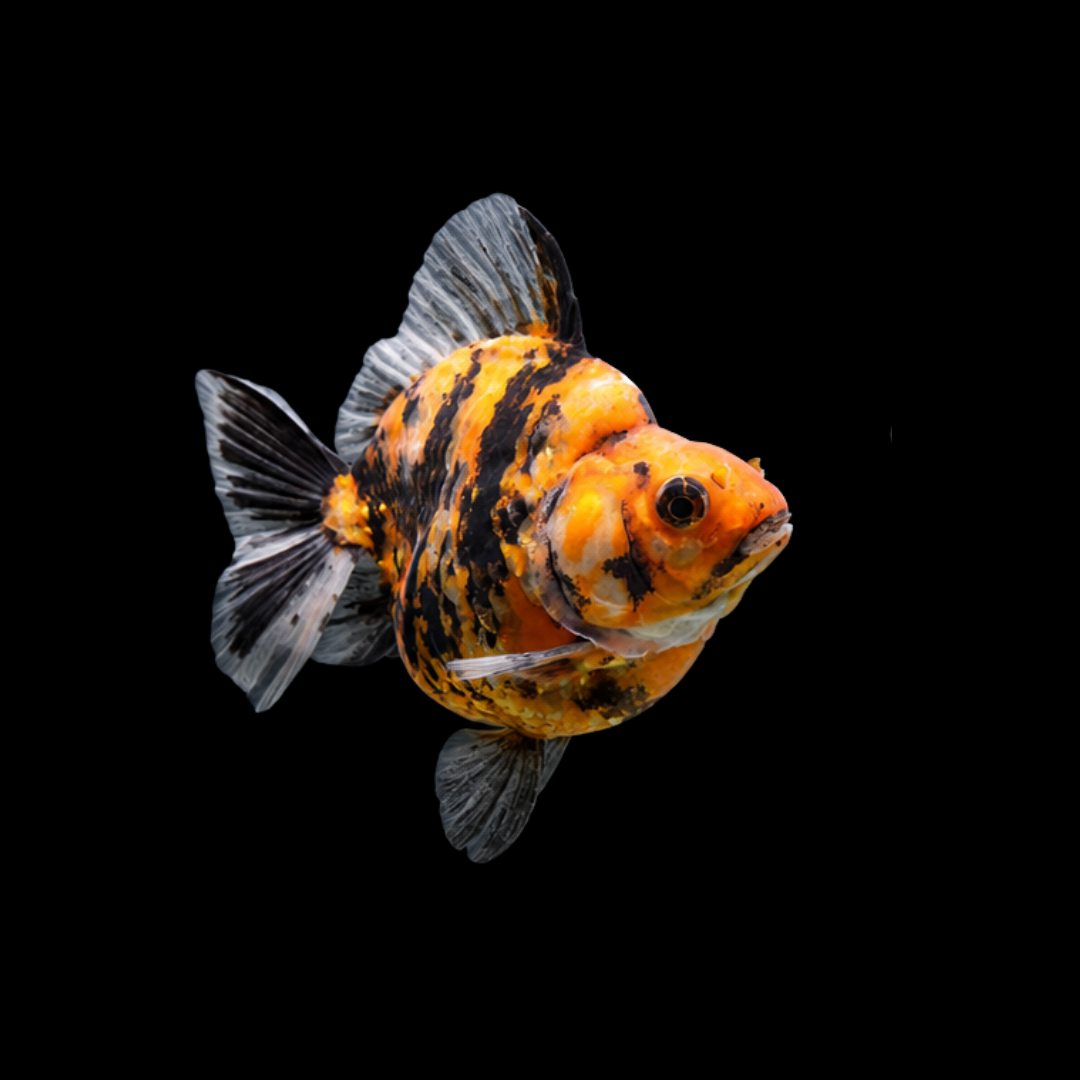
解説 / Description
だるま琉金タイガーは、琉金らしい高い体高と背中の盛り上がりを残しながら、胴を短く丸く仕上げた「だるま体型」と、赤地に黒い斑紋が走るタイガー柄をあわせ持つ改良金魚です。ショートテール琉金の一系統として流通することが多く、横見で際立つ球状のシルエットと、個体ごとに異なる赤と黒のコントラストが最大の魅力です。黒色は成長や飼育環境によって変化しやすく、模様が一生同じとは限りません。その変化も含めて、一尾ごとの個性を楽しむ観賞魚といえます。 Daruma Ryukin Tiger is a selectively bred goldfish that combines the high-backed form of the Ryukin with an extremely short, rounded body and a red-and-black tiger-like pattern. It is commonly traded as a short-tail Ryukin type and is especially striking when viewed from the side, where its compact, almost spherical silhouette is most apparent. The black areas may change as the fish grows or as environmental conditions change, so the pattern is not necessarily permanent. This changing coloration is part of the individuality of each fish.
基本情報 / Basic Information
| 学名 / Scientific Name | Carassius auratus |
|---|---|
| 通称 / Common Name | だるま琉金タイガー、タイガーだるま琉金、ショートテール琉金・虎柄Daruma Ryukin Tiger, Tiger Short-tail Ryukin |
| 分類 / Family | コイ科・フナ属の金魚改良品種Family Cyprinidae; a domesticated variety of goldfish in the genus Carassius |
| 英名 / English Name | Short-tail Ryukin Goldfish / Tiger-pattern Ryukin Goldfish(descriptive names) |
| 分布 / Distribution | 野生分布はなく、人為選抜によって維持される観賞用品種です。日本国内では国産個体に加え、中国やタイなどで生産された個体も流通します。It has no natural wild distribution and is maintained through selective breeding. In Japan, both domestically bred fish and imported fish from countries such as China and Thailand are traded. |
| 最大体長 / Max Size | ファンシー金魚の一種として、成長すると20cm前後に達することがあります。だるま琉金タイガーでは体長だけでなく、体高と胴の厚みが見た目のボリュームを大きく左右します。As a fancy goldfish variety, it may grow to around 20 cm. In Daruma Ryukin Tiger, visual mass is strongly influenced by body depth and thickness as well as body length. |
| 寿命 / Lifespan | だるま琉金タイガーだけを対象とした寿命データは見当たりません。ファンシー金魚全般では6〜8年程度の飼育例が多く、良好な環境でさらに長く生きる例も報告されています。寿命は水質、給餌、体調管理などに大きく左右されます。There is no well-established lifespan data specific to Daruma Ryukin Tiger. Fancy goldfish are commonly reported to live around 6–8 years, with some individuals living considerably longer under good conditions. Lifespan is strongly influenced by water quality, feeding, and overall health management. |
飼育環境 / Aquarium Environment
| 水槽サイズ / Tank Size | 成魚1尾では100L前後をひとつの目安とします。60cm規格水槽(約60L)は終生飼育には余裕が少ないため、成長後は90cm規格水槽など、100L以上を確保しやすい水槽を検討します。複数飼育ではさらに水量を増やします。金魚は排泄量が多いため、水量の余裕は水質の安定にもつながります。For one adult, around 100 L is a useful benchmark. A standard 60 cm aquarium of roughly 60 L offers limited room for lifelong housing, so a larger tank that comfortably exceeds 100 L should be considered as the fish grows. Provide additional volume for each extra fish. Goldfish produce substantial waste, so greater water volume also helps maintain stable conditions. |
|---|---|
| 水温 / Temperature | ファンシー金魚全般では15〜23℃程度が飼育しやすい範囲とされ、より広い温度にも徐々に順応できます。だるま琉金タイガーだけに22〜26℃を通年維持する必要があるという根拠は確認できません。ヒーターは必須ではありませんが、室温が大きく下がる場所や急変しやすい環境では、水温を安定させる目的で使用します。 For fancy goldfish in general, about 15–23°C is considered an easy-to-manage range, although they can gradually acclimate to a wider range. There is no clear basis for requiring Daruma Ryukin Tiger to be kept at 22–26°C year-round. A heater is not always necessary, but it can be used to prevent large or rapid temperature changes in a cold room. |
| 水質 / Water Quality | pH6.5〜8.5程度を目安にし、アンモニアと亜硝酸は検出されない状態を保ちます。十分な生物ろ過を確保し、週1回・約25%の部分換水を出発点として、水質検査や飼育数に応じて調整します。数値を無理に動かすより、急変を避けて安定させることが重要です。Aim for approximately pH 6.5–8.5, with ammonia and nitrite kept at undetectable levels. Provide adequate biological filtration and use a weekly partial water change of about 25% as a starting point, adjusting according to water tests and stocking level. Stability is more important than forcing the water toward an exact number. |
| レイアウト / Layout | 強い水流を避け、広い遊泳空間を確保します。フィルターの吐出口にはフローパイプやスポンジなどを使い、水流を拡散させると安心です。タイガー柄の黒色を見せやすくする目的では、黒や濃紺の背景、暗色の底床が好まれます。装飾物は尾鰭や体表を傷つけない滑らかなものを選びます。Avoid strong current and leave generous open swimming space. Diffuse filter outflow with a spray bar, sponge, or similar method. Dark backgrounds and substrates are often preferred because they visually emphasize the black tiger markings. Decorations should be smooth and free of sharp edges that could damage fins or skin. |
| 注意点 / Precautions | ファンシー金魚では、丸い体型や脊椎の湾曲に伴って浮袋が圧迫・変位し、浮力調整の不調が起こりやすいことがあります。強い水流、急な水温変化、過密、食べ過ぎを避けてください。黒色は成長や背景、照明条件によって見え方が変わることがありますが、特定のタイガー斑を環境操作だけで固定できるとはいえません。照明は通常の昼夜リズムを保つ範囲で使い、黒色維持を目的とした過度な紫外線照射は避けます。In fancy goldfish, a rounded body and spinal curvature can compress or displace the swim bladder and make buoyancy problems more likely. Avoid strong current, sudden temperature changes, overcrowding, and overfeeding. Black coloration may appear different with growth, background, and lighting, but environmental manipulation cannot be relied upon to permanently fix a particular tiger pattern. Use lighting to maintain a normal day–night rhythm and avoid excessive ultraviolet exposure for the purpose of preserving black coloration. |
餌と給餌 / Feeding
| 餌の種類 / Diet | 主食には金魚用の高品質な沈下性顆粒・ペレットが向きます。色揚げを目的とする場合はスピルリナやカロテノイドを含む飼料も利用できますが、これらは赤色の発色を補助するもので、黒色を直接増やすものではありません。植物質を補助的に与える場合は、消化しやすい形に整えて少量にします。High-quality sinking granules or pellets formulated for goldfish are suitable as the staple diet. Foods containing spirulina or carotenoids may support red coloration, but they do not directly increase black pigmentation. Plant matter can be offered occasionally in small, easily digestible portions. |
|---|---|
| 給餌のポイント / Feeding Tips | 沈下性またはゆっくり沈む飼料を中心にし、数分で食べ切れる少量を与えます。ファンシー金魚では水面で餌を食べる際に空気を取り込み、一時的な浮力異常につながることがあるため、沈下性飼料への切り替えが役立つ場合があります。食べ過ぎを避け、腹部の張り、糞の状態、泳ぎ方を見ながら総量を調整します。Use sinking or slow-sinking foods as the main diet and offer only a small amount that can be eaten within a few minutes. Some fancy goldfish take in air while feeding at the surface and may temporarily lose buoyancy, so switching to a sinking diet can help in such cases. Avoid overfeeding and adjust the total amount while observing the abdomen, feces, and swimming posture. |
性格と混泳 / Temperament and Tank Mates
| 性格 / Temperament | 基本的には温和で、人にもよく慣れる金魚らしい親しみやすい性格です。餌の時間を学習して水槽前に寄ってくることも多く、観賞だけでなく日々の反応を楽しめます。ただし、丸い体型のため泳ぎは俊敏ではありません。They are generally peaceful and can become very accustomed to their keeper. Like many goldfish, they often learn feeding routines and approach the front of the aquarium. Their rounded body, however, makes them less agile swimmers than streamlined varieties. |
|---|---|
| 混泳の相性 / Compatibility | 単独飼育、または同程度の遊泳力を持つ琉金系や他の丸物金魚との混泳が基本です。和金やコメットなど素早い品種と同居させると、餌を奪われたり水流の強い環境を要求されたりして不利になりやすいため避けます。ピンポンパールなど、同じくゆっくり泳ぐ品種とは相性を見ながら組み合わせられます。Keeping them alone or with similarly slow-swimming fancy goldfish is generally best. Fast varieties such as common goldfish or comets may outcompete them for food and often thrive in stronger current, so these combinations should be avoided. Other slow fancy varieties, including pearlscale-type fish, can be considered when individual compatibility is monitored. |
病気と対策 / Diseases and Prevention
| かかりやすい病気 / Common Diseases | 体型上とくに注意したいのは、浮力調整が乱れて水面に浮く、沈む、傾く、逆さになるなどの転覆症状です。原因は体型だけでなく、水質、浮袋そのものの異常、感染、摂餌時の空気の取り込みなど複数考えられます。ほかの金魚と同様、導入直後や水質悪化時には白点病や細菌性疾患にも注意します。新しく黒い斑点が現れた場合は、模様の変化と決めつけず、まずアンモニアや亜硝酸などの水質を確認します。The main body-form-related concern is buoyancy disorder, which may cause floating, sinking, tilting, or rolling. Possible causes include body conformation, water quality, abnormalities of the swim bladder itself, infection, or air intake during surface feeding. As with other goldfish, newly introduced or stressed fish may also develop ich or bacterial disease. If new black patches appear, do not assume they are simply pattern changes; check ammonia, nitrite, and overall water quality first. |
|---|---|
| 対策と予防 / Prevention | 予防の中心は、過食を避けること、安定した水温と水質を保つこと、十分なろ過と定期換水を行うこと、新規導入魚を隔離観察することです。転覆症状が出たときは、まず水質を測定し、給餌を見直します。症状が続く、悪化する、体表病変や呼吸異常を伴う場合は、原因を決めつけて民間療法を重ねるのではなく、魚病に詳しい獣医師や専門家への相談を優先します。Prevention centers on avoiding overfeeding, maintaining stable temperature and water quality, providing adequate filtration and regular water changes, and quarantining new fish. If buoyancy problems appear, test the water first and review feeding. If symptoms persist, worsen, or are accompanied by skin lesions or abnormal breathing, avoid stacking unproven home remedies and seek advice from a veterinarian or fish-health specialist. |
増やし方(繁殖) / Breeding
| 雌雄の判別 / Sexing | 平常時の外見だけで確実に判別するのは簡単ではありません。繁殖期には、雄の鰓蓋や胸鰭に追星と呼ばれる白い小突起が現れることがあり、雌は抱卵すると腹部がふっくらします。体型が極端に丸い個体では腹部の形だけで判断せず、複数の特徴を組み合わせて見ます。Reliable sexing from appearance alone can be difficult outside the breeding season. Males may develop small white breeding tubercles on the gill covers and pectoral fins, while females often become fuller when carrying eggs. In extremely rounded fish, abdominal shape alone is unreliable, so several features should be considered together. |
|---|---|
| 繁殖形態 / Reproduction | 卵生で、成熟個体は水草や産卵床などに粘着性の卵を産み付けます。親魚は卵を保護せず、卵や稚魚を食べることがあるため、採卵後は親魚と卵を分ける管理が基本です。They are egg layers and scatter adhesive eggs onto aquatic plants or spawning media. The parents do not guard the eggs and may eat eggs or fry, so separating the adults from the spawn after spawning is standard practice. |
| 繁殖のポイント / Breeding Tips | だるま体型、尾型、背なり、赤黒の模様は複数の形質が組み合わさって見えるため、親と同じ外見がそのまま子に再現されるとは限りません。繁殖では多数の稚魚から体型・尾型・色彩を段階的に選別していく作業が重要です。体型だけを選抜基準にせず、泳ぎ、成長、餌食いも含めた健全性を重視して選びます。The Daruma body, tail form, back profile, and red-black pattern are the visible result of multiple traits, so offspring will not necessarily reproduce the parents exactly. Breeding requires staged selection from many fry for body shape, tail form, coloration, and overall quality. Selection should not focus on body shape alone; swimming ability, growth, and feeding vigor should also be considered. |
雑学と豆知識 / Trivia and Fun Facts
| 雑学・豆知識 / Trivia & Fun Facts | だるま琉金タイガーの魅力をたどると、まず金魚そのものの長い歴史に行き着きます。東アジアで赤や金色の体色を持つフナの変異個体が人の目に留まり、長い選抜飼育の中で多様な金魚が生まれてきました。琉金の名は、琉球を経由して日本へ伝わったとされる歴史に由来します。高い背と丸い胴、華やかな尾を持つ琉金は、日本の水鉢文化や観賞文化の中で独自の存在感を築きました。その後、短い胴と短めの尾を強調したショートテール系も流通するようになり、日本では丸みの強い個体に「だるま琉金」という呼称が使われています。 赤と黒が交差するタイガー柄は、個体ごとに模様の出方が異なることが大きな魅力です。金魚の体色には複数の色素細胞が関わり、成長に伴って模様が変わることがあります。また、金魚では白い背景と黒い背景への順応に伴って、全体の体色が可逆的に明るくなったり暗くなったりすることが研究されています。つまり背景色は「見え方」や体色調節に影響しますが、特定のタイガー斑を恒久的に固定する方法が示されたわけではありません。黒色の変化も、この品種の成長過程の一部として観察するとよいでしょう。 金魚の双尾形成には、胚の体のつくり方に関わるchordin遺伝子の変異が関与することが分かっています。つまり、二つに分かれた尾は尾鰭だけの表面的な変化ではなく、発生の早い段階で起こる体軸形成の変化に由来する形質です。金魚が長い家畜化と選抜の中で、野生型とは大きく異なる姿を獲得してきたことを示す代表例といえます。また、金魚にまぶたがなく目を開けたまま休むこと、喉の奥に餌を砕く咽頭歯を持つこと、単純な「3秒記憶」では説明できない学習能力を示すことなども、身近な観賞魚の印象を大きく変えてくれる話題です。1994年のスペースシャトル「コロンビア」STS-65ミッションでは、日本のワキンが水棲生物実験装置に搭載され、微小重力環境への姿勢・行動の順応が研究されました。身近な観賞魚でありながら、現代科学の実験動物としても利用されてきた歴史があります。 日本国内では国産個体のほか、中国やタイなどで生産された個体も流通します。金魚を含むCarassius属の生体は日本の水産輸入防疫制度の対象であり、輸入には所定の手続きと健康条件が求められます。購入時は産地だけで良否を決めず、体型、泳ぎ、鰭や体表の状態、餌への反応を確認し、導入後は既存魚とすぐに混ぜず隔離観察することが重要です。The story of Daruma Ryukin Tiger begins with the much older history of goldfish themselves. In East Asia, unusually red or golden crucian-carp-like fish attracted human attention, and centuries of selective keeping gradually produced the extraordinary diversity seen in goldfish today. The name Ryukin is traditionally linked to the route by which the variety reached Japan through the Ryukyu Islands. With its deep body, high back, and elegant tail, the Ryukin became well suited to Japanese ornamental-fish culture. Later, short-tail forms emphasizing a compact body and shorter finnage also entered the trade. In Japan, the name “Daruma Ryukin” is used for especially rounded, short-bodied fish. The red-and-black tiger pattern is compelling because its distribution varies from one individual to another. Goldfish coloration involves several types of pigment cells, and the visible pattern may change as the fish grows. Studies also show that goldfish can reversibly become lighter or darker when adapting to white or black backgrounds. In practical terms, background color can affect overall appearance and color regulation, but this does not mean that a particular tiger pattern can be permanently fixed by changing the background. Color change is best viewed as part of the fish’s development. The paired tail of goldfish is associated with a mutation in a chordin gene involved in early body-pattern formation. In other words, the split tail is not merely a superficial change in fin shape; it reflects a developmental change established early in the embryo. It is a striking example of how far domestication and selective breeding have altered goldfish morphology. Goldfish also lack eyelids and rest with their eyes open, possess pharyngeal teeth deep in the throat for processing food, and show learning abilities that are far more sophisticated than the old “three-second memory” myth suggests. In 1994, Japanese wakin goldfish were flown aboard Space Shuttle Columbia on mission STS-65, where researchers studied their behavioral and postural adaptation to microgravity. This familiar ornamental fish has therefore also played a role in modern biological research. In Japan, both domestically bred fish and imports from countries such as China and Thailand are available. Live fish of the genus Carassius, including goldfish, are covered by Japan’s aquatic-animal import quarantine system and must meet the required procedures and health conditions. When choosing a fish, judge the individual rather than the country of origin alone: check body conformation, swimming, fins and skin, and feeding response, and quarantine new arrivals before mixing them with established fish. |
|---|
まとめ / Conclusion
だるま琉金タイガーは、琉金の伝統的な美しさに、短く丸い体型と赤黒の力強い模様を重ねた、存在感の大きな金魚です。水槽の中では一尾ごとの模様や体型がはっきりと個性として現れ、成長とともに色彩が変化していく姿も大きな鑑賞要素になります。 Daruma Ryukin Tiger combines the traditional elegance of the Ryukin with an exceptionally short, rounded body and bold red-and-black patterning. In the aquarium, each individual displays a distinct combination of form and markings, and the way its coloration changes with growth can become an important part of the viewing experience.
長く楽しむために大切なのは、強い水流や急な環境変化を避け、十分な水量と安定した水質を確保し、食べ過ぎを防ぐことです。丸い体型に伴う浮力トラブルへ配慮しながら、一尾ごとの体型や色彩の変化を丁寧に観察していくと、だるま琉金タイガーならではの個性を無理なく楽しめます。 Long-term care depends on avoiding strong current and sudden environmental changes, providing adequate water volume and stable water quality, and preventing overfeeding. By watching for buoyancy problems associated with the rounded body and observing how each fish’s form and coloration change over time, keepers can enjoy the individuality of Daruma Ryukin Tiger without forcing its appearance.

気になる道具や飼い方を見つけてみませんか?
 アイのアクアグッズ案内バクテリアって、結局なんなんだ? タマスとアイのボトル探究ロック好きのカバ・タマスが初登場。サイクル、ベストバイオ、バイコムのボトルから、菌の役割と保存の工夫、二本組の歴史をアイと探ります。記事はコチラ →
 アイのアクアグッズ案内水草水槽のCO₂添加|3つの方式の選び方とおすすめ用品道具の特徴や使い方、選ぶときのポイントをアイが紹介します。記事はコチラ →
さまざまな飼育テーマをご紹介。リンク先の記事には広告・商品紹介が含まれます。
案内・紹介記事一覧へ →分布マップ
Carassius auratus の改良品種であるだるま琉金タイガーには自然の野生分布はなく、人為的な選抜飼育によって維持されています。日本国内で生産されるほか、中国やタイなどで生産された個体も流通するため、下図では日本・中国・タイを含む東アジアから東南アジアの範囲を概略表示しています。
※この地図は記事に記載された生産・流通地域をもとにした概略表示であり、野生分布や正確な生産地点を示すものではありません。地図上のマーカーは表示範囲を把握しやすくするための代表地点で、実際の採集地点・生産地点・生息地点ではありません。
参考文献
- Froese, R. and Pauly, D. (eds.). FishBase. “Carassius auratus (Linnaeus, 1758), Goldfish.” 分類、種としての分布、生息環境、食性、産卵形態の確認に参照。 https://www.fishbase.org/summary/Carassius-auratus.html
- Ornamental Aquatic Trade Association. “How to look after fancy goldfish.” ファンシー金魚の分類上の位置づけ、水温・pH・水質、水槽容量、ろ過、水流、給餌、混泳、雌雄判別、繁殖管理の確認に参照。 https://ornamentalfish.org/what-we-do/advice-information/care-sheets/caresheets-coldwater-fish/how-to-look-after-fancy-goldfish/
- RSPCA Australia Knowledgebase. “How should I care for my goldfish?” Updated May 1, 2024. 水槽環境、水質管理、ろ過、水流、部分換水、水温など、家庭飼育における基本的な管理条件の確認に参照。 https://kb.rspca.org.au/categories/companion-animals/fish/how-should-i-care-for-my-goldfish
- Palmeiro, B. S. “Swim Bladder Disease/Buoyancy Disorders.” In Clinical Veterinary Advisor: Birds and Exotic Pets, edited by Helen E. Roberts. Elsevier, 2013. 丸い体型のファンシー金魚で浮力障害が起こりやすいこと、原因が単一ではないこと、水質・飼育環境の確認を優先する考え方の根拠として参照。 https://elsevier-elibrary.com/contents/fullcontent/82109/epubcontent_v2/OEBPS/xhtml/B9781416039693000251.htm
- Mizusawa, K., Yamamura, Y., Kasagi, S., Cerdá-Reverter, J. M., and Takahashi, A. “Expression of genes for melanotropic peptides and their receptors for morphological color change in goldfish Carassius auratus.” General and Comparative Endocrinology 264 (2018): 138–150. doi:10.1016/j.ygcen.2017.06.012. 背景色によって金魚の体色が可逆的に変化し得ることを示す研究として、黒色の見え方と飼育背景に関する注意点の確認に参照。 https://pubmed.ncbi.nlm.nih.gov/28647318/




コメント