

解説 / Description
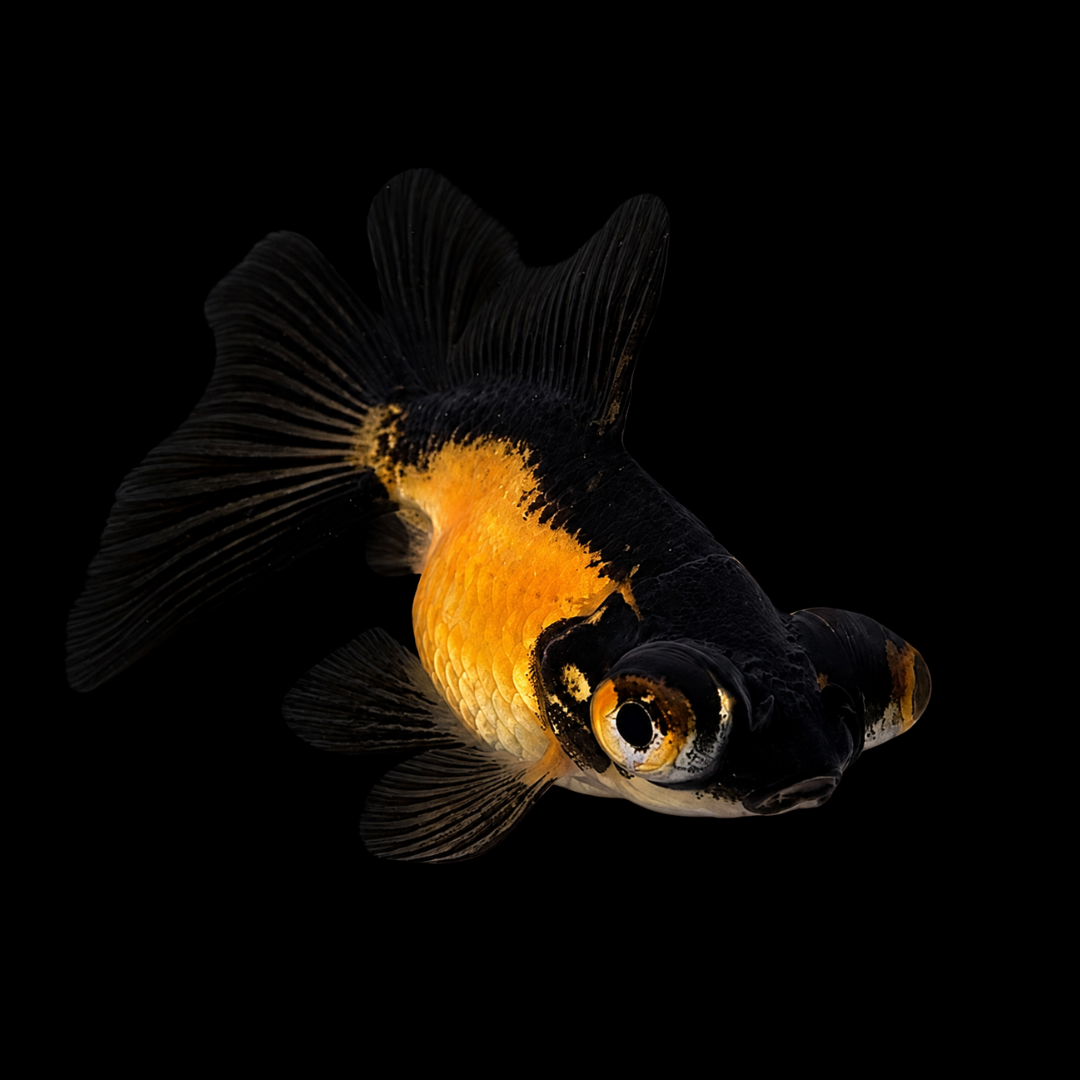
虎蝶尾(とらちょうび)は、出目金系の丸みを帯びた体と突出した眼、そして上から見たときに蝶が羽を広げたように見える大きな双尾をあわせ持つ金魚です。赤と黒が入り交じる個体は、その配色から「レッサーパンダ蝶尾」と呼ばれることもあります。ただし「レッサーパンダ」は流通上の愛称として使われる名称で、国際的に統一された正式品種名ではありません。最大の魅力は、水平に大きく開く尾鰭と赤黒のコントラストです。一方、出目と大きな尾鰭のため泳ぎはゆっくりしており、一般的な和金やコメットよりも穏やかな水流と安全なレイアウトが適しています。黒色は成長に伴って減少することがあり、暗い背景や照明条件によって見え方が変わることもあります。ただし、成長に伴う黒色の減少を確実に防ぐ飼育法は確立されていません。国内では中国由来の輸入個体と国内繁殖個体の双方が流通し、尾の左右対称性、眼のそろい、泳ぎの安定、赤黒の配置などが観賞価値を大きく左右します。 The Tora Chobi, also called the Lesser Panda Butterfly Telescope in the Japanese aquarium trade, is a fancy goldfish combining the rounded body and protruding eyes of telescope-eye strains with a broad twin tail that resembles a butterfly when viewed from above. Red-and-black individuals are especially prized for their strong contrast. “Lesser Panda” is a trade nickname rather than a universally standardized breed name. Its greatest appeal lies in the horizontally spread caudal fins and dramatic coloration, but the enlarged eyes and broad tail also make it a relatively slow swimmer. Gentle circulation and a hazard-free layout are therefore preferable to the stronger flow tolerated by common goldfish or comets. Black pigmentation may decrease as the fish matures, and background or lighting conditions can also affect how dark the fish appears. However, no husbandry method has been established that can reliably prevent age-related loss of black coloration. In Japan, both imported Chinese fish and domestically bred individuals are available, and commercial value is strongly influenced by tail symmetry, eye symmetry, stable swimming posture, and the arrangement of red and black markings.
基本情報 / Basic Information
| 学名 / Scientific Name | Carassius auratus (Linnaeus, 1758) |
|---|---|
| 通称 / Common Name | 虎蝶尾、レッサーパンダ蝶尾Tora Chobi, Lesser Panda Butterfly Telescope |
| 分類 / Family | コイ科(Cyprinidae)フナ属(Carassius)。金魚の家畜化品種で、出目・双尾を持つ蝶尾系統。Family Cyprinidae, genus Carassius. A domesticated goldfish variety belonging to the telescope-eye, twin-tail butterfly group. |
| 英名 / English Name | Butterfly Telescope Goldfish; Red-and-Black Butterfly Telescope Goldfish |
| 分布 / Distribution | 野生分布を持つ独立種ではなく、中国で長い家畜化と選択交配を受けて成立した金魚の一系統。現在は日本を含む各国で飼育・繁殖される。Not a wild-ranging species or subspecies. It is a domesticated goldfish lineage developed through long-term selective breeding in China and is now kept and bred in Japan and other countries. |
| 最大体長 / Max Size | 全長15〜20cm前後が目安。系統や飼育条件によっては尾鰭を含め20cmを超える個体もいる。Typically around 15–20 cm in total length. Large individuals may exceed 20 cm including the caudal fins, depending on lineage and husbandry. |
| 寿命 / Lifespan | 10〜15年程度がひとつの目安。寿命には個体差があり、安定した水質、適切な給餌、病気や外傷への早めの対応によって長期飼育につながる。Around 10–15 years is a practical general expectation, although lifespan varies among individuals. Stable water quality, appropriate feeding, and prompt attention to disease or injury support long-term care. |
飼育環境 / Aquarium Environment
| 水槽サイズ / Tank Size | 成魚1匹でも60cm規格水槽を最低限の目安とし、可能であれば60cmワイド水槽など、60L以上の水量を確保しやすい容器が望ましい。複数の成魚を飼う場合は90cm規格水槽以上を検討し、尾を広げて泳げる底面積にも余裕を持たせる。蝶尾は上見との相性が良いため、表面積の広い浅型水槽やトロ舟も適している。幼魚は小型容器でも管理できるが、成長を見越して飼育容器を選ぶ。For a single adult, a Japanese-standard 60 cm aquarium should be treated as a minimum starting point, with a 60 cm wide tank or another container that can provide at least about 60 L being preferable when possible. For multiple adults, consider a 90 cm standard aquarium or larger and allow enough floor area for the fish to spread their tails and swim comfortably. Because butterfly tails are especially attractive from above, wide and relatively shallow tanks or tubs can also work well. Juveniles can be raised temporarily in smaller containers, but future growth should be planned for from the beginning. |
|---|---|
| 水温 / Temperature | 18〜24℃前後は給餌・消化・日常管理を安定させやすい範囲。金魚自体は馴化すればより低い水温にも耐えるが、短時間での急変を避けることが重要。高水温では溶存酸素が下がるため、夏季は特に酸欠と水質悪化に注意する。室温が安定していればヒーターは必須ではない。 Around 18–24°C is an easy range for routine feeding and maintenance. Goldfish can tolerate cooler water when properly acclimated, but sudden temperature changes should be avoided. Warm water holds less dissolved oxygen, so summer heat increases the importance of aeration and water-quality control. A heater is not automatically required when room temperature is stable. |
| 水質 / Water Quality | pH6.5〜8.0程度の弱酸性から弱アルカリ性の範囲が管理しやすい。アンモニアと亜硝酸は0mg/Lを維持し、硝酸塩も定期換水で低く保つ。金魚は排泄量が多いため、生物ろ過を十分に立ち上げることが重要。蝶尾では強い水流を避けながら、スポンジフィルター、弱いエアリフト式ろ過、吐出口を壁面へ向けた外部・上部ろ過などで穏やかな循環と酸素供給を確保する。A slightly acidic to mildly alkaline pH of approximately 6.5–8.0 is practical. Ammonia and nitrite should remain at 0 mg/L, while nitrate should be kept low through regular water changes. Goldfish produce substantial waste, so mature biological filtration is essential. For butterfly telescopes, provide gentle circulation and good oxygenation with methods such as sponge filters, low-flow airlift filtration, or filter outlets diffused against a tank wall. |
| レイアウト / Layout | 突出した眼を傷つけないことを最優先にし、鋭い石、枝状の流木、狭い隙間のある装飾は避ける。底床はベアタンクが管理しやすい。使用する場合は角のない細かな砂などを選び、口に挟まりやすい大きさの砂利や、眼を傷つけるおそれのある鋭い素材は避ける。暗色の底面や背景は黒色素が広がった状態を見せやすい傾向があるが、恒久的な黒色維持を保証するものではない。上見を楽しむ場合は広い水面を確保し、過度に深くしない設計が扱いやすい。Protecting the protruding eyes is the first priority. Avoid sharp rocks, branching driftwood, and decorations with narrow gaps. A bare-bottom tank is easy to maintain. If substrate is used, choose smooth fine sand or similarly safe material, and avoid gravel sizes that can lodge in the mouth or sharp material that may injure the eyes. Dark floors and backgrounds may encourage a darker visible appearance, but they do not guarantee permanent retention of black pigment. For top-view appreciation, a broad surface area and moderate water depth are usually easier to manage. |
| 注意点 / Precautions | 大きな尾鰭と出目を持つため、強い一方向の水流では泳ぎにくくなりやすい。完全な無ろ過・無曝気の止め水にするのではなく、魚が流されない程度の穏やかな循環と十分な酸素を両立させる。上見を重視する飼育では浅めの容器が用いられることもあるが、深い水そのものの水圧で尾芯が立つと断定できる科学的根拠は確認されていない。照明は昼夜のリズムを作れる一般的な水槽照明でよく、黒色維持を目的に強い紫外線や直射日光へさらす必要はない。The broad tail and telescope eyes make this fish less efficient in strong directional current, so excessive flow should be avoided. However, this does not mean keeping the aquarium completely stagnant and unaerated; gentle circulation and adequate oxygen are still essential. Relatively shallow vessels are sometimes used for top-view keeping, but there is no well-established scientific basis for claiming that water pressure in a deep aquarium itself forces the central tail rays upright. Normal aquarium lighting with a clear day–night cycle is sufficient, and intense ultraviolet exposure or direct sunlight is not necessary for retaining black coloration. |
餌と給餌 / Feeding
| 餌の種類 / Diet | 金魚用の高品質な人工飼料を主食にする。視力が弱く泳ぎが遅い個体には、小粒の沈下性またはゆっくり沈むタイプが食べやすい。補助的に冷凍赤虫、ブラインシュリンプ、ミジンコ類、柔らかくした葉野菜などを少量取り入れると食性の幅を持たせられる。赤色の発色にはアスタキサンチンやスピルリナなどのカロテノイドを含む色揚げ飼料が役立つ場合がある。一方、成長に伴う黒色の減少を色揚げ飼料だけで止められるとは限らない。Use a high-quality goldfish formula as the staple diet. Small sinking or slow-sinking pellets are often easier for slow-swimming, visually limited telescope fish to locate and eat. Small amounts of frozen bloodworms, brine shrimp, daphnia-type foods, and softened leafy vegetables can add dietary variety. Color-enhancing diets containing carotenoids such as astaxanthin or spirulina may support red and orange saturation. However, such foods cannot be assumed to prevent age-related loss of black coloration. |
|---|---|
| 給餌のポイント / Feeding Tips | 1回量を少なくし、短時間で食べ切れる量を1日1〜2回程度から個体の体格、水温、活動量に合わせて調整する。丸みの強い金魚は浮力異常を起こしやすいため、食べ過ぎを避け、腹部が張る、食欲が落ちる、浮き沈みが不安定になるといった変化を早めに見つける。浮上性飼料がすべて転覆病の原因になるわけではないが、水面で空気を盛んに飲み込む個体では沈下性飼料へ切り替える価値がある。餌を与えた量だけでなく、翌日までの排泄と泳ぎ方まで観察することが大切。Feed small portions, usually once or twice daily, adjusting the amount to body size, temperature, and activity. Deep-bodied fancy goldfish are predisposed to buoyancy problems, so overfeeding should be avoided and early changes such as abdominal distension, reduced appetite, or unstable floating and sinking should be noticed promptly. Floating food is not automatically the cause of swim-bladder problems, but individuals that gulp large amounts of air at the surface may benefit from a sinking diet. Evaluate not only how much food is eaten, but also the fish’s feces and swimming posture afterward. |
性格と混泳 / Temperament and Tank Mates
| 性格 / Temperament | 基本的には温和で、同種間で強い縄張りを作る魚ではない。人に慣れると給餌時に寄ってくることも多い。ただし視力が弱く泳ぎが遅いため、餌取りでは俊敏な魚に負けやすい。Generally peaceful and not strongly territorial toward its own kind. Many individuals become accustomed to their keeper and approach during feeding. Because eyesight is limited and swimming is slow, they can easily be outcompeted for food by faster fish. |
|---|---|
| 混泳の相性 / Compatibility | 蝶尾、出目金、穏やかな琉金系など、泳ぐ速さと体格が近い丸手の金魚同士が合わせやすい。和金、コメット、朱文金のように俊敏なタイプとは給餌競争が起きやすく、ヒレをつつく魚や熱帯性の強い魚との混泳も避ける。出目は接触事故に弱いため、同居魚が温和でも過密飼育にしないことが重要。They are best matched with other slow fancy goldfish of similar size, such as butterfly telescopes, black moor-type telescopes, and calm deep-bodied varieties. Fast common goldfish, comets, and shubunkins can dominate feeding. Avoid fin-nipping species and fish requiring substantially warmer tropical conditions. Even with peaceful tank mates, overcrowding increases the risk of eye and fin injuries. |
病気と対策 / Diseases and Prevention
| かかりやすい病気 / Common Diseases | 白点病、エラや体表の寄生虫症、細菌性の皮膚・鰭トラブル、尾腐れ症状など、金魚一般に見られる病気に注意する。蝶尾特有の弱点として、突出した眼の擦過傷や白濁、広い尾鰭の裂けが起こりやすい。丸みの強い体型では、消化管の膨満、浮袋の異常、感染、体型そのものなど複数の要因が関係する浮力異常、いわゆる転覆症状も見られることがある。Watch for common goldfish problems such as white spot disease, gill and skin parasites, bacterial skin and fin infections, and fin deterioration. Butterfly telescopes are additionally prone to abrasions or cloudiness of the protruding eyes and tearing of their broad caudal fins. Deep-bodied individuals may also develop buoyancy disorders, often called “swim bladder disease,” which can involve several factors including gastrointestinal distension, swim-bladder pathology, infection, and body conformation. |
|---|---|
| 対策と予防 / Prevention | アンモニアや亜硝酸が検出されない状態を維持できる成熟したろ過、定期換水、急激な水温変化の回避、過密防止が基本。新しく迎えた魚は可能であれば別容器で数週間観察し、食欲、体表、呼吸、便、泳ぎに問題がないことを確認してから合流させる。眼や鰭を傷つける装飾を排除し、病変を見つけた場合は原因を推測だけで決めつけず、水質確認と隔離観察を優先する。急な水温低下は魚の調子を崩す一因になり得るが、白点病そのものは寄生虫による感染症であり、低水温だけで発生する病気ではない。治療薬を使う場合は製品の対象魚種、用量、水温条件を守る。Prevention begins with mature filtration that keeps ammonia and nitrite undetectable, regular water changes, avoidance of sudden temperature shifts, and sensible stocking density. When possible, observe newly acquired fish in a separate tank for several weeks before introduction, checking appetite, skin, respiration, feces, and swimming. Remove decorations that can damage the eyes or fins. If disease appears, check water quality and isolate the fish rather than assuming a single cause. A sudden temperature drop can stress the fish, but white spot disease itself is a parasitic infection and is not caused by cool water alone. When medication is required, follow the product’s species, dosage, and temperature instructions carefully. |
増やし方(繁殖) / Breeding
| 雌雄の判別 / Sexing | 繁殖期のオスでは、エラ蓋や胸鰭の前縁に白い追星が現れやすく、メスは成熟卵を持つと腹部が丸く張る。肛門周辺の形にも差が出ることがある。ただし季節外や若魚では判別が難しく、体型だけで確実に雌雄を決めることはできない。During the breeding season, males commonly develop white breeding tubercles on the gill covers and leading rays of the pectoral fins, while mature females become fuller in the abdomen as eggs develop. The vent may also differ in shape. Outside the breeding season or in young fish, reliable sexing can be difficult and body shape alone is not definitive. |
|---|---|
| 繁殖形態 / Reproduction | 卵生で、水草や産卵用モップなどに粘着性の卵をばらまく散乱型。春の水温上昇や日長変化が繁殖のきっかけになりやすい。親魚は卵を保護せず食べることがあるため、採卵後は親魚と卵を分けて管理する。An egg-scattering species that deposits adhesive eggs on plants, spawning mops, or similar surfaces. Rising spring temperatures and changing day length commonly stimulate breeding. The parents do not guard the eggs and may eat them, so eggs are usually separated after spawning. |
| 繁殖のポイント / Breeding Tips | 健康な親魚を十分に仕上げ、冬から春への季節変化を無理なく経験させると繁殖行動につながりやすい。稚魚では双尾の開き、尾芯、左右対称性、眼の発達、体型、色柄が大きくばらつくため、虎蝶尾らしい外見を固定するには世代を重ねた選抜が必要となる。虎蝶尾の赤黒模様について、単一の遺伝子だけから成魚の模様を予測できるという確立した知見はない。成長に伴う色変わりもあるため、幼魚期の模様だけで成魚の完成形を正確に予測するのは難しい。Condition the parents well and allow them to experience a gradual seasonal transition from winter toward spring rather than forcing abrupt changes. Offspring vary widely in twin-tail spread, central tail structure, left–right symmetry, eye development, body shape, and coloration, so producing a consistent Tora Chobi phenotype requires repeated selection across generations. There is no established evidence that the adult red-and-black pattern of Tora Chobi can be predicted from a single gene. Developmental color change also means that juvenile markings do not perfectly predict the adult appearance. |
雑学と豆知識 / Trivia and Fun Facts
| 1. 金魚は中国のフナから生まれた家畜化動物 / 1. Goldfish arose through domestication of Chinese crucian carp | 金魚の歴史をたどると、最初から現在のような華やかな姿だったわけではありません。中国では古くから灰色や銀灰色のフナの中に赤みを帯びる個体が現れることが知られ、やがて人の手で好ましい色や形が選ばれるようになりました。現代のゲノム研究でも、家畜化金魚が中国南部、とくに長江下流域のフナ系統と近いことが示されています。虎蝶尾も独立した野生種ではなく、この長い選択交配の歴史の先に生まれた造形のひとつです。Goldfish did not begin as the spectacular forms seen today. In China, reddish individuals were occasionally noticed among gray or silvery crucian carp, and people gradually began selecting preferred colors and body forms. Modern genomic work supports a close relationship between domesticated goldfish and crucian carp lineages from southern China, especially the lower Yangtze region. Tora Chobi is therefore not a separate wild species but a highly derived product of this long history of artificial selection. |
|---|---|
| 2. 蝶尾の「双尾」には発生遺伝学の裏付けがある / 2. The twin tail has a known developmental-genetic basis | 金魚の双尾は、単に長い尾鰭を選び続けた結果だけではありません。研究では、胚の背腹方向の形成に関わるchordin系遺伝子のE127X変異が、双尾形成の重要な要因として示されています。この変異は従来chdA E127Xと呼ばれ、近年の一部研究ではchdS E127Xとも表記されています。胚の段階で尾部の骨格と鰭の原基が左右へ分かれるため、成魚では二つに大きく開く尾鰭になります。蝶尾の美しい左右対称性は、この発生学的な変化にさらに長年の選抜が重ねられた結果と考えると、その姿の見え方も少し変わってきます。The goldfish twin tail is not simply the result of selecting progressively longer fins. Developmental studies have shown that an E127X mutation in a chordin gene is a major factor in twin-tail formation. The mutation has traditionally been described as chdA E127X and is also termed chdS E127X in some more recent studies. The caudal skeletal and fin primordia become bilaterally separated during embryonic development, producing the paired adult tail. The striking symmetry of a high-grade butterfly tail can therefore be viewed as the result of both a major developmental mutation and centuries of additional selective breeding. |
| 3. 「黒抜け」は単なる色揚げ不足ではない / 3. Loss of black is not simply a lack of color-enhancing food | 金魚では幼魚期の黒褐色から赤、橙、白などへ変わる「色変わり」が古くから知られています。古典的な遺伝研究では、幼生期のメラノフォアを失う性質に複数の遺伝因子が関与することが示され、近年は皮膚内のメラニンやメラノソームの移動、細胞骨格、細胞間結合、小胞輸送まで色変化に関係する可能性が研究されています。虎蝶尾の赤黒模様そのものを一つの遺伝子だけで説明できる段階にはありません。そのため、黒色が減少した個体に色揚げ飼料を与えても、元の黒色が必ず戻るとは限りません。Goldfish are famous for developmental “color change,” in which dark juvenile pigmentation may give way to red, orange, white, and other adult colors. Classic genetic studies demonstrated that the loss of larval melanophores can involve multiple genetic factors, while more recent work has implicated melanin and melanosome movement, cytoskeletal reorganization, cell junctions, and vesicle trafficking in skin-color transformation. The exact red-and-black Tora Chobi pattern cannot currently be reduced to a single known gene. Therefore, feeding a color-enhancing diet cannot be expected to reliably restore black coloration once it has faded. |
| 4. 背景色は本当に金魚の見た目を変える / 4. Background color really can change how a goldfish looks | 「黒い容器で飼うと色が濃く見える」という愛好家の経験則には、生理学的な裏付けがあります。金魚では白背景と黒背景で飼育したとき、メラニン凝集ホルモンに関わるmchや、α-MSHの前駆体であるpomcなどの発現が変化し、体色も背景に応じて明暗を変えることが実験的に確認されています。ただし、背景への反応には短期的な色素顆粒の移動だけでなく、より長期的な色素胞の変化も関わるため、見た目の変化は単純ではありません。黒背景は黒色を「見せやすくする」助けにはなっても、成長に伴う黒色の減少そのものを止める方法ではありません。The hobbyist observation that goldfish often appear darker in black containers has a physiological basis. Experiments with goldfish kept against white and black backgrounds have shown changes in body color together with altered expression of genes such as mch, related to melanin-concentrating hormone, and pomc, the precursor of α-MSH. The response is complex and can involve both short-term movement of pigment granules and longer-term changes in chromatophore biology. A dark background can help display black coloration more strongly, but it should not be regarded as a method for stopping age-related or developmental loss of black coloration. |
| 5. 紫外線を当てれば黒が残る、とは言い切れない / 5. More ultraviolet light does not guarantee permanent black pigment | メラニンという言葉から、人の「日焼け」と同じ感覚で強い紫外線を当てたくなるかもしれません。しかし魚類の体色制御は、色素胞、視覚情報、神経内分泌系、発生過程が組み合わさった仕組みです。金魚では背景色や光の波長がmchやpomcの発現に影響する研究はありますが、「強いUVを当てれば虎蝶尾の黒抜けを防げる」という確立した飼育法はありません。むしろ直射日光は水温上昇や藻類増殖を招きやすいため、安定した通常照明と昼夜リズムを優先する方が安全です。Because melanin is associated with tanning in humans, it may seem intuitive to expose a goldfish to strong ultraviolet light. Fish coloration, however, is controlled through an interaction of chromatophores, visual input, neuroendocrine signaling, and developmental processes. Studies in goldfish show that background and light wavelength can affect mch and pomc expression, but there is no established husbandry rule showing that strong UV exposure prevents black loss in Tora Chobi. Direct sunlight also increases the risks of overheating and uncontrolled algae, so stable ordinary aquarium lighting and a regular day–night cycle are safer priorities. |
| 6. 浅い水は「蝶尾らしさ」を楽しみやすいが、止め水とは別問題 / 6. Shallow water can suit the butterfly form, but it is not the same as stagnant water | 蝶尾は上から尾の開きを楽しむ上見と非常に相性がよく、広く浅い容器では魚の姿を観察しやすくなります。そのため、上見を重視する飼育では浅めの水深が用いられることがあります。一方で、水流を嫌うことと酸素やろ過が不要であることは同じではありません。排泄量の多い金魚を完全な止め水で維持するには頻繁な換水と高度な管理が必要です。一般家庭では、魚体を押し流さない弱い循環を作りつつ、生物ろ過と酸素供給を確保する方が再現性の高い方法です。Butterfly telescopes are especially well suited to top-view appreciation, and a wide, shallow vessel makes their tail spread easy to observe. For this reason, relatively shallow water is sometimes used when top-view presentation is a priority. However, disliking strong current is not the same as not needing oxygenation or filtration. Maintaining waste-producing goldfish in truly stagnant water requires frequent water changes and careful management. In most home aquariums, a more repeatable approach is to provide gentle circulation that does not push the fish around while still maintaining biological filtration and oxygen exchange. |
| 7. 日本へ輸入する金魚は水産資源保護法の輸入防疫対象 / 7. Goldfish imports into Japan are subject to aquatic-animal quarantine controls | 日本では、金魚を含む生きたフナ属魚類の輸入に水産資源保護法に基づく農林水産大臣の輸入許可が必要です。中国からの生きたフナ属魚類についても日本との衛生条件が設定されています。現行制度では、輸入者は原則として日本到着5日前までに輸入許可申請書と輸出国政府機関が発行する検査証明書を到着港・空港を管轄する動物検疫所へ提出し、書類検査と現物検査を受けます。異状があれば精密検査、管理命令、返送または処分につながる場合があります。さらに繁殖・養殖用として輸入する生体は都道府県による着地検査の対象となり、2026年6月9日改定の指針では原則おおむね6か月とされています。一方、輸入許可後に直接店頭等で観賞用として販売されるものは同指針の着地検査対象から除かれます。制度や対象疾病は改定されるため、商業輸入では必ず最新の農林水産省・動物検疫所の条件を確認する必要があります。In Japan, live fish of the genus Carassius, including goldfish, require an import permit from the Minister of Agriculture, Forestry and Fisheries under the Act on the Protection of Fishery Resources. Health conditions are also established for live Carassius imports from China. Under the current system, importers generally submit an import-permit application and a health certificate issued by the exporting country’s competent authority to the Animal Quarantine Service office responsible for the arrival port or airport at least five days before arrival. Documentary and physical inspections follow, and abnormalities may lead to detailed testing, management orders, return, or disposal. Live fish imported for breeding or aquaculture are also subject to prefectural post-entry inspection; guidance revised on June 9, 2026 states that this is generally about six months. Fish that are released from import quarantine and then sold directly at retail as ornamental animals are excluded from that post-entry inspection category. Because covered diseases and procedures can change, commercial importers should always confirm the latest MAFF and Animal Quarantine Service requirements before shipping. |
| 8. 「レッサーパンダ」は色柄を伝える日本市場の愛称 / 8. “Lesser Panda” is a Japanese trade nickname describing the color pattern | 白黒の蝶尾が「パンダ蝶尾」と呼ばれるのに対し、赤と黒が印象的な個体には、国内の流通で「レッサーパンダ」という呼称が用いられています。ただし個体の色は成長とともに変化するため、幼魚期に見事な赤黒だった魚が成魚で赤主体になることもあります。購入時は現在の模様だけでなく、尾の左右対称性、眼の傷、泳ぎの安定、餌食いを同時に見ると、長く付き合える個体を選びやすくなります。While black-and-white butterfly telescopes are commonly called “Panda Butterfly” in the trade, the nickname “Lesser Panda” is also used in Japan for red-and-black individuals. It is a descriptive sales name rather than a taxonomically or internationally standardized breed designation. Because pigmentation can continue changing as the fish matures, a strongly red-and-black juvenile may become predominantly red later in life. When selecting a fish, it is therefore wise to look beyond the current pattern and also evaluate tail symmetry, eye condition, stable swimming, and feeding response. |
まとめ / Conclusion
虎蝶尾は、蝶のように開く双尾、出目金らしい愛嬌のある顔立ち、そして赤と黒が織りなす一匹ごとに異なる模様を楽しめる金魚です。美しい尾を無理なく保つには、広い遊泳面、弱い水流、十分な酸素とろ過、安全なレイアウトを組み合わせ、速い金魚との餌取り競争を避けることが大切です。沈下性やゆっくり沈む餌は扱いやすい選択肢ですが、特定の餌だけに頼るのではなく、食べる量と排泄、泳ぎの変化まで見ながら日々調整していくことが健康維持につながります。 Tora Chobi combines a butterfly-like twin tail, the endearing telescope-eye face, and an individual red-and-black pattern that makes every fish look different. Keeping those fins attractive without overtaxing the fish depends on combining a broad swimming area, gentle current, adequate oxygenation and filtration, and a safe layout while avoiding feeding competition with faster goldfish. Sinking or slow-sinking foods are convenient choices, but good husbandry comes from watching not only what the fish eats, but also its waste, posture, and daily behavior.
黒色は虎蝶尾の大きな魅力ですが、成長とともに変化することがあります。暗い背景や照明条件によって色を見せやすくすることはできても、模様を固定することだけを優先するのではなく、安定して泳ぎ、よく食べられる環境を整えることが大切です。ゆったりと泳ぎながら、上から見たときに大きな尾をふわりと開く姿は、虎蝶尾ならではの味わいがあります。 Black pigmentation is one of this goldfish’s most attractive features, but it may change with age. A dark background or suitable lighting can make the existing coloration easier to appreciate, yet the priority should be an environment in which the fish can swim steadily and feed well rather than trying to force the pattern to remain unchanged. Its unhurried movement and broad tail opening under a top view give Tora Chobi a character all its own.

気になる道具や飼い方を見つけてみませんか?
 アイのアクアグッズ案内カルキ抜き・水質調整剤の選び方|水換えと水槽の種類に合わせて選ぶ道具の特徴や使い方、選ぶときのポイントをアイが紹介します。記事はコチラ →
 アイのアクアグッズ案内水換え・底砂掃除の道具の選び方|砂利・砂・ソイルに合うクリーナーとポンプ道具の特徴や使い方、選ぶときのポイントをアイが紹介します。記事はコチラ →
さまざまな飼育テーマをご紹介。リンク先の記事には広告・商品紹介が含まれます。
案内・紹介記事一覧へ →分布マップ
Carassius auratus(金魚)は野生分布を持つ独立した品種ではなく、中国で長期にわたる家畜化と選択交配によって成立しました。虎蝶尾もその家畜化系統のひとつで、現在は日本を含む世界各地で飼育・繁殖されています。以下の地図では、起源となった中国全体を概略的に表示しています。
※この地図は、記事の分布情報をもとに中国を概略的な起源地域として示したものです。マーカーは地図表示のために設定した代表地点であり、虎蝶尾またはその祖先個体の実際の採集地点・産地を示すものではありません。また、虎蝶尾は家畜化された金魚品種であるため、地図上の範囲は現在の野生分布を意味するものではありません。
参考文献
-
Fricke, R., Eschmeyer, W. N. & Van der Laan, R. (eds.). 2026. Eschmeyer’s Catalog of Fishes: Genera, Species, References. California Academy of Sciences. Online version updated 13 August 2026.
分類・学名・フナ属における位置づけの確認。
California Academy of Sciences -
Chen, D. et al. 2020. The evolutionary origin and domestication history of goldfish (Carassius auratus). Proceedings of the National Academy of Sciences of the United States of America, 117(47), 29775–29785. DOI: 10.1073/pnas.2005545117.
金魚の中国における家畜化、選択交配、系統的背景の確認。
PubMed Central -
Froese, R. & Pauly, D. (eds.). 2026. FishBase: Carassius auratus (Linnaeus, 1758).
種としての分布、生息環境、水質範囲、食性、産卵様式などの基礎生態の確認。
FishBase -
Royal Society for the Prevention of Cruelty to Animals (RSPCA). Choosing an Aquarium for Pet Fish.
金魚1匹あたりの水量、ろ過設備、酸素交換、照明、急激な水温変化を避ける飼育環境の確認。
RSPCA -
Petty, B. D., Francis-Floyd, R. & Yanong, R. P. E. 2024. Management of Aquarium Fish. Merck Veterinary Manual. Full review May 2022; last updated September 2024.
水温と生理、水質管理、生物ろ過、アンモニア・亜硝酸、隔離、浮袋と浮力異常、治療時の基本原則の確認。
Merck Veterinary Manual -
Petty, B. D., Francis-Floyd, R. & Yanong, R. P. E. 2024. Parasitic Diseases of Fish. Merck Veterinary Manual. Full review May 2022; last updated September 2024.
白点病(Ichthyophthirius multifiliis)、鰓・体表寄生虫、過密や衛生状態と寄生虫症の関係、診断・隔離上の注意点の確認。
Merck Veterinary Manual -
Li, I.-J., Chang, C.-J., Liu, S.-C., Abe, G. & Ota, K. G. 2015. Postembryonic staging of wild-type goldfish, with brief reference to skeletal systems. Developmental Dynamics, 244(12), 1485–1518. DOI: 10.1002/dvdy.24340.
成魚の雌雄判別に用いられる追星、雌の肛門部形態、成熟と季節的な水温・光条件との関係の確認。
PubMed Central -
Kobayashi, M., Iwata, E. & Sorensen, P. W. 2026. Environmental and Physiological Regulation of Reproduction in the Goldfish: Gonadal Development, Maturation, and Spawning Behavior: A Review. Animals, 16(5), 775. DOI: 10.3390/ani16050775.
季節、水温、日長と繁殖成熟、雄の追尾行動、植物などへの粘着卵の産卵といった繁殖生態の確認。
PubMed Central -
農林水産省 動物検疫所. 2026. 水産動物の検査について.
金魚を含むフナ属魚類が輸入検疫対象であること、輸入許可申請を原則として日本到着5日前までに行う現行手続の確認。
農林水産省 動物検疫所 -
農林水産省. 2026. 水産防疫対策要綱(令和8年6月9日改定).
養殖用等として輸入された水産動物の着地検査、原則おおむね6か月の検査期間、輸入許可後に直接店頭等で観賞用販売されるものの扱いの確認。
農林水産省




コメント