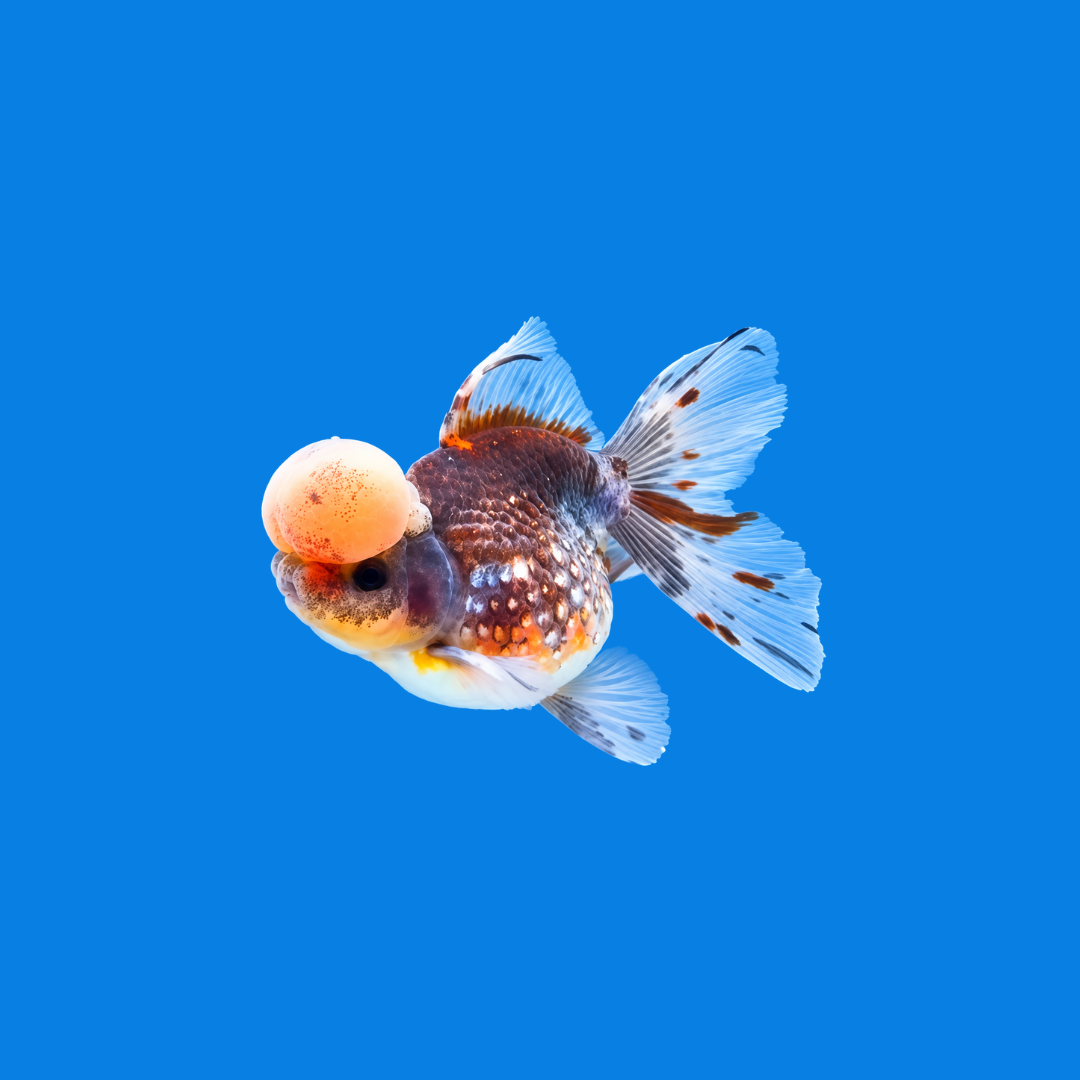
キャリコ高頭パールスケールは、真珠を並べたように一枚一枚の鱗が丸く盛り上がるパールスケールの体型に、頭部に発達する肉瘤と、赤・橙・黒・灰青・白などが入り混じるキャリコ模様を組み合わせた観賞金魚です。短く丸い胴と立体的な鱗が生む独特の存在感が大きな魅力ですが、その姿は鱗、頭部、体型、色彩といった複数の形質を選抜してきた結果です。現在の国内流通では「高頭パール」「キャリコ高頭パール」「五花高頭珍珠鱗」などの呼称が見られます。なお、国内で改良・認定された浜錦は高頭パールと系譜上の関係が深いものの、現在流通する高頭パールを一律に浜錦とみなすのは適切ではありません。飼育では、十分なろ過能力を確保しつつ水流を穏やかにすること、急な水温変化を避けること、突出した鱗を傷つけないこと、そして過給餌による肥満や浮力トラブルを防ぐことが重要です。The Calico High-Head Pearlscale is a fancy goldfish combining the raised, pearl-like scales and compact rounded body of the Pearlscale with developed fleshy growth on the head and a multicolored calico pattern of red, orange, black, bluish gray, white, and related shades. Its distinctive appearance reflects the selective breeding of several traits involving scale form, head development, body shape, and coloration. In the Japanese aquarium trade, names such as High-Head Pearlscale, Calico High-Head Pearlscale, and the Chinese-derived term Wuhua High-Head Pearlscale may all be encountered. Hamanishiki, a variety developed and recognized in Japan, is closely related to High-Head Pearlscale in breeding history, but modern High-Head Pearlscales should not automatically be treated as Hamanishiki. Successful care depends on providing sufficient filtration while keeping the current gentle, avoiding sudden temperature changes, protecting the protruding scales from injury, and preventing overfeeding that may worsen obesity or buoyancy problems.
コイ目・コイ科。金魚の改良品種Order Cypriniformes, family Cyprinidae. A domesticated fancy goldfish variety.
英名 / English Name
Calico High-Head Pearlscale Goldfish
分布 / Distribution
観賞用に作出された改良品種のため、野生下に固有の自然分布はありません。国内では国産・外国産の双方が流通し、対象となる外国産個体についても具体的な生産国が公表されていない場合があります。金魚そのものの家畜化・改良の歴史的背景は東アジアにあります。As a selectively bred ornamental variety, it has no natural wild distribution of its own. Both domestically bred and imported fish are sold in Japan, and the exact production country of some imported stocks is not publicly disclosed. The broader domestication and development history of goldfish is rooted in East Asia.
最大体長 / Max Size
個体差がありますが15cmを超えて成長する個体があり、国内では17〜18cm級の大型個体が流通した例もあります。購入時が8〜9cmでも、成長後の体格を見越した水槽を用意する必要があります。Size varies by individual, but some fish exceed 15 cm in total length, and specimens around 17–18 cm have appeared in the Japanese trade. Even fish purchased at 8–9 cm should be housed with their adult size in mind.
寿命 / Lifespan
キャリコ高頭パールスケール固有の寿命統計はありません。金魚は適切な環境では10年以上生きることがあるため、短期飼育ではなく長期維持を前提に設備を整えるのが望まれます。There is no established lifespan dataset specific to the Calico High-Head Pearlscale. Goldfish can live for more than ten years under suitable conditions, so the aquarium should be planned for long-term care rather than short-term display.
飼育環境 / Aquarium Environment
水槽サイズ / Tank Size
成魚1匹で75L前後をひとつの目安とし、できれば90cm近い横幅を確保できる水槽が安心です。一般的な60cm規格水槽(約56〜59L)は、8〜9cmの個体を単独で管理する場合でも長期飼育には余裕が少ないため、成長を見越してより大きな水槽を検討します。複数飼育や大型個体では90cm規格水槽など、底面積と水量に余裕のある環境を選びます。丸い体型では、過度な水深より横方向の遊泳スペースを確保する方が扱いやすくなります。For one adult fancy goldfish, around 75 L is a useful baseline, and a tank close to 90 cm in length provides a more comfortable swimming footprint. A standard Japanese 60 cm aquarium of roughly 56–59 L offers limited long-term room even for a single 8–9 cm fish, so a larger tank should be planned as the fish grows. Multiple fish or large adults are better kept in a 90 cm class aquarium or another setup with generous water volume and floor area. For this rounded body form, horizontal swimming space is generally more useful than excessive depth.
水温 / Temperature
20〜24℃程度をひとつの目安に、短時間で大きく変動させないことを優先します。外国産かどうかだけで適温を決めつけず、導入時は販売店での管理水温を確認し、自宅の水槽へ段階的に馴化させます。A stable temperature around 20–24°C is a practical target, with avoidance of rapid changes taking priority over chasing an exact number. Do not assume that an imported fish requires a particular temperature solely because it is imported; check the retailer’s holding temperature and acclimate the fish gradually to the home aquarium.
水質 / Water Quality
pH6.5〜7.5前後をひとつの目安とし、アンモニアと亜硝酸はできるだけ検出されない状態を保ちます。硝酸塩は50mg/L未満を目安に、定期換水で蓄積を抑えます。金魚は排泄量が多いため、生物ろ過を十分に成熟させ、数値そのものより急変を避けた安定した管理を優先します。Use pH 6.5–7.5 as a practical reference range, and keep ammonia and nitrite as close to undetectable as possible. Keep nitrate below about 50 mg/L and control accumulation through regular partial water changes. Because goldfish produce a heavy waste load, mature biological filtration and stable conditions are more important than chasing a single exact number.
レイアウト / Layout
ベアタンク、または角のない細粒砂を使ったシンプルなレイアウトが安全です。突出したパール鱗は擦れに弱いため、尖った石、枝状の流木、狭い隙間のある装飾は避けます。ろ過能力は高く確保しつつ、吐出口を壁面へ向ける、拡散させるなどして強い一点水流を作らないことが重要です。エアレーションは常設すると管理しやすくなります。A bare-bottom tank or a simple layout with smooth fine substrate is safest. The protruding pearl scales are vulnerable to abrasion, so avoid sharp rocks, branching wood, and narrow gaps where the fish may scrape itself. Use generous filtration capacity, but diffuse or redirect the outlet so the fish is not forced to swim against a concentrated current. Continuous aeration is also helpful.
注意点 / Precautions
隆起した鱗は網や硬い装飾に触れると欠損しやすく、剥がれた部分が同じ形のパール鱗として完全に戻るとは限りません。体型については、特に扁平なおまんじゅう型に近い個体ほど、成長後に姿勢維持が難しくなる傾向が指摘されています。新規導入魚は本水槽へすぐ合流させず、別水槽で状態を観察してから移すと安全です。自然の川や池へは絶対に放流しないでください。The raised scales can be damaged by nets or hard decorations, and a lost pearl scale may not regrow with the same domed appearance. Among body shapes, especially flattened, bun-like individuals have been noted as more likely to struggle with balance as they grow. Newly acquired fish are best observed in a separate quarantine aquarium before being introduced to the main tank. Never release goldfish into natural waterways.
餌と給餌 / Feeding
餌の種類 / Diet
金魚用の小粒ペレットを主食にします。丸胴個体では摂餌量を調整しやすい沈下性またはゆっくり沈むタイプが扱いやすく、補助的に消化しやすい植物性原料や冷凍・生餌などを少量組み合わせることもできます。Use a high-quality small goldfish pellet as the staple food. Sinking or slow-sinking pellets are often easier to portion for rounded-bodied fish, and small amounts of digestible plant-based foods or suitable frozen and live foods may be used as supplements.
給餌のポイント / Feeding Tips
1日2〜3回を目安に、短時間で食べ切れる少量を分けて与えます。腹部が極端に膨らむほど一度に食べさせると、丸い体型では遊泳姿勢や浮力の乱れが目立ちやすくなります。残餌は水質悪化の原因になるため除去し、低水温期は代謝に合わせて回数や量を減らします。頭部の発達を狙って給餌量を増やすのではなく、水平に安定して泳げる体型を保つことを優先します。Offer small portions two or three times per day, limiting each meal to an amount the fish can finish quickly. Large single meals can cause marked abdominal distension and may worsen balance or buoyancy in very rounded fish. Remove leftovers, reduce feeding as metabolism slows in cooler water, and avoid increasing food intake merely to accelerate head growth. Stable swimming ability and body balance are more important than exaggerated bulk.
性格と混泳 / Temperament and Tank Mates
性格 / Temperament
基本的には温和な金魚ですが、体型の影響で泳ぎは長手型の金魚よりゆっくりしています。活発に泳ぎ回るタイプではないため、落ち着いた環境の方が餌を取りやすく、体力も消耗しにくくなります。It is generally a peaceful goldfish, but its rounded body makes it a slower swimmer than long-bodied varieties. A calm aquarium environment helps it feed efficiently and reduces unnecessary physical stress.
混泳の相性 / Compatibility
同程度の泳力を持つ穏やかな丸手の金魚との混泳が向いています。和金、コメットなど俊敏な長手型金魚と一緒にすると、給餌競争で不利になりやすいため注意が必要です。ヒレをつつく魚、強い縄張り性を持つ魚、水温や水質要求が大きく異なる熱帯魚との混泳は避けます。複数飼育では水量とろ過能力を十分に増やしてください。Tank mates should be similarly gentle, slow-swimming fancy goldfish. Fast single-tailed varieties such as Common Goldfish and Comets may outcompete Pearlscales at feeding time. Avoid fin-nipping species, strongly territorial fish, and tropical species with substantially different temperature or water-quality requirements. Increase both aquarium volume and filtration capacity when keeping multiple goldfish.
病気と対策 / Diseases and Prevention
かかりやすい病気 / Common Diseases
パールスケールだけに特有の病原体があるわけではありませんが、白点病などの寄生虫症、尾ぐされ病や鰓の細菌性疾患、水カビ、エロモナス関連症など一般的な金魚の病気に加え、突出した鱗の外傷、輸送ストレス、浮力・姿勢障害を特に警戒します。松かさ、著しい腹水、持続する転覆や沈下は重い異常の可能性があります。Pearlscales do not have a unique pathogen of their own, but they can develop common goldfish problems such as white spot disease, bacterial fin or gill disease, fungal infections, and Aeromonas-related disease. Their body form also makes scale injuries, transport stress, and buoyancy or balance disorders especially important. Pineconing, marked abdominal swelling, or persistent floating, sinking, or rolling may indicate serious illness.
対策と予防 / Prevention
新規導入時は隔離観察を行い、アンモニア、亜硝酸、水温を確認してから本水槽へ移します。外傷を防ぐため、魚を網で長時間追い回さず、必要なら容器ですくう方法を使います。症状が出た場合は水質悪化を先に確認し、観賞魚用医薬品は対象疾病と現行ラベルを確認して使用します。複数薬の自己流混用や、すべての症状を塩浴だけで治そうとする対応は避け、重症や長引く症状では魚を診療できる獣医師への相談を検討します。Quarantine new arrivals and confirm stable temperature, ammonia, and nitrite levels before moving them into the main aquarium. To prevent injury, avoid prolonged chasing with a net and use a container to transfer the fish when practical. When symptoms appear, check water quality first and use aquarium medications only for the appropriate condition and according to the current label. Avoid improvised drug combinations or assuming that salt alone will treat every problem, and seek veterinary advice from a practitioner experienced with fish when severe or persistent signs occur.
増やし方(繁殖) / Breeding
雌雄の判別 / Sexing
繁殖期の雄では、鰓蓋や胸鰭の前縁に追星と呼ばれる白い小突起が現れやすく、雌を追尾する行動も目立ちます。雌は成熟すると腹部がふっくらし、総排泄孔がやや目立つことがあります。ただし季節外や若魚では判別が難しく、外見だけで100%確実に見分けられるとは限りません。During the breeding season, males often develop small white breeding tubercles on the gill covers and leading edges of the pectoral fins and may actively chase females. Mature females may become fuller through the abdomen and show a more prominent vent. Outside the breeding season or in young fish, however, visual sexing is not always reliable.
繁殖形態 / Reproduction
卵生で、水草や産卵巣などへ粘着性の卵をばらまくように産み付けます。親魚には卵を食べる習性があるため、産卵後は親魚を取り出すか、産卵床ごと卵を別容器へ移して管理します。It is an egg-laying, adhesive egg-scattering fish. Eggs are deposited on aquatic plants, spawning mops, or similar surfaces. Because adult goldfish readily eat their eggs, the parents should be removed after spawning or the egg-covered spawning medium should be transferred to a separate hatching container.
繁殖のポイント / Breeding Tips
健康な親魚を選び、繁殖槽に産卵床を用意します。産卵後は弱いエアレーションで酸素を確保し、白くなった無精卵や死卵を取り除きます。孵化後、稚魚が遊泳を始めたら微細な生餌や稚魚用飼料へ移行します。キャリコ高頭パールスケールでは「高頭」「良好なパール鱗」「丸い体」「キャリコ柄」を同時に揃える必要があり、孵化に成功しても親魚と同等の外観を持つ魚が高い割合で得られるとは限りません。本品種固有の受精率、孵化率、良魚歩留まりを示す公開統計はありません。Select healthy breeders and provide a spawning mop or similar substrate. After spawning, maintain gentle aeration and remove opaque unfertilized or dead eggs. Once the fry become free-swimming, begin appropriately sized live or prepared fry foods. Producing high-quality Calico High-Head Pearlscales requires several traits to appear together, including head development, good pearl scaling, rounded body shape, and desirable calico coloration. Successful hatching therefore does not mean that a high proportion of juveniles will resemble the parents closely. Published breed-specific statistics for fertilization rate, hatch rate, and show-quality yield are not available.
雑学と豆知識 / Trivia and Fun Facts
1. 「真珠の鱗」は一枚ずつ盛り上がっている / 1. Each “Pearl” Is a Raised Scale
パールスケールの名は、体表に真珠を埋め込んだような立体感から生まれました。実際には鱗の露出部がドーム状に盛り上がる形質が固定されており、金魚の形態進化を扱う研究でもPearlscaleの代表的な特徴として扱われています。見た目には硬質で丈夫そうですが、むしろ突出している分だけ接触に弱く、網や装飾で一枚失うだけでも模様の連続性が崩れてしまいます。そのため、鱗を傷つけにくいレイアウトと扱い方を最初から意識することが基本になります。The Pearlscale name comes from the impression that small pearls have been set into the body surface. In reality, the exposed portion of each scale forms a domed profile, a trait recognized in scientific reviews of goldfish morphological variation. Although the scales may look hard and armor-like, their protruding shape actually makes them vulnerable to abrasion. Losing even one can interrupt the regular pattern, so care should focus from the outset on a layout and handling methods that reduce physical contact and scale damage.
2. 「五色」は五つの色を数える言葉ではない / 2. “Five-Color” Does Not Mean Exactly Five Colors
流通名に使われる「五色」や中国語系の「五花」は、赤・橙・黒・灰青・白などが複雑に混じるキャリコ系の色彩を表す言葉です。必ず五つの決まった色が揃っていなければならない、という厳密な遺伝学的規格ではありません。キャリコでは鱗の反射性や色素の見え方が一様でないため、同じ黒でも深く沈んで見えたり、灰青色に見えたりします。一匹ごとに模様が違うのは偶然のように見えますが、その背景には透明鱗や色素の発現など、複数の色彩形質を長く選抜してきた金魚育種の歴史があります。Trade names such as “five-color” and the Chinese-derived term “wuhua” describe a calico appearance in which red, orange, black, bluish gray, white, and related tones form complex patterns. They do not define a strict genetic standard requiring exactly five fixed colors. In calico goldfish, variation in scale reflectivity and pigment visibility can make the same dark pigment appear deep black in one area and blue-gray in another. The apparently unique pattern of every fish is therefore not simply random decoration; it reflects a long breeding history involving transparent-scale traits, pigmentation, and other aspects of coloration.
3. 高頭パールと浜錦は近縁でも同じ名前ではない / 3. High-Head Pearlscale and Hamanishiki Are Related but Not Identical
日本の金魚文化をたどると、高頭パールは浜錦の成立と深く関わっています。高頭パールを基礎に国内で改良が重ねられ、浜錦が1970年代後半に新品種として承認・発表されたことは複数の資料で確認できますが、導入年や作出経緯の細部には資料によって記述の違いがあります。一方、現在流通する高頭パールと浜錦は同じ名称で扱われるものではなく、国内の品評会でも浜錦とパールスケールは別カテゴリーとして扱われています。近縁の歴史を持ちながら、現在は別の品種・流通群として整理するのが分かりやすいでしょう。In Japanese goldfish culture, the High-Head Pearlscale is closely connected with the development of Hamanishiki. Multiple sources agree that Hamanishiki was developed in Japan from High-Head Pearlscale stock and was recognized or introduced as a new variety in the late 1970s, although details such as the exact introduction date and breeding process differ among historical accounts. Modern High-Head Pearlscales and Hamanishiki are not simply interchangeable names, and Japanese shows continue to treat Hamanishiki and Pearlscale as separate categories. It is therefore clearer to regard them as closely related in history but distinct in present-day variety and trade usage.
4. 「高頭」は高さ何mmという規格名ではない / 4. “High-Head” Is a Trait Category, Not a Millimeter Standard
「高頭」という響きから、頭の高さに明確な数値基準があるように感じますが、少なくとも一般流通で統一された数値規格は確認できません。実際には、頭部に肉瘤が発達するパールスケールを表す呼称として使われています。発達位置、左右対称性、質感、成熟後の大きさには個体差があり、同じ商品名でも印象は大きく変わります。そのため良い個体を選ぶときは、頭の大きさだけではなく、口や鰓の動き、胸鰭の使い方、水平に泳げるかどうかまで一緒に見ることが大切です。The name “High-Head” can sound as though it refers to a precise numerical standard, but no unified measurement standard is evident in ordinary trade usage. In practice, it is used for Pearlscale goldfish with developed fleshy head growth. Position, symmetry, texture, and mature size can vary greatly among individuals, so two fish sold under the same name may look quite different. When choosing a fish, the size of the head should therefore be considered together with mouth and gill movement, pectoral-fin use, and the ability to maintain level, controlled swimming.
5. 丸さより「泳げる体」を選ぶという考え方 / 5. Choosing a Body That Can Swim, Not Just the Roundest Body
パールスケールは丸みの強い体型が目を引きますが、特に扁平なおまんじゅう型に近い体型では、成長とともに姿勢維持が難しくなることがあります。観賞魚の価値は外見だけで決まるものではありません。安定して水平に泳ぎ、呼吸と摂餌が自然で、腹部の左右差が少なく、鱗と皮膚が健全な個体は、長く付き合うほどその良さが分かります。色柄や頭部の迫力を楽しみながらも、機能的に無理のない体を選ぶことが、この品種と長く暮らすための大切な視点です。A strongly rounded Pearlscale can be visually striking, yet especially flattened, bun-like body forms may make balance increasingly difficult as the fish grows. The value of an ornamental fish does not have to be judged by appearance alone. A fish that swims level, breathes and feeds normally, shows good left-right abdominal symmetry, and has healthy skin and scales often proves its quality over years of care. Appreciating dramatic coloration and head development while still selecting a functionally balanced body is one of the most important principles for living successfully with this variety.
6. 放流すると「生き残るか」だけが問題ではない / 6. Release Risk Is Not Only About Whether the Fish Survives
観賞用に改良された金魚は自然界で弱そうに見えるため、「放しても定着しない」と思われがちです。しかし日本では、放流された金魚と在来のフナ類が交雑したことを示す遺伝学的研究が報告されています。つまり問題は、放した魚がそのまま大群で増えるかどうかだけではなく、在来集団へ遺伝子が入り込む可能性にもあります。飼いきれなくなった場合は、自然水域へ放すのではなく、販売店や引取先、信頼できる飼育者への譲渡を検討することが必要です。Because fancy goldfish can appear poorly suited to the wild, it is easy to assume that releasing one would not matter because it would fail to establish. Genetic research in Japan, however, has documented introgression between released goldfish and native crucian carp populations. The ecological risk is therefore not limited to whether a released fish survives and multiplies visibly; its genes may also enter native populations. If a fish can no longer be kept, rehoming through a retailer, rescue route, or responsible keeper should be considered instead of release into any natural water body.
まとめ / Conclusion
キャリコ高頭パールスケールは、五色の模様、発達する頭部の肉瘤、真珠のように盛り上がる鱗、そして丸い体型という複数の魅力が一匹の中に重なった金魚です。その一方で、強い水流、急な温度変化、硬い装飾、過給餌とは相性がよくありません。余裕のある水量と十分なろ過能力、穏やかな流れ、安定した水温を用意することで、落ち着いた泳ぎと色彩を楽しみやすくなります。The Calico High-Head Pearlscale brings several striking traits together in one fish: multicolored calico patterning, developed fleshy head growth, raised pearl-like scales, and a rounded body. Those same features make it poorly suited to strong current, sudden temperature changes, abrasive decorations, and heavy feeding. With generous water volume, sufficient filtration capacity, gentle flow, and stable temperature, its calm swimming style and complex coloration can be appreciated more safely.
個体を選ぶときは、最も丸い体や最も大きな頭だけを追うのではなく、水平に泳げること、呼吸や摂餌が自然であること、鱗と皮膚に傷が少ないことを優先すると長期飼育につながります。ゆったりとした水槽の中で、一匹ごとに異なる五色模様と立体的な鱗が少しずつ成熟していく様子は、この金魚ならではの大きな楽しみです。When selecting an individual, long-term success is more likely if level swimming, normal breathing and feeding, and healthy skin and scales are valued above the roundest body or the largest head. In a spacious, calm aquarium, watching each fish’s unique calico pattern and sculpted scales mature over time becomes one of the most rewarding aspects of keeping this distinctive goldfish.






コメント