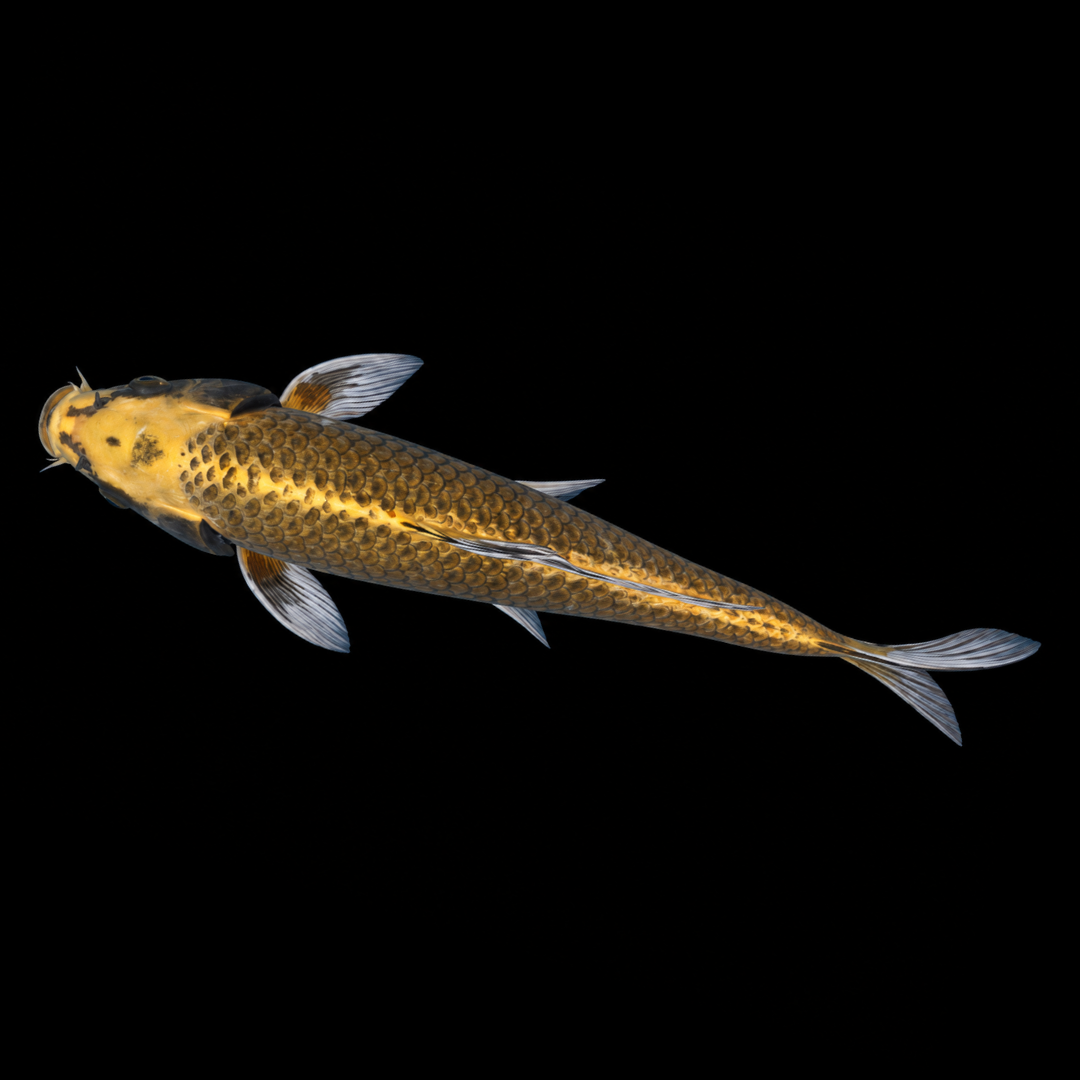
金松葉は、全身に黄金色の金属光沢をまとい、規則正しく並ぶ鱗の中央に黒い色が入る錦鯉です。この黒い部分が連なり、松ぼっくりの鱗片を思わせる網目に見えることから「松葉」と呼ばれます。品種分類では一般に光り無地に含まれ、派手な斑紋ではなく、体型、照り、頭部の清潔感、鱗列と松葉紋の均一さが主な見どころです。国内では新潟県をはじめとする養鯉場、錦鯉専門店、通信販売、競りなどを通じて流通し、価格はサイズだけでなく、性別、血統、肌質、松葉紋の完成度、健康状態によって大きく変わります。幼魚を大型水槽で一時的に管理することはできますが、成長後は十分な水量と遊泳面積を備えた池での飼育が基本です。Kin Matsuba is a metallic koi with a rich golden ground and dark centers on its neatly arranged scales. Together, the dark scale centers create reticulation reminiscent of the scales of a pinecone, giving the variety its Matsuba name. It is generally shown in the Hikarimuji class. Rather than relying on large patches of color, its appeal comes from body conformation, metallic sheen, a clean head, orderly scale rows, and even reticulation. In Japan it is distributed through koi farms, specialist dealers, online sales, and auctions. Value varies widely with size, sex, lineage, skin quality, reticulation, and health. Juveniles may be kept temporarily in a very large aquarium, but mature fish normally require a spacious, well-filtered pond.
基本情報 / Basic Information
学名 / Scientific Name
Cyprinus carpio
通称 / Common Name
金松葉、黄金松葉Kin Matsuba, Gold Matsuba
分類 / Family
コイ目コイ科コイ属。錦鯉の品種分類では光り無地に含められるのが一般的です。Order Cypriniformes, family Cyprinidae, genus Cyprinus. In koi show classification, it is generally placed in Hikarimuji.
英名 / English Name
Kin Matsuba Koi
分布 / Distribution
観賞品種のため、金松葉そのものに自然分布はありません。日本で育種された錦鯉として、現在は国内外で養殖・飼育されています。コイはユーラシアに自然分布し、人為的な移入によって世界各地にも分布しています。As a domesticated ornamental variety, Kin Matsuba has no natural range of its own. It was developed within Japanese koi culture and is now bred and kept worldwide. Common carp occur naturally in parts of Eurasia and have also been introduced to many other regions by people.
最大体長 / Max Size
成魚は60〜80cmほどを目安にします。血統や飼育環境によっては80cmを超えるため、幼魚の大きさではなく、成長後の体格を見込んで設備を用意する必要があります。Plan for an adult size of about 60–80 cm. Some individuals exceed 80 cm depending on genetics and husbandry, so housing should be designed for the mature fish rather than its juvenile size.
寿命 / Lifespan
適切な飼育下で20〜30年以上が目安です。水質、疾病管理、過密の有無によって大きく変わり、さらに長生きする個体もいます。A practical expectation under good care is 20–30 years or more. Longevity varies greatly with water quality, disease control, and stocking density, and some individuals live considerably longer.
飼育環境 / Aquarium Environment
水槽サイズ / Tank Size
終生飼育は池が基本です。小型の幼魚を一時的に室内管理する場合でも、120cmワイド水槽以上を検討し、個体の大きさと匹数に余裕を持たせます。成長に合わせて速やかに大型設備へ移し、成魚では数千L規模以上の水量、十分な水深と遊泳面、強力なろ過、安定した酸素供給を確保してください。匹数が増えるほど、必要な水量とろ過能力も大きくなります。A pond is the normal long-term home. Even for temporary indoor care of small juveniles, consider a 120 cm wide aquarium or larger and allow ample space for the size and number of fish. Move them to larger quarters as they grow. Adults require several thousand liters or more, with adequate depth and swimming area, strong filtration, and reliable aeration. Required volume and filtration capacity increase with stocking density.
水温 / Temperature
活動と消化が安定しやすい目安は18〜25℃です。コイはより広い温度域に適応しますが、急変は避けます。低水温期は消化能力が落ちるため給餌を減らし、高水温期は溶存酸素の低下に備えてエアレーションを強化します。About 18–25°C is a useful range for steady activity and digestion. Koi tolerate a wider seasonal range, but rapid changes should be avoided. Reduce feeding as digestion slows in cold water, and increase aeration in warm weather because dissolved oxygen falls as temperature rises.
水質 / Water Quality
中性〜弱アルカリ性を基本とし、pH7.0〜8.0前後を安定して保つのが目安です。アンモニアと亜硝酸は検出されない状態を目指し、硝酸塩の蓄積、pHの急変、酸素不足を防ぎます。数値そのものより、十分に熟成したろ過と急変のない安定性が重要です。Stable neutral to mildly alkaline water, around pH 7.0–8.0, is a practical target. Ammonia and nitrite should remain undetectable, while nitrate accumulation, pH swings, and oxygen shortage must be prevented. Mature biological filtration and stability are more important than chasing a single exact number.
レイアウト / Layout
体を傷つけない滑らかな壁面と底面、排泄物を集めやすい排水構造、飛び出しを防ぐ縁やネットを用意します。鋭い石、狭い隙間、絡まりやすい器具は避けてください。水草は掘り返されたり食べられたりしやすいため、植栽するなら隔離した植栽帯にします。黄金色と松葉紋は、暗めの池底と穏やかな自然光の下で見やすくなります。Use smooth walls and floors, efficient bottom drainage, and a secure rim or net to prevent jumping. Avoid sharp rocks, tight gaps, and equipment that can trap fins. Aquatic plants are often uprooted or eaten, so place them in protected planting zones if used. A darker pond floor and gentle natural light make the golden sheen and Matsuba reticulation easier to appreciate.
注意点 / Precautions
成長速度と排泄量を小型魚と同じ感覚で見積もらないことが大切です。新しく迎えた魚は既存魚と分けて検疫し、毎日の泳ぎ方、呼吸、食欲、体表、鰭を観察します。換水では水温とpHの差を小さくし、水道水には適切な中和処理を行います。屋外池では猛暑、凍結、豪雨による急変、鳥獣による捕食にも備えます。Do not underestimate growth or waste production by treating koi like small aquarium fish. Quarantine new arrivals away from established fish, and observe swimming, breathing, appetite, skin, and fins every day. Match temperature and pH during water changes and neutralize disinfectants in tap water. Outdoor ponds also need protection from heat waves, freezing, storm-driven water changes, and predators.
餌と給餌 / Feeding
餌の種類 / Diet
主食には、成長段階と水温に合った錦鯉用の総合栄養ペレットを用います。成長期用、低水温期用、色揚げ用などを目的に応じて選び、必要に応じて安全性を確認した補助食を少量与えます。色揚げ飼料は黄金色の発色を補う目的で使われますが、肌の光沢や松葉紋そのものを餌だけで作れるわけではありません。Use a complete koi pellet matched to the fish’s size, season, and water temperature. Growth, cool-season, and color-enhancing formulas can be selected for specific purposes, with small amounts of verified safe supplementary foods when needed. Color-enhancing food may support the golden coloration, but diet alone cannot create metallic skin quality or Matsuba reticulation.
給餌のポイント / Feeding Tips
数分で食べ切れる量を複数回に分け、食べ残しを出さないことが基本です。水温、魚の活動、ろ過能力に合わせて量を調整し、急な増量は避けます。低水温時や体調不良時は消化が落ちるため給餌を控えます。大きくすることだけを優先すると、内臓脂肪、水質悪化、体型の崩れにつながるため、成長とコンディションを同時に観察してください。Offer only what the fish can finish within a few minutes, divided into several small meals when conditions permit. Adjust quantity to temperature, activity, and filtration capacity, and avoid sudden increases. Feed sparingly or stop when water is cold or fish are unwell. Chasing size alone can promote excess internal fat, poor water quality, and weak conformation, so growth and condition must be monitored together.
性格と混泳 / Temperament and Tank Mates
性格 / Temperament
基本的に温和で、群れの中で行動します。飼育環境に慣れると、飼育者の姿や給餌の時間に反応して水面へ寄るようになります。慣れやすさや警戒心には個体差があり、金松葉だけに共通する性格として確認されているわけではありません。Koi are generally peaceful and tend to move with other koi. Once accustomed to their environment, they may approach the surface in response to their keeper and the feeding routine. Tameness and caution vary among individuals and have not been established as traits specific to Kin Matsuba.
混泳の相性 / Compatibility
体格が近く、健康状態の良い錦鯉同士の混泳に向きます。金魚などとの混泳例もありますが、体格差、餌の競争、持ち込まれる病原体、必要な水量の違いを考えると、錦鯉中心の池が管理しやすい環境です。口に入るほど小さな魚、攻撃性の強い魚、極端に異なる水温を好む魚との混泳は避けます。They mix well with healthy koi of similar size. They are sometimes kept with goldfish, but differences in size, feeding competition, disease risk, and space requirements make a koi-centered pond easier to manage. Avoid fish small enough to be swallowed, aggressive species, and species requiring very different temperatures.
病気と対策 / Diseases and Prevention
かかりやすい病気 / Common Diseases
金松葉だけが特にかかりやすい病気は知られていません。錦鯉全般では、白点病、トリコディナ症、吸虫類などの寄生虫症、細菌性の穴あき病や鰭ぐされ、真菌症に注意します。また、コイヘルペスウイルス病やコイ浮腫症候群は、まん延を防ぐうえでも重要な感染症です。粘液の増加、体をこすりつける、鰭を閉じる、食欲低下、群れから離れる、呼吸が速い、潰瘍、鰓の異常などが見られたら、早めに原因を確認します。黒い色調の変化だけで病気とは判断できませんが、急な変化があれば水質と体表の状態を確認してください。No disease is known to affect Kin Matsuba more readily than other koi. Koi in general may develop white spot disease, Trichodina or fluke infestations, bacterial ulcers and fin rot, and fungal infections. Koi herpesvirus disease and carp edema virus disease are also important because of the need to prevent their spread. Excess mucus, flashing, clamped fins, loss of appetite, separation from the group, rapid breathing, ulcers, or abnormal gills should prompt an early investigation. A change in dark pigmentation alone does not establish disease, but a sudden change warrants checks of both water quality and the skin.
対策と予防 / Prevention
最も有効な予防は、導入魚の隔離観察、過密回避、安定したろ過、十分な酸素、適切な換水、器具の使い回し防止です。異常が出たら、まずアンモニア、亜硝酸、pH、水温、溶存酸素を確認し、可能なら顕微鏡検査や専門家の診断で原因を特定します。塩や薬剤は病原体、濃度、水温、魚の状態によって適否が変わるため、原因不明のまま一律に使用しないでください。コイヘルペスウイルス病など、行政による対応が必要な疾病が疑われる場合は、販売店、魚病に詳しい獣医師、地域の行政窓口へ相談します。The strongest prevention is quarantine, sensible stocking, mature filtration, ample oxygen, appropriate water changes, and avoiding shared equipment between systems. When signs appear, first check ammonia, nitrite, pH, temperature, and dissolved oxygen, then use microscopic examination or professional diagnosis where possible. Salt and medications are not universal cures; suitability depends on the cause, dose, temperature, and the fish’s condition. If koi herpesvirus disease or another disease requiring an official response is suspected, contact the dealer, an aquatic veterinarian, or the relevant local authority.
増やし方(繁殖) / Breeding
雌雄の判別 / Sexing
成熟魚では、雌は腹部に丸みと幅が出やすく、雄は比較的細身です。繁殖期の雄では鰓蓋や胸鰭に追星と呼ばれる小さな白い隆起が現れ、胸鰭前縁が硬く感じられることがあります。幼魚の外見だけで確実に判別するのは難しく、総排泄孔の形や繁殖期の行動も合わせて判断します。Mature females tend to develop a broader, rounder abdomen, while males are usually slimmer. During the breeding season, males may develop small white breeding tubercles on the gill covers and pectoral fins, and the leading edge of the pectoral fin may feel firmer. Juveniles are difficult to sex reliably, so vent shape and seasonal behavior are also considered.
繁殖形態 / Reproduction
卵生で、春から初夏に水温が上昇すると繁殖行動が起こりやすくなります。雄が雌を追い、植物や産卵ブラシなどに粘着性の卵を産み付け、体外受精します。親魚は卵を食べるため、採卵後は卵または親魚を分けて管理します。Koi are egg layers. Spawning is commonly triggered as water warms from spring into early summer. Males chase the female, which releases adhesive eggs onto plants or spawning brushes for external fertilization. Adults eat the eggs, so either the eggs or the parent fish must be moved after spawning.
繁殖のポイント / Breeding Tips
大量の卵と稚魚を安全に管理できる別設備、安定した水質、細かな初期餌料、成長に応じた選別スペースが必要です。金松葉らしい金属光沢と均一な松葉紋は、親の外見をそのまま複製するようには遺伝せず、多数の稚魚から段階的に選別して固定します。親魚への追尾は激しく、雌が傷つくこともあるため、十分な広さと退避場所を確保します。家庭繁殖は可能ですが、余剰魚の終生飼育先まで計画してから行ってください。Successful breeding requires separate facilities for large numbers of eggs and fry, stable water quality, appropriately fine first foods, and space for repeated grading as the young grow. Metallic sheen and even Matsuba reticulation do not reproduce as an exact copy of the parents; breeders select desirable fish from many offspring over several stages. Courtship can be rough and females may be injured, so provide adequate room and safe refuge. Home spawning is possible, but permanent homes for surplus fish must be planned in advance.
雑学と豆知識 / Trivia and Fun Facts
1. 黄金と松葉、二つの美が重なった名前 / 1. A Name Combining Gold and Pine
「金」は金属光沢を帯びた黄金色、「松葉」は鱗の中心に入る暗色が連なってできる網目を表します。遠目には一枚の金色の魚に見えますが、近づくと一枚ごとの鱗が黒い芯を持ち、見る距離によって印象が変わります。金松葉の鑑賞では、この華やかな反射と野趣のある網目が互いを打ち消さず、全身で均一に続くことが大切です。“Kin” refers to the golden metallic ground, while “Matsuba” describes the dark scale centers that join visually into a net-like pine pattern. From a distance the fish can appear almost solid gold; at close range, each scale reveals a dark core. The finest examples balance brilliant reflection with orderly, natural-looking reticulation across the whole body.
2. 黄金の作出史と語り継がれる系譜 / 2. The Breeding Story Behind Metallic Gold
全日本愛鱗会が紹介する養鯉史では、大正期の新潟で背に金色の光を持つ真鯉を親に選抜が重ねられ、金兜、銀兜、砂金などを経て、戦後に全身が光る黄金が品種として固定されたとされています。この経緯は、錦鯉の品種が一度の交配で完成するのではなく、現れた特徴を何世代にもわたって選び続けることで形づくられることを示しています。金松葉は、こうして発達した金属光沢に、松葉特有の網目表現を備えた品種です。According to the breeding history presented by Zen Nippon Airinkai, selection in Niigata began in the Taisho era with a dark carp showing a golden shine along its back. Intermediate forms such as Kin Kabuto, Gin Kabuto, and Sakin preceded the establishment of the fully metallic Ogon after the war. This history shows that a koi variety is not completed by a single cross; it is shaped by selecting the desired expression over generations. Kin Matsuba combines this developed metallic quality with Matsuba reticulation.
3. 金色は「黄色い絵の具」だけではない / 3. Gold Is More Than Yellow Pigment
魚の輝きには、色素だけでなく、光を反射する虹色素胞という細胞が関わります。虹色素胞の中にはグアニンを主成分とする薄い結晶が並び、入ってきた光を反射・干渉させます。つまり、金松葉の黄金色は黄色い色素だけで塗られた色ではなく、皮膚の中にある微細な反射構造が重なって見える色です。魚種によっては結晶の角度を変えて反射色を調節する仕組みも研究されていますが、その研究結果を金松葉へそのまま当てはめることはできません。光源、観察する角度、水の透明度、体表の状態によっても、照りの見え方は変わります。A fish’s brilliance is produced not only by pigment but also by reflective cells called iridophores. Thin guanine-based crystals inside these cells reflect and interfere with incoming light. In other words, the gold of Kin Matsuba is not simply a yellow pigment; it is also an appearance created by microscopic reflective structures in the skin. Some fish species have been shown to adjust reflected color by changing crystal angles, but those findings cannot be applied directly to Kin Matsuba without specific evidence. Lighting, viewing angle, water clarity, and the condition of the skin also affect the apparent luster.
4. 覆鱗がつくる立体的な網目 / 4. Fukurin Adds Depth Between the Scales
成長した錦鯉では、鱗の周囲に見える皮膚が輪郭を縁取るように発達し、覆鱗と呼ばれる立体感を生みます。金松葉では、暗い鱗の中心と、光を受ける鱗の縁や周囲の皮膚が対照をつくるため、網目がいっそう深く見えます。覆鱗は単なる「盛り上がり」ではなく、鱗の並び、皮膚の質、成長の余裕が一体となって見える鑑賞表現です。若魚で未完成でも、成長とともに存在感が増すことがあります。In mature koi, visible skin around the scales may frame each scale and create the three-dimensional effect known as fukurin. On Kin Matsuba, the contrast between dark scale centers and light-catching scale edges or surrounding skin gives the reticulation greater depth. Fukurin is not merely raised tissue; it is a visual quality produced by scale alignment, skin quality, and the way the body has grown. It may become more pronounced as a young fish matures.
5. 品評会では模様より「隠せない基礎」が問われる / 5. Show Quality Reveals the Fundamentals
金松葉は一般に光り無地として扱われます。黒い松葉紋があっても、大きな色斑による「模様」とは異なる網目表現として見られるためです。審査では品評会ごとの規定に従い、骨格のゆがみがなく尾筒まで力のある体型、均一で強い照り、清潔な頭部、そろった鱗列と松葉紋などが注目されます。大きな柄で視線をそらせない分、わずかな鱗の乱れや頭部のくすみまで見えやすく、単色系ならではの難しさがあります。固定された万能の点数配分がすべての大会に共通するわけではなく、その日の魚の完成度と各大会の審査基準が評価の土台になります。Kin Matsuba is generally shown as Hikarimuji. Although it carries dark Matsuba centers, these are treated as reticulation rather than large multicolored pattern elements. Under each show’s rules, judges consider sound conformation and strength through the tail tube, even metallic luster, a clean head, orderly scales, and consistent reticulation. With no large pattern to distract the eye, a misplaced scale or dull patch is easy to see. There is no single universal percentage formula governing every show; judging depends on the event’s standards and the fish’s condition on the day.
6. 国内流通は「サイズ」だけで値段が決まらない / 6. Size Alone Does Not Determine Market Value
国内では池上げ後に販売の機会が増えることがあり、養鯉場、専門店、イベント、通信販売、オークションなど複数の経路で出会えます。当歳や二歳の個体から、体型と肌質に優れ、将来性を評価された大型候補まで価格帯は幅広くなります。オークションの開始価格は最終的な価値を示すものではなく、写真だけでは照り、鱗の乱れ、泳ぎ、体表の状態を十分に判断できません。購入時は価格だけで決めず、実寸、雌雄判定の確度、飼育履歴、疾病検査の有無、輸送方法、到着後の補償条件を確認すると安心です。In Japan, sales opportunities may increase after pond harvests, and fish are offered through farms, specialist shops, events, mail order, and auctions. Prices range widely, from young koi to larger prospects selected for conformation, skin quality, and future potential. An auction’s opening bid does not establish the final value, and photographs alone cannot fully reveal luster, scale alignment, swimming behavior, or skin condition. Before buying, look beyond price and confirm actual size, confidence of sexing, husbandry history, whether disease testing has been performed, transport arrangements, and arrival guarantees.
7. 人に慣れるのは品種名だけでは決まらない / 7. Tameness Is Not Determined by Variety Alone
コイは給餌の時間や人の接近を学習し、同じ手順で世話を続けると水面へ集まるようになります。ただし、金松葉や黄金がほかの品種より必ず人に慣れやすいとする十分な根拠はありません。慣れやすさは個体差に加え、捕食者の有無、隠れ場所、過去の扱われ方、群れの構成などにも左右されます。手から餌を与える場合も魚を追わず、毎日同じ位置で静かに待つと、警戒心を和らげやすくなります。Koi can learn feeding times and the approach of people, and a consistent care routine often brings them to the surface. However, there is not enough evidence to say that Kin Matsuba or Ogon invariably tame more readily than other varieties. Tameness reflects individual differences as well as predators, shelter, previous handling, and group composition. For hand feeding, avoid chasing the fish and wait quietly in the same place each day to reduce caution.
まとめ / Conclusion
金松葉は、黄金色の照りと黒い松葉紋を併せ持つ、力強く端正な錦鯉です。華やかな印象を与える一方、見どころは体型、肌、鱗列といった基本的な資質に集約されます。澄んだ水の中をゆったりと泳ぐ成魚には、派手な色模様とは異なる、落ち着いた存在感があります。Kin Matsuba combines golden metallic luster with dark reticulation in a powerful, elegant koi. Despite its brilliant appearance, its quality rests on fundamentals: conformation, skin, and scale alignment. A mature fish swimming through clear water has a calm presence quite different from the impact of a bold multicolored pattern.
十分な水量とろ過能力、安定した酸素供給、急変の少ない水質管理、季節に合った給餌を続けることが、健康と美しさを保つ基本です。成長後の大きさまで見据えて環境を整えれば、金属光沢と整った松葉紋を備えた姿を長く楽しめます。Ample water, adequate filtration, reliable oxygenation, stable water quality, and seasonally appropriate feeding are the foundations of health and lasting appearance. When the environment is planned for the fish’s mature size, its metallic sheen and orderly Matsuba reticulation can be enjoyed for many years.






コメント