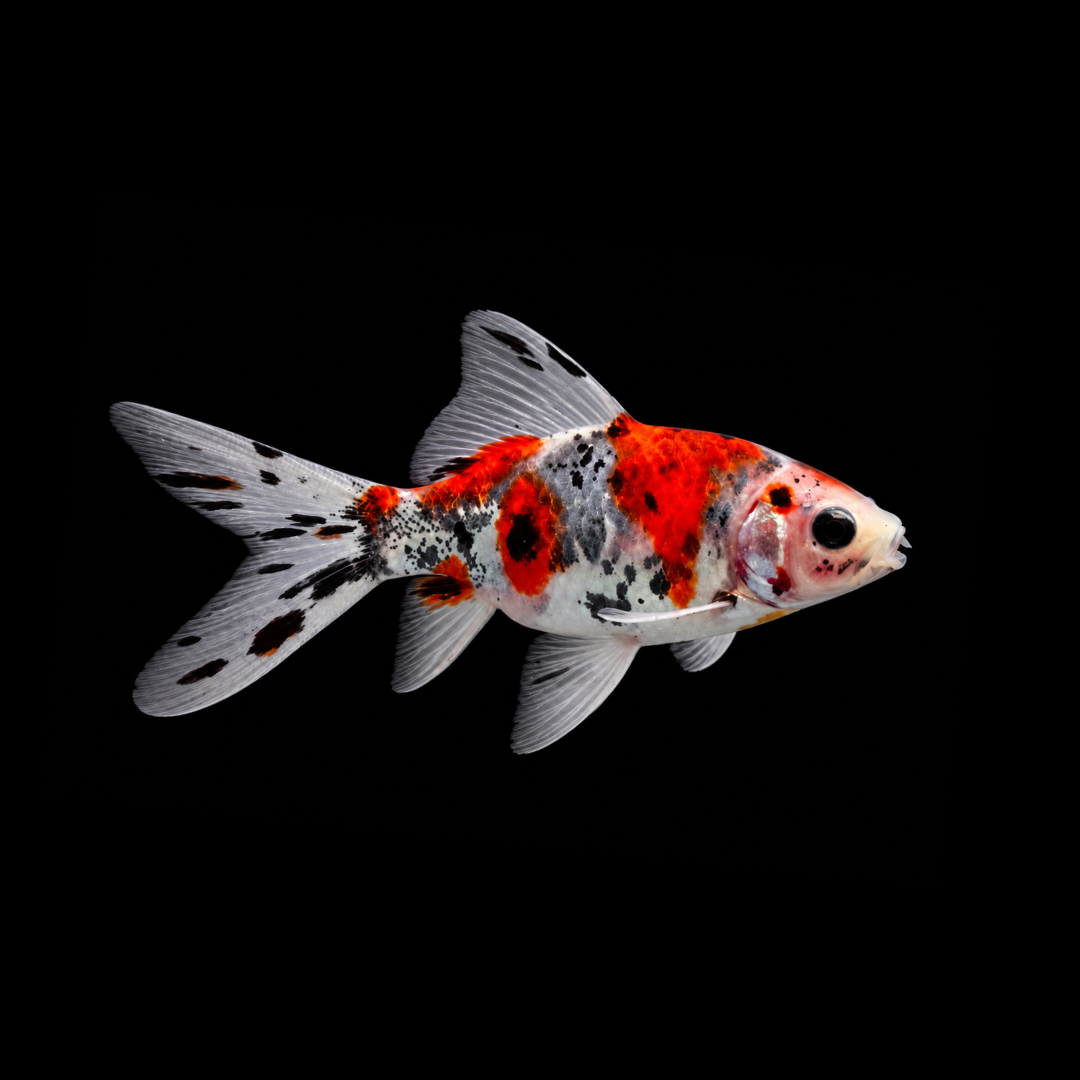
朱文金は、細長い体と一枚の尾を持つキンギョの改良品種で、赤・橙・黒・白に浅葱から青灰色が加わるキャリコ模様が特徴です。独立した種ではなく、キンギョ Carassius auratus の品種群のひとつです。朱文金らしい色彩は、普通鱗と透明鱗が入り交じるモザイク透明鱗に、皮膚の色素胞や反射組織の見え方が重なって生まれます。和金に近いすらりとした体形で遊泳力が高く、金魚の中では比較的丈夫ですが、大きく育つため、成魚では広い遊泳空間と十分な濾過能力が必要です。日本で成立したのち、英国ではLondon ShubunkinやBristol Shubunkin、米国では長い体や鰭を評価するタイプが選抜され、地域ごとに異なる美しさが磨かれてきました。Shubunkin is a single-tailed variety of goldfish with a streamlined body and a distinctive calico pattern combining red, orange, black, white, and slate-blue tones. It is not a separate species, but a domesticated variety of the goldfish Carassius auratus. Its characteristic appearance is produced by a mosaic of normal and transparent scales together with the way pigment cells and reflective tissues are seen through the skin and scales. Shubunkins are strong swimmers and are generally hardier than many highly modified fancy goldfish, but adults grow large enough to require ample swimming space and effective filtration. After the variety was established in Japan, regional forms such as the London Shubunkin and Bristol Shubunkin were selected in Britain, while long-bodied, long-finned show types were developed in the United States.
基本情報 / Basic Information
学名 / Scientific Name
Carassius auratus
通称 / Common Name
朱文金、シュブンキンShubunkin
分類 / Family
コイ目・コイ科・フナ属。キンギョの改良品種Order Cypriniformes, family Cyprinidae, genus Carassius; a domesticated goldfish variety
英名 / English Name
Shubunkin
分布 / Distribution
日本で成立した観賞用品種。現在は世界各地で飼育・繁殖され、英国や米国では独自の系統も発達しています。An ornamental variety developed in Japan and now kept and bred worldwide. Distinct regional strains have also been developed in the United Kingdom and the United States.
最大体長 / Max Size
20cmを超える大型魚になります。系統や飼育環境によって差があり、Bristol Shubunkinでは通常約25cm、池飼育で約38cmに達する例もあります。Adults commonly exceed 20 cm. Size varies by strain and husbandry; Bristol Shubunkins are often around 25 cm, with pond-raised specimens reported at about 38 cm.
寿命 / Lifespan
適切な水質管理と十分な飼育空間のもとでは、10年以上生きることもある長寿の金魚です。実際の寿命は、水温、過密度、疾病管理、遺伝的背景などによって大きく変わります。With good water quality and adequate space, Shubunkins can live for more than a decade. Actual lifespan varies greatly with temperature, stocking density, disease control, and genetic background.
飼育環境 / Aquarium Environment
水槽サイズ / Tank Size
成魚を長期飼育する場合は、90cm規格水槽(約180L)をひとつの目安とし、複数飼育では120cm規格水槽(約240L)以上や120cmワイド水槽、屋外池・大型容器が適します。これは一律の最低水量ではなく、成魚の体格と活発な遊泳性を考えた実用的な目安です。若魚のうちは小さな水槽でも管理できますが、成長を見越して早めに広い環境へ移行します。For long-term adult care, a 90 cm standard aquarium of roughly 180 L is a practical guideline rather than a universal minimum. Groups are better maintained in a 120 cm standard tank of about 240 L or larger, a wide 120 cm aquarium, or a spacious outdoor pond or tub. These recommendations reflect adult size and active swimming behavior. Juveniles can be raised in smaller tanks temporarily, but the system should be upgraded before growth makes space limiting.
水温 / Temperature
通常飼育では概ね10~25℃を目安にし、急激な変化を避けます。夏は高水温に伴う酸欠に注意し、日陰の確保、水面撹拌、十分な曝気を優先します。A practical range for routine care is about 10–25°C, with sudden changes avoided. During hot weather, pay particular attention to oxygen depletion by providing shade, strong surface movement, and adequate aeration.
水質 / Water Quality
中性~弱アルカリ性を基本とし、数値そのものより安定性を重視します。アンモニアと亜硝酸は検出されない状態を目標にし、硝酸塩は定期換水で蓄積を抑えます。水道水は塩素・クロラミンを適切に中和して使用します。Neutral to slightly alkaline water is suitable, with stability more important than chasing an exact pH value. Ammonia and nitrite should remain undetectable with routine aquarium testing, while nitrate should be controlled through regular water changes. Tap water must be properly treated to neutralize chlorine and chloramine.
レイアウト / Layout
活発に泳げる横方向の空間を広く取り、中央部はできるだけ開けます。底床や石を使う場合は、口や体を傷つけにくい形状を選びます。水草は利用できますが、金魚は柔らかい葉をついばんだり根を掘り返したりすることがあるため、丈夫な種類や鉢植え、産卵用の人工産卵床などを目的に応じて使い分けると管理しやすくなります。Provide a broad, open swimming area, especially across the length of the aquarium. If substrate or stones are used, choose smooth materials that are unlikely to injure the mouth or body. Live plants can be included, but goldfish may nibble soft leaves or disturb roots, so robust plants, potted specimens, or artificial spawning mops can be selected according to the purpose of the setup.
注意点 / Precautions
丈夫な品種ですが、小容器や無濾過環境に適しているという意味ではありません。高温時の酸欠、過密、濾過未成熟によるアンモニア・亜硝酸上昇に注意します。新規導入魚は可能であれば隔離観察し、既存魚へすぐ合流させない方が安全です。飼えなくなった個体を河川、池、水路へ放流してはいけません。Although hardy, Shubunkins are not suited to tiny unfiltered containers. Watch for oxygen depletion in warm water, overcrowding, and ammonia or nitrite spikes in immature filtration systems. New arrivals are best quarantined before being introduced to established fish. Unwanted fish must never be released into rivers, ponds, canals, or other natural waters.
餌と給餌 / Feeding
餌の種類 / Diet
基本は金魚用の良質な完全配合飼料です。浮上性・沈下性は個体や水槽環境に合わせて選び、主食として必要な栄養を安定して与えられるものを中心にします。A high-quality complete goldfish diet should form the staple food. Floating or sinking pellets can be selected to suit the fish and aquarium, with the main diet providing balanced nutrition consistently.
給餌のポイント / Feeding Tips
水温と活動性に合わせ、短時間で食べ切れる量を少量ずつ与えます。高水温時の過剰給餌は酸素消費と水質悪化を同時に招きやすく、低水温時は消化と摂餌活動が落ちるため、季節を通して同じ量を機械的に与えないことが大切です。繁殖親魚も肥満させるのではなく、体型と活動性を保ちながら栄養状態を整えます。Feed small portions that are consumed quickly, adjusting the amount to temperature and activity. Overfeeding in warm water can worsen both oxygen demand and water quality, while digestion and appetite decline at lower temperatures. Rather than feeding the same amount year-round, adjust the ration seasonally. Conditioning breeding fish should improve nutritional status without producing obesity.
性格と混泳 / Temperament and Tank Mates
性格 / Temperament
基本的には温和ですが、和金型らしい高い遊泳力と旺盛な食欲があり、水槽内では活発に泳ぎます。繁殖期にはオスがメスを強く追尾するため、狭い水槽ではメスが消耗したり体表を傷つけたりすることがあります。Shubunkins are generally peaceful, but their streamlined body gives them strong swimming ability and they are active, vigorous feeders. During the breeding season, males may chase females persistently, which can exhaust or injure females in cramped quarters.
混泳の相性 / Compatibility
和金、コメットなど、体格と遊泳力が近い単尾系金魚とは合わせやすい傾向があります。泳ぎの遅い丸手の高改良金魚とは、餌の取り合いや接触で不利が出ることがあるため、長期飼育では分けた方が管理しやすい場合があります。極端に小さな魚や口に入るサイズの生体との混泳も避け、同居魚全体が十分に泳げる水量を確保します。They are generally compatible with similarly sized, fast-swimming single-tailed goldfish such as common-type goldfish and comets. Very slow, round-bodied fancy goldfish may be disadvantaged during feeding or by constant activity, so separate long-term housing can be easier to manage. Avoid very small tank mates that could be swallowed, and provide enough water volume for all fish to swim freely.
病気と対策 / Diseases and Prevention
かかりやすい病気 / Common Diseases
白点病、寄生虫症、細菌性の潰瘍など、一般的な金魚の疾病に注意します。日本では、Cyprinid herpesvirus 2(CyHV-2)の感染によるキンギョヘルペスウイルス性造血器壊死症も重要な疾病です。過剰粘液、呼吸の速まり、食欲低下、異常遊泳、白点、潰瘍などが見られたら、早めに原因を確認します。Shubunkins are susceptible to the same general health problems as other goldfish, including white spot disease, parasitic infections, and bacterial ulcers. In Japan, herpesviral hematopoietic necrosis caused by Cyprinid herpesvirus 2 (CyHV-2) is also an important concern. Excess mucus, rapid breathing, loss of appetite, abnormal swimming, white spots, or ulcers should prompt early investigation.
対策と予防 / Prevention
異常が見られたら、薬を使う前に水温、pH、アンモニア、亜硝酸、酸素状態、直近の新魚導入歴を確認します。急な温度差や塩素、濾過不良だけでも感染症に似た症状が出ることがあります。新規個体の隔離、器具の共用を減らすこと、過密を避けることが基本的な予防策です。大量死や原因不明の症状、CyHV-2が疑われる場合は、水産試験場や魚病に対応できる専門家へ相談する方が安全です。When abnormalities appear, check temperature, pH, ammonia, nitrite, oxygenation, and recent introductions before reaching for medication. Sudden temperature changes, chlorine exposure, or filtration failure can mimic infectious disease. Quarantine, reduced sharing of equipment between groups, and avoidance of overcrowding are fundamental preventive measures. Unexplained mass mortality or suspected CyHV-2 disease should be referred to an aquatic animal health specialist or appropriate fisheries authority.
増やし方(繁殖) / Breeding
雌雄の判別 / Sexing
成熟期のオスは鰓蓋や胸鰭前縁に追星と呼ばれる小さな白い突起が現れやすく、繁殖期にはメスを盛んに追尾します。成熟したメスは産卵期に腹部がふっくらし、生殖孔が目立ちやすくなります。ただし若魚や繁殖期以外では判別が難しいため、単一の特徴だけで断定しない方が安全です。Mature males often develop small white breeding tubercles on the gill covers and leading edges of the pectoral fins and actively chase females during the spawning season. Mature females become fuller through the abdomen and the vent becomes more prominent as spawning approaches. Juveniles and fish outside the breeding season can be difficult to sex, so no single feature should be used as absolute proof.
繁殖形態 / Reproduction
卵生で、水草、産卵藻、人工産卵床などに多数の粘着卵をばらまくタイプです。温帯性の季節周期が明瞭で、自然水温では冬の低温期を経た親魚が春の水温上昇に反応し、おおむね15~25℃の範囲で排卵・産卵が起こりやすくなります。Shubunkins are egg-laying fish that scatter numerous adhesive eggs among aquatic plants, spawning mops, or similar surfaces. Their reproductive cycle is strongly seasonal in temperate climates. Under natural temperature conditions, brood fish that have passed through winter commonly respond to rising spring temperatures, with ovulation and spawning becoming more likely at roughly 15–25°C.
繁殖のポイント / Breeding Tips
追尾と放卵を確認したら、親魚による卵食を防ぐため卵または親魚を分けます。孵化後は卵黄吸収を終えた仔魚へ、口に合う微小な餌から開始し、成長に合わせて粒径を上げます。朱文金では単に育てるだけでなく、曲がり、体形、尾形、鱗の透明性、浅葱・赤・墨の配置などを段階的に選別することで品種らしさを残します。Bristol系では特に尾形の選抜が重要です。Once active chasing and egg release are confirmed, separate the eggs or adults to prevent egg predation. After the yolk sac is absorbed, begin feeding fry with very small foods and increase particle size as they grow. Breeding Shubunkins involves more than simply raising survivors: breeders progressively select for straight bodies, sound fins, desired scale transparency, and the balance of blue-gray, red, and black markings. In Bristol strains, tail shape is especially important.
雑学と豆知識 / Trivia and Fun Facts
1. 明治期の日本で生まれた近代金魚 / 1. A Modern Goldfish Born in Meiji-Era Japan
朱文金の成立について、日本の金魚文化では初代秋山吉五郎が1892年ごろに三色出目金、ヒブナ、フナ尾和金などを基礎として作出し、1900年に水産講習所の松原新之助が「朱文金」と命名したという説が広く伝えられています。当時の一次史料まで完全に遡れる部分ばかりではないため、細かな交配史は慎重に扱う必要がありますが、江戸期に成熟した金魚文化へ明治期の計画的な育種が加わって生まれた品種として見ると、その位置づけがよく分かります。和金型の機敏な体と、三色系の複雑な色彩がひとつになった朱文金は、日本の古い金魚文化と近代育種を結ぶ存在でもあります。A widely repeated Japanese account credits the first Kichigoro Akiyama with developing the Shubunkin around 1892 from stock including calico telescope-eyed goldfish, red crucian-type fish, and single-tailed Wakin-type goldfish, with Shinnosuke Matsubara of the Fisheries Training Institute naming it “Shubunkin” in 1900. Not every detail can be traced directly to surviving primary records, so the exact crossing history should be treated with appropriate caution. Even so, the variety is a useful symbol of the point where the long goldfish culture of the Edo period met the more deliberate selective breeding of modern Japan.
2. 朱文金の「青」は青い色素だけでできているわけではない / 2. Shubunkin Blue Is Not Simply a Blue Pigment
朱文金の浅葱色や青灰色は、単純に青い色素だけでできているわけではありません。透明鱗ではグアニンを含む反射組織の分布が不均一になり、そこに深い位置の黒色素胞などが重なることで、青灰色の奥行きとして見えます。つまり、浅葱は表面に青色が塗られたような色ではなく、鱗や皮膚の構造を通して生まれる複合的な見え方です。このため、個体によって青みの深さや広がり方に大きな違いが生じます。The slate-blue or asagi tone of a Shubunkin is not produced by blue pigment alone. In transparent-scaled areas, guanine-rich reflective tissue is distributed unevenly, and deeper melanophores contribute to a blue-gray appearance with visual depth. In other words, asagi is not simply a surface layer of blue, but a composite optical effect created through the structure of the scales and skin. This is why the depth and extent of blue can vary greatly from fish to fish.
3. モザイク透明鱗は古典遺伝学の教材にもなった / 3. Mosaic Scales Became a Classic Genetics Example
朱文金らしさの中心にあるのは、普通鱗と透明鱗が入り交じるモザイク透明鱗です。古典的な金魚遺伝学では、透明鱗性は不完全優性の形質として解析され、朱文金に典型的なモザイク型はヘテロ接合型の代表として扱われました。単純な遺伝モデルでは、モザイク型同士の交配で鱗の表現型が1対2対1に分かれることが期待されます。ただし、実際の観賞価値を決める赤、墨、浅葱の位置や濃さ、尾形、成長性までがこの一つの遺伝座だけで決まるわけではありません。現代のゲノム研究では透明鱗性に関わる有力な候補遺伝子まで絞り込まれていますが、機能の検証はまだ完了していません。そのため、透明鱗性の遺伝と、朱文金の色柄全体を一つの「朱文金遺伝子」で説明することはできません。At the center of the Shubunkin phenotype is the nacreous or mosaic scale condition, in which normal reflective scales and transparent scales occur together. Classical goldfish genetics treated transparency as an incompletely dominant trait, with the Shubunkin-type mosaic phenotype representing the heterozygous condition. In a simple genetic model, crossing two mosaic fish is expected to produce scale phenotypes in a 1:2:1 ratio. However, the placement and intensity of red, black, and blue-gray, along with body shape, tail form, and growth, are not determined by that single locus alone. Modern genomic research has narrowed the transparent-scale trait to a strong candidate gene, but functional validation is still incomplete. The inheritance of transparent scaling therefore cannot be equated with a single gene that explains the entire Shubunkin color pattern.
4. 海を渡った朱文金は地域ごとに異なる理想形へ選抜された / 4. Different Countries Selected Different Shubunkin Ideals
朱文金を基礎とする系統は、海外で日本型をそのまま保つだけでなく、地域ごとの審査基準や好みに沿って選抜されてきました。英国では、比較的がっしりした普通金魚型の体と短めの鰭を持つLondon Shubunkinと、大きく丸く開く一枚尾を重視するBristol Shubunkinが発達しました。米国でも、長い体と鰭を評価するショータイプが知られています。同じキャリコの単尾金魚でも、重視する形質が異なれば理想とされる姿も変わります。とくにBristolでは、単に尾が長いことより、尾の輪郭や開き方、保持のされ方が重要な評価点です。Shubunkin-derived lines were not simply preserved unchanged outside Japan; they were selectively bred according to regional judging standards and preferences. In Britain, the London Shubunkin developed as a compact common-goldfish type with relatively short fins, while the Bristol Shubunkin was selected for a broad, rounded single tail. In the United States, show types emphasizing a long body and long fins are also recognized. Even among calico single-tailed goldfish, different priorities produce different ideals. In Bristol judging in particular, the outline, spread, and carriage of the tail matter more than tail length alone.
5. 幼魚の模様は完成形ではない / 5. A Juvenile Pattern Is Not the Final Pattern
朱文金を選ぶとき、幼魚の時点で気に入った墨や赤の位置が、そのまま一生固定されるとは限りません。金魚の色素胞は成長や成熟に伴って見え方が変わり、特に黒色は濃くなる部分もあれば退色する部分もあります。透明鱗の下にある色素や反射組織の見え方も体の成長とともに変化するため、若魚はある意味で「途中の絵」です。購入時には柄だけでなく、背線のまっすぐさ、口や鰓蓋の左右対称性、尾筒の強さ、尾の左右バランス、呼吸と遊泳の正常さも見ておくと、成長後の満足につながりやすくなります。The pattern that attracts you in a juvenile Shubunkin may not remain unchanged for life. Goldfish pigment cells alter in appearance as the fish grows and matures, and black areas in particular may intensify in some places while fading in others. The way deeper pigments and reflective tissues are seen through transparent scales also changes as the body grows, making a young fish something like a picture still in progress. When choosing a specimen, it is therefore wise to look beyond color and also check a straight back line, symmetrical mouth and gill covers, a strong caudal peduncle, balanced fins, normal breathing, and confident swimming.
6. 丈夫さの本当の意味は「雑に飼える」ことではない / 6. Hardy Does Not Mean Neglect-Proof
朱文金は丸手の高改良金魚に比べて泳ぎが力強く、比較的丈夫な金魚として知られています。しかし、丈夫だからといって、小さな容器、酸欠、過密、濾過不足に耐え続けられるわけではありません。長手の金魚は活発に泳ぎ、よく食べ、大きく育てば排泄量も増えます。十分な水量と安定した生物濾過を整えることで、浅葱や墨の色彩だけでなく、伸びやかな泳ぎも朱文金の魅力として楽しめます。丈夫さは管理を省ける性質ではなく、適切な環境のもとで健やかに飼育しやすいという意味で捉えるのが適切です。Shubunkins are known as relatively hardy goldfish with strong swimming ability compared with many highly modified fancy varieties. However, hardiness does not mean they can remain healthy indefinitely in small containers, low oxygen, overcrowding, or inadequate filtration. Active single-tailed goldfish swim strongly, eat well, grow large, and produce increasing amounts of waste as they mature. With generous water volume and stable biological filtration, their appeal includes not only the depth of the blue-gray and black markings but also their flowing movement. Hardiness is best understood as good resilience under proper husbandry, not as freedom from husbandry requirements.
まとめ / Conclusion
朱文金は、和金型の伸びやかな体と、モザイク透明鱗による複雑なキャリコ模様をあわせ持つ、日本生まれの金魚です。赤や墨の鮮やかさだけでなく、浅葱の奥行き、成長とともに変化する色柄、力強い遊泳まで含めて楽しめるところに、この品種ならではの魅力があります。The Shubunkin is a Japanese goldfish that combines a streamlined single-tailed body with the complex calico effects of mosaic transparent scaling. Its appeal is not limited to bright red and black markings; the depth of the blue-gray ground, changes in pattern as the fish matures, and its strong swimming are all characteristic of the variety.
十分な水量と安定した濾過を確保し、季節に合わせて給餌や水温の変化を管理すれば、朱文金は長期飼育を楽しみやすい金魚です。広い水槽や池を伸びやかに泳ぐ姿には、鮮やかな色柄だけではない落ち着いた美しさがあり、成長とともに変わる表情をじっくり観察できます。With generous water volume, stable filtration, and feeding and temperature management that follow the seasons, Shubunkins are well suited to long-term care. Their strong movement through open water has an appeal that goes beyond bright coloration, while gradual changes in growth and pattern provide much to observe over time.
Kobayashi M, Iwata E, Sorensen PW. Environmental and Physiological Regulation of Reproduction in the Goldfish: Gonadal Development, Maturation, and Spawning Behavior: A Review. Animals. 2026;16(5):775. doi:10.3390/ani16050775.
季節繁殖・成熟・排卵と水温・産卵行動https://doi.org/10.3390/ani16050775






コメント