
解説 / Description
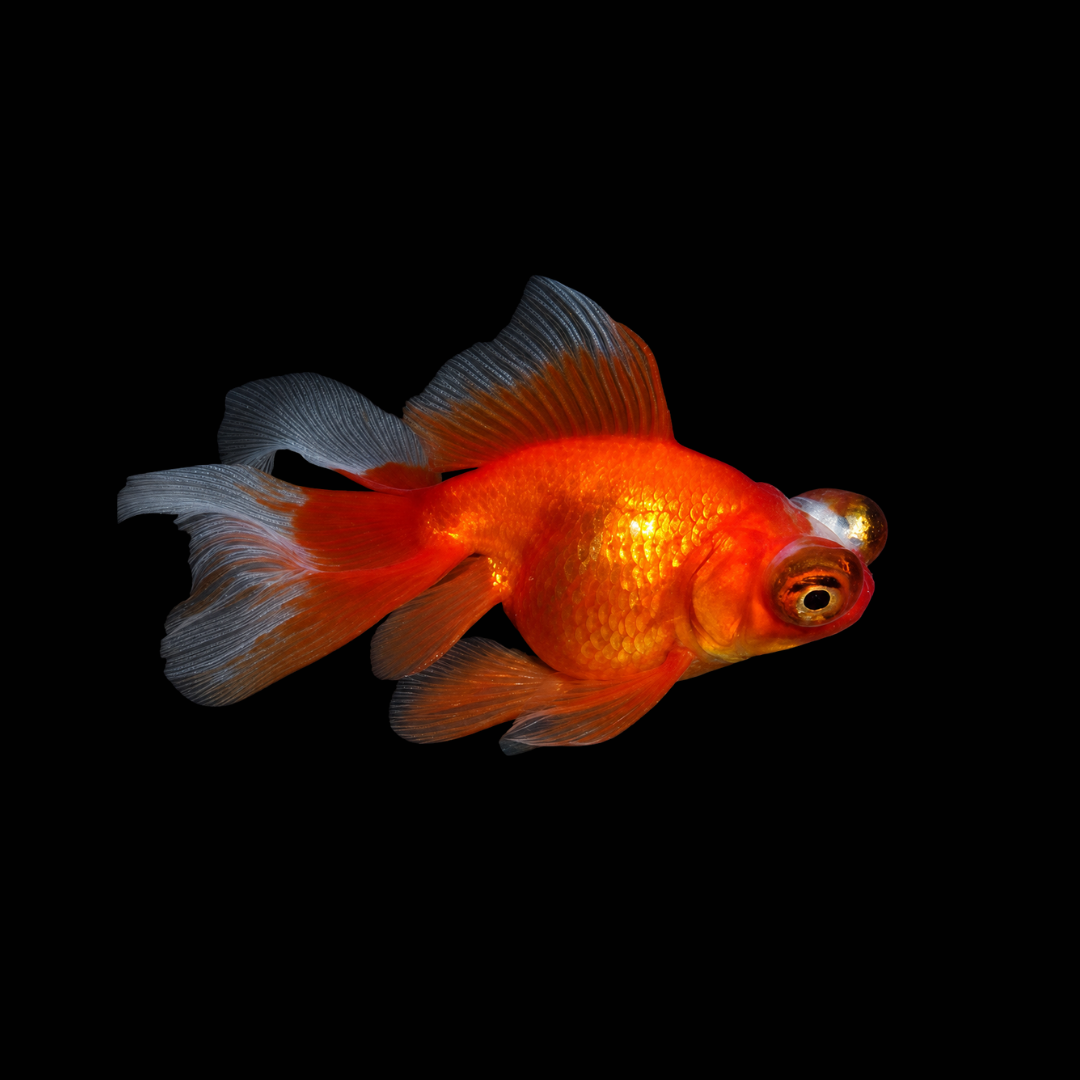
赤蝶尾(あかちょうび)は、中国で発達した蝶尾系金魚のうち、全身が赤から橙赤色にまとまる個体を指す流通・品種呼称です。左右へ大きく張り出す双尾を真上から見ると、蝶が翅を広げたような輪郭を描き、左右へ突出した出目も大きな特徴です。観賞では、尾の左右対称性や親骨の張り、体と眼のバランス、赤色の均一さなどが見どころになります。和金やコメットに比べると泳ぎはゆっくりしているため、強い水流や激しい餌競争を避け、広い水面と穏やかな環境を用意すると特徴を楽しみやすくなります。赤蝶尾は自然界に分布する魚ではなく、長い金魚飼育史の中で人為選択によって形質が受け継がれてきた観賞用品種です。 Red Butterfly Telescope Goldfish refers to red or orange-red individuals of the butterfly-tail fancy goldfish lineage developed in China. Viewed from above, the broad paired caudal fin forms a silhouette reminiscent of a butterfly with outstretched wings, and the laterally protruding telescope eyes are another defining feature. Important points of appreciation include bilateral tail symmetry, the strength and spread of the outer caudal rays, balance between body and eyes, and even red coloration. Because it swims more slowly than common goldfish or comets, it is easier to keep in gentle currents with ample surface area and limited feeding competition. This is a domesticated ornamental form with no natural distribution, maintained through generations of artificial selection.
基本情報 / Basic Information
| 学名 / Scientific Name | Carassius auratus |
|---|---|
| 通称 / Common Name | 赤蝶尾、蝶尾の赤系統Red Butterfly Telescope Goldfish, Red Butterfly Tail Goldfish |
| 分類 / Family | コイ目・コイ科・フナ属Order Cypriniformes, Family Cyprinidae, Genus Carassius |
| 英名 / English Name | Red Butterfly Telescope Goldfish |
| 分布 / Distribution | 観賞用に作出された飼育品種のため自然分布はありません。蝶尾は中国原産とされ、日本には1980年頃から知られるようになり、現在は中国産の輸入個体に加えて日本国内で繁殖された個体も流通しています。This ornamental breed has no natural distribution. The butterfly-tail form originated in China and became known in Japan around 1980. Today, imported Chinese stock and domestically bred Japanese fish are both found in the aquarium trade. |
| 最大体長 / Max Size | 成魚では全長15~20cm程度がひとつの目安です。ただし、これは厳密な上限ではなく、血統、給餌、飼育密度、容器の広さなどによって体格には大きな個体差があります。An adult length of roughly 15–20 cm is a useful general guide rather than a strict maximum. Final size varies considerably with lineage, diet, stocking density, and available space. |
| 寿命 / Lifespan | 寿命は5~10年程度がひとつの目安で、良好な環境では10年以上飼育されることもあります。水質の安定、過密や肥満の回避、季節に応じた給餌管理が長期飼育の基本です。A lifespan of about 5–10 years is a useful general guide, although some individuals live beyond 10 years under good conditions. Stable water quality, avoidance of crowding and obesity, and seasonally appropriate feeding are important for long-term care. |
飼育環境 / Aquarium Environment
| 水槽サイズ / Tank Size | 成魚1匹なら60cm規格水槽(約60Lクラス)をひとつの目安とし、2~3匹では90cmクラスの水槽(約150~180L程度)や同等以上の水量があると管理しやすくなります。上見を重視する場合は、60~90cmクラスのプラ舟や角型容器を使い、魚の体格や季節に合わせて水深を浅めに調整すると尾の展開を観察しやすくなります。金魚は排泄量が多いため、単純な体長だけでなく実水量とろ過能力を優先してください。For one adult, a standard 60 cm aquarium in the roughly 60 L class is a practical guide. For two or three adults, a 90 cm class aquarium holding roughly 150–180 L, or an equivalent volume, is easier to maintain. For top-view keeping, a 60–90 cm wide tub can be used with a relatively shallow water depth adjusted to fish size and season. Because goldfish produce substantial waste, actual water volume and filtration capacity matter more than body length alone. |
|---|---|
| 水温 / Temperature | 18~24℃を安定域の目安にします。健康な金魚はより広い範囲に適応できますが、赤蝶尾では急激な温度変化を避けることが重要です。冬季に低水温で維持する場合は代謝低下に合わせて給餌量を大きく落とし、室内で一定に育てる場合はヒーターで急変を抑えます。 A stable range of 18–24°C is a useful target. Healthy goldfish can tolerate a wider range, but rapid temperature changes should be avoided. If kept cool in winter, reduce feeding substantially as metabolism slows; indoors, a heater can be used when necessary to prevent abrupt fluctuations. |
| 水質 / Water Quality | 弱酸性~弱アルカリ性の安定した淡水に適応し、pH6.5~8.0程度が扱いやすい範囲です。日本の一般的な水道水は適切に塩素を中和すれば利用できます。アンモニアと亜硝酸は検出されない状態を維持し、硝酸塩や溶存有機物が蓄積しないよう定期換水を行います。硬度の数値を追うことより、急変を避けて安定させることが重要です。It adapts well to stable freshwater from slightly acidic to mildly alkaline, with pH 6.5–8.0 being a practical range. Typical Japanese tap water is generally suitable after proper dechlorination. Maintain undetectable ammonia and nitrite and perform regular water changes to prevent nitrate and dissolved organic waste from accumulating. Stability is more important than chasing a specific hardness value. |
| レイアウト / Layout | 底床なし、または角の丸い細砂を薄く敷くシンプルな構成が安全です。突出した眼と大きな尾鰭を傷つけないよう、尖った石、硬い枝状流木、狭い隙間を作る装飾は避けます。ろ過はスポンジフィルター、投げ込み式、吐出口を弱めた上部式など、穏やかな流れを作れる方式が向きます。上見では広い水面を確保し、魚が止まった時にも尾を自然に広げられる空間を残します。A bare bottom or a thin layer of smooth fine substrate is safest. Avoid sharp rocks, hard branching wood, and narrow gaps that could injure the protruding eyes or large fins. Sponge filters, gentle internal filters, or overhead filters with diffused outlets are suitable because they can provide filtration without excessive current. For top viewing, prioritize a broad surface area and leave enough open space for the fish to spread its tail naturally while resting. |
| 注意点 / Precautions | 出目と大きな蝶尾の組み合わせにより、視界と遊泳速度の両面で一般的な長手の金魚より不利です。強い水流、過密、餌の奪い合いを避け、眼や尾の小さな傷を早期に見つけられる環境にします。上見育成では浅めの水深が伝統的に好まれますが、水深だけで尾型が決まるわけではなく、遺伝、成長速度、栄養、運動量、水流などが複合的に影響します。屋外では夏の高水温と冬の急冷、鳥や猫などの捕食にも注意が必要です。The combination of telescope eyes and a large butterfly tail places this fish at a disadvantage in both vision and swimming speed compared with long-bodied goldfish. Avoid strong currents, crowding, and intense feeding competition, and use a setup where minor eye or fin injuries can be noticed early. Shallow water is traditionally favored for top-view development, but water depth alone does not determine tail form; genetics, growth rate, nutrition, exercise, and flow all contribute. Outdoor keepers must also manage summer overheating, sudden winter cooling, and predators such as birds and cats. |
餌と給餌 / Feeding
| 餌の種類 / Diet | 消化性に配慮した金魚用の沈下性またはゆっくり沈む人工飼料を主食にし、必要に応じて冷凍赤虫、イトミミズ類、ブラインシュリンプ、ゆでた青菜などを補助的に与えます。緋色を維持したい場合は、アスタキサンチン、カンタキサンチン、スピルリナなどのカロテノイド源を含む色揚げ飼料をローテーションに加える方法があります。屋外の青水では植物プランクトン由来の微細な栄養源も利用されます。Use a digestible sinking or slow-sinking goldfish pellet as the staple diet, supplemented when appropriate with frozen bloodworms, aquatic worms, brine shrimp, or soft blanched greens. To support red coloration, feeds containing carotenoid sources such as astaxanthin, canthaxanthin, or spirulina may be rotated into the diet. In outdoor green-water systems, suspended microalgae also provide small, continuously available food particles. |
|---|---|
| 給餌のポイント / Feeding Tips | 1回に多量を与えるより、活動が高い時期は少量を1日1~3回に分け、短時間で食べ切れる量を基本にします。沈下性の餌は、水面で空気を飲み込みやすい丸型金魚の給餌管理にも使いやすい選択肢です。低水温で活動が鈍る時期は回数と量を減らし、食欲や排泄の様子を見ながら調整します。色揚げ飼料は赤色の維持を助けますが、遺伝的な色素細胞の構成、光環境、健康状態も発色を左右するため、色揚げ飼料だけに依存しないことが大切です。Rather than giving large meals, offer small portions one to three times daily when the fish are active, using an amount that is eaten promptly. Sinking foods can also be useful for managing feeding in deep-bodied fancy goldfish that tend to gulp air at the surface. During cooler periods when activity declines, reduce both feeding frequency and quantity while watching appetite and waste production. Color-enhancing diets can support red pigmentation, but chromatophore genetics, lighting, and overall health also influence color, so feeding alone cannot determine the final result. |
性格と混泳 / Temperament and Tank Mates
| 性格 / Temperament | 基本的には温和で、同種間で強い縄張りを作る魚ではありません。一方で食欲は旺盛で、個体差によっては給餌時に前へ出る魚もいます。出目のため近距離の餌を探すのが得意とは限らず、尾が大きい個体ほど加速や方向転換もゆっくりです。Generally peaceful and not strongly territorial toward its own kind. Goldfish are enthusiastic feeders, although individual behavior varies. Telescope eyes can make close-range food location less efficient, and fish with especially broad tails tend to accelerate and turn more slowly. |
|---|---|
| 混泳の相性 / Compatibility | 合わせやすいのは、同程度の大きさで泳ぐ速度や採餌ペースが近い蝶尾や出目金などです。琉金やらんちゅうなどの丸手の金魚とも飼える場合がありますが、個体ごとの活発さや体格差を見て、餌が行き渡っているか確認してください。水泡眼は眼下の水泡が傷つきやすく、頂天眼も視界に大きな制約があるため、同じ「泳ぎの遅い金魚」でも設備と給餌には別の配慮が必要です。和金、コメット、朱文金などの長手で俊敏な金魚との混泳は、餌の競争や眼・尾の損傷につながりやすいため避けるのが無難です。The easiest companions are similarly sized butterfly tails, telescope-eye goldfish, and other individuals with comparable swimming and feeding speeds. Ryukin, ranchu, and other deep-bodied varieties can sometimes be kept together, but differences in activity and body size should be watched closely to ensure every fish gets enough food. Bubble-eye and celestial-eye goldfish are also slow, yet their specialized eyes require different protection and feeding considerations. Fast single-tailed varieties such as common goldfish, comets, and shubunkins are best avoided because feeding competition and accidental eye or fin damage are more likely. |
病気と対策 / Diseases and Prevention
| かかりやすい病気 / Common Diseases | 丸みのある体型では、いわゆる転覆症状などの浮力異常が見られることがあります。ただし、浮力異常は単一の原因で起こるとは限らず、消化状態だけでなく、浮き袋やほかの臓器の異常、感染、水質悪化など複数の要因を考える必要があります。ほかに白点病、エラ・体表の寄生虫、尾ぐされや赤斑を伴う細菌性疾患、イカリムシ、ウオジラミなどが問題になります。赤蝶尾では、突出した眼の擦過傷や白濁、幅広い尾鰭の裂けも特に観察したいポイントです。Deep-bodied goldfish may develop abnormal buoyancy, including the overturning signs often grouped under “swim-bladder disorder.” Such problems do not necessarily have a single cause; digestion, abnormalities of the gas bladder or other organs, infection, and poor water quality may all need to be considered. Other concerns include ich, gill and skin parasites, bacterial fin or skin disease, anchor worms, and fish lice. In Red Butterfly Telescope Goldfish, abrasions or cloudiness of the protruding eyes and tears in the broad tail deserve especially close observation. |
|---|---|
| 対策と予防 / Prevention | 予防の基本は、アンモニアや亜硝酸を蓄積させないろ過管理、定期換水、急変の少ない水温、適量給餌、新規個体の隔離観察です。浮力異常が出た場合は、まず水質と水温を確認し、餌を1~3日休んで排泄や姿勢の変化を観察します。症状が続く、体表に充血がある、沈み続ける、呼吸が速いなどの場合は、単純な消化不良と決めつけず、観賞魚を診られる獣医師や魚病に詳しい専門家へ相談してください。塩水浴や薬浴は目的と濃度を明確にし、イカリムシやウオジラミなどに薬剤を使う場合も製品表示を厳守します。目に見える寄生虫を除去しても環境中に別の生活段階が残ることがあるため、水槽全体と生活環を意識して管理することが重要です。Prevention centers on filtration that prevents ammonia and nitrite from accumulating, regular water changes, stable temperature, controlled feeding, and quarantine of new fish. If buoyancy problems appear, first check water quality and temperature, withhold food for one to three days, and watch for changes in waste production and posture. Persistent symptoms, skin reddening, continuous sinking, or rapid breathing should not be assumed to be simple indigestion; consult a veterinarian or fish-health specialist experienced with ornamental fish. Salt or medications should be used for a defined purpose and concentration, and product directions must be followed carefully when treating parasites such as anchor worms or fish lice. Removing visible parasites alone may leave other life stages in the system, so control should address the aquarium as a whole and the parasite life cycle. |
増やし方(繁殖) / Breeding
| 雌雄の判別 / Sexing | 成熟期のオスは、春を中心にエラ蓋や胸鰭の前縁に白い追星が現れやすく、メスを追尾する行動が増えます。成熟したメスは腹部がふっくらし、上から見た時に左右の張りが強くなることがあります。ただし体型の個体差が大きいため、腹の形だけで断定せず、追星、肛門周辺、行動を合わせて判断します。During the breeding season, males often develop small white breeding tubercles on the gill covers and leading edges of the pectoral fins and show increased chasing behavior. Mature females may become fuller through the abdomen and broader when viewed from above. Because body shape varies widely among fancy goldfish, sexing should combine tubercles, vent appearance, and behavior rather than relying on abdominal shape alone. |
|---|---|
| 繁殖形態 / Reproduction | 卵生で、水草や産卵巣などに粘着性の卵を多数ばらまく体外受精型です。春の水温上昇が繁殖の大きな刺激になり、親魚は産卵後に卵を食べるため、採卵を目的とする場合は親と卵を分けます。受精卵は水温によって数日で孵化し、仔魚は卵黄を吸収して遊泳を始めてから小型の生餌へ移行します。An egg-laying, externally fertilizing fish that scatters many adhesive eggs onto plants or spawning media. Rising spring temperatures are a major reproductive cue. Adults readily eat the eggs, so breeders normally separate the parents from the spawning material. Fertilized eggs hatch within several days depending on temperature, and the fry begin taking very small live foods after absorbing the yolk sac and becoming free-swimming. |
| 繁殖のポイント / Breeding Tips | 親魚は冬から春にかけて肥満させずにコンディションを整え、繁殖期には清潔な産卵巣や柔らかい水草を用意します。採卵後は弱いエアレーションを行い、白く濁った未受精卵やカビた卵を早めに除去します。仔魚期はブラインシュリンプ幼生など食べやすい餌を少量頻回で与え、成長差が大きくなれば選別します。蝶尾らしい左右対称の尾、均整の取れた出目、赤色、体型を同時に高い水準で残すには多数の仔魚からの選抜が不可欠です。双尾形質ではchordin系遺伝子の変異が強く関与しますが、実際の観賞形質は尾の角度や長さなど複数の遺伝的・発生的要素に左右されるため、親の外観だけから全仔魚の完成形を予測することはできません。Condition the breeders from winter into spring without allowing obesity, and provide clean spawning mops or soft plants during the breeding season. After spawning, use gentle aeration and remove opaque unfertilized or fungused eggs promptly. Feed newly free-swimming fry small live foods such as newly hatched brine shrimp in frequent small meals and grade them if size differences become large. Producing fish that simultaneously retain a symmetrical butterfly tail, balanced telescope eyes, strong red color, and a compact body requires selection from many juveniles. A chordin-related mutation strongly underlies the twin-tail condition, but ornamental details such as tail angle and length are influenced by multiple genetic and developmental factors, so the final form of every fry cannot be predicted from the parents’ appearance alone. |
雑学と豆知識 / Trivia and Fun Facts
| 1. 赤蝶尾は「種」ではなく、人が守り育ててきた観賞形質の組み合わせ / 1. Red Butterfly Tail Is a Human-Maintained Combination of Ornamental Traits | 赤蝶尾に独立した学名があるわけではなく、生物学的には金魚Carassius auratusの飼育品種です。「蝶尾」は上見で蝶の翅のように見える尾型と、一般に出目性を組み合わせた系統名として扱われ、その中で全身が赤から橙赤色にまとまった個体が赤蝶尾と呼ばれます。つまり名前の中には、尾の形、眼の形、体色という三つの選抜目標が同時に折り重なっています。このため同じ赤蝶尾という販売名でも、尾の開き、眼の大きさ、胴の丸み、赤色の深さには生産者や血統ごとの差が表れます。Red Butterfly Telescope Goldfish does not have its own scientific name; biologically it is a domesticated form of Carassius auratus. “Butterfly tail” is used for a top-view tail configuration resembling spread butterfly wings, usually combined with telescope eyes, and uniformly red to orange-red individuals are sold as Red Butterfly Telescope Goldfish. The name therefore combines three breeding targets at once: tail shape, eye shape, and body color. Fish sold under the same name can differ noticeably in tail spread, eye size, body depth, and the intensity of red according to lineage and breeder selection. |
|---|---|
| 2. 少なくとも1600年以上の記録を経て、蝶尾は1980年頃に日本へ伝わった / 2. More Than 1,600 Years of Recorded Goldfish History Preceded the Butterfly Tail’s Arrival in Japan Around 1980 | 遺伝学的研究では、金魚は中国南部、特に長江下流域のフナ類と近い系統関係を持つことが示されています。赤い鱗を持つフナの記録は中国の晋代(265~420年)までさかのぼり、宋代には観賞を目的とした選抜が本格化しました。日本への渡来時期については諸説がありますが、1748年刊の『金魚養玩草』は、文亀2年(1502年)に明から堺へ金魚が伝わったと記しています。蝶尾はそれよりはるかに新しい中国原産の品種で、作出過程の細部は明確ではないものの、日本では1980年頃に輸入されたとする資料があります。長い金魚文化の中では比較的新しい蝶尾にも、それ以前に積み重ねられた選抜の歴史がつながっています。Genetic studies link domestic goldfish closely with crucian carp populations from southern China, especially the lower Yangtze region. Records of red-scaled crucian carp in China date back to the Jin dynasty (AD 265–420), while deliberate ornamental selection became prominent by the Song dynasty. The timing of the goldfish’s arrival in Japan is not documented by a contemporary record; the 1748 book Kingyo Sodategusa states that goldfish were brought from Ming China to Sakai in 1502. Butterfly Tail is much more recent. It originated in China, its detailed creation history remains unclear, and Japanese references place its importation around 1980. Even this comparatively modern variety therefore rests on a much longer history of goldfish selection. |
| 3. 蝶のような双尾を支えるchordin遺伝子のE127X変異 / 3. The E127X Chordin Mutation Behind the Twin Tail | 金魚の双尾形質を分子レベルで象徴するのが、chordin遺伝子座のE127Xと呼ばれる早期終止変異です。2014年の研究ではchdA、近年の研究ではchdSとも表記される同じ遺伝子座で、変異タンパク質は本来4つあるシステインリッチ領域のうち後半3つを失います。Chordinは胚の背腹方向を決めるBMPシグナルを抑える因子です。その働きが弱まると胚の腹側組織が広がり、尾部の軸骨格や尾鰭が二分される方向へ発生が変化します。つまり、成魚で見える蝶のような尾は、胚発生のごく早い段階で起こる体の設計変化から始まっています。One of the clearest molecular signatures of the goldfish twin tail is an early stop mutation known as E127X in a chordin locus. The same locus was described as chdA in the 2014 study and is also called chdS in more recent work. The truncated protein loses the latter three of its four conserved cysteine-rich domains. Chordin normally antagonizes BMP signaling during dorsal–ventral patterning. When its activity is reduced, ventral tissues expand and development of the posterior axial skeleton and caudal fin shifts toward a bifurcated form. In other words, the butterfly-like adult tail begins with a change in the body plan at a very early embryonic stage. |
| 4. 「E127Xだけが生き残れる変異」ではないことがCRISPR研究で分かった / 4. CRISPR Showed That E127X Is Not the Only Viable Route to a Twin Tail | 現代の双尾系金魚ではE127Xが広く共有されていますが、それだけで「E127Xだけが生存可能な変異だった」とは言えません。2024年の研究では、CRISPR/Cas9で同じchordin遺伝子に別の短縮変異を作って比較したところ、複数の変異でE127Xと同程度に双尾が現れ、生存性にも明確な差が見られませんでした。研究者らは、E127Xが現在ほぼ唯一の双尾アレルとして残った理由について、生物学的に特別有利だったからではなく、祖先集団に競合する変異が存在しなかった可能性を重視しています。確率的な消失も検討されていますが、少なくとも「E127Xだけが生き残れる変異だった」という説明は支持されません。Modern twin-tail goldfish broadly share the E127X allele, but that does not mean E127X was the only mutation compatible with survival. In a 2024 study, researchers created other truncating mutations in the same chordin gene with CRISPR/Cas9 and found that several produced twin tails with penetrance, expressivity, and viability comparable to E127X. The authors therefore favored the explanation that competing mutations were probably absent from the ancestral breeding population, rather than E127X having a unique biological advantage. Stochastic loss was also considered, but the study does not support the simple idea that only E127X could survive. |
| 5. 出目の鍵はLRP2。13kb級のレトロトランスポゾン挿入も見つかっている / 5. LRP2 Is Central to Telescope Eyes, Including a Large Retrotransposon Insertion | 出目金系統の突出眼では、lrp2aLと呼ばれるLRP2系遺伝子の機能喪失変異が重要です。2020年のゲノム研究では、出目表現型を持つ系統から、同じ遺伝子に二つのナンセンス変異と、イントロン45への約13kbのフォーミー様内在性レトロウイルス由来配列の挿入という、複数の変異が見つかりました。挿入を持つ系統では正常な転写産物がほとんど作られず、LRP2タンパク質が途中で切れます。その後のゲノム編集研究でもlrp2aの機能を失わせると突出眼が生じており、LRP2の機能低下が出目形成の中心にあることが強く支持されています。赤蝶尾のすべてが同じLRP2変異を持つと考えるのではなく、異なる機能喪失変異が似た出目表現型につながり得る点が重要です。Loss-of-function variants in an LRP2-related gene, often described as lrp2aL, are central to telescope-eye development. A 2020 genomic study found multiple variants in telescope-eye strains, including two nonsense mutations and an approximately 13-kb insertion of a foamy-like endogenous retroviral sequence in intron 45 of the same gene. In the insertion-bearing lineage, normal transcript production was largely disrupted and the LRP2 protein was truncated. Later genome-editing work also produced protruding eyes by disrupting lrp2a, strongly supporting reduced LRP2 function as a central cause of the telescope-eye phenotype. Not every Red Butterfly Telescope lineage should therefore be assumed to carry the same mutation; different loss-of-function variants can converge on a similar eye form. |
| 6. 頂天眼もLRP2だが、出目金とは別の変異で似た眼を作った / 6. Celestial Eyes Also Involve LRP2, but Through an Independent Mutation | 2025年に報告された研究では、上向きの眼を持つ頂天眼でLRP2のエクソン38に早期終止を生じる候補変異が特定されました。興味深いのは、出目金で知られるイントロン45の約13kb挿入や別のナンセンス変異とは共有されていないことです。人間は異なる時期・系統で「大きく突出した眼」や「上を向く眼」を選んできましたが、その選抜が同じLRP2という遺伝子へ独立にたどり着きました。これは、似た表現型が別々の変異から生じる分子レベルの並行進化を、身近な観賞魚で観察できる好例です。A 2025 study identified a candidate premature-stop mutation in exon 38 of LRP2 in celestial-eye goldfish, whose enlarged eyes turn upward. Remarkably, this mutation is not shared with the approximately 13-kb intron-45 insertion or the other nonsense variants known from telescope-eye strains. Breeders selected enlarged protruding eyes and upward-turning eyes in different lineages, yet independent selection repeatedly arrived at the same gene, LRP2, through different mutations. This makes fancy goldfish a particularly accessible example of molecular parallel evolution, in which similar phenotypes arise independently through distinct genetic changes. |
| 7. 緋色は「黒が抜ける」だけではなく、カロテノイドを蓄える仕組みとの共同作品 / 7. Red Color Requires More Than Losing Black Pigment | 金魚の仔魚はフナに似た暗色から始まり、成長の途中でメラノフォアが減少して橙赤色へ移る「褪色」を示す系統があります。古典的な交配研究では、この幼生期メラノフォアの消失に複数の遺伝因子が関わることが示されており、一般的な赤金魚の色変わりを単一のチロシナーゼ変異だけで説明するのは適切ではありません。また、赤や橙の発色には餌から得るカロテノイドも重要です。つまり緋色は、黒色素が減る過程だけで決まるのではなく、遺伝的な色素細胞の性質に、餌、光、健康状態などが重なって現れる形質です。Goldfish fry often begin with a dark crucian-carp-like appearance, and some lineages undergo developmental depigmentation in which melanophores decline as orange-red coloration emerges. Classic breeding experiments showed that this loss of larval melanophores involves multiple genetic factors, so ordinary red goldfish color change should not be reduced to a single tyrosinase mutation. Dietary carotenoids are also important for red and orange pigmentation. In other words, the final red color is not simply the result of losing black pigment; it reflects inherited pigment-cell traits together with diet, light, and overall health. |
| 8. アスタキサンチンは色揚げに役立つが、フラミンゴと「まったく同じ」ではない / 8. Astaxanthin Helps Coloration, but the Flamingo Analogy Has Limits | フラミンゴも魚も、赤い色を食物由来のカロテノイドに強く依存するという点ではよく似ています。そのため「金魚の色揚げはフラミンゴと同じ仕組み」と説明されることがあります。ただし実際には、動物ごとに吸収、代謝、変換、運搬、色素細胞や羽毛への沈着機構が異なり、完全に同一の仕組みではありません。金魚ではアスタキサンチン添加飼料が体表色の改善に利用できることが飼料試験でも確かめられており、色揚げ飼料は理にかなっています。一方で過剰な高栄養給餌は肥満や水質悪化を招くため、色を濃くすることより体調と水質を優先するのが長期飼育の基本です。Flamingos and fish are similar in that their red coloration depends strongly on dietary carotenoids, which is why goldfish color feeding is often compared with flamingo pigmentation. The analogy is useful but not literal: absorption, metabolism, conversion, transport, and deposition into chromatophores or feathers differ among animals. In goldfish, feeding trials have shown that dietary astaxanthin can improve pigmentation, so carotenoid-rich color feeds have a sound biological basis. However, overly rich feeding can cause obesity and deteriorating water quality, so long-term health and clean water should always take priority over maximizing color intensity. |
| 9. 青水は万能薬ではないが、日本の金魚飼育で理にかなった「生きた環境」 / 9. Green Water Is Not a Cure-All, but It Is a Biologically Rich Rearing Environment | 屋外飼育で使われる青水は、微細藻類が増殖して水が緑色に見える状態です。魚は水中の微細な有機物や藻類をついばむことができ、明るい屋外光と組み合わせることで色彩や成長を整える伝統的な育成法として利用されてきました。ただし、青水そのものに転覆病を治す作用が証明されているわけではなく、濃くなり過ぎれば夜間の酸素低下やpH変動を招く可能性があります。適度な濃度、十分な水面、エアレーション、定期的な水の更新を組み合わせて初めて長所が生きます。透明な水とは違い、魚の姿が見えにくい分、定期的に掬って眼、鰭、体表を確認する習慣も大切です。“Green water” used in outdoor goldfish culture is water rich in suspended microalgae. Fish can graze on fine organic particles and algae, and breeders have long used the combination of green water and natural light to support growth and color development. It should not, however, be treated as a proven cure for buoyancy disorders. If it becomes excessively dense, nighttime oxygen depletion and large pH swings can occur. Its benefits are best realized with moderate algal density, a broad surface area, aeration, and regular water renewal. Because visibility is poorer than in clear water, the keeper should periodically inspect the fish directly for eye, fin, and skin problems. |
| 10. 加須は「赤蝶尾専用市場」ではなく、多品種の観賞魚が交わる関東の流通拠点 / 10. Kazo Is a Multi-Species Ornamental-Fish Hub, Not a Market Dedicated to Red Butterfly Tails | 埼玉県加須市北小浜には埼玉県養殖漁業協同組合の水産流通センターがあり、金魚、錦鯉、改良メダカ、川魚などが集まる観賞魚流通の拠点です。組合の公式案内では水曜日が市場開催日とされ、登録された出荷者や買参人を中心に取引されています。同施設では2026年にも日本観賞魚フェアが開かれ、その催しとして全日本金魚品評会が開催されました。赤蝶尾だけの取引量や価格帯を示す公的統計は明らかではありませんが、加須は、さまざまな観賞魚の生産者、卸売、専門店をつなぐ流通拠点の一つです。The Saitama Aquaculture Fisheries Cooperative operates a fisheries distribution center in Kitakobama, Kazo City, serving as a wholesale hub for goldfish, koi, ornamental medaka, native freshwater fish, and other stock. The cooperative’s official information identifies Wednesday as market day, with trading centered on registered consignors and buyers. In 2026 the same facility also hosted the Japan Ornamental Fish Fair, including the All-Japan Goldfish Show. Public statistics isolating transaction volumes or price ranges for Red Butterfly Telescope Goldfish alone are not available. Kazo is one of the distribution hubs linking producers, wholesalers, and specialty retailers across multiple ornamental-fish categories. |
| 11. 2025年の「推し金魚総選挙」で1位になったのは赤蝶尾限定ではなく「蝶尾」 / 11. The 2025 Popularity Vote Was Won by Butterfly Tail as a Variety, Not Specifically Red Butterfly Tail | アートアクアリウム美術館GINZAが2025年に実施した「推し金魚総選挙2025」では、蝶尾が390票を得て1位となり、有効投票総数は1,588票でした。ここで重要なのは、対象が「赤蝶尾」ではなく、体色のバリエーションを含む「蝶尾」という品種全体だったことです。この結果は蝶尾の一般的な人気を示す一例ですが、赤蝶尾単独の人気順位や市場価値を示すものではありません。赤蝶尾について紹介する際は、この範囲を分けて捉える必要があります。In the Art Aquarium Museum GINZA “Favorite Goldfish Election 2025,” Butterfly Tail received 390 votes and placed first out of 1,588 valid votes. Importantly, the category was Butterfly Tail as a variety, including its different color forms, rather than Red Butterfly Telescope Goldfish alone. The result is one example of the variety’s broad public popularity, but it does not establish a separate popularity ranking or market value for the red form. That distinction is important when discussing Red Butterfly Telescope Goldfish specifically. |
| 12. 蝶尾は尾だけでなく、静止時と遊泳時の全体バランスを見る / 12. Butterfly Tail Is Appreciated as a Whole Fish, Both at Rest and in Motion | 蝶尾の観賞では、上見で左右の親骨がしっかり張り、尾が不自然に重ならず、左右のバランスが整っていることが大きな見どころです。ただし、尾だけが大きければ良いわけではありません。尾と体の釣り合い、左右の眼のバランス、体表や鰭の状態、泳いだ時の安定感まで含めて見ると、その個体のまとまりが分かります。静止時に蝶のような輪郭を見せ、泳ぎ出しても姿勢が大きく崩れない個体は、蝶尾らしい形と動きの両方を楽しめます。When appreciating a Butterfly Tail from above, strong outer caudal rays, minimal overlap, and balanced left–right spread are major attractions. A large tail alone, however, does not make a well-balanced fish. The relationship between tail and body, symmetry of the eyes, condition of the skin and fins, and stability while swimming all contribute to the overall impression. Fish that form a clear butterfly-like outline at rest without losing posture when they begin to swim show the variety’s characteristic shape and movement together. |
まとめ / Conclusion
赤蝶尾は、緋色の体、左右へ広がる蝶型の尾、突出した出目が一体になった金魚です。その形質の背景には、長い金魚の選抜史に加え、双尾に関わるchordin遺伝子や、出目に関わるLRP2遺伝子の変異があります。華やかな外見に対して泳ぎはゆっくりしているため、強い水流や鋭い装飾を避け、十分な水量と落ち着いて採餌できる環境を整えることが、健康と観賞性の両立につながります。 Red Butterfly Telescope Goldfish combines a red body, a broad butterfly-shaped tail, and protruding telescope eyes. Behind these traits lies a long history of goldfish selection together with mutations involving chordin in twin-tail development and LRP2 in telescope-eye development. Its appearance is elaborate, but its swimming is relatively slow, so gentle flow, injury-free surroundings, adequate water volume, and a calm feeding environment help support both health and ornamental quality.
上から眺めた時、丸みのある体から赤い尾が左右へ開き、蝶の翅を思わせる輪郭を見せるところに赤蝶尾ならではの魅力があります。色や尾の大きさを急いで求めるより、安定した水質、適切な給餌、穏やかな水流、季節に応じた管理を続けることで、その個体が持つ形と色を無理なく保ちやすくなります。日々の観察を重ねながら、眼や尾を傷つけず、落ち着いて泳げる環境を維持することが、赤蝶尾を長く楽しむ基本です。 Viewed from above, the rounded body and red tail open to form the butterfly-like outline that gives this variety its distinctive appeal. Rather than trying to force deeper color or larger fins quickly, stable water quality, appropriate feeding, gentle flow, and seasonal management help preserve the fish’s natural balance of form and color. Regular observation and an environment that protects the eyes and tail while allowing calm swimming are the foundations for enjoying Red Butterfly Telescope Goldfish over the long term.
気になる道具や飼い方を見つけてみませんか?
 アイのアクアグッズ案内エビのおうち、食べちゃっていいの!? コタロウと探る、不思議なエビのごはん道具の特徴や使い方、選ぶときのポイントをアイが紹介します。記事はコチラ →
 アイのアクアグッズ案内テトラミンって、こんなにあるの? アイとコタロウのごはん探究旅道具の特徴や使い方、選ぶときのポイントをアイが紹介します。記事はコチラ →
さまざまな飼育テーマをご紹介。リンク先の記事には広告・商品紹介が含まれます。
案内・紹介記事一覧へ →分布マップ
赤蝶尾(Carassius auratus)は観賞用に作出された飼育品種で、自然分布はありません。蝶尾は中国原産とされ、日本では1980年頃から知られるようになり、現在は中国産の輸入個体と日本国内で繁殖された個体が流通しています。
※この地図は、中国から日本にかけての原産・流通地域を示す概略表示です。赤蝶尾は人為的に作出された観賞用品種であり、自然界の分布範囲を示すものではありません。マーカーは地図表示のために設定した代表地点で、実際の採集地点や特定の生産地を示すものではありません。
参考文献
-
California Academy of Sciences. Eschmeyer’s Catalog of Fishes: Carassius auratus (Linnaeus, 1758). Online Version, updated 13 August 2026.
主な参照範囲:学名、分類、分類学上の位置づけhttps://researcharchive.calacademy.org/research/ichthyology/catalog/fishcatget.asp?spid=2009
-
RSPCA. Keeping Pet Fish Together – Aquarium Tips.
主な参照範囲:人為的に作出されたファンシー金魚の位置づけ、単尾型と双尾型の遊泳能力・採餌競争を踏まえた混泳上の注意https://www.rspca.org.uk/en/adviceandwelfare/pets/fish/company
-
U.S. Geological Survey. Carassius auratus (Linnaeus, 1758): Goldfish — Species Profile. Nonindigenous Aquatic Species Database. Revision date: 27 March 2026.
主な参照範囲:原種の分布、生息環境、体サイズ、寿命、食性、産卵生態https://nas.er.usgs.gov/queries/factsheet.aspx?speciesid=508
-
RSPCA Australia. How should I care for my goldfish? RSPCA Knowledgebase. Updated 1 May 2024.
主な参照範囲:水槽容量、水温、pH、水質管理、ろ過・エアレーション、装飾物の安全性https://kb.rspca.org.au/categories/companion-animals/fish/how-should-i-care-for-my-goldfish
-
Razani H, Hanyu I. Annual Reproductive Cycle of 2–3 Years Old Female Goldfish and Its Artificial Modification by Manipulations of Water Temperature and Photoperiod. 日本水産学会誌. 1986;52(6):965–969. doi:10.2331/suisan.52.965.
主な参照範囲:繁殖期、生殖年周期、水温・光周期と成熟・産卵の関係https://doi.org/10.2331/suisan.52.965
-
Tanaka D, Wada S, Hatai K. キンギョの転覆病罹病魚の肉眼的, 放射線学的および解剖学的所見. 水産増殖. 1998;46(2):293–299. doi:10.11233/aquaculturesci1953.46.293.
主な参照範囲:丸型金魚の転覆症状、鰾の形態変化、単一原因では説明できない浮力異常https://doi.org/10.11233/aquaculturesci1953.46.293
-
Petty BD, Francis-Floyd R, Yanong RPE. Management of Aquarium Fish. Merck Veterinary Manual. Full review May 2022; last updated September 2024.
主な参照範囲:水質、アンモニア・亜硝酸、ろ過、隔離、バイオセキュリティ、疾病時の基本的な評価https://www.merckvetmanual.com/exotic-and-laboratory-animals/aquarium-fish/management-of-aquarium-fish
-
Petty BD, Francis-Floyd R, Yanong RPE. Parasitic Diseases of Fish. Merck Veterinary Manual.
主な参照範囲:白点病、イカリムシ、ウオジラミなどの外部寄生虫、生活環を踏まえた管理https://www.merckvetmanual.com/exotic-and-laboratory-animals/aquarium-fish/parasitic-diseases-of-fish
-
Petty BD, Francis-Floyd R, Yanong RPE. Bacterial Diseases of Fish. Merck Veterinary Manual. Full review May 2022; last updated September 2024.
主な参照範囲:Aeromonas属、Flavobacterium属などの細菌性疾患、水質悪化・過密・外傷などの誘因https://www.merckvetmanual.com/exotic-and-laboratory-animals/aquarium-fish/bacterial-diseases-of-fish
コメント