

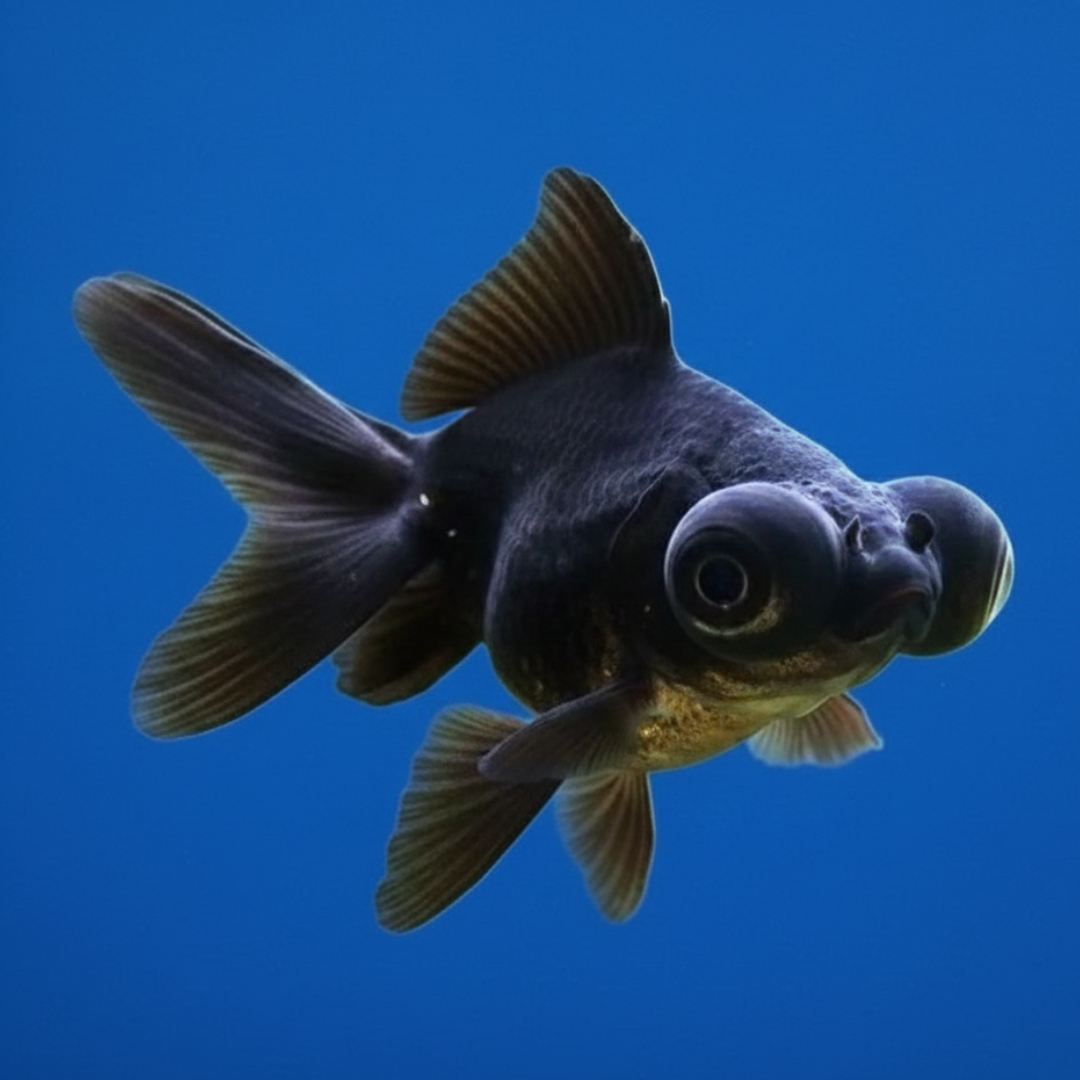
解説 / Description
黒出目金は、丸みのある琉金型の体と、左右へ大きく張り出した眼球、そしてベルベットを思わせる黒い体色が印象的な金魚です。出目金の仲間の中でも日本で特に親しまれてきた品種で、ゆったりとした泳ぎと愛嬌のある表情から、古くから観賞魚として高い人気があります。一方で、大きく突出した眼は傷つきやすく、視力も強い近視の状態にあることが知られているため、普通の金魚以上に「ぶつからない」「餌を取り負けない」「強い水流にさらさない」という配慮が重要です。漆黒の体色は生涯まったく変わらないとは限らず、成長や遺伝的要因、飼育環境によって赤褐色やオレンジ色が現れることもあります。黒出目金らしい姿を長く楽しむには、色だけを追うのではなく、眼の安全、安定した水質、消化しやすい給餌、そしてゆとりある飼育環境を優先することが大切です。 The Black Moor is a fancy goldfish recognized by its rounded Ryukin-like body, large laterally protruding eyes, and deep black coloration reminiscent of velvet. It is one of the best-known telescope-eye goldfish in Japan and has long been admired for its slow, gentle swimming style and expressive appearance. Its protruding eyes, however, are physically vulnerable, and telescope goldfish are known to have severe myopia. For this reason, husbandry should place greater emphasis than usual on preventing collisions, ensuring that the fish can obtain food without competition, and avoiding excessive current. The black coloration is not necessarily permanent throughout life; reddish-brown or orange areas may appear with age because of genetic and environmental influences. Long-term care should therefore prioritize eye safety, stable water quality, digestible feeding, and generous swimming space rather than focusing solely on maintaining the darkest possible color.
基本情報 / Basic Information
| 学名 / Scientific Name | Carassius auratus |
|---|---|
| 通称 / Common Name | 黒出目金、ブラックモーアBlack Moor, Black Telescope Goldfish |
| 分類 / Family | コイ目・コイ科・フナ属。黒出目金は独立した種ではなく、金魚の改良品種の一つです。Order Cypriniformes, family Cyprinidae, genus Carassius. The Black Moor is a domesticated variety of goldfish rather than a separate species. |
| 英名 / English Name | Black Moor Goldfish / Black Telescope Goldfish |
| 分布 / Distribution | 野生分布を持たない改良品種です。出目形質は中国で固定化されたと考えられ、その後日本を含む各国へ広まりました。現在は日本国内の養魚場、観賞魚店、ホームセンターなどで広く流通しています。As a domesticated variety, it has no natural wild distribution. The telescope-eye trait is considered to have been established in China, after which the variety spread to Japan and many other countries. Today it is widely distributed through ornamental-fish breeders and retailers. |
| 最大体長 / Max Size | 一般的な飼育下では全長15〜20cm前後が目安です。系統や飼育環境によってはさらに大きく育つ個体もいます。Around 15–20 cm in total length is a practical expectation in aquaria, although some individuals can grow larger depending on lineage and husbandry conditions. |
| 寿命 / Lifespan | 黒出目金だけを対象にした確立した寿命統計は乏しいものの、金魚全体では適切な飼育下で10〜15年ほどが一つの目安とされています。黒出目金も長期飼育が可能なため、水質、給餌、飼育密度、体型由来のトラブルを継続して管理することが大切です。Reliable lifespan statistics for the Black Moor alone are limited, but goldfish as a whole are commonly expected to live around 10–15 years under appropriate care. Black Moors can therefore be long-term pets, making consistent management of water quality, feeding, stocking density, and body-shape-related problems important. |
飼育環境 / Aquarium Environment
| 水槽サイズ / Tank Size | 幼魚1尾の導入では60cm規格水槽(約57L)から飼育できますが、成魚を長期的にゆったり育てるなら90cm規格水槽(約150〜160L)を推奨します。複数飼育では90cm規格水槽以上を基準にし、個体数が増えるほど水量に余裕を持たせます。金魚は排泄量が多いため、単純な体長だけでなく濾過能力と換水頻度も考えて飼育密度を決めてください。A 60 cm standard aquarium of about 57 L can be used for a single juvenile, but a 90 cm standard aquarium of roughly 150–160 L is recommended for spacious long-term care of adults. For multiple fish, use a 90 cm tank or larger and increase water volume as stocking rises. Because goldfish produce substantial waste, stocking density should be based not only on body size but also on filtration capacity and water-change frequency. |
|---|---|
| 水温 / Temperature | 18〜24℃程度を安定して維持するのが扱いやすい範囲です。金魚は低水温にも耐えますが、急激な温度変化は避けます。10℃を下回る環境では消化能力が落ちるため給餌量を減らし、屋外越冬では水温と魚の状態に応じて給餌を停止します。 A stable range of approximately 18–24°C is practical for aquarium care. Goldfish can tolerate cooler water, but sudden temperature changes should be avoided. Digestion slows markedly below about 10°C, so feeding should be reduced, and outdoor winter feeding should be stopped when temperature and fish condition indicate that normal digestion has ceased. |
| 水質 / Water Quality | 中性付近を基本とし、pH6.5〜8.0程度の安定した水質が目安です。アンモニアと亜硝酸は検出されない状態を維持し、硝酸塩の蓄積を抑えるため定期的に換水します。日本の水道水は飼育に利用しやすい地域が多いものの、必ず塩素やクロラミンを中和してから使用してください。Aim for stable water near neutral, roughly pH 6.5–8.0. Ammonia and nitrite should remain undetectable, and regular water changes are needed to limit nitrate accumulation. Tap water is suitable in many regions once chlorine or chloramine has been properly neutralized. |
| レイアウト / Layout | 眼球を傷つけないことを最優先に、凹凸の少ないシンプルなレイアウトにします。尖った石、溶岩石、硬く鋭い人工水草、小さな穴のある装飾品は避けます。底床を使う場合は角のない細かな砂利や砂を選び、ベアタンクも管理しやすい選択肢です。フィルターの吸水口にはスポンジを装着し、排水は壁面へ当てるなどして流れを弱めます。Prioritize eye safety by keeping the layout simple and free of sharp surfaces. Avoid pointed stones, abrasive lava rock, rigid artificial plants with sharp tips, and ornaments with holes in which the eyes could become trapped. If substrate is used, choose smooth fine gravel or sand; a bare-bottom tank is also easy to manage. Cover filter intakes with sponge and diffuse the outlet flow, for example by directing it toward the aquarium wall. |
| 注意点 / Precautions | 突出した眼球は擦り傷や感染を起こしやすく、強い近視のため障害物や餌を見つけにくい傾向があります。購入後は泳ぎ、左右の眼の対称性、白濁や充血の有無を日常的に観察してください。黒い体色は成長に伴って変化することがあり、色を保つ目的で強い直射日光や過度な紫外線にさらすのは避けます。体色よりも健康と安全を優先し、通常の観賞照明で安定して管理します。The protruding eyes are vulnerable to abrasion and infection, and severe myopia makes obstacles and food harder to locate. Regularly observe swimming behavior, symmetry of the eyes, and any cloudiness or redness. Black coloration may change with age; avoid intense direct sunlight or excessive ultraviolet exposure in an attempt to preserve the color. Health and safety should take priority, with stable conditions under normal aquarium lighting. |
餌と給餌 / Feeding
| 餌の種類 / Diet | 主食には消化性のよい金魚用の沈下性ペレットを用います。補助的にミジンコ、ブラインシュリンプ、赤虫などの冷凍餌や、少量の柔らかい植物質を与えると食餌の幅を持たせられます。色揚げ成分は赤やオレンジの発色を助けることがありますが、黒色素そのものを直接増やすものではありません。Use easily digested sinking pellets formulated for goldfish as the staple diet. Frozen foods such as daphnia, brine shrimp, or bloodworms, along with small amounts of soft plant material, can be offered as supplements. Color-enhancing carotenoids may support red and orange pigmentation but do not directly increase black melanin pigmentation. |
|---|---|
| 給餌のポイント / Feeding Tips | 視力が弱く餌取りが遅いため、沈下性の小粒飼料を魚の近くへ数か所に分けて落とし、確実に食べられているか確認します。成魚では1日1〜2回を基本に、数分で食べ切れる少量を与え、残餌は回収します。浮上性飼料は、水面で空気を取り込みやすい個体では食後の浮力異常につながることがあるため、黒出目金には沈下性飼料のほうが扱いやすい場合があります。ただし、浮力異常には体型、水質、消化器の状態など複数の要因があり、餌だけを原因と決めつけないことが大切です。低水温時は食欲だけでなく消化能力そのものが落ちるため、水温に合わせて給餌量を調整してください。Because vision is poor and feeding is slow, offer small sinking pellets at several nearby points and confirm that each fish actually eats. For adults, one or two small meals per day is a practical routine, with only as much as can be consumed quickly; remove leftovers. Floating foods can contribute to post-feeding buoyancy problems in individuals that take in excess air at the surface, so sinking foods are often easier to manage for Black Moors. However, buoyancy disorders can have several causes, including body conformation, water quality, and gastrointestinal factors, and should not be attributed to food alone. At low temperatures, adjust feeding to reduced digestive capacity rather than appetite alone. |
性格と混泳 / Temperament and Tank Mates
| 性格 / Temperament | 基本的には温和で、縄張り性も強くありません。泳ぎはゆっくりで、障害物を避けるのも得意ではないため、落ち着いた環境で本来の魅力を発揮します。繁殖期の雄は雌を追尾することがありますが、通常時に他魚を積極的に攻撃するタイプではありません。Generally peaceful and not strongly territorial. Its swimming is slow and obstacle avoidance is limited, so it performs best in a calm aquarium. Males may chase females during the breeding season, but outside reproductive behavior this variety is not normally aggressive toward tank mates. |
|---|---|
| 混泳の相性 / Compatibility | 同じ黒出目金、出目金、琉金、らんちゅうなど、遊泳速度が近い丸物系金魚との組み合わせが向きます。ただし個体差があるため、餌取りで負けていないかを確認してください。和金、コメット、朱文金などの長物は泳ぎが速く、餌を先に食べてしまったり、接触によって眼を傷つけたりする危険があるため避けるのが無難です。極端に小さな魚や高水温を好む熱帯魚との混泳も適しません。Suitable companions include other Black Moors, telescope goldfish, Ryukin, Ranchu, and similarly slow-bodied fancy goldfish. Individual differences still matter, so check that no fish is being outcompeted for food. Fast single-tailed varieties such as common goldfish, comets, and Shubunkin are best avoided because they can dominate feeding and may accidentally injure the eyes through contact. Very small fish and tropical species requiring much warmer water are also poor choices. |
病気と対策 / Diseases and Prevention
| かかりやすい病気 / Common Diseases | 注意したいのは、転覆病などの浮力異常、白点病、尾ぐされ病、細菌性感染症、外傷に続く眼の白濁や炎症です。特にポップアイは、もともとの出目形質と見分けにくい点が問題になります。片目だけが急に大きくなる、左右差が短期間で増す、眼球が白濁・充血する、松かさ状の鱗や腹部膨満を伴うといった変化は病的な眼球突出を疑うサインです。Important problems include buoyancy disorders, white spot disease, fin rot, bacterial infections, and eye cloudiness or inflammation following trauma. Exophthalmos, or pathological pop-eye, is especially difficult to recognize because the normal telescope-eye phenotype is already protruding. Warning signs include sudden enlargement of one eye, rapidly increasing asymmetry, cloudiness or hemorrhagic redness, or associated symptoms such as raised scales and abdominal swelling. |
|---|---|
| 対策と予防 / Prevention | 予防の基本は、過密を避け、アンモニアと亜硝酸を出さない濾過環境を整え、定期換水を続けることです。眼を傷つける装飾を置かず、新しい魚は可能であれば隔離観察してから合流させます。体調不良時の塩水浴は、症状と原因を見極めたうえで補助療法として用いられることがあります。0.5%濃度は金魚飼育で広く用いられる方法の一つですが、すべての病気に有効な万能治療ではなく、薬剤との併用や長期実施は病状と治療法を確認して行ってください。Prevention begins with avoiding overcrowding, maintaining filtration that keeps ammonia and nitrite at zero, and performing regular water changes. Do not use decorations that can injure the eyes, and quarantine new fish when possible before introduction. Salt baths may be used as supportive care in selected situations after considering the likely cause of illness. A concentration of 0.5% is commonly used in goldfish care, but it is not a universal cure; prolonged use or combination with medications should be considered carefully according to the condition being treated. |
増やし方(繁殖) / Breeding
| 雌雄の判別 / Sexing | 非繁殖期は判別が難しいことがあります。繁殖期の雄では、鰓蓋や胸鰭の前縁に白い小突起である追星が現れやすく、雌を追いかける行動が見られます。成熟した雌は抱卵すると腹部がふっくらし、雄より丸みが強く見えることがあります。体型だけでは確実に判断できないため、追星、追尾行動、腹部、総排泄孔付近を総合して見ます。Sexing can be difficult outside the breeding season. Mature males commonly develop small white breeding tubercles on the gill covers and leading edges of the pectoral fins and may actively chase females. Gravid females often become fuller through the abdomen. Body shape alone is not reliable, so breeding tubercles, chasing behavior, abdominal fullness, and the vent area should be considered together. |
|---|---|
| 繁殖形態 / Reproduction | 卵生で、水草や産卵床などへ粘着性のある卵をばらまくタイプです。春の水温上昇など季節変化が刺激となり、雄が雌を追尾して産卵を促します。親魚には卵や孵化直後の仔魚を保護する習性がなく、卵を食べることもあります。An egg-laying, egg-scattering fish that releases adhesive eggs onto aquatic plants or spawning media. Seasonal cues such as rising spring temperatures stimulate spawning, during which males chase females. Adults do not provide parental care and may eat the eggs or newly hatched fry. |
| 繁殖のポイント / Breeding Tips | 繁殖を狙う場合は、十分に成熟した親魚を良質な餌で仕上げ、産卵用の人工水草や産卵モップを用意します。産卵後は親魚を別水槽へ移し、卵を食べられないようにします。孵化後の仔魚には、成長段階に合わせて微細な初期飼料からブラインシュリンプ幼生などへ段階的に切り替えます。黒い体色や眼球突出の程度、尾形などは親と同じ姿が必ず再現されるわけではなく、選別育種では多数の稚魚から目的の形質を持つ個体を残していく作業が必要です。Condition mature breeders with a high-quality diet and provide spawning mops or soft artificial plants. After spawning, remove the adults to prevent egg predation. Once the fry hatch, begin with appropriately fine starter foods and gradually transition to items such as newly hatched brine shrimp as they grow. Black coloration, degree of eye protrusion, tail shape, and other traits will not necessarily reproduce identically in every offspring, so selective breeding requires raising many juveniles and retaining individuals that express the desired characteristics. |
雑学と豆知識 / Trivia and Fun Facts
| 1. 「龍の眼」から生まれた出目金の物語 / 1. From “Dragon Eyes” to the Telescope Goldfish | 出目金の大きな眼は、自然界で生き残るために発達した形ではなく、人が珍しい突然変異を見いだし、世代を重ねて固定してきた結果です。中国では突出した眼を持つ金魚が「龍睛」と呼ばれ、龍を思わせる印象的な眼の造形が観賞上の価値として受け継がれてきました。日本へ本格的に広まった時期については諸説がありますが、近代以降には赤、黒、キャリコなど多彩な出目金が定着し、その中でも黒出目金は最も分かりやすい「出目金らしさ」を備えた存在として広く親しまれるようになりました。1748年に刊行された『金魚養玩草』は、金魚の渡来や飼育・繁殖を記した日本の初期の代表的な飼育書ですが、黒出目金の成立時期そのものを示す資料ではありません。ひとつの突然変異が、文化の中で「美しい個性」として残されていったことを実感させる品種です。The large eyes of telescope goldfish did not evolve as an adaptation for survival in the wild. Instead, people noticed an unusual mutation and preserved it through generations of selective breeding. In China, protruding-eye goldfish were known as “Dragon Eyes,” a name that reflects how their striking appearance became an ornamental virtue. The exact timing of their establishment in Japan is debated, but red, black, and calico telescope strains became firmly established in the modern period. The 1748 Japanese husbandry book Kingyo Sodategusa is an important early source on the arrival, care, and breeding of goldfish in Japan, but it does not itself establish when the Black Moor originated. The Black Moor is therefore a vivid example of how a biological mutation can become a lasting cultural form of beauty. |
|---|---|
| 2. 出目形質の鍵を握る遺伝子「lrp2a」 / 2. The lrp2a Gene Behind the Telescope-Eye Trait | 現代のゲノム研究によって、出目金の眼球突出には、低密度リポタンパク質受容体関連タンパク質をコードする lrp2a の機能低下が関わることが示されています。出目系統では遺伝子内部への大きな挿入や、途中でタンパク質の合成を止める変異が確認され、ゲノム編集による実験でも出目形質との因果関係が支持されました。頂点眼でもLRP2の別の変異が報告されており、よく似た突出眼でも、まったく同じ突然変異から生じたとは限りません。つまり、見た目の特徴だった「大きな眼」が、現在ではDNAの変化と眼の発生を結びつけて研究できる形質になっているということです。Modern genomic research has shown that reduced function of lrp2a, which encodes a low-density lipoprotein receptor-related protein, is involved in the protruding-eye phenotype of telescope goldfish. Telescope lineages carry large insertions or mutations that prematurely stop protein production, and genome-editing experiments support a causal relationship with the telescope-eye trait. Celestial-eye goldfish have also been reported to carry a different mutation in LRP2, so similar protruding eyes do not necessarily arise from an identical mutation. In practical terms, a feature once described only as “large eyes” can now be studied by linking DNA changes with eye development. |
| 3. 金魚の多様性を支えた全ゲノム重複 / 3. Whole-Genome Duplication and Goldfish Diversity | 金魚とコイの共通祖先の系統では、およそ1400万年前に全ゲノム重複が起きたと考えられています。現在の金魚のゲノムには、その結果生じた二つのサブゲノムが残り、両者が同じ速さではなく非対称に変化してきたことがゲノム解析から示されています。さらに、出目、長い鰭、アルビノなど複数の改良形質について、こうしたサブゲノム上の変異との関連が明らかにされています。ここで重要なのは、「ゲノムが倍になったから黒出目金が生まれた」と単純に考えるのではなく、古いゲノム重複と、その後に蓄積した変異、そして人による選択が重なって現在の多様な金魚が形づくられたと捉えることです。A whole-genome duplication is thought to have occurred in the lineage ancestral to goldfish and common carp roughly 14 million years ago. Modern goldfish retain two subgenomes produced by that event, and genomic studies show that the two have changed asymmetrically rather than at identical rates. Researchers have also linked variants on these subgenomes with several domesticated traits, including telescope eyes, long fins, and albinism. The important point is not that genome duplication by itself “created” the Black Moor, but that this ancient genomic history, later mutations, and human selection together form the background from which today’s diverse goldfish varieties emerged. |
| 4. 大きな眼でも、よく見えるとは限らない / 4. Larger Eyes Do Not Mean Better Vision | 黒出目金の眼は大きいため、よく見えそうな印象を受けますが、眼科学的な測定では強い近視であることが確認されています。1986年の研究では、6匹12眼の屈折異常が89〜268ディオプトリーに達しました。さらに別の研究では、一般的な金魚では眼軸長の約37%を占める硝子体腔が、黒出目金では70%を超えることが示されています。つまり、眼球が大きいことと視界が鮮明であることは同じではなく、むしろ大きくなった眼の構造そのものが強い近視に関係していると考えられます。飼育ではこの見えにくさを前提に、餌の位置や障害物の少なさへ配慮することが重要です。The Black Moor’s large eyes may look as though they should provide excellent vision, but ophthalmic measurements show that they are strongly myopic. A 1986 study measured refractive errors of 89–268 diopters in 12 eyes from six fish. Another study found that the vitreous chamber accounts for more than 70% of axial eye length in Black Moors, compared with about 37% in common goldfish. In other words, a larger eye does not mean a clearer view; enlargement of the eye itself is associated with the severe myopia. In husbandry, this means food placement and an uncluttered, obstacle-free environment deserve particular attention. |
| 5. 黒は「塗られた色」ではなく、生きた色素細胞の働き / 5. Black Color Is a Living Cellular Process | 黒出目金の黒色は、黒色素胞と呼ばれる細胞に蓄えられたメラニンによって生み出されます。色素は体表に固定されたインクのようなものではなく、細胞の状態や遺伝的背景、成長、周囲の環境に影響される動的な仕組みです。そのため、幼魚のころに真っ黒だった個体でも、成長とともに赤やオレンジが現れることがあります。これは必ずしも病気ではありません。愛好家にとって黒の深さは大きな魅力ですが、色を維持するために直射日光や過度な紫外線へさらすことは、水温上昇や藻類増殖など別の問題を招きます。黒色が変化する可能性も、この品種が生き物であることの一部として受け止めるのが自然です。The Black Moor’s coloration is produced by melanin stored in pigment cells known as melanophores. This is not a layer of fixed “paint,” but a living biological system influenced by genetics, growth, cellular regulation, and the surrounding environment. A fish that is jet black when young may therefore develop reddish or orange areas as it matures, and this is not automatically a sign of disease. Deep black remains an important ornamental trait, but exposing the aquarium to intense direct sunlight or excessive ultraviolet radiation simply to preserve color can create other problems such as overheating and algal growth. Color change is best understood as part of the biology of a living variety. |
| 6. 「かんこ」を流れる金魚と日本の流通文化 / 6. Kanko Trays and Japan’s Goldfish Market Culture | 日本の金魚文化を支えてきた代表的な地域として、愛知県弥富市と奈良県大和郡山市が知られています。なかでも弥富の競りでは、金魚を「かんこ」と呼ばれる底に網を張った木枠や木舟に入れ、競り小屋へ流しながら取引する独特の方法が受け継がれています。仲買人は上から金魚を見て、体型、泳ぎ、色艶などを短時間で見極めます。一方、大和郡山でも金魚の競売会が流通を支えており、地域ごとに異なる生産と販売の仕組みが発達してきました。黒出目金が家庭の水槽へ届くまでには、生産、選別、畜養、競り、出荷といった多くの工程があり、その背景には長く培われてきた育種と流通の技術があります。Aichi Prefecture’s Yatomi City and Nara Prefecture’s Yamatokoriyama City are among Japan’s best-known centers of goldfish culture. In Yatomi in particular, a distinctive auction system is still used in which goldfish are placed in shallow wooden frames or boats called kanko, with netting on the bottom, and moved through the auction area as they are traded. Buyers view the fish from above and quickly assess body shape, swimming, and coloration. Yamatokoriyama also supports distribution through organized goldfish auctions, but its production and sales system has developed in its own regional form. Before a Black Moor reaches a home aquarium, it may pass through breeding, selection, holding, auction, and shipping, all supported by long-established skills in goldfish culture and distribution. |
| 7. 改良品種だからこそ問われる、飼育者の役割 / 7. The Keeper’s Responsibility Toward a Highly Modified Variety | 黒出目金の魅力である突出した眼や丸い体は、人の選択によって強調されてきた形質です。しかしその美しさは、自然界では不利になりやすい弱点と表裏一体でもあります。視力の低下、眼の外傷、餌取りの遅さ、浮力異常へのなりやすさなどを考えると、黒出目金は「丈夫な金魚だから適当に飼える」という感覚では扱えません。尖った装飾を置かない、速い金魚と競わせない、餌を確実に届ける、体型に無理のない水流を作るといった小さな配慮が、そのまま生活の質につながります。人が作り上げた美しい形を楽しむのであれば、その形が抱える不便さまで引き受けて環境を整えることが、黒出目金との最も誠実な付き合い方です。The protruding eyes and rounded body that make the Black Moor attractive are traits intensified through human selection. Yet those same traits can create disadvantages that would be severe in the wild: reduced vision, vulnerable eyes, slow access to food, and increased risk of buoyancy problems. The variety should not be treated under the assumption that “goldfish are hardy, so almost any setup will do.” Small husbandry choices—removing sharp decorations, avoiding competition with fast swimmers, delivering food where the fish can find it, and keeping current gentle—directly affect quality of life. If people choose to enjoy a form created by selective breeding, responsible care means accommodating the limitations that accompany that form. |
まとめ / Conclusion
黒出目金は、深い黒色と大きな眼が特徴的で、穏やかに泳ぐ姿をじっくり楽しめる金魚です。大きな眼は見た目の魅力であると同時に、強い近視や外傷の受けやすさにもつながるため、角のないレイアウト、弱い水流、沈下性飼料、余裕ある水量といった配慮が健康維持の基本になります。 The Black Moor is defined by its deep black coloration, large eyes, and calm swimming style. Those eyes are both a major visual feature and a source of severe myopia and physical vulnerability, so smooth décor, gentle current, sinking foods, and generous water volume form the foundation of good long-term care.
数百年にわたる人の選択と、さらに古い金魚の進化史が重なって生まれたその姿は、水槽の中でもひときわ存在感があります。見えにくさに合わせて餌を見つけやすくし、眼を傷つけにくい環境を整えることで、黒出目金ならではの穏やかな泳ぎと個性的な姿を長く楽しめます。 Its form reflects both centuries of selective breeding and a much older evolutionary history within the goldfish lineage, giving it a distinctive presence in the aquarium. By making food easy to locate and creating an environment that protects its vulnerable eyes, the keeper can enjoy the Black Moor’s calm swimming style and characteristic appearance for many years.

気になる道具や飼い方を見つけてみませんか?
 アイのアクアグッズ案内水槽のコケ掃除|道具の選び方とお掃除生体の得意・不得意道具の特徴や使い方、選ぶときのポイントをアイが紹介します。記事はコチラ →
 アイのアクアグッズ案内海水魚の底砂の選び方|サンゴ砂・ライブサンドとおすすめ商品道具の特徴や使い方、選ぶときのポイントをアイが紹介します。記事はコチラ →
さまざまな飼育テーマをご紹介。リンク先の記事には広告・商品紹介が含まれます。
案内・紹介記事一覧へ →分布マップ
黒出目金(Carassius auratus)は野生分布を持たない改良品種です。出目形質は中国で固定化されたと考えられ、その後、日本を含む各国へ広まりました。地図では由来に関係する中国と日本を含む東アジアを概略表示しています。
※この地図は、記事に記載された由来・分布情報をもとにした概略表示です。マーカーは分布を把握しやすくするため中国内に設定した代表地点であり、実際の採集地点、原産地点、品種成立地点を示すものではありません。
参考文献
-
Froese, R. & Pauly, D. (eds.). FishBase. Carassius auratus (Linnaeus, 1758).
対応項目:分類、野生型の分布・生息環境、食性、繁殖形態、粘着性卵。 -
Chen, D. et al. (2020). The evolutionary origin and domestication history of goldfish (Carassius auratus). Proceedings of the National Academy of Sciences, 117(47), 29775–29785. DOI: 10.1073/pnas.2005545117.
対応項目:金魚が中国で長期にわたり家畜化・選択育種されてきた改良魚であること、各改良品種が同じ金魚の系統に属すること。 -
RSPCA Australia. How should I care for my goldfish? RSPCA Knowledgebase.
対応項目:水槽容量、水温、pH、アンモニア・亜硝酸・硝酸塩、濾過、換水、弱い水流、鋭利な装飾の回避、沈下性飼料、低水温時の給餌、混泳上の注意。 -
Ornamental Aquatic Trade Association (OATA). How to look after fancy goldfish.
対応項目:黒出目金を含む丸物金魚の水質、水槽容量、穏やかな水流、眼を傷つけにくいレイアウト、給餌、混泳、雌雄判別、家庭水槽での繁殖。 -
Easter, S. S. Jr. & Hitchcock, P. F. (1986). The myopic eye of the Black Moor goldfish. Vision Research, 26(11), 1831–1833. DOI: 10.1016/0042-6989(86)90135-5.
対応項目:黒出目金の眼が強い近視であること、眼の構造に配慮した飼育上の注意。 -
Li, I.-J., Chang, C.-J., Liu, S.-C., Abe, G. & Ota, K. G. (2015). Postembryonic staging of wild-type goldfish, with brief reference to skeletal systems. Developmental Dynamics, 244(12), 1485–1518. DOI: 10.1002/dvdy.24340.
対応項目:繁殖期の雄に見られる鰓蓋・胸鰭の追星、成熟雌の総排泄孔、季節的な水温・光周期と産卵の関係。 -
Merck Veterinary Manual. Bacterial Diseases of Fish.
対応項目:観賞魚の細菌性感染症、水質悪化・有機物負荷・過密・急激な水温変化などが疾病発生の素因になること、眼球突出を含む臨床症状。 -
Merck Veterinary Manual. Parasitic Diseases of Fish.
対応項目:白点病(Ichthyophthirius multifiliis)などの寄生虫症、衛生管理、適応可能な魚種における塩分5g/L(0.5%)を用いた管理例。




コメント