

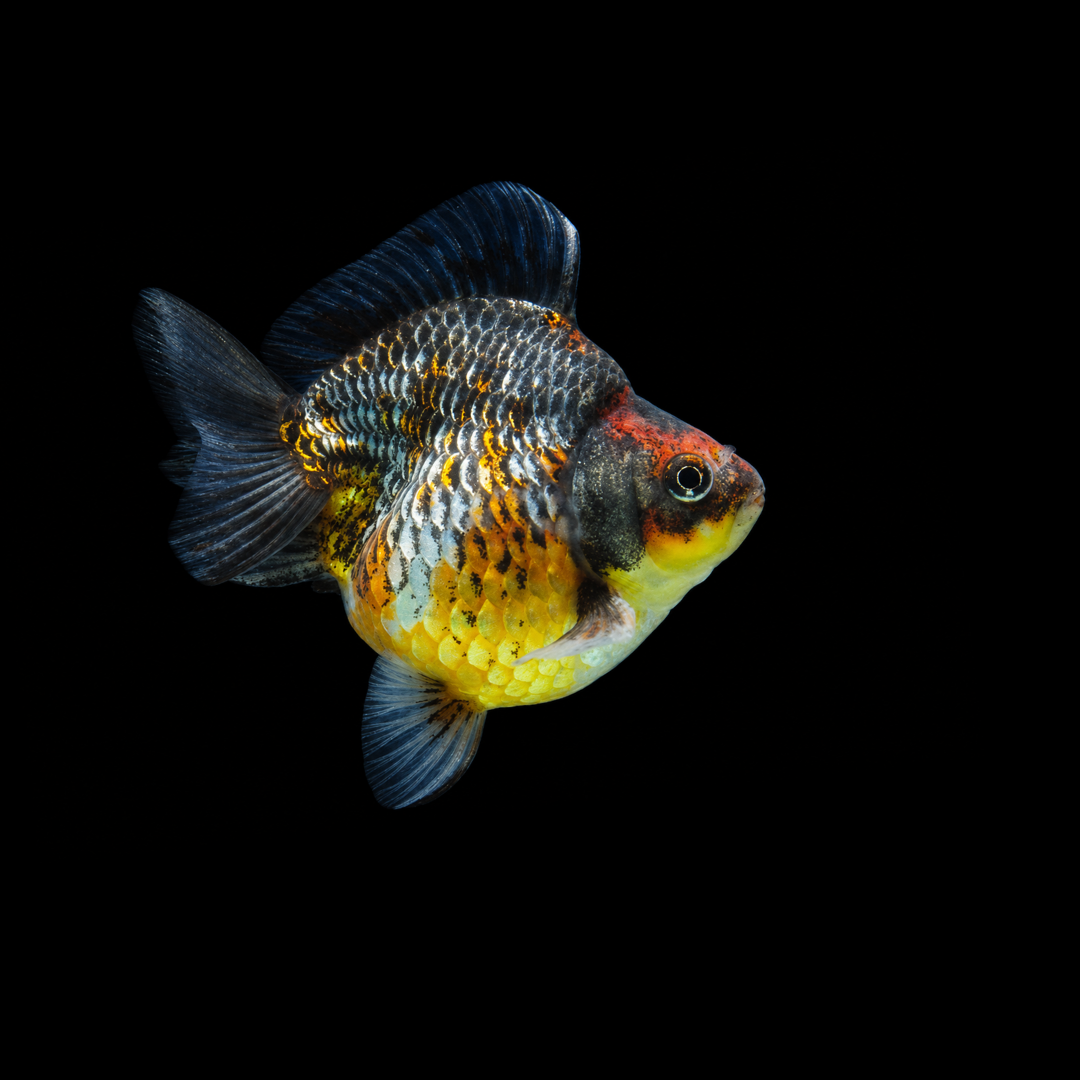
解説 / Description
だるま琉金トリカラーは、短い尾びれを持つ琉金を日本の流通で「だるま琉金」と呼び、その中でも赤・白・黒の三色が目立つ個体を「トリカラー」として扱う金魚です。頭の後ろから背中が高く盛り上がる体型、短く丸い胴、コンパクトな尾がつくる力強い横見のシルエットが大きな魅力です。「トリカラー」は流通上の色柄名で、厳密な遺伝学上の品種名ではありません。キャリコなどとの呼び分けも販売者や系統によって一致しない場合があり、名称だけから鱗の性質や遺伝型を断定することはできません。黒斑は成長に伴って変化することがあり、金魚の体色そのものも背景色、光環境、水温などに反応します。ただし、これらの環境条件だけで黒斑を固定できるわけではありません。琉金などの丸物金魚では浮力異常が問題になることがあるため、強すぎる水流を避け、十分な水量と酸素、安定した水質、沈下性を中心とした給餌を組み合わせることが長期飼育の基本です。 Tricolor Daruma Ryukin is a Ryukin goldfish with a short caudal fin, a form commonly called “Daruma Ryukin” in the Japanese aquarium trade. Fish showing conspicuous red, white, and black coloration are marketed as “tricolor.” Its main appeal is the powerful side-view silhouette created by a high back rising behind the head, a compact rounded body, and a short tail. “Tricolor” is a commercial color-pattern term rather than a strictly defined genetic breed name. The distinction from categories such as calico is not always applied consistently among sellers or bloodlines, so scale type or genotype should not be inferred from the sales name alone. Black markings can change as the fish grows, and goldfish body coloration in general responds to factors such as background color, lighting, and water temperature. These environmental factors, however, cannot be relied upon to permanently preserve black markings. Because buoyancy problems are seen in rounded fancy goldfish, long-term care should emphasize gentle water movement, ample water volume and oxygen, stable water quality, and a feeding program centered on sinking foods.
基本情報 / Basic Information
| 学名 / Scientific Name | Carassius auratus |
|---|---|
| 通称 / Common Name | だるま琉金トリカラー、三色だるま琉金、ショートテール琉金トリカラーTricolor Daruma Ryukin, Tricolor Short-tail Ryukin |
| 分類 / Family | コイ目・コイ科・フナ属。キンギョはフナ類から長期にわたる人為選択で作られた家畜化系統です。Order Cypriniformes, family Cyprinidae, genus Carassius. Goldfish are domesticated lineages derived through long-term artificial selection from crucian-carp-like ancestors. |
| 英名 / English Name | Tricolor Daruma Ryukin / Tricolor Short-tail Ryukin Goldfish |
| 分布 / Distribution | 野生分布を持つ独立種ではなく、飼育下で維持される改良金魚です。琉金は中国から琉球を経て、安永・天明年間(1772〜1788年)に日本へ渡来したと伝えられています。現在の日本市場では外国産のだるま琉金が継続的に流通しており、国産のだるま琉金も見られます。This is not a separate wild species but a domesticated ornamental goldfish maintained in captivity. Ryukin is traditionally said to have reached Japan from China through the Ryukyu Islands during the An’ei–Tenmei period (1772–1788). In the current Japanese market, imported Daruma Ryukin are regularly sold, and domestically bred Daruma Ryukin are also available. |
| 最大体長 / Max Size | 成魚では全長15〜20cm前後を一つの目安に考えます。系統、尾の長さ、飼育期間、給餌、飼育環境による個体差が大きく、販売時のサイズは成魚の大きさとは限りません。A practical adult-size guide is roughly 15–20 cm in total length. Final size varies with bloodline, tail length, age, feeding, and husbandry, and the size at which a fish is sold should not be confused with its eventual adult size. |
| 寿命 / Lifespan | 目安は10〜15年ほどです。水質、体型、系統、病気の有無、給餌などによる差が大きく、良好な環境ではさらに長く生きることもあります。A typical expectation is about 10–15 years. Lifespan varies greatly with water quality, body conformation, genetics, disease, and feeding, and some individuals live considerably longer under excellent long-term care. |
飼育環境 / Aquarium Environment
| 水槽サイズ / Tank Size | 単独飼育でも成魚を見据えるなら60cm規格水槽(約55〜60L)以上を最低限の目安とし、余裕を持たせるなら60cmワイド水槽(約80〜100L)がおすすめです。成魚2匹なら90cm規格水槽(約150〜160L)前後から考えると水質を安定させやすくなります。匹数だけでなく、個体の体格とろ過能力に合わせて水量を増やしてください。For one fish, plan for at least a standard 60 cm aquarium of roughly 55–60 L when adult size is considered; a 60 cm wide tank of about 80–100 L offers more margin. For two adults, a standard 90 cm aquarium of roughly 150–160 L is a practical starting point for easier water-quality control. Increase water volume according to body size and filtration capacity, not merely fish count. |
|---|---|
| 水温 / Temperature | 18〜25℃程度で飼育可能ですが、日常管理では20〜24℃前後の安定した水温が扱いやすい範囲です。重要なのは「常に高温にすること」より急変を避けることです。冬季に室温が大きく下がる環境ではヒーターで変動幅を抑え、夏は高水温と酸欠に注意します。 They can be maintained around 18–25°C, with a stable range near 20–24°C being convenient for routine care. Avoiding sudden temperature change is more important than keeping the fish permanently warm. Use a heater to limit large winter fluctuations where necessary, and watch for heat stress and low oxygen during summer. |
| 水質 / Water Quality | 中性付近から弱アルカリ性を中心に、pH6.5〜8.0程度の安定した水が扱いやすいです。アンモニアと亜硝酸は検出されない状態を保ち、硝酸塩の蓄積も定期換水で抑えます。金魚は排泄量が多いため、十分に成熟したろ過と強めのエアレーションが重要です。Stable water from near-neutral to mildly alkaline, roughly pH 6.5–8.0, is practical. Keep ammonia and nitrite undetectable and control nitrate accumulation with regular water changes. Goldfish produce substantial waste, so mature biological filtration and generous aeration are important. |
| レイアウト / Layout | 泳ぎが得意ではないため、遊泳スペースを広く取り、鋭い石や尖った流木は避けます。底砂を使うなら誤飲しにくい粒径と清掃性を優先し、ベアタンクでも飼育できます。金魚は背景色によって体色の見え方や色素細胞の反応が変わることが知られていますが、暗い背景にすればトリカラーの黒斑を固定できるという意味ではありません。吐出口は壁面へ向けるなどして、強い直線的な水流を弱めます。Because these fish are not powerful swimmers, leave generous open space and avoid sharp rocks or pointed wood. If substrate is used, prioritize a particle size that is difficult to swallow and easy to clean; a bare-bottom tank is also suitable. Goldfish are known to change aspects of body coloration in response to background color, but this does not mean that a dark background will permanently preserve the black markings of a tricolor fish. Diffuse strong filter outflow by directing it toward a wall or otherwise reducing direct current. |
| 注意点 / Precautions | 琉金などの丸物金魚では、浮く、沈む、逆立ちするなどの浮力異常が見られることがあります。食後だけ浮く、潜りにくい、沈んだままになるといった変化が出たら、水質、給餌量、餌の浮沈性、腹部の張りなどを確認してください。黒色維持を目的に爬虫類用UVBライトを常用する方法には、金魚での有効性を裏づける十分な根拠がありません。通常の観賞魚用照明と安定した飼育環境を優先し、自然光を取り入れる場合も直射日光による急激な水温上昇を避けます。Buoyancy problems such as persistent floating, sinking, or head-standing are seen in rounded fancy goldfish. If a fish floats after meals, struggles to dive, or remains on the bottom, check water quality, ration size, whether the food floats or sinks, and any abdominal distension. There is insufficient evidence that routine use of reptile-style UVB lamps preserves black coloration in goldfish. Standard aquarium lighting and a stable environment should take priority, and any natural light should be managed to avoid rapid overheating from direct sun. |
餌と給餌 / Feeding
| 餌の種類 / Diet | 主食は金魚用の沈下性ペレットや、沈下性・ゲル状の総合栄養食が適します。補助的に冷凍赤虫などの動物質や、柔らかい植物質を少量利用できます。カロテノイドを含む色揚げ飼料は赤や橙の発色を補助することがあります。スピルリナなどを含む飼料も栄養源として利用できますが、トリカラーの黒斑を直接固定する餌として確立されているわけではありません。Use sinking goldfish pellets or a complete sinking or gel-based diet as the staple. Small amounts of animal-based foods such as frozen bloodworms and soft plant matter can be used as supplements. Color-enhancing diets containing carotenoids may support red and orange coloration. Spirulina-containing feeds can also be used nutritionally, but they are not established as a way to permanently preserve the black markings of tricolor fish. |
|---|---|
| 給餌のポイント / Feeding Tips | 一度に大量に与えず、1〜2分程度で食べ切る少量を1日1〜2回から調整します。だるま体型の個体では、水面で空気を取り込みやすい浮上性フードより、沈下性フードを選ぶ方が扱いやすいでしょう。金魚を含むコイ科魚類には、人のような明瞭な胃がありません。そのため「乾燥ペレットが胃の中で膨らむから」という理由だけで、すべての餌を事前にふやかす必要はありません。食後に浮力異常が出る個体では、まず1回量を減らし、沈下性またはゲル状の餌へ変更し、必要に応じて給餌回数を分けます。絶食を日常的な予防法として一律に行うのではなく、成長段階や体格、症状に合わせて給餌量を調整することが大切です。Avoid large meals; begin with small portions eaten within about one to two minutes, once or twice daily, and adjust to the individual. In rounded Daruma-type fish, sinking foods are generally easier to manage than floating foods because they reduce feeding at the surface. Cyprinids, including goldfish, do not have a distinct stomach like humans, so pellets do not need to be pre-soaked simply to prevent “stomach expansion.” If buoyancy problems occur after meals, first reduce meal size, switch to sinking or gel foods, and divide the daily ration into smaller feedings if needed. Fasting should not be treated as a universal routine preventive measure; feeding should be adjusted to growth stage, body condition, and symptoms. |
性格と混泳 / Temperament and Tank Mates
| 性格 / Temperament | 温和で人慣れしやすく、給餌者を覚えて前面へ寄ってくる個体も多い金魚です。ただし食欲は旺盛で、餌場では押し合うことがあります。体型のため急加速や長時間の遊泳は得意ではありません。They are generally peaceful and often become accustomed to people, with many individuals approaching the front when their keeper appears. They are enthusiastic feeders and may jostle at mealtimes, but their rounded body makes rapid acceleration and sustained swimming difficult. |
|---|---|
| 混泳の相性 / Compatibility | 体格と遊泳力が近い琉金、オランダ獅子頭、出目金などの丸物金魚とは合わせやすい傾向があります。ただし同じ丸物でも泳力には個体差があるため、餌を十分に取れているか確認してください。和金、コメット、朱文金など速く泳ぐ長物は餌を先取りしやすく、だるま琉金が痩せる原因になることがあります。小型熱帯魚、エビ、貝などとの混泳は、水温、水質、捕食、食害などの条件が合わないことがあるため、基本的には金魚同士での飼育が管理しやすいでしょう。They are generally easiest to keep with fancy goldfish of similar size and swimming ability, such as Ryukin, Oranda, and telescope-eye varieties. Even among fancy goldfish, however, swimming ability varies, so make sure every fish is getting enough food. Faster single-tailed goldfish such as Common Goldfish, Comets, and Shubunkin can outcompete Daruma Ryukin at feeding time. Small tropical fish, shrimp, and snails may also be unsuitable because temperature, water quality, predation, and feeding requirements do not always match; in practice, keeping them with compatible goldfish is usually easier to manage. |
病気と対策 / Diseases and Prevention
| かかりやすい病気 / Common Diseases | とくに注意したいのは、浮く、沈む、横倒しになる、逆立ちするなどの「浮力異常」です。一般に転覆病と呼ばれますが、一つの病原体で起こる単一の病気ではありません。水質悪化、餌と一緒に取り込む空気、鰾の形や位置の異常、脊椎や内臓の異常、感染、外傷など、さまざまな原因で似た症状が現れます。そのほか、白点病、細菌性の鰭・皮膚障害、寄生虫症、鱗の逆立ちを伴う全身状態の悪化にも注意が必要です。A major concern is abnormal buoyancy: persistent floating, sinking, rolling, or head-standing. In Japanese hobby usage this is often called “tenpuku-byo,” but it is not a single disease caused by one pathogen. Similar signs can result from poor water quality, air taken in during feeding, abnormal swim-bladder shape or position, spinal or internal-organ disorders, infection, or trauma. Also watch for ich, bacterial fin and skin disease, parasites, and systemic illness accompanied by raised scales or generalized decline. |
|---|---|
| 対策と予防 / Prevention | まず水質を測定し、アンモニアや亜硝酸の上昇、急なpH変動、水温変化があれば是正します。浮力異常が食後に強く出る場合は、1回の給餌量を減らし、沈下性フードへ切り替えて経過を見ます。症状が続く、腹部が異常に張る、体表出血、鱗の逆立ち、呼吸が速い、食欲がなくなるといった変化がある場合は、内臓疾患や感染を含めて原因を確認する必要があります。塩水浴は原因や状態によって補助的に用いられることがありますが、浮力異常そのものを治す万能な方法ではありません。ココア浴やクロレラを下剤として用いる民間療法も、標準的な治療法として確立していません。症状が重い場合や長引く場合は、自己流の薬浴を重ねず、観賞魚を診られる獣医師へ相談するのが安全です。First test the water and correct elevated ammonia or nitrite, sudden pH shifts, and temperature instability. If buoyancy problems are clearly worse after feeding, reduce the amount offered and switch to sinking food while monitoring the fish. Persistent signs, marked abdominal swelling, skin hemorrhage, raised scales, rapid breathing, or loss of appetite warrant evaluation for internal disease or infection. Salt baths may be used as supportive care in selected situations, but they are not a universal cure for buoyancy disorders. Folk methods such as cocoa baths or using chlorella as a laxative are not established standard treatments. If signs are severe or persistent, avoid stacking unproven treatments and consult a veterinarian experienced with ornamental fish. |
増やし方(繁殖) / Breeding
| 雌雄の判別 / Sexing | 繁殖期にはオスの鰓蓋や胸びれ前縁に白い追星が現れ、メスを追尾する行動が強くなります。メスは成熟すると腹部が左右にふっくらし、産卵前には生殖孔がやや突出することがあります。追星は白点病のように全身へ無秩序に広がるものではなく、典型的な位置に整って出る点が目安です。During the breeding season, males commonly develop white breeding tubercles on the gill covers and leading edges of the pectoral fins and show strong chasing behavior. Mature females become fuller through the abdomen and the vent may protrude slightly before spawning. Unlike ich, breeding tubercles tend to occur in characteristic, orderly locations rather than appearing randomly across the entire body. |
|---|---|
| 繁殖形態 / Reproduction | 卵生で、水草や人工産卵床に粘着性の卵をばらまく散乱型です。春から初夏、水温上昇と日長の変化で産卵しやすくなります。親魚は卵を食べるため、産卵後は親を別水槽へ移すか、産卵床を隔離します。孵化日数は水温に左右され、20℃前後ではおおむね4〜6日程度が目安です。They are egg-layers that scatter adhesive eggs onto plants or artificial spawning media. Spawning is most common from spring into early summer as temperature and day length increase. Adults readily eat the eggs, so remove the parents or isolate the spawning media after spawning. Hatching time depends on temperature and is typically around four to six days near 20°C. |
| 繁殖のポイント / Breeding Tips | 「だるま体型」と「トリカラー」を同時に揃えるには、多数の稚魚から体型、尾の開き、背骨、遊泳状態、色彩を段階的に選別する必要があります。金魚には比較的単純な遺伝様式が研究されている形質もありますが、丸い体型や鰭の形などの観賞形質には複数の遺伝要因が関わります。だるま琉金のショートテールについても、すべての系統に共通して「劣性」あるいは「不完全優性」と断定できる十分な根拠はありません。繁殖では健康な親魚を選び、強い脊椎変形や慢性的な浮力障害がある個体を親に用いないことも重要です。Producing offspring that combine both the Daruma body form and attractive tricolor pattern requires repeated selection among many juveniles for body shape, tail spread, spinal alignment, swimming ability, and coloration. Some goldfish traits have relatively simple inheritance patterns, but ornamental features such as rounded body shape and fin form involve multiple genetic factors. There is not enough evidence to classify the Daruma short-tail trait universally as recessive or incompletely dominant across all bloodlines. Select healthy broodstock and avoid breeding individuals with severe spinal deformity or chronic buoyancy impairment. |
雑学と豆知識 / Trivia and Fun Facts
| 1. 琉金という名前に残る「海の道」 / 1. The Maritime Route Preserved in the Name “Ryukin” | 琉金は中国から琉球を経て、江戸時代の安永・天明年間に日本へ伝わったとされています。「琉金」という名には、その伝来経路が反映されています。古典的な琉金では長く伸びる尾びれも鑑賞上の大切な要素でしたが、現在のだるま琉金は短い尾を特色とします。それでも、体高のある胴や背の立ち上がりといった琉金らしさは共通しています。尾の長さという評価軸が変わっても、琉金ならではの輪郭を残しながら異なる鑑賞スタイルへ展開してきたと見ることができます。Ryukin is traditionally said to have reached Japan from China through the Ryukyu Islands during the An’ei–Tenmei period of the Edo era. The name “Ryukin” reflects that route of introduction. In classical Ryukin, a long flowing caudal fin was an important part of the ornamental ideal, whereas modern Daruma Ryukin are defined by a short tail. Even so, both retain characteristic Ryukin features such as a deep body and a pronounced rise behind the head. The contrast shows how the same basic body type has been developed in different directions as ornamental preferences changed. |
|---|---|
| 2. 「トリカラー」と「キャリコ」は完全な反対語ではない / 2. “Tricolor” and “Calico” Are Not Perfect Opposites | 日本の販売現場では、赤・白・黒の三色が目立つ個体を「トリカラー」、透明鱗やモザイク透明鱗を背景に複数色が細かく混じる個体を「キャリコ」として別の商品名で扱う例があります。ただし、この呼び分けは販売上の整理であり、すべての系統を遺伝学的に二分する基準ではありません。金魚の透明鱗には遺伝的な仕組みがあることが研究で示されていますが、「トリカラー」という見た目だけから鱗の遺伝型まで判断することはできません。つまり、購入時は名称だけでなく、実際の鱗の見え方と色柄を確認することが大切です。In the Japanese trade, fish with conspicuous red, white, and black are often sold as “tricolor,” while fish with more finely mixed colors over transparent or mosaic-transparent scales may be sold separately as “calico.” This is a practical commercial distinction rather than a genetic rule that cleanly divides every bloodline. Research shows that transparent-scale traits have a genetic basis, but the appearance of a fish sold as “tricolor” does not by itself reveal its scale genotype. In practical terms, buyers should examine the actual scales and pattern rather than relying on the product name alone. |
| 3. 黒色は「紫外線を当てれば固定できる」とは限らない / 3. Black Color Is Not Simply “Fixed by UV” | 黒色の見え方にはメラニンが関わりますが、金魚の体色調節は紫外線の有無だけで決まる単純な仕組みではありません。研究では、背景色や光刺激を受ける眼、体色調節に関わるホルモン、水温などが金魚の体色に影響することが示されています。ここで重要なのは、これらの研究が「強いUVBを当てればトリカラーの黒斑を固定できる」と示しているわけではない点です。飼育では特殊な紫外線照射に頼るより、通常の照明のもとで水温と水質を安定させ、栄養状態を整えることを優先します。それでも成長に伴って黒斑が薄くなる個体はいます。Melanin contributes to black appearance, but goldfish color regulation is not determined simply by the presence or absence of ultraviolet light. Research shows that background color, visual input through the eyes, hormones involved in pigmentation, and water temperature can all influence body coloration. Importantly, these studies do not show that strong UVB exposure will permanently preserve the black markings of a tricolor fish. In normal husbandry, stable water quality and temperature, appropriate aquarium lighting, and sound nutrition should take priority over specialized ultraviolet exposure. Even under good conditions, some fish lose black markings as they mature. |
| 4. 丸い体は「かわいさ」と同時に機能上の代償を持つ / 4. The Rounded Body Carries Functional Trade-offs | 金魚の家畜化では、野生のフナ類に近い流線形から、丸い胴、二つ尾、さまざまな長さの鰭、特殊な眼など、多様な形が人為選択によって生み出されてきました。琉金では脊椎の湾曲が強く、体高のある体型が品種らしさにつながっています。一方、琉金などの丸物金魚では、泳ぎや浮力調節に問題が出ることがあります。良い個体を選ぶときは「どれだけ丸いか」だけでなく、停止時にも姿勢が安定し、無理なく潜り、餌を追えるかという機能面も確認したいところです。During goldfish domestication, artificial selection produced forms far removed from the streamlined shape of wild crucian carp, including rounded bodies, duplicated tails, fins of many lengths, and unusual eye morphologies. Ryukin are characterized by pronounced spinal curvature and a deep-bodied profile. In rounded fancy goldfish, however, swimming and buoyancy problems can occur. When selecting a specimen, therefore, do not judge only how round it is; stable posture at rest, the ability to dive normally, and comfortable feeding are also important. |
| 5. 転覆は「腸のガスだけ」が原因ではない / 5. Buoyancy Problems Are Not Caused Only by Intestinal Gas | 食後に浮く個体では空気の嚥下や消化管内容物が関係することがあり、沈下性フードへの変更で改善する例もあります。しかし、金魚の浮力異常には、鰾の形や位置、脊椎変形、感染、臓器腫大、腫瘍、外傷など多くの原因があります。とくに慢性的に沈む、常時横倒しになる、腹部が左右非対称に膨れるような場合は、「便秘だから」と決めつけず原因を探ることが大切です。魚類診療ではX線撮影が鰾の形や位置を確認する有力な方法で、飼育改善だけでは判断できないケースの切り分けに役立ちます。In fish that float after meals, swallowed air or intestinal contents may contribute, and switching to sinking food can help some individuals. Goldfish buoyancy disorders, however, have many possible causes, including abnormal swim-bladder shape or position, spinal deformity, infection, enlarged internal organs, tumors, and trauma. If a fish persistently sinks, rolls continuously, or develops asymmetric abdominal swelling, it should not automatically be labeled “constipation.” In aquatic veterinary medicine, radiography is a valuable way to assess swim-bladder shape and position and can help distinguish cases that cannot be explained by husbandry alone. |
| 6. 金魚には人のような「胃」がない / 6. Goldfish Do Not Have a Human-like Stomach | 金魚はコイ科の魚で、消化管に人や多くの肉食魚のような明瞭な胃を持ちません。餌は咽頭歯で処理されたあと腸管へ送られ、消化・吸収されます。このため「乾燥ペレットが胃の中で膨れて転覆する」という説明は正確ではありません。重要なのは、過剰給餌を避けること、個体が空気を飲み込みにくい給餌方法を選ぶこと、消化しやすい総合栄養食を用いることです。事前に餌をふやかす方法を使う飼育者もいますが、すべての金魚に必須の処置ではありません。Goldfish are cyprinids and lack a distinct stomach comparable to that of humans or many predatory fishes. Food is processed by pharyngeal teeth and then passes into the intestine for digestion and absorption. Therefore, the common explanation that “dry pellets expand inside the stomach and cause buoyancy problems” is inaccurate. More important measures are preventing overfeeding, choosing feeding methods that reduce air gulping, and providing a digestible complete diet. Some keepers pre-soak food, but it is not a requirement for every goldfish. |
| 7. ショートテールの遺伝はまだ単純化できない / 7. Short-tail Inheritance Cannot Yet Be Reduced to a Simple Rule | 金魚には透明鱗のように比較的明瞭な遺伝様式が研究されてきた形質がある一方、体型や鰭の形には複数の遺伝要因が関わります。ゲノム研究でも、金魚のさまざまな形態に関連する複数の領域が見つかっています。つまり、だるま琉金の短い尾を、すべての系統で一つの単純な遺伝法則だけで説明することはできません。「劣性」「不完全優性」と一律に決めるより、実際の系統ごとに親子の形質と選抜結果を記録して評価する方が適切です。Some goldfish traits, such as transparent scales, have relatively well-studied inheritance, whereas body shape and fin form involve multiple genetic factors. Genomic research has also identified multiple regions associated with the remarkable morphological diversity of goldfish. In other words, the short tail of Daruma Ryukin cannot be assumed to follow one simple genetic rule in every bloodline. Rather than labeling it universally as “recessive” or “incomplete dominant,” breeders obtain more reliable information by recording parent and offspring phenotypes within each line and evaluating the results of selection over generations. |
| 8. 日本の流通では「外国産」と「国産」が並存する / 8. Imported and Japanese-bred Fish Coexist in the Domestic Market | 日本の観賞魚流通では、だるま琉金は外国産金魚のカテゴリーで継続的に扱われており、キャリコ、トリカラー、タイガー、白黒など複数の色柄とサイズが流通しています。また、国産のだるま琉金も確認できます。価格は産地だけでなく、体高、背の立ち上がり、尾の形、左右のバランス、泳ぎの安定、柄、サイズなどによって変わります。一点物を選ぶ場合は、写真だけでなく、可能であれば動画で姿勢や泳ぎ方まで確認すると個体の状態を判断しやすくなります。In Japan’s ornamental-fish trade, Daruma Ryukin continue to be handled as imported goldfish, with multiple color forms and size grades including calico, tricolor, tiger, and black-and-white fish. Domestically bred Daruma Ryukin are also available. Price varies not only with origin but with body depth, the rise of the back, tail form, left-right balance, swimming stability, pattern, and size. When buying a one-of-a-kind specimen, video can help assess posture and swimming condition in addition to the pattern shown in photographs. |
まとめ / Conclusion
だるま琉金トリカラーは、琉金らしい高い背と丸い胴、短い尾に、赤・白・黒の色柄が重なることで、横から見たときに強い存在感を見せる金魚です。黒斑は成長に伴って変化することがあり、背景色や光などの飼育環境も金魚の体色に影響しますが、環境だけで柄を固定することはできません。色を無理に維持しようとするより、安定した水質と水温、適切な照明、偏りのない給餌を優先することが、健康な状態でその個体らしい色彩を楽しむ基本になります。 Tricolor Daruma Ryukin combines the high back, rounded body, and short tail of the Daruma form with conspicuous red, white, and black patterning, giving the fish a strong presence when viewed from the side. Black markings may change as the fish grows, and environmental factors such as background color and lighting can influence goldfish coloration, but they cannot be relied upon to lock a pattern in place. Rather than trying to force color to remain unchanged, stable water quality and temperature, appropriate lighting, and balanced feeding should take priority so the fish can be enjoyed in good health.
長く飼ううえでは、体型の丸さや柄だけでなく、姿勢が安定し、無理なく泳いで潜り、餌をきちんと取れる個体を選ぶことが大切です。十分な水量と酸素、穏やかな水流、食べ過ぎを避けた沈下性中心の給餌を整え、浮力異常が見られたときは「丸い金魚だから」と片づけず、水質や給餌、体の状態を確認します。健康を土台に管理することで、だるま琉金ならではの丸い造形と、三色がつくる一匹ごとの表情を長く楽しむことができます。 For long-term care, body roundness and pattern should not be the only selection criteria. Choose a fish that maintains a stable posture, swims and dives without obvious strain, and feeds normally. Provide ample water volume and oxygen, gentle current, and modest portions of mainly sinking food. If buoyancy changes appear, check water quality, feeding, and the fish’s physical condition rather than dismissing the problem as inevitable in a rounded goldfish. Good health is the foundation for enjoying the distinctive body form and individual three-color pattern of Daruma Ryukin over the years.

気になる道具や飼い方を見つけてみませんか?
 アイのアクアグッズ案内水槽の流木の選び方|枝・マングローブ・アク抜きとおすすめ商品水槽に小さな森を作る流木。枝流木やマングローブという名前の違いから、魚の隠れ家、水草の取り付け、浮く・水が茶色くなるときの準備まで、アイとコタロウが商品とともに案内します。記事はコチラ →
 アイのアクアグッズ案内ショップで見かけるカラフルなバケツ。いったい何が入ってる?道具の特徴や使い方、選ぶときのポイントをアイが紹介します。記事はコチラ →
さまざまな飼育テーマをご紹介。リンク先の記事には広告・商品紹介が含まれます。
案内・紹介記事一覧へ →分布マップ
だるま琉金(赤)は野生分布をもつ魚ではなく、人為選択によって維持される観賞魚です。日本では国産個体のほか、中国産・タイ産などのショートテール琉金も流通しているため、地図では記事中で挙げられている日本・中国・タイを含む東アジアから東南アジアを概略範囲として表示しています。
※この地図は記事中の流通・飼育地域をもとにした概略表示で、野生での自然分布や個々の生産地を示すものではありません。マーカーは地図表示の目安として設定した代表地点であり、実際の採集地点・生産地点を示すものではありません。
参考文献
- Integrated Taxonomic Information System (ITIS). Carassius auratus (Linnaeus, 1758), TSN 163350. 分類・学名 https://itis.gov/servlet/SingleRpt/SingleRpt?search_topic=TSN&search_value=163350
- U.S. Geological Survey, Nonindigenous Aquatic Species. Goldfish (Carassius auratus) — Species Profile. 分布・生息環境・成魚サイズ・寿命・環境耐性 https://nas.er.usgs.gov/queries/factsheet.aspx?speciesid=508
- Watson, C. A., Hill, J. E., & Pouder, D. B. (2004). Species Profile: Koi and Goldfish. Southern Regional Aquaculture Center, SRAC Publication No. 7201. 飼育水温・溶存酸素・pH・アンモニア/亜硝酸・養殖管理 https://srac.tamu.edu/fact-sheets/serve/178
- Merck Veterinary Manual. Management of Aquarium Fish. 水質管理・生物ろ過・アンモニア/亜硝酸・換水・薬浴や治療時の注意 https://www.merckvetmanual.com/exotic-and-laboratory-animals/aquarium-fish/management-of-aquarium-fish
- Merck Veterinary Manual. Fish Taxonomy. コイ科魚類の消化器・鰾の特徴、琉金など丸物金魚の浮力管理、沈下性飼料 https://www.merckvetmanual.com/exotic-and-laboratory-animals/aquarium-fish/fish-taxonomy
- Kobayashi, M., Iwata, E., & Sorensen, P. W. (2026). Environmental and Physiological Regulation of Reproduction in the Goldfish: Gonadal Development, Maturation, and Spawning Behavior: A Review. Animals, 16(5), 775. 成熟・産卵行動・環境条件と繁殖生理 https://doi.org/10.3390/ani16050775
- Love, N. E., & Lewbart, G. A. (1997). Pet Fish Radiography: Technique and Case History Reports. Veterinary Radiology & Ultrasound, 38(1), 24–29. 鰾・骨格異常の画像診断、浮力異常の鑑別 https://doi.org/10.1111/j.1740-8261.1997.tb01598.x
- Yang, T., Kasagi, S., Takahashi, A., & Mizusawa, K. (2024). Effects of Water Temperature on the Body Color and Expression of the Genes Related to Body Color Regulation in the Goldfish. Zoological Science, 41(1), 117–123. 水温・背景色と金魚の体色調節 https://doi.org/10.2108/zs230062
- Chen, D., Zhang, Q., Tang, W., et al. (2020). The Evolutionary Origin and Domestication History of Goldfish (Carassius auratus). Proceedings of the National Academy of Sciences of the United States of America, 117(47), 29775–29785. 家畜化・品種分化・体型や鰭など観賞形質の遺伝的背景 https://doi.org/10.1073/pnas.2005545117





コメント