

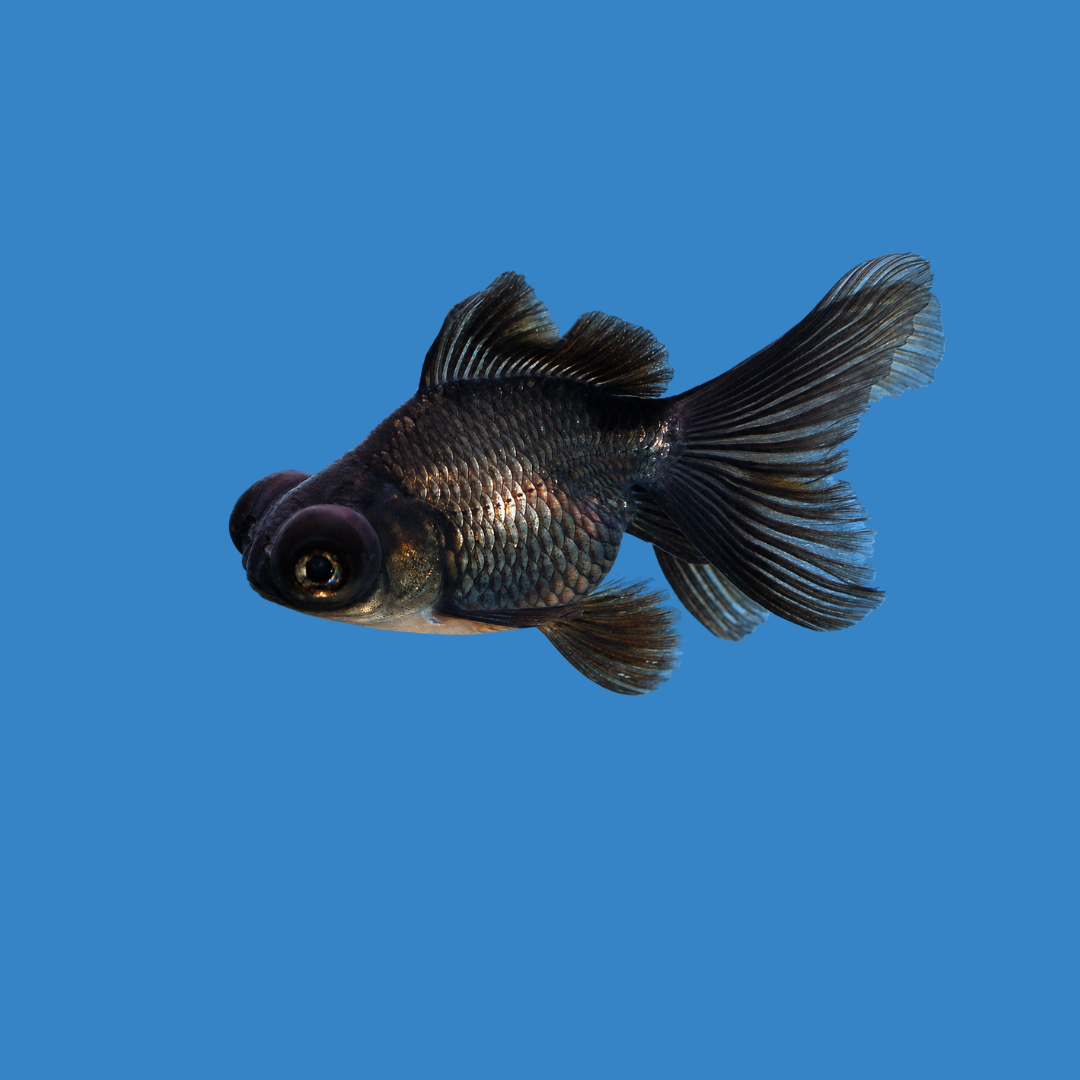
解説 / Description
黒蝶尾(くろちょうび)は、中国で作出された蝶尾のうち、黒い体色を持つものに用いられる呼称です。最大の魅力は、真上から見たときに蝶が翅を広げたような輪郭をつくる大きな尾びれにあります。左右へ張り出す尾と、出目金系統に見られる突出した眼が合わさり、横見とは異なる「上見」ならではの造形美を楽しめます。突出した眼と幅広い尾びれのため、素早い遊泳や採餌では不利になりやすく、広い遊泳スペース、穏やかな水流、眼や尾を傷つけにくい安全なレイアウトが適しています。 The Black Butterfly Telescope is a Chinese-developed butterfly-tail goldfish with a black body coloration. Its most distinctive feature is the broad double tail that forms a butterfly-like outline when viewed from above. The horizontally spreading tail and protruding telescope-type eyes make it especially attractive for top-view appreciation. Because the eye shape and broad fins can put it at a disadvantage during fast swimming and feeding, it is best kept with ample open space, gentle current, and smooth, safe furnishings.
基本情報 / Basic Information
| 学名 / Scientific Name | Carassius auratus (Linnaeus, 1758) |
|---|---|
| 通称 / Common Name | 黒蝶尾、黒蝶尾出目金Black Butterfly Telescope, Butterfly Tail Demekin, Top-view Telescope |
| 分類 / Family | コイ目・コイ科・フナ属。金魚の改良品種で、黒蝶尾自体に独立した種としての学名はありません。Order Cypriniformes, family Cyprinidae, genus Carassius. The Black Butterfly Telescope is a domesticated goldfish variety rather than a separate species. |
| 英名 / English Name | Black Butterfly Telescope Goldfish |
| 分布 / Distribution | 中国原産の改良品種で、野生分布を持つ品種ではありません。日本には1980年頃に輸入され、現在は中国由来の輸入個体に加えて国内繁殖個体も流通しています。A domesticated variety originating in China rather than a naturally distributed wild form. It was introduced to Japan around 1980 and is now available as both imported and domestically bred stock. |
| 最大体長 / Max Size | 黒蝶尾に限った厳密な最大体長の統計は確認されていません。国内では全長15cm前後の成魚も流通しており、系統や育成環境、尾びれを含むかどうかで測定値に差が出ます。A strict variety-specific maximum size has not been established. Adult specimens around 15 cm in total length are commonly seen in the Japanese trade, with measurements varying by lineage, husbandry, and whether fin length is included. |
| 寿命 / Lifespan | 黒蝶尾だけを対象にした寿命統計は確認されていません。金魚全体では10〜15年程度が平均的な目安とされ、適切な環境ではさらに長く生きる例もあります。There are no reliable lifespan statistics specific to the Black Butterfly Telescope. Goldfish as a whole are commonly reported to average about 10–15 years, with some individuals living longer under appropriate care. |
飼育環境 / Aquarium Environment
| 水槽サイズ / Tank Size | 成魚1尾でも60cm規格水槽(約60〜65L)を下限の目安とし、余裕を持たせるなら60cmワイド水槽(約100〜120L)が管理しやすくなります。複数飼育では90cm規格水槽(約160〜180L)以上を目安に、匹数とろ過能力に応じてさらに水量を確保します。黒蝶尾は尾を左右へ大きく広げるため、高さだけでなく十分な底面積と遊泳幅を取れる水槽が向いています。For one adult, a standard 60 cm aquarium of about 60–65 L should be treated as a lower practical guideline, while a 60 cm wide aquarium of roughly 100–120 L offers more margin. For several adults, a standard 90 cm aquarium of about 160–180 L or larger is easier to manage, with additional volume provided according to stocking and filtration. Floor area and swimming width are especially important because the broad tail occupies considerable horizontal space. |
|---|---|
| 水温 / Temperature | 日常管理では20〜24℃前後を安定して保つと扱いやすくなります。金魚はこれより低い水温にも耐えますが、急激な変化は避け、低水温時は活動量と消化の低下に合わせて給餌量を調整します。室温変動が大きい場合は、必要に応じてサーモスタット付きヒーターや冷却対策を利用します。 For routine indoor care, a stable temperature around 20–24°C is easy to manage. Goldfish can tolerate cooler water, but rapid changes should be avoided and feeding should be reduced as activity and digestion slow at lower temperatures. Use thermostatic heating or cooling measures when room temperatures fluctuate substantially. |
| 水質 / Water Quality | pH6.5〜7.5前後の弱酸性〜中性を中心に、アンモニアと亜硝酸は検出されない状態を維持します。金魚は排泄量が多いため、十分な生物ろ過と定期的な換水が不可欠です。硝酸塩もできるだけ低く保ち、水質の急変を避けます。Aim for approximately pH 6.5–7.5, with ammonia and nitrite kept at undetectable levels. Because goldfish produce substantial waste, mature biological filtration and regular partial water changes are essential. Keep nitrate low and avoid abrupt changes in water chemistry. |
| レイアウト / Layout | 広い遊泳スペースを残し、尖った石や複雑に枝分かれした流木は避けます。突出した眼と大きな尾びれを傷つけないよう、角の丸い素材を選び、フィルター吸水口にはスポンジを装着すると安全性が高まります。水流は弱〜中程度に抑え、尾が常にあおられない状態にします。暗色の底床や背景は黒い体色を見やすくし、金魚では背景色に応じて体色の濃淡が変化する反応も確認されています。Keep the layout open and avoid sharp rocks or complex branching wood. Choose smooth furnishings to protect the protruding eyes and large tail, and cover filter intakes with sponge where appropriate. Maintain a gentle to moderate current so the fins are not constantly pushed around. Dark substrate or backgrounds make the black body easier to appreciate, and studies in goldfish have also confirmed background-dependent changes in overall body tone. |
| 注意点 / Precautions | 突出した眼と大きな尾びれのため、餌の取り合い、眼球の擦り傷、尾びれの裂けに注意します。金魚の黒色は系統や成長、飼育環境の影響で変化することがあり、飼育方法だけで完全に固定できるものではありません。強すぎる照明や急激な環境変化で体色を維持しようとせず、安定した水質と無理のない照明環境を優先します。Because the protruding eyes and broad fins can make feeding and movement less efficient, watch for feeding competition, eye injuries, and torn fins. Black coloration in goldfish can change with lineage, growth, and environmental conditions, and cannot be completely fixed through husbandry alone. Prioritize stable water quality and moderate, consistent lighting rather than extreme light exposure. |
餌と給餌 / Feeding
| 餌の種類 / Diet | 金魚用の総合栄養食を主食にします。浮力異常を起こしやすい個体では、沈下性または水中でゆっくり沈むタイプの餌が使いやすく、必要に応じて消化しやすい補助食を少量組み合わせます。黒色の維持を目的として、赤色を強める色揚げ飼料だけに依存する根拠は十分ではありません。Use a complete goldfish diet as the staple food. For individuals prone to buoyancy problems, sinking or slowly sinking foods are often easier to manage, with small amounts of easily digested supplemental food used when appropriate. There is not sufficient basis for relying on red-enhancing color foods alone to maintain black coloration. |
|---|---|
| 給餌のポイント / Feeding Tips | 1日1〜2回、短時間で食べ切れる少量を基本にし、低水温時や活動量が落ちているときは量を減らします。金魚は浮き袋と消化管がつながる有管魚で、水面で多くの空気を取り込む個体では浮力異常につながることがあります。沈下性の餌はそのリスクを減らす方法のひとつですが、浮力異常の原因は食餌だけとは限りません。食べ残しは早めに除去し、便や腹部の状態を見ながら給餌量を調整します。Feed small portions once or twice daily and reduce feeding when water is colder or activity declines. Goldfish are physostomous fish, meaning the swim bladder is connected to the digestive tract, and excessive air intake at the surface can contribute to buoyancy problems in some individuals. Sinking diets can reduce that risk, although buoyancy disorders have multiple possible causes. Remove leftovers promptly and adjust portions according to body condition and feces. |
性格と混泳 / Temperament and Tank Mates
| 性格 / Temperament | 基本的に温和で、ゆったりと泳ぐ性質です。積極的に他魚を追い回すタイプではありませんが、餌の存在には敏感で、慣れると飼育者の接近に反応して寄ってくることがあります。Generally peaceful and slow-moving. It is not typically aggressive toward tank mates, although it remains highly food-motivated and may learn to approach its keeper at feeding time. |
|---|---|
| 混泳の相性 / Compatibility | 同程度の体格で、泳ぎが速すぎない出目金系、琉金型、オランダ獅子頭などの丸手金魚が候補になります。ただし個体差が大きいため、黒蝶尾が十分に餌を取れているかを必ず確認します。和金、コメット、朱文金などの俊敏な長手金魚や、ひれをつつく魚との混泳は避けた方が無難です。Suitable companions include similarly sized, slower fancy goldfish such as other telescopes, ryukin-type fish, and orandas, provided feeding competition is carefully monitored. Fast single-tailed goldfish such as common goldfish, comets, and shubunkins, as well as fin-nipping species, are generally poor choices. |
病気と対策 / Diseases and Prevention
| かかりやすい病気 / Common Diseases | 浮力異常や転覆症状、白点病、尾ぐされ病、鰓のトラブル、外傷に注意します。丸みのある体型に改良された金魚では、体腔内の構造や浮き袋の位置関係などが影響し、浮力異常が起こりやすいことがあります。また、突出した眼は擦り傷を受けやすく、傷口から二次的な感染につながることがあります。Common concerns include buoyancy disorders, white spot disease, fin rot, gill problems, and physical injuries. In rounded fancy goldfish, internal anatomy and swim-bladder position can contribute to buoyancy problems. Protruding eyes are also vulnerable to abrasion and possible secondary infection. |
|---|---|
| 対策と予防 / Prevention | 十分なろ過、定期的な水質検査と換水、過密飼育の回避、適量給餌が基本です。新しく迎えた個体は可能であれば隔離して状態を観察し、既存魚への病原体持ち込みを減らします。浮力異常が出た場合は、まず水質と水温、給餌量を確認します。症状が続く、呼吸が荒い、出血や潰瘍がある場合は、魚類を診られる獣医師への相談を検討します。Prevention starts with adequate filtration, routine water testing and water changes, avoiding overcrowding, and careful feeding. Quarantine new arrivals where possible to reduce disease introduction. If buoyancy problems appear, first review water quality, temperature, and feeding. Persistent symptoms, respiratory distress, bleeding, or ulcers warrant consultation with a veterinarian experienced in aquatic animals. |
増やし方(繁殖) / Breeding
| 雌雄の判別 / Sexing | 繁殖期の成熟したオスでは、鰓ぶたや胸びれ前縁に白い追星が現れやすく、メスは抱卵すると腹部が丸みを帯びます。肛門の形状にも差が出ることがありますが、繁殖期以外は判別が難しく、体型だけでの断定は避けます。During the breeding season, mature males often develop white breeding tubercles on the gill covers and leading rays of the pectoral fins, while gravid females become noticeably fuller in the abdomen. Vent shape may also differ, but sexing outside the breeding season can be unreliable. |
|---|---|
| 繁殖形態 / Reproduction | 卵生で、メスが水草や産卵床へ粘着性の卵を産み、オスが放精して体外受精します。水温上昇や日長の変化をきっかけに春から初夏に繁殖行動が活発になることが多く、親魚は卵を食べるため産卵後は分離します。An egg-laying, external-fertilizing fish. Females scatter adhesive eggs onto plants or spawning media while males release milt. Spawning activity often increases from spring into early summer as temperature and day length rise. Adults should be separated from the eggs because they may eat them. |
| 繁殖のポイント / Breeding Tips | 繁殖前は親魚の体調を整え、産卵床を用意して複数の成熟魚から自然産卵を狙います。孵化後の稚魚には初期飼料から細かな人工飼料へ段階的に切り替えます。黒蝶尾では、成長に伴って尾の開き、尾芯の向き、左右対称性、尾肩の張りなどが見えるようになるため、品種らしい形を残すには稚魚期の継続的な選別が重要です。尾芯の曲がりや尾づけの大きな非対称など、成長後の尾型に影響する特徴が強い個体は、種親候補から外す判断が行われます。Condition the adults well before spawning and provide spawning media. Fry should be moved gradually from first foods to finely sized prepared diets as they grow. In Black Butterfly Telescopes, tail spread, the direction of the central tail structure, left-right symmetry, and the strength of the tail shoulders become easier to assess with growth. Repeated juvenile selection is therefore central to maintaining the characteristic butterfly shape, and fish with pronounced tail-core curvature or major asymmetry are generally excluded from breeding stock. |
雑学と豆知識 / Trivia and Fun Facts
| 1. 蝶尾は「上見」で完成する品種 / 1. A Goldfish Designed for Top Viewing | 蝶尾と通常の出目金を見分ける最大の手掛かりは、尾びれの展開方向です。一般的な出目金では尾が後方へ流れる姿が目立ちますが、蝶尾では左右へ大きく張り出し、真上から見たときに一枚の蝶が水面下を滑るような輪郭をつくります。中国では金魚を上から観賞する文化があり、蝶尾はその視点で特徴が最も分かりやすい品種のひとつです。横見でも楽しめますが、上見では尾の左右対称性や広がりがより明瞭に見えます。The clearest difference between a butterfly telescope and a conventional telescope goldfish is the direction of tail spread. Instead of flowing mainly backward, the butterfly tail extends broadly to both sides, creating a wing-like silhouette from above. China has a long tradition of appreciating goldfish from above, and the butterfly tail is one of the forms whose defining features are especially clear from that viewpoint. Side viewing is still enjoyable, but top viewing makes the symmetry and breadth of the tail easier to judge. |
|---|---|
| 2. 日本では比較的新しい「中国金魚」 / 2. A Relatively Recent Arrival in Japan | 金魚そのものは日本で長い歴史を持ちますが、蝶尾が広く知られるようになったのはずっと後のことです。中国原産の蝶尾は1980年前後に日本へ導入されたとされ、和金や琉金、らんちゅうなどに比べると国内での歴史は比較的新しい品種です。それでも、出目金の愛嬌と上見の尾型を同時に楽しめる個性から愛好家の支持を広げ、現在では黒、赤、更紗、パンダ、キャリコなど多様な色彩の系統が流通しています。Goldfish have a long history in Japan, but the butterfly-tail form became familiar much later. Originating in China, it is generally reported to have reached Japan around 1980, making it a relatively recent addition compared with long-established Japanese varieties such as wakin, ryukin, and ranchu. Its combination of telescope eyes and dramatic top-view tail shape quickly attracted enthusiasts, and today butterfly tails are seen in black, red, red-and-white, panda, calico, and other color forms. |
| 3. 双尾は発生初期の遺伝子変化から生まれる / 3. The Twin Tail Begins in Early Development | 黒蝶尾の尾は、一枚の尾びれが成長後に二つへ裂けたものではありません。双尾金魚では尾部の軸骨格そのものが分岐しており、その形成には胚発生の背腹軸を調整するchordin遺伝子座の機能低下変異が深く関わることが研究で示されています。これは黒蝶尾だけに固有の仕組みではなく、双尾金魚に共通する形態形成の研究成果です。つまり、愛好家が尾の形として選抜してきた特徴は、成魚になってから生じるのではなく、胚発生の早い段階から始まっていることを意味します。The paired tail of a Black Butterfly Telescope is not simply a single fin that splits later in life. In twin-tailed goldfish, the caudal axial skeleton itself is bifurcated. Developmental studies show that reduced function at the chordin gene locus, which helps regulate early dorsal-ventral patterning, is a major cause of this morphology. This mechanism is not unique to the Black Butterfly Telescope; it is a finding about twin-tailed goldfish more broadly. In practical terms, the tail form selected by breeders begins to be established very early in embryonic development. |
| 4. 黒い体色はひとつの要因だけで決まらない / 4. Black Color Is Shaped by Several Factors | 金魚の体色は、メラニンを持つ黒色素胞、黄〜橙色に関わる黄色素胞、光を反射する虹色素胞など、複数の色素細胞と光学的な効果が重なって見えています。金魚では背景色によって体色の濃淡が変わる反応が実験的に確認されており、黒い背景では全体に濃く、白い背景では淡く見える方向へ変化します。ただし、黒蝶尾の黒色そのものが背景だけで維持できるわけではなく、系統や成長に伴う変化もあります。暗い底床や背景は黒を見やすくしますが、体色を無理に操作するより安定した飼育環境を保つことが大切です。Goldfish coloration is produced by several chromatophore types and optical effects, including melanin-containing melanophores, yellow-to-orange xanthophores, and light-reflecting iridophores. Experiments in goldfish have confirmed background-dependent shifts in overall body tone, with darker backgrounds tending to produce a darker appearance and white backgrounds a paler one. This does not mean that the black coloration of a Black Butterfly Telescope can be permanently maintained by background alone; lineage and growth also influence color. Dark substrate and backgrounds can make black easier to appreciate, but stable husbandry is more important than trying to force coloration. |
| 5. 出目は生まれた瞬間から完成しているわけではない / 5. Telescope Eyes Develop as the Fish Grows | 出目金系の稚魚は、孵化した直後から成魚と同じように大きな眼を突き出しているわけではありません。成長の途中で眼球周辺の形態が変化し、左右へ張り出す特徴が次第に明瞭になります。そのため、黒蝶尾の育成では尾だけでなく、眼の左右差、突出の程度、体型とのバランスも成長を追って評価されます。完成した姿だけを見ると大胆な造形ですが、その特徴は稚魚期から段階的に現れてくるものです。Telescope fry are not born with the fully exaggerated eyes seen in adults. The protruding eye shape becomes progressively clearer during growth as the surrounding structures develop. For this reason, breeders evaluate not only the tail but also eye symmetry, degree of projection, and overall balance over time. The dramatic adult appearance is therefore the result of a gradual developmental process rather than a feature that is complete at hatching. |
| 6. 「尾芯」を見ると育種の厳しさが分かる / 6. The Tail Core Reveals the Breeder’s Eye | 蝶尾の選別では、単に尾が大きいかどうかだけでなく、尾芯の向きや尾づけの左右対称性、尾肩の張りなどが細かく見られます。尾芯の曲がりや左右差は、成長後のシルエットや尾の支え方に影響するため、稚魚期から継続して観察されます。ブリーダーの間では尾芯や尾づけの状態を表す独特の用語も使われ、元の形が成長とともにどう変化するかを見ながら種親候補が選ばれます。水面を優雅に漂う一尾の背景には、こうした長期的な選別があります。Butterfly-tail selection is not based on tail size alone. Breeders closely examine the direction of the central tail structure, left-right symmetry of the tail attachment, and the strength of the tail shoulders. Small irregularities can become more obvious as the fish matures and can affect how the tail is supported. Breeders therefore follow these traits through juvenile development before deciding which fish to retain as future breeding stock. The seemingly effortless elegance of a finished butterfly tail reflects long-term observation and selection. |
| 7. 学名の「auratus」は金色を意味する / 7. The Species Name auratus Means “Gilded” | 黒蝶尾は黒い体色を持ちますが、種としての学名は他の金魚と同じCarassius auratusです。auratusは「金色の」「金で飾られた」といった意味を持つラテン語に由来します。黒い金魚に「金色」を意味する名が付いているように見えるのは少し不思議ですが、これは黒蝶尾が独立した野生種ではなく、人為選抜によって生まれた金魚の一系統であることをよく示しています。Although the Black Butterfly Telescope has a black body coloration, its species name is the same as that of other goldfish: Carassius auratus. The Latin epithet auratus means gilded or golden. The apparent mismatch is a useful reminder that the Black Butterfly Telescope is not a separate wild species, but one selectively bred form within the diverse domesticated goldfish lineage. |
まとめ / Conclusion
黒蝶尾は、黒い体色、左右へ突出した眼、そして水面に蝶の翅を描く大きな尾びれが一体となった、上見の魅力に富む金魚です。その特徴的な体つきは素早い遊泳や採餌には向きにくいため、広い空間、穏やかな水流、滑らかなレイアウト、餌を落ち着いて取れる環境を整えることが長期飼育の基本になります。 The Black Butterfly Telescope combines a dark body, protruding eyes, and a broad wing-like tail into one of the most distinctive top-view forms of fancy goldfish. Its unusual body shape is less suited to fast swimming and competitive feeding, so long-term care depends on ample open space, gentle current, smooth furnishings, and an environment where it can feed without being rushed.
水質と給餌を安定させ、眼と尾を傷つけにくい環境で育てることで、黒蝶尾らしい落ち着いた泳ぎと大きな尾の広がりを楽しめます。真上から静かに眺めると、黒い魚体の後ろで尾が柔らかく開閉し、選抜によって形づくられた造形の美しさと、生きものとしての繊細さを同時に感じさせてくれます。 With stable water quality, careful feeding, and an aquarium that protects its eyes and fins, the Black Butterfly Telescope can display the calm movement and broad tail spread that define the variety. Viewed quietly from above, the dark body and gently opening tail show both the beauty created through selective breeding and the delicacy of the living fish itself.

気になる道具や飼い方を見つけてみませんか?
 アイのアクアグッズ案内ローチの仲間に合わせる飼育用品|クーリー・流水性・ボーシャの水槽と底砂道具の特徴や使い方、選ぶときのポイントをアイが紹介します。記事はコチラ →
 アイのアクアグッズ案内そのごはん、泳いでる! 卵から始めるブラインシュリンプの孵化と道具選び道具の特徴や使い方、選ぶときのポイントをアイが紹介します。記事はコチラ →
さまざまな飼育テーマをご紹介。リンク先の記事には広告・商品紹介が含まれます。
案内・紹介記事一覧へ →分布マップ
黒蝶尾(Carassius auratus)は中国原産の改良品種で、自然の野生分布を持ちません。日本には1980年頃に導入され、現在は中国由来の輸入個体に加えて国内繁殖個体も流通しています。以下の地図は、起源地である中国と日本を含む範囲を概略的に示しています。
※この地図は分布欄の記述をもとに、中国と日本を含む地域を概略表示したものです。マーカーは中国を示すための代表地点であり、実際の採集地点・産地・養殖場の位置を示すものではありません。
参考文献
-
Catalogue of Life. Carassius auratus (Linnaeus, 1758)
対応内容:学名、分類
-
FishBase. Carassius auratus summary page
対応内容:金魚種としての分布、生息環境、食性、繁殖生態、繁殖期の追星
-
Loh, R. Diagnostic Techniques for Pet Fish Diseases. World Small Animal Veterinary Association World Congress Proceedings, 2015
対応内容:金魚・コイの水温、pH、アンモニア、亜硝酸、硝酸塩などの飼育水管理
-
Royal Society for the Prevention of Cruelty to Animals. Choosing an Aquarium for Pet Fish
対応内容:金魚の水槽容量、ろ過、水質検査、アンモニア・亜硝酸管理、水温急変の回避
-
Royal Society for the Prevention of Cruelty to Animals. Keeping Fish Together
対応内容:改良金魚の遊泳特性、双尾品種と単尾品種の混泳、給餌競争への注意
-
Petty, B. D., Francis-Floyd, R., Yanong, R. P. E. Management of Aquarium Fish. MSD Veterinary Manual
対応内容:水質管理、隔離・防疫、魚類の浮き袋構造、外傷や環境ストレスを含む飼育上の注意
-
Petty, B. D., Francis-Floyd, R., Yanong, R. P. E. Parasitic Diseases of Fish. MSD Veterinary Manual
対応内容:白点病を含む寄生虫疾患、症状、診断、衛生管理
-
Petty, B. D., Francis-Floyd, R., Yanong, R. P. E. Bacterial Diseases of Fish. MSD Veterinary Manual
対応内容:細菌性疾患、鰭・皮膚・鰓の異常、水質悪化・過密・外傷・温度変化などの発症要因
-
Sirri, R., Mandrioli, L., Zamparo, S., Errani, F., Volpe, E., Tura, G., Barbé, T., Ciulli, S. Swim Bladder Disorders in Koi Carp (Cyprinus carpio). Animals. 2020;10(11):1974. doi:10.3390/ani10111974
対応内容:コイ科観賞魚の浮き袋障害、浮力異常に複数の原因が関与しうる点、診断上の注意





コメント