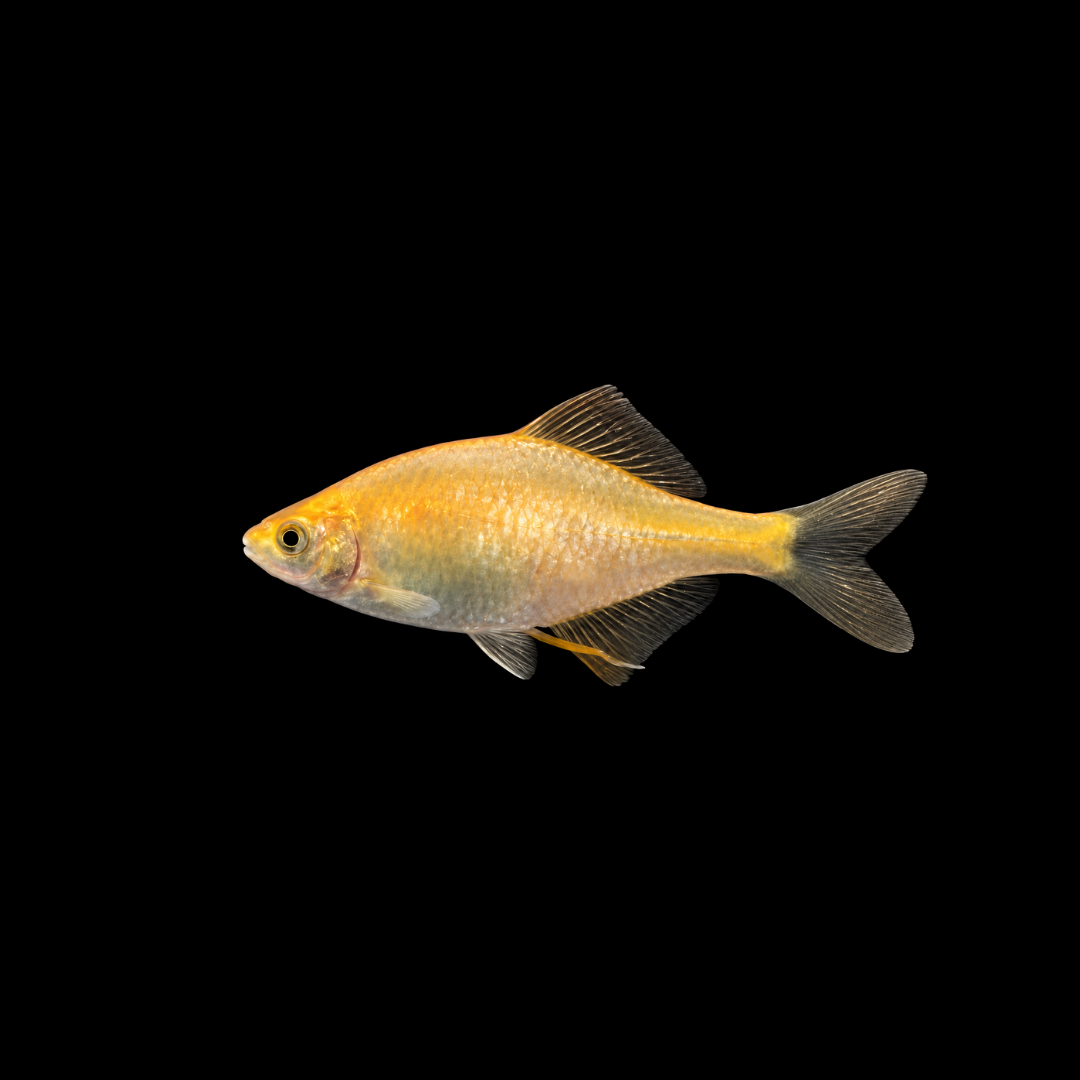
イエロータイリクバラタナゴは、東アジア原産のタイリクバラタナゴのうち、淡い黄色の体色を特徴とする観賞用の改良品種として流通しています。丸みのある体高の高い姿と、光を受けた鱗のやわらかな金属光沢が魅力で、繁殖期の雄には個体によって赤や青みを帯びた婚姻色も現れます。比較的丈夫で人工飼料にも慣れやすい一方、群れで落ち着いて泳げる空間、夏の高水温対策、繁殖期の雄同士が距離を取れる隠れ場所が必要です。もとになったタイリクバラタナゴは日本では外来魚として定着しており、在来のニッポンバラタナゴとの交雑が深刻な問題になっています。最後まで責任をもって飼育し、川・池・水路には決して放さないことが、この改良品種を楽しむための大切な前提です。The Yellow Rosy Bitterling is marketed as an ornamental form of the East Asian rosy bitterling and is distinguished by its pale yellow body. Its deep, rounded form and softly metallic scales are especially attractive, and some breeding males also develop red and bluish tones. Although relatively hardy and generally willing to accept prepared foods, it needs enough room to feel secure in a group, protection from excessive summer heat, and visual barriers that allow males to avoid one another during the breeding season. The rosy bitterling on which the strain is based is established as a non-native fish in Japan and hybridizes with the native Japanese rosy bitterling. Responsible lifelong care and an absolute commitment never to release fish into rivers, ponds, or drainage channels are therefore essential.
基本情報 / Basic Information
学名 / Scientific Name
Rhodeus ocellatus ocellatus (Kner, 1866) (国内の公的資料で用いられる亜種名。国際的な現行目録では Rhodeus ocellatus を有効種名として扱う。イエローは分類学上の名称ではなく改良品種名)(The subspecific name used in Japanese official sources; current international catalogues treat Rhodeus ocellatus as the valid species name. “Yellow” is an ornamental strain name, not a taxonomic designation.)
コイ目タナゴ科バラタナゴ属(国内資料ではコイ科タナゴ亜科とする体系もある)Genus Rhodeus, family Acheilognathidae, order Cypriniformes; some Japanese sources retain the traditional placement in subfamily Acheilognathinae of Cyprinidae
英名 / English Name
Rosy bitterling; Yellow rosy bitterling
分布 / Distribution
もとになったタイリクバラタナゴは、揚子江水系を中心とするアジア大陸東部に自然分布します。日本列島と琉球列島の個体群は、人為的に持ち込まれて定着したものです。イエロー系統は飼育下で維持される改良品種です。The rosy bitterling from which this strain was developed is native mainly to the Yangtze River system and other parts of eastern continental Asia. Populations in the Japanese and Ryukyu archipelagos were introduced by people and subsequently became established. The yellow strain is an ornamental form maintained in captivity.
最大体長 / Max Size
全長約6〜8cm。Approximately 6–8 cm in total length.
寿命 / Lifespan
正確な寿命は情報不足です。飼育環境や健康状態、繁殖による負担などによって差が生じます。Reliable species- and strain-specific lifespan information is insufficient. Longevity varies with husbandry, health, and the demands of reproduction.
飼育環境 / Aquarium Environment
水槽サイズ / Tank Size
複数飼育では60cm規格水槽(約55〜60L)以上を推奨します。少数なら45cm規格水槽(約30〜35L)でも飼育できますが、繁殖期の追尾を考えると広いほど管理しやすくなります。A standard 60 cm aquarium of roughly 55–60 L or larger is recommended for a group. A small number can be kept in a standard 45 cm aquarium of about 30–35 L, but extra space makes breeding-season chasing easier to manage.
水温 / Temperature
18〜25℃を安定して保つことを目安にし、急変を避けます。28℃を超える状態が続かないよう、夏は冷却ファンや室温管理を利用してください。季節変化には適応しますが、飼育下で極端な高温や低温を経験させる必要はありません。As a practical aquarium target, keep the water stable at 18–25°C and avoid rapid fluctuations. Use a cooling fan or room climate control so that the water does not remain above 28°C. The fish can adapt to seasonal change, but captive fish need not be exposed to extreme heat or cold.
水質 / Water Quality
弱酸性〜弱アルカリ性の中性付近、pH6.5〜7.8を目安にします。軟水〜中硬水に適応します。アンモニアと亜硝酸が検出されない、よくろ過された水を保ち、週1回を目安に水量の4分の1〜3分の1を換水します。Keep the water near neutral, from mildly acidic to mildly alkaline, at approximately pH 6.5–7.8. Soft to moderately hard water is suitable. Maintain mature filtration with undetectable ammonia and nitrite, and replace about one-quarter to one-third of the water weekly as a general guide.
レイアウト / Layout
中央から前面には遊泳空間を残し、側面と背面にマツモ、アナカリス、ミクロソリウムなどをまとめて植えると、追われた個体の逃げ場になります。細目の砂や角のない砂利、流木、石を使い、強すぎない水流と十分な酸素を確保します。屋外容器では、ふたや目の細かなネットを用いて生体の流出を防いでください。Leave open swimming room across the front and center, while grouping plants such as hornwort, anacharis, or Java fern along the sides and rear to create refuges for chased fish. Use fine sand or smooth gravel with wood and stone, and provide good oxygenation without an excessively strong current. On outdoor containers, use a secure cover or fine mesh to prevent fish from escaping.
注意点 / Precautions
タイリクバラタナゴは、環境省の生態系被害防止外来種リストで重点対策外来種に位置づけられています。外来生物法の特定外来生物には指定されていませんが、野外への放流は厳禁です。屋外飼育では排水口を細かな網やスポンジで覆い、大雨時の越水、鳥獣による持ち出し、稚魚を含む飼育水の流出を防ぎます。在来タナゴ類との交雑を避けるため、同じ繁殖環境に収容しないでください。地域によっては条例による規制があるため、屋外飼育や移動の前に自治体の最新情報も確認します。In Japan, the rosy bitterling is categorized as a Priority Management Invasive Species on the national invasive-species list. It is not designated as an Invasive Alien Species under the Invasive Alien Species Act, but it must never be released. For outdoor keeping, cover drains with fine mesh or sponge and prevent overflow during heavy rain, removal by animals, and discharge of water that could contain fry. Do not keep it with native bitterlings in the same breeding environment, because hybridization is a serious conservation risk. Local ordinances may impose additional controls, so check current municipal or prefectural rules before outdoor keeping or transport.
餌と給餌 / Feeding
餌の種類 / Diet
雑食性で、小型魚用の顆粒・フレークフードを主食にできます。冷凍アカムシ、ブラインシュリンプ、ミジンコなどの小型動物質、植物質やスピルリナを含む餌を組み合わせると栄養の偏りを抑えられます。This omnivore accepts small-fish granules and flakes as a staple. Supplementing with small animal foods such as frozen bloodworms, brine shrimp, or daphnia, together with foods containing plant material or spirulina, helps prevent nutritional imbalance.
給餌のポイント / Feeding Tips
1日1〜2回、数分で食べ切る量を与えます。口が小さいため、粒が大きければ砕いてください。黄色の見え方は系統ごとの特徴に加え、健康状態、照明、背景色にも左右されます。特定の色揚げ餌だけに偏らず、動物質と植物質を少量ずつ組み合わせ、水を汚さないことが健全な体色の維持につながります。Feed once or twice daily, offering only what can be consumed within a few minutes. Crush oversized particles for the fish’s small mouth. The apparent yellow tone reflects the characteristics of each lineage as well as health, lighting, and background color. Rather than relying on a single color-enhancing food, offer small portions of varied animal and plant foods and keep the water clean to support healthy coloration.
性格と混泳 / Temperament and Tank Mates
性格 / Temperament
平常時は活発で比較的温和な群泳魚です。単独より複数のほうが落ち着きやすい一方、繁殖期には雄が二枚貝の周囲に縄張りをつくり、同種の雄を追うことがあります。繁殖期は一般に3〜9月とされますが、水温や地域によって前後します。It is an active, generally peaceful shoaling fish and usually settles better with companions than alone. During the breeding season, however, males may establish territories around mussels and chase rival males. The season is generally reported as March to September, although timing varies with temperature and locality.
混泳の相性 / Compatibility
同程度の水温を好む、同じくらいの大きさの温和な小型魚と混泳できます。動きが極端に遅い魚、肉食性の強い大型魚、激しく縄張りを主張する魚は避けます。餌を素早く取るため、底生魚や臆病な魚にも餌が届いているか確認してください。繁殖を狙う場合は本種だけで飼育するほうが管理しやすくなります。It can live with peaceful fish of similar size that prefer comparable temperatures. Avoid extremely slow fish, large predatory species, and strongly territorial tank mates. Because rosy bitterlings feed quickly, make sure bottom dwellers and shy fish also receive enough food. A species-only aquarium is easier to manage when breeding is intended.
病気と対策 / Diseases and Prevention
かかりやすい病気 / Common Diseases
本品種だけに特有の疾病情報は限られています。一般的な淡水魚と同様に、水質悪化や急な水温変化、輸送時の擦れ傷、過密飼育が重なると、白点病、水カビ病、尾ぐされなどを発症することがあります。白い点、綿状の付着物、ひれの欠損、体をこすりつける行動、食欲低下を早期サインとして観察します。Disease information specific to this ornamental strain is limited. As with other freshwater aquarium fish, poor water quality, rapid temperature changes, transport abrasions, and crowding can contribute to ich, fungal infection, fin rot, and similar conditions. Watch for early signs such as white spots, cotton-like growths, damaged fins, flashing against objects, or loss of appetite.
対策と予防 / Prevention
新しく迎えた魚は別容器で2〜4週間観察し、温度合わせと水合わせをゆっくり行います。定期換水、過剰給餌の回避、安定した水温、十分な酸素、けがをしにくいレイアウトが予防の基本です。異常個体は早めに隔離し、水質と水温を確認したうえで症状を見分けます。薬を使う場合は対象疾病と有効成分を確認し、製品表示に従ってください。診断が難しい場合は魚類を診療できる獣医師へ相談します。Observe new fish in a separate container for two to four weeks and acclimate them gradually to both temperature and water chemistry. Regular water changes, restrained feeding, stable temperature, good oxygenation, and an injury-safe layout form the basis of prevention. Isolate affected fish promptly, check water parameters and temperature, and identify the symptoms before treatment. If medication is used, confirm that it matches the suspected condition and follow the product label. Consult a veterinarian experienced with fish when diagnosis is uncertain.
増やし方(繁殖) / Breeding
雌雄の判別 / Sexing
繁殖期の雄は、体側上部が青緑色に輝き、頭部側面から腹部にかけて赤みを帯びます。背びれと尻びれの縁、尾びれ中央も赤くなり、成魚の雄では腹びれ前縁の白線が目立つことが多くなります。雌は成熟すると腹部がふくらみ、肛門付近から細長い産卵管を伸ばします。若魚や非繁殖期は判別が難しく、イエロー系統では色彩の現れ方に個体差があります。In breeding condition, males develop a blue-green sheen on the upper body and reddish coloration from the sides of the head toward the belly. The margins of the dorsal and anal fins and the center of the tail also become red, while most adult males show a conspicuous pale leading edge on the pelvic fins. Mature females swell with eggs and extend a long, slender ovipositor near the vent. Juveniles and fish outside the breeding season can be difficult to sex, and expression of these colors varies among yellow-strain individuals.
繁殖形態 / Reproduction
卵生で、繁殖期は一般に3〜9月ごろです。雌は生きた淡水二枚貝の出水管から産卵管を差し込み、鰓へ産卵します。雄の精子は入水管へ吸い込まれる水流に乗って卵へ届きます。孵化した仔魚は貝の中で発育し、遊泳できる段階になると外へ出ます。二枚貝を単なる産卵容器として使うのではなく、魚と貝の双方を生かし続ける管理が必要です。This is an egg-laying fish with a breeding season generally reported from about March to September. The female inserts her ovipositor through the exhalant siphon of a living freshwater mussel and deposits eggs in its gills. The male’s sperm is carried toward the eggs by water drawn into the inhalant siphon. Hatched larvae develop inside the mussel and emerge once capable of free swimming. The mussel is a living animal rather than a disposable spawning vessel, so husbandry must protect both fish and mussel.
繁殖のポイント / Breeding Tips
繁殖を試みる前に、親魚の健康と水質を安定させます。自然繁殖では、合法かつ持続可能な由来の、本種が利用できる二枚貝を選ぶ必要があります。二枚貝は植物プランクトンや微細な懸濁物をこし取って食べるため、一般的な透明水槽で長期維持するのは難しく、専用の管理環境が欠かせません。貝の衰弱や死亡は水質を急変させるため、毎日状態を確認します。人工授精は研究や計画繁殖で用いられますが、親魚を傷つけるおそれがあるため、十分な経験と設備を持つ飼育者向けです。得られた稚魚も含め、屋外への流出と在来タナゴとの交雑を必ず防いでください。Before attempting to breed the fish, stabilize the health of the adults and the water quality. Natural breeding requires a compatible mussel obtained from a legal and sustainable source. Because freshwater mussels filter phytoplankton and fine suspended particles, they are difficult to maintain long-term in a conventional clear aquarium and need dedicated care. Check them daily, as a weakened or dead mussel can rapidly foul the water. Artificial fertilization is used in research and planned breeding, but the risk of injuring broodstock makes it suitable only for experienced keepers with appropriate facilities. Prevent every adult and fry from escaping outdoors or hybridizing with native bitterlings.
雑学と豆知識 / Trivia and Fun Facts
1. 「イエロー」は分類名ではなく、観賞上の呼び名 / 1. “Yellow” Is an Ornamental Name, Not a Taxon
魚の体色は、黒色素胞、黄色素胞、赤色素胞、虹色素胞など、役割の異なる色素細胞の組み合わせで見え方が変わります。ただし、市場でイエロータイリクバラタナゴと呼ばれる系統について、体色の由来や原因となる変異が十分に公表されているわけではありません。「イエロー」は淡い黄色の外観を示す流通名であり、アルビノや透明鱗と同じ性質を意味する言葉ではありません。同じ呼び名でも、系統、成長段階、照明、背景、体調によって色調に差が出ます。A fish’s appearance results from the combined effects of several pigment-cell types, including melanophores, xanthophores, erythrophores, and reflective iridophores. However, the origin and causal mutation of every strain marketed as a Yellow Rosy Bitterling have not been adequately documented. “Yellow” is a trade name describing a pale yellow appearance; it does not by itself mean that the fish is albino or transparent-scaled. Color can differ among lineages and with age, lighting, background, and health.
2. バラ色を映す属名と、眼状斑を示す種小名 / 2. A Rose-Colored Genus Name and an Eye-Spot Epithet
属名の Rhodeus は「バラ色」を意味するギリシャ語に由来し、繁殖期の雄が見せる赤みを思わせます。種小名 ocellatus は、ラテン語で「小さな眼」を意味する ocellus に由来する、眼状斑を表す語です。ただし、命名者が本種のどの模様を念頭に置いたかは、確認できる資料からは明確ではありません。学名の意味は由来を知る手掛かりになりますが、実際の識別には腹びれ前縁の白線や側線の特徴など、確認された形質を用います。The genus name Rhodeus derives from a Greek word meaning “rose-colored,” recalling the reddish breeding dress of males. The epithet ocellatus is related to the Latin ocellus, meaning “small eye,” and denotes an eye-like spot. The available sources do not make clear which particular marking the original author intended. Etymology provides historical context, but identification should rely on documented characters such as the pale leading edge of the pelvic fin and features of the lateral line.
3. 観賞魚の黄色と、日本での重い歴史 / 3. An Ornamental Color with a Serious History in Japan
タイリクバラタナゴは20世紀半ば、大陸から他の魚を移入した際に混入して日本へ入ったとされ、その後の放流や移動によって分布を広げました。よく似た在来のニッポンバラタナゴとは交雑し、外見だけでは交雑の程度を見抜けない場合もあります。淡い黄色を楽しむ水槽の向こうには、純系の在来集団を守ろうとする地域の長い努力があります。「飼えなくなったから自然へ返す」という考えは成り立ちません。飼育個体にとっての故郷は、責任をもって管理される水槽です。The rosy bitterling is thought to have entered Japan in the mid-twentieth century as an accidental passenger among fish imported from the Asian mainland, later spreading through stocking and transfer. It hybridizes with the very similar native Japanese rosy bitterling, and the degree of introgression cannot always be recognized by appearance alone. Behind the pleasure of a pale yellow aquarium fish lies decades of local work to protect genetically intact native populations. Releasing an unwanted fish is not “returning it to nature.” For a captive-bred fish, home is the responsibly managed aquarium.
4. 二枚貝は、命を預かる揺りかご / 4. A Living Mussel Becomes a Nursery
雌の産卵管が伸びると、雄は二枚貝の周囲を守り始めます。卵は貝の出水管から鰓へ入り、精子は反対側の入水管から吸い込まれる流れを利用して届きます。仔魚は外敵の多い水中へすぐに出ず、貝の中で発育してから泳ぎ出します。しかし、これは単純な「助け合い」とは限りません。卵や仔魚が過密になると貝の呼吸や摂餌に負担をかける可能性があり、関係の損得は魚種、貝種、密度、環境によって変わります。水槽で繁殖を試みるなら、この複雑な関係を一方の都合だけで扱わない姿勢が欠かせません。As the female’s ovipositor lengthens, a male begins guarding the area around a mussel. Eggs enter the gills through the exhalant siphon, while sperm reaches them on the current drawn through the inhalant siphon. The larvae do not immediately face open water; they develop inside before swimming free. This is not necessarily a simple story of mutual help. High loads of eggs and larvae may burden a mussel’s respiration and feeding, and the costs and benefits change with fish species, mussel species, density, and environment. Breeding them in captivity therefore calls for respect for both participants in this intricate relationship.
5. 縄張りを持たない雄にも作戦がある / 5. Males Without Territories Still Have a Strategy
大きな雄が二枚貝を守っていても、繁殖の機会を独占できるとは限りません。小さな雄は争いを避けて近くに潜み、雌が産卵する前後の隙を突いて放精することがあります。行動学では、このような雄をスニーカー雄と呼びます。力で場所を守る戦術と、素早さやタイミングに賭ける戦術が同じ水辺で競い合うのです。なお、近縁のニッポンバラタナゴを対象とした野外研究では、雌の産卵管が産卵と休止の周期に合わせて伸縮し、その長さが貝の鰓内に置かれる卵の位置と関係することが示されています。これは、二枚貝の内部を一様な産卵場所として使うのではなく、状態に応じて卵を置く位置を変えている可能性を示す結果です。Even a large male guarding a mussel cannot always monopolize reproduction. A smaller male may avoid direct combat, remain nearby, and release sperm during a brief opportunity around the female’s spawning event. Behavioral ecologists call such a fish a sneaker male. One strategy depends on defending space, while another depends on speed and timing. A field study of the closely related native Japanese rosy bitterling found that the female’s ovipositor lengthens and shortens with spawning and resting phases, and that its length is related to where eggs are placed within the mussel’s gills. In practical terms, the result suggests that females may adjust egg placement rather than treating the entire gill chamber as a uniform spawning site.
6. 白い腹びれは手掛かり、答えは遺伝子にもある / 6. A Pale Pelvic Fin Is a Clue, While Genes Hold the Deeper Answer
タイリクバラタナゴの雄では腹びれ前縁の白い帯が目立ちやすく、ニッポンバラタナゴとの識別に使われてきました。側線の孔がある鱗の枚数など、ほかの形態形質も手掛かりになります。ただし、両者は交雑して繁殖能力のある子孫を残すため、外見が中間的になった個体を目視だけで確実に判定することはできません。保全の現場で遺伝子解析が重要になるのは、魚が見せる美しい色や形の奥に、肉眼では読めない系譜が刻まれているからです。Male rosy bitterlings often show a conspicuous pale band along the front edge of the pelvic fin, a feature long used to distinguish them from the native Japanese rosy bitterling. Other clues include the number of pored scales in the incomplete lateral line. However, the two forms can hybridize and produce fertile offspring, creating intermediate fish that cannot be identified reliably by sight alone. Genetic analysis matters in conservation because lineage can remain invisible beneath a fish’s attractive color and shape.
まとめ / Conclusion
イエロータイリクバラタナゴは、淡い黄金色の体と活発な群泳、繁殖期に変化する雄の色彩を楽しめる小型魚です。60cm規格水槽を基本に、安定した水質、夏の高水温対策、植物による逃げ場、少量ずつの多様な餌を用意すると、落ち着いた群れの動きと健全な体色を保ちやすくなります。The Yellow Rosy Bitterling is a small fish valued for its pale golden body, lively shoaling, and the changing colors of breeding males. A standard 60 cm aquarium with stable water quality, protection from summer heat, planted refuges, and modest portions of varied food makes it easier to maintain calm group behavior and healthy coloration.
二枚貝を利用する独特の繁殖生態を持つ一方、日本では在来のタナゴ類に影響を及ぼす外来魚でもあります。野外へ流出しない環境を整え、最後の一匹まで大切に飼い切ることが欠かせません。その責任とともに向き合うことで、やわらかな黄色と繊細な泳ぎを水槽の中で安心して楽しめます。Its distinctive reproductive ecology depends on freshwater mussels, yet in Japan it is also a non-native fish that affects native bitterlings. A secure system with no route into the wild and lifelong care for every individual are essential. With that responsibility in place, its gentle yellow color and delicate movement can be enjoyed safely within the aquarium.
分類・学名・分布
Fricke, R., Eschmeyer, W. N. & Van der Laan, R. (eds.). Eschmeyer’s Catalog of Fishes: Rhodeus ocellatus. California Academy of Sciences. 資料を開く
繁殖期・成熟・繁殖生態
Solomon, G., Matsushita, K., Shimizu, M. & Nose, Y. 1984. “The Reproduction and Condition Factor of Rose Bitterling in Shin Tone River.” Nippon Suisan Gakkaishi, 50(7), 1095–1103. DOI: 10.2331/suisan.50.1095
産卵行動・雄の繁殖戦術
Kanoh, Y. 1996. “Pre-oviposition Ejaculation in Externally Fertilizing Fish: How Sneaker Male Rose Bitterlings Contrive to Mate.” Ethology, 102(11), 883–899. DOI: 10.1111/j.1439-0310.1996.tb01169.x
二枚貝内での発育・宿主への影響
Spence, R. & Smith, C. 2013. “Rose Bitterling (Rhodeus ocellatus) Embryos Parasitize Freshwater Mussels by Competing for Nutrients and Oxygen.” Acta Zoologica, 94(1), 113–118. DOI: 10.1111/j.1463-6395.2011.00532.x
近縁種の産卵管・二枚貝利用
Kitamura, J. 2006. “Seasonal Change in the Spatial Utilization of Host Mussels in Relation to Ovipositor Length by Female Rosy Bitterling Rhodeus ocellatus kurumeus.” Journal of Fish Biology, 68(2), 594–607. DOI: 10.1111/j.0022-1112.2006.00949.x
ニッポンバラタナゴとの交雑・遺伝子浸透
Kawamura, K., Ueda, T., Arai, R., Nagata, Y., Saitoh, K., Ohtaka, H. & Kanoh, Y. 2001. “Genetic Introgression by the Rose Bitterling, Rhodeus ocellatus ocellatus, into the Japanese Rose Bitterling, R. o. kurumeus (Teleostei: Cyprinidae).” Zoological Science, 18(7), 1027–1039. DOI: 10.2108/zsj.18.1027
疾病の兆候・水質管理・予防
Francis-Floyd, R., Stilwell, N. K. & Yanong, R. P. E. Introduction to Fish Health Management. UF/IFAS Extension, CIR921/FA004. 資料を開く
白点病・検疫・診断・対策
Francis-Floyd, R., Yanong, R. P. E. & Pouder, D. B. Ichthyophthirius multifiliis (White Spot) Infections in Fish. UF/IFAS Extension, CIR920/FA006. 資料を開く






コメント