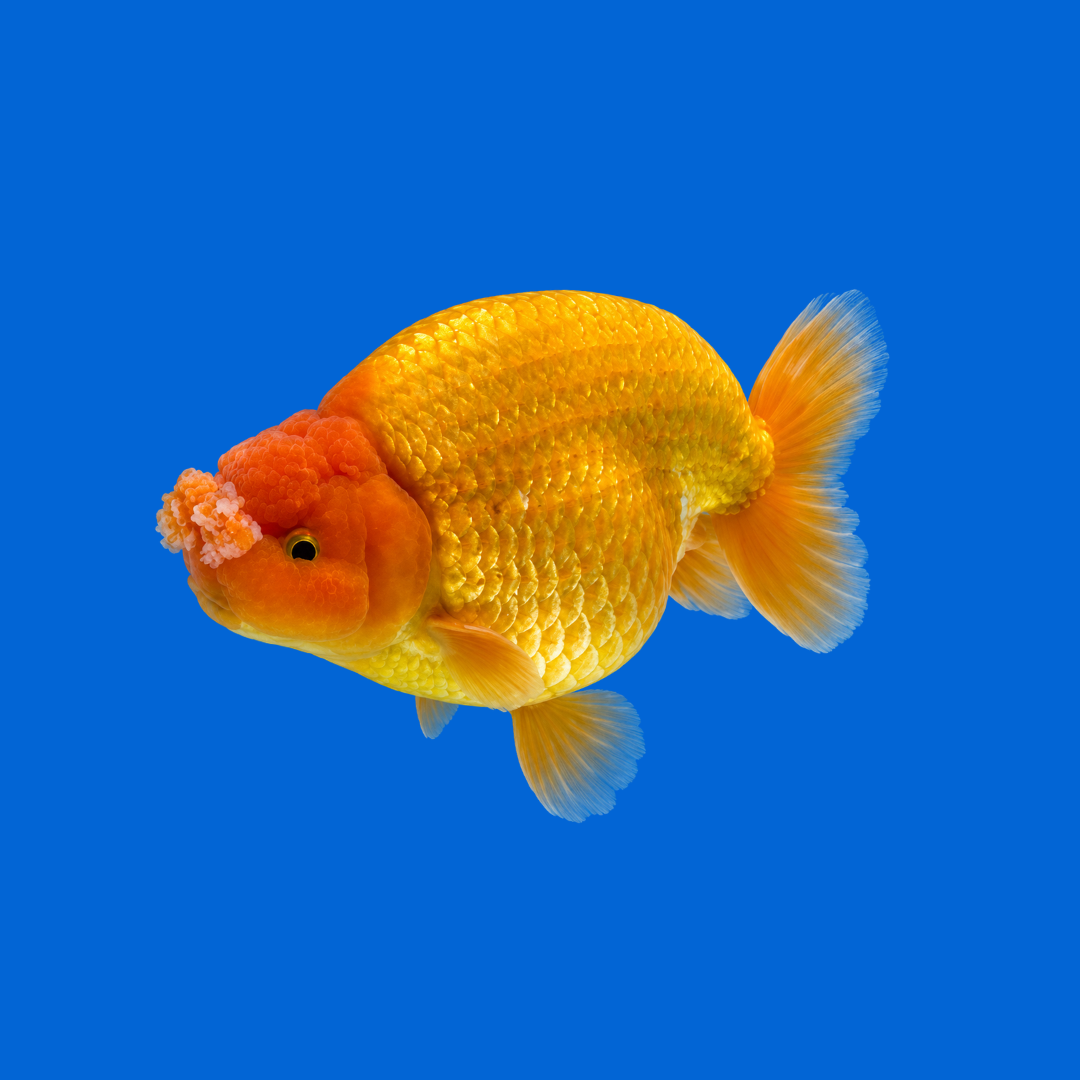
花房らんちゅうは、金魚の一品種で、背びれを持たないらんちゅう型の体と、左右の鼻孔の周囲に発達する房状の組織を最大の特徴とします。この房は鼻孔周辺の組織が著しく発達したもので、丸く密に育った個体では、鼻先に二輪の花が咲いたような独特の表情を見せます。英語圏では Pompon Goldfish や Egg-Pompon と呼ばれ、背びれを持つ Wen-Pompon と区別されることがあります。丸みのある体型とゆったりした泳ぎ、そして顔の正面に強い個性が集まるため、横見でも上見でも印象に残る金魚です。鼻房は魅力の中心である一方、擦れや吸い込み事故に弱い繊細な組織でもあります。花房らんちゅうを美しく健康に育てる鍵は、強い水流や鋭利な装飾を避け、十分な水量と安定した水質を確保し、泳ぎの速度に合った穏やかな環境を整えることにあります。The Hanafusa Ranchu is a domesticated goldfish variety characterized by a dorsal-finless Ranchu-type body and prominent frilled tissue around the paired nostrils. These enlarged tissues around the nostrils can form dense, rounded clusters that resemble two flowers blooming at the tip of the snout. In English, dorsal-finless forms are commonly described as Pompon Goldfish or Egg-Pompon, and may be distinguished from dorsal-finned Wen-Pompon forms. Its rounded body, unhurried swimming style, and highly distinctive face make it striking from both side and top views. The nasal pompons are also delicate soft tissues, so they can be damaged by abrasion, rough décor, or unprotected filter intakes. Successful long-term care therefore depends on generous water volume, stable water quality, gentle circulation, and a layout designed around the fish’s slower swimming ability.
コイ目・コイ科・フナ属。キンギョの改良品種Order Cypriniformes, family Cyprinidae, genus Carassius; a domesticated goldfish variety
英名 / English Name
Pompon Goldfish / Egg-Pompon
分布 / Distribution
野生種ではなく、人為選抜によって成立した金魚の品種です。花房は中国で発達した金魚系統に由来し、現在は日本を含む各地で観賞魚として飼育・流通しています。A domesticated variety rather than a naturally occurring wild population. Pompon goldfish derive from lineages developed through selective breeding in China and are now kept and traded as ornamental fish in Japan and elsewhere.
最大体長 / Max Size
全長15〜20cm前後が一般的な目安。良好な飼育環境では20cm級まで育つ個体もいます。Typically around 15–20 cm in total length, with well-kept individuals sometimes reaching about 20 cm.
寿命 / Lifespan
目安は6〜10年程度です。水質、給餌、飼育密度が適切なら10年以上生きることもあり、金魚全体ではさらに長寿の例も知られています。A practical expectation is around 6–10 years. With excellent water quality, nutrition, and stocking density, individuals may live beyond 10 years, and much longer lifespans are known in goldfish generally.
飼育環境 / Aquarium Environment
水槽サイズ / Tank Size
成魚1匹でも60cmワイド水槽など約100L級以上を推奨します。2匹なら90cm規格水槽(約150L級)以上を目安にすると、水質と遊泳スペースを安定させやすくなります。幼魚は60cm規格水槽でも飼育できますが、成長に合わせたサイズアップが必要です。For one adult, a tank of roughly 100 L or more is recommended, such as a Japanese 60 cm wide-format aquarium. For two adults, a standard 90 cm aquarium of roughly 150 L or larger provides more stable water quality and swimming space. Juveniles can be started in a standard 60 cm tank, but the aquarium should be upgraded as they grow.
水温 / Temperature
15〜23℃程度を飼育の目安とします。金魚自体はより広い温度域に適応できますが、急激な温度変化は避け、季節変化も緩やかになるよう管理します。About 15–23°C is a practical target range for fancy goldfish. Goldfish can acclimate to a broader temperature range, but sudden changes should be avoided and seasonal shifts should occur gradually.
水質 / Water Quality
弱酸性から弱アルカリ性の範囲で、pH6.5〜8.5程度を安定させるのが目安です。アンモニアと亜硝酸は0mg/Lを維持し、硝酸塩も低く抑えます。排泄量が多いため、十分なろ過と定期的な換水が重要です。硬度やpHを人為的に大きく動かすより、急変させないことを優先します。Stable water from mildly acidic to mildly alkaline, around pH 6.5–8.5, is a practical target. Ammonia and nitrite should remain at 0 mg/L, with nitrate kept low. Because goldfish produce substantial waste, efficient filtration and regular partial water changes are essential. Stability is more important than aggressively adjusting hardness or pH.
レイアウト / Layout
鼻房を傷つけないことを最優先にします。ベアタンク、細かな砂、角の丸い底床が扱いやすく、流木や岩を使う場合は尖りや粗い面がないものを選びます。フィルター吸水口にはスポンジを付け、吐出口は水流が一点に集中しないよう調整します。水草を入れる場合は、金魚に食べられることがある点を前提に、傷の原因になりにくいものを選びます。Protecting the nasal pompons is the first priority. Bare-bottom tanks, fine sand, or smooth rounded substrate are suitable. Any wood or rockwork should be free of sharp points and abrasive surfaces. Fit a sponge guard to filter intakes and diffuse the outflow so that the current is not concentrated in one area. If live plants are used, choose types that are unlikely to cause injury and keep in mind that goldfish may eat them.
注意点 / Precautions
鼻房は柔らかく傷つきやすいため、吸水口への巻き込み、硬い装飾との擦れ、同居魚によるついばみに注意します。らんちゅう型で泳ぎが速くないため、強い水流は避けます。小さな鉢や無ろ過の容器での長期飼育には向きません。新しい個体は本水槽へ直ちに混ぜず、隔離して健康状態を観察してから導入すると病気の持ち込みを減らせます。The nasal pompons are soft and easily injured, so prevent contact with unguarded intakes, abrasive décor, and tank mates that may peck at them. As a Ranchu-type fish it is not a powerful swimmer, so strong currents should be avoided. Small bowls or long-term unfiltered containers are unsuitable. Newly acquired fish are best quarantined and observed before being introduced to an established aquarium.
餌と給餌 / Feeding
餌の種類 / Diet
金魚用の良質な粒餌を主食にし、花房らんちゅうでは沈下性またはゆっくり沈むタイプが扱いやすい選択です。冷凍赤虫、ミジンコ、ブラインシュリンプ、加熱して柔らかくした葉野菜などを補助的に与えます。栄養の偏りを避けるため、単一の生餌だけに依存しないようにします。Use a high-quality goldfish pellet as the staple food; for Hanafusa Ranchu, sinking or slow-sinking types are often practical choices. Frozen bloodworms, daphnia, brine shrimp, and softened leafy vegetables can be offered as supplements. Avoid relying on a single live or frozen food as the entire diet.
給餌のポイント / Feeding Tips
成魚は1日1回を基本に、数分で食べ切れる量を与えます。花房らんちゅうは泳ぎがゆっくりしているため、沈下性・緩沈下性の餌は落ち着いて食べやすい選択です。ファンシーゴールドフィッシュには、水面で餌を食べる際に空気を取り込み、給餌後に一時的な浮力の乱れを示す個体もいるため、そのような場合はゆっくり沈む餌への変更が役立つことがあります。持続する浮力異常は餌の浮沈だけで判断せず、まず水質や魚の状態を確認します。低水温時は食欲を見ながら給餌量を控えめにします。For adults, a once-daily feeding is a practical baseline, offering only what the fish can finish within a few minutes. Because Hanafusa Ranchu are slow swimmers, sinking or slow-sinking foods are often easier for them to eat calmly. Some fancy goldfish take in air while feeding at the surface and may show temporary buoyancy problems afterward; in those individuals, changing to a slow-sinking food can help. Persistent buoyancy problems should not be judged from food type alone, so water quality and the fish’s overall condition should be checked first. Feed more sparingly in cooler water according to appetite.
性格と混泳 / Temperament and Tank Mates
性格 / Temperament
基本的には温和で、同種間でも強い縄張り争いを起こしにくい金魚です。人に慣れると前面に寄ってきて餌をねだるなど、金魚らしい学習性も見せます。体型上、直線的な高速遊泳は得意ではありません。Generally peaceful and not strongly territorial toward its own kind. Like other goldfish, it can learn feeding routines and may approach the front of the aquarium when people are nearby. Its body shape is not suited to sustained fast swimming.
混泳の相性 / Compatibility
同程度の大きさで泳ぎの遅いらんちゅう、オランダ獅子頭、琉金など、穏やかな丸手金魚との混泳が向きます。和金、コメット、朱文金など泳ぎの速い金魚は餌を先に食べてしまいやすく、花房をついばむ個体もいるため避けたほうが無難です。小型熱帯魚やエビ類との混泳も、水温、餌、捕食、ついばみの面から基本的にはおすすめしません。Best kept with similarly sized, slow-swimming fancy goldfish such as Ranchu, Oranda, and Ryukin. Faster varieties such as Common Goldfish, Comets, and Shubunkins may outcompete them for food, and individual fish may nip delicate tissue. Mixing with small tropical fish or shrimp is generally not recommended because of differences in temperature, feeding, predation risk, and pecking behavior.
病気と対策 / Diseases and Prevention
かかりやすい病気 / Common Diseases
白点病、エラや体表の寄生虫、細菌性の尾ぐされ・皮膚炎・潰瘍など、一般的な金魚の疾病に注意します。丸い体型の個体では浮力異常も見られます。また花房らんちゅう特有のリスクとして、鼻房の擦過傷、裂傷、吸水口への巻き込み、その傷からの二次感染があります。導入した個体では、イカリムシやウオジラミなど目視できる外部寄生虫の有無も確認します。Watch for common goldfish problems such as white spot disease, gill and skin parasites, bacterial fin rot, dermatitis, and ulcers. Rounded fancy-goldfish body shapes can also be associated with buoyancy problems. A variety-specific concern is trauma to the nasal pompons from abrasion, tearing, or filter intakes, followed by secondary infection. Newly acquired fish should also be checked for visible external parasites such as anchor worms or fish lice.
対策と予防 / Prevention
予防の基本は、アンモニアと亜硝酸を検出させない水質管理、過密を避けた十分な水量、適切な給餌、定期換水、新規導入魚の隔離です。鼻房を守るため、鋭利な装飾と強い吸い込みをなくします。体表異常、呼吸の速さ、食欲低下、体をこする行動などが見られた場合は、まず隔離して水質と全身状態を確認します。症状のない魚へ抗菌薬を一律に使うのではなく、原因を見極め、治療が必要な場合は症状に合った観賞魚用薬を用法どおりに使用します。Prevention starts with water quality that keeps ammonia and nitrite undetectable, adequate water volume, sensible stocking, appropriate feeding, regular water changes, and quarantine of new fish. Eliminate sharp décor and hazardous suction points to protect the nasal tissue. If abnormal skin changes, rapid breathing, loss of appetite, or flashing behavior appears, first isolate the fish and check water quality and overall condition. Rather than routinely giving antibacterial medication to symptom-free fish, identify the likely cause and use an ornamental-fish medication appropriate to the symptoms according to its label when treatment is needed.
増やし方(繁殖) / Breeding
雌雄の判別 / Sexing
繁殖期になると、オスはエラ蓋や胸びれの前縁に追星と呼ばれる白い小突起が現れやすくなります。メスは成熟すると腹部に丸みが出やすく、産卵が近い個体では生殖孔がやや突出して見えることがあります。若魚や非繁殖期は外見だけでの判別が難しい場合があります。During the breeding season, males often develop small white breeding tubercles on the gill covers and leading edges of the pectoral fins. Mature females tend to become fuller through the abdomen, and the vent may appear slightly more prominent near spawning. Sexing juveniles or fish outside the breeding season can be difficult by appearance alone.
繁殖形態 / Reproduction
卵生で、水草や産卵床に粘着性の卵をばらまく産卵形態です。オスがメスを追尾して産卵を促し、放出された卵に放精します。親魚は卵や孵化仔魚を食べるため、産卵後は親魚または産卵床を分けます。An egg-laying scatter spawner. Adhesive eggs are deposited among plants or on spawning mops while males chase females and release sperm over the eggs. Adults readily eat eggs and newly hatched fry, so the parents or spawning media should be separated after spawning.
繁殖のポイント / Breeding Tips
春の水温上昇を再現するように、十分に成熟した親魚を良好な栄養状態で管理し、産卵用の水草や産卵モップを用意します。18〜20℃前後への緩やかな昇温や換水が刺激になることがあります。孵化後の仔魚には口に入る大きさの微細な初期餌料から始め、成長に応じてブラインシュリンプ幼生などへ切り替えます。花房の大きさ、左右対称性、背なり、尾形などは子に均一には現れないため、品種らしい形質を維持する繁殖には複数世代の選別が必要です。鼻房そのものの遺伝機構は、双尾など一部の既知形質ほど単純には解明されていません。Condition mature adults well and provide fine-leaved plants or spawning mops while gradually mimicking the warming conditions of spring. A gentle rise toward roughly 18–20°C and a water change can help stimulate spawning. Start newly free-swimming fry on suitably small first foods that they can ingest, then move to items such as newly hatched brine shrimp as they grow. Pompon size, symmetry, back profile, and tail form will not appear uniformly among offspring, so maintaining a consistent strain requires selection over multiple generations. The inheritance of the nasal pompon itself is not yet resolved as simply as some better-studied goldfish traits such as the twin-tail phenotype.
雑学と豆知識 / Trivia and Fun Facts
1. 鼻先の「花」は、鼻孔の周囲が育ったもの / 1. The “flowers” are enlarged tissues around the nostrils
花房らんちゅうを初めて見ると、頭に別の器官が付いているようにも見えます。しかし、その正体は左右の鼻孔周辺にある組織が大きく発達したものです。英語では narial bouquets と表現されることがあり、直訳すれば「鼻孔の花束」。日本語の「花房」という呼び名と、驚くほど似たイメージで捉えられてきたことが分かります。理想的な個体では左右の房がバランスよく育ち、正面から見たときに顔全体の印象を決めるほどの存在感を持ちます。At first glance, the pompons can look like separate organs attached to the head. In reality, they are dramatically enlarged tissues associated with the paired nostril region. English-language goldfish literature has long used the term “narial bouquets,” literally suggesting a bouquet around the nares. That imagery closely parallels the Japanese name Hanafusa, which evokes a cluster of flowers. In well-developed specimens, the paired pompons grow with pleasing balance and can define the entire expression of the fish when viewed from the front.
2. 背びれのない花房と、背びれのある花房は遺伝的にもつながっている / 2. Dorsal-finless and dorsal-finned pompons are genetically connected
花房には、背びれのない Egg-Pompon と、背びれを持つ Wen-Pompon が知られています。2020年に発表された金魚の集団ゲノム解析では、Egg-Pompon から Wen-Pompon へ向かう遺伝子流動が検出され、日本花房を含む Wen-Pompon が中国の Egg-Pompon と遺伝的につながっていることが示されました。つまり、背びれの有無が異なる花房系統は、育種の歴史の中で完全に独立していたわけではなく、過去の交配による遺伝的交流の痕跡を共有しています。Pompon goldfish include dorsal-finless Egg-Pompon forms and dorsal-finned Wen-Pompon forms. A 2020 population-genomic study detected gene flow from Egg-Pompon into Wen-Pompon and specifically discussed Japanese Hanafusa within this relationship. In practical terms, dorsal-finless and dorsal-finned pompon lineages were not completely isolated during their breeding history; they retain genomic traces of historical genetic exchange.
3. 双尾と背びれ欠損を読み解く鍵の一つは chordin / 3. Chordin is one key to understanding the twin tail and dorsal-finless body
金魚の遺伝学で最もよく研究されている形質の一つが、二つに分かれた尾の骨格です。研究では、胚の背腹方向の形成に関わる chordin 系の遺伝子変異が双尾形質に深く関係し、2022年の研究では同じ遺伝子系が背びれ欠損の現れ方にも関与することが示されました。つまり、双尾と背びれのない体型は、別々に見える特徴でありながら、発生の段階では共通する遺伝的仕組みの影響を受けています。一方、金魚とコイの共通祖先が約1400万年前に経験した全ゲノム重複は、金魚のゲノム全体を理解するための重要な背景ですが、それだけで花房らんちゅうの個々の形態が直接説明できるわけではありません。One of the best-studied goldfish traits is the bifurcated skeletal system underlying the twin tail. Research has shown that mutations in the chordin gene system, which is involved in embryonic dorsal–ventral patterning, are strongly associated with this phenotype, and a 2022 study showed that the same system also influences expression of the dorsal-finless phenotype. In other words, the twin tail and dorsal-finless body may look like separate traits, yet they are influenced by shared developmental genetics. The common ancestor of goldfish and common carp also underwent whole-genome duplication roughly 14 million years ago, an important part of the broader genomic background of goldfish. That event, however, does not by itself directly explain each distinctive feature of Hanafusa Ranchu.
4. 鼻房の遺伝は、まだ「この遺伝子」と言い切れない / 4. The nasal pompon still lacks a single confirmed genetic explanation
双尾や体色の一部では原因遺伝子や関連領域の研究が進んでいますが、花房そのものについては事情が異なります。鼻孔周辺の組織がなぜ大きく発達し、どの遺伝要因が房の大きさや左右差を決めるのかは、単一遺伝子で説明できる段階にはありません。2024年にも Egg-Pompon を含む中国宮廷金魚の集団を対象とした全ゲノム解析が行われていますが、主眼は遺伝的多様性と保存管理です。つまり、目の前の大きな房は派手で分かりやすい形質でありながら、その遺伝学にはまだ解かれていない部分が残っています。For some goldfish traits, including the twin tail and certain color or body-form characters, specific genes or genomic regions have been identified. The nasal pompon is less completely understood. We still cannot point to a single confirmed gene that fully explains why the tissues enlarge or why pompon size and symmetry differ among individuals. Whole-genome work published in 2024 has examined genetic diversity in Chinese palace-goldfish populations including Egg-Pompon, but its main focus was conservation genetics rather than identifying a definitive pompon gene. The result is a striking paradox: the most visually obvious feature of this fish remains one of the less completely solved genetic traits.
5. 「伊勢花房」と伊勢に残る「花房」の名 / 5. Ise Hanafusa and the Hanafusa name preserved in Ise
背びれを持つ花房は「日本花房」として知られ、文献上も中国の背びれのない Pompon に対応する日本の系統として扱われてきました。「伊勢花房」という呼称も愛好家の間で伝えられていますが、その作出時期や命名の経緯を直接示す一次資料は確認しにくく、由来を断定するのは避けるべきです。伊勢には、1631年から1641年まで山田奉行を務めた花房志摩守幸次(よしつぐ)の供養碑が現存しますが、この人物の姓と金魚の名称を直接結びつける史料は確認できません。歴史上の「花房」と金魚の「花房」は、同じ名を持つ興味深い存在として区別して理解するのが適切です。A dorsal-finned Japanese pompon has long been known as Japanese Hanafusa and has been treated in the literature as the Japanese counterpart of the Chinese dorsal-finless Pompon. The name “Ise Hanafusa” is also used in hobby accounts, but primary documentation directly establishing its date of origin or naming history is difficult to verify, so those details should not be stated as settled fact. A memorial monument to Hanafusa Shimanokami Yoshitsugu, the historical Yamada magistrate who served from 1631 to 1641, still exists in Ise. However, no source has been confirmed that directly links his family name to the naming of the goldfish. The historical Hanafusa and the goldfish name are therefore best understood as two interesting uses of the same name rather than as a proven naming relationship.
6. 約1000年の選抜が、「野生では不利な美しさ」を残してきた / 6. A millennium of selection preserved forms that nature would rarely favor
金魚の観賞育種は中国で1000年以上の歴史を持ちます。自然界では、背びれがないこと、極端に丸い体、二つに分かれた尾、顔の大きな付属組織は、必ずしも泳ぎや生存に有利とは限りません。しかし、人の手で外敵や餌不足から守られ、美しいと感じられた形質が繰り返し選ばれたことで、そうした特徴が品種として維持されました。花房らんちゅうの姿は、単に珍しい突然変異の集まりではなく、人間が何世代にもわたって「この形を残したい」と選び続けてきた文化史の結果でもあります。Ornamental goldfish breeding in China has a history of more than a thousand years. In the wild, the absence of a dorsal fin, an extremely rounded body, a divided tail, or enlarged facial tissues would not necessarily improve swimming or survival. Under human care, however, fish were protected from many natural pressures, and traits considered beautiful could be repeatedly selected and preserved. The Hanafusa Ranchu is therefore more than a collection of unusual mutations: its form is also the result of generations of people repeatedly deciding that these particular features were worth carrying forward.
まとめ / Conclusion
花房らんちゅうは、らんちゅうらしい滑らかな背なりと丸い体に、左右の鼻先で揺れる房が加わった、ひと目で個性が伝わる金魚です。ゆったり泳ぐ姿を眺めていると、房の大きさや揺れ方、背中から尾筒へ続く線、尾の開きまで、一匹ごとの違いが少しずつ見えてきます。Hanafusa Ranchu combines the smooth dorsal profile and rounded body of a Ranchu with paired nasal pompons that make its individuality immediately recognizable. As it swims slowly through the aquarium, differences in pompon size and movement, the curve from head to caudal peduncle, and the spread of the tail become increasingly apparent from fish to fish.
その魅力を長く保つためには、房を傷つけない穏やかなレイアウト、余裕のある水量、安定した水質、そして食べ過ぎを避けた丁寧な給餌が欠かせません。繊細な鼻房とゆったりした遊泳に合う環境を整えることで、独特の表情と体型を落ち着いて長く楽しめる金魚です。Keeping that beauty intact requires a gentle layout that protects the pompons, generous water volume, stable water quality, and careful feeding that avoids overfeeding. With an environment suited to its delicate nasal tissues and unhurried swimming style, its distinctive expression and body form can be appreciated over the long term.
Kobayashi, M., Iwata, E. and Sorensen, P. W. 2026. Environmental and Physiological Regulation of Reproduction in the Goldfish: Gonadal Development, Maturation, and Spawning Behavior: A Review. Animals, 16(5), 775. DOI: 10.3390/ani16050775.
Francis-Floyd, R., Yanong, R. P. E. and Pouder, D. B. Ichthyophthirius multifiliis (White Spot) Infections in Fish. University of Florida IFAS Extension, CIR920/FA006.







コメント