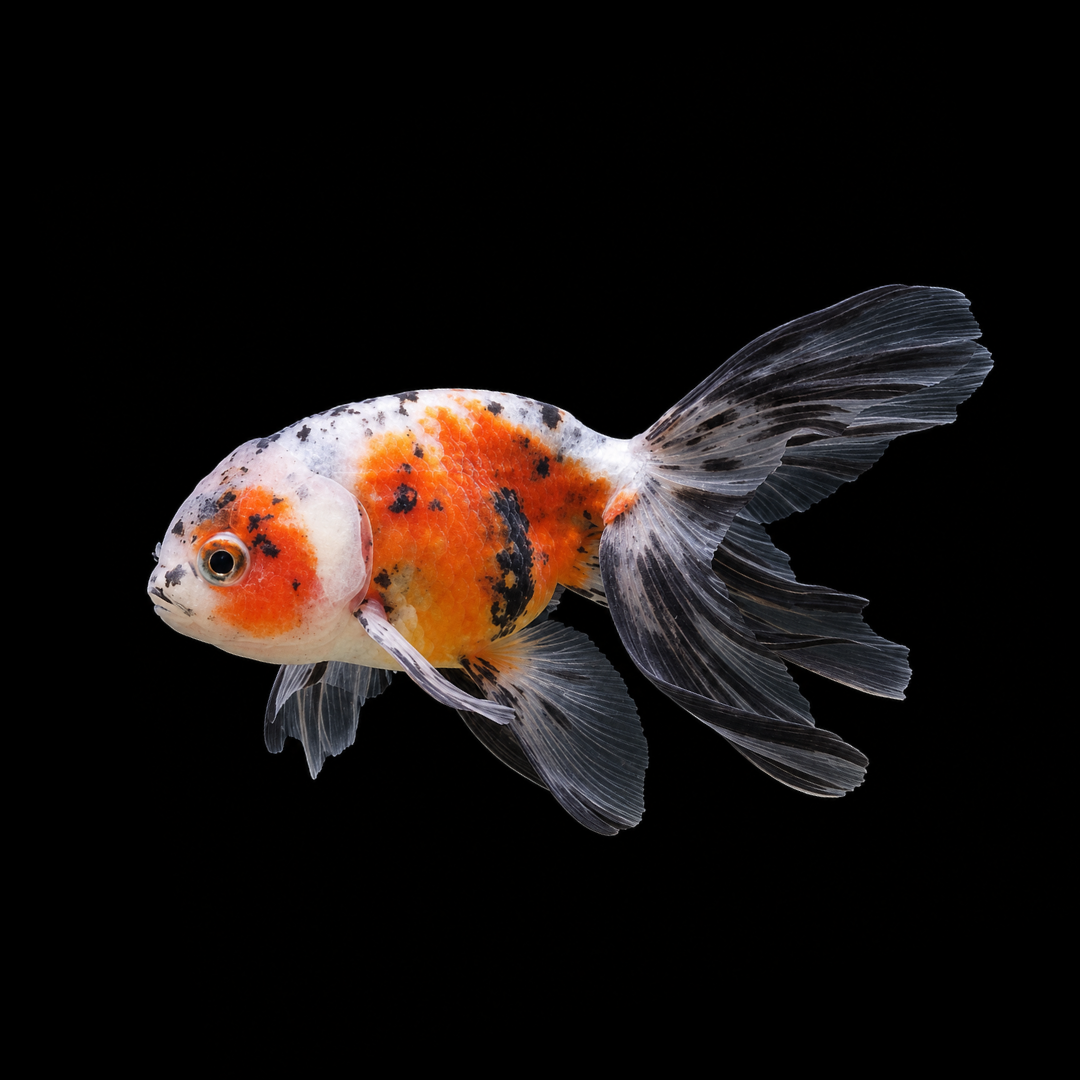
京錦(きょうにしき)は、背びれを持たないらんちゅう型の体に、赤・白・黒・浅葱色が入り混じるキャリコ模様と、長く優雅に伸びる尾びれを組み合わせた日本の改良金魚です。一般には江戸錦から現れる長尾の系統を選抜・維持して成立した品種として説明され、江戸錦の重厚さとは異なる、ゆったりと尾をたなびかせる姿が大きな魅力です。モザイク透明鱗による柔らかな発色は個体差が非常に大きく、同じ血統から生まれた魚でも模様の印象が一匹ずつ異なります。丈夫な金魚ではありますが、背びれを欠く丸手体型と長いひれのため遊泳力は和金型より低く、広い底面積、穏やかな水流、過密を避けた管理が美しさと健康を保つ鍵になります。Kyo Nishiki is a Japanese fancy goldfish with a dorsal-finless ranchu-type body, a calico pattern of red, white, black and bluish asagi tones, and long, flowing fins. It is generally described as a long-finned line derived from Edo Nishiki and has a softer, more graceful swimming style than the compact, powerful appearance usually associated with short-tailed ranchu-type fish. Its mosaic transparent scales create highly individual patterns, so even siblings can look strikingly different. Although goldfish are hardy overall, Kyo Nishiki has lower swimming performance than streamlined single-tailed varieties. A tank with generous floor space, gentle current, good oxygenation and low stocking density is therefore especially suitable.
基本情報 / Basic Information
学名 / Scientific Name
Carassius auratus
通称 / Common Name
京錦、キョウニシキKyo Nishiki
分類 / Family
コイ目・コイ科・フナ属。キンギョの改良品種Order Cypriniformes, family Cyprinidae, genus Carassius. A domesticated goldfish variety
英名 / English Name
Kyo Nishiki Goldfish
分布 / Distribution
自然分布を持つ野生種ではなく、日本で作出・維持されている観賞用品種です。埼玉県をはじめとする国内の養魚場から専門店や観賞魚市場を通じて全国へ流通し、海外へ輸出されることもあります。This is a domesticated ornamental variety rather than a naturally occurring wild population. It is bred in Japan, including by producers in Saitama Prefecture, and distributed nationwide through specialist dealers and ornamental-fish markets. Some fish are also exported overseas.
最大体長 / Max Size
全長15〜20cm前後が目安です。血統、尾びれの長さ、給餌、飼育密度、飼育年数によっては20cmを超える個体も見られます。Usually around 15–20 cm in total length. Some individuals may exceed 20 cm depending on lineage, fin length, feeding, stocking density and age.
寿命 / Lifespan
京錦だけを対象にした寿命の統計はほとんどありませんが、一般的な金魚と同様、適切な管理下では10年前後からそれ以上の長期飼育が可能です。寿命は水質、飼育密度、給餌量、病気の有無などに大きく左右されます。There are few lifespan data specific to Kyo Nishiki, but like other goldfish it can be kept for around a decade or longer under appropriate care. Longevity varies greatly with water quality, stocking density, feeding and disease management.
飼育環境 / Aquarium Environment
水槽サイズ / Tank Size
成魚1匹なら60cm規格水槽(約57L)以上をひとつの目安とし、複数飼育では90cm規格水槽(約150L)以上が管理しやすくなります。京錦は長い尾を広げて旋回するため、水槽の高さだけでなく底面積に余裕を持たせることが大切です。上見飼育では浅めの容器も使われますが、水深を特定の数値に固定する必要はありません。十分な水量による水質の安定と、無理なく泳げる穏やかな環境を優先します。For one adult, a standard 60 cm Japanese aquarium of about 57 L or larger is a useful starting point, while a standard 90 cm tank of roughly 150 L or more is easier to manage for several fish. Because Kyo Nishiki needs room to turn with its long tail extended, generous floor area matters as much as tank height. Shallow containers are often used for top-view keeping, but there is no need to fix the water depth to one specific number. Prioritize adequate water volume, stable water quality and a calm environment in which the fish can swim comfortably.
水温 / Temperature
18〜24℃前後を安定させると飼育しやすく、急激な温度変化は避けます。健康な個体は季節的な低温にも耐えますが、低水温時は消化と活動が落ちるため給餌量を減らします。治療目的で加温する場合も、病状と使用薬の適温を確認し、短時間で大きく変温させないことが重要です。A stable temperature of about 18–24°C is easy to manage. Avoid rapid temperature changes. Healthy goldfish can tolerate cooler seasonal water, but feeding should be reduced as digestion and activity slow. When warming the water for treatment, check the disease and medication requirements and avoid abrupt temperature changes.
水質 / Water Quality
弱酸性〜弱アルカリ性(pH6.5〜8.0程度)まで比較的幅広く適応しますが、数値そのものより急変を避けることが重要です。アンモニアと亜硝酸は検出されない状態を維持し、硝酸塩の蓄積を定期換水で抑えます。金魚は排泄量が多いため、十分な生物ろ過と酸素供給を確保してください。Kyo Nishiki adapts to a fairly broad range from slightly acidic to slightly alkaline water, roughly pH 6.5–8.0, but stability is more important than chasing a specific number. Keep ammonia and nitrite undetectable and control nitrate accumulation with regular water changes. Because goldfish produce substantial waste, strong biological filtration and adequate oxygenation are essential.
レイアウト / Layout
ベアタンク、または角のない細かな底砂を薄く敷いたシンプルな構成が管理しやすいです。長い尾びれを傷つける尖った石や複雑な枝流木は避け、広い遊泳空間を残します。水草を使う場合も、魚が引っ掛からない配置を優先してください。黒や濃紺の背景は浅葱色や赤を見やすくし、背景適応によって短期的に体色の見え方が変わることがありますが、遺伝的な色柄そのものが変化するわけではありません。A bare-bottom tank or a simple layout with a thin layer of smooth, fine substrate is easy to maintain. Avoid sharp rocks and complex branches that can damage the long fins, and leave plenty of open swimming space. If plants are used, arrange them so the fish cannot easily snag its fins. Dark backgrounds can make the asagi and red areas easier to see, and background adaptation may temporarily alter the apparent intensity of color, but it does not change the fish’s inherited pattern.
注意点 / Precautions
強い吐出口を魚へ直接当てず、尾が常に押し流されない程度の穏やかな流れにします。ただし水流を弱めることと酸素量を減らすことは別なので、水面が静止しない程度のエアレーションや排水調整を行います。過密飼育、急な全換水、餌の与えすぎは水質悪化や消化不良の原因になりやすいため避けます。新しく迎えた魚は可能であれば別容器で状態を観察してから合流させると、寄生虫や細菌性疾患の持ち込みリスクを下げられます。Do not direct a strong filter outlet at the fish; keep the flow gentle enough that the tail is not constantly pushed aside. Low flow does not mean low oxygen, so provide mild aeration or surface movement. Avoid overcrowding, abrupt complete water changes and overfeeding, all of which can contribute to water-quality and digestive problems. When possible, observe new fish separately before introduction to reduce the risk of bringing in parasites or bacterial disease.
餌と給餌 / Feeding
餌の種類 / Diet
金魚用の高品質な沈下性ペレットを主食にし、補助的に冷凍または生のミジンコ、ブラインシュリンプ、植物質を含むフードなどを組み合わせます。浮上性フードが直ちに問題を起こすわけではありませんが、空気を飲み込みやすい個体や食後に浮きやすい個体では沈下性フードのほうが管理しやすい傾向があります。Use a high-quality sinking goldfish pellet as the staple diet, supplemented with foods such as daphnia, brine shrimp and feeds containing plant material. Floating food is not automatically harmful, but sinking pellets are often easier to manage for fish that gulp air or tend to become buoyant after meals.
給餌のポイント / Feeding Tips
活動期は1日1〜3回、数分以内に食べ切れる少量を基本にし、腹部の張り、糞、泳ぎ方を見ながら調整します。低水温時は回数と量を減らし、食後に尻上がりや浮きが見られる場合は一時的に給餌を止めて状態を観察します。長期的な健康には「色揚げ」よりも、過栄養を避けながら十分な栄養を与えることが優先です。特定の食品や民間療法だけで転覆症状を治療できるとは考えず、再発する場合は水質、便秘、感染、浮き袋や臓器の異常など複数の原因を疑います。During the active season, feed one to three small meals a day, offering only what can be eaten within a few minutes. Adjust the amount according to abdominal fullness, feces and swimming behavior. Reduce feeding in cooler water, and temporarily stop feeding if the fish becomes tail-up or unusually buoyant after meals. Long-term health depends more on balanced nutrition and avoiding overfeeding than on color-enhancing foods alone. Recurrent buoyancy problems should be treated as a symptom with several possible causes rather than something reliably cured by a single food or folk remedy.
性格と混泳 / Temperament and Tank Mates
性格 / Temperament
基本的には温和で、人にもよく慣れる金魚です。餌の時間には活発になりますが、長尾とらんちゅう型の体つきのため俊敏さは高くありません。個体同士で軽く追い合うことはあるものの、通常は縄張り性の強い魚ではありません。Generally peaceful and often very responsive to its keeper. It becomes active at feeding time, but its long fins and ranchu-type body make it less agile than streamlined goldfish. Mild chasing can occur, but the species is not strongly territorial under normal conditions.
混泳の相性 / Compatibility
らんちゅう、江戸錦、桜錦など、泳ぐ速さと給餌ペースが近い丸手の金魚との混泳が向きます。和金、コメット、朱文金など泳ぎの速い魚と同居させると、餌を取り負けたり長い尾が傷んだりすることがあるため慎重に判断します。体格差の大きい個体、ヒレをつつく魚、熱帯性の魚との安易な混泳は避けてください。Best kept with similarly slow, rounded fancy goldfish such as Ranchu, Edo Nishiki and Sakura Nishiki. Fast swimmers such as common goldfish, Comets and Shubunkins may outcompete Kyo Nishiki for food or damage the long fins, so such combinations require caution. Avoid large size differences, known fin-nippers and casual mixing with tropical species.
病気と対策 / Diseases and Prevention
かかりやすい病気 / Common Diseases
金魚で一般的な白点病、尾ぐされ病・口ぐされ病などのカラムナリス感染症、イカリムシ症、ミズカビ症に注意します。京錦では長いひれが外傷や尾ぐされの影響を受けやすく、見た目の変化も早く現れます。また「転覆病」は単一の病名というより、浮力や姿勢を正常に保てない症状の総称として扱うのが適切です。消化管の膨満、便秘、感染、浮き袋や周辺臓器の異常、体型など複数の要因が関係する可能性があります。Watch for common goldfish problems including ich, columnaris infections such as fin rot and mouth rot, anchor worm and fungal growth. Because Kyo Nishiki has long fins, trauma and fin damage can become noticeable quickly. “Swim bladder disease” is best regarded as a description of abnormal buoyancy or posture rather than a single disease. Digestive distension, constipation, infection, abnormalities of the swim bladder or nearby organs, and body conformation may all contribute.
対策と予防 / Prevention
毎日の観察で、ヒレ先の白濁、充血、白点、体をこすりつける行動、呼吸の速さ、食欲、浮き沈みの異常を早く見つけます。病魚は必要に応じて隔離し、まず水温、アンモニア、亜硝酸、pHなどを確認します。尾ぐされ病では原因に応じた観賞魚用抗菌薬、白点病では適応が明記された観賞魚用治療薬を使用し、必ず製品の用法・用量に従います。0.3〜0.5%程度の塩水浴が補助的に用いられることはありますが、すべての病気に有効な万能治療ではありません。薬剤の自己流混用は避け、重症例や繰り返す転覆症状では魚類診療に対応する獣医師への相談を検討します。Daily observation is the best early-warning system. Look for cloudy fin edges, redness, white spots, flashing, rapid breathing, appetite loss and abnormal buoyancy. Isolate sick fish when appropriate and first check temperature, ammonia, nitrite and pH. Use ornamental-fish antibacterial medication for confirmed or strongly suspected bacterial fin disease and a treatment specifically labeled for ich when white spot disease is present, always following the product label. Salt baths around 0.3–0.5% are sometimes used as supportive care, but they are not a universal cure. Avoid mixing medications without guidance, and consider a veterinarian experienced with fish for severe disease or recurrent buoyancy disorders.
増やし方(繁殖) / Breeding
雌雄の判別 / Sexing
繁殖期の雄は、エラぶたや胸びれの前縁に白い粒状の追星が現れやすく、雌を追尾する行動も増えます。成熟した雌は腹部がふっくらし、産卵が近づくと生殖孔がやや目立つことがあります。非繁殖期や若魚では外見だけでの判別は難しく、複数の特徴を組み合わせて判断します。During the breeding season, males often develop small white breeding tubercles on the gill covers and leading rays of the pectoral fins and may chase females. Mature females usually become fuller in the abdomen, and the vent may become more noticeable before spawning. Sexing juveniles or fish outside the breeding season is difficult, so several traits should be considered together.
繁殖形態 / Reproduction
卵生で、春から初夏にかけて水温上昇と日長の変化をきっかけに繁殖行動が活発になります。雄が雌を追尾し、水草、産卵モップ、人工産卵藻などへ粘着性の卵をばらまくように産み付けます。親魚は卵を食べるため、産卵後は親魚を分けるか、卵の付着物を別容器へ移します。Kyo Nishiki is an egg-laying fish. Breeding activity usually increases from spring into early summer as water temperature and day length rise. Males chase females, which scatter adhesive eggs onto plants, spawning mops or artificial spawning media. Because adults may eat the eggs, remove the parents after spawning or transfer the egg-covered media to a separate rearing container.
繁殖のポイント / Breeding Tips
十分に成熟した健康な親魚を整え、産卵前から過密を避けて管理します。ふ化後は仔魚の口に合う初期飼料を少量ずつ与え、成長に合わせてブラインシュリンプ幼生や細かな人工飼料へ移行します。京錦の繁殖で難しいのは、産卵そのものよりもその後の選別です。背びれの有無、背なり、尾の長さと開き、モザイク透明鱗、浅葱・赤・黒・白の配色には大きな個体差が出るため、狙った表現を残すには多数の稚魚を育てながら段階的に選抜します。Condition healthy, fully mature broodstock and avoid crowding before spawning. After hatching, offer small amounts of appropriately sized first food, then transition to baby brine shrimp and fine prepared feeds as the fry grow. The difficult part of breeding Kyo Nishiki is usually not spawning itself but the selection that follows. Dorsal-fin expression, back line, tail length and spread, mosaic scale pattern and the balance of asagi, red, black and white vary widely among offspring, so breeders raise many juveniles and select them in stages.
雑学と豆知識 / Trivia and Fun Facts
1. 江戸錦から生まれた「長尾」という個性 / 1. A Long-Tailed Expression from Edo Nishiki
京錦を理解する近道は、まず江戸錦を見ることです。江戸錦は、背びれのないらんちゅう型と、東錦に由来するキャリコのモザイク透明鱗を組み合わせた系統として知られています。東錦の血を引くため、累代繁殖の中では尾が長く伸びる個体が現れることがあり、この長尾の美しさに価値を見いだして選抜・維持されたものが京錦と説明されています。つまり京錦は、らんちゅう型の丸みと、東錦系統を思わせる柔らかな尾さばきを同時に楽しめるところに大きな個性があります。海外では形態を説明するためにlong-fin calico ranchuなどの表現が使われることがありますが、日本では「京錦」という品種名そのものが通用します。The easiest way to understand Kyo Nishiki is to start with Edo Nishiki. Edo Nishiki combines a dorsal-finless ranchu-type body with the calico mosaic transparent scales associated with Azuma Nishiki ancestry. Long-tailed individuals can appear in such breeding lines, and Kyo Nishiki is generally explained as the result of selecting and maintaining that graceful long-fin expression. Its appeal therefore lies in combining the rounded ranchu form with a softer, flowing tail movement reminiscent of the Azuma Nishiki lineage. Descriptive labels such as “long-fin calico ranchu” may be used overseas, but in Japan the established variety name Kyo Nishiki is used directly.
2. 「江戸」に対する「京」――名前が生む文化的な余韻 / 2. “Kyo” Opposite “Edo”: Cultural Resonance in the Name
江戸錦の短く力強い尾に対し、長い尾がゆったりと広がる姿へ「京」の名を与えた対比は、金魚の命名の中でも印象的です。「錦」という語は、さまざまな色が織り重なる華やかさを表す日本語として古くから使われ、キャリコ金魚の色彩を表現する名称にもよく登場します。京錦の命名そのものが京友禅や錦市場に直接由来したと断定できる一次資料は乏しいものの、浅葱、赤、白、黒が水の中でほどけるように見える姿は、京都の染織文化を自然に連想させます。事実としての命名史と、鑑賞者が受け取る文化的イメージを分けて味わうと、この名前の面白さがより深くなります。The contrast between the compact, powerful tail of Edo Nishiki and the long, softly spreading fins of Kyo Nishiki gives the name a memorable cultural resonance. The Japanese word nishiki has long suggested richly layered colors like brocade and appears frequently in names for multicolored ornamental fish. There is little primary-source evidence proving that Kyo Nishiki was named directly after Kyoto textiles or Nishiki Market, so those connections should not be presented as literal naming history. Even so, the way asagi, red, white and black seem to dissolve into one another in the water naturally evokes Kyoto’s celebrated textile and dyeing traditions. Separating documented history from aesthetic association makes the name even more interesting.
3. モザイク透明鱗は、遺伝学でも古くから研究されてきた / 3. Mosaic Transparent Scales Have a Long History in Genetics
キャリコ金魚のモザイク透明鱗は、反射性のある鱗と透明感の強い鱗が入り混じって見える特徴です。この性質は20世紀前半から交配実験の対象となり、透明鱗に関わる形質が遺伝することが確かめられてきました。現在のゲノム研究でも透明鱗に関連する遺伝領域が調べられており、見た目の模様が単なる偶然ではなく、遺伝的な背景を持つことが分かっています。ただし、京錦では体型や尾、色柄など複数の形質を同時に選ぶため、親と同じ姿がそのまま子に現れるわけではありません。The mosaic transparent scales of calico goldfish combine reflective and more transparent-looking areas. This trait has been studied through breeding experiments since the early twentieth century, establishing that scale transparency has a heritable basis. Modern genomic studies have also identified regions associated with transparent-scale traits. In Kyo Nishiki, however, breeders select several features at once—including body form, tail and color pattern—so offspring do not simply reproduce the appearance of their parents.
4. 浅葱色は「青い色素」だけでできているわけではない / 4. Asagi Is Not Produced by a Simple Blue Pigment
京錦の浅葱色は、ひとつの青色色素だけで生まれる色ではありません。金魚の皮膚では、黒色素胞などの色素細胞と、グアニン結晶を含む虹色素胞による反射が重なり、見る人には青灰色から浅葱色として認識されます。モザイク透明鱗では反射組織の量や見え方が場所によって異なるため、同じ魚の中にも濃淡が生まれます。背景色などによって色素胞の状態が変わり、短期的に色の見え方が変化することはありますが、それは遺伝的な模様そのものが作り替えられるという意味ではありません。The asagi tones of Kyo Nishiki are not created by a single blue pigment. In goldfish skin, pigment cells such as melanophores interact visually with light reflected by iridophores that contain guanine crystals, producing blue-gray to asagi tones. Because the amount and visibility of reflective tissue vary across mosaic transparent scales, different shades can appear on the same fish. Background color can temporarily alter the apparent intensity of pigmentation through physiological color responses, but it does not rewrite the fish’s inherited pattern.
5. 埼玉・加須は、現在も金魚流通の重要な拠点 / 5. Kazo, Saitama Remains an Important Goldfish Hub
埼玉県は現在も金魚を含む観賞魚生産の盛んな地域で、加須市の水産流通センターでは観賞魚の流通や品評会、即売に関わる取り組みが続いています。京錦についても、埼玉の養魚場が現在まで生産・販売を続けていることが確認できます。一方、国内の流通経路は一つではなく、市場を介した卸売のほか、生産者から専門店への出荷や直売、オンライン販売などもあります。京錦を「加須だけを通る魚」と捉えるより、埼玉を重要な生産・流通拠点の一つとして見るのが実態に近いでしょう。Saitama remains an active region for ornamental-fish production, and the fisheries distribution center in Kazo continues to support trade, shows and sales. Kyo Nishiki is also still bred and sold by producers in Saitama. Domestic distribution is not limited to a single route, however: fish may move through wholesale markets, directly from breeders to specialist shops, through breeder sales or via online retail. It is therefore more accurate to regard Kazo and Saitama as important hubs rather than the only route through which Kyo Nishiki reaches keepers.
6. 鑑賞では、色だけでなく体型と泳ぎの調和も大切 / 6. Appreciation Depends on Balance, Not Color Alone
京錦は鮮やかなキャリコ柄が目立つ金魚ですが、鑑賞の魅力は色だけでは決まりません。背びれがないため頭から尾筒までの背なりがよく見え、長い尾では左右の開きや付け根のまとまり、泳いだときのたなびき方が印象を大きく左右します。肉瘤、体幅、尾筒、色柄、健康状態が一体となったとき、京錦らしい優雅さが際立ちます。品評会では主催団体や出品区分によって評価方法が異なるため、特定の基準を京錦共通の絶対条件として扱わないことも大切です。Kyo Nishiki is immediately noticeable for its calico coloration, but its appeal is not determined by color alone. Because there is no dorsal fin, the line from the head to the caudal peduncle is easy to see, while the long tail is judged visually by its balance, attachment and movement in the water. Head growth, body volume, caudal peduncle, pattern and overall health all contribute to the fish’s characteristic elegance. Show criteria vary among organizations and classes, so no single judging standard should be treated as an absolute rule for every Kyo Nishiki.
7. 同じ親からでも、同じ京錦にはならない / 7. Even Siblings Can Look Very Different
京錦の繁殖では、同じ親魚から生まれた稚魚でも外見に大きな幅が出ます。背びれの有無や背なり、尾の長さ、モザイク透明鱗の出方、赤・黒・浅葱・白の配置がそれぞれ組み合わさるためです。そのため、生産者が行う選別は単に「きれいな魚を残す」作業ではなく、どの体型と色柄を次の世代へつなぐかを決める育種そのものです。店頭で一匹ずつ模様が違って見えることも、京錦が長く愛好される理由の一つです。Kyo Nishiki fry from the same parents can differ greatly in appearance. Dorsal-fin expression, back line, tail length, mosaic scale pattern and the placement of red, black, asagi and white all combine independently to create variation. Breeder selection is therefore not merely a matter of keeping the prettiest fish; it is the process of deciding which body forms and color patterns will be carried into the next generation. The fact that almost every fish looks different is also part of Kyo Nishiki’s lasting appeal.
8. 似た品種と比べると、京錦の特徴が分かりやすい / 8. Similar Varieties Make Kyo Nishiki Easier to Recognize
京錦に最も近いのは江戸錦で、一般には江戸錦の尾が長く伸びたものが京錦と説明されます。桜錦は同じく背びれのないらんちゅう型でモザイク透明鱗を持ちますが、基本的には紅白系の色調が中心です。また、桜錦の長尾型は「京桜」と呼ばれることがあります。販売名には生産者や店舗による違いもあるため、名前だけでなく、背びれの有無、鱗の質、黒や浅葱の有無、尾の長さを合わせて見ると、京錦の特徴を整理しやすくなります。The closest comparison is Edo Nishiki, and Kyo Nishiki is generally described as its long-tailed form. Sakura Nishiki also has a dorsal-finless ranchu-type body and mosaic transparent scales, but is typically selected toward softer red-and-white coloration. A long-tailed Sakura Nishiki may be called Kyo Sakura. Retail naming can vary among breeders and shops, so it is useful to look beyond the label and compare dorsal-fin presence, scale type, the presence of black and asagi, and tail length.
まとめ / Conclusion
京錦は、らんちゅう型の丸み、江戸錦と共通するキャリコ模様、そして長くたなびく尾びれを併せ持つ金魚です。浅葱色を含む複雑な色合いは、色素細胞と反射組織、モザイク透明鱗の見え方が重なることで生まれ、見る角度や背景によって印象も変わります。目を引く色彩だけでなく、背なりや尾の広がり、泳ぎ方まで含めた全身の調和に京錦らしい魅力があります。Kyo Nishiki combines the rounded form of ranchu-type goldfish, the calico pattern shared with Edo Nishiki, and a long, flowing tail. Its complex coloration, including asagi tones, emerges from the interaction of pigment cells, reflective tissue and the appearance of mosaic transparent scales, so the impression can shift with viewing angle and background. Beyond its striking colors, much of its appeal lies in the overall harmony of back line, tail spread and swimming style.
飼育では、極端に特殊な環境を作るより、十分な底面積、穏やかな水流、高い溶存酸素、安定したろ過、少量ずつの給餌を丁寧に積み重ねることが大切です。長い尾がゆっくりと開き、浅葱の中に赤や墨が浮かび上がる姿は、健康状態が整ってこそ最も美しく見えます。日々の小さな変化を観察しながら付き合うほど、同じ魚でも季節や成長に応じて違う表情を見せてくれる、長く楽しめる観賞魚です。Successful care depends less on creating an extreme or highly specialized setup than on consistently providing broad floor space, gentle current, good oxygenation, stable filtration and modest feeding. The long tail opens most beautifully, and the red and black markings stand out most clearly against asagi, when the fish is in good health. Kyo Nishiki rewards close observation: as it grows and moves through the seasons, the same individual can reveal subtly different expressions, making it a goldfish that can remain engaging for many years.
Fricke, R., Eschmeyer, W. N. & Van der Laan, R. (eds.). Eschmeyer’s Catalog of Fishes: Carassius auratus. California Academy of Sciences. 主に支える内容:学名、コイ科・フナ属としての分類、東アジアの分布、淡水魚としての位置づけ、栽培・観賞用品種の存在。 Eschmeyer’s Catalog of Fishes
Froese, R. & Pauly, D. (eds.). Carassius auratus (Linnaeus, 1758). FishBase. 主に支える内容:淡水域での生息環境、止水・緩流域への適応、pHの目安、食性、粘着卵を植物などへ産み付ける繁殖生態、飼育下での長寿性。 FishBase
Watson, C. A., Hill, J. E. & Pouder, D. B. (2004). Species Profile: Koi and Goldfish. Southern Regional Aquaculture Center, Publication No. 7201. 主に支える内容:金魚の改良品種、18〜24℃を中心とする飼育水温、水質・溶存酸素管理、ろ過と養殖環境、給餌、春季の産卵、粘着卵、親魚と卵の分離。 Southern Regional Aquaculture Center
Francis-Floyd, R., Stilwell, N. K. & Yanong, R. P. E. Introduction to Fish Health Management. University of Florida IFAS Extension. 主に支える内容:水質・栄養・衛生を基本とする疾病予防、過密やストレスの影響、日常観察、異常時にアンモニア・亜硝酸・pH・溶存酸素などを確認する考え方。 University of Florida IFAS Extension
Petty, B. D., Francis-Floyd, R. & Yanong, R. P. E. Bacterial Diseases of Fish. MSD Veterinary Manual. 主に支える内容:カラムナリス病を含む細菌性疾患、外傷・過密・低酸素・水質悪化・急な温度変化などの発症要因、診断と抗菌薬使用に関する獣医学的原則。 MSD Veterinary Manual
Petty, B. D., Francis-Floyd, R. & Yanong, R. P. E. Parasitic Diseases of Fish. MSD Veterinary Manual. 主に支える内容:白点病(Ichthyophthirius multifiliis)、イカリムシ類(Lernaea spp.)、ミズカビ類(Saprolegnia)など、観賞魚で問題となる寄生虫・水カビ性疾患の症状、感染経路、予防と治療の基本。 MSD Veterinary Manual






コメント