
解説 / Description
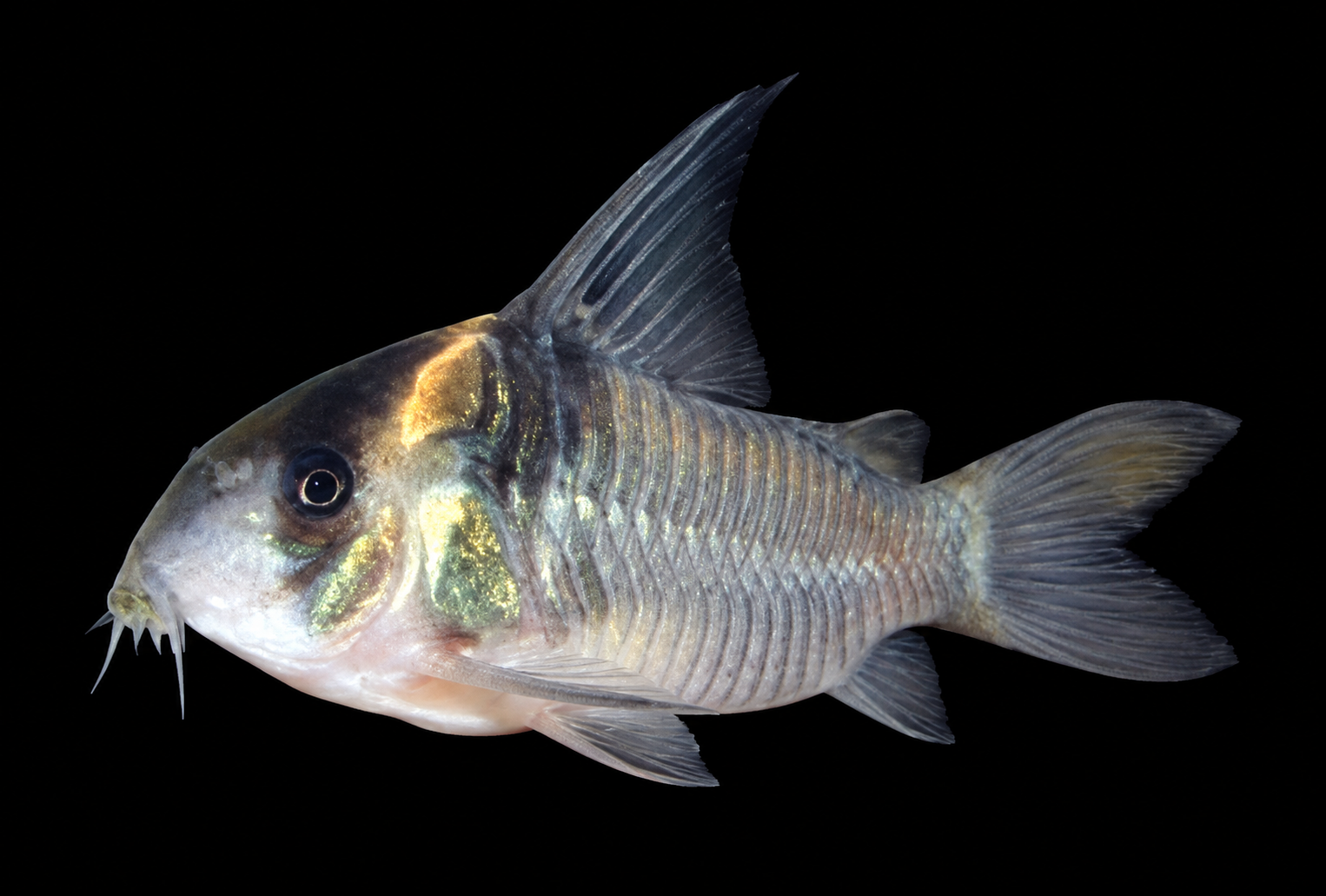
コリドラス・レセックスは、ブラジルのアマゾン水系に分布する、体高のある姿が印象的な小型のナマズです。厚みのある体に高く伸びる背ビレを備え、目を横切る黒い模様と、頭部からエラぶた付近に見られる黄〜橙色の輝きが表情を添えます。体色は淡い灰褐色から黒に近い色まで幅があり、同じ個体でも濃さが変わることがあります。長らく未記載種の「CW045」や「レセックス」として親しまれ、現在の学名はHoplisoma colossusです。精悍な見た目とは対照的に性格は温和で、仲間と一緒に底砂を探る姿にはコリドラスらしい親しみやすさがあります。清潔な底床、十分な酸素、落ち着ける空間を用意し、迎える際には個体の状態をよく確認しましょう。 The Resex cory is a small catfish from the Brazilian Amazon basin, distinguished by its deep, robust body and tall dorsal fin. A dark marking crosses the eyes, while yellow to orange iridescence around the head and gill covers adds subtle detail. Its coloration ranges from pale greyish brown to nearly black, and the same individual may change in shade. Long known in the aquarium hobby as the undescribed CW045 or “Resex,” it is now scientifically named Hoplisoma colossus. Despite its imposing appearance, it is peaceful, and watching a group search through the sand reveals the familiar charm of cory catfish. Provide clean substrate, ample oxygen, and sheltered resting places, and check the condition of each fish carefully when bringing it home.
基本情報 / Basic Information
| 学名 / Scientific Name | Hoplisoma colossus (Tencatt, Grant & Bentley, 2023) |
|---|---|
| 通称 / Common Name | コリドラス・レセックス、レセックス、コリドラス・コロッサス。未記載種時代の識別番号はCW045です。Resex cory, Colossus cory. Its identification code before formal description was CW045. |
| 分類 / Family | ナマズ目・カリクティス科・コリドラス亜科・ホプリソマ属。Order Siluriformes; family Callichthyidae; subfamily Corydoradinae; genus Hoplisoma. |
| 英名 / English Name | Resex Cory, Colossus Cory |
| 分布 / Distribution | ブラジル・アマゾナス州のジュタイ川水系。ソリモエンス川との合流部付近から報告されていますが、支流などを含む詳しい分布範囲には不明な点が残っています。The Jutaí River drainage in Amazonas State, Brazil. It is reported from near the confluence with the Solimões River, although its detailed distribution, including possible occurrences in tributaries, remains incompletely known. |
| 最大体長 / Max Size | 確かな最大体長は不明です。体高のある魚なので、成長後の体格も考慮し、底面に余裕のある水槽を用意してください。A reliable maximum size has not been established. Consider its deep body when choosing an aquarium, allowing ample floor space for the fish as they mature. |
| 寿命 / Lifespan | 本種の平均寿命や最長寿命を示す十分な情報はありません。数年単位の長期飼育を見据え、成長後も無理なく管理できる環境を整えて迎えましょう。There is insufficient information to establish a reliable average or maximum lifespan for this species. Plan for care over several years and provide an aquarium that will remain suitable as the fish mature. |
飼育環境 / Aquarium Environment
| 水槽サイズ / Tank Size | 5〜6匹ほどのグループなら、60cm規格水槽(60×30×36cm、容量約60〜65L)以上を飼育の目安にします。成魚の群れに混泳魚も加える場合は、90cm規格水槽(90×45×45cm、容量約180L)など、底面に余裕のある水槽が扱いやすくなります。これらは飼育計画の目安であり、底砂や器具を入れた実際の水量、ろ過能力、同居魚の数によって調整が必要です。高さや水量だけでなく、砂を探りながら移動できる底面積を重視してください。For a group of around five or six, use at least a Japanese standard 60 cm aquarium measuring 60 × 30 × 36 cm, with a nominal capacity of approximately 60–65 L, as a practical planning guideline. A Japanese standard 90 cm aquarium measuring 90 × 45 × 45 cm, approximately 180 L, offers more room for an adult group with additional tank mates. These are husbandry guidelines: stocking should also reflect the actual water volume after adding substrate and equipment, filtration capacity, and the other fish present. Prioritize usable floor area for foraging rather than considering height or volume alone. |
|---|---|
| 水温 / Temperature | 22〜26℃程度を日常管理の目安にします。迎える個体がそれまで飼育されていた水温も確認し、急な変化を避けてください。夏は高温の長期化と酸素不足に注意し、必要に応じて冷却ファンや水槽用クーラーで穏やかに調整します。換水時にも新しい水との温度差を小さく保ちましょう。 Approximately 22–26°C is a practical range for routine care. Check the water temperature at which the fish were previously kept and avoid abrupt changes. During summer, watch for prolonged high temperatures and reduced oxygen availability, using an aquarium fan or chiller when needed to make gradual adjustments. Keep replacement water close to the aquarium temperature during water changes. |
| 水質 / Water Quality | 弱酸性〜中性の軟水を基本に、pH6.0〜7.0前後を管理の目安とします。ろ過が安定して働き、アンモニアと亜硝酸が検出されない水槽で飼育してください。換水は週1回、全水量の1/4〜1/3程度を目安に、飼育数や汚れ方に合わせて調整します。水道水は地域差があるため、まず実際のpHや硬度を測ることが大切です。マジックリーフやピートを使う場合も少量から試し、着色の濃さだけで水質を判断しないようにしましょう。極端な低硬度や低pHを無理に目指すより、安定した状態を保つことを優先します。Soft, mildly acidic to neutral water is a suitable starting point, with approximately pH 6.0–7.0 as a practical management target. Use an established aquarium with stable biological filtration and no detectable ammonia or nitrite. A weekly change of roughly one-quarter to one-third of the water is a useful guideline, adjusted to stocking and waste accumulation. Tap water varies by location, so measure its actual pH and hardness first. Introduce Indian almond leaves or peat gradually if used, and do not judge water chemistry by the depth of its brown coloration. Prioritize stability over attempting to reproduce extremely low hardness or pH. |
| レイアウト / Layout | 口先で探りやすい、粒の細かい角の丸い砂を薄く敷き、前面には広く餌を探せる場所を残します。流木やなめらかな石で陰をつくり、水草は底面をふさぎすぎないように配置すると、隠れ場所と観察のしやすさを両立できます。落ち葉を使う場合は少量にとどめ、その下に残餌がたまらないように管理してください。暗い色の砂や背景は体色の見え方を楽しむ選択肢ですが、黒い砂を使えば必ず黒くなるわけではありません。水流は底面まで穏やかに循環させ、流れを避けて休める場所も用意します。Provide a shallow layer of fine, rounded sand and leave a broad foraging area open at the front. Use driftwood or smooth stones for shade, with plants positioned so that they do not occupy too much of the floor. This provides shelter while keeping the fish easy to observe. If leaf litter is included, use modest amounts and prevent uneaten food from collecting underneath. Dark sand or backgrounds offer one way to enjoy its changing appearance, but black substrate does not guarantee black coloration. Maintain gentle circulation across the bottom while also providing resting areas away from the current. |
| 注意点 / Precautions | 胸ビレや背ビレには鋭い棘があるため、素手でつかまず、網への引っ掛かりにも注意してください。移動時は個別梱包などで過密を避け、揺れや温度変化を抑えます。コリドラスの仲間の一部では、強いストレスを受けた際の分泌物が輸送水に影響することがありますが、白濁だけで原因を毒と判断することはできません。 導入時は水温・水質の差と魚の状態を確認して水合わせを行います。汚れた輸送水の中で何時間も点滴を続ける方法は避け、呼吸が速い、姿勢が崩れるなどの異常があれば、温度や水質の差を抑えた清浄な水への移動を優先してください。輸送水は飼育水槽へ注がないようにします。日常管理では十分な酸素を確保し、水面まで浮上できる通り道と、飛び出しを防ぐフタを用意しましょう。The dorsal and pectoral fins bear sharp spines, so avoid grasping the fish with bare hands and take care to prevent entanglement in nets. During transport, avoid crowding, use individual packing when appropriate, and minimize shaking and temperature fluctuations. In some cory catfish, secretions released under severe stress can affect transport water, but cloudiness alone does not establish that toxins are the cause. Choose an acclimation method according to differences in temperature and water chemistry and the condition of the fish. Avoid keeping fish in polluted shipping water for hours during a prolonged drip acclimation. If breathing is rapid or posture becomes abnormal, prioritize transfer into clean water with closely matched temperature and chemistry. Do not pour shipping water into the aquarium. During routine care, provide ample oxygen, an unobstructed route to the surface, and a lid to prevent jumping. |
餌と給餌 / Feeding
| 餌の種類 / Diet | 動物質の餌をよく食べる雑食性です。栄養バランスの整ったコリドラス用の沈下性タブレットや顆粒を主食にし、冷凍アカムシや冷凍ブラインシュリンプなどを組み合わせます。口に合う大きさと、底まで届くことが大切です。イトメなどの生き餌を使う場合は、衛生管理と鮮度に気を配り、特定の餌だけに偏らないようにしてください。An omnivore that readily accepts animal-based foods. Use nutritionally complete sinking tablets or granules formulated for cory catfish as the staple, supplemented with frozen bloodworms or brine shrimp. Food should be appropriately sized and reach the bottom. If live foods such as tubifex worms are offered, pay close attention to hygiene and freshness, and maintain variety rather than relying on a single food. |
|---|---|
| 給餌のポイント / Feeding Tips | 1日1〜2回を目安に少量ずつ与え、すべての個体が実際に食べているか確認します。混泳水槽では餌を数か所に分けて沈めると、素早い魚に独占されにくくなります。導入直後に警戒している場合は、照明を落とした時間帯に隠れ場所の近くへ少量届けてみましょう。食べ残しは取り除き、腹部のへこみや痩せが続かないかも観察してください。底を探る魚だからといって他魚の残餌だけに頼らず、本種のための給餌を毎日の管理に組み込みます。Offer small portions once or twice daily as a starting routine, checking that every fish actually feeds. In a community aquarium, distribute sinking food among several locations so that faster fish cannot monopolize it. Newly introduced, nervous individuals may respond better to small amounts placed near shelter under dim lighting. Remove leftovers and watch for a persistently hollow abdomen or weight loss. Include deliberate feeding for these fish in the daily routine rather than assuming that leftovers from other species will meet their needs. |
性格と混泳 / Temperament and Tank Mates
| 性格 / Temperament | 基本的に温和で、同種同士が近くで休んだり、一緒に底砂を探ったりする姿が見られます。単独よりも、同種の仲間とグループで飼育するのに向いています。迎えた直後は物陰に隠れがちでも、隠れ場所と落ち着いた環境を保つことで、少しずつ前面に出てくることがあります。観察のために頻繁に追い出したり、隠れ場所を取り除いたりしないようにしましょう。Generally peaceful, with individuals often resting near one another or searching through the substrate together. It is better suited to keeping in a group of its own species than to solitary care. Newly introduced fish may spend much of their time in cover, gradually appearing in open areas as they settle into a calm environment with dependable shelter. Avoid repeatedly disturbing them or removing their hiding places simply to make them easier to see. |
|---|---|
| 混泳の相性 / Compatibility | 水温や水質の好みが近い、穏やかな小型カラシンやラスボラなどが候補になります。ほかの温和なコリドラス類とも組み合わせられますが、底面の混雑と餌の競争に注意してください。ヒレをかじる魚や、本種を口に入れられる大型魚は避けます。アピストグラマなど底面付近に縄張りをつくるシクリッドは、特に産卵時や稚魚の世話をしている時期に攻撃的になることがあるため、慎重な判断が必要です。追われ続ける場合は別水槽に分けましょう。稚エビや魚卵などは食べられる可能性があるため、エビやほかの魚の繁殖を優先する場合も、分けて管理すると安心です。Peaceful small tetras or rasboras with compatible temperature and water requirements are possible tank mates. Other gentle cory species can also be considered, provided that floor space and access to food remain adequate. Avoid fin-nippers and large fish capable of swallowing it. Bottom-territorial cichlids such as Apistogramma require particular caution because aggression may increase during spawning or while caring for fry. Separate the fish if persistent chasing occurs. Shrimp juveniles and fish eggs may be eaten, so keep shrimp or other fish separately when successful breeding is a priority. |
病気と対策 / Diseases and Prevention
| かかりやすい病気 / Common Diseases | 本種が特にかかりやすい病気については、情報が限られています。飼育中は、白点病などの寄生虫疾患、口元やヒレの細菌感染、外傷に伴う水カビ病に注意が必要です。導入直後の食欲不振や呼吸の乱れには、感染症だけでなく水質悪化や酸素不足が関係していることもあります。ヒゲの短縮、口元の赤み、ヒレの傷み、痩せ、体をこすりつける動きなどを観察し、体色の濃淡だけで健康状態を決めつけないようにしてください。Information on disease susceptibility specific to this species is limited. General concerns in aquarium care include parasitic infections such as white spot disease, bacterial infections of the mouth or fins, and water mold infections associated with injuries. Loss of appetite or abnormal breathing after introduction may also result from poor water quality or insufficient oxygen rather than infection alone. Watch for shortening barbels, redness around the mouth, damaged fins, weight loss, or rubbing against objects, and do not assess health solely by how light or dark the fish appears. |
|---|---|
| 対策と予防 / Prevention | 新しい個体は別水槽で状態を観察してから合流させ、日頃から残餌と底床の汚れを取り除きます。ヒゲや口元に異常がある場合は、底砂の形状だけでなく、水質や汚れの蓄積も確認してください。不調時はまず水温、アンモニア、亜硝酸、酸素供給を点検し、必要な換水や環境調整を行います。症状に応じて隔離し、改善しない場合は魚の診療に対応する獣医師などへ相談しましょう。薬を使う際は、使用できる魚種や対象となる病気、濃度、使用期間を確認し、製品の説明に従ってください。自己判断で複数の薬を混ぜたり、指定された濃度を変更したりしないことが大切です。Observe new arrivals in a separate aquarium before introducing them to established fish, and routinely remove uneaten food and accumulated debris. If the barbels or mouth become damaged, investigate water quality and waste buildup as well as substrate texture. When a fish is unwell, first check temperature, ammonia, nitrite, and oxygen provision, then make appropriate water changes or environmental adjustments. Isolate affected fish when necessary and seek advice from a veterinarian experienced with fish if problems persist. When medication is required, check which fish species and conditions it can be used for, along with its concentration and treatment duration, and follow the product instructions. Do not independently mix medications or change the concentrations specified in those instructions. |
増やし方(繁殖) / Breeding
| 雌雄の判別 / Sexing | 成熟したメスは上から見たときに腹部の幅が広くなりやすく、オスは比較的細身になる傾向があります。オスには生殖突起が見られますが、未成熟魚や小さな個体を外見だけで見分けるのは難しいことがあります。本種では雌雄とも背ビレの前方の軟条が長く伸びる場合があるため、背ビレの高さや長さだけで判別しないでください。成熟度、体形、繁殖時の行動を合わせて観察します。Mature females tend to become broader across the abdomen when viewed from above, while males are usually more slender. Males possess a genital papilla, but young or immature fish may be difficult to sex externally. In this species, the anterior soft rays of the dorsal fin can become elongated in both sexes, so fin height or length alone is not a dependable guide. Consider maturity, body shape, and reproductive behavior together. |
|---|---|
| 繁殖形態 / Reproduction | 卵生で、水槽内での繁殖が確認されています。コリドラス類に一般的な産卵行動では、メスがオスの腹側に口を寄せ、雌雄が直角に組み合う「Tポジション」と呼ばれる姿勢をとります。メスは腹ビレで卵を保持し、水槽のガラス面や水草などに粘着性の卵を付着させます。本種の繁殖を試みる際も、親魚や同居魚による食卵に備え、卵を分けて管理します。This egg-laying species has been bred in aquaria. In the spawning behavior generally seen among cory catfish, the female brings her mouth close to the male’s underside, forming the characteristic right-angled “T-position.” She holds eggs between her pelvic fins before attaching the adhesive eggs to aquarium glass, plants, or similar surfaces. When attempting to breed this species, separate the eggs as a precaution against their being eaten by adults or tank mates. |
| 繁殖のポイント / Breeding Tips | 繁殖を試みる際は、コリドラス類の一般的な繁殖管理を基本にします。まずは十分に成熟した雌雄を含むグループを、安定した環境でじっくり育てましょう。栄養バランスの整った人工飼料を基本に冷凍餌なども組み合わせ、痩せや過度な肥満を避けながら親魚の状態を整えてください。繁殖を狙う間も通常の換水と酸素供給を続け、急激な冷却や水質変更で無理に産卵を促さないようにします。水草や産卵モップなど、卵を付けられる場所を用意すると管理しやすくなります。 産卵を確認したら、卵を傷つけないように分け、親魚の水槽と水温・水質を合わせた清潔な水を入れた別の容器で管理します。穏やかな通水とエアレーションを確保し、白く濁った卵やカビの生えた卵は取り除いてください。孵化までの日数は条件によって変わるため、日数だけを目安にせず、卵の内部の変化も観察します。 孵化直後の稚魚は、お腹にある卵黄嚢に蓄えられた栄養で成長します。卵黄嚢が小さくなり、餌を探し始めたら初期給餌を始めます。口に入る大きさの孵化直後のブラインシュリンプや稚魚用の微細な餌を少量ずつ与え、餌が大きくて食べられない個体にはゾウリムシなど、さらに小さな餌を用意します。残餌とフンはこまめに取り除き、水温・水質を合わせた水で少量ずつ換水してください。ろ過器の吸い込み口にはスポンジを付け、稚魚が吸い込まれないようにします。Use general cory catfish breeding practices as a starting point when attempting to breed this species. Begin by raising a group containing fully mature males and females in stable conditions. Condition the adults with nutritionally complete prepared foods supplemented by frozen foods, maintaining good body condition without allowing them to become thin or excessively fat. Continue routine water changes and ample oxygenation while attempting breeding, and avoid forcing a spawning response through abrupt chilling or major changes in water chemistry. Plants or spawning mops provide manageable surfaces for egg deposition. Once spawning occurs, separate the eggs carefully and place them in a separate container filled with clean water matching the temperature and chemistry of the adults’ aquarium. Provide gentle water movement and aeration, and remove opaque or fungus-covered eggs. Incubation time varies with conditions, so observe changes inside the eggs rather than relying on a fixed timetable. Newly hatched larvae initially grow using the reserves in their abdominal yolk sac. Begin feeding when these reserves diminish and the fry start searching for food. Offer small amounts of suitably sized newly hatched brine shrimp or fine fry foods. Individuals unable to take these foods because of their size may need smaller prey such as cultured Paramecium. Remove uneaten food and waste frequently, and perform small water changes with closely matched replacement water. Cover filter intakes with a sponge to prevent the fry from being drawn in. |
雑学と豆知識 / Trivia and Fun Facts
| 1. 流通名から正式な学名へ / 1. From a Trade Name to a Scientific Name | レセックスは、学名が付く前から愛好家に親しまれてきた魚です。未記載のコリドラス類を区別するためのCW番号では「CW045」と呼ばれ、その姿や飼育経験が流通名とともに共有されてきました。2023年にCorydoras colossusとして新種記載され、翌2024年に発表されたコリドラス亜科の分類見直しでホプリソマ属へ移されました。これによって、現在のHoplisoma colossusという学名になりました。この見直しは、DNAなどから推定した類縁関係と体の構造を照らし合わせ、亜科全体を7属に整理したものです。親しみのある「コリドラス・レセックス」という呼び名の背後には、愛好家が魚を見分けてきた歩みと、進化の関係を明らかにしようとする分類学の歩みが重なっています。Resex was familiar to aquarists long before it received a scientific name. Within the CW numbering system used to distinguish undescribed cory catfish, it was known as CW045, and information about its appearance and care circulated under that code and its trade name. It was formally described as Corydoras colossus in 2023. A reassessment of Corydoradinae published in 2024 then transferred it to the genus Hoplisoma, giving it the current name Hoplisoma colossus. That revision compared evolutionary relationships inferred from DNA with anatomical features and organized the subfamily into seven genera. Behind the familiar name “Resex cory” are two connected histories: aquarists learning to recognize the fish, and taxonomists working to understand its evolutionary relationships. |
|---|---|
| 2. 「巨像」の名に似合う、厚みのある体 / 2. An Armored Body Named After a Giant Statue | 種小名のcolossusは、古代ギリシャ語の「巨大な像」を意味する言葉に由来します。この名は、骨板に覆われた頑丈な体つきにちなんでいます。高く伸びる背ビレと厚みのある体には、小さな彫像を思わせる存在感があります。コリドラスの仲間の体側には骨質の板が並び、本種では腹面にも、大きさの異なる小さな骨板がつながるモザイク状の構造が発達しています。この腹側の骨板は、似た模様の魚との違いを調べる際にも役立つ特徴です。色彩だけに目を向けず、横から見た輪郭や体のつくりを眺めると、この名前に込められた印象が伝わってきます。The species name colossus comes from an Ancient Greek word meaning a giant statue, referring to its robust, armored body. Its tall dorsal fin and substantial body give it the presence of a small sculpture. Cory catfish have rows of bony plates along their flanks, and this species also develops a mosaic of interconnected platelets of different sizes across the belly. These abdominal plates help distinguish it from certain similarly patterned fish. Looking beyond its coloration to the outline and construction of the body reveals why the name is so fitting. |
| 3. 淡い魚と黒い魚をつなぐ、体色の変化 / 3. The Color Changes Behind Resex and Lessex | レセックスには、黒に近い体の個体もいれば、灰褐色の地肌に黒い模様がはっきり見える個体もいます。かつては暗い色の姿に「Resex」、明るい色の姿に「Lessex」という異なる流通名が使われましたが、これらは同じ種に見られる体色の違いとして理解されています。魚類では、色素細胞の中で色素の粒が広がったり集まったりすることで色の見え方が変わる、生理学的体色変化が知られています。本種の変化にもこうした仕組みの関与が考えられていますが、どのような条件で、どのように体色が変わるのかは、実験によって十分に確かめられていません。暗い背景で濃く見える傾向がある一方、明るい砂の上でも黒い個体が見られます。黒さを一定に保とうと環境を頻繁に変えるより、その個体が落ち着いて暮らす中で見せる表情の違いを楽しみたいものです。Some Resex corys are nearly black, while others show distinct dark markings against a greyish-brown background. The darker appearance was traded as “Resex” and the lighter appearance as “Lessex,” but these names are now understood to represent color differences within the same species. Fish can change their appearance through physiological color change, in which pigment granules spread out or concentrate within pigment cells. Such processes may contribute to the changes seen here, although the conditions that trigger them and the mechanisms involved have not been fully tested in this species. Darker surroundings may be associated with darker coloration, yet black individuals also occur over light sand. Maintaining a settled environment allows the keeper to appreciate these variations without repeatedly changing the aquarium in pursuit of a particular shade. |
| 4. 隠れる色と、存在を知らせる色 / 4. Colors That Conceal and Colors That Signal | 黒い体に浮かぶ黄〜橙色の輝きは、観賞上の魅力であると同時に、自然の中でどのように働くのかを考えたくなる特徴です。暗い体色が落ち葉や陰にまぎれる保護色として役立つ可能性がある一方、明るい斑紋との組み合わせが、捕食者に防御の存在を知らせる警告として働く可能性も考えられています。同じ模様でも、水の色や光の当たり方、見る距離によって、周囲に溶け込んで見えたり、目立って見えたりすることがあります。ただし、本種でそれぞれの役割が確定しているわけではありません。体色の濃さと毒性の強さとの関係も明らかではなく、その色彩が持つ意味には、まだ解き明かされていない部分が残されています。The yellow to orange iridescence against a dark body is visually attractive, but it also raises questions about how the pattern functions in nature. Dark coloration may help the fish blend into leaf litter and shade, while its contrast with brighter patches could potentially signal defenses to predators. The same pattern may blend into its surroundings or stand out depending on water color, lighting, and viewing distance. These proposed functions have not been established conclusively for this species, however. The relationship between color intensity and the potency of any defensive secretion is also unclear. The biological meaning of its coloration remains an intriguing subject with unanswered questions. |
| 5. ジュタイ川が教えてくれる、水の色と底砂の関係 / 5. What the Jutaí River Reveals About Water and Sand | ジュタイ川は黒水の川として知られますが、土砂を含んで濁る白水との中間的な性質も持っています。川底には白い砂や落ち葉、流木が見られます。黒水の茶褐色は、植物に由来する腐植物質などが水に溶け込むことで生まれます。ただし、水の色だけでpHや硬度まで判断することはできません。落ち葉で茶色くなった水が、どの水槽でも同じpHや硬度になるとは限らないためです。レセックスに落ち着いた環境を用意するときは、水の色を濃くすることだけに集中せず、砂を探れる場所、陰になる場所、清潔で安定した水を一緒に整えてあげましょう。The Jutaí is known as a blackwater river, but it also shows characteristics intermediate between blackwater and whitewater, which is clouded by suspended sediment. White sand, fallen leaves, and submerged wood occur on the riverbed. The brown coloration of blackwater develops as plant-derived humic substances and other compounds dissolve into it. Water color alone, however, cannot establish its pH or hardness: adding leaves will not produce the same pH or hardness in every aquarium. A comfortable environment for Resex corys combines accessible sand, shaded shelter, and clean, stable water rather than focusing solely on making the water darker. |
| 6. 水面への短い往復に隠れた、もう一つの呼吸 / 6. A Second Way to Breathe | 底で休んでいたコリドラスが、突然まっすぐ水面へ向かい、すぐに戻ってくることがあります。これは、コリドラスの仲間が水面で空気を取り込み、腸を通じて酸素を吸収する補助的な呼吸を行うためです。消化を担う器官が呼吸にも関わっているところに、水辺で暮らす魚の体の工夫が見えてきます。時折の浮上は通常の行動として見られますが、頻繁な浮上が続き、エラの動きまで速くなっている場合は、水温や酸素供給、水質を確認してください。この呼吸ができるからといって酸素の少ない水を好むわけではありません。水面への通り道を残し、底にいる間も十分な酸素を得られる環境を保つことが大切です。A cory resting on the bottom may suddenly dart straight to the surface and return almost immediately. Cory catfish can take in atmospheric air and absorb oxygen through the intestine as a supplementary form of respiration. An organ involved in digestion thus also contributes to breathing, an elegant adaptation to life in aquatic habitats. Occasional surfacing can be normal, but repeated trips accompanied by rapid gill movements warrant checks of temperature, oxygen provision, and water quality. This ability does not mean that the fish prefer poorly oxygenated water. Keep their route to the surface clear and ensure that ample oxygen remains available while they are on the bottom. |
まとめ / Conclusion
コリドラス・レセックスの魅力は、深みのある体色や高く伸びる背ビレに加え、仲間と寄り添いながら砂を探る穏やかな暮らしぶりにもあります。底面に余裕のある水槽、口元にやさしい細砂、十分な酸素と安定した水質を整え、すべての個体が餌を食べているか確かめることが、長く付き合うための土台になります。 The appeal of the Resex cory lies not only in its deep coloration and tall dorsal fin, but also in the peaceful way it rests with companions and searches through the sand. An aquarium with generous floor space, fine substrate, ample oxygen, and stable water chemistry provides the foundation for long-term care. Making sure that every individual feeds is an equally important part of that relationship.
同じ個体でも、光の加減やそのときの状態によって、模様や輝きの見え方は少しずつ変わります。体色の濃淡に加え、よく食べ、落ち着いて泳ぎ、ゆったりとヒレを広げる姿にも目を向けてみてください。日々の小さな変化に気づくほど、水槽の底で穏やかに過ごすレセックスに親しみが深まるでしょう。 Even the same individual can reveal different markings and iridescence as the light and its condition change. Alongside its changing shades, appreciate good appetite, relaxed movement, and naturally spread fins. Noticing these small daily changes can deepen your appreciation of the Resex cory as it goes about its peaceful life on the aquarium floor.
気になる道具や飼い方を見つけてみませんか?
 アイのアクアグッズ案内テトラミンって、こんなにあるの? アイとコタロウのごはん探究旅道具の特徴や使い方、選ぶときのポイントをアイが紹介します。記事はコチラ →
 アイのアクアグッズ案内水草トリミングの道具とやり方|ハサミ・ピンセットを水草に合わせて選ぼう伸びすぎた水草は切っていい? 有茎草の差し戻し、前景草の絨毯、流木のモスを整える場面から、水草用ハサミ・ピンセット・ゴミ取りネットの選び方と片付けを紹介します。記事はコチラ →
さまざまな飼育テーマをご紹介。リンク先の記事には広告・商品紹介が含まれます。
案内・紹介記事一覧へ →分布マップ
Hoplisoma colossus(コリドラス・レセックス)は、ブラジル・アマゾナス州のジュタイ川水系に分布し、ソリモエンス川との合流部付近から報告されています。
地図はジュタイ川水系と周辺地域の位置関係を示す概略表示です。表示範囲全体が本種の生息域であることを示すものではありません。マーカーはジュタイ市周辺を示す案内用の代表地点であり、実際の採集地点ではありません。
参考文献
分類・分布・生息環境
-
Tencatt, L. F. C., Grant, S. & Bentley, R. F.(2023)
A new color-changing species of Corydoras (Siluriformes: Callichthyidae) from the rio Jutaí, Brazilian Amazon.
Neotropical Ichthyology, 21(4), e230105. -
Dias, A. C. ほか(2025)
Phylogenomic analyses in the complex Neotropical subfamily Corydoradinae (Siluriformes: Callichthyidae) with a new classification based on morphological and molecular data.
Zoological Journal of the Linnean Society, 203(3), zlae053(2024年6月11日オンライン公開). -
Ríos-Villamizar, E. A. ほか(2013)
Chemistry of different Amazonian water types for river classification: a preliminary review.
WIT Transactions on Ecology and the Environment, 178, 17–28.
コリドラス類の飼育・繁殖・呼吸
-
Chiang, A. ほか(2024)
Comprehensive Husbandry Protocol for Corydoras Catfish and Many Other Amazonian Species.
Journal of the American Association for Laboratory Animal Science, 63(5), 472–479. DOI: 10.30802/AALAS-JAALAS-24-039. -
Kohda, M., Tanimura, M., Kikue-Nakamura, M. & Yamagishi, S.(1995)
Sperm drinking by female catfishes: a novel mode of insemination.
Environmental Biology of Fishes, 42, 1–6. -
Pineda, M., Aragao, I., McKenzie, D. J. & Killen, S. S.(2020)
Social dynamics obscure the effect of temperature on air breathing in Corydoras catfish.
Journal of Experimental Biology, 223(21), jeb222133.
病気・輸送・取り扱い
-
Francis-Floyd, R. & Petty, B. D.(2026年4月更新)
Disorders and Diseases of Fish.
Merck Veterinary Manual. -
Francis-Floyd, R., Yanong, R. P. E. & Pouder, D. B.(1991;2026年5月改訂)
Ichthyophthirius multifiliis (White Spot) Infections in Fish.
University of Florida, UF/IFAS Extension, CIR920 / FA006. -
Crosby, T. C. ほか(2005;2021年5月改訂)
On-Farm Transport of Ornamental Fish.
University of Florida, UF/IFAS Extension, FA119. -
Kiehl, E., Rieger, C. & Greven, H.(2006)
Axillary gland secretions contribute to the stress-induced discharge of a bactericidal substance in Corydoras sterbai (Callichthyidae, Siluriformes).
Verhandlungen der Gesellschaft für Ichthyologie, 5, 111–115.




コメント