

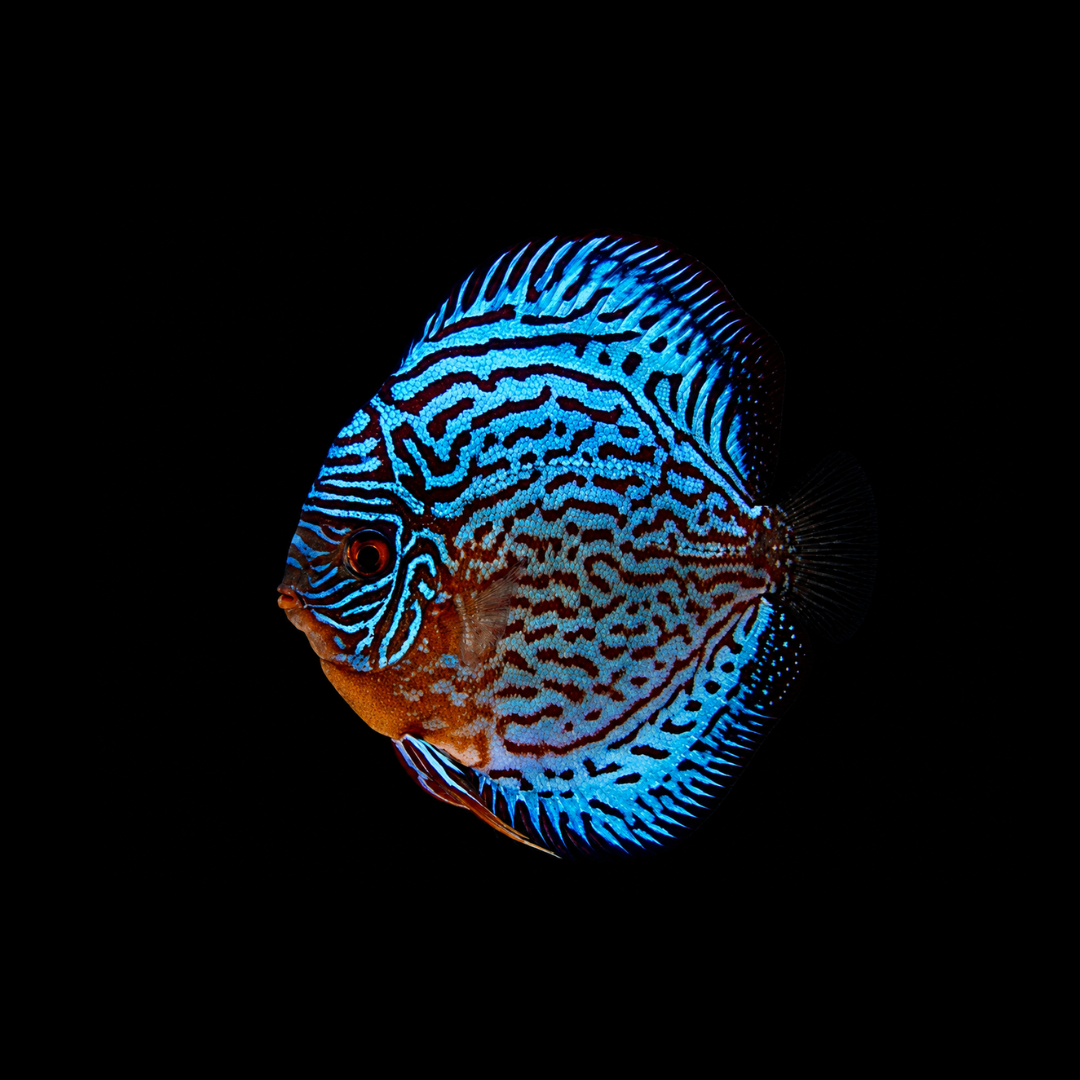
解説 / Description
ロイヤルブルーディスカスは、頭部から体側、背ビレ・尻ビレにかけて青いウェーブラインが広がるディスカスの流通名・系統名です。野生のシンフィソドン属に見られる強い青色表現が選抜され、長年の繁殖によって模様や体型が洗練されてきました。ただし「ロイヤルブルー」は独立した種名ではなく、流通個体の由来も一様ではありません。円盤状に強く側扁した体型とゆったりした泳ぎは、水槽内でも大きな存在感を示します。飼育では28〜30℃前後の水温、十分な酸素、安定した水質、食べ残しを溜めない管理、新規導入魚の検疫が重要です。こうした基本を安定して続けることで、個体ごとに異なるウェーブラインと発色を健康的に楽しめます。 Royal Blue Discus is a trade and strain name used for discus showing extensive blue wave-like lines across the head, body, dorsal fin, and anal fin. Strong blue patterning found within wild Symphysodon populations was selected and refined through generations of captive breeding, although Royal Blue is not a separate species and fish sold under the name do not all share a single lineage. Their strongly laterally compressed, disc-shaped body and calm swimming style give them a striking presence in the aquarium. Successful care centers on water around 28–30°C, ample oxygenation, stable water quality, prompt removal of uneaten food, and quarantine of new arrivals. With these basics kept consistent, their individual wave patterns and coloration can be maintained in good health.
基本情報 / Basic Information
| 学名 / Scientific Name | Symphysodon spp.(ロイヤルブルーは独立した種名ではなく、シンフィソドン属の個体に用いられる流通名・系統名・表現型名) (Royal Blue is not a separate species; it is a trade, strain, or phenotype name used for fish in the genus Symphysodon.) |
|---|---|
| 通称 / Common Name | ロイヤルブルー、ロイヤルブルーディスカス。赤い斑紋や赤色ラインの発現が強い個体はレッドロイヤルブルーと呼ばれることがあります。Royal Blue, Royal Blue Discus. Individuals showing especially strong red spotting or red line coloration may be called Red Royal Blue. |
| 分類 / Family | シクリッド目(Cichliformes)、シクリッド科(Cichlidae)、シンフィソドン属(Symphysodon)。ディスカス類では種の境界や学名の扱いに見解の違いがあり、流通名をそのまま特定の種名へ結び付けることはできません。Order Cichliformes, family Cichlidae, genus Symphysodon. Species boundaries and nomenclature within discus remain disputed, so a trade name such as Royal Blue should not be assigned automatically to a single species. |
| 英名 / English Name | Royal Blue Discus |
| 分布 / Distribution | 野生のディスカス類は南米アマゾン川流域に分布します。ロイヤルブルーという呼称は野生個体の表現型にもブリード系統にも使われ、日本の流通ではヨーロッパや東南アジアなどで改良・養殖された個体も扱われています。Wild discus are native to the Amazon Basin of South America. The name Royal Blue is used both for a wild phenotype and for captive-bred strains, and fish developed in Europe, Southeast Asia, and other regions are also present in the Japanese trade. |
| 最大体長 / Max Size | 全長15〜20cm前後が目安です。系統や個体差、飼育条件によって成長には幅があります。About 15–20 cm in total length is a practical adult range, although growth varies with lineage, individual fish, and husbandry. |
| 寿命 / Lifespan | 飼育下では10年前後がひとつの目安です。水質、給餌、感染症管理が安定していれば、10年以上生きる個体も見られます。Around ten years is a useful general expectation in captivity, and well-kept individuals may live beyond a decade when water quality, nutrition, and disease prevention remain stable. |
飼育環境 / Aquarium Environment
| 水槽サイズ / Tank Size | 成魚を群れで飼育する場合は300L級以上をひとつの目安とし、日本の規格水槽では120cmワイド水槽(約300L以上)が扱いやすいサイズです。成魚ペアのみであれば90cm規格水槽(約180L)程度から管理できますが、水草レイアウトや混泳を行う場合は、より大きな水量を確保したほうが水質と遊泳空間を安定させやすくなります。For a group of adult discus, a tank in the 300 L class or larger is a practical target; in Japanese standard sizing, a 120 cm wide aquarium of roughly 300 L or more is easier to manage. A bonded adult pair can be kept from around a 90 cm standard tank of roughly 180 L, but planted displays and community setups benefit from more water volume and swimming space. |
|---|---|
| 水温 / Temperature | 通常飼育は28〜30℃を中心に管理します。繁殖や育成の方法によって一時的に調整されることはありますが、必要以上の高温は避けます。水温が高いほど溶存酸素量は低下するため、十分なエアレーションと水流を確保します。 Maintain discus mainly at 28–30°C. Temperature may be adjusted temporarily for particular breeding or grow-out methods, but unnecessarily high temperatures should be avoided. Because warm water holds less dissolved oxygen, adequate aeration and circulation are essential. |
| 水質 / Water Quality | ブリード個体の通常飼育では、弱酸性〜中性付近の安定した水を基本とし、pHはおおむね6.0〜7.5を目安にします。野生由来の個体では、産地や導入時の水質に合わせて、より軟らかく酸性寄りの水が必要になる場合があります。日本の水道水は全体として軟水が多いものの、GH(総硬度)とKH(炭酸塩硬度・アルカリ度)は同じ指標ではないため、必要に応じて実測します。KHが低い水では、硝化によって緩衝力が消費されるとpHが下がりやすくなります。アンモニアと亜硝酸を検出させず、硝酸塩を蓄積させないよう定期的に換水することが重要です。For captive-bred fish, stable slightly acidic to near-neutral water is a useful general target, with a practical pH range of about 6.0–7.5. Wild-derived fish may require softer, more acidic conditions depending on their origin and acclimation history. Japanese tap water is generally soft, but GH and KH/alkalinity are different measurements, so carbonate buffering should be measured when relevant rather than assumed. In low-KH water, nitrification can consume buffering capacity and allow pH to fall. Keep ammonia and nitrite undetectable and prevent nitrate from accumulating through regular water changes. |
| レイアウト / Layout | 育成や繁殖を優先する場合は、残餌や糞をすぐに確認・除去できるベアタンクが管理しやすい方法です。観賞用では、流木や背の高い水草で落ち着ける場所をつくりつつ、体高のあるディスカスが無理なく方向転換できる遊泳空間を確保します。底床を使用する場合は汚れを溜め込みにくい構成にし、尖った石や狭すぎる隙間は避けます。For grow-out and breeding, a bare-bottom aquarium makes uneaten food and waste easy to see and remove. In display tanks, use driftwood and taller plants to provide visual shelter while leaving enough open space for the deep-bodied fish to turn comfortably. If substrate is used, choose a layout that does not trap excessive debris, and avoid sharp rocks or overly narrow gaps. |
| 注意点 / Precautions | 高水温と多給餌の組み合わせは、酸素不足と水質悪化を同時に招きやすいため注意が必要です。食べ残しはこまめに除去し、ろ過だけに頼らず換水で窒素化合物や溶存有機物の蓄積を抑えます。新しいディスカスは少なくとも30日、可能であれば30〜60日を目安に別水槽で検疫し、網やホースなどの器具も共用しないほうが安全です。水道水を使用する場合は、地域の水質に応じて遊離残留塩素や結合残留塩素を適切に処理してから使用します。Warm water combined with heavy feeding can quickly create both oxygen shortage and declining water quality. Remove leftovers promptly and use regular water changes, rather than filtration alone, to limit the accumulation of nitrogenous and dissolved organic waste. New discus should be quarantined for at least 30 days, and 30–60 days is preferable for valuable fish; quarantine equipment should also be kept separate. When using tap water, treat free or combined residual chlorine as appropriate for the local water supply before it enters the aquarium. |
餌と給餌 / Feeding
| 餌の種類 / Diet | ディスカス用の高品質な総合栄養ペレットや顆粒を主食にし、冷凍アカムシやブラインシュリンプなどを補助的に組み合わせます。育成では牛ハツなどをベースにしたディスカスハンバーグが用いられることもありますが、衛生状態と水質への負荷に注意し、単一の餌へ偏らせないことが大切です。Use a high-quality complete discus pellet or granule as the staple and supplement it with foods such as frozen bloodworms and brine shrimp. Beef-heart-based discus mixes are also used in grow-out, but hygiene and water fouling must be considered, and no single food should dominate the diet unnecessarily. |
|---|---|
| 給餌のポイント / Feeding Tips | 幼魚は少量を複数回に分け、成魚は1日2〜3回程度を目安に、毎回短時間で食べ切れる量を与えます。残餌は放置しません。群れでは順位の低い個体が餌を取れているかを確認し、痩せや黒化が見られる場合は給餌位置を分けるなどの配慮が必要です。給餌量が増えるほど排泄物とろ過負荷も増えるため、給餌と換水はセットで考えます。Feed juveniles several small meals per day and adults roughly 2–3 times daily, offering only what can be eaten promptly. Remove leftovers. In groups, make sure subordinate fish are actually reaching the food; individuals that become thin or unusually dark may need a separate feeding position. More food also means more waste and greater filtration demand, so feeding intensity and water-change frequency should be planned together. |
性格と混泳 / Temperament and Tank Mates
| 性格 / Temperament | 基本的には穏やかなシクリッドですが、群れの中では順位関係が形成され、弱い個体が追われることがあります。複数飼育では、特定の個体だけが継続して追われていないかを観察することが大切です。繁殖ペアは卵や稚魚の周囲を守るため、一時的に縄張り性が強くなります。Discus are generally peaceful cichlids, but a social hierarchy forms within a group and weaker individuals may be chased. In group housing, watch for persistent aggression directed at the same fish. A breeding pair becomes more territorial while defending eggs and fry. |
|---|---|
| 混泳の相性 / Compatibility | 28〜30℃前後の高めの水温に耐え、温和で、ディスカスの餌を奪いすぎない魚が向きます。カージナルテトラなどの小型カラシンは代表的な候補です。反対に、活発すぎる魚、ヒレをつつく魚、強い縄張り性を持つ魚、低水温を好む魚は避けます。新規魚の追加は病原体を持ち込む機会にもなるため、相性だけでなく検疫まで含めて混泳を計画します。Good tank mates are peaceful species that tolerate the relatively warm 28–30°C environment and do not outcompete discus at feeding time. Cardinal tetras and similar small characins are classic examples. Avoid overly active fish, fin-nippers, strongly territorial species, and fish that prefer cooler water. Because every new fish can also introduce pathogens, quarantine should be part of the compatibility plan. |
病気と対策 / Diseases and Prevention
| かかりやすい病気 / Common Diseases | シクリッド類では、スピロヌクレウス属などの腸管鞭毛虫が問題になることがあり、食欲低下、痩せ、白く細い糞などが見られる場合があります。ただし、こうした症状だけで原因を特定することはできません。ディスカスではエラの単生類などの寄生虫、細菌性疾患、水質悪化に伴う二次感染にも注意が必要です。異なる由来の個体を混ぜた後に黒化、大量の粘液分泌、呼吸異常などが群れに広がる状態を、愛好家が「ディスカスエイズ」などと呼ぶことがありますが、これは正式な病名や単一のウイルス感染を示す言葉ではありません。症状の呼び名ではなく、水質、寄生虫、細菌など実際の原因を確認することが重要です。Intestinal flagellates such as Spironucleus can cause problems in cichlids and may be associated with reduced appetite, weight loss, and pale or stringy feces, although these signs are not diagnostic by themselves. Discus are also susceptible to gill monogeneans, bacterial disease, and secondary infections associated with poor water quality. Hobbyists sometimes use terms such as “discus AIDS” for outbreaks of darkening, heavy mucus production, and respiratory distress after fish from different sources are mixed, but this is not a formal disease name or evidence of one specific virus. The underlying water-quality and infectious causes must be investigated instead. |
|---|---|
| 対策と予防 / Prevention | 予防の基本は、新規個体の検疫、安定した水温と酸素量、こまめな清掃、過密を避けることです。体色の急変、拒食、白い糸状便、呼吸の速まりなどを見つけたら、まず水温・pH・アンモニア・亜硝酸・硝酸塩を確認し、必要に応じて隔離します。原因が分からないまま複数の薬剤を同時に使用すると、生物ろ過を傷めて水質をさらに悪化させることがあります。薬剤治療はできるだけ症状や検査結果に基づいて選び、極端な昇温や処方薬の使用は、魚類診療に詳しい獣医師や専門家の助言を得て行うのが安全です。Prevention centers on quarantine of new fish, stable temperature and oxygenation, frequent cleaning, and avoidance of overcrowding. If a fish suddenly darkens, stops feeding, produces white stringy feces, or breathes rapidly, first check temperature, pH, ammonia, nitrite, and nitrate, and isolate the fish when appropriate. Using several medications without a diagnosis can damage biological filtration and worsen water quality. Whenever possible, treatment should be chosen from observed signs and diagnostic evidence; extreme heat treatment or prescription drugs are best used with guidance from a veterinarian or experienced aquatic-health professional. |
増やし方(繁殖) / Breeding
| 雌雄の判別 / Sexing | 外見だけでの確実な判別は難しい魚です。成熟すると雄はやや大きく力強い体型になり、雌はやや丸みを帯びる傾向が語られますが、個体差が大きく決め手にはなりません。繁殖期には産卵管の形がもっとも参考になり、雌は比較的太く丸みのある産卵管、雄は細く尖った生殖突起を見せる傾向があります。Reliable sexing from body shape alone is difficult. Mature males are sometimes larger or more robust and females may appear rounder, but individual variation is too great for these traits to be definitive. During spawning, the genital papilla is more useful: females tend to show a broader, blunter ovipositor, while males generally show a narrower, more pointed papilla. |
|---|---|
| 繁殖形態 / Reproduction | ペアを形成し、流木、産卵筒、水槽壁などの垂直面へ産卵する基質産卵型です。卵と仔魚は両親が共同で守り、遊泳を始めた稚魚は親魚の体表に集まって皮膚粘液を摂食します。この粘液は重要な栄養源で、繁殖期にはその成分が変化します。また、親魚の皮膚粘液と飼育水の微生物が、稚魚の腸内細菌叢の形成に関与することも研究で示されています。Discus form pairs and are substrate spawners, usually laying eggs on vertical surfaces such as driftwood, spawning cones, or aquarium walls. Both parents guard the eggs and larvae. Once the fry become free-swimming, they gather on the parents and feed directly on skin mucus. The mucus is an important nutritional source and its composition changes during parental care. Research also indicates that microorganisms from parental mucus and the surrounding water contribute to the developing gut microbiota of the fry. |
| 繁殖のポイント / Breeding Tips | 自然に形成された相性のよいペアを専用水槽へ移し、28〜30℃前後の安定した水温、清潔な水、弱めの水流、産卵筒などの垂直な産卵面を用意します。遊泳開始直後の稚魚は親の皮膚粘液に依存するため、早すぎる親子分離は避けます。成長に合わせてブラインシュリンプ幼生などの餌へ徐々に移行し、親魚の消耗と水質悪化の両方を見ながら管理します。Move a naturally compatible pair to a dedicated breeding tank and provide stable water around 28–30°C, excellent cleanliness, gentle current, and a vertical spawning surface such as a spawning cone. Newly free-swimming fry depend on parental skin mucus, so separating the parents too early should be avoided. As the fry grow, gradually introduce newly hatched brine shrimp and other suitable foods while monitoring both parental condition and the increasing bioload. |
雑学と豆知識 / Trivia and Fun Facts
| 1. 「ロイヤルブルー」は種名ではなく、青い表現を示す流通名 / 1. “Royal Blue” is a trade name for blue patterning, not a species | ロイヤルブルーという名前は、分類学上の独立した種を示すものではありません。もともとは、野生のディスカスの中でも青いウェーブラインが広く発現する個体を区別する呼称として使われ、のちに同じ方向の色彩を目指す改良系統にも用いられるようになりました。そのため現在の「ロイヤルブルー」には、野生個体の表現型を指す場合と、ブリードされた系統名として使われる場合があります。名前だけから一律に学名や血統を決めないことが、正確に理解するためのポイントです。Royal Blue is not a separate taxonomic species. The name was originally used to distinguish wild discus with unusually extensive blue wave-like lines and was later also applied to captive-bred strains selected in the same visual direction. Today, therefore, Royal Blue may refer either to a wild phenotype or to a bred strain name. The name alone should not be used to assign a precise species or pedigree. |
|---|---|
| 2. ディスカスの分類では、学名の扱いが資料によって異なる / 2. Discus names are still treated differently among sources | ディスカス類は、形態、分布、遺伝情報のどこを重視するかによって、種や亜種の扱いが変化してきました。ブルーディスカスに使われてきた haraldi という名前も扱いが統一されておらず、2026年8月時点のEschmeyer’s Catalog of Fishesでは Symphysodon tarzoo のシノニムとされています。一方で、研究論文などでは Symphysodon haraldi という表記が現在も使われています。こうした事情から、ロイヤルブルーという流通名を特定の学名に固定せず、シンフィソドン属に見られる青い表現・系統名として扱うのが安全です。Discus classification has changed with the relative weight given to morphology, geography, and genetic evidence. The name haraldi, long associated with blue discus, is not treated uniformly: as of August 2026, Eschmeyer’s Catalog of Fishes lists it as a synonym of Symphysodon tarzoo, while current research papers still use Symphysodon haraldi. For this reason, the Royal Blue trade name is best treated as a blue phenotype or strain within Symphysodon rather than being fixed automatically to one scientific name. |
| 3. 全身に広がる青いストライプは、青系ディスカス改良で重要な選抜対象だった / 3. Extensive blue striping became an important breeding target | 20世紀後半のディスカス改良では、野生個体に見られる青い模様をより広く、より鮮明に表現させる選択が繰り返されました。全身にウェーブラインが広がるロイヤルブルー型の個体も、青系・ターコイズ系統の改良史の中で重要な選抜対象や交配素材として扱われてきました。ただし、現在の各品種をひとつの単純な系譜だけで説明することはできません。今日見られる青い表現は、異なるブリーダーがそれぞれの系統で選抜と交配を重ねてきた結果として理解するのが適切です。During the second half of the twentieth century, breeders repeatedly selected discus for broader and more intense blue patterning. Royal Blue-type fish with extensive wave-like striping were among the important selection targets and breeding material used in the development of blue and turquoise lines. Modern strains, however, do not follow one simple pedigree; their present coloration reflects selection and crossing carried out by different breeders over many generations. |
| 4. 稚魚が親の体表を食べるという、魚類では珍しい子育て / 4. Fry literally feed from their parents’ skin | ディスカスの繁殖を初めて見ると、稚魚が親魚の体表へ密集する姿に驚かされます。これは単に親の近くへ隠れているのではなく、稚魚が皮膚粘液をついばむように摂食しているためです。両親がこの役割を担い、稚魚は親魚の体表を行き来しながら成長します。哺乳類の授乳とは構造も進化的な起源も異なりますが、「親が分泌する物質を子が直接利用する」という機能的な共通点があり、魚類としては非常に特徴的な子育てです。When discus fry cluster tightly on their parents, they are not simply hiding; they are actively feeding on skin mucus. Both parents participate, and the fry move between them as they grow. This system is not evolutionarily equivalent to mammalian lactation, but it shares a functional feature: offspring directly use a substance secreted by the bodies of their parents. |
| 5. ディスカスミルクは、栄養だけでなく「親から子への微生物の橋」でもある / 5. Parental mucus is also a microbial bridge between generations | ディスカスの皮膚粘液は、稚魚の栄養源であるだけではありません。研究では、繁殖期の親魚で皮膚のプロラクチン受容体mRNAの発現が高まることが報告されており、粘液分泌の調節にプロラクチン系が関わる可能性が示されています。また、16S rRNA解析では、親魚の皮膚粘液と飼育水の双方に由来する微生物が、稚魚の腸内細菌叢の形成に関わることが示されました。つまり稚魚の微生物環境は、親からの経路と水からの経路の両方によって形づくられていくと考えられます。Discus skin mucus is more than a food source for fry. Research has reported increased prolactin-receptor mRNA expression in parental skin, suggesting a role for prolactin signaling in regulating mucus production. Studies using 16S rRNA sequencing also show that microorganisms from both parental skin mucus and the surrounding water help shape the developing gut microbiota of the fry. In other words, the microbial community develops through both parent-associated and environmental routes. |
| 6. 日本の水道水では、GHとKHを分けて考えることが大切 / 6. In Japanese tap water, GH and KH should be considered separately | 日本の水道水は全国的に軟水が多いことが知られていますが、ここでいう硬度は主にカルシウムとマグネシウムを示すGHであり、pHの緩衝力を表すKHとは別の指標です。ディスカス水槽では給餌量が多くなりやすく、硝化が進むとアルカリ度が消費されます。もともとKHが低い水では、そのまま管理を続けるとpHが下がりやすくなるため、必要に応じてGHとKHをそれぞれ測定することが大切です。弱酸性へ近づけること自体よりも、飼育個体に合った水質を急変させず安定させることを優先します。Japanese tap water is generally soft, but the hardness usually discussed is GH, which reflects calcium and magnesium, whereas KH/alkalinity describes buffering capacity. In a heavily fed discus aquarium, nitrification consumes alkalinity. If the source water is low in KH, pH can therefore become less stable over time. Measuring GH and KH separately when needed is more useful than assuming that all soft water has low buffering. The priority is stable water suited to the fish, not simply forcing the pH downward. |
| 7. 体色の黒化やバーチカルストライプは、魚が出している「状態のサイン」 / 7. Darkening and vertical bars can act as visual condition signals | 野生型に近いディスカスでは、環境変化、緊張、順位争い、体調不良などに伴って、垂直の黒いバンドが目立つことがあります。バンドや体色だけで病気を診断することはできませんが、普段は明るい個体が急に黒くなり、群れから離れる、呼吸が速くなる、餌を取らなくなるといった変化が重なった場合は、水質や健康状態を確認する合図になります。色彩の変化を、行動や呼吸、食欲と合わせて観察することが大切です。Wild-type and wild-derived discus may show stronger vertical dark bars with environmental change, social stress, or poor health. Color change alone is not diagnostic, but if sudden darkening occurs together with isolation from the group, rapid breathing, or loss of appetite, water quality and health should be checked promptly. Color is most useful when interpreted together with behavior, respiration, and feeding. |
まとめ / Conclusion
ロイヤルブルーディスカスの魅力は、鮮やかな青いウェーブラインだけにありません。円盤状の体型、群れの中で見せる社会性、両親の皮膚粘液を利用して稚魚が育つ独特の繁殖行動まで、ディスカスならではの特徴が一匹の魚の中に重なっています。 The appeal of Royal Blue Discus extends beyond their vivid blue wave patterns. Their disc-shaped body, social behavior, and unusual biparental care in which fry feed from parental skin mucus all contribute to the distinctive character of discus.
28〜30℃前後の安定した水温、十分な酸素、清潔な水、適切な給餌、慎重な検疫を保てば、ロイヤルブルーは個体ごとに異なるウェーブラインと落ち着いた存在感を長く楽しませてくれます。体色だけでなく、食欲、呼吸、泳ぎ方まで日々観察することが、青い発色を健康な状態で維持する最も確実な近道になります。 With stable water around 28–30°C, ample oxygenation, clean conditions, appropriate feeding, and careful quarantine, Royal Blue Discus can display their individual wave patterns and calm presence for many years. Watching appetite, respiration, swimming behavior, and coloration together is the most reliable way to keep that blue expression associated with a healthy fish.
気になる道具や飼い方を見つけてみませんか?
 アイのアクアグッズ案内水槽用浄水器の選び方|水換えを楽にするタイプとROの違い道具の特徴や使い方、選ぶときのポイントをアイが紹介します。記事はコチラ →
 アイのアクアグッズ案内アカヒレの仲間に合わせる飼育用品|無加温・混泳・繁殖の水槽とろ過道具の特徴や使い方、選ぶときのポイントをアイが紹介します。記事はコチラ →
 アイのアクアグッズ案内エンゼルフィッシュの飼育用品|高さのある水槽・ろ過・水草・餌の選び方道具の特徴や使い方、選ぶときのポイントをアイが紹介します。記事はコチラ →
 アイのアクアグッズ案内水槽の流木の選び方|枝・マングローブ・アク抜きとおすすめ商品水槽に小さな森を作る流木。枝流木やマングローブという名前の違いから、魚の隠れ家、水草の取り付け、浮く・水が茶色くなるときの準備まで、アイとコタロウが商品とともに案内します。記事はコチラ →
さまざまな飼育テーマをご紹介。リンク先の記事には広告・商品紹介が含まれます。
案内・紹介記事一覧へ →分布マップ
野生のディスカス類(Symphysodon spp.)は、南米のアマゾン川流域に分布します。ロイヤルブルーの名称は野生個体の表現型だけでなく、養殖・改良された系統にも用いられます。
※地図はアマゾン川流域を広く示した概略表示です。マーカーは分布域を把握しやすくするために設定した代表地点であり、実際の採集地点・観察地点を示すものではありません。
参考文献
- Fricke, R., Eschmeyer, W. N. & Van der Laan, R. (eds.). Eschmeyer’s Catalog of Fishes: Genera, Species, References. California Academy of Sciences, online version, updated 7 July 2026. 分類・学名・シノニムの扱いを確認するための基礎資料。 California Academy of Sciences
- Ready, J. S., Ferreira, E. J. G. & Kullander, S. O. (2006). Discus fishes: mitochondrial DNA evidence for a phylogeographic barrier in the Amazonian genus Symphysodon (Teleostei: Cichlidae). Journal of Fish Biology, 69(Suppl. B), 200–211. doi:10.1111/j.1095-8649.2006.01232.x 分類、系統地理、アマゾン流域における分布と生息域の理解を支える資料。 DOI
- Ribeiro, M. W. S., Carvalho, T. B., Aride, P. H. R., Lima, T. P. & Oliveira, A. T. (2025). Overview of the discus fish (Symphysodon spp.): narrative review combined with potential for ornamental aquaculture. Brazilian Journal of Biology, 85, e296151. doi:10.1590/1519-6984.296151 分布、生息環境、水温・pH、水質管理、給餌、繁殖、飼育下での管理を総合的に確認するためのレビュー。 DOI
- Tibile, R. M., Sawant, P. B., Chadha, N. K., Lakra, W. S., Prakash, C., Swain, S. & Bhagawati, K. (2016). Effect of stocking density on growth, size variation, condition index and survival of discus, Symphysodon aequifasciatus Pellegrin, 1904. Turkish Journal of Fisheries and Aquatic Sciences, 16(2), 453–460. doi:10.4194/1303-2712-v16_2_25 飼育密度と成長・生残の関係を確認するための飼育試験。 DOI
- Buckley, J., Maunder, R. J., Foey, A., Pearce, J., Val, A. L. & Sloman, K. A. (2010). Biparental mucus feeding: a unique example of parental care in an Amazonian cichlid. Journal of Experimental Biology, 213(22), 3787–3795. doi:10.1242/jeb.042929 両親による皮膚粘液給餌、稚魚の摂食行動、繁殖期における粘液成分の変化を支える資料。 DOI
- Khong, H. K., Kuah, M. K., Jaya-Ram, A. & Shu-Chien, A. C. (2009). Prolactin receptor mRNA is upregulated in discus fish (Symphysodon aequifasciata) skin during parental phase. Comparative Biochemistry and Physiology Part B: Biochemistry and Molecular Biology, 153(1), 18–28. doi:10.1016/j.cbpb.2009.01.005 繁殖期の皮膚におけるプロラクチン受容体発現と、粘液分泌調節への関与を示す研究。 DOI
- Sylvain, F.-É. & Derome, N. (2017). Vertically and horizontally transmitted microbial symbionts shape the gut microbiota ontogenesis of a skin-mucus feeding discus fish progeny. Scientific Reports, 7, 5263. doi:10.1038/s41598-017-05662-w 親魚の皮膚粘液と飼育水の双方が、稚魚の腸内細菌叢形成に関与することを示す研究。 DOI
- Merck Veterinary Manual. Fish Taxonomy. Merck & Co., Inc. シクリッド類の飼育環境、Spironucleus、単生類など、記事内の疾病・寄生虫に関する記述を確認するための獣医学資料。 Merck Veterinary Manual
- Merck Veterinary Manual. Environmental Diseases of Aquatic Animals in Aquatic Systems. Last updated June 2026. Merck & Co., Inc. 塩素・クロラミン、窒素化合物、pH・炭酸系、水温、溶存酸素など、水質管理上の注意点を支える獣医学資料。 Merck Veterinary Manual
- Merck Veterinary Manual. Management of Aquarium Fish. Merck & Co., Inc. 新規導入魚の最低30日間の検疫、隔離設備と専用器具の使用など、感染症予防の基本を支える資料。 Merck Veterinary Manual




コメント