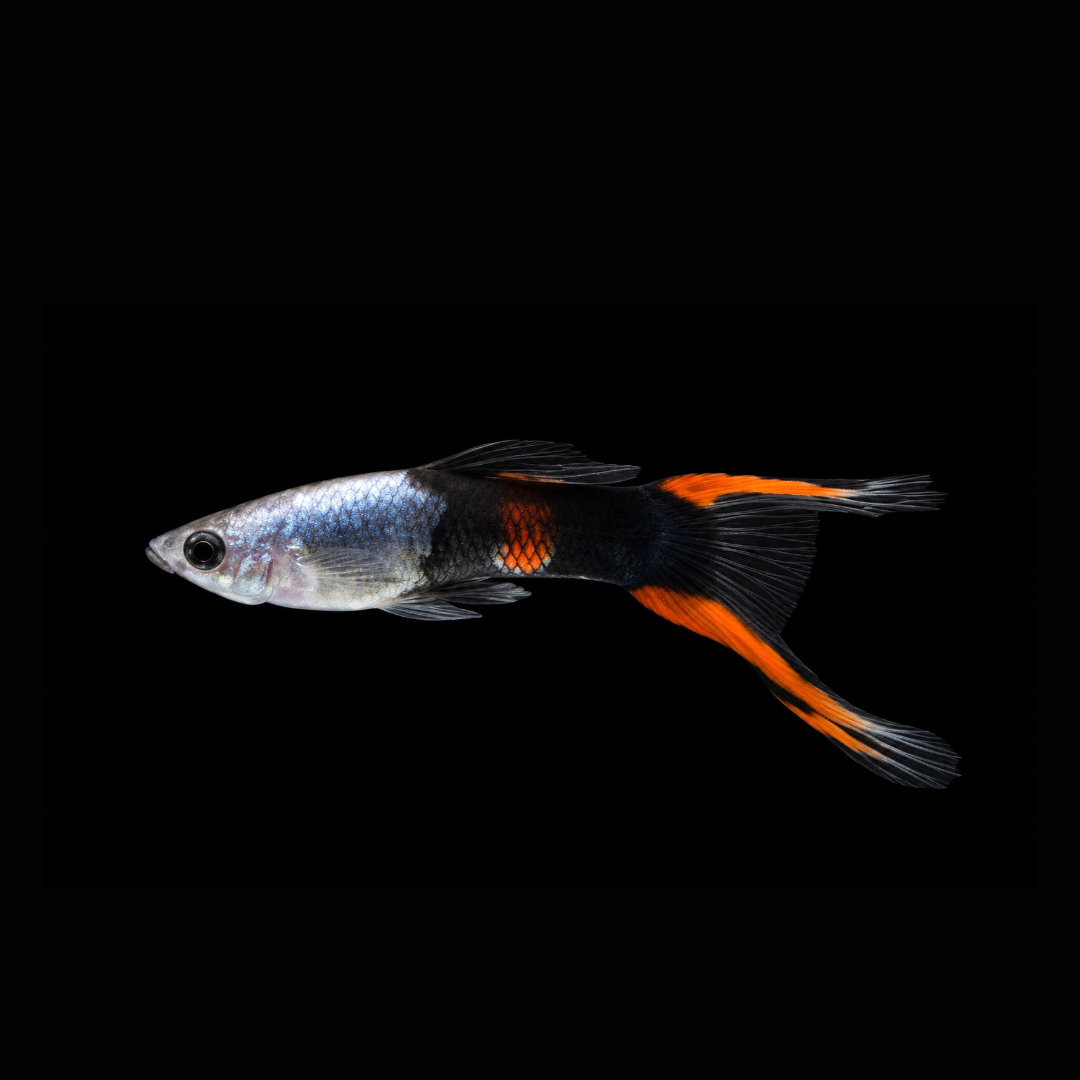
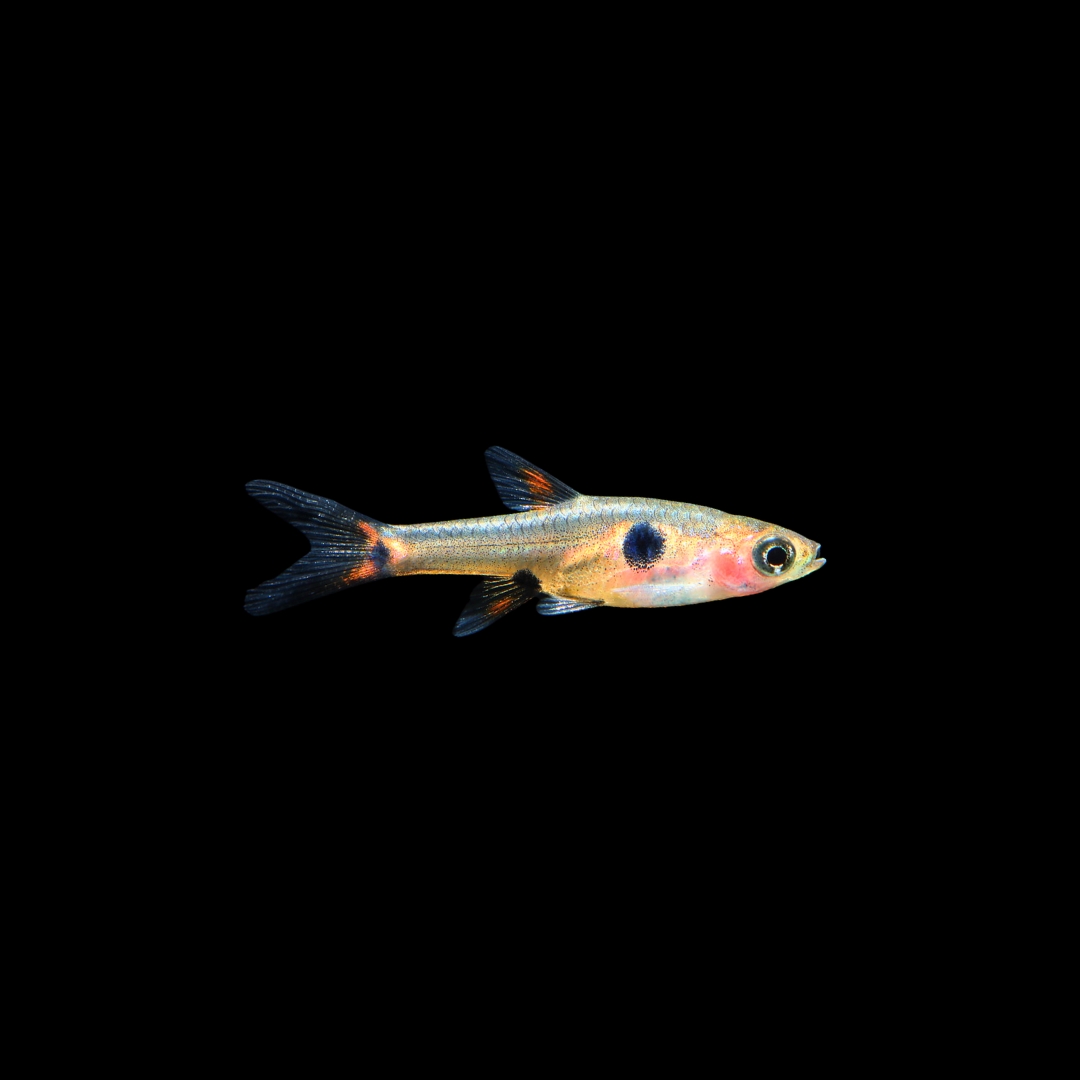
プラチナブラックライヤーテールグッピーは、2026年にスリランカ産の外国産グッピーとして日本に紹介された新しい改良品種です。頭から体の前半にかけては、ミユキメダカの背中を思わせる強い金属光沢(プラチナ)に覆われ、背ビレの後方から尾柄、尾ビレにかけては深い黒(ブラック)に染まります。前後でくっきりと分かれるこの二色のコントラストに加え、尾ビレの上下両端が竪琴のように外側へ反りながら伸びる「ライヤーテール」と呼ばれる形を持ち、黒い尾ビレに赤い差し色が入る個体も見られます。流通サイズは全長2cm前後と小柄です。鋭く立ち上がる背ビレや剣のように伸びる尾ビレ、黒地に赤が差す配色は、エンドラーズ(Poecilia wingei)との交雑系グッピーによく見られる特徴であることから、エンドラーズの血が入っている可能性が指摘されています。ただし遺伝子解析による裏付けはまだないため、現時点では「エンドラーズの血統が入っていると考えられる改良グッピー」と捉えるのが妥当です。大きく広がるデルタテール系に比べるとヒレがコンパクトで泳ぎも軽快なため、導入時の水合わせと検疫を丁寧に行えば、比較的丈夫で飼いやすいグッピーと考えられています。国内では現在オスの単体流通が中心で、日本の水で育った系統を作り上げていく余地も残された、これからが楽しみな品種です。The Platinum Black Lyretail Guppy is a new ornamental strain introduced to Japan in 2026 as an imported guppy from Sri Lanka. The head and front half of the body are covered in an intense metallic sheen (platinum) reminiscent of the back of a Miyuki medaka, while the area from behind the dorsal fin through the caudal peduncle and tail is a deep black. Beyond this crisp two-tone contrast, the tail has a lyretail shape, in which the upper and lower tips extend outward in a curve like the arms of a lyre, and some individuals show red accents on the black tail. It is sold at around 2 cm in total length. Its sharply raised dorsal fin, sword-like tail extensions and red-on-black coloration are features commonly seen in guppies hybridized with Endler’s livebearer (Poecilia wingei), which has led to the suggestion that it carries Endler’s blood. Because there is no confirmation from genetic analysis yet, it is currently best regarded as an improved guppy thought to include Endler’s ancestry. Compared with large-finned delta-tail strains, its fins are compact and it swims nimbly, so it is considered relatively hardy and easy to keep, provided acclimation and quarantine are handled carefully on arrival. In Japan, males are mainly sold on their own at present, leaving room to develop a line raised in Japanese water, which makes this a strain with much to look forward to.
基本情報 / Basic Information
学名 / Scientific Name
Poecilia reticulata
通称 / Common Name
プラチナブラックライヤーテールグッピー、プラチナブラックライヤー(グッピーの改良品種。エンドラーズの血統が入っている可能性が示唆されている)Platinum Black Lyretail Guppy, Platinum Black Lyre (an ornamental guppy strain; Endler’s livebearer ancestry is suggested)
分類 / Family
カダヤシ目 カダヤシ科 ポエキリア属Order Cyprinodontiformes, Family Poeciliidae, Genus Poecilia
英名 / English Name
Platinum Black Lyretail Guppy
分布 / Distribution
改良品種のため自然分布はありません。原種のグッピーは、ベネズエラ、ガイアナ、トリニダード・トバゴなど南米北部からカリブ海周辺に分布します。本品種はスリランカの養殖場で生産されたものが輸入されています。As an ornamental strain, it has no natural range. The wild guppy is native to northern South America and the surrounding Caribbean, including Venezuela, Guyana and Trinidad and Tobago. This strain is produced on fish farms in Sri Lanka and imported from there.
最大体長 / Max Size
オス約3cm、メス約4〜5cm(流通しているオスは全長2cm前後が中心)Males about 3 cm, females about 4 to 5 cm (males on the market are usually around 2 cm in total length)
寿命 / Lifespan
約1〜2年。環境が良ければ3年近く生きることもあります。高めの水温では成長や繁殖が早まる一方、寿命はやや短くなる傾向があります。About 1 to 2 years; in good conditions it may live close to 3 years. Higher temperatures speed up growth and breeding but tend to shorten lifespan somewhat.
飼育環境 / Aquarium Environment
水槽サイズ / Tank Size
30cm規格水槽(約20〜25L)以上。繁殖や複数匹での飼育を考えている場合は、水量に余裕があって水質が安定しやすい45cm規格水槽(約35L)以上がおすすめです。フィルターは、スポンジフィルターや水流の穏やかな外掛け式が向いています。A 30 cm standard tank (about 20 to 25 L) or larger. If you plan to breed them or keep several fish, a 45 cm standard tank (about 35 L) or larger is recommended, since the extra water volume keeps conditions more stable. Sponge filters or hang-on filters with gentle flow are well suited.
水温 / Temperature
24〜26℃(許容範囲はおよそ23〜28℃)。急な水温変化を避け、ヒーターで年間を通して安定させます。24 to 26°C (tolerable range roughly 23 to 28°C). Avoid sudden temperature changes and keep it stable year-round with a heater.
水質 / Water Quality
pH6.8〜7.5の中性〜弱アルカリ性で、やや硬めの水が適しています。日本の水道水は全国平均の硬度がおよそ50mg/L前後の軟水で、地域によってはさらに軟らかく、その環境では黒の発色が淡くなりやすいと考えられています。グッピーは時間をかければ幅広い水質に順応するため、極端な硬水にする必要はありません。大磯砂を使ったり、pHが6.8を下回るようならサンゴ砂を少量加えたりして、弱酸性に傾かないよう緩やかにミネラルを補うと水質が安定しやすくなります。Neutral to slightly alkaline water at pH 6.8 to 7.5, on the moderately hard side, is suitable. Japanese tap water is soft, with a national average hardness of around 50 mg/L and even softer water in some regions, and such conditions are thought to make the black coloration paler. Guppies adapt to a wide range of water conditions given time, so there is no need for very hard water. Using Oiso gravel, or adding a little coral sand if the pH drops below 6.8, gently replenishes minerals and keeps the water from drifting acidic, which helps stabilize conditions.
レイアウト / Layout
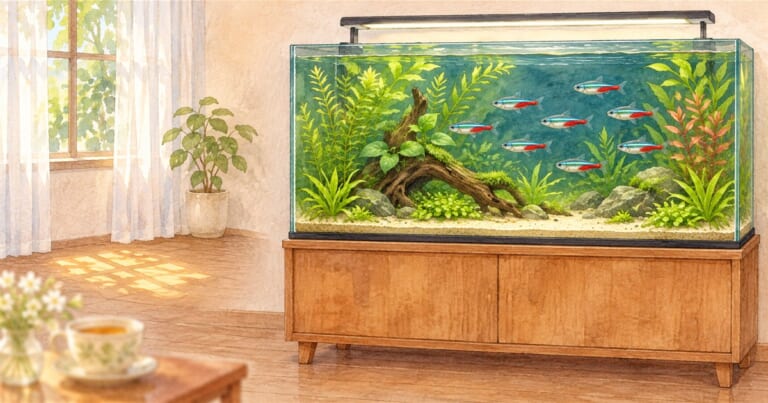
底床は大磯砂や暗い色の砂利、背景は黒や濃紺のバックスクリーンがおすすめです。暗い背景は前半身のプラチナ光沢を際立たせるうえ、魚が落ち着くことで黒もより濃く発色します。白く明るい底床は反射が強く、魚の色が抜けたように見える「色飛び」を招きやすいほか、水草用のソイルは水質を弱酸性に傾けやすいため注意が必要です。ウィローモスやマツモなどの水草は、隠れ家や稚魚の避難場所になります。照明はタイマーを使って1日8〜10時間ほど規則正しく点灯させましょう。赤や青の光を調整できるRGB対応LEDを使うと、プラチナの輝きと尾ビレの赤を同時に引き立てることができます。Oiso gravel or dark gravel for the substrate and a black or dark navy background are recommended. A dark background highlights the platinum sheen of the front half, and because the fish feel more settled, their black also becomes deeper. A bright white substrate reflects strongly and tends to wash out the fish’s color, and plant soils tend to make the water slightly acidic, so take care. Plants such as moss or hornwort provide hiding places and refuge for fry. Run the lights on a regular schedule of about 8 to 10 hours a day with a timer. RGB LEDs that let you adjust red and blue light can bring out both the platinum sheen and the red in the tail.
注意点 / Precautions
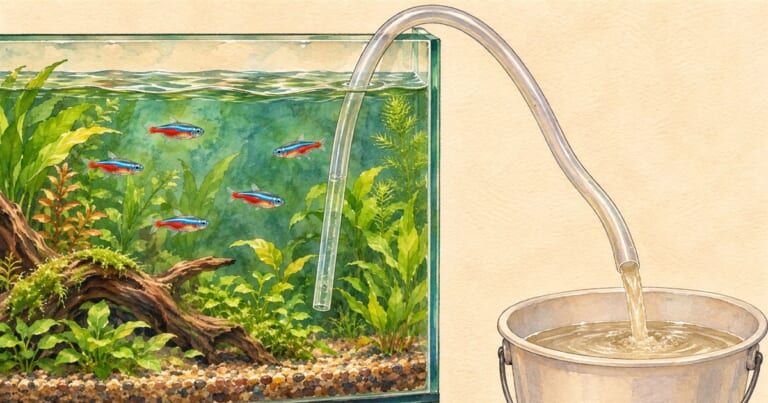
海外から空輸されたばかりの個体は、長時間の袋詰めによる絶食やアンモニアの蓄積、水温の変化で体力を消耗しています。購入後すぐに本水槽へ入れず、底砂や水草のない隔離水槽で1〜2週間ほど様子を見る検疫期間を設けるのが理想です。輸送水が黄褐色に濁っている場合はアンモニアが溜まっているサインなので、時間のかかる点滴法にこだわらず、カルキを抜いた新しい水で薄めながら手早く水質を改善してあげましょう。また、病気の持ち込みを防ぐため国産グッピーとの混泳は避け、網やホース、バケツなどの器具も分けて使います。ライヤーテールはデルタテールより水流に強いものの、強すぎる水流は尾ビレ先端のすり切れにつながります。そして、たとえ飼えなくなっても、グッピーを川や池などの野外へ放すことは生態系を乱すため絶対にやめてください。Fish that have just been flown in from overseas are worn out from long hours in bags without food, ammonia buildup and temperature changes. Ideally, do not put them straight into the main tank; keep them in a quarantine tank without substrate or plants for about one to two weeks. If the shipping water has turned yellowish brown, ammonia has built up, so rather than insisting on slow drip acclimation, quickly improve the water by diluting it with fresh dechlorinated water. To avoid introducing disease, do not mix them with Japanese domestic-line guppies, and keep separate nets, hoses and buckets. Lyretails handle current better than delta tails, but strong flow can still fray the tail tips. And even if you can no longer keep them, never release guppies into rivers, ponds or other outdoor waters, as this disrupts ecosystems.
餌と給餌 / Feeding
餌の種類 / Diet
雑食性で、グッピー用の細かい粒状やフレークタイプの人工飼料をよく食べます。これに孵化させたばかりのブラインシュリンプ幼生や冷凍ミジンコなどを組み合わせると、栄養のバランスが整い、体格もしっかりします。スピルリナやクロレラを含む餌は健康維持や黒の発色に、アスタキサンチンを含む餌やブラインシュリンプ幼生は赤い差し色の発色に役立つとされています。They are omnivorous and readily eat fine-granule or flake foods made for guppies. Adding freshly hatched brine shrimp nauplii or frozen daphnia balances their nutrition and builds a sturdy body. Foods containing spirulina or chlorella are said to support health and black coloration, while foods containing astaxanthin and brine shrimp nauplii are said to help bring out the red accents.
給餌のポイント / Feeding Tips
1日1〜2回、数分で食べ切れる量を与えます。食べ残しや糞が底に溜まると、輸入グッピーで問題になる繊毛虫テトラヒメナが増える原因になるため、与えすぎに注意し、残った餌は早めに取り除きましょう。導入直後は体力が落ちているので、水に慣れて落ち着いてから少量ずつ与え始めると安心です。Feed once or twice a day, an amount they can finish within a few minutes. Leftover food and waste on the bottom encourage the ciliate Tetrahymena, which is a problem in imported guppies, so avoid overfeeding and remove uneaten food promptly. Fish are weakened right after introduction, so it is safest to begin with small amounts once they have settled in.
性格と混泳 / Temperament and Tank Mates
性格 / Temperament
温和で活発な性格です。オスはメスを見つけるとヒレを広げて盛んに求愛し、そのときに金属光沢が一段と強まる様子を楽しめます。ただし、メスが少ないとオスの求愛が集中してメスが疲れてしまうため、繁殖を兼ねる場合はオス1匹に対してメス2〜3匹程度が目安です。They are peaceful and active. When a male spots a female, he spreads his fins and courts her eagerly, and you can enjoy watching his metallic sheen intensify at those moments. However, if females are few, the males’ attention is concentrated on them and wears them out, so when breeding, about two to three females per male is a good guideline.
混泳の相性 / Compatibility
コリドラス、オトシンクルス、ネオンテトラなどの温和な小型魚やヤマトヌマエビとはうまく混泳できます。一方、ベタや中型のグラミー類はヒレをかじる恐れがあるため向きません。病気の持ち込みや意図しない交雑を防ぐため、国産グッピーとの混泳も避けてください。稚魚は親魚を含むほとんどの魚に食べられてしまうため、繁殖を狙う場合は別に対策が必要です。They live well with peaceful small fish such as Corydoras, Otocinclus and neon tetras, as well as Amano shrimp. Bettas and medium-sized gouramis, on the other hand, may nip their fins and are not suitable. To prevent disease transmission and unintended crossbreeding, also avoid keeping them with Japanese domestic-line guppies. Fry are eaten by almost any fish, including their own parents, so separate measures are needed if you want to breed them.
病気と対策 / Diseases and Prevention
かかりやすい病気 / Common Diseases
輸入直後に特に警戒したいのが、繊毛虫テトラヒメナ(Tetrahymena corlissi)によるテトラヒメナ症です。シンガポールから日本へ輸入され病気になったグッピーを調べた研究では、半数以上の個体からこの繊毛虫が見つかったと報告されています。テトラヒメナは体表の小さな傷から入り込み、筋肉や内臓、眼の周り、さらには脳にまで広がることがあります。グッピーはこれに対する体の防御反応が弱く、感染実験では発症した個体の大半が死んでしまったと報告されています。つまり、一度体内深くに広がると助けるのが非常に難しい病気だということです。このほか、外国産と国産を混泳させた際などに次々と衰弱死が起こる症状が、俗に「グッピーエイズ」と呼ばれています(ヒトのHIVとは無関係です)。輸送による消耗や体表の擦れをきっかけに起こりやすい尾ぐされ病(カラムナリス症)、エロモナス症、白点病にも注意が必要です。The disease to watch for most closely right after import is tetrahymenosis, caused by the ciliate Tetrahymena corlissi. A study of sick guppies imported into Japan from Singapore reported finding this ciliate in more than half of them. It enters through small wounds in the skin and can spread into the muscles, internal organs, the area around the eyes and even the brain. Guppies mount only a weak defensive response against it, and in infection experiments most fish that developed the disease died. In other words, once it has spread deep into the body, it is very difficult to save the fish. In addition, a condition in which fish weaken and die one after another, for example when imported and domestic guppies are mixed, is commonly called “guppy AIDS” (it has nothing to do with human HIV). Fin rot (columnaris), Aeromonas infections and ich, which tend to be triggered by the stress of shipping or skin abrasions, also require attention.
対策と予防 / Prevention
体の奥深くに入り込んだテトラヒメナには一般的な観賞魚用の薬浴剤が効きにくく、家庭で根本的に治療する手段は限られています。そのため、「持ち込まない・増やさない・二次感染させない」ことが最善の対策です。導入時は1〜2週間のベアタンク検疫を行い、その間は残餌や糞を毎日吸い出して底を清潔に保ちます。体表の白い濁り、鱗の浮き、筋肉の腫れ、眼の周りの白い縁取り、異常な泳ぎが見られた個体は、すぐに別の容器へ隔離しましょう。尾ぐされ病などの細菌による病気には、隔離水槽で0.3〜0.5%の塩水浴を併用しながら、グリーンFゴールド顆粒や観パラDといった市販の魚病薬で5〜7日間薬浴します。白点病にはアグテンなどの専用薬を使います。薬浴中は餌を与えず、エアレーションを強めましょう。なお、健康な個体に予防のつもりで強い薬を使うとかえって体力を奪ってしまうため、まずは清潔な水と丁寧な水合わせで様子を見ることが基本です。Tetrahymena that has penetrated deep into the body does not respond well to common aquarium bath treatments, and the means of curing it at home are limited. The best strategy, therefore, is to keep it out, keep it from multiplying and prevent secondary infections. Quarantine new fish in a bare tank for one to two weeks, siphoning out leftover food and waste daily to keep the bottom clean. Immediately isolate any fish showing cloudy white skin, raised scales, swollen muscles, a white rim around the eyes or abnormal swimming. For bacterial diseases such as fin rot, treat the fish in a quarantine tank for 5 to 7 days with a commercially available medication such as Green F Gold granules or Kanpara D, combined with a 0.3 to 0.5% salt bath. For ich, use a dedicated medication such as Aguten. Do not feed during treatment, and increase aeration. Note that using strong medications on healthy fish as a precaution can actually sap their strength, so the basic approach is to observe them in clean water after careful acclimation.
増やし方(繁殖) / Breeding
雌雄の判別 / Sexing
最も確実な見分け方は尻ビレの形です。オスの尻ビレは細長い棒状の交尾器(ゴノポディウム)に変化しており、メスの尻ビレは扇形をしています。オスは小柄で、プラチナとブラックの対比やライヤーテールがはっきり現れます。メスは体が大きくふっくらとしており、色彩は控えめです。The most reliable way to tell the sexes apart is the shape of the anal fin. In males it has become a slender, rod-shaped copulatory organ called the gonopodium, while in females it is fan-shaped. Males are small and clearly show the platinum-and-black contrast and the lyretail. Females are larger and plumper, with more subdued coloring.
繁殖形態 / Reproduction
卵胎生で、メスはお腹の中で卵を孵化させ、稚魚の姿で産みます。妊娠期間はおよそ3〜4週間です。1回に産む稚魚の数は系統によって差があり、ハーフブラック系では15〜25匹前後とやや少なめになりやすいとされています。メスは一度受け取った精子を体内に蓄えておくことができるため、オスと離した後も数回にわたって出産を続けます。They are livebearers: the female hatches the eggs inside her body and gives birth to fry. Gestation is about three to four weeks. Brood size varies by line, and half-black strains are said to tend toward somewhat smaller broods of around 15 to 25 fry. Because females can store sperm from a mating inside their bodies, they continue to give birth several times even after being separated from the male.
繁殖のポイント / Breeding Tips
国内では現在オスの単体流通が中心のため、繁殖させるにはメスを別に用意する必要があります。メスには精子を蓄える性質があるので、他のオスと一緒にいたメスではなく、生後1カ月前後で雌雄を分けて育てた未交尾の「処女メス」を使うことが鉄則です。相手の候補としては、黒の発色を補いつつ尾ビレの形が崩れにくいハーフブラック(タキシード)系のショートテールやソード系の処女メス、あるいは小柄な体型や赤い差し色と相性の良いエンドラーズ系の処女メスが挙げられます。一方、大きな尾を持つデルタテール系のメスと掛け合わせると、生まれたオスの尾ビレがデルタ型になり、ライヤーテールが失われやすい点に注意が必要です。生まれたオスに特徴が十分に出なくても、メス側に形質が隠れている可能性があるため、優れたメスの子は処女メスとして分けて育て、父親の系統に戻し交配することで特徴を集めていきます。選別は、生後4週目に体型と背骨の異常、6週目に黒の濃さとプラチナとの境目の鮮明さ、8週目に尾ビレの上下の対称性と外向きのカーブを見るのが目安です。系統の安定には一般に3〜5世代かかるとされます。近親交配が続くと背曲がりや産仔数の低下が起こりやすくなるため、おおむね4世代に1回は別の血統を取り入れると、系統を長く維持しやすくなります。稚魚は産卵箱や水草の茂みで親から守り、孵化直後のブラインシュリンプ幼生を与えると安定して育ちます。Because mainly males are sold in Japan at present, you need to obtain females separately to breed them. Since females store sperm, the golden rule is to use virgin females that were separated from males at around one month of age, rather than females that have been kept with other males. Good partner candidates include virgin females from half-black (tuxedo) short-tail or sword lines, which reinforce black coloration without disrupting tail shape, and virgin females from Endler’s lines, which suit the small body and red accents. On the other hand, be aware that crossing with large-tailed delta females tends to give the sons delta-shaped tails, causing the lyretail to be lost. Even if the resulting males do not show the traits well, the traits may be hidden in the females, so raise the best daughters separately as virgins and backcross them to the father’s line to concentrate the features. As a guideline, cull at four weeks for body shape and spinal defects, at six weeks for depth of black and sharpness of the border with the platinum, and at eight weeks for symmetry of the upper and lower tail extensions and their outward curve. Stabilizing a line is generally said to take three to five generations. Continued inbreeding tends to cause bent spines and smaller broods, so bringing in an unrelated line roughly once every four generations makes the line easier to maintain long-term. Protect fry from the parents with a breeding box or dense plants, and feed them freshly hatched brine shrimp nauplii for steady growth.
雑学と豆知識 / Trivia and Fun Facts
1. 竪琴に見立てられた尾ビレとダブルソードとの違い / 1. A Tail Likened to a Lyre, and How It Differs from the Double Sword
「ライヤーテール」のライヤー(lyre)とは、古代ギリシャの弦楽器である竪琴のことです。丸い尾ビレの付け根から上下の縁が左右へ優美に反り返るシルエットが、竪琴の両腕の形によく似ていることからこう呼ばれています。日本の熱帯魚店では、尾ビレの上下が伸びるグッピーを「ライヤーテール」とも「ダブルソード」とも呼ぶことが少なくありません。しかし、欧州を中心に国際的なグッピーの審査基準を定めている国際グッピー高度繁殖会議(IKGH)では、この二つははっきり区別されています。ライヤーテールは丸い基部から上下の縁が外側へ湾曲しながら伸びる形、ダブルソードは楕円形の基部から上下がまっすぐ剣のように伸びる形です。興味深いのは、ライヤーテールは長ければ長いほど良いわけではないという点です。この基準では、尾の伸びが体長の8割を超えるとかえって減点され、上下の長さとカーブがそろっていることが美しさの決め手とされています。輸入個体には湾曲のはっきりしたライヤー型と、まっすぐなダブルソードに近い個体が混ざることがあります。「長さのバランス」と「上下対称のカーブ」に注目して眺めると、個体ごとの違いがぐっと見えてきます。The “lyre” in lyretail refers to the stringed instrument of ancient Greece. The name comes from the way the upper and lower edges sweep gracefully outward from a rounded tail base, much like the two arms of a lyre. In Japanese aquarium shops, guppies with extended upper and lower tail edges are often called either lyretails or double swords. However, the International Congress for Guppy High-Breeding (IKGH), which sets international judging standards for guppies mainly in Europe, clearly distinguishes the two. A lyretail has upper and lower edges that curve outward from a round base, while a double sword has extensions that grow straight like swords from an oval base. Interestingly, a lyretail is not simply better the longer it is. Under these standards, points are deducted if the extensions exceed eight-tenths of the body length, and evenly matched length and curve on top and bottom are considered the key to its beauty. Imported fish may include a mix of clearly curved lyre types and straighter, double-sword-like individuals. Looking at the balance of length and the symmetry of the curves makes the differences between individuals much easier to see.
2. プラチナの輝きは「色」ではなく「光の反射」 / 2. The Platinum Shine Is Not a Pigment but Reflected Light
前半身のまばゆいプラチナ光沢は、実は色素そのものの色ではありません。魚の皮膚には、メラニンを持つ黒色素胞や黄色・赤色の色素胞のほかに、グアニンという物質の薄い結晶板を細胞の中に何層も重ねた「虹色素胞」があります。この積み重なった結晶板が特定の波長の光を反射・干渉させることで、金属のような輝きが生まれるのです。シャボン玉やCDの表面が虹色に見えるのと同じ「構造色」という仕組みです。一方、後半身の漆黒は、黒色素胞の中のメラニンがさまざまな波長の光を吸収することで現れます。つまりこのグッピーは、体の前半で光を跳ね返し、後半で光を吸い込むという正反対の仕組みを、一匹の中に併せ持っていることになります。プラチナ系の光沢を持つ系統としては、ドイツで作出された「シュメルペニヒ・プラチナ」が国際的に知られており、その輝きは性染色体上の遺伝子と、性染色体以外の染色体上にあるメタリック遺伝子の組み合わせによって生まれると考えられています。本品種のプラチナ因子が父から息子へ受け継がれるY染色体型なのか、X染色体にも乗っているのかはまだ確かめられておらず、今後の交配を通じて明らかになっていくことが期待されています。The dazzling platinum sheen on the front half is not actually the color of a pigment. In addition to melanin-bearing melanophores and yellow and red pigment cells, fish skin contains iridophores, cells that hold many stacked layers of thin crystal plates made of a substance called guanine. These stacked plates reflect and interfere with specific wavelengths of light, producing a metallic shine. This is structural coloration, the same mechanism that makes soap bubbles and CD surfaces look iridescent. The jet black of the rear half, by contrast, appears because melanin in the melanophores absorbs a broad range of wavelengths. In other words, this guppy combines two opposite mechanisms in one fish: the front half bounces light back while the rear half absorbs it. Among strains with platinum-type sheen, the Schimmelpfennig Platinum created in Germany is internationally known, and its shine is thought to arise from a combination of a gene on a sex chromosome and a metallic gene on a non-sex chromosome. Whether the platinum factor in this strain is Y-linked, passed from father to son, or is also carried on the X chromosome has not yet been confirmed, and it is hoped that future breeding will reveal the answer.
3. グッピーの「黒」には複数のルーツがある / 3. Guppy Black Has Several Different Roots
一口にグッピーの黒い体色と言っても、遺伝的にはいくつかの異なるタイプがあります。代表的なのが、背ビレの付け根付近から尾にかけて黒くなる「ハーフブラック(タキシード)」です。ドイツなどで20世紀半ばから遺伝的な研究が進められてきたタイプで、メスでも体の後ろ側やヒレがうっすら黒ずむ傾向があります。もうひとつは、ロシアで生まれ欧州を経て世界に広まった「モスコー」です。こちらは主にY染色体上の遺伝子によって体の前半が黒やメタリックブルーに染まり、ハーフブラックと組み合わさると全身が真っ黒な「ブラックモスコー」になるとされています。さらに、体の前半にプラチナ光沢、後半にタキシードの黒を配したタイプも知られています。前は輝き、後ろは黒というプラチナブラックライヤーテールグッピーのくっきりした配色は、このプラチナとタキシードの組み合わせとよく一致しています。その黒がハーフブラック系に由来するのか、エンドラーズ系に由来するのかを想像しながら眺めるのも、この魚ならではの楽しみ方です。Although we speak simply of black guppies, genetically there are several different types. The best known is the half-black, or tuxedo, in which the body turns black from around the base of the dorsal fin to the tail. Its genetics have been studied since the mid-twentieth century, notably in Germany, and even females tend to show faint darkening on the rear body and fins. Another is the Moscow type, which originated in Russia and spread worldwide via Europe. Here, mainly a gene on the Y chromosome turns the front half of the body black or metallic blue, and combined with the half-black it is said to produce the all-black Black Moscow. There is also a known type with platinum sheen on the front half and tuxedo black on the rear. The Platinum Black Lyretail Guppy’s sharp shining-front, black-rear coloration matches this platinum-and-tuxedo combination well. Wondering whether its black comes from half-black lines or from Endler’s lines is a pleasure unique to this fish.
4. 赤い差し色が語るエンドラーズの物語 / 4. The Story of Endler’s Told by a Splash of Red
尾ビレの赤や小柄な体型からその血筋が推測されているエンドラーズ(Poecilia wingei)には、ちょっとしたドラマがあります。1930年代後半にベネズエラで最初に見つかったものの、その後長く忘れられ、1975年にジョン・エンドラー博士によって再発見されました。初期に飼育下で殖やされた系統は交雑や近親交配で純粋さを失ってしまったため、1990年代後半以降、ベネズエラ北東部クマナ周辺のラグーンから新たに野生個体が持ち帰られ、これをきっかけに世界中でエンドラーズ系のさまざまな改良品種が生まれました。愛好家の間では、野生個体まで血統をたどれる純血系統を「Nクラス」、見た目は似ているものの血統の証明がないものを「Pクラス」、グッピーなどとの交雑が確認されているものを「Kクラス」と呼び分けています。エンドラーズとグッピーは別種とされていますが、互いに交配でき、その子孫にも繁殖能力があることが実験で確かめられています。もしこのグッピーにエンドラーズの血が入っているとすれば、Kクラスに相当する交雑改良品種ということになり、その赤い差し色は、遠いベネズエラのラグーンから続く物語の名残なのかもしれません。Endler’s livebearer (Poecilia wingei), whose ancestry is suspected from the red in the tail and the small body, has a dramatic history of its own. It was first found in Venezuela in the late 1930s but was then long forgotten, until Dr. John Endler rediscovered it in 1975. Because the early captive-bred lines lost their purity through hybridization and inbreeding, new wild fish were brought back from the late 1990s onward from lagoons around Cumaná in northeastern Venezuela, and this sparked the creation of many Endler’s-based ornamental strains around the world. Among enthusiasts, pure lines traceable to wild fish are called Class N, fish that look similar but lack proof of lineage are Class P, and those with confirmed hybridization with guppies or other fish are Class K. Endler’s and guppies are regarded as separate species, yet experiments have confirmed that they can interbreed and that their offspring are fertile. If this guppy does carry Endler’s blood, it would be a hybrid ornamental strain equivalent to Class K, and its splash of red may be a trace of a story that began in a distant Venezuelan lagoon.
5. ライヤーテールとデルタテールを掛け合わせると / 5. What Happens When You Cross a Lyretail with a Delta Tail
尾ビレの上下を長く伸ばす遺伝子は、尾ビレの上下にある特定の鰭条(ヒレの骨)を伸ばす働きを持ち、X染色体、Y染色体、あるいはその両方に乗っていることがあります。ところが、この遺伝子に尾ビレ全体を色づけて広げる遺伝子が組み合わさると、尾は剣状ではなく、扇のように大きく広がるデルタテールに姿を変えることが知られています。実際の交配記録でも、ダブルソードとデルタテールを掛け合わせたところ、最初の世代のオスはすべてデルタテールになり、次の世代以降で再びソードテールが現れたと報告されています。つまり、ソードの遺伝子が消えたわけではなく、別の遺伝子との組み合わせによって表に出なくなっていただけなのです。同じ遺伝子を持っていても組み合わせ次第でまったく違う形になるという点に、グッピーの遺伝の奥深さが表れています。ライヤーテールの形を守りたい場合に大きな尾を持つデルタ系のメスを避けるのは、こうした理由によるものです。The gene that lengthens the upper and lower tail edges works by extending specific fin rays at the top and bottom of the tail, and it may be carried on the X chromosome, the Y chromosome or both. However, when this gene is combined with a gene that colors and expands the entire tail, the tail is known to change from a sword shape into a broad, fan-like delta tail. Breeding records in fact report that when a double sword was crossed with a delta tail, all males in the first generation had delta tails, and sword tails reappeared from the following generation onward. In other words, the sword gene had not disappeared; it was simply hidden by its combination with another gene. That the same gene can produce a completely different form depending on its partners shows the depth of guppy genetics, and it is the reason to avoid large-tailed delta females when you want to preserve the lyretail shape.
6. 日本のグッピー史とスリランカ産の歩み / 6. Guppy History in Japan and the Rise of Sri Lankan Fish
グッピーが日本に初めて渡来したのは1920年頃とされ、1930年頃には日本橋の三越本店や銀座の千疋屋に並ぶなど、一般の人にはなかなか手の届かない高級熱帯魚だったと伝えられています。戦後になって一般家庭にも広まり、1960年代後半の第一次グッピーブーム、1980年代後半の第二次ブームを経て、日本独自の飼育文化が育まれました。国内で血統を管理し、大柄な体と長大なデルタテールを追求する「国産グッピー」と、海外から輸入される「外国産グッピー」を分けて楽しむというスタイルです。外国産グッピーの世界で大きな転機となったのが、1990年代初めのスリランカ産グッピーの評価の高まりです。健康で体格が良く、発色も鮮やかなスリランカ産は欧州で人気を集め、日本でも定着していきました。スリランカの観賞魚産業は長い歴史を持ち、なかでもファンシーグッピーは淡水観賞魚輸出の主力となっています。それから30年余りを経て、欧州で育まれたプラチナとライヤーテールの魅力をあわせ持つ新たな品種としてその産地から届いたのが、このプラチナブラックライヤーテールグッピーです。Guppies are said to have first arrived in Japan around 1920, and around 1930 they were reportedly displayed at the Mitsukoshi main store in Nihonbashi and at Sembikiya in Ginza as luxury tropical fish beyond the reach of most people. After the war they spread to ordinary households, and through the first guppy boom of the late 1960s and the second boom of the late 1980s, a uniquely Japanese style of fishkeeping developed: enjoying domestic guppies, bred in managed lines in Japan for large bodies and long delta tails, separately from imported guppies. A major turning point in the imported guppy world came in the early 1990s, when Sri Lankan guppies rose in esteem. Healthy, well-built and brightly colored, they gained popularity in Europe and became established in Japan as well. Sri Lanka’s ornamental fish industry has a long history, and fancy guppies are the mainstay of its freshwater ornamental fish exports. More than thirty years later, the Platinum Black Lyretail Guppy has arrived from those farms as a new strain combining the platinum sheen and lyretail shape developed in Europe.
7. 気分で変わる体色のしくみ / 7. How Body Color Changes with Mood
「お店では真っ黒だったのに、家に来たら色が薄くなった」「水換えの後や求愛のときに急に光沢が強くなった」。こうした変化にはきちんとした理由があります。魚の色素胞の多くは、細胞の中で色の粒を動かす力を持っています。神経やストレスに関わるホルモンの働きによって、黒色素胞の中のメラニン粒を素早く集めたり広げたり、虹色素胞の結晶板の角度を変えたりすることができるのです。これを「生理的体色変化」と呼びます。白っぽく明るい底砂の上でグッピーの色が抜けたように見えるのも、周囲の明るさに合わせてメラニン粒を集める反応によるものです。黒い背景や暗い底床、ストレスの少ない安定した水質を用意することは、単なる見栄えの演出ではなく、魚の体の仕組みに沿った理にかなった発色の引き出し方だといえます。A fish that was jet black in the shop turns pale at home, or its sheen suddenly intensifies after a water change or during courtship. There is a clear reason for changes like these. Many fish pigment cells can move their color granules within the cell. Through the action of nerves and stress-related hormones, they can rapidly gather or spread the melanin granules in melanophores and change the angle of the crystal plates in iridophores. This is called physiological color change. When guppies look washed out over a bright white substrate, it is likewise because they gather their melanin granules to match the brightness of their surroundings. Providing a black background, a dark substrate and stable, low-stress water is therefore not just staging for looks; it is a sensible way to bring out color that works with how the fish’s body actually functions.
8. 沖縄で起きた「グッピーがカダヤシを追い出した」謎 / 8. The Mystery of Guppies Displacing Mosquitofish in Okinawa
沖縄本島では1960年代、ボウフラ退治のために放流されたカダヤシが在来のメダカを追いやり、広く定着しました。ところが1970年代以降、飼われていたグッピーが逃げ出して川に入り込むと、今度はグッピーがカダヤシにとって代わっていったのです。この不思議な入れ替わりを調べた琉球大学の研究チームは、沖縄本島各地での野外調査と水槽実験を行い、2019年にその原因が「繁殖干渉」であると発表しました。カダヤシのメスがグッピーのオスと一緒にいると、カダヤシの産む稚魚の数が大きく減る一方、グッピーのメスはカダヤシのオスと一緒にいても影響を受けないという、一方的な干渉が起きていたのです。簡単に言えば、グッピーのオスがカダヤシの繁殖を邪魔することで、カダヤシが少しずつ数を減らしていったということです。この性質を利用してカダヤシだけを減らす新しい駆除方法の研究も、厳重に管理された施設で進められています。ただし、これは専門の研究機関による管理された実験です。グッピーもまた環境省の生態系被害防止外来種リストに掲載されている魚であり、飼育者がグッピーを野外に放すことは在来の生き物に深刻な影響を与えかねないため、決して行ってはいけません。On the main island of Okinawa in the 1960s, mosquitofish released to control mosquito larvae drove out native medaka and became widely established. From the 1970s onward, however, guppies that escaped from captivity entered the rivers, and this time the guppies replaced the mosquitofish. A research team at the University of the Ryukyus investigated this curious turnover through field surveys across the island and aquarium experiments, and in 2019 announced that the cause was reproductive interference. When female mosquitofish were kept with male guppies, the number of fry the mosquitofish produced dropped sharply, whereas female guppies were unaffected when kept with male mosquitofish; the interference ran only one way. Put simply, male guppies disrupted mosquitofish reproduction, so the mosquitofish gradually declined. Research into a new control method that uses this trait to reduce only mosquitofish is under way in strictly controlled facilities. However, these are managed experiments by specialist research institutions. Guppies themselves are listed on the Ministry of the Environment’s list of invasive alien species that harm ecosystems, and hobbyists must never release them into the wild, as this could seriously harm native wildlife.
まとめ / Conclusion
前半身で光を跳ね返すプラチナの輝きと、後半身で光を吸い込む漆黒、そして竪琴のように反り返る尾ビレ。プラチナブラックライヤーテールグッピーは、欧州で磨かれてきた改良の美学とスリランカの養殖技術が、小さな体の中で出会って生まれた魚です。黒い背景の水槽で泳ぐ姿は、わずか2〜3cmの体とは思えないほどの存在感を放ち、オスが光沢を強めながらメスに求愛する瞬間には、思わず見入ってしまうことでしょう。A platinum shine that bounces light from the front half, a jet black that absorbs light on the rear half, and a tail that curves like a lyre. The Platinum Black Lyretail Guppy is a fish in which the breeding aesthetics refined in Europe and the fish-farming skill of Sri Lanka meet in one small body. Swimming against a black background, it has a presence far beyond what its mere 2 to 3 cm would suggest, and the moment a male intensifies his sheen as he courts a female is sure to hold your gaze.
迎え入れるときの丁寧な水合わせと検疫、日本の軟らかい水に寄り添った穏やかな水づくりを心がければ、軽やかな泳ぎで長く楽しませてくれます。処女メスとの交配から一世代ずつ形質を見極めていけば、日本の水で育った新しい系統へとつないでいくこともできるかもしれません。輝きと黒のコントラストを自分の手で磨き上げていけることこそ、このグッピーと暮らす何よりの喜びといえるでしょう。With careful acclimation and quarantine when you bring it home, and gentle water management suited to Japan’s soft water, it will delight you for a long time with its light, nimble swimming. By assessing its traits generation by generation, starting with crosses to virgin females, you may even be able to carry it forward into a new line raised in Japanese water. Being able to refine the contrast of shine and black with your own hands may be the greatest joy of living with this guppy.
Poeser, F. N., M. Kempkes and I. J. H. Isbrücker (2005). Description of Poecilia (Acanthophacelus) wingei n. sp. from the Paría Peninsula, Venezuela, including notes on Acanthophacelus Eigenmann, 1907 and other subgenera of Poecilia Bloch and Schneider, 1801 (Teleostei, Cyprinodontiformes, Poeciliidae). Contributions to Zoology, 74(1/2): 97–115. https://repository.naturalis.nl/pub/214343/
Vila-Pouca, C., H. De Waele and A. Kotrschal (2022). The effect of experimental hybridization on cognition and brain anatomy: Limited phenotypic variation and transgression in Poeciliidae. Evolution, 76(12): 2864–2878. https://doi.org/10.1111/evo.14644
体色と色素細胞
Kottler, V. A., A. Fadeev, D. Weigel and C. Dreyer (2013). Pigment pattern formation in the guppy, Poecilia reticulata, involves the Kita and Csf1ra receptor tyrosine kinases. Genetics, 194(3): 631–646. https://doi.org/10.1534/genetics.113.151738
Kottler, V. A., I. Koch, M. Flötenmeyer, H. Hashimoto, D. Weigel and C. Dreyer (2014). Multiple pigment cell types contribute to the black, blue, and orange ornaments of male guppies (Poecilia reticulata). PLoS ONE, 9(1). https://www.ncbi.nlm.nih.gov/pmc/articles/PMC3899072/
Fujii, R. (2000). The regulation of motile activity in fish chromatophores. Pigment Cell Research, 13(5): 300–319.
Hatai, K., K. Chukanhom, O. Lawhavinit, C. Hanjavanit, M. Kunitsune and S. Imai (2001). Some biological characteristics of Tetrahymena corlissi isolated from guppy in Thailand. Fish Pathology, 36(4): 195–199. https://www.jstage.jst.go.jp/article/jsfp1966/36/4/36_4_195/_article
Leibowitz, M. P. and D. Zilberg (2009). Tetrahymena sp. infection in guppies, Poecilia reticulata Peters: parasite characterization and pathology of infected fish. Journal of Fish Diseases, 32(10): 845–855.
Hoffman, G. L., M. Landolt, J. E. Camper, D. W. Coats, J. L. Stookey and J. D. Burek (1975). A disease of freshwater fishes caused by Tetrahymena corlissi Thompson, 1955, and a key for identification of holotrich ciliates of freshwater fishes. Journal of Parasitology, 61(2): 217–223. https://doi.org/10.2307/3278995
外来種としての注意点・生態
Tsurui-Sato, K., S. Fujimoto, O. Deki, T. Suzuki, H. Tatsuta and K. Tsuji (2019). Reproductive interference in live-bearing fish: the male guppy is a potential biological agent for eradicating invasive mosquitofish. Scientific Reports, 9: 5439. https://doi.org/10.1038/s41598-019-41858-y







コメント