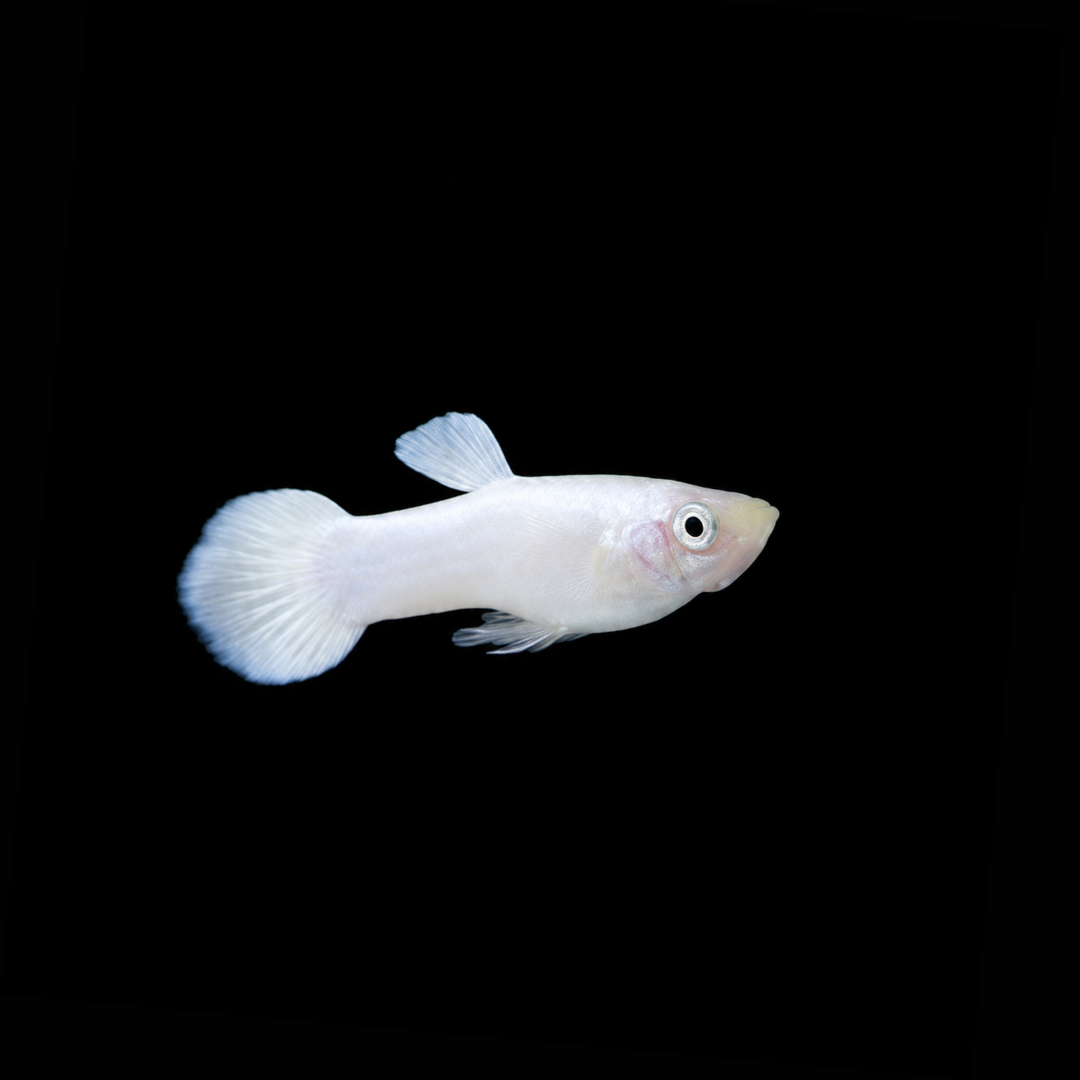
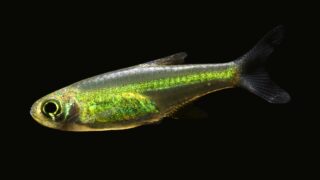
プラチナホワイトグッピーは、頭の先から尾びれまでが白く染まり、その上に真珠のようなやわらかい光沢が重なるグッピーの改良品種です。目は黒く、白い体の中で銀色に縁取られた瞳がくっきりと映えます。体の白さは、色素をつくる働きが抑えられていることと、光を白く散らす細胞によって生まれ、表面のつやは、別の細胞の中に並ぶ微細な結晶が光を反射することで生まれていると考えられています。そのため、暗い背景の水槽では、見る角度によって乳白色から銀白色へと表情が移ろいます。体の色素が少ないぶん、エラぶたの奥の赤みがほんのりと透けて見えることもあり、その繊細さも白い品種ならではの趣です。尾びれと背びれは体と同じ白で、ひれの筋が透けるような質感をもっています。主に東南アジアや南アジアの養殖場で生産された外国産の個体が流通しており、手頃な価格で迎えられる白いグッピーとして親しまれています。The Platinum White Guppy is an ornamental guppy variety whose body is white from the tip of the head to the tail fin, overlaid with a soft, pearl-like sheen. Its eyes are black, and the silver-rimmed pupils stand out sharply against the white body. The whiteness is thought to come from suppressed pigment production together with cells that scatter light as white, while the surface luster comes from tiny crystals arranged inside other cells that reflect light. In a tank with a dark background, its appearance therefore shifts from milky white to silvery white depending on the viewing angle. Because the body has little pigment, the red of the gills may show faintly through the gill covers, a delicate touch characteristic of white varieties. The tail and dorsal fins share the body’s white color, with a texture through which the fin rays appear translucent. Imported fish produced on farms in Southeast and South Asia are mainly available, and it is popular as a white guppy that can be acquired at a reasonable price.
基本情報 / Basic Information
学名 / Scientific Name
Poecilia reticulata
通称 / Common Name
プラチナホワイトグッピー、プラチナホワイトPlatinum White Guppy, Platinum White
分類 / Family
カダヤシ目 カダヤシ科 ポエキリア属(改良品種)Cyprinodontiformes, Poeciliidae, genus Poecilia (ornamental variety)
英名 / English Name
Platinum White Guppy
分布 / Distribution
原種のグッピーは、ベネズエラ周辺を中心とする南米北部と、トリニダード島などの周辺の島々に分布しています。本品種は改良品種のため自然分布はなく、スリランカなどアジア各地の養殖場で生産されています。なお日本では、放流されたり逃げ出したりしたグッピーが、沖縄県や小笠原諸島、各地の温泉排水が流れ込む水域に定着していることが知られています。The wild guppy is native to northern South America, centered around Venezuela, and to nearby islands such as Trinidad. As an ornamental variety, this fish has no natural range and is produced on fish farms in various parts of Asia, including Sri Lanka. In Japan, guppies that were released or escaped are known to have become established in Okinawa, the Ogasawara Islands, and waters fed by hot-spring outflows in various regions.
最大体長 / Max Size
オス約4cm、メス約6cm(尾びれを含む全長の目安)Males about 4 cm, females about 6 cm (approximate total length including the tail)
寿命 / Lifespan
一般的には1〜2年程度です。適温と良好な水質が保たれた環境では、それより長く生きる個体もいるとされています。Generally about 1 to 2 years. Some individuals kept at suitable temperatures in good water quality are said to live longer.
飼育環境 / Aquarium Environment
水槽サイズ / Tank Size
45cm規格水槽(約35L)〜60cm規格水槽(約57L)が扱いやすい目安です。水量に余裕があるほど水質が安定し、生まれた稚魚を育てる余地も生まれます。少数のペアであれば30cm規格水槽(約12L)でも飼育できますが、グッピーはよく増える魚なので、稚魚の育成用や新しく迎えた魚の隔離用に、予備の水槽も計画しておくと安心です。A 45 cm standard tank (about 35 L) to a 60 cm standard tank (about 57 L) is a convenient guideline. The more water volume, the more stable the water quality, and the more room there is to raise the fry that are born. A small pair can be kept in a 30 cm standard tank (about 12 L), but because guppies multiply readily, it is reassuring to plan spare tanks for raising fry and for quarantining newly acquired fish.
水温 / Temperature
25〜26℃前後が推奨されます。許容範囲はおおむね21〜28℃で、稚魚の育成には27〜28℃がよく用いられます。20℃を下回ると免疫力が落ちて白点病などにかかりやすくなるため、冬はヒーターが欠かせません。夏は30℃を超えないよう、冷却ファンやエアコンで管理します。ヒーターは故障による事故を防ぐため、1年ごとの交換が推奨されています。Around 25 to 26°C is recommended. The tolerable range is roughly 21 to 28°C, and 27 to 28°C is often used for raising fry. Below 20°C, immunity drops and the fish become more prone to diseases such as white spot, so a heater is essential in winter. In summer, use a cooling fan or air conditioning to keep the water from exceeding 30°C. Replacing heaters every year is recommended to prevent accidents caused by failure.
水質 / Water Quality
pH6.5〜7.5の中性付近が目安です(許容範囲はおおむね6.0〜8.0)。外国産の個体は海外の硬めの水で育てられていることが多く、総硬度10〜20dGH程度が目安とされ、極端な軟水では尾びれが傷みやすくなります。日本の水道水は軟水寄りのことが多いため、迎え入れる際は時間をかけて水合わせを行ってください。pHが6.8を下回りやすい水では、サンゴ砂を少量加えて調整する方法があります。アンモニアと亜硝酸は検出されない状態を保ち、硝酸塩は20mg/L以下を目標に、定期的な換水を行いましょう。Aim for a near-neutral pH of 6.5 to 7.5 (tolerable range roughly 6.0 to 8.0). Imported fish are often raised in harder water abroad; a general hardness of about 10 to 20 dGH is the guideline, and their tails tend to deteriorate in very soft water. Because Japanese tap water is often on the soft side, take time to acclimate them when bringing them home. If your water tends to fall below pH 6.8, adding a small amount of coral sand can help adjust it. Keep ammonia and nitrite undetectable, aim for nitrate at or below 20 mg/L, and perform regular water changes.
レイアウト / Layout
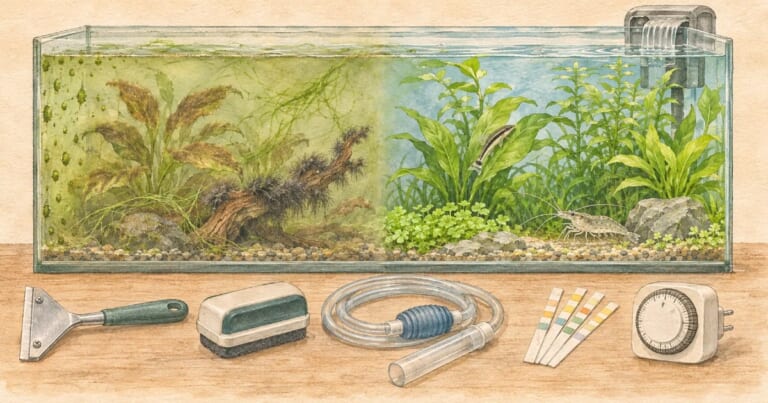
白い体と真珠のような光沢を引き立てるには、黒いバックスクリーンや暗い色の底砂でコントラストをつけるのが効果的です。白い魚は明るい背景の中では輪郭がぼやけますが、暗い背景の中では浮かび上がるように見えます。光沢は上からのやや明るい照明で引き出されます。一部に水草や浮草を配置しておくと、魚が身を寄せる場所になり、稚魚の隠れ家にもなります。大きな尾びれには強い水流が負担になるため、スポンジフィルターなど水流を弱められるろ過器が向いています。To set off the white body and pearl-like sheen, contrast is effective: use a black background or a dark substrate. White fish lose their outline against a bright background but seem to float into view against a dark one. The sheen is brought out by fairly bright lighting from above. Placing plants or floating plants in part of the tank gives the fish places to rest and gives fry places to hide. Strong currents burden the large tail, so a filter whose flow can be softened, such as a sponge filter, is well suited.
注意点 / Precautions
外国産のグッピーは、国産のグッピーと同じ水槽に入れないことが鉄則とされています。外国産の中には病原体を持ちながら発症しない個体がいると考えられており、抵抗力のない国産個体が短期間で全滅した例が飼育者の間で語られています。両方を飼う場合は水槽を分けるだけでなく、網やホース、バケツなどの器具も完全に分けてください。また、白い体では病気の初期サインが見えにくいため、日々の観察が特に重要です。増えすぎた場合でも、川や池、用水路へ放すことは絶対にやめてください。It is considered a golden rule not to keep imported guppies in the same tank as domestic Japanese guppies. Some imported fish are thought to carry pathogens without showing symptoms, and keepers tell of cases in which susceptible domestic fish died out within a short time. If you keep both, separate not only the tanks but also nets, hoses, buckets, and all other equipment. Because a white body makes early signs of disease hard to see, daily observation is especially important. Even if they multiply beyond your capacity, never release them into rivers, ponds, or irrigation channels.
餌と給餌 / Feeding
餌の種類 / Diet
雑食性で、グッピー用や小型熱帯魚用の人工飼料をよく食べます。主食には栄養バランスの良い総合栄養食を選び、ブラインシュリンプや冷凍アカムシなどを補助的に与えると、成長期や出産前後の体力づくりに役立ちます。Omnivorous; readily accepts prepared foods for guppies and small tropical fish. Choose a nutritionally balanced staple food, and supplementing with brine shrimp or frozen bloodworms helps build condition during growth and before and after giving birth.
給餌のポイント / Feeding Tips
白いグッピーで気をつけたいのが「黄ばみ」です。市販のフードの多くには、赤や橙の発色を強めるために、アスタキサンチンやスピルリナなどのカロテノイド系色素が含まれています。魚はこうした色素を体内で作れず、餌から取り込んで体に沈着させます。そのため、色揚げ用のフードを与え続けると白い体に黄色みが乗ってくるように感じられると、飼育者の間で報告されています。白さを保ちたい場合は色揚げに特化したフードを避け、ブラインシュリンプやクリルも適量にとどめて、体色の変化を見ながら調整するのが現実的です。なお、頭部などのわずかな黄色みは、餌だけでなく個体差や加齢、照明の色味によっても生じます。1回の量は2〜3分で食べ切れる程度にし、水質悪化の原因となる食べ残しは取り除いてください。One thing to watch for in white guppies is “yellowing.” Many commercial foods contain carotenoid pigments such as astaxanthin or spirulina to intensify red and orange coloration. Fish cannot produce these pigments themselves; they take them in from food and deposit them in their bodies. For this reason, keepers have reported that with continued feeding of color-enhancing foods, a yellowish tint seems to appear on white bodies. If you want to keep them white, it is practical to avoid foods specialized for color enhancement, keep brine shrimp and krill to moderate amounts, and adjust while watching for color changes. A slight yellowish tint around the head can also arise from individual variation, aging, or the color tone of the lighting, not only from food. Feed only what is eaten within 2 to 3 minutes, and remove leftovers, which degrade water quality.
性格と混泳 / Temperament and Tank Mates
性格 / Temperament
温和で、ほかの魚を攻撃することはほとんどありません。オスにはメスを熱心に追いかける習性があり、オスが多すぎるとメスが疲れてしまうことがあります。大きな尾びれを持つため泳ぎはそれほど得意ではなく、ゆったりと泳ぐ姿が特徴です。Peaceful and rarely aggressive toward other fish. Males have a habit of persistently chasing females, and too many males can exhaust them. Because of their large tails they are not strong swimmers, and their leisurely movement is characteristic.
混泳の相性 / Compatibility
ヒレをかじる魚や、動きが素早く先に餌を食べてしまう魚との混泳には向きません。混泳させるなら、コリドラスやオトシンクルスなど底層で暮らす温和な種類が無難です。白さとひれの美しさを保ち、純粋な系統を殖やしたい場合は、プラチナホワイトだけで飼う単独飼育が基本となります。ほかの品種のグッピーと一緒に飼うと交雑して白さが失われるため、品種を分けて飼育しましょう。Not suitable with fin-nipping fish or fast fish that get to the food first. If keeping them with other species, gentle bottom dwellers such as Corydoras or Otocinclus are a safe choice. To preserve their whiteness and fin quality and to breed a pure line, keeping Platinum Whites on their own is the standard approach. Kept with other guppy varieties, they will interbreed and the white coloration will be lost, so house varieties separately.
病気と対策 / Diseases and Prevention
かかりやすい病気 / Common Diseases
代表的なものに、白点病、カラムナリス症(尾ぐされ病・口ぐされ病)、水カビ病、テトラヒメナ症があります。テトラヒメナ症は繊毛虫による病気で、シンガポールから輸入され、異常な泳ぎや体表の白濁が見られたグッピーを調べた研究では、半数以上から原因となる繊毛虫が見つかり、鱗の隙間から体内に入り込んで、筋肉や内臓、眼の周り、脊髄まで傷つけることが報告されています。つまり、体の表面だけでなく内部まで侵される病気であり、体内に広がると一般的な薬浴では駆除が難しく、確立された治療法はないとされています。白い品種で特に注意したいのは、白点病の白い粒、カラムナリス症初期の白い濁り、水カビの綿のような付着、テトラヒメナ症の白濁といった初期のサインが、白い体色と光沢に紛れて見つけにくいという点です。Typical diseases include white spot disease, columnaris (tail rot and mouth rot), water mold (fungal infection), and tetrahymenosis. Tetrahymenosis is caused by a ciliate. A study of guppies imported from Singapore that showed abnormal swimming and clouded skin found the ciliate in more than half of them and reported that it enters the body through gaps between the scales and damages muscle, internal organs, the area around the eyes, and even the spinal cord. In other words, it attacks not only the body surface but the inside of the body as well; once it spreads internally, ordinary bath treatments struggle to eliminate it, and no established treatment is considered available. A particular concern with white varieties is that early signs such as the white dots of white spot, the faint white haze of early columnaris, cotton-like fungal growth, and the clouding of tetrahymenosis blend into the white body and sheen and are hard to notice.
対策と予防 / Prevention
体色の変化だけに頼らず、「ヒレをたたんで泳ぐ」「底や流木に体をこすりつける」「水面で口をパクパクさせる」「ヒレ先がギザギザになったり充血したりする」「急に痩せる」「泳ぎがふらつく」といった行動や体形の変化を、毎日の給餌のときに確認しましょう。最大の予防策は、新しく迎えた魚を最低2週間ほど別の水槽で様子を見てから合流させること、過密を避けること、十分な生物ろ過で汚れのもとになる有機物を減らすことです。実験では、輸送のストレスや過密な環境でテトラヒメナ症が悪化し、飼育密度が低いと回復しやすいことが示されています。異変に気づいたら、すぐに薬を入れるのではなく、まず水温、pH、アンモニア、亜硝酸、エアレーションを点検してください。1日に何匹も急死する場合は、病気よりも水質の急変を先に疑います。魚病薬は1種類ずつ製品の表示どおりに使い、自己判断で複数の薬を混ぜないでください。塩浴は0.3〜0.5%程度とし、魚の体力を温存するための補助手段と考えましょう。使い終わった薬液は川や排水へそのまま流さず、表示どおりに処置しても改善しない場合は、発売元や魚を診る獣医師に相談してください。Rather than relying on color changes alone, check daily at feeding time for changes in behavior and body shape: clamped fins, rubbing against the bottom or driftwood, gasping at the surface, ragged or reddened fin edges, sudden weight loss, or unsteady swimming. The best prevention is to keep new arrivals in a separate tank for at least two weeks before introducing them, to avoid overcrowding, and to reduce the organic waste that fouls water through ample biological filtration. Experiments have shown that transport stress and crowded conditions worsen tetrahymenosis, while low stocking density makes recovery easier. If you notice something wrong, do not add medication right away; first check temperature, pH, ammonia, nitrite, and aeration. If several fish die suddenly in one day, suspect a sudden change in water quality before disease. Use fish medications one at a time exactly as labeled, and never combine multiple medications on your own judgment. Keep salt baths at around 0.3 to 0.5% and think of them as a supportive measure to conserve the fish’s strength. Do not pour used medicated water directly into rivers or drains, and if treatment as labeled brings no improvement, consult the manufacturer or a veterinarian who treats fish.
増やし方(繁殖) / Breeding
雌雄の判別 / Sexing
オスは体が小さく(約4cm)、尾びれが大きく、尻びれが細長い交接器(ゴノポディウム)に変化しています。メスは体が大きく(約6cm)、腹部がふっくらとしていて、尻びれは扇形のままです。メスは尾びれが丸みを帯びた扇形になり、オスより落ち着いた印象になります。なお、ロットによってはメスの白さや光沢がオスほど強く出ないことがあります。Males are smaller (about 4 cm), with large tails, and their anal fin is modified into a slender copulatory organ (gonopodium). Females are larger (about 6 cm), with fuller bellies, and their anal fin remains fan-shaped. The female’s tail is a rounded fan, giving a calmer impression than the male. In some batches, the whiteness and sheen of females may not appear as strongly as in males.
繁殖形態 / Reproduction
卵胎生で、メスの体内でかえった卵が、稚魚の姿で生まれてきます。生後2〜3か月で成熟し、水温が高いとオスは6〜8週で成熟することもあります。水温26℃前後ではおよそ28日(21〜35日程度の幅があります)の妊娠期間を経て、1回に5〜60匹ほど、大型のメスでは100匹近くを産むこともあります。メスは1回の交尾で得た精子を体内に蓄えておけるため、オスと離したあとも数回続けて出産することがあります。Livebearing: eggs hatch inside the female, and the young are born as free-swimming fry. They mature at 2 to 3 months, and at higher temperatures males may mature in 6 to 8 weeks. At around 26°C, after a gestation of about 28 days (ranging roughly from 21 to 35 days), a female gives birth to about 5 to 60 fry at a time, and large females may produce close to 100. Because females can store sperm from a single mating, they may give birth several more times even after being separated from males.
繁殖のポイント / Breeding Tips
白さを次の世代へつなぐには、プラチナホワイト同士で殖やすことが基本です。ほかの品種と交配すると、白さや光沢が次の世代で失われやすくなります。また、オスの色や交接器が現れ始める生後4〜8週(体長1.5〜2cm前後)までにオスとメスを分けておくと、意図しない交配を防げます。繁殖させるときの比率は、オス1匹にメス2〜3匹が目安です。種親には、体とひれに黒い点やくすみ、黄ばみが少なく、背骨が真っすぐな個体を選びましょう。近親交配を無計画に続けると、背骨の曲がりや尾びれの変形、産む稚魚の数の減少などを招きやすいとされています。種親を2〜3のグループに分けて殖やし、数世代ごとにグループ間で掛け合わせる方法が堅実です。出産が近いメスは産卵箱や水草の多い別水槽に移すと、親魚に稚魚が食べられるのを防げます。To carry the whiteness into the next generation, breeding Platinum Whites with each other is the basic approach; crossing with other varieties tends to lose the whiteness and sheen in the next generation. Separating males and females by 4 to 8 weeks of age (about 1.5 to 2 cm), when male coloration and the gonopodium begin to appear, prevents unintended matings. One male to two or three females is a good breeding ratio. Choose breeders with few black spots, dullness, or yellowing on the body and fins, and with a straight spine. Unplanned, continued inbreeding is said to tend to cause spinal curvature, tail deformities, and smaller broods. A sound method is to divide the breeders into two or three groups and cross between groups every few generations. Moving a female close to giving birth into a breeding box or a separate, densely planted tank prevents the adults from eating the fry.
雑学と豆知識 / Trivia and Fun Facts
1. 名前の由来と学名の意味 / 1. The Origin of the Name and the Meaning of the Scientific Name
「グッピー」という名前は、19世紀にトリニダード島で標本を採集して英国へ送った博物学者、レクメア・グッピー氏に由来すると伝えられています。一方、学名に目を向けると、属名のPoeciliaはギリシャ語で「多彩な」「まだら模様の」を意味する言葉に、種小名のreticulataはラテン語で「網目状の」を意味する言葉に由来します。鱗の縁取りが網の目のように見える、野生のグッピーの姿を表した名前です。「多彩さ」を名に持つ魚から、色をそぎ落とした白い品種が生まれたことを思うと、どこか不思議な巡り合わせを感じさせます。The name “guppy” is said to come from Robert John Lechmere Guppy, a naturalist who collected specimens in Trinidad in the 19th century and sent them to Britain. Turning to the scientific name, the genus Poecilia derives from a Greek word meaning “many-colored” or “mottled,” and the species name reticulata from a Latin word meaning “net-like,” describing how the edged scales of wild guppies resemble a mesh. It is a curious twist that a fish whose name speaks of many colors gave rise to a white variety stripped of color.
2. 「白い」と「光る」は別の仕組み / 2. “White” and “Shining” Are Different Mechanisms
魚の体色をつくる細胞のうち、黒色素胞や黄色素胞は、光を吸収することで色を見せる「色素色」の担い手です。これに対し、銀色の輝きは「構造色」と呼ばれ、虹色素胞という細胞の中にごく小さなグアニン結晶が規則正しく重なり、光を反射することで生まれます。シャボン玉の膜が虹色に見えるのと同じように、色素ではなく微細な構造が色をつくっているのです。さらに電子顕微鏡を使った研究では、グッピーの皮膚には金属のように強く光を反射する虹色素胞とは別に、落ち着いた白い光を散らす白色素胞があることが確かめられています。プラチナホワイトの「白さ」と「光沢」が別々の性質のように見えるのは、この二つが異なる仕組みで働いているためと考えられます。この品種の名前は、白い地色をもたらす形質と、プラチナと呼ばれる光沢の形質が組み合わさって生まれたことに由来すると説明されることがあります。Among the cells that create fish coloration, melanophores and xanthophores produce “pigment color” by absorbing light. Silvery shimmer, by contrast, is called “structural color”: it arises when tiny guanine crystals stacked in orderly layers inside cells called iridophores reflect light. Just as a soap bubble’s film looks iridescent, it is fine structure rather than pigment that creates the color. Studies using electron microscopes have further confirmed that guppy skin contains, in addition to iridophores that reflect light strongly like metal, leucophores that scatter a softer white light. The reason the “whiteness” and “sheen” of the Platinum White seem like separate qualities is thought to be that the two work by different mechanisms. The variety’s name is sometimes explained as reflecting its origin in a combination of a trait that gives a white base color and a sheen trait known as platinum.
3. 黒い目が語ること / 3. What the Black Eyes Tell Us
白い魚と聞くと、色素をまったく持たないアルビノを思い浮かべる人も多いかもしれません。しかしアルビノの魚は目の中の色素も失われるため、血液の色が透けて目が赤く見えます。プラチナホワイトの黒い瞳は、目の色素がきちんと残っている証です。体の色が抜けていても、目には色素がある。この組み合わせが、白い体の中で瞳をくっきりと際立たせ、表情豊かな顔立ちをつくっています。購入の際に「白いグッピー」の中から本品種を見分ける手がかりにもなります。When people hear “white fish,” many may picture an albino lacking pigment entirely. In albino fish, however, pigment in the eye is also lost, so the color of the blood shows through and the eyes look red. The Platinum White’s black pupils are evidence that pigment in the eye remains intact. The body has lost its color, yet the eyes keep their pigment; this combination makes the eyes stand out vividly within the white body and gives the face its expressiveness. It is also a clue for telling this variety apart from other “white guppies” when purchasing.
4. 同じ名前を持つ別の魚 / 4. Other Fish with the Same Name
「プラチナホワイト」というカラー名は、グッピーだけのものではありません。改良メダカやエンゼルフィッシュ、ショーベタなど、まったく別の魚にも同じ名前が付けられています。グッピーの体を輝かせるグアニン結晶は、改良メダカで「ラメ」と呼ばれて珍重される光沢や、アジやサバ、タチウオの銀色の体と同じ物質で、同じ原理によって光っています。また、グッピーの中にも「白」や「プラチナ」を名に含む品種がいくつもあり、目の色や体の光り方が異なります。名前も仕組みも魚の種類を越えて共有されているのは、それだけ多くの人がこの輝きに惹かれてきた証なのかもしれません。The color name “Platinum White” is not unique to guppies; the same name is also given to entirely different fish such as ornamental medaka, angelfish, and show bettas. The guanine crystals that make the guppy’s body shine are the same substance, shining by the same principle, as the sparkle prized in medaka as “lame” and the silver bodies of horse mackerel, mackerel, and cutlassfish. Among guppies, too, there are several varieties with “white” or “platinum” in their names that differ in eye color and in how the body shines. That both the name and the mechanism are shared across species may be a sign of how many people have been drawn to this brilliance.
5. 野生の色覚と、人が選んだ白 / 5. Wild Color Vision and the White Humans Chose
原産地の野生のグッピーでは、メスが鮮やかなオスを好む「性選択」と、目立つオスほど捕食者に狙われやすい「捕食圧」という、相反する力の綱引きの中で、体の色や模様がほどよい目立ち方に調整されてきたと考えられています。グッピーは色の見え方に関わる遺伝子にも多様性があり、暮らす水の光環境と体色の関係は、長く研究者の関心を集めてきました。捕食者のいない水槽の中で、人が白さと光沢を選び抜いて固定していった結果がプラチナホワイトです。自然界では目立ちすぎて生き残りにくい色だからこそ、人の手による世話の中で輝き続ける魚だといえるでしょう。In wild guppies in their native range, colors and patterns are thought to have been tuned to a moderate level of conspicuousness through a tug-of-war between two opposing forces: sexual selection, in which females prefer brightly colored males, and predation pressure, in which conspicuous males are more likely to be targeted. Guppies also show diversity in genes involved in color vision, and the relationship between the light environment of their waters and their body coloration has long attracted researchers’ interest. In the predator-free aquarium, humans selected and fixed whiteness and sheen, and the Platinum White is the result. Precisely because it is a color too conspicuous to survive easily in nature, it can be called a fish that continues to shine under human care.
6. 温泉と南の島に生きるグッピー / 6. Guppies Living in Hot Springs and Southern Islands
熱帯魚のグッピーは日本の冬を越せないと思われがちですが、実際には1955年頃から、手放された観賞用の個体が日本の自然の水域に定着してきたことが記録されています。冬でも水温が下がりにくい温泉排水の流れ込む水域では、福島、長野、静岡、岡山、大分、鹿児島などの温泉地で定着が確認されてきました。北海道の温泉地の滝にも定着していましたが、2019年に根絶が確認されたとされています。亜熱帯の沖縄県では1960年頃から定着し、小笠原諸島とともに、川や水路に広く分布しています。琉球大学の研究チームが、水に含まれる生き物のDNAを調べる「環境DNA」の手法で行った調査では、沖縄の川に入り込んだグッピーは原産地よりも天敵の種類が少ない環境で暮らしており、さらに沖縄にもともといる捕食者に合わせて、体色の模様が変わりつつある可能性が示唆されました。水槽から手放されたグッピーが、日本の自然の中で短い期間のうちに適応していく現実を物語る研究です。プラチナホワイトもひと月で数十匹単位に増えうる繁殖力を持っています。飼育スペースの計画とオスとメスの分離、そして決して野外へ放さないことが、この白い品種と長く付き合うための前提となります。It is often assumed that tropical guppies cannot survive Japanese winters, but records show that released ornamental guppies have become established in Japan’s natural waters since around 1955. In waters fed by hot-spring outflows that stay warm even in winter, populations have been confirmed in hot-spring areas in Fukushima, Nagano, Shizuoka, Okayama, Oita, Kagoshima, and elsewhere. A population once established at a hot-spring waterfall in Hokkaido is reported to have been confirmed eradicated in 2019. In subtropical Okinawa, guppies have been established since around 1960 and, together with the Ogasawara Islands, are widely distributed in rivers and channels. A University of the Ryukyus research team used “environmental DNA,” a method that detects organisms from DNA in the water, and found that guppies that entered Okinawan rivers live with fewer kinds of natural enemies than in their native range; the study also suggested that their color patterns may be changing in response to Okinawa’s native predators. The research shows how quickly guppies released from aquariums can adapt to Japanese nature. Platinum Whites, too, can multiply by dozens in a single month. Planning your space, separating males and females, and never releasing them outdoors are prerequisites for a long relationship with this white variety.
まとめ / Conclusion
プラチナホワイトグッピーは、白い体と真珠のような光沢、そして白の中でくっきりと際立つ黒い瞳をあわせ持つ魚です。暗い背景の水槽を泳ぐと、見る角度によって乳白色から銀白色へと表情を変え、尾びれの筋までが光を受けて浮かび上がります。多彩な色を持つ魚から色をそぎ落とすことで生まれた、静かで上品な美しさが魅力です。The Platinum White Guppy combines a white body, a pearl-like sheen, and black eyes that stand out sharply against the white. Swimming in a dark-backed tank, it shifts from milky white to silvery white with the viewing angle, and even the rays of its tail catch the light and come into view. Its appeal is a quiet, refined beauty born from stripping color away from a fish known for its many colors.
その白さは、黄ばみを抑える餌選び、迎え入れるときの丁寧な水合わせ、白い体に紛れる病気のサインを見逃さない観察、そして同じ品種同士での繁殖によって守られます。手をかけるほど澄んだ白で応えてくれるこの魚は、日々の世話そのものを楽しみに変えてくれる存在です。生まれてくる命を最後まで水槽の中で見守りながら、そのやわらかな輝きを長く味わってください。That whiteness is protected by choosing foods that limit yellowing, acclimating carefully when bringing the fish home, watching closely for disease signs that blend into a white body, and breeding within the same variety. The more care you give, the more this fish answers with a clear white, turning daily upkeep into a pleasure of its own. Caring for every new life within the aquarium to the end, enjoy its soft glow for a long time to come.
Takeuchi, I. K. (1976) Electron microscopy of two types of reflecting chromatophores (iridophores and leucophores) in the guppy, Lebistes reticulatus Peters. Cell and Tissue Research, 173(1): 17–27. https://doi.org/10.1007/BF00219263
Kottler, V. A., Koch, I., Flötenmeyer, M., Hashimoto, H., Weigel, D. & Dreyer, C. (2014) Multiple pigment cell types contribute to the black, blue, and orange ornaments of male guppies (Poecilia reticulata). PLoS ONE, 9(1): e85647. https://doi.org/10.1371/journal.pone.0085647
Pimenta Leibowitz, M., Ariav, R. & Zilberg, D. (2005) Environmental and physiological conditions affecting Tetrahymena sp. infection in guppies, Poecilia reticulata Peters. Journal of Fish Diseases, 28(9): 539–547. https://doi.org/10.1111/j.1365-2761.2005.00658.x
Sharon, G., Pimenta-Leibowitz, M., Vilchis, M. C. L., Isakov, N. & Zilberg, D. (2015) Controlled infection of Poecilia reticulata Peters (guppy) with Tetrahymena by immersion and intraperitoneal injection. Journal of Fish Diseases. https://doi.org/10.1111/jfd.12204






コメント