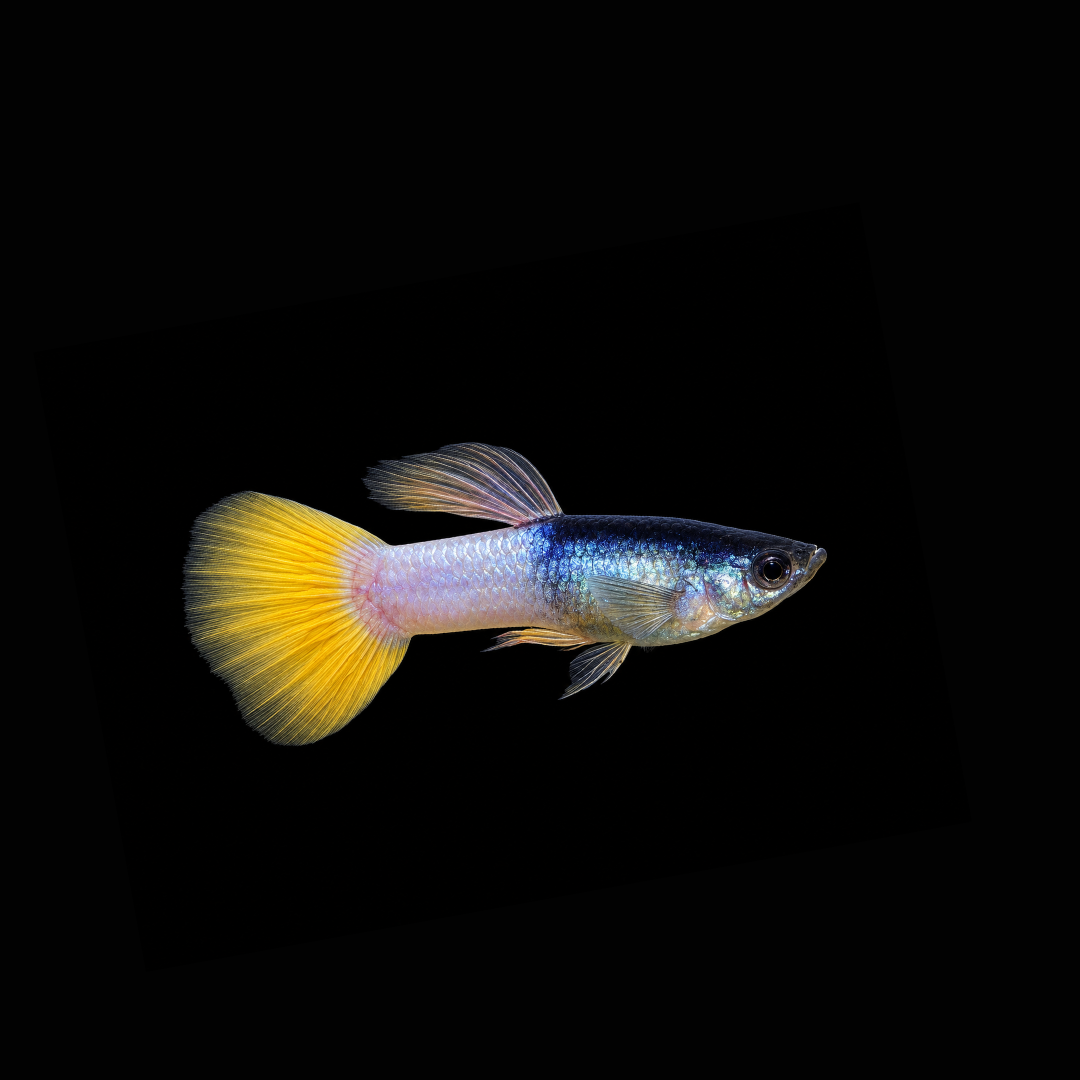
メタルピングーグッピーは、上半身が金属のような青〜銀色の光沢に覆われ、体の後半にあたる尾筒(びとう)が淡いピンク色に色づく改良グッピーです。尾筒のピンクは白に近いほど淡く、透けるような質感で出ることが多いため、写真では白っぽく写ることもあります。多くの系統では背ビレと尾ビレが黄色く、面積の大きい黄色の尾ビレがよく目立つので、全体として黄色の印象が強く見える個体も少なくありません。青銀の上半身、淡いピンクの尾筒、黄色いヒレという色の組み合わせが、この品種ならではの上品な雰囲気を生み出しています。ピングーと呼ばれる系統は、常染色体上の劣性遺伝子「ピンク」を持ち、ハーフブラック(タキシード)の遺伝子と組み合わさった形で維持されてきました。そこに上半身の金属光沢が加わったものが、メタルピングーとして流通しています。性格は温和で、水草もほとんど食べないため、水草レイアウト水槽にもよくなじみます。丈夫で季節を問わず殖えるので初めてのグッピーにも向いていますが、メタル光沢とピンクをきれいに引き出すには、水質と水温の管理にひと工夫したいところです。The Metal Pingu Guppy is a fancy guppy strain whose upper body is covered in a metallic blue-to-silver sheen, while the rear of the body, the caudal peduncle, is tinted a soft pink. The pink on the peduncle is often so pale and translucent that it is close to white, and it can look whitish in photographs. In many lines the dorsal and tail fins are yellow, and because the large yellow tail fin stands out, quite a few individuals give a strongly yellow impression overall. The combination of a blue-silver upper body, a pale pink peduncle, and yellow fins creates the refined appearance unique to this strain. Pingu lines carry the autosomal recessive “Pink” gene and have been maintained in combination with the half-black (tuxedo) gene. Fish that also carry metallic sheen on the upper body are sold as the Metal Pingu. It is peaceful and rarely eats aquatic plants, so it fits nicely into planted layout tanks. Hardy and willing to breed year-round, it is a good choice for a first guppy, but bringing out clean metallic sheen and pink takes a little care with water chemistry and temperature.
基本情報 / Basic Information
学名 / Scientific Name
Poecilia reticulata ‘Metal Pingu’
通称 / Common Name
メタルピングー、メタルピングータキシード、バンブルビーグッピー(外国産の流通名として使われることがあります)Metal Pingu, Metal Pingu Tuxedo, Bumblebee Guppy (a trade name sometimes used for imported fish)
分類 / Family
カダヤシ目カダヤシ科ポエキリア属(卵胎生メダカの仲間)Order Cyprinodontiformes, family Poeciliidae, genus Poecilia (livebearers)
英名 / English Name
Metal Pingu Guppy, Metal Pingu Tuxedo Guppy
分布 / Distribution
原種のグッピーは、南米北部(ベネズエラ、ガイアナなど)とトリニダード島周辺の淡水域に分布しています。メタルピングーは人の手で作出された改良品種のため、野生には存在しません。なお、原種のグッピーは世界各地に持ち込まれており、日本でも沖縄島をはじめとする琉球列島の河川や水路のほか、北海道の温泉地など水温が高く保たれる場所で野生化が確認されています。Wild guppies are native to fresh waters of northern South America (including Venezuela and Guyana) and around the island of Trinidad. The Metal Pingu is a man-made fancy strain and does not occur in the wild. Guppies have been introduced to many parts of the world, and in Japan feral populations have been confirmed in rivers and channels of the Ryukyu Islands, including Okinawa Island, as well as in places where the water stays warm, such as hot spring areas in Hokkaido.
最大体長 / Max Size
オス約4cm前後、メス約6cm前後(よく育ったメスは7cm近くになることもあります)Males around 4 cm; females around 6 cm (well-grown females can approach 7 cm)
寿命 / Lifespan
2〜3年程度About 2–3 years
飼育環境 / Aquarium Environment
水槽サイズ / Tank Size
1〜数ペアで繁殖を楽しむなら、30cm規格水槽(約12L)から45cm規格水槽(約35L)で十分に飼育できます。群泳や水草レイアウトを楽しみたい場合は、60cm規格水槽(約57L)以上がおすすめです。稚魚の育成や系統ごとの管理を考えるなら、小型水槽を複数用意しておくと便利です。For breeding one to a few pairs, a 30 cm standard tank (about 12 L) to a 45 cm standard tank (about 35 L) is sufficient. For a schooling display or a planted layout, a 60 cm standard tank (about 57 L) or larger is recommended. If you plan to raise fry or keep separate lines, having several small tanks on hand is very convenient.
水温 / Temperature
22〜28℃が飼育の目安です。日本の夏は閉め切った室内で水温が30℃を超えやすく、高水温が続くと魚が体力を消耗し、発色も落ちやすくなります。冷却ファンや水槽用クーラー、エアコンによる室温管理を検討しましょう。冬はヒーターでの加温が必要です。A range of 22–28°C is a good guideline. Japanese summers can easily push water above 30°C in closed rooms, and prolonged high temperatures wear the fish out and tend to dull their colors. Consider a cooling fan, an aquarium chiller, or air conditioning. A heater is needed in winter.
水質 / Water Quality
中性〜弱アルカリ性(pH7.0〜7.8前後)で、やや硬めの水(GH8〜15前後)を好みます。日本の水道水は多くの地域で軟水ですが、グッピーは順応性が高いため、そのままでも飼育できます。ただし、流木のアクやソイルの影響で水が酸性に傾くと発色が冴えなくなり、調子も崩しやすくなるため、pH6.0を下回らないよう注意してください。フィルターの中や水槽の隅に少量のカキ殻を入れておくと、pHと硬度をゆるやかに高めに保てます。サンゴ砂も使えますが、pHが上がりすぎることがあるので量は控えめにしましょう。大磯砂も新品のうちは弱アルカリ性の維持に役立ちますが、長く使うと効果が薄れていくため、定期的に水質を測っておくと安心です。Prefers neutral to slightly alkaline water (around pH 7.0–7.8) that is moderately hard (GH around 8–15). Tap water in most of Japan is soft, but guppies are adaptable and can be kept in it as is. However, if driftwood tannins or aqua soil push the water toward acidity, colors lose their brilliance and the fish become prone to problems, so keep the pH from dropping below 6.0. A small amount of crushed oyster shell in the filter or a corner of the tank gently keeps pH and hardness on the higher side. Coral sand also works, but it can raise pH too far, so use it sparingly. Oiso gravel helps maintain slight alkalinity when new, but the effect fades with long use, so regular water testing gives peace of mind.
レイアウト / Layout
主に水槽の上層を泳ぐので、水面付近に泳ぐスペースを確保しましょう。オスはメスをしつこく追いかけるため、ウィローモスやグッピーグラスなどの水草を多めに入れておくと、メスの休憩場所や稚魚の隠れ家になります。底砂やバックスクリーンに暗い色を選ぶと、上半身の青銀と淡いピンク、黄色いヒレがよく映えます。反対に、白い砂を全面に敷くと体色が薄くなる「色飛び」が起こりやすいので注意が必要です。They mainly swim in the upper layer of the tank, so leave open swimming space near the surface. Males chase females persistently, so planting plenty of Java moss or guppy grass gives females a place to rest and fry a place to hide. A dark substrate and background make the blue-silver upper body, pale pink, and yellow fins stand out. On the other hand, covering the bottom entirely with white sand tends to make the colors fade, so be careful.
注意点 / Precautions
ヒレの形は系統によって異なります。ピングーはもともと尾ビレが小さめで、下側に小さな剣状の突起を持つ系統として知られ、現在もコンパクトな尾ビレの個体が多く見られます。一方で、デルタテールやリボン、ダンボ(胸ビレが大きく伸びるタイプ)などを取り入れた系統もあります。尾ビレの大きな系統は強い水流が苦手なので、フィルターの水流は控えめにしましょう。また、グッピーは環境省と農林水産省が作成した生態系被害防止外来種リストに掲載されている魚です。飼育や譲渡は可能ですが、川や池などの野外へは絶対に放さないでください。Fin shape varies by line. The Pingu was originally known as a line with a fairly small tail fin bearing a small sword on its lower edge, and many individuals today still have compact tails. There are also lines that incorporate delta tails, ribbon fins, or Dumbo (enlarged pectoral fins). Lines with large tails dislike strong currents, so keep filter flow gentle. Note also that the guppy is listed on the list of invasive alien species that threaten ecosystems, compiled by Japan’s Ministry of the Environment and Ministry of Agriculture, Forestry and Fisheries. Keeping and giving them away is permitted, but never release them into rivers, ponds, or any other outdoor waters.
餌と給餌 / Feeding
餌の種類 / Diet
雑食性で、グッピー用の細かい浮上性フードをよく食べます。これに加えて、孵化させたブラインシュリンプなどの生き餌を与えると、成長が良くなり、発色も向上しやすくなります。Omnivorous, they readily accept fine floating guppy foods. Adding live foods such as freshly hatched brine shrimp improves growth and tends to enhance coloration.
給餌のポイント / Feeding Tips
口がやや小さく、水面近くで餌を食べる習性があるので、細かい粒を少量ずつ、何回かに分けて与えましょう。与えすぎは吐き戻しや水質悪化の原因になります。ブラインシュリンプは、25〜28℃の塩水にエアレーションをかけ、適度に光を当てると孵化しやすくなります。ただし、食べ残しが多いとヒドラが発生しやすくなるため、食べきれる量にとどめてください。Their mouths are fairly small and they feed near the surface, so offer fine granules in small amounts several times a day. Overfeeding leads to regurgitation and poor water quality. Brine shrimp hatch better in aerated salt water at 25–28°C under moderate light. However, leftover brine shrimp can encourage hydra outbreaks, so feed only what the fish can finish.
性格と混泳 / Temperament and Tank Mates
性格 / Temperament
とても温和で、ほかの魚を攻撃することはほとんどありません。ただし、オスはメスに盛んに求愛し、追いかけ回すことがあります。Very peaceful and rarely aggressive toward other fish. Males, however, court females actively and may chase them around the tank.
混泳の相性 / Compatibility
小型カラシンやコリドラス、オトシンクルスなど、温和な小型魚とは混泳させやすい魚です。スマトラのようにヒレをかじる魚や、口に入る大きさの魚を食べてしまう中〜大型魚との混泳は避けましょう。稚魚はほかの魚に食べられやすく、反対にグッピーが稚エビを食べてしまうこともあります。系統を維持したい場合、別品種のグッピーと同じ水槽に入れると交雑してしまうため、単独の品種で管理するのが基本です。また、病気を防ぐ観点から、国産と外国産のグッピーは混泳させないことが大切です。Easy to keep with peaceful small fish such as small tetras, Corydoras, and Otocinclus. Avoid fin-nippers such as tiger barbs, and medium to large fish that will eat anything that fits in their mouths. Fry are easily eaten by other fish, and guppies themselves may eat baby shrimp. If you want to maintain the line, keep it as a single strain, since different guppy strains in the same tank will interbreed. To prevent disease, it is also important not to mix domestically bred and imported guppies.
病気と対策 / Diseases and Prevention
かかりやすい病気 / Common Diseases
日常の飼育で最も見かけやすいのは、カラムナリス症(尾ぐされ病・口ぐされ病)です。原因となる細菌は水槽内にありふれた菌で、水質悪化や急な水温変化、追い回しによるストレスで魚が弱ったときに、ヒレの先が白く濁り、溶けるように欠けていきます。生まれて間もない稚魚では、尾ビレが針のように閉じてしまうハリ病も見られます。さらにグッピーで特に警戒したいのが、通称「グッピーエイズ」と呼ばれる症状と、繊毛虫の寄生によるテトラヒメナ症です。グッピーエイズはヒトのHIVとは無関係で、人にうつることはありませんが、原因がはっきりしておらず、治療法も確立していません。胸ビレが白く曇って動きが硬くなるところから始まり、尾ビレの曇り、ふらつくような泳ぎへと進んで、短期間に水槽内の多くの魚が死んでしまうこともあるといわれます。テトラヒメナ症は、世界各地のグッピー養殖で深刻な被害を出している病気で、寄生虫が皮膚から筋肉や内臓にまで入り込みます。白点病などと見分けにくく、有効な治療法はまだ確立されていません。The disease most often seen in everyday keeping is columnaris (fin rot and mouth rot). The bacterium behind it is common in aquariums, and when fish are weakened by poor water quality, sudden temperature changes, or stress from being chased, their fin edges turn cloudy white and erode away. In newborn fry, “needle disease,” in which the tail fin clamps shut into a needle-like shape, may also appear. Of particular concern with guppies are the condition commonly called “guppy AIDS” and tetrahymenosis, caused by parasitic ciliates. Guppy AIDS has nothing to do with human HIV and cannot infect people, but its cause is unclear and there is no established treatment. It is said to begin with the pectoral fins turning cloudy white and stiff, progress to a cloudy tail fin and unsteady swimming, and sometimes kill many of the fish in a tank within a short time. Tetrahymenosis causes serious losses on guppy farms around the world; the parasite can invade from the skin into the muscles and internal organs. It is easily confused with white spot disease, and no effective treatment has yet been established.
対策と予防 / Prevention
カラムナリス症は、早めに気づいて隔離し、0.5%の塩水浴を行えば回復が期待できます。症状が進んでいる場合は、グリーンFゴールド顆粒やエルバージュエースなど、市販の細菌性魚病薬で薬浴しましょう。ハリ病の稚魚は、きれいな水と適温の環境に移し、0.5%の塩水浴を行います。グッピーエイズやテトラヒメナ症は、「持ち込まない」ことが最大の予防策です。テトラヒメナ症は、シンガポールから輸入されたグッピーで診断された例も報告されており、輸入魚が病原体を持ち込む可能性は軽視できません。日本の飼育現場でも、外国産と一緒にした国産グッピーが次々に発症する例がたびたび指摘されています。国産と外国産は水槽を分けるだけでなく、網やスポイト、ホース、ろ過設備も共用しないよう徹底してください。胸ビレの初期の曇りは上からの照明では見落としやすいので、気になる個体は透明なカップにすくい、ライトを横や斜め下から当てて、健康な個体と見比べると見つけやすくなります。なお、外国産の個体は長距離輸送や水質の違いで弱っていることが多いものの、導入直後の数週間を丁寧な水合わせと安定した環境で乗り越えれば、本来の丈夫さを取り戻しやすいといわれています。If caught early, columnaris can be treated by isolating the fish in a 0.5% salt bath. In more advanced cases, use a commercial antibacterial fish medication such as Green F Gold Granules or Elbagel Ace. Move fry with needle disease into clean water at a suitable temperature and give them a 0.5% salt bath. For guppy AIDS and tetrahymenosis, the best defense is never bringing them in. Tetrahymenosis has been diagnosed in guppies imported from Singapore, so the possibility of imported fish introducing pathogens should not be taken lightly. Keepers in Japan have also repeatedly observed domestically bred guppies falling ill one after another after being housed with imported fish. Keep domestic and imported fish not only in separate tanks but also with completely separate nets, pipettes, hoses, and filtration equipment. Early clouding of the pectoral fins is easy to miss under overhead lighting, so scoop any suspicious fish into a clear cup and shine a light from the side or below to compare it with a healthy fish. Imported fish are often weakened by long-distance transport and differences in water chemistry, but it is said that if they get through the first few weeks with careful acclimation and a stable environment, they usually recover their natural hardiness.
増やし方(繁殖) / Breeding
雌雄の判別 / Sexing
オスは体が小さく、尻ビレが細長い交接器(ゴノポディウム)に変化しています。メタル光沢と淡いピンクの組み合わせがはっきり現れるのはオスです。メスはオスよりひと回り大きく、お腹がふっくらとしていて、体色は地味ですが、系統によっては尾筒にうっすらとピンクや黒みが乗ることがあります。成長とともにオスの尻ビレが変化し、色も乗ってくるので、生後1か月半〜2か月ほどで見分けやすくなります。Males are smaller, and their anal fin is modified into a long, slender mating organ called a gonopodium. The combination of metallic sheen and pale pink appears clearly in males. Females are noticeably larger than males with a rounder belly and are plainer in color, though in some lines a faint pink or dark tint appears on the caudal peduncle. As males grow, their anal fin changes and their colors develop, so the sexes become easy to tell apart at around six to eight weeks of age.
繁殖形態 / Reproduction
卵胎生で、卵はメスのお腹の中で孵化し、稚魚の姿で産まれてきます。成熟したメスはおよそ4週間前後の間隔で出産し、1回に20〜30匹ほどの稚魚を産むのが目安です。メスは交尾で得た精子を体内に蓄えておけるため、オスと離したあとも何度か出産することがあります。生まれたばかりの稚魚は地味な姿で、成長とともに色や模様が現れてきます。Guppies are livebearers: the eggs hatch inside the female and the young are born as free-swimming fry. A mature female gives birth at intervals of about four weeks, typically producing around 20–30 fry at a time. Because females can store sperm from mating, they may give birth several more times even after being separated from males. Newborn fry are plain in appearance, and their colors and patterns develop as they grow.
繁殖のポイント / Breeding Tips
殖やすこと自体は簡単ですが、美しい系統を保つには計画的な管理が欠かせません。種親は、別系統と混泳させず単一品種で管理している専門店やブリーダーから迎えましょう。稚魚は雌雄の区別がつき始めたら早めに分けておくと、意図しない兄妹交配を防げます。メタル光沢やピンクは成長とともに少しずつ仕上がっていくので、若いうちに絞り込みすぎず、色が出そろってから最終的な選別をするのがコツです。近親交配を重ねると体力が落ちたり、ハリ病などが増えたりしやすくなるため、ときどき同じ色の系統で血縁の遠い個体を交配に加えると、色柄を崩さずに活力を保ちやすくなります。なお、ピンク遺伝子は劣性なので、ピンク遺伝子を持たない個体と交配すると、生まれる世代ではピンクが表に出なくなります。ピンクを取り戻すには、その子ども同士を交配して約4分の1の確率で回収する方法と、子どものメスを元のメタルピングーのオスに戻し交配して約2分の1の確率で回収する方法があり、後者のほうが効率的です。Breeding them is easy, but keeping a beautiful line requires planned management. Obtain breeding stock from specialist shops or breeders that keep the strain on its own, not mixed with other lines. Separate the fry by sex as soon as the sexes can be distinguished to prevent unintended sibling matings. Metallic sheen and pink develop gradually as the fish grow, so the trick is not to narrow down too early and to make the final selection once the colors have fully come in. Repeated inbreeding tends to reduce vigor and increase problems such as needle disease, so occasionally bringing in a distantly related fish of the same color line helps maintain vitality without disrupting the color pattern. Note that the Pink gene is recessive, so if you cross with a fish lacking it, the pink will not show in the resulting generation. To recover it, you can either mate those offspring to each other, regaining pink in about one quarter of the young, or backcross the daughters to the original Metal Pingu male, regaining it in about half; the latter is more efficient.
雑学と豆知識 / Trivia and Fun Facts
1. 「ピングー」の名前と、黄色いヒレの由来 / 1. The Name “Pingu” and the Origin of the Yellow Fins
「ピングー」という名前は、この系統のピンク色の発色にちなむものとされ、「ピンク・グッピー(Pink Guppy)」を縮めた呼び名だと説明されることが多い名前です。ではなぜ、写真で見ると黄色が目立つのでしょうか。その答えは、系統の初期の姿にあります。1980年代のアメリカでピングーを維持していたブリーダーの記録によると、当時の系統には大きく二つのタイプがありました。ひとつは黄色いヒレと小さな下側の剣状の突起を持つタイプ、もうひとつは体が鮮やかなピンクに輝き、そのピンクがヒレにまでにじむタイプです。どちらにも、尾筒の付け根にピンクの斑点が見られました。つまり、ピンクはもともと尾筒という限られた場所に現れる色で、黄色いヒレはピングーの典型的な特徴のひとつだったのです。ピングーはその後、1990年ごろにイギリスへ送られ、その子孫がアジアに渡って、現在流通する多くのピンク系グッピーの基盤になった可能性があるとも伝えられています。The name “Pingu” is said to come from the strain’s pink coloration and is often explained as a contraction of “Pink Guppy.” So why does yellow stand out so much in photos? The answer lies in what the early strain looked like. According to the records of a breeder who maintained Pingus in the United States in the 1980s, the line at that time came in two main types: one with yellow fins and a small lower sword, and another whose body glowed bright pink, with the pink bleeding into the fins. Both showed a pink spot at the base of the caudal peduncle. In other words, pink was originally a color that appeared in a limited area, the peduncle, while yellow fins were one of the typical features of the Pingu. Around 1990, Pingus were sent to the United Kingdom, and it is said that their descendants may have gone on to Asia and helped form the basis of many pink guppy strains sold today.
2. ピンクはどんな仕組みで生まれるのか / 2. How the Pink Is Produced
グッピーの体色は、皮膚の中にある何種類もの色素胞が重なり合ってつくられています。研究によると、グッピーの模様は、黒い色素を持つ黒色素胞、黄色〜橙色の黄色素胞、光を反射して青い輝きを生む虹色素胞、そしておそらく白色素胞といった細胞の組み合わせでできています。ピングーのピンクを生むのは、常染色体上にある劣性の「ピンク」遺伝子です。グッピーの遺伝を研究してきたブリーダーによれば、この遺伝子は尾筒の後半に、淡く、しばしば透けるような白っぽい色をもたらし、その色は白色素胞によるものと説明されています。つまり、ピングーのピンクは赤い色素で塗られた濃いピンクではなく、白く明るい色が透けて見える、やわらかな色合いなのです。写真でピンクが白っぽく写りやすいのも、この性質を考えると自然なことといえます。A guppy’s body color is created by several kinds of pigment cells layered in the skin. Research shows that guppy patterns are built from combinations of black melanophores, yellow-to-orange xanthophores, iridophores that reflect light to produce a blue shimmer, and possibly white leucophores. The pink of the Pingu comes from the autosomal recessive “Pink” gene. According to a breeder who has studied guppy genetics, this gene produces a light, often translucent whitish color on the rear of the caudal peduncle, which is attributed to leucophores. In other words, the Pingu’s pink is not a deep pink painted on with red pigment, but a soft tone in which a bright, whitish color shows through. Considering this, it is only natural that the pink so often looks whitish in photos.
3. 父から息子へ受け継がれる色 / 3. Colors Passed from Father to Son
グッピーはメスがXX、オスがXYという仕組みで性が決まり、Y染色体上の遺伝子によって形質が受け継がれることが初めて示された動物として、遺伝学の歴史に名を残しています。Y染色体上にある色の遺伝子は父親から息子へだけ受け継がれ、メスには現れません。初期のピングーの遺伝子構成は、X染色体上のハーフブラック、Y染色体上のモスコー、そして劣性のピンク遺伝子の組み合わせと記録されており、モスコーは肩のあたりに青紫色の輝きをもたらすY染色体性の遺伝子とされています。日本で流通するメタルピングーの上半身の光沢も、一般にY染色体性のメタル形質とされ、系統を維持するうえではオスの選び方が光沢の質を大きく左右します。一方で、金属光沢を生む遺伝子にはシュテルツバッハと呼ばれる常染色体上の遺伝子も知られていて、こちらは1つ持つだけでも光沢が出るとされます。同じ「メタル」という言葉でも遺伝の仕方が異なるため、海外の資料を読むときや交配計画を立てるときは、どの遺伝子を指しているのかを意識しておくと混乱せずに済みます。In guppies, sex is determined by an XX female and XY male system, and the guppy has a place in the history of genetics as the first animal shown to pass on traits through genes on the Y chromosome. Color genes on the Y chromosome are inherited only from father to son and do not appear in females. The genetic makeup of early Pingus was recorded as a combination of half-black on the X chromosome, Moscow on the Y chromosome, and the recessive Pink gene, with Moscow described as a Y-linked gene that produces a violet-blue shimmer around the shoulders. The upper-body sheen of the Metal Pingu sold in Japan is likewise generally considered a Y-linked metal trait, so in maintaining the line, the choice of males greatly affects the quality of the sheen. On the other hand, an autosomal gene called Stoerzbach is also known to produce metallic sheen, and it is said to show even when a fish carries only one copy. Since the same word “metal” can refer to different modes of inheritance, keeping in mind which gene is meant helps avoid confusion when reading foreign sources or planning crosses.
4. 名前の似た品種たちとの見分け方 / 4. Telling Apart Similarly Named Strains
ショップでは、名前のよく似たピンク系のグッピーが並んでいることがあります。外国産を中心に流通する「メタルピンク」は、体の後ろ半分だけでなく全身がピンクがかった銀白色に輝くのが特徴で、マゼンタと呼ばれる別の遺伝子が関わる系統と考えられています。そのため、メタルピングーの表記違いではなく、別の品種である可能性があります。また、パンダモスコーは、Y染色体上のモスコー遺伝子と劣性のピンク遺伝子を組み合わせた品種で、体の前半が明るく、後半が暗くなる配色をしています。同じピンク遺伝子を持ちながら、組み合わせる遺伝子によってここまで印象が変わるのは、グッピーの色の遺伝の奥深さを感じさせるところです。Shops sometimes display pink guppies with very similar names side by side. The “Metal Pink,” sold mainly as imported fish, shines a pinkish silver-white over its entire body rather than just the rear half, and is thought to be a line involving a different gene called Magenta. It may therefore be a separate strain rather than an alternate spelling of Metal Pingu. The Panda Moscow, meanwhile, combines the Y-linked Moscow gene with the recessive Pink gene and has a color scheme that is light in front and dark at the rear. The way the same Pink gene can create such different impressions depending on the genes it is paired with shows just how deep guppy color genetics can be.
5. コンテストの規格に収まらなかったピングー / 5. The Pingu That Did Not Fit the Show Standards
北米のグッピー協会IFGAの審査基準では、大きく広がるデルタテールや、色の混じらない澄んだ尾ビレなどが重視されます。1980年代にピングーを維持していたブリーダーの記録によると、当時のピングーはこの基準のどの部門の条件も満たせず、基準に合う剣状の尾を持つ個体もつくり出せなかったため、「その他の色」の部門で出品されていたそうです。コンテストの評価軸からは外れていたものの、その独特の色合いに惹かれた愛好家たちによって系統は守られ、海を越えて受け継がれていきました。現在、ピングーやメタルピングーが多くの人に親しまれているのは、規格よりも美しさを信じた人たちの積み重ねがあったからだといえるかもしれません。The judging standards of North America’s International Fancy Guppy Association (IFGA) place great weight on wide-spreading delta tails and clear, unmixed tail fins. According to the records of a breeder who maintained Pingus in the 1980s, the Pingus of that time could not meet the requirements of any class under this standard, and no one managed to produce a conforming swordtail from them, so they were shown in the “Any Other Color” class. Although they fell outside the contest’s criteria, the line was preserved by hobbyists drawn to its unique coloring and passed on across the sea. Perhaps the reason Pingus and Metal Pingus are so widely loved today is the accumulated effort of people who believed in beauty over standards.
6. 沖縄でカダヤシを追いやったグッピー / 6. The Guppy That Pushed Out Mosquitofish in Okinawa
グッピーは、日本の野外生態学でもユニークな研究対象になっています。沖縄島では、20世紀前半にボウフラ退治のために持ち込まれたカダヤシ(Gambusia affinis)が、在来のミナミメダカを脅かしながら分布を広げていました。ところが1960〜70年代ごろから、観賞魚として持ち込まれたグッピーが川に逃げ出して定着すると、今度はグッピーがカダヤシに置き換わっていく現象が起きたのです。2019年、琉球大学の研究チームは野外調査と水槽実験の結果を国際学術誌『Scientific Reports』に発表し、その原因が「繁殖干渉」であることを示しました。繁殖干渉とは、別の種どうしの間で「間違った」繁殖行動が起こり、相手の子孫の数を減らしてしまう現象のことです。この研究では、カダヤシのメスがグッピーのオスと一緒にいるときにだけ、産む稚魚の数が減ることが確かめられました。両種のメスがよく似ているため、グッピーのオスがカダヤシのメスに間違えて交尾してしまうと考えられています。つまり、グッピーが一方的にカダヤシの繁殖を邪魔したことで、カダヤシが数を減らしていったのです。卵胎生魚でこうした繁殖干渉が実証されたのは世界で初めてとされています。研究チームは、定着の心配がないグッピーのオスだけを放してカダヤシを駆除する方法の実用化に向けて、実証実験も進めています。ただし、この発見は、逃げ出したグッピーがほかの魚の繁殖を妨げてしまう可能性も示しています。小さな水槽の中の美しい魚が、野外ではこれほど大きな影響を持ちうるという事実は、最後まで責任を持って飼育することの大切さを改めて教えてくれます。The guppy has also become a unique subject of field ecology in Japan. On Okinawa Island, the mosquitofish (Gambusia affinis), introduced in the early twentieth century to control mosquito larvae, spread widely while threatening the native southern medaka. But from around the 1960s and 1970s, after guppies brought in as ornamental fish escaped into rivers and became established, the guppies in turn began replacing the mosquitofish. In 2019, a research team from the University of the Ryukyus published field surveys and aquarium experiments in the journal Scientific Reports, showing that the cause was “reproductive interference.” Reproductive interference is a phenomenon in which “mistaken” reproductive behavior between different species reduces the other species’ number of offspring. The study confirmed that mosquitofish females produced fewer fry only when kept with guppy males. Because the females of the two species look very similar, guppy males are thought to mistakenly mate with mosquitofish females. In other words, the guppies one-sidedly disrupted mosquitofish breeding, and the mosquitofish declined as a result. This is said to be the world’s first demonstration of such reproductive interference in livebearing fish. The research team is also conducting trials toward a practical method of eliminating mosquitofish by releasing only male guppies, which cannot establish a population on their own. At the same time, the discovery shows that escaped guppies could interfere with the reproduction of other fish. The fact that a beautiful fish from a small aquarium can have such a large impact in the wild is a fresh reminder of the importance of caring for it responsibly to the very end.
まとめ / Conclusion
メタルピングーグッピーは、青銀のメタル光沢と尾筒の淡いピンク、そして黄色いヒレがひとつの体に調和した、品のある改良グッピーです。そのやわらかな色合いの裏には、劣性のピンク遺伝子と、父から息子へ受け継がれる光沢の遺伝子が組み合わさる仕組みがあり、コンテストの規格に収まらなくてもこの色を愛した人々の手で、系統が受け継がれてきました。丈夫で殖やしやすく、水草水槽にもよくなじむため、初めてのグッピーとしても、じっくり取り組む系統維持の相手としても楽しめる魚です。The Metal Pingu Guppy is a refined fancy guppy in which blue-silver metallic sheen, a pale pink peduncle, and yellow fins come together in harmony in a single body. Behind its soft coloring is a combination of the recessive Pink gene and sheen genes passed from father to son, and the line has been carried on by people who loved these colors even when they did not fit show standards. Hardy, easy to breed, and well suited to planted tanks, it can be enjoyed both as a first guppy and as a partner for dedicated line breeding.
美しさを引き出すコツは、水を弱アルカリ性寄りに整え、夏の高温を避け、生き餌も取り入れながら、国産と外国産をきちんと分けて管理することです。稚魚が育つにつれて少しずつメタルが広がり、淡いピンクが色づいていく様子を見守る時間は、この魚ならではの楽しみといえるでしょう。暗めの底砂の上で、光を受けて青にも銀にも揺らめく群れは、水槽に静かな華やかさを添えてくれます。The keys to bringing out its beauty are keeping the water leaning slightly alkaline, avoiding summer heat, including live food in the diet, and keeping domestic and imported fish strictly apart. Watching the metal gradually spread and the pale pink come in as the fry grow is a pleasure unique to this fish. Over a dark substrate, a group shimmering blue and silver as it catches the light adds a quiet elegance to any aquarium.
Winge, Ö. (1922). One-sided masculine and sex-linked inheritance in Lebistes reticulatus. Journal of Genetics, 12, 145–162.
Künstner, A., Hoffmann, M., Fraser, B. A., et al. (2016). The genome of the Trinidadian guppy, Poecilia reticulata, and variation in the Guanapo population. PLoS ONE, 11(12), e0169087. https://doi.org/10.1371/journal.pone.0169087
Kottler, V. A., Fadeev, A., Weigel, D. & Dreyer, C. (2013). Pigment pattern formation in the guppy, Poecilia reticulata, involves the Kita and Csf1ra receptor tyrosine kinases. Genetics, 194(3), 631–646. https://doi.org/10.1534/genetics.113.151738
Kottler, V. A., Koch, I., Flötenmeyer, M., Hashimoto, H., Weigel, D. & Dreyer, C. (2014). Multiple pigment cell types contribute to the black, blue, and orange ornaments of male guppies (Poecilia reticulata). PLoS ONE, 9(1), e85647. https://doi.org/10.1371/journal.pone.0085647
Declercq, A. M., Haesebrouck, F., Van den Broeck, W., Bossier, P. & Decostere, A. (2013). Columnaris disease in fish: a review with emphasis on bacterium-host interactions. Veterinary Research, 44, 27. https://doi.org/10.1186/1297-9716-44-27
Pimenta Leibowitz, M. & Zilberg, D. (2009). Tetrahymena sp. infection in guppies, Poecilia reticulata Peters: parasite characterization and pathology of infected fish. Journal of Fish Diseases, 32(10), 845–855.
Sharon, G., Pimenta Leibowitz, M., Kumar Chettri, J., Isakov, N. & Zilberg, D. (2014). Comparative study of infection with Tetrahymena of different ornamental fish species. Journal of Comparative Pathology, 150(2–3), 316–324.
Tsurui-Sato, K., Fujimoto, S., Deki, O., Suzuki, T., Tatsuta, H. & Tsuji, K. (2019). Reproductive interference in live-bearing fish: the male guppy is a potential biological agent for eradicating invasive mosquitofish. Scientific Reports, 9, 5439. https://doi.org/10.1038/s41598-019-41858-y









コメント