| 学名 / Scientific Name |
Poecilia reticulata |
| 通称 / Common Name |
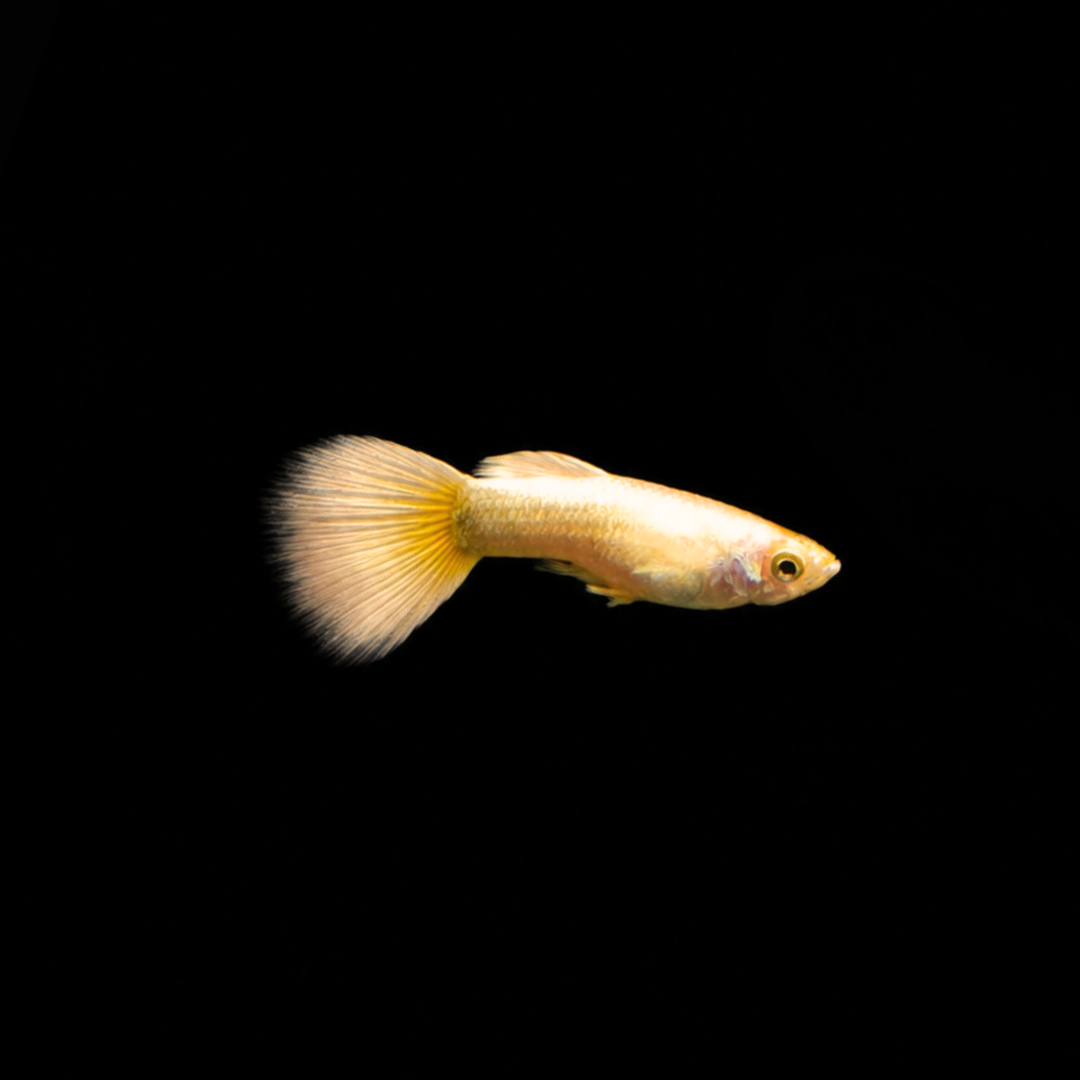
フルゴールデングッピー、フルゴールドグッピー、24Kゴールド(改良品種)Full Golden Guppy, Full Gold Guppy, 24K Gold (ornamental strain) |
| 分類 / Family |
カダヤシ目 カダヤシ科 ポエキリア属Cyprinodontiformes, Poeciliidae, genus Poecilia |
| 英名 / English Name |
Full Gold Guppy, 24K Gold Guppy |
| 分布 / Distribution |
原種のグッピーは、トリニダード島やベネズエラ、ブラジル北部など南米北部の淡水域に分布しています。フルゴールデングッピーは自然界には存在しない改良品種で、タイ、シンガポール、台湾、スリランカなどアジア各地の養殖場や、日本国内のブリーダーによって作出・維持されています。Wild guppies inhabit fresh waters of northern South America, including Trinidad, Venezuela, and northern Brazil. The Full Golden Guppy is an ornamental strain that does not occur in nature; it is produced and maintained by fish farms across Asia, such as in Thailand, Singapore, Taiwan, and Sri Lanka, and by breeders in Japan. |
| 最大体長 / Max Size |
オス約4cm、メス約6cmMales about 4 cm, females about 6 cm |
| 寿命 / Lifespan |
2〜3年程度About 2 to 3 years |
| 水槽サイズ / Tank Size |
鑑賞が目的であれば、30cmキューブ水槽(約27L)から飼育できます。繁殖や系統維持まで考える場合は、水量が多く水質が安定しやすい45cm規格水槽(約35L)〜60cm規格水槽(約57L)が理想的です。稚魚の育成や雌雄の分離に使える予備の水槽があると、管理の幅が大きく広がります。For display purposes, a 30 cm cube tank (about 27 L) is sufficient. If you plan to breed or maintain a line, a 45 cm standard tank (about 35 L) to a 60 cm standard tank (about 57 L) is ideal, as the larger water volume keeps conditions more stable. Spare tanks for raising fry and separating the sexes greatly expand what you can manage. |
| 水温 / Temperature |
24〜28℃(最適は26℃前後、飼育可能な範囲はおおむね20〜30℃)。発色を良くする目的で28℃以上に固定する必要はなく、水温が高すぎると酸欠や稚魚の奇形を招きやすくなります。冬場はヒーターで加温してください。
24 to 28°C (ideally around 26°C; tolerable range roughly 20 to 30°C). There is no need to hold the temperature at 28°C or higher to improve color, and excessive heat makes oxygen shortages and deformities in fry more likely. Use a heater in winter.
|
| 水質 / Water Quality |
pH 6.8〜7.8程度の弱酸性〜弱アルカリ性で、やや硬度のある水を好みます。軟水傾向の日本の水道水では、ろ過槽に少量のサンゴ砂やカキ殻を入れると調子が上がりやすいとされています。アンモニアと亜硝酸は検出されない状態に保ちましょう。数値を頻繁に調整するよりも、生物ろ過が十分に機能している水槽で安定した状態を保つことのほうが大切です。Prefers slightly acidic to slightly alkaline water of about pH 6.8 to 7.8 with some hardness. Where tap water is soft, as it often is in Japan, adding a small amount of coral sand or oyster shell to the filter is said to help the fish thrive. Keep ammonia and nitrite at undetectable levels. Maintaining stable conditions in a tank with well-functioning biological filtration matters more than frequently adjusting parameters. |
| レイアウト / Layout |
ウィローモスや水草で適度な隠れ家を作り、背景を暗い色や水草の緑にすると、黄金のシルエットが美しく引き立ちます。反対に、物陰のない真っ白な水槽で強い光を当て続けると、魚が落ち着かず、黄色みが薄れてクリーム色っぽく見えることがあります。照明は演色性の高いニュートラルな色合いのLEDを使い、タイマーで1日8〜10時間点灯させるのがおすすめです。ヒレの長い個体が疲れないよう、水流は緩やかに保ちましょう。Create moderate cover with willow moss or aquatic plants, and use a dark background or a backdrop of green plants to make the golden silhouette stand out. In contrast, keeping fish in a bare white tank under constant strong light can leave them unsettled and make the yellow fade toward cream. Neutral LED lighting with good color rendering, run on a timer for 8 to 10 hours a day, is recommended. Keep the water flow gentle so long-finned fish do not tire. |
| 注意点 / Precautions |
最も大切なのは、仕入れ先や産地の異なるグッピー同士をむやみに同じ水槽へ入れないことです。見た目は健康でも病原体を持っている個体がおり、抵抗力のない別系統と一緒にした結果、水槽全体が短期間で全滅してしまう例が知られています。また、外国産の個体は硬度が高く弱アルカリ性の水で育っていることが多いため、迎え入れた直後は急激なpHや水温の変化を避け、時間をかけて水に慣らしてください。リボン系やビッグドーサル系など長いヒレを持つ個体は、強い水流やヒレをかじる魚によってヒレを傷めやすい点にも注意が必要です。The most important rule is not to casually mix guppies from different suppliers or origins in the same tank. Some fish carry pathogens while looking perfectly healthy, and cases are known in which an entire tank was wiped out within a short time after such fish were combined with a line that had no resistance. Imported fish have often been raised in hard, slightly alkaline water, so avoid sudden changes in pH and temperature right after arrival and acclimate them gradually. Also note that long-finned fish, such as ribbon or big-dorsal types, easily suffer fin damage from strong currents or fin-nipping tank mates. |
| かかりやすい病気 / Common Diseases |
最も警戒されているのは、通称「グッピーエイズ」と呼ばれる、感染力が強く死亡率の高い病気です。人間のエイズとは関係がなく、原因ははっきりとは解明されていませんが、カラムナリス菌などの細菌感染が関わっていると考えられています。見た目は健康なまま病原体を持ち続ける個体がいるとされ、抵抗力のない個体と一緒にした直後から、異常な泳ぎ方や連続死が起こることがあります。また、繊毛虫の寄生によって起こる「テトラヒメナ症」(通称グッピー病)も代表的な脅威です。体表に白い塊が現れることもあれば、白点病と見分けにくい小さな白点程度にしか見えないこともあります。このほか、白点病や尾ぐされ病、ギロダクチルスなどの吸虫類やトリコディナといった寄生虫にも注意が必要です。The most feared disease is a highly contagious and often fatal condition known among hobbyists as “guppy AIDS.” It has nothing to do with human AIDS; its cause has not been fully established, but a bacterial infection, such as columnaris-type bacteria, is thought to be involved. Some fish are believed to carry the pathogen while appearing healthy, and abnormal swimming and successive deaths can begin soon after they are combined with fish that lack resistance. Tetrahymena infection, caused by a parasitic ciliate and often called “guppy disease,” is another major threat; it may appear as large white patches on the body or only as small white spots that are hard to tell apart from ich. Also watch for ich, fin rot, and parasites such as Gyrodactylus flukes and Trichodina. |
| 対策と予防 / Prevention |
新しく迎えた個体は、産地を問わずすぐに本水槽へ入れず、別の容器や水槽で数日〜1〜2週間ほど様子を見ます。必要に応じて塩水浴や、細菌感染症向けの魚病薬を用いた用法・用量どおりの薬浴を行いますが、薬浴をしたからといって別系統と一緒にしても安全だという保証にはなりません。どうしても別系統を合流させる場合は、トリートメントを終えたあと、双方からごく一部の個体だけを選んで別の容器で試しに同居させ、異常がないことを確かめてから全体を移すと安心です。購入時には、体表の白点や綿のような付着物、ヒレをたたんでいないか、呼吸が荒くないかを確認し、同じ水槽に痩せた個体や死んだ魚が混じっていないかも群れ全体で観察しましょう。なお、高濃度で短時間だけ薬浴させる方法はメーカーの推奨外で、魚への負担も大きいため避けてください。Regardless of origin, do not put new fish straight into the main tank; observe them in a separate container or tank for a few days to one or two weeks. Salt baths, or medicated baths with a fish medicine for bacterial infections used exactly as labeled, can be given as needed, but treatment alone does not guarantee that fish from different lines can then be mixed safely. If you must combine lines, after treatment select just a few fish from each side, house them together in a separate container as a trial, and move the rest only once no problems appear. When buying, check for white spots or cotton-like growths, clamped fins, and labored breathing, and look over the whole group to make sure there are no emaciated or dead fish in the same tank. Avoid short, high-concentration medicated baths; they are not recommended by manufacturers and are hard on the fish. |
| 雌雄の判別 / Sexing |
オスは小柄でスリムな体に大きな尾ビレと鮮やかな黄金のメタリックをまとい、尻ビレが細長い交接器(ゴノポディウム)に変化しています。メスは大柄で丸みがあり、尻ビレは扇形のままで、体色はオスより淡く控えめなのが一般的です。ただし高度に選別された系統では、メスでも背中から体側にかけて強い黄金光沢を示す個体が見られます。雌雄の違いは生後1ヶ月前後から現れ始めます。Males are small and slender, with a large caudal fin and vivid golden metallic coloring, and their anal fin is modified into a slender mating organ called the gonopodium. Females are larger and rounder, keep a fan-shaped anal fin, and are usually paler and more subdued in color than males. In highly selected lines, however, some females show a strong golden sheen from the back down the flanks. Differences between the sexes begin to appear at around one month of age. |
| 繁殖形態 / Reproduction |
メスの体内で卵がふ化し、稚魚の姿で産み落とす卵胎生です。オス1匹に対してメス2〜3匹(多頭飼育ならオス1〜2匹に対してメス3〜5匹)の割合で飼うと自然に交配し、メスは4〜5週間ごとに20〜35匹程度の稚魚を産みます。メスは一度の交尾で受け取った精子を体内に蓄えておくことができ、オスと離したあとも数ヶ月にわたって何度か出産します。A livebearer: eggs hatch inside the female, and she gives birth to free-swimming fry. Kept at a ratio of one male to two or three females (or one to two males to three to five females in larger groups), they breed naturally, and females produce about 20 to 35 fry every four to five weeks. A female can store sperm from a single mating and will give birth several times over a period of months even after being separated from males. |
| 繁殖のポイント / Breeding Tips |
メスには精子を蓄える性質があるため、購入した成魚のメスは、すでに別系統のオスと交尾している可能性があります。系統を守るには、雌雄の区別がつき始める生後1ヶ月前後(遅くとも6週目)に雌雄を別々の水槽へ分け、交尾していないメスを育てることが大切です。選別は生後2ヶ月ごろに一次、3ヶ月ごろに最終を行います。背中だけに光沢が乗って体側の下半分が抜ける部分的な発色の個体、白っぽいクリーム色に薄れた個体、背骨の曲がった個体や成長の悪い個体は、親に使わないようにしましょう。色だけで選ばず、力強く泳ぎ、背骨がまっすぐな個体を優先することが系統維持の基本です。また、外見が似ていても、出自の異なるフルプラチナとの交配は中途半端なクリーム色の子を生みやすいため避けてください。近い血縁同士の交配を続けると体の小型化や奇形が増えるため、3〜5世代に一度は血統のはっきりした同じ品種を導入するか、複数の系統を並行して維持し、交互に掛け合わせると安定します。リボン系はオスの交接器も長く伸びて交尾が難しくなるため、繁殖にはノーマル(非リボン)のオスとリボンのメスを組み合わせます。出産が近いメスは、照明を落とした静かな環境で見守ってください。Because females store sperm, an adult female you buy may already have mated with a male from another line. To protect a line, separate males and females into different tanks at around one month of age (six weeks at the latest), when the sexes become distinguishable, and raise unmated females. Make a first selection at about two months and a final selection at about three months. Do not use as parents fish with partial coloring, where the sheen covers only the back and the lower flanks are bare, fish whose gold has faded to a whitish cream, or fish with bent spines or poor growth. The basic rule of line maintenance is to prioritize strong swimmers with straight backbones rather than choosing on color alone. Also avoid crossing with Full Platinum guppies of a different origin even if they look similar, since such crosses tend to produce offspring of an in-between cream color. Continued mating between close relatives increases dwarfing and deformities, so introduce a well-documented fish of the same strain every three to five generations, or keep several lines in parallel and cross them in rotation. In ribbon strains the male’s gonopodium also elongates, which makes mating difficult, so pair a normal (non-ribbon) male with a ribbon female. Keep females close to giving birth in a quiet, dimly lit environment. |
| 1. 「フルゴールド」と「24Kゴールド」は何が違う? / 1. What Is the Difference Between “Full Gold” and “24K Gold”? |
ショップや通販で「フルゴールデン」「フルゴールド」「24Kゴールド」と書かれた札を見比べて、別の品種なのだろうかと首をかしげた方も多いかもしれません。実はこれらはいずれも「全身が黄金色でメタリックに輝く単色系」を指す流通上の呼び名で、学術的に区別された品種名ではありません。海外の愛好家の間では、体の一部にそばかすのような斑や銅色の光沢が混じる系統を広い意味でフルゴールドと呼び、全身がより均一で強い金属光沢を放つ選び抜かれた系統を「24Kゴールド」や「ジャーマンゴールド」と呼び分ける習慣があるとされます。ただ、この呼び分けに国際的な決まりはなく、通常のグレードの個体が24Kの名で売られていることも珍しくありません。日本国内では「ゴールデンスーパーフルプラチナ」という呼び名も見かけますが、これもフルゴールドとの境目がはっきりしない名前のひとつです。名前に頼るよりも、親魚の血統や実際の発色を自分の目で確かめることが、理想の一匹に出会う近道といえます。Many hobbyists have compared labels reading “Full Golden,” “Full Gold,” and “24K Gold” in a shop or online and wondered whether they are different strains. In fact, all of these are trade names for solid-colored fish that shine gold and metallic over the whole body, not scientifically distinguished strain names. Among overseas hobbyists there is said to be a custom of calling lines with freckle-like spots or a coppery sheen on parts of the body “Full Gold” in the broad sense, while reserving names such as “24K Gold” or “German Gold” for highly selected lines with a more uniform and intense metallic sheen. There is no international rule for this distinction, however, and it is not unusual to see ordinary-grade fish sold as 24K. In Japan you may also see the name “Golden Super Full Platinum,” another label whose boundary with Full Gold is unclear. Rather than relying on the name, checking the parent stock and the actual coloring with your own eyes is the surest way to find the fish you want. |
| 2. 日本と欧米で意味が食い違う「ゴールデン」 / 2. “Golden” Means Different Things in Japan and the West |
グッピーの遺伝を調べようと海外の資料を読み始めると、多くの人が「ゴールデン」という言葉でつまずきます。グッピーには、黒い色素の働きを弱めて体を明るい黄色に見せる、劣性遺伝の体色の変異が主に2種類あります。そのひとつ(遺伝子記号 bb)を、日本では「ゴールデン」と呼んでいます。2010年代の研究によって、この変異は adcy5 という遺伝子の変化によるもので、黒い色素を持つ細胞(黒色素胞)が一つひとつ小さくなることなどで黒みが弱まることが明らかにされました。ところが欧州ではこの bb を「ブロンド」、米国では「ゴールド」と呼びます。もうひとつの変異(gg)は kita という遺伝子が働かなくなったもので、黒色素胞の数そのものが大きく減り、ウロコの縁に黒みが残る独特の姿になります。こちらは欧州で「ゴールデン」、米国で「ブロンズ」、そして日本では「タイガー」と呼ばれています。つまり同じ「ゴールデン」という言葉でも、日本と欧州ではまったく別の遺伝子を指しているのです。さらに、黄色を担う細胞(黄色素胞)がつくられるには csf1ra という遺伝子が欠かせず、この遺伝子が働かない系統では黄色素胞が正常に形成されないこともわかっています。フルゴールデングッピーの濃い黄金色は、黒みを弱める変異を持ちながらも、黄色素胞を育てる仕組みがしっかり保たれていることで成り立っていると考えられています。Many people who start reading overseas material on guppy genetics stumble over the word “golden.” Guppies have two main recessive body-color mutations that weaken black pigment and make the body look bright yellow. In Japan, one of them (gene symbol bb) is called “Golden.” Research in the 2010s showed that this mutation is a change in a gene called adcy5, and that the darkness fades partly because each black pigment cell (melanophore) becomes smaller. In Europe, however, this same bb is called “Blond,” and in the United States it is called “Gold.” The other mutation (gg) is a loss of function in a gene called kita; it greatly reduces the number of melanophores and produces a distinctive look with dark edges remaining on the scales. This one is called “Golden” in Europe, “Bronze” in the United States, and “Tiger” in Japan. In other words, the same word “Golden” refers to completely different genes in Japan and Europe. It is also known that a gene called csf1ra is essential for forming the yellow pigment cells (xanthophores), and that lines in which this gene does not work fail to form them normally. The rich gold of the Full Golden Guppy is thought to depend on carrying mutations that weaken black while keeping the system that produces yellow pigment cells fully intact. |
| 3. 黄金の輝きを生む「色素細胞のミルフィーユ」 / 3. The Layered Pigment Cells Behind the Golden Glow |
フルゴールデングッピーの金属的な輝きは、体が黄色いだけのゴールデン体色とは仕組みが異なります。皮膚の奥では、光を強く反射する白っぽい層(虹色素胞や白色素胞)の上に黄色素胞が重なる、ミルフィーユのような構造ができていると考えられています。面白いのは細胞同士の関係です。黒色素胞には近くの黄色素胞を押しのけてしまう性質があるとされますが、白い色素細胞が両者の間に入って仕切りの役目を果たすことで、黄色素胞が表面近くでたっぷりと増えられるようになると説明されています。一般的なメタルグッピーが青緑がかった光沢を帯びるのに対し、フルゴールドが青みの少ない純粋な黄金色に輝くのは、こうした層の構造に加えて、別のメタリック因子が関わっているためと考えられています。また、黄色素胞の中の色素は集まったり広がったりできるため、ストレスや照明の具合によって黄色みの見え方が変わります。同じ個体でも、落ち着いた環境では深い黄金色に、驚いた直後には少し淡く見えることがあるのはこのためです。The metallic glow of the Full Golden Guppy works differently from a golden body color that is simply yellow. Deep in the skin, a layered structure is thought to form, with yellow pigment cells stacked on top of a whitish, highly reflective layer of iridophores and leucophores. The relationship between the cells is what makes this interesting. Black pigment cells are said to push neighboring yellow pigment cells aside, but white pigment cells are explained to slip between them and act as a partition, allowing the yellow cells to multiply abundantly near the surface. Typical metallic guppies have a blue-green sheen, while Full Gold shines a pure gold with little blue, which is thought to involve a separate metallic factor in addition to this layered structure. Because the pigment inside yellow pigment cells can gather or spread, the yellow looks different depending on stress and lighting. That is why the same fish may look deep gold in a calm tank and slightly paler right after being startled. |
| 4. ゴールドとプラチナは「表と裏」の関係 / 4. Gold and Platinum: Two Sides of the Same Coin |
黄金色のフルゴールドと白金色のフルプラチナは、見た目こそ対照的ですが、遺伝的にはとても近い関係にあると考えられています。現代の海外ブリーダーの間では、両者はハーフブラック(タキシード)系やメタル系の遺伝子といった共通の土台を持ち、そこから黄色素胞を強める方向へ仕上げたものがゴールド、抑える方向へ仕上げたものがプラチナだと整理されることがあります。一方、日本の伝統的な系統図では、フルゴールドは「ソリッド」と呼ばれる遺伝子を持ち、プラチナ遺伝子は持たない系統として、プラチナ系とははっきり区別されてきました。解釈は分かれるものの、ブリーダーが引き出す結論は共通しています。黄色素を強める方向と抑える方向という正反対の性質を持つ両者を安易に掛け合わせると、子の世代に黄ばんだプラチナや中途半端なクリーム色が生まれやすく、せっかくの系統の純度が崩れてしまうのです。また、メタル系の遺伝子は2つそろうと全身に、1つだけだと背中側だけに発色がとどまりやすいとも言われており、全身の均一な黄金色がいかに繊細なバランスの上に成り立っているかがうかがえます。Golden Full Gold and white-gold Full Platinum look like opposites, but they are thought to be genetically very close. Some modern overseas breeders describe the two as sharing a common foundation, such as half-black (tuxedo) and metallic genes, with gold being the version finished toward enhancing yellow pigment cells and platinum the version finished toward suppressing them. Traditional Japanese pedigree charts, on the other hand, have clearly separated them, treating Full Gold as a line that carries a gene called “solid” but not the platinum gene. The interpretations differ, but breeders draw the same practical conclusion: casually crossing two types that push yellow pigment in opposite directions tends to produce yellowish platinum or in-between cream offspring and breaks down the purity of the line. It is also said that metallic genes produce full-body color when two copies are present but tend to stay on the back when only one is present, which shows how delicate the balance behind a uniform full-body gold really is. |
| 5. 1990年の転機と、アジアと日本をめぐる黄金の循環 / 5. A Turning Point Around 1990 and the Golden Cycle Between Asia and Japan |
フルゴールデングッピーがいつ、どこで初めて作られたのかを示す確かな記録は見つかっておらず、その系譜ははっきりしていません。それでも歴史の大きな転機として語られているのが、1990年ごろにプラチナ遺伝子がヨーロッパから日本へもたらされたという出来事です。日本の名ブリーダーは、この遺伝子のルーツを「プラチナソード」にあると推測していたとされます。この強い金属光沢の形質が、当時すでに完成度の高かったドイツイエロータキシードなどのタキシード系と組み合わされたことで、1990年代以降、白金系・黄金系の系統づくりが大きく進んだと考えられています。現在では、24Kゴールドやリボン、ビッグドーサルといった華やかな黄金系統の多くが、タイやシンガポール、台湾、スリランカの養殖場で生み出されています。それらが日本へ輸入されると、今度は日本のブリーダーが国産のゴールドタキシードなどと掛け合わせて発色を濃く磨き上げ、日本の水に慣れた国産系統へと育てていきます。海を越えて黄金色が受け継がれ、磨かれていく循環は、今も続いているのです。No reliable record has been found of when or where the Full Golden Guppy was first created, and its lineage remains unclear. Even so, one event is often described as a major turning point: the arrival of the platinum gene in Japan from Europe around 1990. A renowned Japanese breeder is said to have suspected that this gene traced back to the “Platinum Sword.” Combining this strongly metallic trait with tuxedo lines such as the already highly refined German Yellow Tuxedo is thought to have greatly advanced the development of platinum and golden lines from the 1990s onward. Today many of the showy golden lines, such as 24K Gold, ribbon, and big-dorsal types, are produced on fish farms in Thailand, Singapore, Taiwan, and Sri Lanka. Once they are imported to Japan, local breeders cross them with domestic lines such as Gold Tuxedo to deepen the color, developing domestic lines adapted to Japanese water. This cycle of gold being passed across the sea and refined continues today. |
| 6. 品評会では「穴場」の部門? / 6. An Underrated Category at Shows? |
グッピーの品評会は、国や団体によって審査の考え方が大きく異なり、フルゴールド系の立ち位置にもその違いが表れています。欧州の基準では、体やヒレがどれだけ均一に色で覆われているかが厳しく問われ、尾ビレの色の乗りが不完全だと大きく減点されるほか、背骨の曲がりなどの奇形は失格になるとされます。米国では、既存の部門に収まらない単色系が「その他の色」の部門に振り分けられることが多く、黄色系の部門は伝統的に出品数が少なかったと言われています。シンガポールでも近年のメタル部門はプラチナレッド系が上位を占めていますが、これはゴールド系の質が劣るからではなく、取り組むブリーダーが少なく競争が育っていないためだと見られています。日本にはオス3匹とメス1匹の計4匹で審査する部門があり、オスのそろい具合やメスの質、系統づくりの難しさまで評価に含める点が世界的にも珍しいとされます。全身の黄金色の乗り、メスの発色、ヒレの張りを高い水準でそろえたフルゴールド系統は、品評会の世界で大きな存在感を示せる可能性を秘めています。Guppy shows differ greatly in judging philosophy from country to country and organization to organization, and this is reflected in where Full Gold stands. European standards are said to be strict about how uniformly the body and fins are covered in color, with heavy deductions for incomplete color on the caudal fin and disqualification for deformities such as a bent spine. In the United States, solid colors that do not fit existing classes are often placed in an “any other color” class, and yellow classes are said to have traditionally drawn few entries. In Singapore, too, recent metallic classes have been dominated by platinum-red types, but this is seen not as a sign of lower quality in gold lines but as the result of too few breeders working with them for competition to develop. Japan has a class judged on a set of three males and one female, which evaluates how well the males match, the quality of the female, and even the difficulty of establishing the line, an approach said to be unusual worldwide. A Full Gold line that achieves full-body gold, a well-colored female, and well-spread fins at a high level has the potential to make a real mark in the show world. |
| 7. 東南アジアでは「上から眺める」黄金 / 7. Gold Viewed From Above in Southeast Asia |
日本では熱帯魚といえばガラス水槽を横から眺めるのが一般的ですが、24Kゴールドやフルゴールドが広く親しまれている東南アジアでは、屋外の池や睡蓮鉢で飼育し、上から楽しむ愛好家も多いと伝えられています。そこには気候や設備の事情だけでなく、光の当たり方という理由もあるようです。フルゴールドの背中から体側にかけて密に並ぶ虹色素胞は、頭上から降り注ぐ自然光を受けることで反射がいっそう際立ち、横から見る以上に強い光沢を放つとされます。日本の改良メダカが「上見」の美しさを追い求めて発展してきたことを思うと、遠く離れた熱帯の地でも上から眺める黄金の美学が息づいているのは、興味深い共通点です。機会があれば、室内の水槽でも斜め上から覗き込むようにして、背中の輝きを味わってみてください。In Japan, tropical fish are usually viewed from the side through a glass tank, but in Southeast Asia, where 24K Gold and Full Gold are widely loved, many hobbyists reportedly keep them in outdoor ponds or water lily bowls and enjoy them from above. This seems to be not only a matter of climate and equipment but also of how light falls on the fish. The iridophores packed along the back and upper flanks of a Full Gold are said to reflect overhead sunlight even more strikingly, giving off a stronger sheen than when seen from the side. Considering that Japanese ornamental medaka developed by pursuing beauty viewed from above, it is an intriguing parallel that the same top-down aesthetic thrives in the distant tropics. If you get the chance, try looking down into your indoor tank at an angle to enjoy the shine along the back. |
| 8. 安価な「ミックスグッピー」は雑種ではない / 8. Inexpensive “Mixed Guppies” Are Not Hybrids |
ホームセンターなどで手頃な価格で売られている外国産の「ミックスグッピー」は、養殖場でいろいろな品種が入り混じって生まれた雑種だと思われがちです。しかし実際には、海外の大規模な養殖場では品種ごとに池を分けて計画的に繁殖させており、出荷の際に現地のスタッフがサイズと品種を選り分けたうえで、バランスよく混ぜて送り出しているとされています。だからこそ、安価なミックスの中にも、フルゴールデンやコブラ、タキシードといったはっきりした品種の特徴を持つ個体が混じっていることがあるのです。水槽の中で思いがけず黄金色に輝く一匹を見つけたら、その背後には遠い国の池で品種ごとに大切に育てられてきた系統があるのだと想像してみてください。きっと、また違った愛着が湧いてくるはずです。The inexpensive imported “mixed guppies” sold at home centers and similar stores are often assumed to be hybrids born from many strains interbreeding on the farm. In reality, large overseas farms are said to breed each strain separately in its own pond, with local staff sorting fish by size and strain at shipping time and then mixing them in balanced proportions. That is why a cheap mixed batch can sometimes include fish with clear strain traits, such as Full Golden, Cobra, or Tuxedo. If you unexpectedly find one fish glowing gold in your tank, try picturing the line behind it, carefully raised strain by strain in ponds in a faraway country. You will likely find a whole new kind of affection for it. |
| 9. 黄金色の原点は「メスに選ばれるための色」 / 9. The Origin of Gold: Colors for Winning Females |
グッピーは、脊椎動物の中でも際立って多彩な体色を持つことから、世界中の進化生物学者に研究されてきた生き物です。野生のグッピーのメスは、より大きく鮮やかなオレンジ色の斑を持つオスを好んで選ぶことが知られており、こうした「メスによる選り好み(性選択)」が、オスの派手な色彩を磨き上げてきたと考えられています。オスの体色は成長とともに少しずつ現れ、光を反射する虹色素胞、黒い斑、オレンジ色の斑といった要素が段階的に加わって完成していきます。近年の遺伝子の働きを調べた研究では、オレンジ色の斑は黄色系の色素細胞が新しく生まれるというより、すでにある細胞が Csf1 という因子や甲状腺ホルモンの働きによってもう一段階成熟する「二次分化」によって形づくられることが示唆されています。つまり、オスの鮮やかな色は、体の中の信号に導かれて色素細胞が段階的に仕上がっていくことで生まれるのです。アクアリストが長い年月をかけて磨いてきたフルゴールデングッピーの全身の黄金色も、野生のグッピーが進化させてきたこの色彩の仕組みの延長線上にある姿と見ることができるでしょう。若いオスがだんだんと金色に染まっていく過程を観察すると、その長い物語を水槽の中で追体験できます。Guppies have been studied by evolutionary biologists around the world because their coloration is exceptionally diverse even among vertebrates. Wild female guppies are known to prefer males with larger, more vivid orange spots, and this female choice, known as sexual selection, is thought to have refined the males’ showy colors. A male’s coloration appears gradually as he grows, completed in stages as elements such as light-reflecting iridophores, black spots, and orange spots are added. Recent research on gene activity suggests that orange spots form not so much from newly generated yellow-type pigment cells as from a “secondary differentiation,” in which existing cells mature one step further under the influence of a factor called Csf1 and thyroid hormone. In other words, a male’s vivid color arises as pigment cells are finished in stages, guided by signals within the body. The full-body gold of the Full Golden Guppy, refined by aquarists over many years, can likewise be seen as an extension of the color system that wild guppies evolved. Watching a young male gradually turn gold lets you relive that long story right in your tank. |
| 10. 「くらってる」と「グッピーに始まりグッピーに終わる」 / 10. “Kuratteru” and “It Begins and Ends With Guppies” |
日本のグッピー愛好家や専門店の間では、グッピーエイズの病原体を持っている個体や水槽のことを、俗に「くらってる」と表現する独特の言い回しがあります。見た目には元気いっぱいに輝いている魚ほど、ほかの系統と混ぜた途端に思わぬ惨事を招くことがある。その怖さを短い言葉で言い表した、現場ならではの知恵といえるでしょう。また、熱帯魚の世界には古くから「グッピーに始まり、グッピーに終わる」という格言があります。グッピーは誰でも気軽に飼い始められる一方で、フルゴールドのような単色メタリック系統の遺伝や色素細胞の仕組み、雌雄の分離と選別、品評会を見据えた系統づくりにひとたび踏み込めば、生涯をかけても探求し尽くせないほどの奥深さが待っています。手軽な観賞魚としての親しみやすさと、緻密な育種の対象としての懐の深さ。その両方を最もわかりやすく体現している品種のひとつが、フルゴールデングッピーなのです。Among Japanese guppy enthusiasts and specialist shops, there is a distinctive slang expression, “kuratteru” (roughly, “it’s been hit”), for fish or tanks that carry the guppy AIDS pathogen. The fish that look the liveliest and shiniest can be the very ones that bring unexpected disaster the moment they are mixed with another line. The phrase captures that danger in a single word and reflects hard-won practical wisdom. The tropical fish world also has a long-standing saying: “It begins with guppies and ends with guppies.” Anyone can start keeping guppies with ease, but once you step into the genetics and pigment cells of a solid metallic line like Full Gold, separating and selecting males and females, and building a line with shows in mind, you find a depth you could explore for a lifetime. Approachable as an easy display fish and deep as a subject of meticulous breeding, the Full Golden Guppy is one of the clearest embodiments of both sides. |










コメント