

解説 / Description
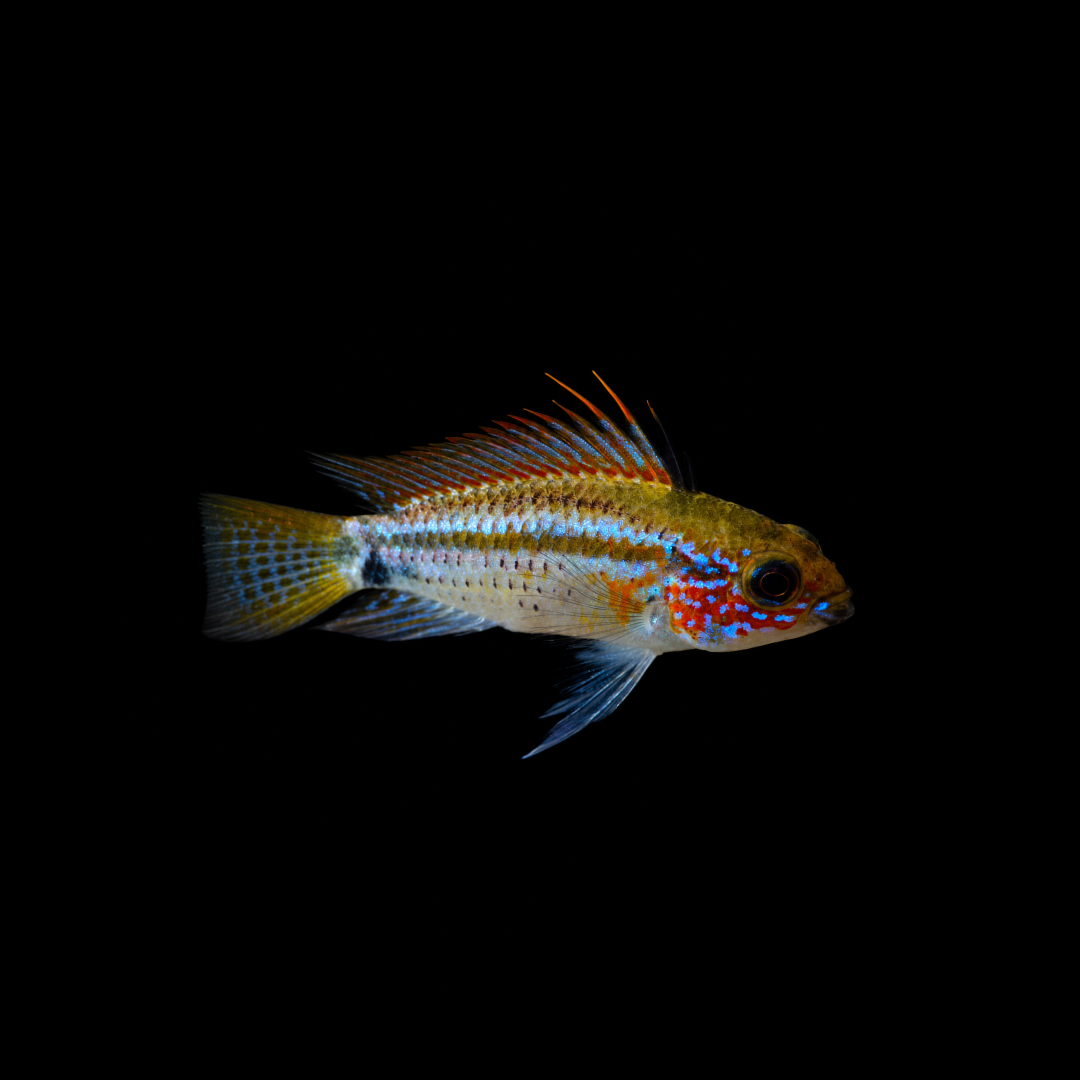
アピストグラマ・エレムノピゲは、ペルー北東部のイタヤ川水系から記載された小型のドワーフシクリッドです。雌雄ともに尾柄の下部へ現れる明瞭な暗色斑が重要な識別点で、2004年の原記載では本種を特徴づける形質として示されています。成熟したオスは頬から鰓蓋に赤と青の模様が入り、背びれにはマルーン、オレンジ、青系の色彩が重なります。さらに、背びれ前方の棘条間膜と尾びれ上下の鰭条が伸び、細身の体型とともに華やかな印象を作ります。日本では「ディアマンテ」の流通名でも知られています。飼育では、弱酸性の軟水を安定させ、穏やかな水流と十分な隠れ場所を用意することが基本です。とくに輸入直後の個体と繁殖期の縄張り争いでは、急な環境変化や逃げ場不足を避ける必要があります。 Apistogramma eremnopyge is a small dwarf cichlid described from the Río Itaya drainage of northeastern Peru. A conspicuous dark blotch on the lower caudal peduncle, present in both sexes, is an important diagnostic feature emphasized in the original 2004 description. Mature males show red and blue markings across the cheek and operculum, with maroon, orange, and bluish tones in the dorsal fin. The anterior dorsal-fin lappets and the upper and lower caudal-fin rays also become elongated, contributing to the fish’s ornate appearance. In Japan it is also known by the trade name “Diamante.” Successful aquarium care centres on stable soft acidic water, gentle flow, and ample cover. Newly imported fish and breeding pairs require particular care to avoid abrupt environmental changes and insufficient refuge from territorial aggression.
基本情報 / Basic Information
| 学名 / Scientific Name | Apistogramma eremnopyge Ready & Kullander, 2004 |
|---|---|
| 通称 / Common Name | エレムノピゲ、ディアマンテ、バルバロハEremnopyge, Diamante, Barbaroja |
| 分類 / Family | カワスズメ目(Cichliformes)・シクリッド科(Cichlidae)・ゲオファーグス亜科(Geophaginae)・アピストグラマ属Order Cichliformes, family Cichlidae, subfamily Geophaginae, genus Apistogramma |
| 英名 / English Name | Blue Dwarf Cichlid |
| 分布 / Distribution | ペルー北東部ロレト州、イキトス近郊のイタヤ川水系ピントゥヤク川。少なくとも確実な産地記録として、この水系から知られています。Río Pintuyacu in the Río Itaya drainage near Iquitos, Loreto, northeastern Peru. This drainage represents the securely documented locality for the species. |
| 最大体長 / Max Size | 原記載のタイプ標本では、最大のオスが34.4mm標準体長、ホロタイプのメスが28.2mm標準体長です。標準体長は尾びれを含まない測定値です。観賞魚としては成熟したワイルド個体が全長5cm前後とされることがありますが、本種の確実な最大全長を示す公表データは限られています。In the original type series, the largest male measured 34.4 mm standard length and the holotype female measured 28.2 mm standard length. Standard length excludes the caudal fin. Mature wild aquarium specimens are sometimes reported at around 5 cm total length, but robust published data establishing the species’ maximum total length are limited. |
| 寿命 / Lifespan | 本種だけを対象にした信頼できる寿命データはほとんどありません。飼育年数は導入時の状態、水温、餌、水質の安定性などに左右されるため、特定の年数を本種の標準寿命として示すのは適切ではありません。Reliable species-specific lifespan data are scarce. Longevity varies with the condition of the fish at introduction, temperature, diet, and water stability, so a fixed number of years should not be treated as a standard lifespan for this species. |
飼育環境 / Aquarium Environment
| 水槽サイズ / Tank Size | ペア単独でも60cm規格水槽(60×30×36cm、約57L)を基本の目安にすると管理しやすいです。より小さな水槽での繁殖例はありますが、繁殖期には追尾が強くなるため、逃げ場を確保できる底面積を優先します。混泳や複数個体の飼育では、さらに余裕のある水槽と十分な視覚的遮蔽物が必要です。For a dedicated pair, a standard Japanese 60 cm aquarium (60 × 30 × 36 cm, about 57 L) is a practical baseline. Breeding has been achieved in smaller tanks, but spawning aggression makes floor area and escape routes especially important. Community or multi-fish setups require additional space and strong visual separation between territories. |
|---|---|
| 水温 / Temperature | 飼育の目安は22〜28℃で、日常管理では24〜27℃前後を安定して保つと扱いやすいです。高温側へ大きく振る必要はなく、日本の夏は長時間の過昇温を避けます。野外で一時的な高水温が記録された例はありますが、その値を水槽の常用温度として再現する必要はありません。 A practical aquarium range is 22–28°C, with about 24–27°C being convenient for routine maintenance. There is no need to maintain the fish near the upper extreme, and prolonged overheating should be avoided during Japanese summers. Occasional high field measurements should not be interpreted as target aquarium temperatures. |
| 水質 / Water Quality | 弱酸性の軟水を基本とし、飼育資料ではpH4.0〜6.0程度の範囲が示されています。ただし、pH4付近まで下げること自体を目的にせず、低硬度の水を安定させることを優先します。馴化した個体がより中性寄りの水に対応する例はありますが、繁殖では軟水・酸性側の条件が適しています。RO水を使う場合も、急激なpH変化を起こさないよう水換え前後の差を小さくします。Soft acidic water is preferred, and aquarium references commonly give a range around pH 4.0–6.0. Reaching pH 4 should not be a goal in itself; stable low-hardness water is more important. Acclimated fish may tolerate conditions closer to neutral, but breeding is better supported by soft acidic conditions. When using RO water, avoid abrupt changes and keep differences in hardness and pH between old and replacement water small. |
| レイアウト / Layout | 細かな砂または暗色系の薄い底床に、流木、枝、落ち葉、石やココナッツシェルターなどを組み合わせ、互いの姿が見え続けない場所を複数作ります。水草は必須ではなく、落ち葉と流木を使った陰の多いレイアウトでも自然な行動を引き出せます。照明は強くしすぎず、スポンジフィルターなどで穏やかな水流を作ると落ち着きやすくなります。Use fine sand or a thin dark substrate with driftwood, branches, leaf litter, stones, and cave-like shelters such as coconut shells. Arrange the decor so fish are not continuously in one another’s line of sight. Aquatic plants are optional; a shaded layout based on leaf litter and wood can also support natural behaviour. Avoid overly bright lighting and use gentle filtration such as a sponge filter. |
| 注意点 / Precautions | 輸入直後のワイルド個体では、痩せやヒレ傷など輸送由来のダメージが見られることがあります。まず食欲、呼吸、体表、ヒレの状態を確認し、水質を急変させずに馴化させます。また、繁殖期にはメスの縄張り意識が強まり、狭い水槽ではオスが追い詰められることがあります。必要に応じてすぐ隔離できるよう、予備水槽や仕切りを準備しておくと安全です。Recently imported wild fish may show transport-related weight loss or fin damage. Check appetite, respiration, skin, and fins, and acclimate the fish without abrupt changes in water chemistry. During breeding, females may become strongly territorial and can trap a male in a confined aquarium. A spare tank or divider should therefore be available if separation becomes necessary. |
餌と給餌 / Feeding
| 餌の種類 / Diet | アピストグラマ属らしく、小型の無脊椎動物などを食べる小型捕食者として扱います。飼育下では冷凍アカムシ、ミジンコ、ブラインシュリンプ、小型の生餌、小粒の沈下性人工飼料などを組み合わせます。馴化した個体は人工飼料にも慣れますが、単一の餌へ偏らせない方が状態を整えやすくなります。Like other Apistogramma, it is best treated as a small predator that feeds largely on small invertebrate prey. In aquaria, offer frozen bloodworms, daphnia, brine shrimp, suitable small live foods, and small sinking prepared foods. Acclimated fish usually accept commercial diets, but a varied feeding routine is preferable to reliance on a single food. |
|---|---|
| 給餌のポイント / Feeding Tips | 1日1〜2回、短時間で食べ切れる量を基本にします。輸入個体の立ち上げや繁殖前のコンディショニングでは、生餌や冷凍餌を交えると食欲を引き出しやすくなります。小型の軟水水槽では食べ残しが水質へ影響しやすいため、与え過ぎは避けます。稚魚には自由遊泳後から孵化直後のブラインシュリンプを少量ずつ与え、落ち葉に生じる微小生物は補助的な餌として利用できます。Feed once or twice daily in portions that are eaten quickly. Live or frozen foods can help stimulate feeding in newly imported fish and condition adults before spawning. Avoid overfeeding because leftovers can destabilize small soft-water aquaria. Once the fry are free-swimming, offer small amounts of newly hatched brine shrimp; microfauna developing around leaf litter can provide supplementary food. |
性格と混泳 / Temperament and Tank Mates
| 性格 / Temperament | 縄張り性を持つシクリッドで、落ち葉や流木、シェルターの周囲を生活圏として使います。明るすぎる環境や隠れ場所の少ない水槽では姿を隠しがちです。繁殖期になると縄張り行動が強まり、とくに卵や稚魚を守るメスは近づく魚を激しく追い払います。It is a territorial cichlid that uses areas around leaf litter, wood, and shelters as its living space. In overly bright or sparsely furnished tanks it may remain hidden much of the time. Territorial behaviour intensifies during breeding, and a female guarding eggs or fry can become highly defensive toward fish approaching the brood area. |
|---|---|
| 混泳の相性 / Compatibility | 十分な広さと隠れ場所があれば、温和な小型カラシンやペンシルフィッシュなどと飼育できます。ただし、繁殖を優先する場合はペアを専用水槽で管理する方が状況を把握しやすくなります。小型のエビ類や、ごく小さな魚は捕食される可能性があります。同属魚や他の底層性シクリッドとは縄張りが重なりやすいため、混泳させる場合は十分な底面積と複数の視覚的な仕切りが必要です。With sufficient space and cover, it can be kept with peaceful small tetras or pencilfish. A dedicated pair aquarium is easier to monitor when breeding is the priority. Small shrimp and very small fish may be treated as prey. Other Apistogramma and bottom-oriented cichlids compete for similar territories, so mixed setups require ample floor space and several visual barriers. |
病気と対策 / Diseases and Prevention
| かかりやすい病気 / Common Diseases | 本種に特有の病気が知られているわけではありません。一般的な淡水魚と同様に、輸送ストレスや水質悪化が重なると、ヒレの傷み、白点病などの外部寄生虫症、細菌性感染などが問題になることがあります。ワイルド個体では、食欲があるのに痩せ続ける、糞の状態が長く乱れるといった変化も観察します。No disease is known to be unique to this species. As with other freshwater fish, transport stress and poor water quality can contribute to fin damage, external parasite problems such as ich, and opportunistic bacterial infections. In wild fish, continued weight loss despite feeding or persistent abnormal feces should also be monitored. |
|---|---|
| 対策と予防 / Prevention | 新規導入魚は可能なら別水槽で観察し、食欲、呼吸、糞、体表、ヒレの状態を確認してから本水槽へ移します。軟水環境では水換え量そのものよりも、交換前後の水温・硬度・pHの差を小さくすることが重要です。食べ残しや過度なデトリタスの蓄積を避け、症状が出た場合は原因を決めつけず、実際の状態に合った対処を行います。Whenever possible, observe new fish separately before introduction, checking appetite, respiration, feces, skin, and fins. In soft-water systems, the key point during water changes is to minimise differences in temperature, hardness, and pH between old and replacement water. Avoid uneaten food and excessive detritus, and if symptoms appear, choose treatment according to the observed condition rather than assuming a diagnosis from the species alone. |
増やし方(繁殖) / Breeding
| 雌雄の判別 / Sexing | 成熟したオスはメスより大きく、背びれ前方では棘条間膜が長く伸び、尾びれの上側と下側の鰭条も伸長します。頬や鰓蓋には赤と青の模様が強く現れ、ヒレも華やかになります。メスは小型でヒレが丸みを帯び、育児期には黄色が強くなって黒い模様とのコントラストが明瞭になります。尾柄下部の暗色斑は雌雄に共通する特徴です。Mature males are larger, with elongated anterior dorsal-fin lappets and extended upper and lower caudal-fin rays. Red and blue cheek and opercular markings become stronger and the fins become more ornate. Females are smaller with rounder fins and develop stronger yellow brood-care coloration with contrasting dark markings. The dark lower caudal-peduncle blotch is present in both sexes. |
|---|---|
| 繁殖形態 / Reproduction | 洞窟産卵型で、メスが流木の下、石の隙間、ココナッツシェルターなどの内側へ産卵します。メスが卵と仔魚の近くを中心に守り、オスはより広い範囲で縄張り行動を示します。産卵数は親魚の大きさや状態で変わるため、固定した数として考えない方が適切です。This is a cave-spawning cichlid. The female deposits eggs on protected interior surfaces beneath wood, between stones, or inside cave-like shelters. She performs most direct care close to the eggs and fry, while the male shows territorial behaviour over a broader area. Clutch size varies with the condition and size of the parents and should not be treated as a fixed species value. |
| 繁殖のポイント / Breeding Tips | 繁殖を狙う場合は、非常に軟らかい弱酸性水、落ち着ける環境、複数の産卵シェルターを用意します。水温は飼育適温内で安定させ、急激なpH操作ではなく、低硬度の水を使った穏やかな部分換水で状態を整えます。産卵後にメスがオスを激しく追う場合は、オスを隔離した方が安全です。自由遊泳を始めた稚魚には孵化直後のブラインシュリンプを少量ずつ与えます。アピストグラマ属では、初期発育期の水温が子の性比へ影響することが複数種で実験的に示され、種によってはpHの影響も報告されています。ただし、その研究はエレムノピゲそのものの温度閾値を示したものではありません。本種に「この温度なら雌雄が半々になる」といった固定値を当てはめず、まず飼育適温内で安定して育成することが重要です。For breeding, provide very soft acidic water, a calm environment, and several suitable spawning caves. Keep temperature stable within the normal maintenance range and condition the fish with gentle partial water changes using low-hardness water rather than abrupt chemical pH manipulation. If the female begins attacking the male intensely after spawning, separation is safer. Feed newly free-swimming fry small amounts of freshly hatched brine shrimp. Experiments on multiple Apistogramma species have shown that temperature during early development can influence offspring sex ratios, with pH also affecting some species. Those studies did not establish a temperature threshold specifically for A. eremnopyge, so fixed claims such as one temperature guaranteeing a 1:1 sex ratio should not be applied to this species. |
雑学と豆知識 / Trivia and Fun Facts
| 1. 学名が示すのは尾柄下部の暗色斑 / 1. The Scientific Name Refers to the Dark Caudal Mark | 種小名「eremnopyge」は、ギリシャ語で黒い・浅黒い・暗いことを表す「eremnos」と、臀部を意味する「pyge」に由来します。2004年の原記載では、雌雄ともに尾柄下部へ現れる暗色斑が本種固有の主要な識別形質として示されました。成熟したオスの赤や青は強く目を引きますが、学名が直接指しているのはその華やかな色彩ではなく、尾の付け根にある小さな暗色斑です。名前の意味を知ると、本種を観察するときにどこを見るべきかが自然に分かります。The specific name “eremnopyge” is derived from Greek words referring to something dark or black and to the rump. In the 2004 original description, the dark blotch on the lower caudal peduncle was presented as a major diagnostic feature present in both sexes. The red and blue colours of mature males may attract attention first, but the scientific name refers directly to this much smaller dark mark at the base of the tail. Knowing the etymology therefore also points to the most useful feature to inspect when identifying the species. |
|---|---|
| 2. 学名が付く前からアクアリウム界で知られていた / 2. Known to Aquarists Before Its Formal Description | エレムノピゲがReadyとKullanderによって正式記載されたのは2004年7月ですが、観賞魚としてはそれ以前から流通していました。欧州では2003年1月にペルーから初輸入された個体が「Barbaroja(赤ひげ)」と呼ばれ、のちに「Fresa」「Strawberry」「Diamond」といった流通名も使われました。日本では「ディアマンテ」の名が残り、現在も「エレムノピゲ(ディアマンテ)」のような表記で販売されることがあります。ひとつの魚に学名と複数の流通名が残っているのは、正式記載より先にアクアリウムの世界へ入ってきた歴史を映しています。A. eremnopyge was formally described by Ready and Kullander in July 2004, but it had already entered the ornamental-fish trade. European trade records describe a first Peruvian import in January 2003 under the name “Barbaroja,” meaning “red beard,” followed later by names such as “Fresa,” “Strawberry,” and “Diamond.” In Japan, “Diamante” has remained a familiar trade name and is still sometimes shown alongside the scientific name. The coexistence of these names reflects the fact that the fish reached aquarists before its formal scientific description. |
| 3. A218は学名とは別の「アピスト整理番号」 / 3. A218 Is an Aquarium Identification Code | 本種には「A218」という番号も使われます。これは学名の一部ではなく、ドイツの観賞魚界でアピストグラマの種や未記載型を整理するために広まったAナンバー体系のコードです。愛好家向けの整理体系では、本種はA. trifasciata lineage、A. agassizii sublineage、A. bitaeniata group・complexに置かれます。ただし、lineage、sublineage、group、complexは、この文脈では比較や整理のために使われる名称で、動物命名規約上の正式な分類階級ではありません。A218は、正式な学名とは別に発達したアピストグラマ愛好文化の実用的な目印と考えると分かりやすいでしょう。The code “A218” is also used for this species. It is not part of the scientific name, but comes from an A-number system popularised in the German-speaking aquarium hobby to organise Apistogramma species and undescribed forms. In hobby-oriented frameworks, A. eremnopyge is placed in the A. trifasciata lineage, A. agassizii sublineage, and the A. bitaeniata group and complex. In this context, terms such as lineage, sublineage, group, and complex are comparative labels rather than formal ranks governed by zoological nomenclature. A218 is therefore best understood as a practical aquarium identification code alongside, but separate from, the scientific name. |
| 4. ビタエニアータに似ていても、尾柄の斑紋が決め手 / 4. Similar to A. bitaeniata, but the Caudal Mark Is Decisive | 原記載では、エレムノピゲはA. bitaeniataやA. gibbicepsと、オスの伸長する背びれ前方の棘条間膜、尾びれ上下の伸長鰭条、頭部感覚管孔の少なさといった特徴を共有するとされています。一方、本種は尾柄下部の暗色斑、幅の細いラテラルバンド、ラテラルスポットを欠くことなどで識別できます。とくにA. bitaeniataは尾びれ基部の暗色斑を持つため、単に「尾の付け根に黒い点がある」と見るのではなく、尾柄下部の斑紋がどこに独立して現れるかまで確認することが大切です。The original description notes that A. eremnopyge shares several features with A. bitaeniata and A. gibbiceps, including elongated anterior dorsal-fin lappets, extended upper and lower caudal-fin rays, and relatively low numbers of certain cephalic sensory-canal pores. A. eremnopyge is nevertheless distinguished by the dark blotch on the lower caudal peduncle, its narrow lateral band, and the absence of a lateral spot. Because A. bitaeniata also has a dark mark at the caudal-fin base, identification requires attention to the exact position and separation of the lower caudal-peduncle marking rather than simply noting that a dark spot is present near the tail. |
| 5. ブラックウォーターの数字は「飼育目標値」とは限らない / 5. Field Blackwater Values Are Not Automatic Aquarium Targets | 愛好家・採集者によるイキトス周辺のフィールド記録では、エレムノピゲが採集された地点でpH約4.2〜4.9、導電率14〜34μS/cmという非常に軟らかい水が測定され、別の採集時には35℃を超える水温も記録されています。ただし、2004年の原記載はタイプ産地の詳しい生態データを示しておらず、これらの数値は限られた日時と地点での測定値です。したがって、35℃やpH4付近をそのまま水槽の目標値にするものではありません。飼育では、極端な数値の再現よりも、軟水・酸性側の水質を急変させず安定させることの方が重要です。Field notes from aquarist-collectors around Iquitos report A. eremnopyge localities with pH around 4.2–4.9 and conductivity of roughly 14–34 μS/cm, and one collection recorded water above 35°C. These figures are measurements from limited places and times, while the 2004 original description provided little ecological information for the type locality itself. They therefore should not be copied directly as aquarium targets. Stable soft acidic water is more important in captivity than reproducing an isolated field extreme such as 35°C or pH near 4. |
| 6. 性比を左右する水温研究は重要だが、本種固有の固定値は確認されていない / 6. Temperature Matters for Sex Ratio, but There Is No Simple Universal Rule | アピストグラマでは、初期発育期の環境と子の性比の関係が研究されています。RömerとBeisenherzが1996年に報告した研究では、調べた33種で水温による性比への有意な影響が確認され、種によってはpHの影響も見られました。ただし、エレムノピゲは2004年に記載された種で、この1996年の研究から本種固有の温度閾値を読み取ることはできません。後年の森林伐採と水温を扱った研究も主対象は別種です。つまり、アピストグラマ全体として水温が性比に関わり得ることは重要な知見ですが、エレムノピゲについて特定の温度と性比を直接結び付けるのは適切ではありません。Research on Apistogramma has examined how environmental conditions during early development affect offspring sex ratios. Römer and Beisenherz reported significant temperature effects in 33 species in 1996, with pH also influencing some species. A. eremnopyge, however, was not formally described until 2004, so that study cannot provide a species-specific temperature threshold for it. Later work on deforestation and stream warming also focused primarily on other Apistogramma species. The important conclusion is therefore that temperature can matter for sex ratio within the genus, not that a species-specific temperature threshold can be assumed for A. eremnopyge. |
| 7. 日本では「ディアマンテ」の名とワイルド文化が今も残る / 7. The “Diamante” Name and Wild-Fish Tradition Remain Strong in Japan | 日本では「エレムノピゲ」と「ディアマンテ」の両名が併用され、ペルー産ワイルドとして販売される例が現在も見られます。一方で、国内繁殖やワイルドF1として流通する例もあります。入荷形態や価格は時期によって変わるため、購入時は流通名やグレードだけで判断せず、痩せていないか、ヒレの傷が悪化していないか、呼吸や泳ぎに不自然さがないか、餌へ反応するかを確認することが大切です。In Japan, both “Eremnopyge” and “Diamante” remain in use, and fish sold as wild Peruvian stock continue to appear in the trade. Domestically bred or wild-F1 fish are also offered at times. Availability and price vary, so selection should focus less on a trade grade and more on the condition of the individual: body weight, fin condition, respiration, swimming, and feeding response are all useful indicators. |
| 8. 「軽度懸念」でも、生息地の変化を軽視できない / 8. “Least Concern” Does Not Mean Habitat Change Is Irrelevant | エレムノピゲはIUCNレッドリストで軽度懸念(LC)と評価されており、この評価は2014年に行われたものです。一方、イキトス周辺で行われた別種A. atahualpaの研究では、森林が失われた小河川で水温が大きく上昇することが示され、アピストグラマ類の繁殖生態への影響が議論されています。これはエレムノピゲで同じ影響を直接証明した研究ではありませんが、森林性の小河川で環境変化が魚の生活条件を変え得ることを示す例です。LCという区分は、局所的な生息環境の変化まで無視してよいという意味ではありません。A. eremnopyge is assessed as Least Concern on the IUCN Red List; the cited assessment was conducted in 2014. Research around Iquitos on another species, A. atahualpa, has shown that loss of forest cover can substantially increase stream temperatures and has raised concerns about effects on Apistogramma breeding ecology. This does not directly demonstrate the same effect in A. eremnopyge, but it does show how local habitat alteration can change the conditions experienced by forest-stream dwarf cichlids. Least Concern therefore should not be read as meaning that local habitat change is irrelevant. |
まとめ / Conclusion
アピストグラマ・エレムノピゲは、成熟したオスの赤や青の色彩と、雌雄に共通する尾柄下部の暗色斑をあわせ持つ小型シクリッドです。弱酸性の軟水を安定させ、落ち葉や流木、シェルターで十分な隠れ場所を作ると、体色だけでなく、縄張り行動、求愛、洞窟産卵、育児といったアピストグラマらしい行動も観察しやすくなります。 Apistogramma eremnopyge combines the red and blue coloration of mature males with the distinctive dark lower caudal-peduncle blotch shared by both sexes. Stable soft acidic water and ample cover made from leaf litter, wood, and shelters allow aquarists to observe not only its coloration but also characteristic Apistogramma behaviour such as territorial displays, courtship, cave spawning, and brood care.
長く楽しむためには、導入時に水質を急変させず、繁殖期には雌雄が逃げ分けられる空間を確保し、稚魚も含めて安定した環境を維持することが大切です。状態の整ったオスがヒレを広げ、落ち葉や流木の間から鮮やかな頬の模様を見せる姿は、本種の大きな魅力です。派手な発色だけでなく、細かな斑紋と行動の変化まで観察することで、エレムノピゲらしさをより深く味わえます。 Long-term success depends on avoiding abrupt changes during introduction, providing enough space for males and females to avoid one another during breeding, and maintaining stable conditions for adults and fry alike. A well-conditioned male spreading its fins among leaf litter and driftwood shows why this species is so appealing. Its character becomes even clearer when the aquarist looks beyond bright colour alone and pays attention to the fine dark markings and changes in behaviour.

気になる道具や飼い方を見つけてみませんか?
 アイのアクアグッズ案内コリドラスのもふもふ時間を楽しむ|餌・底砂・お掃除用品の選び方コリドラスのもふもふする食事風景を楽しむために。沈む餌2種類の違い、口元に配慮した底砂、食べ残しを回収する道具を、アクアグッズナビゲーターのアイが紹介します。記事はコチラ →
 アイのアクアグッズ案内水槽用浄水器の選び方|水換えを楽にするタイプとROの違い道具の特徴や使い方、選ぶときのポイントをアイが紹介します。記事はコチラ →
 アイのアクアグッズ案内コケを食べるコイの仲間に合わせる飼育用品|フライングフォックス・アルジイーター・ガラ道具の特徴や使い方、選ぶときのポイントをアイが紹介します。記事はコチラ →
 アイのアクアグッズ案内水草用ライトの選び方|緑の絨毯と赤い水草を楽しむ照明・植栽用品道具の特徴や使い方、選ぶときのポイントをアイが紹介します。記事はコチラ →
さまざまな飼育テーマをご紹介。リンク先の記事には広告・商品紹介が含まれます。
案内・紹介記事一覧へ →分布マップ
アピストグラマ・エレムノピゲ(Apistogramma eremnopyge)は、ペルー北東部ロレト州のイキトス近郊、イタヤ川水系のピントゥヤク川から知られています。
※この地図は、記事に記載された「ペルー北東部ロレト州、イキトス近郊のイタヤ川水系ピントゥヤク川」という分布情報をもとにした概略表示です。分布欄に採集地点の座標が記載されていないため、マーカーは分布地域を示すための代表地点として設定しており、実際の採集地点を示すものではありません。
参考文献
-
Ready, J. S. & Kullander, S. O. (2004). Apistogramma eremnopyge, a new species of cichlid fish (Teleostei: Cichlidae) from Peru. Zootaxa, 564(1), 1–10.
DOI
分類、学名、形態的識別点、タイプ産地、標準体長、学名の由来
-
Froese, R. & Pauly, D. (eds.). FishBase: Apistogramma eremnopyge Ready & Kullander, 2004.
FishBase
現在の分類、分布、最大標準体長、形態情報、保全状況の照合
-
Ortega Torres, H. Apistogramma eremnopyge. The IUCN Red List of Threatened Species. Assessment date: 25 April 2014.
IUCN Red List
保全状況と既知分布の確認
-
Römer, U. (2006). Cichlid Atlas, Volume 2: Natural History of South American Dwarf Cichlids. Mergus Verlag, Melle. ISBN 978-3-88244-041-6.
アピストグラマ属の自然史、生息環境、飼育・繁殖管理の専門的背景
-
Römer, U. & Beisenherz, W. (1996). Environmental determination of sex in Apistogramma (Cichlidae) and two other freshwater fishes (Teleostei). Journal of Fish Biology, 48(4), 714–725.
DOI
アピストグラマ属における初期発育期の水温・pHと性比の関係
-
Beninde, J., Römer, U., Vela Díaz, A. & Duponchelle, F. (2020). Changes of water temperature caused by deforestation are of major concern for the future of many species of Apistogramma (Regan, 1913) (Teleostei, Perciformes, Cichlidae, Geophaginae). Bulletin of Fish Biology, 19, 1–25.
論文PDF
ロレト州の森林性小河川における水温・水質環境と、森林改変がアピストグラマ類へ与え得る影響
-
Merck Veterinary Manual. Management of Aquarium Fish.
Merck Veterinary Manual
観賞魚の水質管理、導入・隔離、環境変化、寄生虫・細菌感染への基本的な管理原則
-
Merck Veterinary Manual. Disorders and Diseases of Fish.
Merck Veterinary Manual
観賞魚・シクリッドで見られる寄生虫症、輸送やストレスに関連する発症、痩せや異常便などの観察ポイント




コメント