

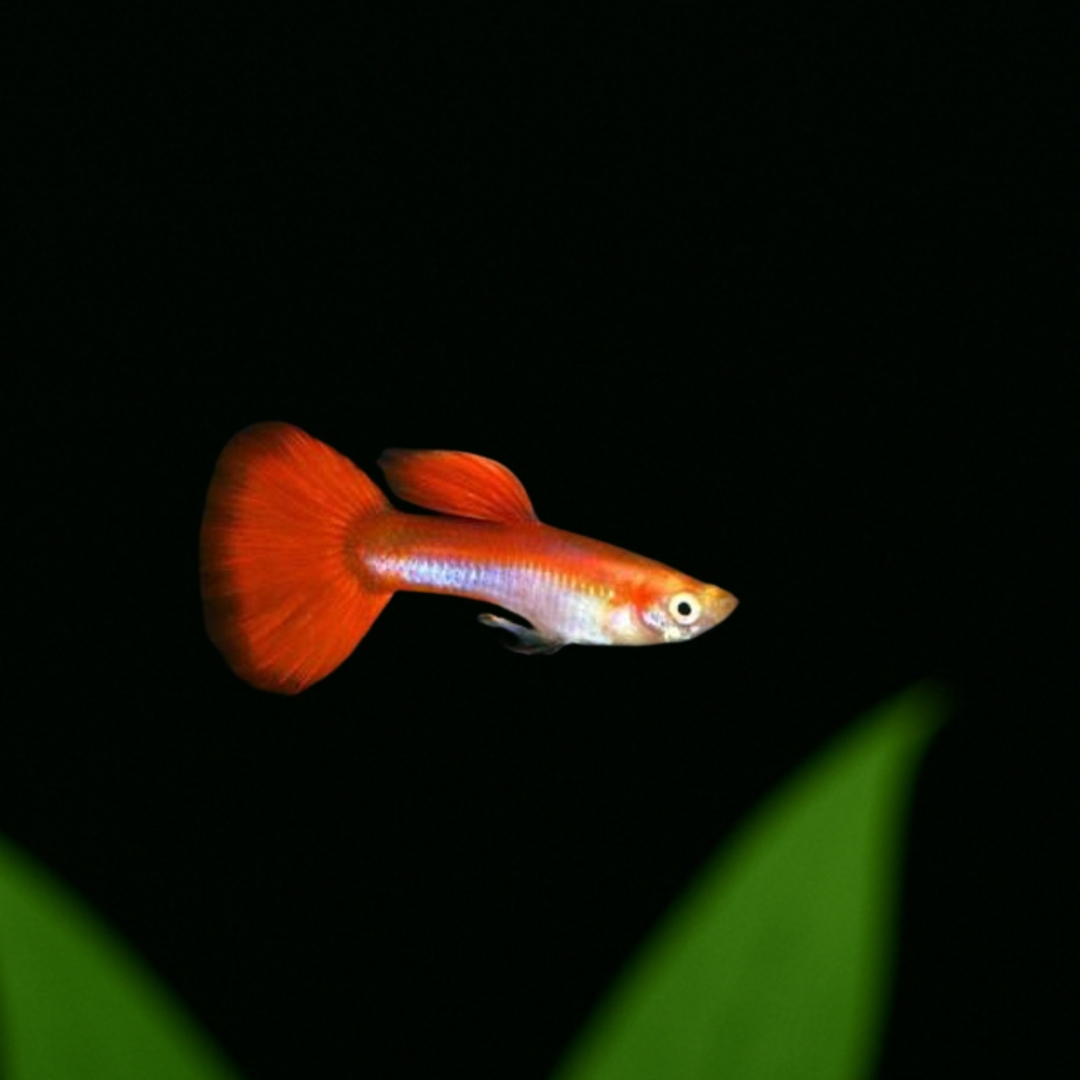
解説 / Description
フラミンゴ・グッピーは、グッピーの改良品種のひとつで、淡いピンクレッドからオレンジレッドに見えるやわらかな色彩が魅力です。名前の通り、水鳥のフラミンゴを思わせる上品な雰囲気があり、真紅の印象が強いフルレッド系とは異なる、やさしく華やかな美しさを楽しめます。特にオスは尾ビレや背ビレが大きく発達し、光の当たり方によってシルバー、クリーム、ゴールド系の体色と赤みのある尾ビレが美しく対比します。 The Flamingo Guppy is a selectively bred variety of guppy admired for its soft pink-red to orange-red coloration. As its name suggests, it has an elegant appearance reminiscent of a flamingo, offering a gentler and more graceful impression than intensely red varieties such as Full Red guppies. Males are especially attractive, with large dorsal and caudal fins and a pleasing contrast between the silvery, cream, or golden body and the reddish tail.
飼育そのものは比較的やさしく、熱帯魚飼育の入門種としても親しまれています。ただし、淡い赤系の発色や大きなヒレをきれいに保つには、安定した水温、水質の急変を避ける管理、強すぎない水流、栄養バランスのよい餌が大切です。繁殖力も高いため、単に増やすだけでなく、フラミンゴらしい色彩を維持するには親魚の選別と系統管理を意識する必要があります。 It is generally easy to keep and is popular even among beginners. However, maintaining its delicate reddish coloration and large fins requires stable temperature, avoidance of sudden water-quality changes, gentle water flow, and a balanced diet. Because guppies breed readily, maintaining the Flamingo type is not just a matter of increasing numbers; careful selection of parent fish and line management are important.
基本情報 / Basic Information
| 学名 / Scientific Name | Poecilia reticulata ※フラミンゴ・グッピーは分類学上の変種ではなく、本種の改良品種名・流通名として扱います。Note: The Flamingo Guppy is not a taxonomic variety, but a selectively bred aquarium strain and trade name of this species. |
|---|---|
| 通称 / Common Name | フラミンゴ・グッピー、フラミンゴグッピー。グッピーの改良品種名・流通名として用いられます。Flamingo Guppy. This name is used as a selectively bred aquarium strain and trade name for guppies. |
| 分類 / Family | カダヤシ目 カダヤシ科 グッピー属Order Cyprinodontiformes, Family Poeciliidae, Genus Poecilia |
| 英名 / English Name | Flamingo Guppy, Guppy |
| 分布 / Distribution | 本品種は人工改良品種です。原種のグッピーは南アメリカ北部からカリブ海地域に自然分布し、ベネズエラ、ガイアナ、トリニダード・トバゴなどに由来します。現在は各地で飼育・養殖され、地域によっては外来個体群として定着している例もあります。This variety is a selectively bred aquarium strain. Wild guppies originate from northern South America and parts of the Caribbean, including Venezuela, Guyana, and Trinidad and Tobago. Today, guppies are bred worldwide and have also established introduced populations in some regions. |
| 最大体長 / Max Size | オス約3〜4cm、メス約4〜6cm。メスのほうが体が大きく、腹部もふっくらします。Males reach about 3–4 cm, while females reach about 4–6 cm. Females are larger and have a fuller abdomen. |
| 寿命 / Lifespan | 約1〜2年。高水温で代謝が上がりすぎる環境では寿命が短くなりやすいため、安定した水温管理が重要です。About 1–2 years. Excessively warm conditions can increase metabolism and shorten lifespan, so stable temperature management is important. |
飼育環境 / Aquarium Environment
| 水槽サイズ / Tank Size | ペアや少数飼育だけなら30cm規格水槽でも可能ですが、長期飼育や繁殖、水質の安定を考えると45〜60cm規格水槽以上が扱いやすいです。複数ペアで飼育する場合は60cm規格水槽を用意すると、過密による水質悪化や稚魚の逃げ場不足を抑えやすくなります。A 30 cm standard aquarium can be used for a pair or a small group, but a 45–60 cm standard aquarium or larger is easier to manage for long-term care, breeding, and stable water quality. For multiple pairs, a 60 cm standard aquarium helps reduce overcrowding, water deterioration, and lack of hiding space for fry. |
|---|---|
| 水温 / Temperature | 23〜26℃前後が目安です。20℃を下回ると調子を崩しやすく、28℃を超える状態が続くと代謝が上がり、体力を消耗しやすくなります。日本の室内では、秋から春はヒーター、夏は冷却ファンなどで急な温度変化を避けることが大切です。 Around 23–26°C is recommended. Below 20°C, guppies are more likely to weaken, while prolonged temperatures above 28°C may increase metabolism and cause fatigue. In Japan, heaters are useful from autumn to spring, and cooling fans may be needed in summer to avoid sudden temperature changes. |
| 水質 / Water Quality | 弱酸性から弱アルカリ性まで幅広く適応しますが、pH6.5〜7.5前後を目安にすると管理しやすいです。極端な酸性化は不調につながりやすいため、週1回を目安に全体の3分の1程度を水換えし、硝酸塩や有機物をため込まない管理が重要です。日本の水道水を使う場合は、必ずカルキを抜いてから使用します。They adapt to a wide range from slightly acidic to slightly alkaline water, with around pH 6.5–7.5 being easy to manage. Extreme acidification can cause problems, so replacing about one-third of the water weekly helps prevent nitrate and organic waste buildup. When using tap water in Japan, always dechlorinate it first. |
| レイアウト / Layout | 強い水流は大きな尾ビレを持つオスの負担になりやすいため、スポンジフィルターや水流を弱めた外掛け式フィルターが向いています。マツモ、ウィローモス、カボンバ、アナカリスなどの水草を入れると、メスや稚魚の隠れ場所になり、落ち着いた環境を作りやすくなります。Strong currents can be stressful for males with large tails, so sponge filters or gently adjusted hang-on filters are suitable. Plants such as hornwort, Java moss, Cabomba, and Egeria provide hiding places for females and fry and help create a calmer environment. |
| 注意点 / Precautions | 国産グッピーと外国産グッピーを安易に同じ水槽へ入れると、環境差や保有している病原体の違いから体調を崩すことがあります。産地や入荷経路が異なる個体を追加する場合は、できれば別水槽で数週間様子を見ると安心です。また、繁殖を目的とする場合は、他品種との混泳を避け、意図しない交雑を防ぐことが重要です。Mixing domestically bred and imported guppies too casually can lead to health problems due to differences in environment and potential pathogens. When adding fish from different origins, observing them in a separate tank for several weeks is safer. If breeding is intended, avoid mixing with other varieties to prevent unintended crossbreeding. |
餌と給餌 / Feeding
| 餌の種類 / Diet | 雑食性で、グッピー用の人工飼料を主食にできます。補助的に冷凍赤虫、ブラインシュリンプ、細かい顆粒餌、稚魚にはすりつぶした人工飼料や沸かしたてのブラインシュリンプを与えると成長を促しやすいです。赤系の発色を意識する場合は、アスタキサンチンなどのカロテノイドを含む色揚げ系飼料も有効です。They are omnivorous and can be fed mainly on commercial guppy foods. Frozen bloodworms, brine shrimp, fine granules, and crushed prepared foods or newly hatched brine shrimp for fry are useful supplements. For enhancing reddish coloration, color-enhancing foods containing carotenoids such as astaxanthin can be helpful. |
|---|---|
| 給餌のポイント / Feeding Tips | 1日1〜2回、数分で食べ切れる量を与えます。繁殖や育成を重視する場合は少量を複数回に分ける方法もありますが、食べ残しは水質悪化の原因になります。フラミンゴらしい淡い赤みを保つには、単に多く与えるのではなく、色揚げ成分を含む餌と水質維持を両立することが大切です。Feed once or twice a day, only as much as they can finish within a few minutes. For breeding and growth, smaller meals several times a day may be used, but uneaten food quickly worsens water quality. Maintaining the Flamingo-type reddish tone depends not on overfeeding, but on balancing color-enhancing nutrition with clean water. |
性格と混泳 / Temperament and Tank Mates
| 性格 / Temperament | 基本的には温和で、群れで泳ぐ姿を楽しみやすい魚です。オス同士で軽い追いかけ合いをすることはありますが、深刻な争いになることは多くありません。ただし、オスがメスを頻繁に追うため、メスの負担を減らすにはオス1匹に対してメス2匹程度の比率にすると落ち着きやすいです。They are generally peaceful and enjoyable in groups. Males may chase each other lightly, but serious fighting is uncommon. However, males often pursue females, so keeping roughly two females per male can reduce stress on females. |
|---|---|
| 混泳の相性 / Compatibility | 同じく温和で小型の魚と相性がよく、コリドラス、小型のラスボラ、穏やかな小型カラシンなどと組み合わせやすいです。一方で、スマトラなどヒレをかじりやすい魚、大型魚、気性の荒い魚との混泳は避けます。品種として維持したい場合は、他のグッピー品種やエンドラーズとの混泳も避ける必要があります。They are compatible with other peaceful small fish, such as Corydoras, small rasboras, and gentle small tetras. Avoid fin-nipping fish such as tiger barbs, large fish, and aggressive species. If maintaining the variety is important, avoid keeping them with other guppy strains or Endler’s livebearers. |
病気と対策 / Diseases and Prevention
| かかりやすい病気 / Common Diseases | 白点病、尾ぐされ病、口ぐされ病、エロモナス感染症などに注意します。導入直後や水温が急に下がったとき、水質が悪化したとき、強い水流や混泳魚によってヒレが傷ついたときに発症しやすくなります。大きな尾ビレを持つオスは、ヒレの裂けや細菌感染にも注意が必要です。Watch for white spot disease, fin rot, mouth rot, and Aeromonas-related infections. Problems are more likely just after introduction, during sudden temperature drops, when water quality deteriorates, or when fins are damaged by strong currents or tank mates. Males with large fins require special attention to fin tears and bacterial infections. |
|---|---|
| 対策と予防 / Prevention | もっとも重要なのは、急な水温変化を避け、清潔な水を保つことです。新しく迎えた個体はすぐに本水槽へ入れず、可能であればトリートメント水槽で観察します。白点病が疑われる場合は水温を急激に変えずに調整し、症状に応じて市販の魚病薬を使用します。尾ぐされ病など細菌性の症状では、早期発見と隔離が回復の鍵になります。The most important prevention is avoiding sudden temperature changes and maintaining clean water. Newly purchased fish should ideally be observed in a quarantine tank before being added to the main aquarium. If white spot disease is suspected, adjust temperature gradually and use appropriate aquarium medications when needed. For bacterial symptoms such as fin rot, early detection and isolation are key to recovery. |
増やし方(繁殖) / Breeding
| 雌雄の判別 / Sexing | オスは体が小さめで色彩が鮮やか、尾ビレや背ビレが大きく発達します。尻ビレは棒状の交接器であるゴノポディウムに変化しています。メスはオスより大きく、体色は控えめで、成熟すると腹部がふっくらし、尻ビレ付近に妊娠斑が見えることがあります。Males are smaller, more colorful, and have larger dorsal and caudal fins. Their anal fin is modified into a gonopodium. Females are larger, less colorful, and develop a fuller abdomen; mature females may show a gravid spot near the anal fin. |
|---|---|
| 繁殖形態 / Reproduction | 卵胎生です。オスがゴノポディウムを使ってメスの体内へ精子を送り、メスは体内で卵を育てたあと、泳げる状態の稚魚を直接産みます。妊娠期間はおおむね約1か月で、成熟したメスでは一度に数十匹の稚魚を産むことがあります。They are livebearers. The male uses his gonopodium to transfer sperm to the female, and the female gives birth to free-swimming fry after the embryos develop internally. The gestation period is roughly one month, and mature females may produce dozens of fry at a time. |
| 繁殖のポイント / Breeding Tips | 繁殖は容易ですが、親魚が稚魚を食べることがあるため、産卵箱や隔離ケース、水草の茂みを利用して稚魚の逃げ場を作ります。フラミンゴ・グッピーとしての色彩やヒレの形を維持したい場合は、色の濁りが少なく、尾ビレの形が整った個体を親に選びます。無計画に同種同士で増やすだけでは、世代を重ねるうちにフラミンゴらしい特徴が弱くなることがあるため、系統維持には選別が重要です。Breeding is easy, but adults may eat fry, so use a breeding box, isolation case, or dense plants as shelter. To maintain Flamingo-type coloration and fin shape, choose parent fish with clear color and well-shaped tails. Simply breeding them without selection can weaken the desired traits over generations, so selection is important for maintaining the line. |
雑学と豆知識 / Trivia and Fun Facts
| 1. フラミンゴという名前が伝える色の物語 / 1. The Color Story Behind the Name “Flamingo” | フラミンゴ・グッピーの魅力は、単に赤いグッピーという言葉では表しきれません。真紅の力強さよりも、ピンクレッドのやわらかさ、クリームやゴールドを帯びた体との対比、そして大きな尾ビレがふわりと広がる雰囲気に特徴があります。鳥のフラミンゴが水辺で淡い桃色の存在感を放つように、この品種も水槽内でやさしい華やかさを添えてくれるタイプのグッピーです。The appeal of the Flamingo Guppy cannot be fully described as simply a red guppy. Its charm lies in the soft pink-red tone, the contrast with a cream or golden body, and the gentle spread of its large tail. Just as flamingos add a pale rosy presence to wetlands, this variety brings a soft elegance to the aquarium. |
|---|---|
| 2. 赤い色は餌とも深く関わる / 2. Red Coloration Is Closely Linked to Diet | 鳥のフラミンゴの羽色は、食べ物に含まれるカロテノイド色素と関係が深いことで知られています。グッピーの赤系の発色も、遺伝だけで完全に決まるものではなく、餌に含まれる色素成分や健康状態の影響を受けます。アスタキサンチンなどを含む色揚げ飼料やブラインシュリンプを上手に取り入れると、フラミンゴらしい赤みを保ちやすくなります。ただし、餌だけで別品種のように変化するわけではないため、血統、選別、飼育環境を合わせて整えることが大切です。The color of flamingo feathers is closely associated with carotenoid pigments in their diet. Similarly, red coloration in guppies is not determined by genetics alone; it is also influenced by dietary pigments and overall health. Foods containing astaxanthin and brine shrimp can help maintain the Flamingo-type reddish tone. However, food alone cannot transform a fish into a different strain, so bloodline, selection, and environment all matter. |
| 3. グッピーの歴史と「ミリオンフィッシュ」 / 3. Guppy History and the “Millionfish” | グッピーは旺盛な繁殖力から「ミリオンフィッシュ」とも呼ばれてきました。原種は南アメリカ北部からカリブ海地域に分布し、蚊の幼虫を食べる性質や環境への適応力の高さから、各地へ持ち込まれた歴史があります。観賞魚としては、体の小ささ、美しいオスの色彩、繁殖のしやすさが重なり、世界中で改良品種が作られてきました。フラミンゴ・グッピーも、その長い品種改良文化の中で生まれた、色彩を楽しむための系統といえます。Guppies have long been called “millionfish” because of their prolific breeding. Wild guppies originate from northern South America and the Caribbean and were introduced to many regions because they eat mosquito larvae and adapt well to varied environments. As aquarium fish, their small size, colorful males, and ease of breeding encouraged the creation of countless strains. The Flamingo Guppy is one such color-focused variety born from this long culture of selective breeding. |
| 4. 美しい系統ほど、放任繁殖では維持しにくい / 4. Beautiful Strains Require More Than Random Breeding | グッピーはよく増える魚ですが、よく増えることと、同じ美しさを保ったまま増えることは別の話です。フラミンゴ・グッピーのように色彩や尾ビレの形に価値がある品種では、何世代も放任で繁殖させると、色が薄くなったり、尾ビレの形が崩れたり、別系統との交雑で特徴が分かりにくくなることがあります。美しい個体を選び、同じ方向性の親を組み合わせていく選別交配こそが、品種の魅力を次世代へ残すための大切な作業です。Guppies reproduce readily, but producing many fish and preserving the same beauty are different things. In a variety such as the Flamingo Guppy, where color and tail shape are important, random breeding over many generations may lead to paler color, poorer fin shape, or unclear traits through mixing with other lines. Selecting beautiful fish and pairing parents with the same desired direction is essential for preserving the variety’s appeal. |
まとめ / Conclusion
フラミンゴ・グッピーは、淡いピンクレッドの発色と優雅なヒレが魅力の改良グッピーです。飼育は比較的やさしく、少数なら30cm規格水槽から始めることもできますが、水質の安定や繁殖を考えるなら45〜60cm規格水槽以上が扱いやすいです。水温は23〜26℃前後、水質は中性付近を意識し、強すぎる水流を避けることで、本来の美しさを楽しみやすくなります。 The Flamingo Guppy is a selectively bred guppy admired for its soft pink-red coloration and elegant fins. It is relatively easy to keep and can be started in a 30 cm standard aquarium for a small group, but a 45–60 cm standard aquarium or larger is easier for stable water quality and breeding. Keeping the temperature around 23–26°C, maintaining near-neutral water, and avoiding strong currents help bring out its natural beauty.
繁殖は容易ですが、品種としての特徴を保つには、他品種との交雑を避け、発色やヒレの形がよい個体を選んで次世代へつなぐことが重要です。色揚げ効果のある餌や清潔な飼育水を組み合わせることで、フラミンゴらしいやわらかな赤みをより長く楽しめます。入門者にも親しみやすく、選別や系統維持の奥深さも味わえる、魅力の幅が広いグッピーです。 Breeding is easy, but preserving the variety requires avoiding crosses with other strains and selecting fish with good color and fin shape for the next generation. By combining color-enhancing foods with clean, stable water, the soft Flamingo-like reddish tone can be enjoyed for longer. This is a guppy that is approachable for beginners yet deep enough for hobbyists interested in selection and line maintenance.

気になる道具や飼い方を見つけてみませんか?
 アイのアクアグッズ案内水槽用ヒーターの選び方|固定式・温度調節式と、水量に合うW数の考え方水槽の魚は冬に寒くない? アイとコタロウが水温計から固定式・温度調節式・分離式ヒーターまで比較。水量と室温に合うW数、設置場所、水換えや交換の注意点を、国内メーカーの商品とともに紹介します。記事はコチラ →
 アイのアクアグッズ案内水槽の底砂の選び方|砂・砂利の違いとおすすめ商品道具の特徴や使い方、選ぶときのポイントをアイが紹介します。記事はコチラ →
 アイのアクアグッズ案内ラスボラ・ボララスの群泳を楽しむ飼育用品|水槽・ろ過・ヒーター・餌・水草道具の特徴や使い方、選ぶときのポイントをアイが紹介します。記事はコチラ →
 アイのアクアグッズ案内ベタの一匹飼いを楽しむ|水槽・ヒーター・ふた・フィルターの選び方ベタの一匹飼いに向く水槽容量、ふたと空気層、ヒーターと水温計、弱い水流のフィルターを、コタロウとアイの会話で分かりやすく解説します。記事はコチラ →
さまざまな飼育テーマをご紹介。リンク先の記事には広告・商品紹介が含まれます。
案内・紹介記事一覧へ →参考文献
本記事では、フラミンゴ・グッピーを分類学上の独立種や変種としてではなく、グッピー Poecilia reticulata の改良品種名・流通名として扱い、原種の分類、分布、生態、繁殖、飼育管理に関する基礎情報を以下の資料に基づいて整理しています。
-
Froese, R. and Pauly, D. Editors. FishBase. Poecilia reticulata, Guppy. 分類、最大体長、原産地、観賞魚としての基本情報、水槽サイズの目安を確認するために参照。
https://www.fishbase.se/summary/Poecilia-reticulata -
CABI Digital Library. Poecilia reticulata (guppy). 分布、外来化、繁殖力、メスの精子貯蔵、導入リスクなど、グッピーの生態的背景を確認するために参照。
https://www.cabidigitallibrary.org/doi/full/10.1079/cabicompendium.68208 -
国立環境研究所 侵入生物データベース. グッピー Poecilia reticulata. 日本国内における定着環境、温泉地・温排水周辺での確認例、自然分布情報を確認するために参照。
https://www.nies.go.jp/biodiversity/invasive/DB/detail/50240e.html -
U.S. Fish & Wildlife Service. Ecological Risk Screening Summary: Guppy, Poecilia reticulata. 卵胎生、性的二型、外来個体群の成立、環境適応性に関する補助資料として参照。
https://www.fws.gov/sites/default/files/documents/Ecological-Risk-Screening-Summary-Guppy.pdf -
Grether, G. F., Hudon, J., and Millie, D. F. 1999/2000. Carotenoid limitation and mate preference evolution: a test of the indicator hypothesis in guppies. Evolution. グッピーのオレンジ系色彩とカロテノイドの関係を確認するために参照。
https://sites.lifesci.ucla.edu/eeb-gretherlab/wp-content/uploads/sites/146/2017/07/Grether-2000-Evolution.pdf -
Grether, G. F., Kasahara, S., Kolluru, G. R., and Cooper, E. L. 2004/2005. Carotenoid availability affects the development of a colour-based mate preference and the sensory bias to which it is genetically linked. グッピーの色彩、カロテノイド摂取、配偶者選好の関係を補足するために参照。
https://pmc.ncbi.nlm.nih.gov/articles/PMC1559943/ -
MSD Veterinary Manual. Bacterial Diseases of Fish. 尾ぐされ病・口ぐされ病に関連する細菌性疾患、水質悪化やストレスが発症要因になり得る点を確認するために参照。
https://www.msdvetmanual.com/exotic-and-laboratory-animals/aquarium-fish/bacterial-diseases-of-fish -
Smithsonian’s National Zoo & Conservation Biology Institute. Why Are Flamingos Pink? And Other Flamingo Facts. フラミンゴの羽色が食物中のカロテノイドと関係するという雑学部分の根拠として参照。
https://nationalzoo.si.edu/animals/news/why-are-flamingos-pink-and-other-flamingo-facts




コメント