| 学名 / Scientific Name |
Poecilia reticulata ‘Micariff Golden Yellow’ |
| 通称 / Common Name |
ミカリフゴールデンイエロー、ミカリフゴールデン、イエローテール(「ミカリフ3兄弟」の一つ。「ミカリフ」を Micallif と綴る例もある)Micariff Golden Yellow, Golden Micariff, Yellow Micariff, Yellow Tail (one of the “Micariff Three Brothers”; the name is sometimes spelled Micallif, Mikariff or Mikarif) |
| 分類 / Family |
カダヤシ目 カダヤシ科 ポエキリア属(グッピーの改良品種)Cyprinodontiformes, Poeciliidae, genus Poecilia (an ornamental guppy strain) |
| 英名 / English Name |
Micariff Golden Yellow Guppy / Yellow Micariff Guppy |
| 分布 / Distribution |
原種のグッピーは、南米北部やトリニダード島などの河川・沼沢地に分布する。本品種はスリランカの商業養殖場で作出・量産された改良品種のため、自然分布はない。なお日本では、グッピーが温泉地や、沖縄島をはじめとする琉球列島の水路・河川で野生化している。The wild guppy is native to rivers and marshes of northern South America and islands such as Trinidad. This strain was developed and is mass-produced on commercial farms in Sri Lanka, so it has no natural range. In Japan, guppies have become naturalized in hot-spring areas and in waterways and rivers of the Ryukyu Islands, including Okinawa Island. |
| 最大体長 / Max Size |
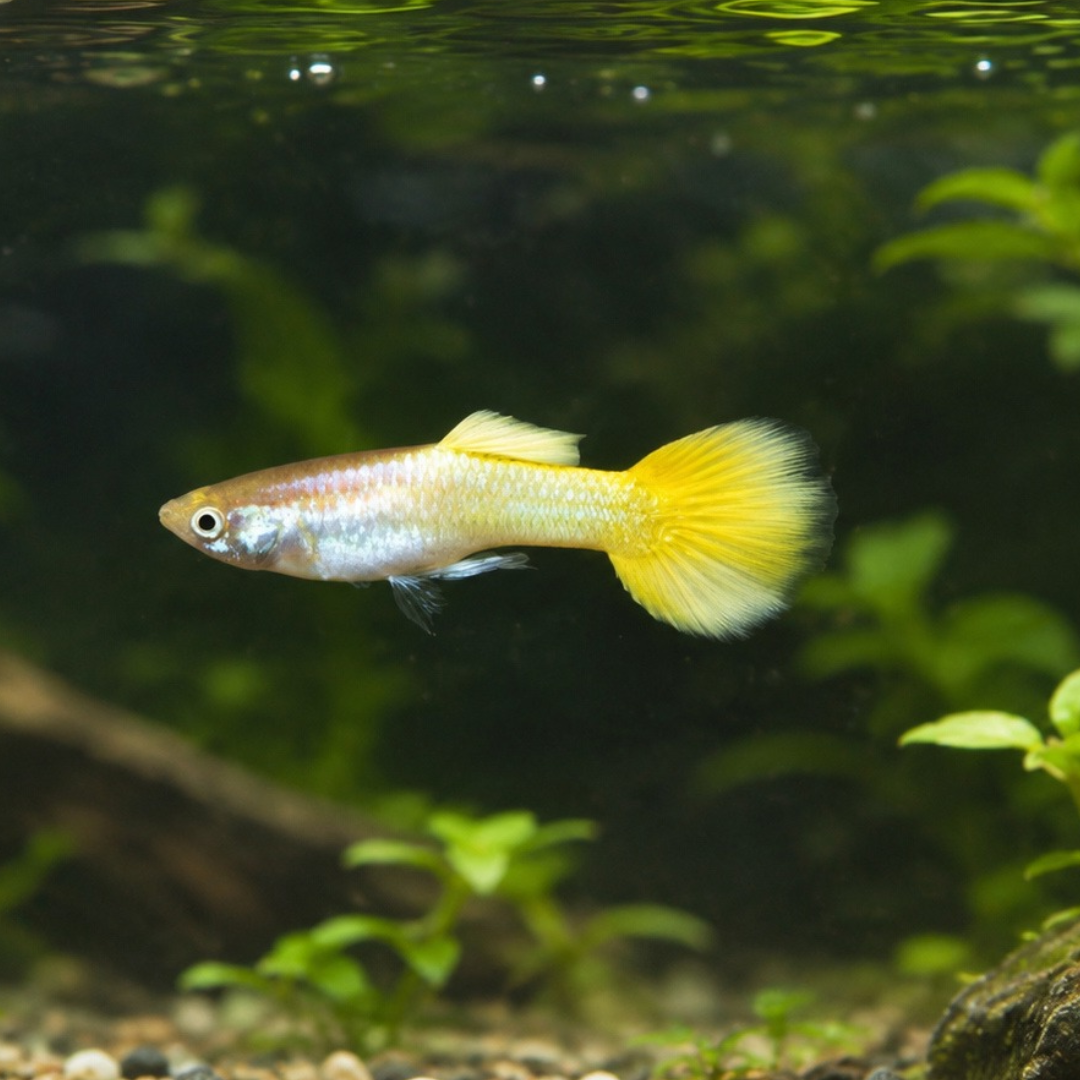
オス約4cm、メス約6cm。一般的な改良品種より体格ががっしりしており、メスはよく育てるとかなり大きくなることがある。Males about 4 cm, females about 6 cm. The body is sturdier than in many ornamental strains, and well-raised females can grow quite large. |
| 寿命 / Lifespan |
約2~3年About 2–3 years |
| 水槽サイズ / Tank Size |
ペアで繁殖を楽しむなら30cm規格水槽(約12L)以上、水草レイアウトで複数匹を群泳させるなら60cm規格水槽(約57L)以上がおすすめ。導入直後のトリートメント用に、小型の隔離水槽を別に用意しておくと安心。A 30 cm standard tank (about 12 L) or larger for breeding a pair, and a 60 cm standard tank (about 57 L) or larger for a group in a planted layout. It is also wise to keep a separate small quarantine tank for newly arrived fish. |
| 水温 / Temperature |
22~24℃前後で安定させるのが理想(許容範囲はおおむね20~30℃)。一時的な低温や夏場の高温に耐える例もあるが、普段はヒーターを使い、水温の急な変化を避ける。
Ideally kept stable at around 22–24 °C (tolerated range roughly 20–30 °C). Fish may survive brief cold spells or summer heat, but in everyday care a heater should be used to avoid sudden temperature changes.
|
| 水質 / Water Quality |
弱酸性~弱アルカリ性(目安はpH 6.5~7.5、下限はpH 6.0)。現地では弱アルカリ性で硬度の高い水で育てられていることが多いため、導入初期は中性~弱アルカリ性寄りの水が安全。時間をかけて慣らせば、カルキを抜いた日本の水道水でも長期飼育は十分に可能。ただし日本の水道水に多い軟水はpHを一定に保つ力が弱く、ろ過バクテリアによる分解が進むにつれてpHが急に下がりやすい。定期的な換水で、pH 6.0を下回らないよう維持することが大切。Slightly acidic to slightly alkaline (target pH 6.5–7.5, lower limit pH 6.0). On the farms they are often raised in slightly alkaline, hard water, so neutral to slightly alkaline water is safest at first. Once gradually acclimated, they can be kept long-term in dechlorinated Japanese tap water. However, the soft water common in Japan has little ability to hold pH steady, and pH tends to drop sharply as filter bacteria break down waste. Regular water changes are important to keep pH from falling below 6.0. |
| レイアウト / Layout |
明るい緑色の有茎草を背景にすると、黄白色の体がよく映える。水草を食べてしまうことはほとんどないため、水草水槽に向いている。成熟したオスはメスを盛んに追いかけるので、雌雄を一緒に飼う場合はマツモや有茎草の茂みなど、メスの隠れ場所を十分に用意する。水槽の上層を泳ぐ魚なので、強い水流を避けた穏やかなろ過環境が適している。Its yellowish-white body looks best against bright green stem plants. It rarely eats plants, making it well suited to planted tanks. Mature males chase females persistently, so when keeping both sexes, provide plenty of cover such as hornwort or dense stem plants. As an upper-level swimmer, it does best with gentle filtration and no strong current. |
| 注意点 / Precautions |
最も重要なのは、国産グッピーとの完全な隔離。水槽を分けるだけでなく、ろ過器、網、スポイト、換水ホースなどの器具も共用しない。外国産同士でも、入荷ロットが異なる個体は直接混ぜないほうが安全。導入時は袋の水を水槽に入れず、時間をかけて水合わせを行う。また、グッピーは日本の野外に定着している外来種で、環境省・農林水産省の「生態系被害防止外来種リスト」にも掲載されている。飼いきれなくなった個体や増えた稚魚を、川や池に放すことは絶対にしない。The most important rule is complete separation from Japanese-bred guppies. Beyond using separate tanks, do not share filters, nets, pipettes or siphon hoses. Even among imported fish, it is safer not to mix fish from different shipments directly. When introducing fish, do not add the bag water to the tank, and acclimate them slowly. Guppies are also an alien species established in the wild in Japan and appear on the list of invasive alien species that threaten ecosystems compiled by the Ministry of the Environment and the Ministry of Agriculture, Forestry and Fisheries. Never release unwanted fish or surplus fry into rivers or ponds. |
| 雌雄の判別 / Sexing |
オスは体が小さく、尾ビレの黄色と体の金属光沢が鮮やかで、尻ビレが棒状に変化した交接器(ゴノポディウム)を持つ。メスはオスより大きく体色が地味で、腹部が丸く膨らむ。日本ではオスのみで流通することが多く、本品種のメスは入手しにくい。Males are smaller, with a vivid yellow tail and a bright metallic body, and their anal fin is modified into a rod-like gonopodium. Females are larger, plainer in color and have a rounded belly. In Japan the strain is mostly sold as males only, so females of this strain are hard to obtain. |
| 繁殖形態 / Reproduction |
卵胎生。メスは体内で卵をかえし、稚魚を直接産む。性成熟した雌雄がそろえば季節を問わず繁殖し、1回の出産で数十匹の稚魚を産む。メスは受け取った精子を体内に長期間蓄えておく「貯精」の能力を持つ。Livebearer. The female hatches eggs inside her body and gives birth to free-swimming fry. With mature males and females present, they breed year-round, producing several dozen fry per birth. Females can store sperm in their bodies for a long time. |
| 繁殖のポイント / Breeding Tips |
オス1~2匹に対してメス3~5匹の割合にすると、追いかけられるストレスが分散して群れが安定する。純系を維持するには、貯精の影響を避けるため、まだ交尾していない若いメスを使うことが欠かせない。生まれたばかりの稚魚は白やグレーで地味なため、生後2~3か月を目安に、背骨の曲がりがない体形、丈夫さ、黄色の均一さと金属光沢など、目標を絞って選別する。本品種は他の品種と交配すると、子の世代(雑種第一代)にスネークスキン模様が現れやすく、黄色や光沢の多くが失われる。元の姿を取り戻すには、その子同士をさらに交配し、孫の世代以降から辛抱強く選び直す必要がある。また、同じ系統の中だけで交配を続けると、小型化や背骨の湾曲、繁殖力の低下が起こりやすい。3~4世代に1回は同品種の別ロットから良い個体を迎え入れ、親の組み合わせや出産日、生まれた子の内訳を記録しておくとよい。A ratio of one or two males to three to five females spreads out the stress of being chased and keeps the group stable. To maintain a pure line, it is essential to use young females that have not yet mated, to avoid the effect of stored sperm. Newborn fry are plain white or gray, so wait until they are about two to three months old and select with focused goals such as a straight spine, robustness, and even yellow color with a metallic sheen. When crossed with other strains, this strain tends to produce a snakeskin pattern in the offspring (the first hybrid generation), losing much of its yellow and sheen. To recover the original look, those offspring must be bred with each other and the grandchildren and later generations patiently reselected. Continued breeding within a single line also tends to cause smaller size, spinal curvature and reduced fertility. Bring in good fish from another shipment of the same strain every three or four generations, and keep records of pairings, birth dates and the makeup of each brood. |
| 1. 「ミカリフ」は2人のブリーダーの名前から生まれた / 1. “Micariff” Comes from the Names of Two Breeders |
どこか異国の響きを持つ「ミカリフ(Micariff)」という名前は、地名でも現地の言葉でもなく、作出者たちの名前を組み合わせた造語です。カリフォルニアのブリーダーで、国際ファンシーグッピー協会(IFGA)の会員でもあるマイク・カリド氏の証言によれば、この品種の特徴はスリランカのブリーダー、マイケル・コール(Michael Cole)とデニス・アリフ(Denis Ariff)によって生み出されたとされます。マイケルの名前の前半「Mic」と、デニスの姓「Ariff」をつなげたものが名前の由来です。命名に関わった初期のブリーダーとして、カリド氏自身を含む3名を挙げる証言もあります。世界中に流通する過程で Mikariff、Mikarif、Micallif などの表記ゆれが広がり、日本の一部の図鑑でも Micallif の綴りが見られますが、グッピーの色彩系統に詳しいフィリップ・シャドックは、著書の中で正しい綴りを Micariff と明記しています。The exotic-sounding name “Micariff” is neither a place name nor a local word, but a coinage combining the breeders’ names. According to Mike Khalid, a California breeder and member of the International Fancy Guppy Association (IFGA), the characteristics of this strain were created by two Sri Lankan breeders, Michael Cole and Denis Ariff. The name joins “Mic” from Michael’s given name with Denis’s surname, Ariff. Some accounts list three early breeders involved in the naming, including Khalid himself. As the fish spread around the world, variant spellings such as Mikariff, Mikarif and Micallif appeared, and some Japanese guides use Micallif, but Philip Shaddock, an expert on guppy color strains, states clearly in his books that the correct spelling is Micariff. |
| 2. シンガポールの魚病がスリランカを表舞台へ押し上げた / 2. A Disease Outbreak in Singapore Brought Sri Lanka to the Fore |
ミカリフが世界に広まった背景には、熱帯魚貿易の大きな変化がありました。ドイツのグッピー研究家クラウス・オシェの記録によれば、1980年代、当時世界最大の観賞魚輸出拠点だったシンガポールの養殖場で深刻な魚病が発生し、世界の輸入業者は新たな仕入れ先としてスリランカに目を向けるようになったとされます。こうした産地の移り変わりの中で、1990年代初頭から中盤にかけて世界へ送り出され、人気を得たのがミカリフ系のグッピーでした。日本にもスリランカ産グッピーの代表格として大量に輸入され、サンセット、レインボー、ゴールデンイエローの「ミカリフ3兄弟」が店頭をにぎわせました。繊細で手間のかかる大型のヒレを持つ品種が主流だった当時、「ヒレは控えめでも、体が大きく丈夫で成長が速く、色が鮮やか」という実用的な魅力は、日本のグッピー愛好家に強い印象を与えたと伝えられています。スリランカは現在も世界有数の観賞魚輸出国で、淡水観賞魚の輸出ではグッピーが大きな割合を占めているとされます。The spread of the Micariff around the world was tied to a major change in the tropical fish trade. According to records by the German guppy researcher Claus Osche, in the 1980s a serious disease outbreak struck fish farms in Singapore, then the world’s largest ornamental fish exporter, and importers worldwide began turning to Sri Lanka as a new source. Amid this shift, Micariff guppies were sent out to the world from the early to mid-1990s and won wide popularity. They were imported into Japan in large numbers as the flagship of Sri Lankan guppies, and the “Micariff Three Brothers” (Sunset, Rainbow and Golden Yellow) filled shop tanks. At a time when delicate, demanding large-finned strains dominated, their practical appeal, with modest fins but a large, hardy, fast-growing body and vivid color, is said to have made a strong impression on Japanese guppy keepers. Sri Lanka remains one of the world’s leading ornamental fish exporters, and guppies are said to account for a large share of its freshwater ornamental fish exports. |
| 3. 黄色い輝きの正体は「白い光沢」 / 3. The Yellow Glow Is Really a “White Sheen” |
金色に輝いて見えるミカリフですが、フィリップ・シャドックは「ミカリフはイエロー・メタリックではなく、ホワイト・メタリックである」と述べています。どういうことなのでしょうか。グッピーの皮膚は層が重なった構造になっていて、下の層には光を反射して銀色や白色に輝く細胞(虹色素胞や白色素胞)が、上の層には黄色や黒の色素を持つ細胞(黄色素胞や黒色素胞)が並んでいます。野生のグッピーは黒色素胞が多いため反射が抑えられ、灰褐色に見えます。一方ミカリフゴールデンイエローでは、ゴールデンと呼ばれる性質によって黒色素胞が減り、皮膚が透けやすくなっています。そのため、差し込んだ光が上の層の黄色を通り抜け、下の層の白い反射層ではね返り、もう一度黄色を通って私たちの目に届くのです。つまり、ミカリフの体そのものが金色の色素で塗られているわけではなく、「白く光る鏡」の上に「黄色いフィルター」を重ねたような仕組みによって、光の角度でゴールドにもプラチナがかった黄色にも見える、淡く上品な輝きが生まれていると考えられています。遺伝研究家のアラン・S・バイアスが「私たちが見ているのは魚の色そのものではなく、光の反射の性質である」と強調しているのも、この仕組みを踏まえてのことです。さらに、黄色素胞には体全体からヒレの先まで広く散らばる小さな点状のタイプと、体の中心付近に集まりやすい枝分かれした大きなタイプがあり、その分布の違いや白い反射層の濃さが、個体ごとの黄色の濃さやヒレの透明感の差につながっているとされます。Although the Micariff seems to shine gold, Philip Shaddock states that “the Micariff is not a yellow metallic but a white metallic.” What does that mean? Guppy skin is built in layers: the lower layers contain cells that reflect light in silver and white (iridophores and leucophores), and the upper layers contain cells carrying yellow and black pigment (xanthophores and melanophores). Wild guppies have many melanophores, which block this reflection, so they look grayish brown. In the Micariff Golden Yellow, a trait called golden reduces the melanophores and makes the skin more see-through. Light entering the skin passes through the yellow upper layer, bounces off the white reflective layer below, and passes back through the yellow to reach our eyes. In other words, the fish is not painted with gold pigment; a structure like a yellow filter laid over a white mirror is thought to create the soft, elegant glow that looks gold or platinum-tinged yellow depending on the angle of light. The genetics researcher Alan S. Bias emphasizes that “what we see is not the color of the fish itself but the way it reflects light,” precisely because of this mechanism. Xanthophores also come in two forms, small dot-like cells scattered over the whole body to the fin tips and large branched cells that tend to gather near the center of the body, and differences in their distribution and in the density of the white reflective layer are thought to explain why the depth of yellow and the translucency of the fins vary between individuals. |
| 4. 交配すると現れる「隠れたスネークスキン」 / 4. The “Hidden Snakeskin” Revealed by Crossing |
スリランカの作出者たちが育て方の秘訣を明かさなかったため、ミカリフがどのような遺伝子の組み合わせでできているのかについては、長年さまざまな憶測が飛び交いました。謎を解く手がかりとなったのが、「オスとメスのどちらのミカリフを他の系統と交配しても、子の世代に網目状のスネークスキン(欧州ではフィリグリー)模様が現れる」という不思議な現象です。これは、ミカリフが見た目には表れないスネークスキン模様の遺伝子を性染色体上に隠し持っていることを示していると考えられています。それなのに純系のミカリフに網目模様が見えないのは、ストルツバッハ・メタリックと呼ばれる別の性質が、模様を溶かすように打ち消しているためだと説明されています。つまり、ミカリフの澄んだ黄色は「模様を出す遺伝子」と「それを消す遺伝子」がそろって初めて現れるもので、他の品種と交配して後者が欠けると、隠れていた模様が表に出てくるというわけです。現在では、ゴールデン体色、ストルツバッハ・メタリック、スネークスキン、メタルゴールド、そして見落とされてきた白色素胞に関わる性質など、複数の遺伝子が組み合わさった結果とする仮説が有力です。ただし、多くの世代にわたる厳密な検証はまだ十分ではなく、ブリーダーの交配記録などに基づく仮説の段階にあるとされています。見た目はシンプルな黄色のグッピーが、実は複数の遺伝子の繊細な組み合わせの上に成り立っていることは、ブリーダーにとって大きな魅力であると同時に、安易な交配を戒める教訓にもなっています。Because the Sri Lankan breeders never revealed their methods, there was much speculation for years about the combination of genes behind the Micariff. A key clue came from a curious phenomenon: whether a male or a female Micariff is crossed with another strain, a reticulated snakeskin (called filigree in Europe) pattern appears in the offspring. This is thought to show that the Micariff carries snakeskin pattern genes on its sex chromosomes without displaying them. The reason purebred Micariffs show no such pattern is explained by another trait called Stoerzbach metallic, which cancels the pattern as if dissolving it. In other words, the Micariff’s clear yellow appears only when the genes that create the pattern and the genes that erase it are both present; when a cross with another strain removes the latter, the hidden pattern comes to the surface. Today the leading hypothesis is that the strain results from several genes working together, including golden body color, Stoerzbach metallic, snakeskin, metal gold, and a previously overlooked trait related to leucophores. However, rigorous verification over many generations is still lacking, and these ideas remain hypotheses based largely on breeders’ crossing records. That a seemingly simple yellow guppy actually rests on a delicate combination of genes is a great attraction for breeders, and also a lesson against careless crossing. |
| 5. ベルリンから続くメタリックの系譜 / 5. A Metallic Lineage Reaching Back to Berlin |
ミカリフの全身を包む金属光沢のルーツをたどると、1969年のドイツ・ベルリンに行き着きます。クラウス・オシェの記録によれば、ドイツのオットー=ミヒャエル・ストルツバッハ博士が、この年の国際ショーで世界初のメタリックグッピーとされる「ストルツバッハ・メタリック」を発表しました。この性質は、ソード型のヒレを作りにくいことや、近親交配で弱りやすいことから、当初はなかなか広まらなかったといわれます。その後、1980年代後半には日本のブリーダーによって日本にも導入され、「ソリッド」などの名で紹介されたとされています。日本ではさらに、この性質を他の色彩遺伝子と組み合わせた全身金色の系統も作出されるなど、ドイツ、日本、スリランカの間でメタリックの遺伝子が受け継がれていきました。水槽の中で静かに輝く1匹の黄色いグッピーの光沢には、半世紀以上にわたり国境を越えて続いてきた品種改良の歴史が重なっているのです。Tracing the roots of the metallic sheen that covers the Micariff’s whole body leads to Berlin, Germany, in 1969. According to Claus Osche, Dr. Otto-Michael Stoerzbach of Germany presented the “Stoerzbach Metallic,” regarded as the world’s first metallic guppy, at an international show that year. The trait is said to have spread slowly at first because sword-shaped fins were hard to produce with it and inbred fish tended to weaken. In the late 1980s it was reportedly brought to Japan by a Japanese breeder and introduced under names such as “Solid.” In Japan it was further combined with other color genes to create lines that are gold all over, and so metallic genes were passed along between Germany, Japan and Sri Lanka. The sheen of a single yellow guppy glowing quietly in a tank carries more than half a century of strain development across national borders. |
| 6. 日本で「ドイツイエロー」と呼ばないほうがよい理由 / 6. Why It Is Best Not to Call It “German Yellow” in Japan |
欧米の愛好家や販売店では、このタイプの黄色いミカリフが「German Yellow(ジャーマンイエロー)」「Yellow Micariff」「Yellow Tail」などと呼ばれることがよくあります。ところが日本で「ドイツイエロー」といえば、1969年に旧西ドイツから導入され、体の後半に黒いタキシード模様、大きな黄白色のデルタテールを持つ国産グッピーの名品「ドイツイエロータキシード」を指すのが一般的です。同じ黄色系でも、タキシードの黒とのコントラストを楽しむドイツイエロータキシード、全身を濃い金色に染めたフルゴールド系、黒い色素を抑えた淡く澄んだ光沢と丈夫さを持つミカリフゴールデンイエローでは、遺伝的な成り立ちも観賞の楽しみどころも大きく異なります。なお、国内の輸入問屋の分類では、灰色系の体色にミカリフの特徴が現れた「メタリックイエロー」をゴールデン体色にしたものが、ミカリフゴールデンイエローとされています。海外の情報を読むときや店頭で品種名を確かめるときは、こうした呼び名の違いを知っておくと混乱を避けられます。Among Western hobbyists and retailers, this type of yellow Micariff is often called “German Yellow,” “Yellow Micariff” or “Yellow Tail.” In Japan, however, “German Yellow” usually refers to the German Yellow Tuxedo, a classic of Japanese guppy breeding introduced from West Germany in 1969, with a black tuxedo pattern on the rear half of the body and a large yellowish-white delta tail. Even among yellow strains, the German Yellow Tuxedo with its tuxedo contrast, the Full Gold lines colored deep gold all over, and the Micariff Golden Yellow with its pale, clear sheen and hardiness differ greatly in genetic makeup and in what makes them enjoyable to watch. In the classification used by Japanese import wholesalers, the Micariff Golden Yellow is the golden-bodied form of the “Metallic Yellow,” which shows Micariff features on a gray body. Knowing these naming differences helps avoid confusion when reading overseas information or checking strain names in shops. |
| 7. なぜ店頭にはオスばかりが並ぶのか / 7. Why Shops Mostly Sell Males |
国産グッピーの多くがペアやトリオ単位で販売されるのに対し、ミカリフゴールデンイエローはオスのみの3匹・5匹・10匹セットやバラ売りが中心です。その背景には、外国産グッピーの1匹あたりの価格が国産のペア品種よりかなり手頃なことに加え、「美しいオスだけを泳がせて、増えすぎを避けたい」という観賞重視の需要があります。また、体色の地味なメスは品種ごとに出荷しても売れ残りやすく、品種を分けないメスとしてまとめて流通することが多いとされます。さらに、グッピーのメスは精子を体内に蓄えておけるため、養殖場育ちのメスを輸入しても、純系の繁殖に使えるとは保証しにくいという事情もあります。本品種を純系で増やしてみたい場合は、専門店に相談したり、ペア販売の例が見られる台湾の市場を探したりするなど、一般的な流通とは異なる入手方法が必要になるでしょう。While most Japanese-bred guppies are sold in pairs or trios, the Micariff Golden Yellow is mainly sold as males only, in sets of three, five or ten, or individually. One reason is that imported guppies cost considerably less per fish than domestic pair strains; another is demand from keepers who want to enjoy only the beautiful males and avoid overpopulation. Plain-colored females also tend to go unsold when shipped by strain, so they are often distributed together as unsorted females. Moreover, because female guppies can store sperm, farm-raised females are hard to guarantee as pure breeding stock even when imported. Anyone wishing to breed this strain true will likely need sources outside the usual channels, such as consulting a specialist shop or looking to markets like Taiwan, where pairs are sometimes sold. |
| 8. 品評会の主役ではなく、家庭の水槽を彩る名品種 / 8. Not a Show Champion, but a Star of the Home Aquarium |
店頭では高い人気を誇るミカリフゴールデンイエローですが、品評会の世界では少し事情が異なります。国際ファンシーグッピー協会(IFGA)のデルタ部門には、尾ビレの開く角度などに厳しい基準があり、見事な尾ビレに高い点数が与えられます。ところがミカリフは遺伝的な性質から尾ビレが控えめになりやすく、大きなデルタテールを保ちにくいとされます。加えて、IFGAの「イエロー」クラスは、伝統的に基準を満たすのが難しい部門とされてきました。完全な純黄色のグッピーを作ること自体が、遺伝的に非常に難しいためです。日本グッピー協会のコンテストも、ソリッドやタキシード、グラスなど、主に国内で親しまれてきた系統ごとの部門で構成されているとされ、オスのみの流通が中心の本品種が競技魚として登場する機会は多くありません。しかしその分、丈夫さと明るい色彩で家庭の水槽を彩る観賞魚として、独自の確かな地位を築いているといえます。Although the Micariff Golden Yellow is highly popular in shops, things are a little different at shows. The IFGA delta division has strict standards, including the spread angle of the tail fin, and awards high points to a magnificent tail. The Micariff, however, tends to have a modest tail because of its genetic makeup, and is said to struggle to maintain a large delta tail. In addition, the IFGA “Yellow” class has traditionally been regarded as a difficult class in which to meet the standard, because creating a truly pure yellow guppy is itself genetically very hard. Contests of the Japan Guppy Association are also said to be organized into divisions by strain groups long popular in Japan, such as Solid, Tuxedo and Grass, so this strain, distributed mainly as males, rarely appears as a competition fish. Instead, with its hardiness and bright color, it has earned a firm place of its own as an ornamental fish that brightens home aquariums. |
| 9. 日本の野外で暮らすグッピーたち / 9. Guppies Living in the Wild in Japan |
南米生まれの熱帯魚であるグッピーですが、日本では1955年頃から各地の温泉地で野生化が確認されるようになったとされます。さらに、一年を通して水温の高い沖縄島をはじめとする琉球列島では、農業用水路や水質の悪化した河川で最も多く見られる魚になるほど、広く定着しています。こうした状況から、グッピーは環境省・農林水産省の「生態系被害防止外来種リスト」で「その他の総合対策外来種」に位置づけられています。特定外来生物ではないため、飼育や販売は法律上問題ありません。しかし、ミカリフゴールデンイエローのように丈夫で繁殖力の旺盛な品種ほど、野外に放たれれば定着してしまうおそれがあります。最後まで責任を持って飼うことが、この魚を楽しむうえで何より大切な約束といえるでしょう。Although guppies are tropical fish from South America, they are said to have been found living wild in hot-spring areas across Japan since around 1955. In the Ryukyu Islands, including Okinawa Island, where water stays warm all year, they have become so widely established that they are the most common fish in some agricultural channels and polluted rivers. For this reason, the guppy is classified as an “other alien species requiring comprehensive countermeasures” on the list of invasive alien species that threaten ecosystems compiled by the Ministry of the Environment and the Ministry of Agriculture, Forestry and Fisheries. It is not a designated invasive alien species, so keeping and selling it is legal. However, hardy and prolific strains like the Micariff Golden Yellow could become established if released. Caring for them responsibly for their whole lives is the most important promise in enjoying this fish. |









コメント