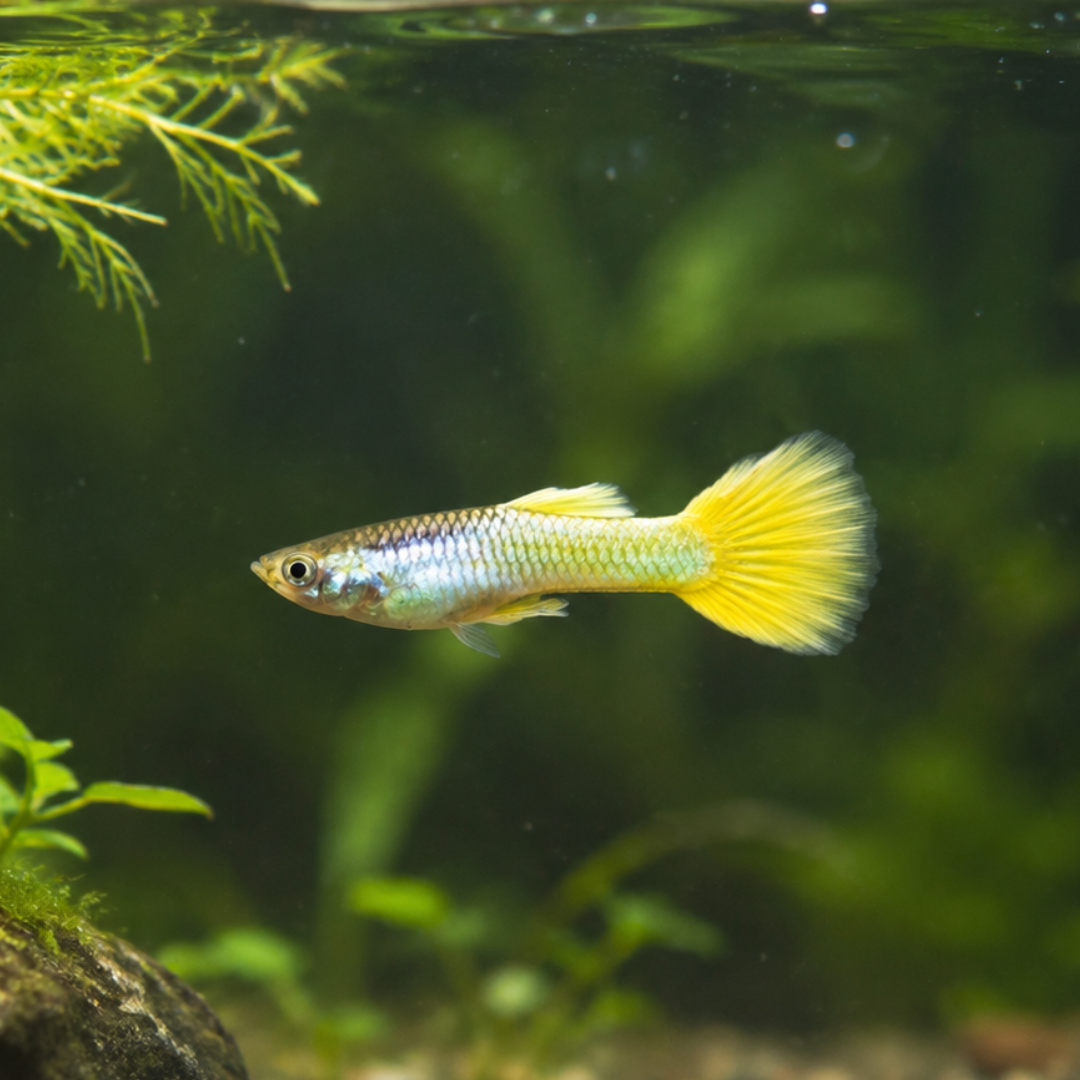
メタリックイエローグッピーは、銀白色から淡い金色に輝くボディと、濁りのない黄色の尾ビレを持つグッピーの改良品種です。ただし、この名前は一つの固定品種だけを指すものではありません。国内の流通では、スリランカの養殖場で生まれた「ミカリフ系」と呼ばれる系統が狭い意味でのメタリックイエローとして扱われ、英名のGerman Yellow guppyもこの系統に対応しています。同じミカリフ系には、体色をゴールデンにした「ミカリフゴールデンイエロー」もあり、見た目はよく似ていますが、黒色素が少ない分、全体がより明るい黄色に見えます。その一方で、金属光沢をもたらすメタル系の遺伝子に、黄色の色素やレース模様、アルビノの形質を組み合わせた「メタルイエローレース」「RREAメタルイエローレース」「フルゴールド」なども、よく似た色合いの仲間として並んで流通しています。その輝きは、皮膚の中で光を反射する結晶の層と、その上に重なる黄色の色素が合わさって生まれるものです。そのため、遺伝的な素質だけでなく、水温や水質、餌の内容によっても見え方が大きく変わります。華やかな赤系とはひと味違う、上品で澄んだ金属黄色を、日々の管理によって引き出していく楽しみがある魚です。The Metallic Yellow Guppy is a cultivated guppy variety with a body that shimmers from silvery white to pale gold and a clean, unblemished yellow tail. The name, however, does not refer to just one fixed strain. In the Japanese trade, a line called the “Micariff” type, developed at farms in Sri Lanka, is treated as the Metallic Yellow in the narrow sense, and the English name German Yellow guppy also corresponds to this line. The same Micariff line also includes the “Micariff Golden Yellow,” which has a golden body color; it looks very similar, but because it has less black pigment, the whole fish appears a brighter yellow. At the same time, related fish such as the “Metal Yellow Lace,” “RREA Metal Yellow Lace,” and “Full Gold,” which combine metallic-sheen genes with yellow pigment, lace patterns, or albinism, are sold alongside it as fish of similar coloration. The glow comes from layers of light-reflecting crystals in the skin combined with yellow pigment lying over them. For this reason, its appearance changes considerably not only with genetics but also with water temperature, water quality, and diet. It is a fish that offers the pleasure of drawing out, through everyday care, an elegant and clear metallic yellow quite different from the flashier red strains.
基本情報 / Basic Information
学名 / Scientific Name
Poecilia reticulata
通称 / Common Name
メタリックイエローグッピー(近い色合いの品種として、ミカリフゴールデンイエロー、メタルイエローレース、フルゴールドなども流通しています)Metallic Yellow Guppy (varieties of similar coloration, such as Micariff Golden Yellow, Metal Yellow Lace, and Full Gold, are also on the market)
分類 / Family
カダヤシ目 カダヤシ科 ポエキリア属(改良品種)Order Cyprinodontiformes, Family Poeciliidae, Genus Poecilia (cultivated variety)
英名 / English Name
Metallic Yellow Guppy / German Yellow Guppy
分布 / Distribution
原種のグッピーは、南米北部からカリブ海周辺の島々に分布しています。本品種は人の手で作られた改良品種で、スリランカ、シンガポール、タイなどの養殖場で生産されているほか、日本国内のブリーダーによっても累代繁殖されています。The wild guppy is native to northern South America and the surrounding Caribbean islands. This variety is a man-made cultivated form; it is produced at farms in Sri Lanka, Singapore, Thailand, and elsewhere, and is also bred over many generations by breeders in Japan.
最大体長 / Max Size
オスで約3〜4cm、メスで約5〜6cmが目安です(尾ビレを含む)。メスのほうが一回り大きくなります。Roughly 3 to 4 cm for males and 5 to 6 cm for females (including the tail). Females grow noticeably larger.
寿命 / Lifespan
一般的には1〜2年程度です。安定した環境では、3年前後生きる個体もいます。Generally about 1 to 2 years. In a stable environment, some individuals live around 3 years.
飼育環境 / Aquarium Environment
水槽サイズ / Tank Size
数匹を観賞する程度であれば、30cm規格水槽(約25L)から飼育できます。繁殖を考える場合は、1ペアからトリオ(オス1・メス2)に対して30〜45L程度、つまり45cm規格水槽(約35L)前後があると管理しやすくなります。あわせて、稚魚の育成用や新しく迎えた個体の隔離用に小型水槽をもう一つ用意しておくと安心です。複数の系統を維持したり、群泳を楽しんだりするなら、60cm規格水槽(約57L)以上がおすすめです。For keeping just a few fish for display, a 30 cm standard tank (about 25 L) is sufficient. For breeding, about 30 to 45 L per pair or trio (one male and two females), roughly a 45 cm standard tank (about 35 L), makes management easier. It is also reassuring to prepare an additional small tank for raising fry and quarantining new arrivals. To maintain several lines or enjoy a group, a 60 cm standard tank (about 57 L) or larger is recommended.
水温 / Temperature
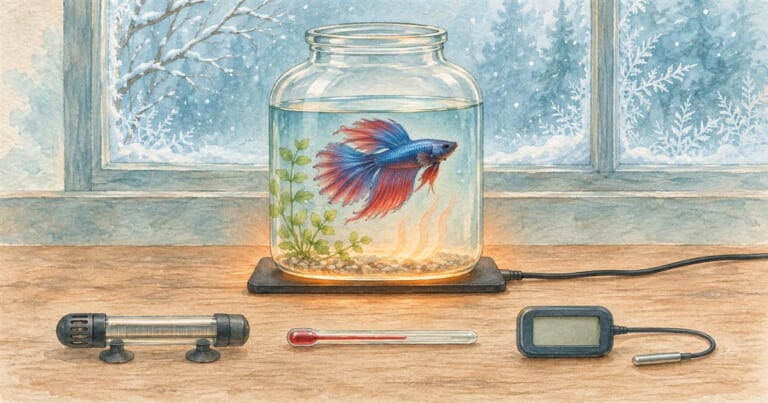
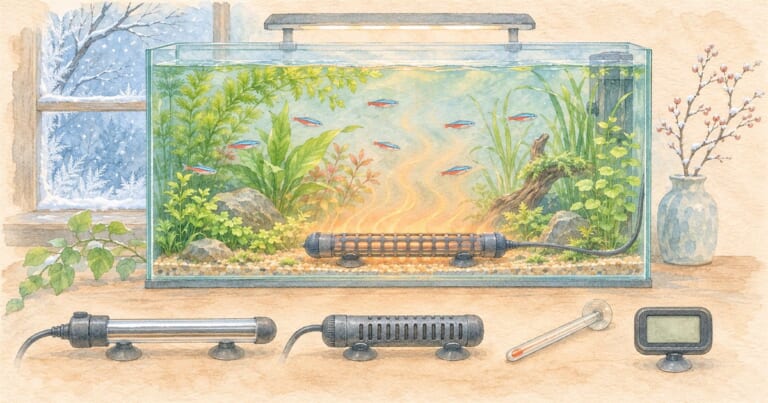
24〜28℃が適温です。なかでも25〜26℃は状態が安定しやすく、メタル系の発色と成長には26〜28℃が向いているとされます。20℃を下回ると免疫力が落ち、白点病などにかかりやすくなるため、冬場はヒーターが欠かせません。反対に、30℃を超える状態が続くと2週間ほどで金属光沢がくすみやすいといわれています。夏場は冷却ファンや水槽用クーラー、エアコンによる室温管理で高水温を防ぎましょう。The suitable range is 24 to 28°C. Within it, 25 to 26°C tends to keep fish most stable, and 26 to 28°C is considered good for color and growth in metal strains. Below 20°C, immunity drops and fish become more prone to diseases such as ich, so a heater is essential in winter. Conversely, if the water stays above 30°C, the metallic sheen is said to dull within about two weeks. In summer, prevent high temperatures with a cooling fan, an aquarium chiller, or air conditioning.
水質 / Water Quality
グッピーに適しているのは、pH 7.0〜8.0、総硬度(GH)8〜20°dH前後の中硬水から硬水です。これに対して日本の水道水は、全国平均でおよそ50mg/L(約3°dH)の軟水で、グッピーの原産地の水よりもかなり柔らかい傾向があります。ただし、国内で累代繁殖された国産個体はこうした水にすでに慣れていることが多く、カルキを抜いた水道水でそのまま飼育できる場合がほとんどです。一方、海外の養殖場から輸入された外国産個体は、弱アルカリ性でやや硬めの水で育っていることが多いため、pHが6.8を下回るときや、特に水が柔らかい地域では、サンゴ砂を少量ろ過器や底床に加え、硬度と緩衝力を緩やかに補うと状態が安定しやすくなります。なお、タイ産のメタルイエローレースコブラのように、販売店から低めのpHを勧められる例もあります。購入の際は、産地と現在の管理水質を確認しておくと安心です。いずれの場合も、数値を細かく合わせることより、短時間でpHを0.5〜1.0以上動かさない安定を優先してください。アンモニアと亜硝酸塩は0、硝酸塩は20mg/L以下を目安に、定期的な換水を続けましょう。Guppies do best in moderately hard to hard water with a pH of 7.0 to 8.0 and general hardness (GH) of around 8 to 20°dH. Japanese tap water, by contrast, averages about 50 mg/L (around 3°dH) nationwide, making it soft and considerably softer than the water of the guppy’s native range. Even so, domestically bred fish raised over many generations in Japan are usually already used to such water, and in most cases can be kept in dechlorinated tap water as is. Imported fish from overseas farms, on the other hand, have often been raised in slightly alkaline, somewhat harder water, so when the pH falls below 6.8 or in regions with especially soft water, adding a small amount of coral sand to the filter or substrate gently raises hardness and buffering capacity and helps the fish settle. Some fish, such as Thai Metal Yellow Lace Cobra, are sold with a shop recommendation for lower pH. When buying, it is wise to check the origin and the water conditions the fish are currently kept in. In every case, prioritize stability over matching exact numbers, and avoid shifting pH by more than 0.5 to 1.0 in a short time. Continue regular water changes, aiming to keep ammonia and nitrite at 0 and nitrate at or below about 20 mg/L.
レイアウト / Layout
ウィローモスやナジャス(グッピーグラス)などの水草を多めに入れておくと、メスの逃げ場や稚魚の隠れ家になります。大きなヒレを持つ魚なので水流は弱めにし、スポンジフィルターのように穏やかな流れのろ過器が向いています。背面や底面に黒などの暗い色のバックスクリーンや底床を使うと、金属光沢が引き立ち、魚も落ち着いて体色を濃く見せやすくなります。照明には、演色性が高く(Ra90以上)、色温度6500〜7500K程度の昼光色LEDを選ぶと、黄色と銀白の光沢を自然な色合いで楽しめます。Adding plenty of plants such as Willow Moss and Najas (guppy grass) provides refuges for females and hiding places for fry. Because these fish have large fins, keep the current gentle; filters with a soft flow, such as sponge filters, are well suited. A black or other dark background and substrate make the metallic sheen stand out and help the fish settle and display deeper color. For lighting, a daylight LED with high color rendering (Ra90 or above) and a color temperature of about 6500 to 7500 K lets you enjoy the yellow and silvery-white sheen in natural tones.
注意点 / Precautions
特に注意したいのが、国産個体と外国産個体の混泳です。見た目は健康でも、育った環境によって持っている病原体や免疫が異なるため、一緒にした直後に片方が次々と弱ってしまうことがあると知られています。国産と外国産、あるいは別のルートで購入した個体は水槽を分け、網やホース、バケツなどの器具も共用しないようにしましょう。新しく迎えた個体は、隔離水槽で2週間ほど様子を見てから本水槽へ移すのが安全です。また、グッピーは環境省の「生態系被害防止外来種リスト」に掲載されている魚です。飼えなくなった場合でも河川や池には絶対に放さず、引き取り手を探すか、観賞魚の引き取り窓口などを利用してください。なお、姿のよく似た近縁種のカダヤシは特定外来生物に指定されており、飼育や譲渡そのものが法律で禁止されています。Particular care is needed with mixing domestically bred and imported fish. Even when they look healthy, fish raised in different environments carry different pathogens and immunity, and it is known that one group may weaken one after another shortly after they are put together. Keep domestic fish, imported fish, and fish purchased through different routes in separate tanks, and do not share equipment such as nets, hoses, and buckets. It is safest to observe new arrivals in a quarantine tank for about two weeks before moving them to the main tank. Guppies are also listed on the Ministry of the Environment’s list of alien species that damage ecosystems. Even if you can no longer keep them, never release them into rivers or ponds; find someone to take them or use an ornamental fish take-back service. The closely related and similar-looking mosquitofish is designated an Invasive Alien Species, and keeping or transferring it is itself prohibited by law.
餌と給餌 / Feeding
餌の種類 / Diet
雑食性で、グッピー用のフレークや顆粒などの人工飼料をよく食べます。主食にはスピルリナを配合した高タンパクの人工飼料を使い、孵化したてのブラインシュリンプ幼生やミジンコ、冷凍赤虫などを組み合わせると、栄養のバランスが整い、発色も良くなります。黄色を引き出したい場合は、ルテイン、ゼアキサンチン、β-カロテンといった黄色系の色素を多く含む、スピルリナやマリーゴールド由来の原料を配合した餌が適しています。Guppies are omnivorous and readily eat prepared foods such as guppy flakes and granules. Use a high-protein prepared food containing spirulina as the staple, and combine it with newly hatched brine shrimp nauplii, daphnia, and frozen bloodworms for balanced nutrition and better color. To bring out yellow, foods containing spirulina or marigold-derived ingredients, which are rich in yellow pigments such as lutein, zeaxanthin, and beta-carotene, are well suited.
給餌のポイント / Feeding Tips
1日2〜3回、数分で食べきれる量を目安に与えます。市販の色揚げ飼料には、赤やオレンジを強めるアスタキサンチンを主体にしたものが多くあります。こうした餌を与えすぎると、繊細なレモンイエローやゴールドが赤みを帯びたオレンジ寄りに傾くおそれがあるため、黄色系の色素を中心にした餌を選ぶのがおすすめです。また、金属光沢の発達には脂質の代謝が関わっているとされ、乾燥飼料だけで育てるよりも、週2〜3回ほどブラインシュリンプ幼生やミジンコなどの生餌を取り入れたほうが、光沢が強く出やすいと報告されています。餌を変えてから色に変化が見え始めるまでには数週間、はっきり定着するまでには1〜2か月ほどかかり、およそ3か月でその個体が持つ遺伝的な上限に近づくとされます。それでも色が薄い個体は、素質による限界と考えられます。色揚げ剤を必要以上に足すのではなく、親魚の選別によって改善を目指しましょう。なお、カロテノイドは光や熱で劣化しやすいため、餌は照明の近くを避け、冷暗所で密閉して保管してください。Feed two to three times a day, giving an amount that is eaten within a few minutes. Many commercial color-enhancing foods are based on astaxanthin, which intensifies reds and oranges. Overfeeding such foods may push a delicate lemon yellow or gold toward a reddish orange, so foods centered on yellow pigments are recommended. Lipid metabolism is also thought to be involved in developing metallic sheen, and fish given live foods such as brine shrimp nauplii or daphnia about two to three times a week are reported to show stronger sheen than those raised on dry food alone. After a change of diet, color changes begin to appear within a few weeks, become clearly established in about one to two months, and are said to approach the individual’s genetic limit in about three months. Fish that are still pale after that are likely at the limit of their genetics. Rather than adding more color enhancer than necessary, aim for improvement by selecting parent fish. Carotenoids degrade easily with light and heat, so keep food sealed in a cool, dark place away from the aquarium lights.
性格と混泳 / Temperament and Tank Mates
性格 / Temperament
温和で活発な性格です。オスはメスを盛んに追いかけて求愛するため、オス1匹に対してメスを2匹以上にするか、水草で逃げ場を作っておくと、メスが疲れにくくなります。Peaceful and active. Males actively chase and court females, so keeping at least two females per male, or creating refuges with plants, helps keep the females from becoming exhausted.
混泳の相性 / Compatibility
同じくらいの大きさのおとなしい小型魚、たとえば小型のラスボラ類やコリドラス、オトシンクルス、ミナミヌマエビなどとは比較的一緒に飼いやすい魚です。一方、スマトラのようにヒレをかじる習性のある魚や、口に入る大きさの魚を食べてしまう大型魚との混泳は避けてください。また、別の系統のグッピーと同居させると交雑して色柄が崩れてしまうため、系統を維持したい場合は品種ごとに水槽を分ける必要があります。前述の通り、国産と外国産を同じ水槽に入れないことも大切です。They are relatively easy to keep with peaceful small fish of similar size, such as small rasboras, Corydoras, Otocinclus, and Neocaridina shrimp. Avoid fin-nipping species such as tiger barbs, and large fish that will eat anything small enough to fit in their mouths. Keeping them with other guppy strains leads to crossbreeding that breaks down color and pattern, so if you want to maintain a line, separate tanks are needed for each variety. As noted above, it is also important not to put domestic and imported fish in the same tank.
病気と対策 / Diseases and Prevention
かかりやすい病気 / Common Diseases
代表的なものに、体やヒレに白い点が現れる白点病、ヒレの先が白く濁って溶けたり口の周りがただれたりするカラムナリス症(尾ぐされ病・口ぐされ病)、体の充血や腹部のふくらみが見られ、進行すると鱗が逆立つ運動性エロモナス症(赤斑病・松かさ病など)、傷口に綿のようなものが付く水カビ病があります。さらに、体の艶が失われて白っぽくなり、急速に弱って次々と死んでしまう、いわゆる「グッピーエイズ」と呼ばれる症状にも注意が必要です。テトラヒメナ症などがその原因の一つと考えられています。Typical diseases include ich, which causes white spots on the body and fins; columnaris (fin rot and mouth rot), in which fin tips turn cloudy white and dissolve or the area around the mouth becomes ulcerated; motile Aeromonas infection (red spot disease, dropsy, and similar), which causes reddening of the body and a swollen abdomen and, as it advances, raised scales; and water mold disease, in which cotton-like growths appear on wounds. Caution is also needed for the condition popularly called “guppy AIDS,” in which the body loses its luster and turns whitish, and fish rapidly weaken and die one after another. Tetrahymena infection is thought to be one of its causes.
対策と予防 / Prevention
予防の基本は、新しく迎えた個体の隔離観察、国産と外国産の水槽や器具の完全な分離、そして水温と水質の安定です。異常に気づいても、すぐに薬を入れるのではなく、まず水温や水質、酸欠の兆候がないかを確認しましょう。病気が疑われる場合は、水草やろ過バクテリアを傷めないよう魚を別の容器に移し、製品の用法と用量を守って、原則として1種類ずつの薬で治療します。白点病には、メチレンブルーなどによる薬浴と、0.5%程度の塩水浴を組み合わせる方法が一般的です。一方、カラムナリス症は塩水浴だけでは改善が期待しにくく、水温を上げると進行が早まるおそれもあるとされます。ヒレ先の白い濁りに気づいたら、早めに抗菌剤による薬浴に切り替えることが大切です。症状が消えても菌が残っている場合があるため、薬浴は決められた日数を最後まで続けましょう。グッピーエイズと呼ばれる症状には確立した治療法がないとされ、発症した個体を早めに隔離し、器具を消毒することが対策の中心になります。判断に迷うときは、魚の病気を診られる獣医師や魚病薬のメーカーに相談すると安心です。The basics of prevention are quarantining new arrivals, completely separating tanks and equipment for domestic and imported fish, and keeping temperature and water quality stable. Even when you notice something wrong, do not add medication right away; first check water temperature, water quality, and signs of oxygen shortage. If disease is suspected, move the fish to a separate container so as not to harm plants and filter bacteria, and, as a rule, treat with one medication at a time while following the product’s directions and dosage. For ich, a common approach combines a medicated bath such as methylene blue with a salt bath of about 0.5%. For columnaris, by contrast, a salt bath alone is said to be unlikely to help, and raising the temperature may speed its progress. When you notice white clouding at the fin tips, it is important to switch early to an antibacterial medicated bath. Bacteria may remain even after symptoms disappear, so continue the bath for the full prescribed number of days. The condition called guppy AIDS is said to have no established treatment, so the main measures are isolating affected fish early and disinfecting equipment. If in doubt, consult a veterinarian who treats fish or a fish medicine manufacturer.
増やし方(繁殖) / Breeding
雌雄の判別 / Sexing
オスは体が小さく、尾ビレや背ビレが大きく色鮮やかで、尻ビレが棒状に変化した交接器(ゴノポディウム)を持っています。メスは体が一回り大きく、ヒレは控えめで、尻ビレは扇形のままです。生後6週前後から見分けられるようになります。Males are smaller, with large, colorful tail and dorsal fins, and have a gonopodium, an anal fin modified into a rod shape. Females are noticeably larger, with more modest fins and a fan-shaped anal fin. The sexes can be told apart from around six weeks of age.
繁殖形態 / Reproduction
卵をメスの体内で育て、稚魚の姿で産む卵胎生です。条件が整えば25〜30日ほどの間隔で、1回に20〜50匹程度(大型のメスではさらに多く)の稚魚を産みます。また、メスは一度の交尾で受け取った精子を体内に蓄え、その後の数回の出産に使うことができます。They are livebearers: eggs develop inside the female, and the young are born as fry. Under good conditions, females give birth about every 25 to 30 days, producing around 20 to 50 fry at a time (more in large females). Females can also store sperm from a single mating and use it for several subsequent broods.
繁殖のポイント / Breeding Tips
メスには精子を蓄える性質があるため、狙った組み合わせで繁殖させるには、生後6週前後でオスと分けて育てた、まだ交尾していないメスを使うことが欠かせません。出産後は親が稚魚を食べてしまうことがあるので、メスを早めに元の水槽へ戻すか、稚魚を育成用の水槽へ移しましょう。メタル系の光沢は完成までに時間がかかります。生後8週ごろに光沢の乗り具合、12週ごろにヒレの形で選別を行い、光沢が育ちきる生後14週(約3か月半)前後に最終的な種親を決めるのが理想的とされます。系統を長く保つには、数世代ごとに同じ色のタイプ(ゴールド系なら別のゴールド系メタルの血統)と交配して血を入れ替えるのがよいとされ、プラチナ系など別のタイプとの交配は色が乱れるため避けます。フルゴールド・リボンなどのリボン系では、リボンのオスは交接器が伸びすぎて繁殖に使えないことが多いため、通常のヒレを持つオスとリボンのメスを組み合わせて繁殖させます。Because females store sperm, breeding a planned pairing requires females that have never mated, separated from males and raised apart from around six weeks of age. Parents may eat their fry after birth, so return the female to her original tank promptly or move the fry to a rearing tank. Metallic sheen takes time to complete. It is considered ideal to select first for sheen coverage at around eight weeks, then for fin shape at around twelve weeks, and to choose the final breeders at around fourteen weeks (about three and a half months), when the sheen has fully developed. To keep a line going over the long term, it is recommended to bring in new blood every few generations by crossing with the same color type (for gold strains, a different gold metal bloodline), while crossing with a different type such as platinum should be avoided because it disrupts color. In ribbon strains such as Full Gold Ribbon, ribbon males often cannot be used for breeding because their gonopodium grows too long, so normal-finned males are paired with ribbon females.
雑学と豆知識 / Trivia and Fun Facts
1. 「ゴールド」が国によって別の魚を指す / 1. “Gold” Means Different Fish in Different Countries
海外の資料を読もうとするグッピー愛好家が最初につまずきやすいのが、体色の呼び名のずれです。黒色素がほとんど抜け、目は黒いまま全身が明るい黄金色になる体色は、日本やアジアでは「ゴールデン」と呼ばれますが、ヨーロッパでは「ブロンド」と呼ばれます。一方、黒色素が半分ほどに減り、鱗の縁が黒く縁取られる古金色の体色は、日本では「タイガー」、北米では「ブロンズ」、そしてヨーロッパでは「ゴールド」と呼ばれています。さらに、北米のグッピー協会のショーでいう「ゴールド」クラスは、ブロンド体色にメタル系の遺伝子が重なった魚を指すとされます。つまり、同じ「ゴールド」という言葉でも、資料の出どころによって指している魚がまったく違うのです。メタリックイエロー系の血統を調べるときは、その言葉がどの地域の呼び方なのかを最初に確かめることが欠かせません。The first stumbling block for guppy enthusiasts reading overseas sources is the mismatch in names for body colors. The body color in which black pigment is almost entirely absent, leaving the eyes black while the whole body turns bright golden yellow, is called “Golden” in Japan and Asia but “Blond” in Europe. Meanwhile, the old-gold body color, in which black pigment is reduced by about half and the scales are edged in black, is called “Tiger” in Japan, “Bronze” in North America, and “Gold” in Europe. On top of that, the “Gold” class in North American guppy association shows is said to refer to fish with metal genes layered on a blond body. In other words, the same word “Gold” can point to entirely different fish depending on where the source comes from. When researching metallic yellow bloodlines, it is essential to first confirm which region’s naming is being used.
2. ミカリフの正体をめぐる遺伝学の謎 / 2. The Genetic Mystery of the Micariff
メタリックイエローの代表格であるミカリフ系は、スリランカの商業養殖場で作り出された、あるいは見いだされた系統とされています。その成り立ちが公表されなかったため、愛好家や研究家の間ではさまざまな説が唱えられてきました。あるグッピー遺伝学の研究家は、すでに知られていたメタル遺伝子とスネークスキン系の遺伝子を組み合わせればミカリフを再現できるのではないかと考え、実際に交配を重ねて確かめました。ところが、生まれてきたのはまだらで粗い光沢の個体ばかりで、ミカリフ特有の絹のように滑らかな輝きは現れなかったといいます。この結果から、ミカリフには既知のものとは別の、劣性の「ソリッドメタル」遺伝子が関わっているのではないかという仮説が示されています。日本では、この遺伝子が全身を金色に覆うフルゴールド系と共通のものだとする見方もあります。一見シンプルな澄んだ黄色の背後には、まだ解き明かされていない遺伝の物語が隠れているのです。The Micariff line, the best-known Metallic Yellow, is said to have been created or discovered at a commercial farm in Sri Lanka. Because its origins were never made public, many theories have circulated among hobbyists and researchers. One student of guppy genetics thought the Micariff might be recreated by combining an already known metal gene with snakeskin genes, and actually tested the idea through repeated crosses. The fish that resulted, however, showed only patchy, coarse sheen, and the Micariff’s characteristic silky smooth glow never appeared. From this result, a hypothesis has been proposed that the Micariff involves a recessive “solid metal” gene distinct from the known ones. In Japan, there is also a view that this gene is shared with the Full Gold strains, whose entire bodies are covered in gold. Behind what looks like a simple, clear yellow lies a genetic story that has yet to be fully solved.
3. ミカリフゴールデンイエローとの見分け方 / 3. Telling It Apart from the Micariff Golden Yellow
ショップでメタリックイエローとミカリフゴールデンイエローを見比べて、「ほとんど同じでは」と感じる人は少なくありません。それもそのはずで、ミカリフゴールデンイエローは、メタリックイエロー(ミカリフ系)の体色をゴールデンにした品種で、いわば同じ系統から生まれた兄弟のような関係です。澄んだ黄色の尾ビレや絹のような金属光沢は共通しているため、似て見えるのはごく自然なことなのです。違いが現れるのは、体の地色です。メタリックイエローは普通体色がベースのため黒色素がある程度残り、鱗の縁や頭、背中側にわずかな暗さが見られ、銀白から淡い金色の落ち着いた印象になります。一方のミカリフゴールデンイエローは、黒色素がほとんど抜けるゴールデン体色のため体全体が明るく、鱗の縁取りも目立たず、黄色がより華やかに見えます。ちなみに、学名の reticulata は「網目模様の」という意味で、普通体色のグッピーに見られる、鱗の縁が描く網目のような模様に由来するとされます。メタリックイエローに残るほのかな鱗の縁取りは、この学名の由来をそっと思い出させる名残ともいえるでしょう。ただし、この差は個体差や照明、写真の写り方によって簡単に埋もれてしまう程度のもので、小さな画像や店頭の照明の下では見分けにくいことも珍しくありません。確かめたいときは、2つの品種を同じ水槽や同じ照明の下で並べて見るのがいちばんです。ゴールデンのほうが全体に白っぽく明るく見えることで、違いが分かりやすくなります。Many people comparing Metallic Yellow and Micariff Golden Yellow in a shop feel that they are almost the same. That is no surprise: the Micariff Golden Yellow is the Metallic Yellow (Micariff line) with a golden body color, so the two are like siblings from the same line. They share the clear yellow tail and silky metallic sheen, so it is only natural that they look alike. The difference shows in the base color of the body. The Metallic Yellow is based on the normal body color, so some black pigment remains; a slight darkness can be seen along the scale edges, on the head, and along the back, giving a calm silvery-white to pale gold impression. The Micariff Golden Yellow, by contrast, has a golden body color in which black pigment is almost entirely absent, so the whole body is brighter, the scale edging is less noticeable, and the yellow looks more vivid. Incidentally, the species name reticulata means “net-patterned,” and is said to come from the net-like pattern drawn by the scale edges in normally colored guppies. The faint scale edging that remains in the Metallic Yellow could be called a quiet reminder of the origin of this scientific name. The difference, however, is small enough to be easily hidden by individual variation, lighting, or how a photo is taken, and it is not unusual for the two to be hard to tell apart in small images or under shop lighting. If you want to be sure, the best way is to view the two varieties side by side in the same tank or under the same light. The golden fish appears whiter and brighter overall, which makes the difference easier to see.
4. 「マテリアル遺伝子」という名の伝言ゲーム / 4. The “Material Gene”: A Game of Telephone
日本の古いグッピー専門資料には、ミカリフやフルゴールドの金属光沢の遺伝子が「マテリアル(material)遺伝子」と書かれていることがあります。金属光沢の遺伝子なのに、なぜ「素材」を意味する言葉なのでしょうか。台湾のブリーダーの指摘によると、英語の「メタリック(metallic)」が日本語のカタカナを経由し、さらに中国語や英語へ訳し直されるうちに、いつの間にか「マテリアル」に変わってしまったと考えられています。魚と一緒に情報も国境を越えて行き来してきたアクアリウムの世界ならではの、少し微笑ましい言葉の旅です。Older Japanese guppy literature sometimes refers to the metallic-sheen gene of the Micariff and Full Gold as the “material gene.” Why would a gene for metallic sheen be named with a word meaning “substance”? According to a Taiwanese breeder, the English word “metallic” is thought to have gradually turned into “material” as it passed through Japanese katakana and was then translated back into Chinese and English. It is a somewhat charming journey of a word, typical of the aquarium world, where information has crossed borders along with the fish.
5. なぜ日本の「ドイツイエロー」は尾が白いのか / 5. Why Japan’s “German Yellow” Has a White Tail
「ドイツイエロータキシード」という名前なのに、国内のショップで見かける個体の尾ビレが真っ白なことを不思議に思った人もいるかもしれません。この品種は1969年に西ドイツから日本へ導入され、当初は名前の通り黄色い尾ビレを持っていました。ところが、日本の愛好家の間では黄色よりも濁りのない純白の尾ビレが好まれ、尾の付け根に残る黄色みを取り除く選別が長年続けられました。その結果、名前だけを残して白い尾の品種として完成したのです。一方、スリランカからはGerman Yellowの英名で黄色い尾を持つミカリフ系が輸入されるようになり、日本ではこちらがメタリックイエローグッピーとして定着しました。名前のよく似た二つの魚が、見た目も遺伝的な成り立ちも異なったまま並んで売られているのは、日本の好みと国際的な流通が交わって生まれた、ちょっと不思議な光景といえます。Some people may have wondered why fish sold in Japanese shops as “German Yellow Tuxedo” have pure white tails. This variety was introduced to Japan from West Germany in 1969 and originally had a yellow tail, true to its name. Japanese hobbyists, however, preferred a clean, pure white tail to a yellow one, and selection to remove the yellowish tinge at the base of the tail continued for many years. As a result, it was perfected as a white-tailed variety that kept only its name. Meanwhile, the yellow-tailed Micariff line began to be imported from Sri Lanka under the English name German Yellow, and in Japan it became established as the Metallic Yellow Guppy. That two fish with such similar names are sold side by side while differing in both appearance and genetic background is a slightly curious sight, born where Japanese tastes and international trade meet.
6. プラチナとゴールドは正反対の設計図 / 6. Platinum and Gold Follow Opposite Blueprints
同じメタル系の輝きでも、白く冴えるプラチナと、黄金色に輝くゴールドやメタリックイエローとでは、仕組みが逆の方向を向いているとされています。プラチナはメタル遺伝子に、黄色の色素を持つ細胞(黄色素胞)が減る性質が組み合わさったものです。これに対してゴールドやメタリックイエローは、メタル遺伝子に黄色素胞が増える性質が組み合わさったものです。どちらも美しいからといって両者を掛け合わせると、その後しばらくの世代にわたり、黄ばんだプラチナやクリーム色にあせたゴールドのような中途半端な色が続き、系統が乱れやすいと指摘されています。輝きの色を守るには、同じ方向を向いた血統同士で受け継いでいくことが大切なのです。Although both are metallic glows, the bright white Platinum and the golden Gold or Metallic Yellow are said to rely on mechanisms pointing in opposite directions. Platinum combines the metal gene with a trait that reduces the cells carrying yellow pigment (xanthophores). Gold and Metallic Yellow, by contrast, combine the metal gene with a trait that increases xanthophores. It has been pointed out that crossing the two simply because both are beautiful tends to produce in-between colors, such as yellowed platinum or cream-faded gold, for several generations afterward, disrupting the line. To preserve the color of the glow, it is important to pass it on between bloodlines that point in the same direction.
7. 輝きを生む「鏡」とその曇り / 7. The “Mirrors” Behind the Glow, and What Clouds Them
メタリックイエローの金属光沢は、皮膚にある虹色素胞(イリドフォア)という細胞の中に並んだ、ごく薄い板状のグアニン結晶が光を反射して生まれる「構造色」です。色素そのものの色ではなく、小さな鏡が光を跳ね返すことで輝いて見えるのです。その上に、餌から取り込んだカロテノイドなどの黄色の色素が重なり、さらにゴールデン体色によって黒色素が抑えられることで、単なる黄色ではない立体的な輝きになります。興味深いことに、青系のグッピーを使った研究では、強い酸化ストレス(体の細胞が傷つきやすくなる状態)を受けた個体の皮膚で構造色がはっきりと劣化したことが報告されました。そして、魚がストレスに対抗するために、鏡の材料であるグアニンを消費している可能性が示唆されています。この研究はメタリックイエローで直接確かめられたものではありませんが、強いストレスが輝きを曇らせるという仕組みは、高水温を避け、清潔で落ち着ける環境を保つことが光沢を守るという飼育の経験則とよく重なります。The metallic sheen of the Metallic Yellow is a “structural color,” created when extremely thin, plate-like guanine crystals lined up inside skin cells called iridophores reflect light. It shines not because of the color of a pigment itself, but because tiny mirrors bounce light back. Yellow pigments such as carotenoids taken in from food lie over these crystals, and the golden body color suppresses black pigment, producing a three-dimensional glow rather than a simple yellow. Interestingly, a study using blue guppies reported that structural color clearly deteriorated in the skin of fish under strong oxidative stress (a state in which the body’s cells are more easily damaged). It also suggested that the fish may be consuming guanine, the material of the mirrors, to counter the stress. This research was not carried out on Metallic Yellows directly, but the idea that strong stress clouds the glow fits well with the keeper’s rule of thumb that avoiding high temperatures and maintaining a clean, calm environment helps protect the sheen.
8. 沖縄の川でカダヤシと入れ替わったグッピー / 8. The Guppies That Replaced Mosquitofish in Okinawa’s Rivers
愛らしい観賞魚のグッピーですが、野外に放たれたときの影響は決して小さくありません。沖縄県では、ペットに由来するとみられるグッピーが1960〜1970年代ごろから野外に定着し、現在では中南部の河川を中心に多く見られるようになっています。沖縄ではもともと、蚊の駆除のために放された北米原産のカダヤシが在来のメダカを追いやっていましたが、その後、グッピーがそのカダヤシに取って代わっていったとされます。琉球大学の研究チームは、野外調査と水槽での実験から、グッピーのオスが別の種であるカダヤシのメスにまで交尾を仕掛けることで、カダヤシの産む子の数を大きく減らしていることを明らかにしました。こうした現象は「繁殖干渉」と呼ばれます。外来種が別の外来種を追いやったというこの皮肉な出来事は、グッピーの旺盛な繁殖力を物語ると同時に、飼っている魚を決して野外に放してはならない理由を改めて教えてくれます。The guppy may be a charming aquarium fish, but its impact when released into the wild is by no means small. In Okinawa Prefecture, guppies apparently of pet origin became established in the wild from around the 1960s and 1970s, and they are now commonly found, mainly in rivers in the central and southern parts of the island. In Okinawa, North American mosquitofish released for mosquito control had originally pushed out the native medaka, but guppies are said to have later replaced those mosquitofish. Through field surveys and aquarium experiments, a research team at the University of the Ryukyus showed that male guppies attempt to mate even with female mosquitofish, a different species, greatly reducing the number of offspring the mosquitofish produce. This phenomenon is called “reproductive interference.” This ironic case of one alien species driving out another speaks to the guppy’s vigorous reproductive power and, at the same time, reminds us once again why fish we keep must never be released into the wild.
9. 濁った水で色を強めるオスと求愛の関係 / 9. Males That Intensify Color in Murky Water, and Their Courtship
グッピーのメスは一般に、オレンジや黄色、そして虹色の構造色を強く持つオスを好んで選ぶことが知られています。ある研究では、視界の悪い濁った水で育ったオスは、澄んだ水で育ったオスに比べて、カロテノイドに由来する色や紫外線領域の色を強めて目立とうとする一方で、体をS字に曲げて行う求愛のディスプレイの回数は減ることが確認されました。見えにくい環境では色で存在を示し、その分ダンスは控えめにするという、小さな魚なりの工夫がうかがえます。水槽を澄んだ水に保つことは魚の健康のためだけでなく、黄金色のオスがヒレを大きく広げてメスの前で舞う姿を楽しむための条件でもあるのです。Female guppies are generally known to prefer males with strong orange, yellow, and iridescent structural colors. One study found that males raised in murky, low-visibility water intensified carotenoid-based colors and ultraviolet colors to stand out more than males raised in clear water, while performing fewer courtship displays, in which they bend their bodies into an S shape. In surroundings where they are hard to see, they announce their presence with color and dance less in return, revealing a small fish’s own strategy. Keeping the aquarium water clear is therefore not only good for the fish’s health but also a condition for enjoying the sight of a golden male spreading his fins wide and dancing before a female.
まとめ / Conclusion
メタリックイエローグッピーは、スリランカで生まれたミカリフ系から、ブリーダーたちが磨き上げてきたメタルイエローレースやフルゴールドまで、さまざまな遺伝的な道筋から生まれた輝きの仲間たちです。銀白から金色へと移ろうボディと澄んだ黄色の尾ビレは、遺伝が上限を決め、適した水温と安定した水質、そして黄色を活かす餌がその美しさを引き出すという、繊細なバランスの上に成り立っています。Metallic Yellow Guppies are a family of glowing fish born from many genetic paths, from the Micariff line that originated in Sri Lanka to the Metal Yellow Lace and Full Gold strains refined by breeders. Their bodies, shifting from silvery white to gold, and their clear yellow tails rest on a delicate balance: genetics set the upper limit, while suitable temperatures, stable water, and food that brings out yellow draw out their beauty.
産地や系統を見極め、水質を整え、世代を重ねながら輝きを受け継いでいく。その一つひとつの積み重ねこそが、この魚と付き合う何よりの楽しみです。暗い背景の前で光を受け、静かに金属黄色のきらめきを放つ姿は、丁寧に手をかけた飼育者の水槽でこそ見られる表情といえるでしょう。Identifying origins and lines, preparing the water, and passing the glow on across generations: each of these steps is itself the greatest joy of keeping this fish. The sight of them catching the light in front of a dark background and quietly giving off a metallic yellow shimmer is an expression best seen in the tank of a keeper who has cared for them attentively.
Magurran, A. E. (2005). Evolutionary Ecology: The Trinidadian Guppy. Oxford University Press.
体色・色素胞・構造色
Kottler, V. A., Koch, I., Flötenmeyer, M., Hashimoto, H., Weigel, D. & Dreyer, C. (2014). Multiple pigment cell types contribute to the black, blue, and orange ornaments of male guppies (Poecilia reticulata). PLoS ONE, 9(1), e85647. https://doi.org/10.1371/journal.pone.0085647
Kottler, V. A., Fadeev, A., Weigel, D. & Dreyer, C. (2013). Pigment pattern formation in the guppy, Poecilia reticulata, involves the Kita and Csf1ra receptor tyrosine kinases. Genetics, 194(3), 631–646. https://doi.org/10.1534/genetics.113.151738
Ren, H.-Y., Ma, H.-C., He, R.-P., Gao, C.-C., Wen, B., Gao, J.-Z. & Chen, Z.-Z. (2025). Microplastics induce structural color deterioration in fish Poecilia reticulata mediated by oxidative stress. Fishes, 10(8), 382. https://doi.org/10.3390/fishes10080382
飼育水・給餌
Hori, M., Shozugawa, K., Takizawa, T. & Watanabe, Y. (2024). Distribution of inorganic compositions of Japanese tap water: a nationwide survey in 2019–2024. Scientific Reports, 14. https://doi.org/10.1038/s41598-024-65013-4
Perera, G. S. C., Bhujel, R. C., Krishna, S. & Sermwatanakul, A. (2024). Comparative effects of Chlorella and Spirulina on growth, pigmentation, breeding, and stress tolerance in guppy (Poecilia reticulata Peters, 1859). Journal of Fisheries and Environment, 48(3), 80–91. https://li01.tci-thaijo.org/index.php/JFE/article/view/261930
Franco Archundia, M. P., Arce Uribe, E. & Luna-Figueroa, J. (2018). The effect of live food on the coloration and growth in guppy fish, Poecilia reticulata. Agricultural Sciences, 9, 171–179. https://doi.org/10.4236/as.2018.92013
繁殖・行動
Houde, A. E. (1997). Sex, Color, and Mate Choice in Guppies. Princeton University Press.
Camargo-dos-Santos, B., Gonçalves, B. B., Bellot, M. S., Guermandi, I. I., Barki, A. & Giaquinto, P. C. (2021). Water turbidity–induced alterations in coloration and courtship behavior of male guppies (Poecilia reticulata). Acta Ethologica, 24(2), 127–136.
病気
Declercq, A. M., Haesebrouck, F., Van den Broeck, W., Bossier, P. & Decostere, A. (2013). Columnaris disease in fish: a review with emphasis on bacterium-host interactions. Veterinary Research, 44, 27. https://doi.org/10.1186/1297-9716-44-27
Tsurui-Sato, K., Fujimoto, S., Deki, O., Suzuki, T., Tatsuta, H. & Tsuji, K. (2019). Reproductive interference in live-bearing fish: the male guppy is a potential biological agent for eradicating invasive mosquitofish. Scientific Reports, 9, 5439. https://doi.org/10.1038/s41598-019-41858-y









コメント