

解説 / Description
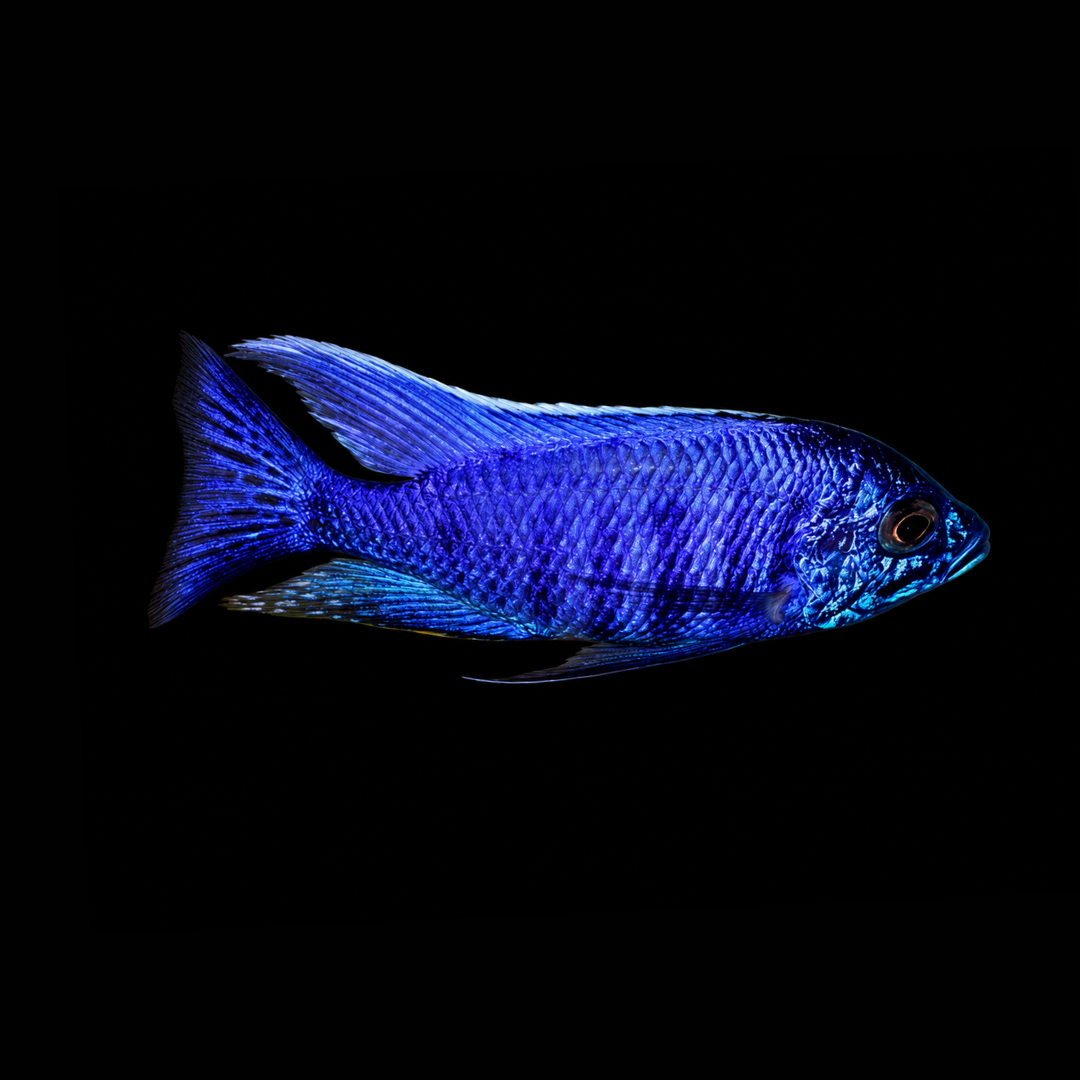
コパディクロミス・アズレウスは、東アフリカのマラウイ湖にのみ分布するシクリッドです。現地で「ウタカ」と呼ばれる遊泳性の魚群に属し、岩礁と砂地が接する水域の周辺で主に動物プランクトンを採食します。成熟したオスは全身が深いメタリックブルーに染まり、銀灰色から褐色を基調とするメスや未成熟魚とは外見が大きく異なります。繁殖期にはオスが砂地に産卵場所を整えてメスを誘い、産卵後はメスが卵と仔魚を口内で保護します。マラウイ湖産シクリッドの中では比較的落ち着いた性質ですが、繁殖期のオスは縄張りを持つため、十分な遊泳空間と、追われた個体が退避できる場所の両方を用意することが大切です。 Copadichromis azureus is a cichlid endemic to Lake Malawi in East Africa. It belongs to the open-water group locally known as “utaka” and feeds mainly on zooplankton around transitional habitats where rocky areas meet sand. Mature males develop a deep metallic blue over much of the body, contrasting strongly with the silver-gray to brown coloration of females and immature fish. During breeding, a male prepares a spawning area on sand and courts females; after spawning, the female carries and protects the eggs and developing fry in her mouth. The species is comparatively calm for a Lake Malawi cichlid, but breeding males become territorial, so the aquarium should provide both generous swimming space and secure retreats for subordinate fish.
基本情報 / Basic Information
| 学名 / Scientific Name | Copadichromis azureus Konings, 1990 |
|---|---|
| 通称 / Common Name | コパディクロミス・アズレウス、アズレウスAzureus cichlid, Azureus |
| 分類 / Family | シクリッド科 Cichlidae、Pseudocrenilabrinae亜科、Haplochromini族、Copadichromis属Family Cichlidae, subfamily Pseudocrenilabrinae, tribe Haplochromini, genus Copadichromis |
| 英名 / English Name | Azureus Cichlid |
| 分布 / Distribution | マラウイ湖固有種。湖の南半部を中心に、ムベンジ諸島、マレリ諸島のナカンテンガ島、ンコモ・リーフ、エクルズ・リーフなどから記録されています。主に岩場と砂地が接する移行帯に生息し、通常は水深19〜25m付近で確認されます。タイプ標本はムベンジ島の水深15〜23mで採集されました。Endemic to Lake Malawi. It is recorded mainly from the southern half of the lake, including the Mbenji Islands, Nakantenga Island in the Maleri group, Nkhomo Reef and Eccles Reef. It is associated chiefly with transitional habitats where rocks meet sand and is usually recorded at depths of about 19–25 m. The holotype was collected at Mbenji Island at a depth of 15–23 m. |
| 最大体長 / Max Size | FishBaseでは最大全長14.6cmが記録されています。飼育下では個体差や給餌条件によってこれに近い大きさまで成長するため、成魚では15cm前後を想定して設備を整えると安全です。メスは一般にオスより小型です。FishBase records a maximum total length of 14.6 cm. Captive fish can approach this size depending on the individual and husbandry, so planning for an adult size of roughly 15 cm is prudent. Females are generally smaller than males. |
| 寿命 / Lifespan | 本種に限定した信頼性の高い寿命データは十分に確立されていません。飼育では数年単位の長期維持を前提に、安定した水質、適切な給餌、慢性的な争いを避ける環境づくりを行います。Reliable species-specific lifespan data are not well established. In captivity, the fish should be regarded as a long-term commitment measured in years, with stable water quality, appropriate feeding and avoidance of chronic aggression forming the basis of longevity. |
飼育環境 / Aquarium Environment
| 水槽サイズ / Tank Size | 成魚を複数で長期飼育する場合は、120cm規格水槽を基本とし、ハーレム飼育や他種との混泳では120cmワイド水槽以上がより安心です。90cm規格水槽は若魚や単独個体の管理には使えますが、成魚の遊泳性と繁殖期の縄張りを考えると余裕は大きくありません。水量だけでなく、水槽の横幅と遊泳距離を重視してください。For long-term maintenance of several adults, a standard 120 cm aquarium is a sound baseline, while a 120 cm wide tank or larger is preferable for a harem or mixed-species community. A standard 90 cm aquarium can serve for juveniles or a single specimen, but offers limited room once adult swimming activity and breeding territories are considered. Tank length and open swimming distance matter as much as total volume. |
|---|---|
| 水温 / Temperature | 24〜27℃を目安に、急変させず安定して維持します。繁殖を狙う場合も極端な昇温は必要なく、25〜26℃前後で安定した環境を保つと管理しやすくなります。 Maintain a stable temperature of about 24–27°C and avoid abrupt changes. Breeding does not require extreme warming; conditions around 25–26°C are straightforward to manage. |
| 水質 / Water Quality | 弱アルカリ性の水を基本とし、飼育ではpH 7.6〜8.4程度を目安にします。日本の水道水は地域によって硬度やアルカリ度が大きく異なるため、最初から大量のミネラル剤を加えるのではなく、水道水と水槽水のpH・KH・GHを測定してから調整します。サンゴ砂や炭酸塩系ろ材はpHの低下を緩やかに抑える補助になりますが、必要量は元水によって変わります。数値を追い過ぎるよりも、水質の急変を避け、アンモニアと亜硝酸が検出されない状態を維持することが重要です。Mildly alkaline water is appropriate, with roughly pH 7.6–8.4 as a practical aquarium target. Because Japanese tap water varies considerably in hardness and alkalinity by region, test pH, KH and GH before adding large quantities of mineral supplements. Coral sand and carbonate-based filter media can help resist downward pH drift, but the amount required depends on the source water. Stability is more important than chasing extreme values, and ammonia and nitrite should remain undetectable. |
| レイアウト / Layout | 底床には細粒から中粒の砂を用い、オスが産卵場所を整えられる開けた砂地を残します。岩組みは背面や側面を中心に配置して視線を遮り、追われたメスや弱い個体が逃げ込める場所を作ります。シクリッドは砂を掘るため、岩は掘削で崩れないよう安定させて設置してください。中央から前面には、群れが無理なく泳げる空間を確保します。Use fine to medium sand and leave an open sandy area where a male can prepare a spawning site. Concentrate rockwork along the back and sides to break lines of sight and provide retreats for females and subordinate fish. Because cichlids dig, rocks must be placed securely so excavation cannot destabilize them. Keep the center and front sufficiently open for normal swimming. |
| 注意点 / Precautions | アルカリ性の水では、総アンモニアのうち毒性が高い非イオン型アンモニアの割合が増えるため、ろ過の成熟と日常的な水質管理が重要です。換水は週1回30〜50%程度を出発点とし、飼育密度、給餌量、硝酸塩の推移に合わせて調整します。ろ過装置の公称流量だけに頼らず、十分な生物ろ過容量と水面の撹拌を確保し、酸素不足を防いでください。In alkaline water, a larger fraction of total ammonia is present as the more toxic un-ionized form, so mature biological filtration and routine water-quality management are especially important. A weekly water change of about 30–50% is a useful starting point, adjusted to stocking density, feeding and nitrate trends. Do not rely on nominal filter flow alone; provide adequate biological filter capacity and strong surface agitation to maintain oxygenation. |
餌と給餌 / Feeding
| 餌の種類 / Diet | 主食には、品質が安定したアフリカンシクリッド用の小粒ペレットやフレークが適します。自然下では主に動物プランクトンを利用するため、ブラインシュリンプ、ミジンコ類、細かくしたクリルなどは副食として取り入れられます。植物質を含む総合飼料も組み合わせ、特定の餌だけに偏らないようにします。A high-quality small pellet or flake formulated for African cichlids is suitable as a staple. Because the species feeds mainly on zooplankton in nature, brine shrimp, daphnia-type foods and finely prepared krill can be offered as supplements. Complete foods containing plant ingredients can also be included to avoid an unnecessarily narrow diet. |
|---|---|
| 給餌のポイント / Feeding Tips | 1日1〜2回、短時間で食べ切れる量を与え、常に腹部が張るような過給餌は避けます。いわゆるマラウイ・ブロートは、特定の餌成分だけで原因を説明できる病態ではありません。消化管の異常、微生物、水質、ストレス、食餌内容など複数の要因が関与すると考えられているため、「高タンパク質の餌はすべて危険」と単純化せず、衛生的で消化しやすい総合飼料を中心に、量と体型を見ながら管理してください。急な餌の切り替えや過食を避けることも大切です。Feed once or twice daily in portions that are consumed quickly and avoid chronic overfeeding that leaves the abdomen persistently distended. So-called Malawi bloat is not a condition that can be attributed to one dietary component alone. Gastrointestinal disturbance, microorganisms, water quality, stress and diet may all contribute. Rather than assuming that all high-protein foods are dangerous, base the diet on hygienic, digestible complete foods, control portions according to body condition, and avoid sudden dietary changes or overeating. |
性格と混泳 / Temperament and Tank Mates
| 性格 / Temperament | マラウイ湖産シクリッドの中では比較的穏やかな部類ですが、繁殖期のオスは砂地の産卵場所を中心に縄張りを持ちます。そのため、同種のオスや体型・体色が似た魚を追うことがあります。メスや未成熟魚はまとまって泳ぐことが多く、広い水槽ほど本来の遊泳性を観察しやすくなります。It is comparatively peaceful for a Lake Malawi cichlid, but breeding males defend territories centered on sandy spawning sites. They may therefore chase rival males or similarly shaped and colored fishes. Females and immature fish often swim in loose groups, and a larger aquarium better reveals their natural open-water behavior. |
|---|---|
| 混泳の相性 / Compatibility | 同程度の大きさで、過度に攻撃的ではないハップ系やウタカ、比較的穏やかなアウロノカラ類が候補になります。縄張り性の強いムブナとの混泳は、広い水槽と十分な経験がない限り避ける方が無難です。同属種や外見のよく似た魚は、闘争や交雑のリスクを考えて慎重に選びます。純系繁殖を目的とする場合は、近縁種を同じ水槽で繁殖させない方が安全です。テトラやコリドラスなど一般的な小型熱帯魚は、水質、体格、行動の違いが大きいため、基本的に混泳対象にはしません。過密飼育で攻撃を分散する方法もありますが、強力なろ過、頻繁な換水、継続的な個体観察が必要な上級者向けの管理法です。Suitable companions include similarly sized, non-hyperaggressive haps and utaka, together with comparatively peaceful Aulonocara. Highly territorial mbuna are best avoided unless the aquarium is large and the keeper experienced. Other Copadichromis and very similar-looking fishes should be chosen cautiously because of aggression and possible hybridization; for lineage-conscious breeding, do not breed close relatives together in the same aquarium. Typical small community fishes such as tetras and Corydoras are generally unsuitable because their water, size and behavioral requirements differ markedly. Deliberate crowding can sometimes diffuse aggression, but it is an advanced technique requiring strong filtration, frequent water changes and continuous observation. |
病気と対策 / Diseases and Prevention
| かかりやすい病気 / Common Diseases | 本種だけに特有の病気が知られているというより、水質悪化や慢性的なストレスをきっかけに、白点病、細菌性の皮膚・鰭の障害、消化管の不調、腹部膨満を伴うマラウイ・ブロート様の症状などが見られることがあります。食欲の低下、白く糸状の排泄物、呼吸の速まり、腹部の異常な膨らみ、急な体色変化、物陰から出なくなる状態などは、早めに原因を確認したいサインです。No single disease is uniquely characteristic of this species. Poor water quality or chronic stress can precede white spot disease, bacterial skin or fin problems, gastrointestinal disorders and Malawi-bloat-like abdominal swelling. Loss of appetite, pale stringy feces, rapid breathing, abnormal abdominal enlargement, sudden color change and persistent hiding are signs that warrant prompt investigation. |
|---|---|
| 対策と予防 / Prevention | 予防の基本は、安定した水質、飼育密度に見合うろ過と換水、適量の給餌、そして追われた個体が逃げられる空間の確保です。新しく迎えた魚は、可能であれば隔離水槽で健康状態を確認してから本水槽へ導入します。腹部膨満や食欲不振が見られたときは、病名を決めつけて複数の薬剤を重ねるのではなく、まず水質、呼吸、排泄、給餌量、他魚からの攻撃の有無を確認してください。症状が強い、または改善しない場合は、魚病に詳しい獣医師や信頼できる専門店に相談し、原因に合った対応を選びます。Prevention begins with stable water quality, filtration and water changes appropriate to stocking density, controlled feeding, and enough space for subordinate fish to escape aggression. Whenever possible, observe new fish in quarantine before introduction. If abdominal swelling or loss of appetite appears, do not stack medications based on an assumed diagnosis; first check water quality, respiration, feces, feeding level and aggression from tank mates. If signs are severe or persistent, seek advice from a veterinarian experienced with fish or a knowledgeable specialist and choose treatment according to the likely cause. |
増やし方(繁殖) / Breeding
| 雌雄の判別 / Sexing | 成熟したオスは全身が鮮やかな青色に発色し、各鰭にも青みが広がります。メスは銀灰色から褐色を基調とし、体側の3個の暗色斑が目立ちます。未成熟魚では雌雄差が小さく、発色前のオスはメスに似るため、小型個体を外見だけで確実に判別するのは難しいことがあります。Mature males develop intense blue coloration across the body and fins. Females remain silver-gray to brownish and show three prominent dark flank spots. Sexing immature fish can be difficult because young males resemble females before adult coloration develops. |
|---|---|
| 繁殖形態 / Reproduction | 母系口内保育型です。成熟したオスは岩に近い砂地にくぼみ状の産卵場所を作り、求愛したメスを誘います。メスは産んだ卵をすぐに口へ収め、産卵行動の中で受精が進みます。オスの尻ビレにあるエッグスポットは、この一連の繁殖行動に関わる視覚信号として知られています。ただし、その働きを単純な「卵そっくりの偽物」だけで説明することには議論があり、求愛や種認識を含む複数の機能が考えられています。抱卵期間は水温や個体によって変わりますが、おおむね3週間前後がひとつの目安です。This species is a maternal mouthbrooder. A mature male prepares a shallow spawning depression on sand near rocks and courts females into the territory. The female quickly collects newly laid eggs in her mouth, and fertilization takes place during the spawning sequence. Male anal-fin egg spots are recognized as visual signals involved in reproduction, although their function is likely more complex than that of a simple perfect egg mimic and may include courtship or species-recognition roles. Brooding duration varies with temperature and the individual, but roughly three weeks is a useful general guide. |
| 繁殖のポイント / Breeding Tips | 1匹のオスに対して複数のメスを用意すると、求愛が1匹に集中しにくくなり、メスの消耗を抑えやすくなります。産卵床を作れる砂地と、抱卵中のメスが追われずに休める岩陰を用意してください。抱卵中のメスは摂餌が大きく減り、強引な捕獲は卵や仔魚を吐き出す原因になることがあります。自然に稚魚を放すまで待つ方法は扱いやすく、放仔後は親魚に捕食されない育成水槽へ移し、細かな人工飼料や孵化直後のブラインシュリンプを与えて育てます。血統を維持したい場合は、近縁種や同属種と同時に繁殖させないよう管理します。Keeping several females with one male helps spread courtship pressure and reduce exhaustion of any single female. Provide open sand for spawning as well as sheltered rockwork where a brooding female can rest without persistent chasing. Feeding falls markedly during brooding, and rough capture can cause a female to release eggs or fry prematurely. Waiting for natural release is usually the simplest method; afterward, move fry to a separate rearing aquarium where they can receive fine prepared food and newly hatched brine shrimp. To preserve lineage integrity, avoid breeding the fish alongside closely related or other Copadichromis species. |
雑学と豆知識 / Trivia and Fun Facts
| 1. 「azureus」は青を表す名前 / 1. A name that evokes blue | 種小名のazureusは「青い」「紺碧の」といった意味につながるラテン語で、成熟したオスの青い体色を端的に表しています。若魚のころは銀灰色で目立たない個体が、成熟と社会的な状態の変化に伴って深い青へ変わるため、飼育では完成した色だけでなく、発色していく過程そのものも大きな見どころです。The species name azureus derives from Latin for blue or azure and directly reflects the coloration of mature males. Juveniles begin in subdued silver-gray tones and develop deep blue as they mature and their social condition changes, making the transition itself one of the most rewarding aspects of keeping the species. |
|---|---|
| 2. 1990年に記載された種 / 2. A species described in 1990 | コパディクロミス・アズレウスはAd Koningsによって1990年に記載されました。正基準標本はムベンジ島の水深15〜23mで採集された標準体長108mmのオスで、現在もCopadichromis azureus Konings, 1990が有効な学名として扱われています。マラウイ湖のシクリッドには外見がよく似た種や地域個体群が多いため、分類では体色だけでなく、斑紋、歯、鰓耙、鰭条数など複数の形質を組み合わせて比較します。Copadichromis azureus was described by Ad Konings in 1990. The holotype is a 108 mm standard-length male collected at Mbenji Island at a depth of 15–23 m, and Copadichromis azureus Konings, 1990 remains the accepted scientific name. Because many Lake Malawi cichlids and geographic populations resemble one another, taxonomy compares combinations of color pattern, spotting, teeth, gill rakers, fin-ray counts and other characters rather than relying on coloration alone. |
| 3. 3個の暗色斑は重要な識別点 / 3. Three dark flank spots are an important clue | メスや未成熟魚では、体側に並ぶ3個の暗色斑がよく目立ちます。成熟して繁殖色が強く出たオスでは青い婚姻色や暗い縦帯が重なり、斑点が目立ちにくくなることがあります。そのため、同じ種でも若魚と成熟オスでは印象が大きく変わります。シクリッドらしい顕著な性的二型を観察できる種のひとつです。Females and immature fish usually show three conspicuous dark spots along the flank. In strongly colored breeding males, intense blue coloration and darker vertical bars can make these spots much less obvious. The same species can therefore look strikingly different at different life stages, providing a clear example of strong sexual dimorphism in Lake Malawi cichlids. |
| 4. プランクトン食に適した「伸びる口」 / 4. A protrusible mouth suited to plankton feeding | Copadichromisの仲間は、口を前方へ大きく突出させることができます。顎を構成する骨が連動して口先を前へ伸ばし、吸い込みと組み合わせて小さな餌生物を取り込む仕組みです。これは開水域で動物プランクトンを利用する生活と結びついた特徴で、水槽でも細かな餌を追う姿を横から観察すると、口が瞬間的に前へ伸びる様子を確認できることがあります。Members of Copadichromis can project the mouth markedly forward. Coordinated movements of the jaw and skull extend the mouth and combine with suction to capture small prey. This mechanism is closely associated with feeding on zooplankton in open water, and careful side-on observation during aquarium feeding may reveal the mouth extending for an instant. |
| 5. エッグスポットは単純な「だまし絵」とは限らない / 5. Egg spots may do more than imitate eggs | ハプロクロミス系シクリッドのオスが尻ビレに持つ黄色いエッグスポットは、長く「メスが卵と見誤って口を近づけるための模様」と説明されてきました。実際に繁殖行動と深く関係する視覚信号ですが、研究では、種によってスポット数と繁殖成功が単純に対応しない例も示されています。求愛、種認識、社会的なシグナルなど、複数の働きが重なっている可能性があり、小さな斑点の背後にもシクリッド進化の興味深い問題が残されています。The yellow egg spots on the anal fins of male haplochromine cichlids have long been explained as markings that encourage females to approach as if collecting eggs. They are clearly involved in reproductive signaling, but studies also show that spot number does not always correspond simply with reproductive success. Courtship, species recognition and social signaling may overlap in their function, leaving an intriguing evolutionary question behind these small markings. |
| 6. マラウイ湖では「高pH」と「極端な硬水」を分けて考える / 6. Alkaline does not automatically mean extremely hard | マラウイ湖の水はアルカリ性ですが、「アフリカ大地溝帯の湖だから極端な硬水」と一括りにすると実際の水質を誤解しやすくなります。飼育では、硬度を必要以上に上げることよりも、適度な炭酸塩緩衝能を確保し、弱アルカリ性のpHを急変させずに維持することが重要です。日本の水道水は地域差が大きいため、サンゴ砂やバッファー剤は固定量で使わず、自宅の水を測定して必要な分だけ調整する方が安全です。Lake Malawi is alkaline, but treating every Rift Valley lake as extremely hard water can be misleading. In aquaria, the goal is not to raise hardness without limit but to provide adequate carbonate buffering and keep a mildly alkaline pH stable. Because Japanese tap water varies greatly by region, coral media and buffers are safer when adjusted to actual measurements rather than used in a fixed recipe. |
| 7. 日本ではブリード個体が中心 / 7. Captive-bred fish dominate the Japanese hobby | 日本の観賞魚市場では、ヨーロッパや東南アジア、国内で繁殖された個体が流通し、サイズ、性別、発色、血統表示、入荷時期によって価格は大きく変わります。野生採集個体が入荷することもありますが、常時見られるものではありません。購入時は「産地名」や「ブリード元」の表示だけで品質を決めつけず、体型、鰭の状態、呼吸、摂餌、混泳水槽での扱われ方まで確認すると、導入後の失敗を減らせます。繁殖個体を選ぶことは、野生個体への採集圧を必要以上に高めないという点でも意味があります。In the Japanese aquarium trade, captive-bred fish from Europe, Southeast Asia and domestic breeders are commonly available, with prices varying widely according to size, sex, coloration, stated lineage and timing of import. Wild-caught fish occasionally appear but are not consistently available. Rather than judging quality from origin labels alone, examine body shape, fin condition, respiration, feeding response and how the fish is managed in the dealer’s aquarium. Choosing captive-bred stock can also reduce unnecessary collecting pressure on wild populations. |
| 8. 保全評価は準絶滅危惧 / 8. Conservation status: Near Threatened | IUCNレッドリストでは2018年6月22日の評価で準絶滅危惧(Near Threatened、NT)とされ、基準表記はB1a+2aです。本種はマラウイ湖全域に均一に分布する魚ではなく、南部の限られた地点に分布するため、局所的な環境変化の影響を受けやすいと考えられます。観賞魚として長く楽しむことと、産地の生態系を尊重することは切り離せない関係にあります。The IUCN Red List assessment dated 22 June 2018 categorizes the species as Near Threatened (NT) under criteria B1a+2a. It is not evenly distributed throughout Lake Malawi, but occurs at a limited set of southern localities, making localized environmental change particularly relevant. Responsible enjoyment of the species in aquaria therefore goes hand in hand with respect for the ecosystems and populations from which it originated. |
まとめ / Conclusion
コパディクロミス・アズレウスの魅力は、成熟したオスの深い青色だけではありません。開けた水域を泳ぐウタカらしい姿、砂地を利用した求愛、そしてメスが次世代を口内で守る繁殖行動まで、マラウイ湖のシクリッドが進化の中で獲得してきた特徴を、水槽の中でじっくり観察できます。十分な遊泳空間を確保し、水質を安定させ、個体同士の力関係に目を配ることで、本種らしい体型と行動が自然に引き出されます。 The appeal of Copadichromis azureus extends well beyond the deep blue of a mature male. Its open-water swimming, courtship over sand and maternal mouthbrooding allow aquarists to observe several of the distinctive traits that Lake Malawi cichlids have acquired through evolution. With ample swimming room, stable water quality and careful management of social relationships, the species can display its characteristic form and behavior naturally.
日本で飼育する際は、「マラウイ湖の魚にはこの数値」と固定的に考えるより、自宅の水道水を測り、無理のない範囲で弱アルカリ性を安定させることが長期飼育につながります。青く発色したオスと控えめな色彩のメスが、それぞれ異なる行動を見せながら同じ環境で暮らす姿には、華やかさと生態の奥深さが同居しています。環境を整え、日々の変化を丁寧に観察できる飼育者にとって、コパディクロミス・アズレウスは長く付き合うほど新しい魅力を見せてくれるマラウイ湖シクリッドです。 For aquarists in Japan, long-term success comes from measuring the local tap water and maintaining a stable mildly alkaline environment rather than forcing every aquarium toward a rigid numerical recipe. The contrast between a blue male and subtly colored females is accompanied by equally different social and reproductive roles, combining visual beauty with ecological depth. For keepers who provide suitable conditions and observe day-to-day changes carefully, Copadichromis azureus remains a rewarding Lake Malawi cichlid whose appeal grows with time.
気になる道具や飼い方を見つけてみませんか?
 アイのアクアグッズ案内コケを食べるコイの仲間に合わせる飼育用品|フライングフォックス・アルジイーター・ガラ道具の特徴や使い方、選ぶときのポイントをアイが紹介します。記事はコチラ →
 アイのアクアグッズ案内水槽用浄水器の選び方|水換えを楽にするタイプとROの違い道具の特徴や使い方、選ぶときのポイントをアイが紹介します。記事はコチラ →
 アイのアクアグッズ案内カルキ抜き・水質調整剤の選び方|水換えと水槽の種類に合わせて選ぶ道具の特徴や使い方、選ぶときのポイントをアイが紹介します。記事はコチラ →
 アイのアクアグッズ案内水草用ソイルの選び方|土・砂の違いとおすすめ商品道具の特徴や使い方、選ぶときのポイントをアイが紹介します。記事はコチラ →
さまざまな飼育テーマをご紹介。リンク先の記事には広告・商品紹介が含まれます。
案内・紹介記事一覧へ →分布マップ
コパディクロミス・アズレウス(Copadichromis azureus)はマラウイ湖の固有種で、湖の南半部を中心に、ムベンジ諸島、マレリ諸島のナカンテンガ島、ンコモ・リーフ、エクルズ・リーフなどから記録されています。
※この地図は記事中の分布情報をもとに、マラウイ湖南半部と主要な記録地域が見えるよう設定した概略表示です。マーカーは分布域を示すための代表地点であり、実際の採集地点を示すものではありません。
参考文献
-
Eschmeyer’s Catalog of Fishes, California Academy of SciencesCopadichromis azureus Konings, 1990 の有効名、原記載、タイプ産地、ホロタイプ、分布の確認に使用。Fricke, R., Eschmeyer, W. N. & Van der Laan, R. (eds.). Eschmeyer’s Catalog of Fishes. California Academy of Sciences.
-
Stauffer & Konings (2006) Review of CopadichromisCopadichromis属の分類学的再検討、本種を含む種群の識別形質、斑紋や計数形質などの分類上の位置づけを支える主要資料。Stauffer, J. R. Jr. & Konings, A. F. (2006). Review of Copadichromis (Teleostei: Cichlidae) with the description of a new genus and six new species. Ichthyological Exploration of Freshwaters, 17(1), 9–42.
-
FishBase: Copadichromis azureus最大体長、マラウイ湖固有種としての分布、生息情報、分類学上の主要文献、保全評価への参照を確認するための基礎データベース。Froese, R. & Pauly, D. (eds.). FishBase. Copadichromis azureus species summary.
-
Turner et al. (2023) Taxonomic investigation of zooplanktivorous Lake Malawi cichlidsウタカと呼ばれる動物プランクトン食性のCopadichromis類について、分類、形態、突出可能な口部、食性適応を理解するための比較資料。Turner, G. F., Crampton, D. A., Rusuwa, B., Hooft van Huysduynen, A. & Svardal, H. (2023). Taxonomic investigation of the zooplanktivorous Lake Malawi cichlids Copadichromis mloto (Iles) and C. virginalis (Iles). Hydrobiologia, 850, 2165–2175. DOI: 10.1007/s10750-022-05025-1.
-
York et al. (2015) Evolution of bower building in Lake Malawi cichlid fishマラウイ湖産シクリッドにみられるバウアー形成、求愛、生殖行動、母系口内保育という繁殖戦略の学術的背景を支える資料。York, R. A., Patil, C., Hulsey, C. D., Anoruo, O., Streelman, J. T. & Fernald, R. D. (2015). Evolution of bower building in Lake Malawi cichlid fish: phylogeny, morphology, and behavior. Frontiers in Ecology and Evolution, 3, 18. DOI: 10.3389/fevo.2015.00018.
-
Branchu et al. (2005) Lake Malawi water chemistryマラウイ湖の水質を、単純な「硬水」という表現だけで捉えず、アルカリ性、水中イオン組成、地質との関係から理解するための湖沼学的資料。Branchu, P., Bergonzini, L., Delvaux, D., De Batist, M., Golubev, V., Benedetti, M. & Klerkx, J. (2005). Tectonic, climatic and hydrothermal control on sedimentation and water chemistry of northern Lake Malawi (Nyasa), Tanzania. Journal of African Earth Sciences, 43, 433–446. DOI: 10.1016/j.jafrearsci.2005.09.004.
-
MSD Veterinary Manual: Environmental Diseases of Aquatic Animals水温、pH、アンモニア、亜硝酸、溶存酸素、アルカリ度など、水槽内の水質管理と疾病リスクの関係を支える獣医学資料。MSD Veterinary Manual. Environmental Diseases of Aquatic Animals in Aquatic Systems.
-
Merck Veterinary Manual: Disorders and Diseases of Fish観賞魚における細菌性疾患、寄生虫、皮膚・鰓障害、過密や衛生状態、水質悪化と疾病発生の関係、隔離飼育の重要性を支える獣医学資料。Merck Veterinary Manual. Disorders and Diseases of Fish.




コメント