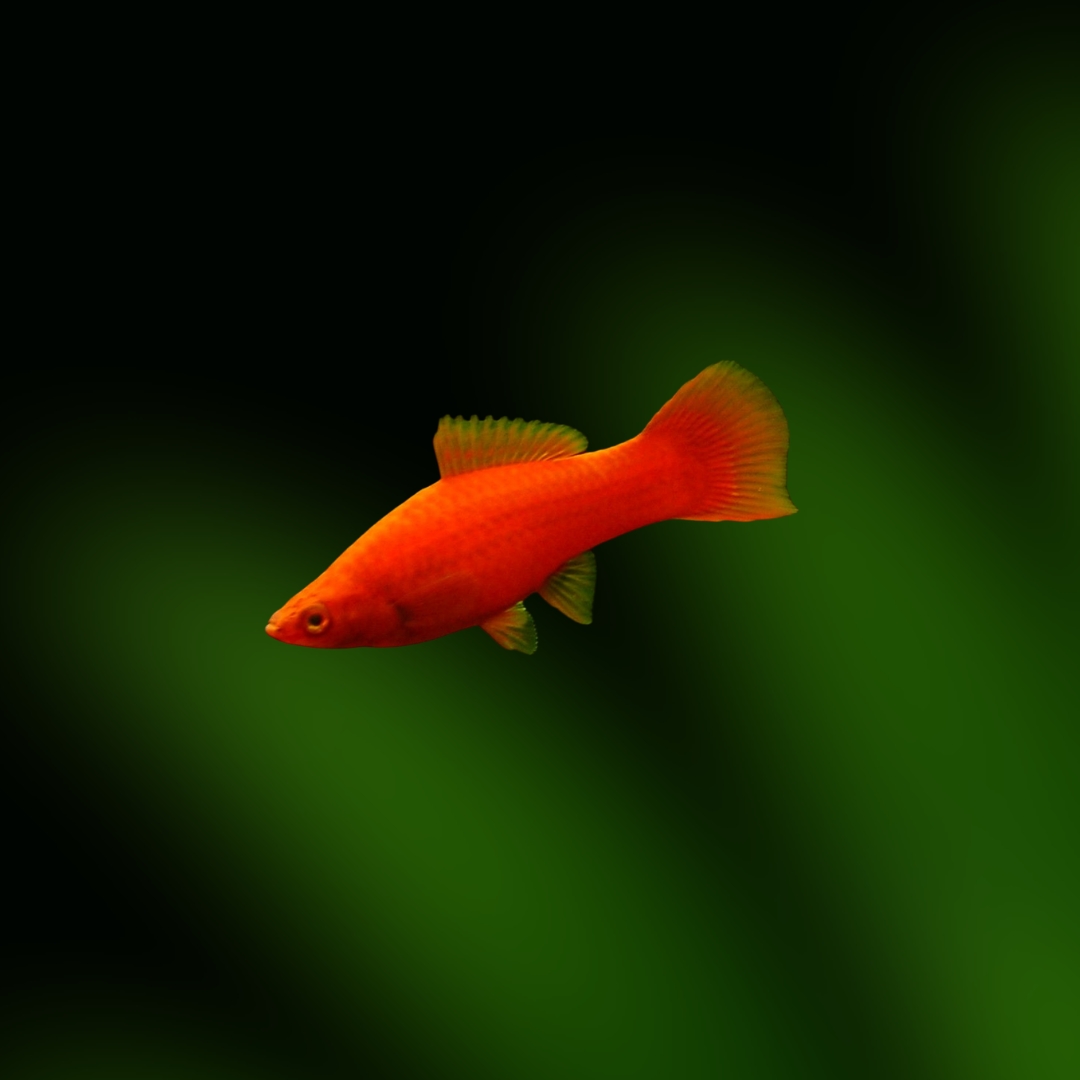
レッドソードテールは、雄の尾びれ下部が剣のように伸びる姿と、鮮やかな赤い体色で古くから親しまれてきた卵胎生の熱帯魚です。野生型のグリーンソードテールはメキシコ南部から中央アメリカ北部にかけて自然分布する種で、現在流通するレッド系品種は、長い品種改良の過程でプラティ類との交雑や選別が関わった品種群として扱われます。丈夫で繁殖も楽しみやすい一方、成長するとよく泳ぎ、雄同士の張り合いや雌への追い回しも起こるため、十分な水量と雌を多めにしたグループ構成が大切です。観賞魚としての親しみやすさに加え、性淘汰、交雑、性決定、腫瘍研究などの分野でも扱われてきた、見た目以上に奥深い魚です。The Red Swordtail is a livebearing tropical fish long admired for the male’s sword-like extension on the lower caudal fin and its vivid red body color. The wild-type Green Swordtail is native from southern Mexico to northern Central America, while the red ornamental forms commonly sold today are best treated as selectively bred strains shaped over time by selection and, in many lines, hybridization with platies. Although hardy and easy to breed, they are active swimmers that need sufficient water volume, and males may compete with each other or persistently court females. A group with more females than males is therefore recommended. Beyond its appeal as an aquarium fish, it has also been used in studies of sexual selection, hybridization, sex determination, and tumor biology.
カダヤシ目カダヤシ科ソードテール属Order Cyprinodontiformes, family Poeciliidae, genus Xiphophorus
英名 / English Name
Red Swordtail, Swordtail Livebearer
分布 / Distribution
野生型のグリーンソードテールは、メキシコ南部、グアテマラ、ホンジュラス北部など、メキシコから中央アメリカ北部にかけて自然分布する。観賞魚としてのレッド系品種は世界各地で養殖され、日本国内にも広く流通している。The wild-type Green Swordtail is native from southern Mexico through Guatemala to northern Honduras. Red ornamental strains are farmed widely around the world and are commonly available in Japan.
最大体長 / Max Size
全長は雄で約14cm、雌で約16cm前後に達する記録がある。改良品種や飼育環境では個体差が大きく、販売個体はこれより小さいことが多いが、終生飼育では中型魚として扱う。Records indicate a maximum total length of about 14 cm for males and about 16 cm for females. Size varies by strain and aquarium conditions, and shop specimens are often smaller, but adults should still be treated as medium-sized aquarium fish.
寿命 / Lifespan
飼育下ではおよそ3から5年が目安。水質悪化や過密飼育、急な低温、雄の過度な追い回しを避けることで、より安定した長期飼育が期待できる。A typical aquarium lifespan is about 3 to 5 years. Stable water quality, adequate space, avoidance of sudden chilling, and reduced social stress help support a longer life.
飼育環境 / Aquarium Environment
水槽サイズ / Tank Size
少数飼育でも60cm規格水槽以上を目安にし、繁殖やグループ飼育を考えるなら60cmワイド水槽から90cm規格水槽、できれば100L前後以上の水量が安心。海外の飼育資料では80cm以上の水槽を推奨する例もあり、活発に泳ぎ、雌も大きくなるため、小型水槽での終生飼育には向かない。Even for a small group, a standard 60 cm tank is a practical starting point, while a 60 cm wide tank to a standard 90 cm tank, preferably around 100 L or more, is safer for groups or breeding. Some care references recommend tanks of 80 cm or larger. They are active swimmers and females can grow large, so long-term care in very small aquariums is not suitable.
水温 / Temperature
22から28℃前後を目安に管理する。日本の冬はヒーターが必須で、夏場は高水温になりすぎないように通気や冷却ファンなどで調整する。Maintain about 22 to 28°C. A heater is essential in Japanese winters, and ventilation or cooling fans may be needed in summer to prevent excessive heat.
水質 / Water Quality
中性から弱アルカリ性、やや硬めの水を好む。目安はpH 7.0から8.0前後、硬度は中硬水寄りだが、流通している改良品種は安定した水であれば比較的幅広く順応する。日本の水道水は地域によって軟水傾向があるため、必要に応じてサンゴ砂や牡蠣殻を少量使い、pHとミネラル分を急変させずに安定させるとよい。They prefer neutral to slightly alkaline, moderately hard water. A practical target is around pH 7.0 to 8.0 with moderate hardness, although captive-bred strains often adapt to a relatively broad range if conditions are stable. Because tap water in many parts of Japan is relatively soft, small amounts of coral sand or oyster shell can help stabilize pH and mineral content without sudden changes.
レイアウト / Layout
前面から中央に遊泳スペースを確保し、後景や側面に水草を茂らせるレイアウトが向く。ウィローモス、マツモ、アナカリス、ウォーターウィステリアなどは稚魚の隠れ家にもなる。水流は強すぎず、ろ過はしっかり効かせる。Provide open swimming space in the front and middle, with dense plants along the back and sides. Java moss, hornwort, anacharis, and water wisteria also provide shelter for fry. Filtration should be reliable, but the current should not be excessively strong.
注意点 / Precautions
古い水や硝酸塩の蓄積で調子を崩しやすいため、定期的な換水を重視する。雄同士は争うことがあり、雄1匹に対して雌2から3匹以上の比率が望ましい。また、飼育個体を河川や池へ放流してはいけない。日本国内でも山梨県、沖縄島、久米島などで野外定着が記録されており、生態系への影響を避けるため終生飼育を徹底する。They may decline in old water with accumulated nitrate, so regular water changes are important. Males may fight, and a ratio of one male to at least two or three females is preferred. Never release aquarium fish into rivers or ponds. Established feral populations have been recorded in parts of Japan, including Yamanashi Prefecture, Okinawa Island, and Kume Island, so responsible lifelong care is essential.
餌と給餌 / Feeding
餌の種類 / Diet
雑食性で、人工フードへの餌付きは良好。フレーク、顆粒、ペレットを主食にし、スピルリナなど植物質を含む飼料、冷凍アカムシ、ブラインシュリンプ、イトミミズなどを補助的に与えるとよい。赤色の発色維持には、栄養バランスのよい色揚げ用飼料も役立つ。They are omnivorous and readily accept prepared foods. Use flakes, granules, or pellets as the staple, and supplement with spirulina-based vegetable foods, frozen bloodworms, brine shrimp, or tubifex. A balanced color-enhancing diet can help maintain the red coloration.
給餌のポイント / Feeding Tips
1日1から2回、数分で食べ切れる量を与える。食欲旺盛で水を汚しやすいため、与えすぎに注意する。稚魚には細かく砕いたフレークや微顆粒フードを1日数回少量ずつ与え、食べ残しをこまめに取り除く。Feed once or twice daily, only as much as they can finish within a few minutes. They eat eagerly and excess food can quickly pollute the water. Fry should be fed finely crushed flakes or micro pellets several times a day in small amounts, with leftovers removed promptly.
性格と混泳 / Temperament and Tank Mates
性格 / Temperament
基本的には丈夫で活発、物怖じしにくい性格。群れで行動する傾向がある一方、雄同士は張り合いやすく、繁殖期には雌をしつこく追うことがある。水槽内の力関係を分散するため、雌を多めに入れ、隠れ場所と遊泳スペースを両立させる。Generally hardy, active, and bold. They tend to live well in groups, but males may compete with each other and may persistently chase females. Keeping more females than males, with both hiding places and swimming space, helps reduce pressure on individual fish.
混泳の相性 / Compatibility
同程度の水質を好む中型の温和な魚と相性がよい。コリドラス、丈夫なテトラ類、レインボーフィッシュ、小型から中型のプレコ類などが候補になる。ベタやロングフィン系グッピーなど、ひれが長く泳ぎの遅い魚はひれをかじられる可能性がある。プラティとは容易に交雑するため、純系維持を目的とする場合は同居を避ける。They are compatible with similarly sized peaceful fish that prefer comparable water conditions, such as Corydoras, hardy tetras, rainbowfish, and small to medium plecos. Slow fish with long fins, such as bettas or long-fin guppies, may be nipped. Because they can hybridize readily with platies, avoid keeping them together if maintaining a pure line is important.
病気と対策 / Diseases and Prevention
かかりやすい病気 / Common Diseases
白点病、尾ぐされ病、カラムナリス症、痩せ、輸送後の体調不良などが見られることがある。急な低水温、水質悪化、過密、雌への追い回しによるストレスが発症のきっかけになりやすい。Possible issues include ich, fin rot, columnaris-like infections, wasting, and post-shipping weakness. Sudden chilling, poor water quality, overcrowding, and stress from persistent chasing are common triggers.
対策と予防 / Prevention
安定した水温、定期的な換水、過密回避、導入時の丁寧な水合わせを徹底する。購入直後の個体は別水槽で数日から数週間観察すると、本水槽への病気の持ち込みを減らせる。異常が出た場合は早めに隔離し、症状に応じて塩水浴や市販薬を検討する。Maintain stable temperature, perform regular water changes, avoid overcrowding, and acclimate new fish carefully. Observing new arrivals in a separate tank for several days to a few weeks helps reduce disease introduction. If symptoms appear, isolate affected fish early and consider salt baths or appropriate commercial medications according to the symptoms.
増やし方(繁殖) / Breeding
雌雄の判別 / Sexing
雄は尾びれ下部が剣状に伸び、尻びれが交尾器であるゴノポディウムへ変化する。雌は尾びれが扇形で、尻びれも通常の扇形または三角形をしており、成熟すると腹部が大きく、肛門付近に妊娠マークが見えることがある。ただし、遅れて成熟する雄は若い時期に雌のように見えることがある。Males develop a sword-like extension on the lower caudal fin and a gonopodium formed from the anal fin. Females retain a fan-shaped tail and a normal fan- or triangle-shaped anal fin, and mature females may show a swollen abdomen and a gravid spot near the vent. However, late-maturing males may resemble females when young.
繁殖形態 / Reproduction
卵胎生。雄がゴノポディウムで雌に精子を送り、雌の体内で受精した卵が発育する。卵ではなく、自力で泳げる稚魚を直接産む。雌は精子を体内に一定期間保存できるため、雄がいない環境でも複数回出産することがある。They are livebearers. The male transfers sperm with the gonopodium, and fertilized eggs develop inside the female. Instead of laying eggs, the female gives birth to free-swimming fry. Females can store sperm for a period, so they may give birth multiple times even without a male present.
繁殖のポイント / Breeding Tips
妊娠期間はおよそ24から30日が目安。雌は20から200匹ほどの稚魚を産むことがあり、よく成熟した大型個体ではさらに多産になる例も報告される。ただし、親魚や他の成魚が稚魚を食べるため、ウィローモスやマツモを密生させるか、出産前の雌を産卵箱や別水槽に移すと生存率が上がる。出産後は雌を速やかに戻し、稚魚には細かい餌を少量ずつ与え、清潔な水を保つ。Gestation is usually about 24 to 30 days. Females may produce around 20 to 200 fry, with especially mature large females sometimes reported to produce even more. Adults often eat the young, so dense Java moss or hornwort, or moving the female to a breeding box or separate tank before birth, improves fry survival. After birth, return the female promptly and feed the fry small amounts of fine food while keeping the water very clean.
雑学と豆知識 / Trivia and Fun Facts
1. 名前に刻まれた「剣」の物語 / 1. The story behind the sword
ソードテールという名は、雄の尾びれ下部が細く長く伸び、まるで剣を携えているように見えることに由来します。この剣は、単なる飾りではなく、雌が雄を選ぶ際の視覚的な手がかりとして働くと考えられてきました。研究では、剣のような装飾への雌の好みが、雄の剣そのものより先に存在していた可能性も示されています。つまり、雌の側に先にあった感覚的な偏りを、雄の形質が後から利用するように進化したかもしれない、という興味深い物語です。水槽の中で雄が雌の前で体を見せる姿は、観賞魚としての美しさであると同時に、進化の長い時間を感じさせる一場面でもあります。The name Swordtail comes from the male’s lower caudal fin extension, which resembles a narrow sword. This sword is not merely decorative; it has long been considered a visual signal involved in female mate choice. Research has suggested that female preference for sword-like ornaments may have existed before the male sword itself evolved. In other words, the male trait may have evolved by taking advantage of a sensory bias already present in females. When a male displays in the aquarium, the scene is not only beautiful but also a small glimpse into a long evolutionary story.
2. レッドソードテールは交雑が生んだ名品種 / 2. A classic strain born from hybridization
現在流通する鮮やかなレッドソードテールは、野生型そのものというより、長い選別育種の中で作られてきた観賞用品種群として理解すると自然です。特にベルリン・ソードテールやベルリン・クロスと呼ばれる系統は、プラティ由来の色彩や斑紋をソードテールの体型へ取り込む試みとして知られています。こうした交雑個体は最初から理想的なソードテール型だったわけではなく、世代を重ねて戻し交配と選別を行うことで、色彩の魅力と剣状尾びれの姿を両立させていきました。私たちがショップで見かける赤い一匹には、観賞魚育種の長い積み重ねが静かに受け継がれています。The vivid Red Swordtail commonly sold today is best understood not as a wild-type fish but as part of a long history of ornamental selective breeding. Strains known as Berlin Swordtails or Berlin crosses are especially associated with attempts to introduce platy-derived color and spotting traits into the swordtail body form. These hybrids did not immediately look like ideal swordtails; repeated backcrossing and selection were needed to combine attractive coloration with the swordtail shape. The red fish seen in shops today quietly carries a long legacy of ornamental fish breeding.
3. 「雌が雄になる」と語られる不思議 / 3. The mystery of females turning male
ソードテールには、昔から「雌が雄に変わる」と語られてきた現象があります。ただし、見た目の変化だけで性転換が起きたと判断することはできません。多くの場合、若い時期には雌のように見えるものの、実は成熟が遅い雄だったという可能性があります。こうした遅延成熟雄は、体が大きくなってから剣状尾びれやゴノポディウムを発達させるため、観察者には性転換のように見えることがあります。一方で、飼育下や実験条件下で性の変化や雄化が報告されることもあり、ソードテール類の性決定は単純な二択だけでは説明しにくい面があります。したがって、家庭水槽で見られる変化は、真の性転換と断定せず、遅延成熟やホルモン状態の変化を含めて観察するのが安全です。Swordtails have long been associated with the idea that females can turn into males, but a change in appearance alone does not establish that sex reversal has occurred. In many cases, a fish that appeared female when young may actually have been a late-maturing male. Such males may grow large before developing a sword and gonopodium, making the change look like sex reversal to the observer. At the same time, changes in sex expression or masculinization have been reported under aquarium or experimental conditions, and sex determination in swordtails is not always simple. Therefore, changes seen in home aquariums should not be labeled as true sex reversal too quickly; late maturation and hormonal changes should also be considered.
4. 医学研究にも関わった小さな熱帯魚 / 4. A small tropical fish with medical importance
ソードテール属とプラティ類を含む Xiphophorus 属は、観賞魚としてだけでなく、遺伝学や腫瘍研究の分野でも扱われてきました。特定の交雑系統では、色素細胞に由来するメラノーマが発生することが知られ、xmrk遺伝子や腫瘍を抑える遺伝的背景との関係が研究されてきました。これは、異なる種のゲノムが組み合わさったときに、色彩や体型だけでなく、細胞の増殖制御にも影響が現れることを示す重要な例です。水槽の中では丈夫で親しみやすい魚ですが、研究の世界では遺伝子、発生、腫瘍形成を考えるための重要な存在でもあります。The genus Xiphophorus, including swordtails and platies, has been used not only in ornamental breeding but also in genetics and tumor research. In certain hybrid lines, melanomas derived from pigment cells can occur, and researchers have studied the relationship between the xmrk gene and genetic backgrounds that suppress tumor formation. This provides an important example of how combining genomes from different species can affect not only color and body form, but also cellular growth control. In the aquarium, the Red Swordtail may seem like a familiar and hardy fish, but in research it has helped scientists think about genes, development, and tumor formation.
5. 飼いやすい魚だからこそ、放流しない責任を / 5. A hardy fish that must never be released
レッドソードテールは丈夫で繁殖力が高く、条件が合えば水槽内で次々と稚魚が生まれます。この魅力は、自然界では注意すべき力にもなります。日本ではグリーンソードテールとして、山梨県、沖縄島、久米島などで定着記録があり、久米島では1960年ごろの定着が示されています。熱帯魚だから寒ければ自然にいなくなる、とは限りません。温泉水や温排水のような局所的に暖かい水域が避難所となり、少数が越冬して再び増える可能性があります。飼育者にできる最も大切な保全行動は、最後まで責任を持って飼い、決して川や池に放さないことです。The Red Swordtail is hardy and highly fertile, and under suitable conditions fry may appear in the aquarium one generation after another. This appeal can become a concern in natural waters. In Japan, the Green Swordtail has recorded established populations in areas such as Yamanashi Prefecture, Okinawa Island, and Kume Island, with establishment on Kume Island indicated around 1960. It is not safe to assume that tropical fish will simply disappear in winter. Warm local refuges such as hot-spring effluent or other thermal waters may allow a few individuals to survive and rebuild a population. The most important conservation action for aquarists is to keep fish responsibly for their entire lives and never release them into rivers or ponds.
まとめ / Conclusion
レッドソードテールは、丈夫さ、鮮やかな赤色、雄の剣状尾びれ、そして卵胎生ならではの繁殖の楽しさを兼ね備えた、熱帯魚飼育の魅力を感じやすい魚です。飼育では、60cm規格水槽以上、できれば60cmワイド水槽から90cm規格水槽程度の余裕ある水量を用意し、中性から弱アルカリ性で清潔な水を保つことが大切です。雄1匹に対して雌を複数入れる構成にすると、雌への負担を減らしやすくなります。The Red Swordtail combines hardiness, vivid red coloration, the male’s sword-like tail, and the excitement of livebearing reproduction, making it an excellent fish for appreciating the appeal of tropical aquariums. For good care, provide at least a standard 60 cm tank, preferably a 60 cm wide to standard 90 cm tank for groups, and maintain clean neutral to slightly alkaline water. Keeping several females per male helps reduce stress on individual females.
一方で、本種は単なる入門魚にとどまらず、交雑による品種改良、性淘汰、性決定、腫瘍研究など、多くの学術的背景を持つ魚でもあります。繁殖力と適応力が高いからこそ、飼育下で増えた個体も含めて、自然水域への放流は絶対に避けなければなりません。適切な環境を整え、その歴史と生態を知りながら向き合えば、レッドソードテールは長く楽しめるだけでなく、アクアリウムの奥深さを教えてくれる頼もしい存在になります。At the same time, this species is more than a beginner fish. It carries rich scientific stories involving hybrid breeding, sexual selection, sex determination, and tumor research. Because it is fertile and adaptable, releasing any individuals, including surplus aquarium-bred fish, into natural waters must be strictly avoided. With proper care and an appreciation of its history and biology, the Red Swordtail becomes not only a long-lasting aquarium companion but also a fish that reveals the depth of the aquarium hobby.
Rosenthal, G. G. and Evans, C. S. 1998. Female preference for swords in Xiphophorus helleri reflects a bias for large apparent size. Proceedings of the National Academy of Sciences.雄の剣状尾びれ、雌の選好、性淘汰、感覚的バイアスに関する記述の確認に参照。https://pmc.ncbi.nlm.nih.gov/articles/PMC22506/
Walling, C. A., Royle, N. J., Metcalfe, N. B. and Lindström, J. 2007. Green swordtails alter their age at maturation in response to the population level of male ornamentation. Biology Letters.成熟時期の可塑性、遅れて成熟する雄に関連する背景情報の確認に参照。https://pmc.ncbi.nlm.nih.gov/articles/PMC2375941/
Fedder, J. et al. 2023. Sex Determination and Male Differentiation in Southern Swordtail Fishes. Fishes.Xiphophorus 属における性決定、雄の分化、性染色体システムに関する補足確認に参照。https://www.mdpi.com/2410-3888/8/8/407
Lu, Y. et al. 2020. Oncogenic allelic interaction in Xiphophorus highlights hybrid incompatibility. Proceedings of the National Academy of Sciences.ソードテール類とプラティ類の交雑、メラノーマ、xmrk遺伝子、雑種不和合性に関する記述の確認に参照。https://pmc.ncbi.nlm.nih.gov/articles/PMC7703647/
Patton, E. E. et al. 2010. Genetic and environmental melanoma models in fish. Pigment Cell & Melanoma Research.Xiphophorus 交雑系統を含む魚類メラノーマモデルの歴史的背景と研究上の位置づけの確認に参照。https://pmc.ncbi.nlm.nih.gov/articles/PMC2881310/



 アイのアクアグッズ案内エーハイムはおもちゃから始まった? 小さな噴水から水槽へ、アイとコタロウの探訪道具の特徴や使い方、選ぶときのポイントをアイが紹介します。記事はコチラ →
 アイのアクアグッズ案内水槽のコケ掃除|道具の選び方とお掃除生体の得意・不得意道具の特徴や使い方、選ぶときのポイントをアイが紹介します。記事はコチラ →



コメント