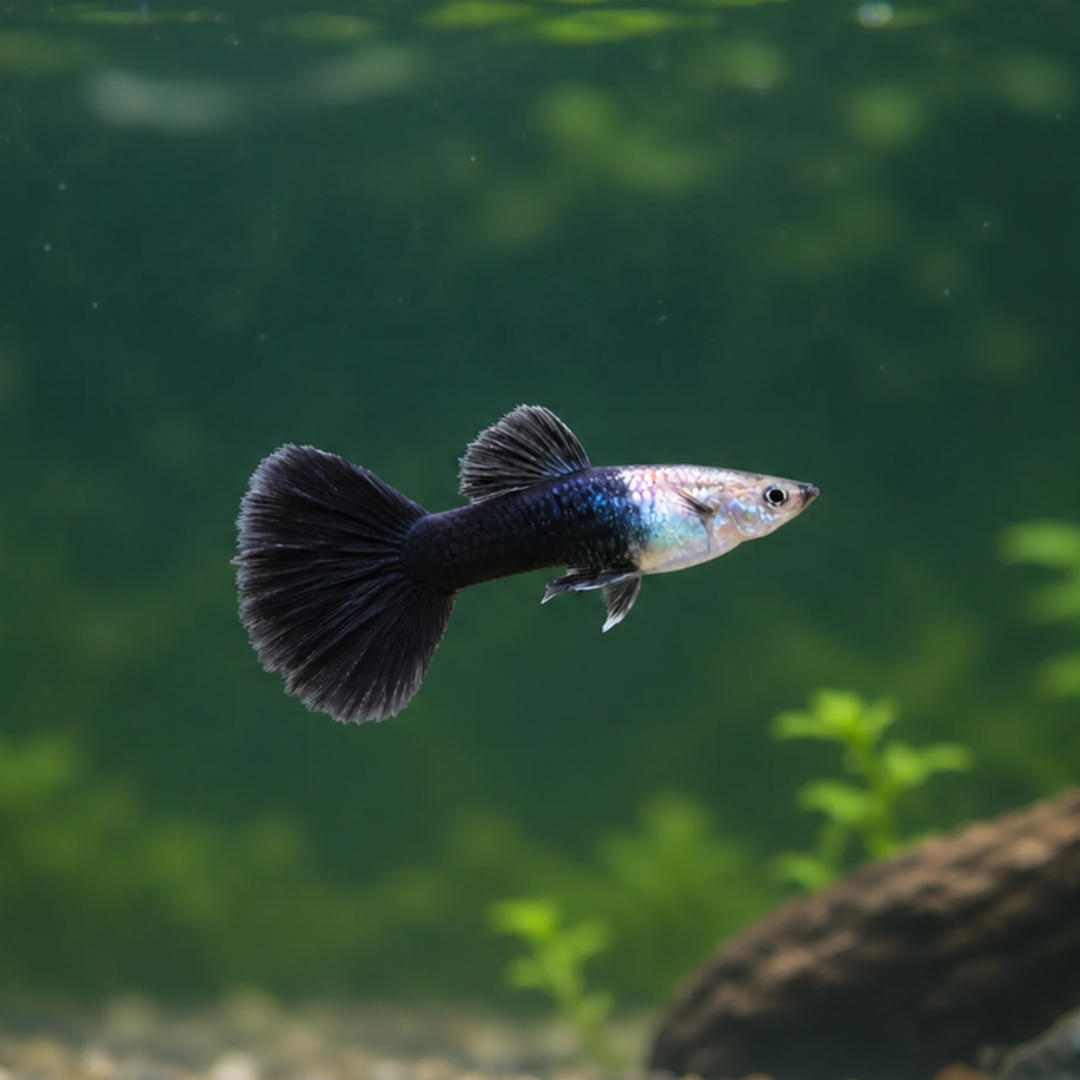
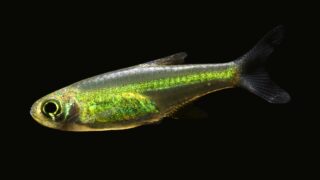
黒紫ネオンタキシードグッピーは、スリランカやシンガポールなどアジア各地の養殖場で生産され、日本へ輸入される「外国産グッピー」の定番として親しまれている改良品種です。銀色に明るく光る体の前半部と、深い黒に紫から青の光沢が重なる後半部・尾ビレとの対比が持ち味です。国内の観賞魚問屋では「フルブラックが登場するまでは、黒といえばこの品種だった」と紹介されており、黒系グッピーの代表格として長く流通してきました。ネオンタキシードの仲間のうち、尾ビレや尾筒(尾ビレの付け根)に黒が特に強く乗り、明るい水色ではなく暗く沈んだ黒紫の光沢を見せるものが、この名前で区別されています。派手さよりも上品さが際立つ配色は、明るい色の熱帯魚や水草の中で全体を引き締める存在として、初心者から混泳レイアウトを楽しむ愛好家まで幅広く支持されています。店頭に並ぶのは主にオスで、手頃な価格で入手しやすい一方、外国産グッピー特有の衛生面への配慮や日本の軟水への慣らし方など、知っておきたいポイントもいくつかあります。The Black Purple Neon Tuxedo Guppy is an ornamental strain loved as a staple among the “imported guppies” farmed in Asian countries such as Sri Lanka and Singapore and shipped to Japan. Its charm lies in the contrast between the brightly shining silver front half of the body and the rear half and tail, where deep black is overlaid with a purple-to-blue sheen. A Japanese aquarium wholesaler describes it as “the black guppy, before Full Blacks came along,” and it has long been sold as the representative black guppy. Among Neon Tuxedo-type fish, those whose tail fin and caudal peduncle (the base of the tail) carry especially heavy black, showing a dark, subdued black-purple sheen rather than bright sky blue, are distinguished by this name. Its coloration, more refined than flashy, tightens up the look of a tank among brightly colored fish and plants, and it is popular with beginners and community-tank enthusiasts alike. Shops mainly sell males, and they are affordable and easy to obtain, but there are some points worth knowing, such as hygiene concerns specific to imported guppies and how to acclimate them to Japan’s soft water.
基本情報 / Basic Information
学名 / Scientific Name
Poecilia reticulata
通称 / Common Name
黒紫ネオンタキシード、黒紫ネオンタキシードグッピー(タキシード系の改良品種で、海外でいうハーフブラック系統にあたります)Black Purple Neon Tuxedo, Black Tail Guppy (an ornamental tuxedo strain, belonging to what is called the Half-Black group overseas)
分類 / Family
カダヤシ目 カダヤシ科 ポエキリア属Cyprinodontiformes, Poeciliidae, genus Poecilia
英名 / English Name
Black Tail Guppy
分布 / Distribution
原種のグッピーは、南米大陸北東部(ベネズエラ、ガイアナなど)と、トリニダード島などカリブ海南部の島々に分布しています。本品種は人の手で作られた改良品種のため野生には存在せず、スリランカ、シンガポール、タイなどアジア各地の養殖場で生産されています。The wild guppy is native to northeastern South America (Venezuela, Guyana and nearby areas) and islands of the southern Caribbean such as Trinidad. As a man-made ornamental strain, this variety does not occur in the wild and is produced at fish farms across Asia, including Sri Lanka, Singapore and Thailand.
最大体長 / Max Size
オス約3〜4cm、メス約4〜6cm(メスのほうが大きく育ちます)Males about 3–4 cm, females about 4–6 cm (females grow larger)
寿命 / Lifespan
一般的な飼育下では1〜2年程度が目安です。かつての飼育下のグッピーは2〜5年ほど生きたとされる一方、世代交代を早めて改良されてきた現代の系統では、寿命が短くなっているとの指摘もあります。Around 1–2 years is typical in home aquariums. Captive guppies of past decades are said to have lived about 2–5 years, while it has been pointed out that modern lines, improved through rapid generation turnover, have become shorter-lived.
飼育環境 / Aquarium Environment
水槽サイズ / Tank Size
数匹を眺めるだけなら30cm規格水槽(約12L)でも飼育できますが、水質が安定しやすい45cm規格水槽(約35L)以上がおすすめです。群泳や繁殖を楽しむなら、60cm規格水槽(約57L)があると稚魚の育成や選別にも余裕を持って対応できます。A few fish can be kept in a 30 cm standard tank (about 12 L), but a 45 cm standard tank (about 35 L) or larger is recommended for more stable water quality. For a group display or breeding, a 60 cm standard tank (about 57 L) gives comfortable room for raising and sorting fry.
水温 / Temperature
24〜28℃(熱帯魚のため、冬場はヒーターが必須です)24–28°C (a heater is essential in winter, as this is a tropical fish)
水質 / Water Quality
中性〜弱アルカリ性(pH7.0〜8.0)で、ミネラル分をある程度含む中程度の硬さの水(GH8〜16程度)を好みます。日本の水道水は多くの地域でミネラル分の少ない軟水のため、硬めの水で育った外国産の個体には負担になることがあります。酸処理されていない大磯砂を使うと、ミネラルが少しずつ溶け出して弱アルカリ性を保ちやすくなります。それでもpHが下がりやすい場合は、サンゴ砂を底砂全体の1〜2割ほど混ぜるか、カキ殻を補助的に使うとよいでしょう。慣れれば中性付近の水でも飼育できるとされますが、急激な水質の変化は避けてください。Prefers neutral to slightly alkaline water (pH 7.0–8.0) of moderate hardness containing some minerals (around GH 8–16). Tap water in most of Japan is soft and low in minerals, which can stress imported fish raised in harder water. Untreated Oiso gravel slowly releases minerals and helps keep the water slightly alkaline. If pH still tends to drop, mix in coral sand at about 10–20% of the substrate or use oyster shell as a supplement. The fish can adapt to near-neutral water over time, but sudden changes in water chemistry should be avoided.
レイアウト / Layout
水草を植えた明るい水槽によく映えますが、水質を弱酸性に傾ける水草用ソイルは長期飼育にはあまり向きません。魚には周囲の明るさに合わせて体色を変える性質(背地適応)があるため、黒系の底砂や黒・濃紺のバックスクリーンを使うと、黒紫がより濃く出やすくなります。照明は、6500K前後の白い光なら自然な色合いに、8000K前後のやや青白い光なら紫から青の光沢が際立って見えます。繁殖を主な目的とする場合は、掃除のしやすいベアタンク(底砂を敷かない水槽)も合理的な選択です。The fish look wonderful in bright planted tanks, but aquarium soils that make water slightly acidic are not well suited to long-term keeping. Because fish adjust their coloration to the brightness of their surroundings, a dark substrate or a black or deep-blue background helps the black-purple appear deeper. White light around 6500K gives natural tones, while slightly bluish light around 8000K makes the purple-to-blue sheen stand out. If breeding is the main goal, a bare-bottom tank that is easy to clean is also a sensible choice.
注意点 / Precautions
外国産グッピーは、国産グッピーと同じ水槽に入れたり、器具や飼育水を共用したりしないことが大切です(理由は「病気と対策」で解説します)。購入時は品種名や価格だけで決めず、よく泳ぎ、ヒレをたたんでいない元気な個体を選びましょう。迎え入れてからの最初の2週間は、水合わせと体調の観察を特に丁寧に行ってください。また、グッピーは環境省の生態系被害防止外来種リストに掲載されています。飼育できなくなっても、川や池などへ絶対に放さないでください。With imported guppies, it is important not to house them with Japanese-bred guppies or share equipment or tank water (the reason is explained under “Diseases and Prevention”). When purchasing, do not decide on the strain name or price alone; choose lively fish that swim actively and do not clamp their fins. Take particular care with acclimation and health checks during the first two weeks after bringing them home. Guppies are also listed on the Japanese Ministry of the Environment’s list of invasive alien species that threaten ecosystems. Never release them into rivers, ponds or other waters, even if you can no longer keep them.
餌と給餌 / Feeding
餌の種類 / Diet
雑食性で、グッピー用のフレークフードや細かい粒状の人工飼料をよく食べます。冷凍ブラインシュリンプや孵化させたブラインシュリンプ、細かく刻んだ冷凍アカムシなどを補助的に与えると、体づくりや調子の維持に役立ちます。カロテノイドなどの色揚げ成分を含む餌も、色の充実を助けます。Omnivorous, readily accepting guppy flake foods and fine granular prepared diets. Supplementing with frozen or freshly hatched brine shrimp and finely chopped frozen bloodworms helps build the body and maintain condition. Foods containing color-enhancing ingredients such as carotenoids also help bring out fuller coloration.
給餌のポイント / Feeding Tips
口が小さいため、粒の細かい餌を1日2〜3回、数分で食べきれる量ずつ与えるのが基本です。食べ残しは水質悪化の原因になるので注意しましょう。黒紫の深みは照明による見え方だけで決まるものではなく、十分な栄養と安定した水質があってこそ引き出されます。稚魚には、孵化したてのブラインシュリンプや稚魚用の粉末飼料が適しています。Because of their small mouths, the basic approach is to feed fine foods two to three times a day, in amounts eaten within a few minutes. Watch out for leftovers, which degrade water quality. The depth of the black-purple is not determined by lighting alone; it is brought out by good nutrition and stable water quality. Newly hatched brine shrimp or powdered fry food suits the young.
性格と混泳 / Temperament and Tank Mates
性格 / Temperament
温和で、ほかの魚を攻撃することはほとんどありません。ただし、オスはメスを追いかけて頻繁に求愛します。メスと一緒に飼う場合は、オス1匹に対してメス2〜3匹ほどの割合にすると、メスの負担を和らげられます。Peaceful and rarely aggressive toward other fish. Males, however, frequently chase and court females. When keeping both sexes, a ratio of about two to three females per male helps reduce stress on the females.
混泳の相性 / Compatibility
ネオンテトラなどの小型カラシン、コリドラス、オトシンクルス、ヤマトヌマエビなど、おとなしく同じくらいの大きさの生き物とは一緒に飼いやすい魚です。一方、スマトラなどヒレをかじる習性のある魚や、グッピーを口に入れられるほど大きな魚との混泳は避けてください。グッピー同士でも、外国産と国産、あるいは仕入れ先の異なる系統を一緒にするのは、感染症のリスクがあるため避けるのが原則です。ネオンタキシード(青)やフラミンゴ(赤)、黄色系の品種など、外国産グッピー同士で組み合わせると、黒紫が群れ全体を引き締める差し色になります。Easy to keep with calm animals of similar size, such as small tetras like Neon Tetras, Corydoras, Otocinclus and Amano shrimp. Avoid fin-nipping species such as Tiger Barbs, and fish large enough to swallow a guppy. Even among guppies, the rule is not to mix imported and Japanese-bred fish, or lines from different suppliers, because of disease risk. When combined with other imported guppies such as Neon Tuxedos (blue), Flamingos (red) and yellow strains, the black-purple serves as an accent color that tightens up the whole group.
病気と対策 / Diseases and Prevention
かかりやすい病気 / Common Diseases
カラムナリス菌による尾ぐされ病やエラ病、エロモナス症、白点病などに注意が必要です。飼育経験からいわれる目安として、カラムナリス症は感染力が非常に強く、尾ビレの縁が溶けるように欠けたりエラが冒されたりしながら、次々とほかの個体へ広がる傾向があります。エロモナス症は比較的感染力が弱く、眼が飛び出すポップアイを伴うことが多いとされます。ただし、初期には両者の症状が似ていることもあります。このほか、通称「グッピーエイズ」と呼ばれる死亡率の高い感染症も知られています。細菌性とする見方が一般的ですが、詳しいことは十分に解明されていません。外国産グッピーは、自分は発症しないまま病原を持ち続ける「キャリア」である可能性が高いと考えられています。そのため、病原への耐性を持たない国産グッピーと一緒にすると急速に感染が広がり、水槽の魚が全滅するおそれがあると指摘されています。Watch for columnaris-related fin rot and gill disease, Aeromonas infections and white spot disease. As a rule of thumb from keepers’ experience, columnaris is highly contagious and tends to spread from fish to fish, eroding the edges of the tail fin as if melting or attacking the gills. Aeromonas is comparatively less contagious and is said to often come with popeye, in which the eyes bulge. In early stages, however, the two can look similar. A highly fatal infection known in Japan as “guppy AIDS” is also recognized. It is generally thought to be bacterial, but its details are not fully understood. Imported guppies are believed likely to be “carriers” that hold the pathogen without falling ill themselves. For this reason, it has been pointed out that housing them with Japanese-bred guppies lacking resistance can cause infection to spread rapidly and wipe out the tank.
対策と予防 / Prevention
もっとも確実な予防策は、外国産の黒紫ネオンタキシードを専用の水槽で飼い、国産グッピーとは網やバケツなどの道具から飼育水まで、きっちり分けて管理することです。キャリアの個体は、一般的な薬浴を行っても病原を完全には取り除きにくいとされるため、隔離して飼うことが基本になります。到着直後に白点病や軽い不調が見られた場合は本水槽に入れず、ゆとりのある隔離容器で0.3〜0.5%の塩浴や市販の魚病薬による治療を行い、回復を確かめてから合流させましょう。日頃から定期的な水換えを行い、過密飼育を避けて水質を安定させることが、病気の予防につながります。The most reliable prevention is to keep imported Black Purple Neon Tuxedos in a dedicated tank, strictly separating them from Japanese-bred guppies, from nets and buckets to tank water. Because ordinary medicated baths are thought to have difficulty fully clearing the pathogen from carriers, keeping them isolated is the basic approach. If white spot or mild illness appears on arrival, do not put the fish into the main tank; treat them in a roomy quarantine container with a 0.3–0.5% salt bath or a commercial fish medication, and add them only after confirming recovery. Regular water changes, avoiding overcrowding and keeping water quality stable all help prevent disease.
増やし方(繁殖) / Breeding
雌雄の判別 / Sexing
オスは体が小さく、銀と黒紫の鮮やかな色彩と大きな尾ビレを持ち、尻ビレが細長い交接器(ゴノポディウム)に変化しています。メスはオスより大きく育ち、体色は控えめな銀灰色系で、尻ビレは扇形のままです。オスの体色は、生後75日頃から光沢(構造色)が現れ始め、85日頃に黒い模様が加わり、生後120日頃に成魚の色彩が完成するとされています。若いうちは黒紫が薄く見えても、焦らずに成熟を待ってから選ぶのが選別のコツです。Males are smaller, with vivid silver and black-purple coloration and a large tail fin, and their anal fin is modified into a slender copulatory organ (gonopodium). Females grow larger than males, have modest silvery-gray bodies and keep a fan-shaped anal fin. In males, the sheen (structural color) is said to begin appearing around day 75, black markings are added around day 85, and adult coloration is complete around day 120. Even if young fish look pale, the key to selection is to wait patiently for them to mature before choosing.
繁殖形態 / Reproduction
卵胎生で、卵はメスのお腹の中で孵化し、稚魚の姿で生まれてきます。妊娠期間は約25〜30日が目安で、1回に20〜40匹ほど、大きなメスでは50匹を超える稚魚を産むこともあります。メスは体内に精子を長期間蓄えることができ、1回の交尾から数か月にわたって何度も出産を続けることが知られています。Livebearing: the eggs hatch inside the female’s body and the young are born as fry. Gestation is about 25–30 days, with around 20–40 fry per brood, and large females may produce more than 50. Females can store sperm in their bodies for long periods and are known to give birth repeatedly over several months from a single mating.
繁殖のポイント / Breeding Tips
店頭で手に入るのは主にオスのため、まずは同じ系統のメスを確保することが最初の課題になります。販売水槽のメスは他品種と交配している可能性が高いため、血統をそろえたい場合は、生後3〜5週ほどのうちに稚魚を雌雄に分け、交尾していないメスを確保するのが基本です。メスの持つ遺伝的な素質は、生まれてくるオスの黒の濃さや体型に大きく影響するとされます。メスは、尾筒の太さ、体型のバランス、体の後半部の黒の濃さを重視して選ぶとよいでしょう。親魚は稚魚を食べてしまうため、水草の茂みや産卵箱で稚魚を守ってあげてください。また、若いメスの最初の数回の出産で生まれた子ばかりを次の親に使い続けると、系統が短命になりやすいと指摘されています。丈夫な系統を育てるには、長く健康を保つオスと、出産を重ねても元気なメスを親に選び、数世代ごとに別の系統を取り入れることが有効と考えられています。背骨が曲がった個体は繁殖に使わないようにしましょう。Since shops mainly offer males, securing females of the same line is the first challenge. Females in sales tanks have very likely mated with other strains, so if you want a consistent line, the basic method is to separate fry by sex at around 3–5 weeks of age and secure females that have not mated. A female’s genetic makeup is said to strongly influence the black intensity and body shape of the males she produces. Choose females with emphasis on a thick caudal peduncle, a well-balanced body and deep black on the rear half. Adults eat fry, so protect the young with dense plants or a breeding box. It has also been pointed out that repeatedly using only offspring from young females’ first few broods as the next parents tends to shorten a line’s lifespan. To build a robust line, it is thought effective to choose males that stay healthy for a long time and females that remain vigorous after many broods, and to introduce another line every few generations. Do not breed fish with curved spines.
雑学と豆知識 / Trivia and Fun Facts
1. 「黒いグッピー」の代名詞だった時代 / 1. When It Was “The” Black Guppy
いまでは、全身が漆黒に染まるフルブラックや、1996年頃に旧ソ連からドイツを経て日本へ紹介されたと伝えられるモスコー系が、黒系グッピーの主役になっています。しかしそれ以前の日本で、「黒いグッピー」の代表として定着していたのが黒紫ネオンタキシードでした。ネオンタキシードの仲間は、日本のグッピー史でもうひとつ大きな役割を担っています。グッピーはもともと赤い色が遺伝しやすく、安定した青を出すのは難しいとされてきました。そこへ東南アジア生まれのネオンタキシードが輸入されたことで、青い色がどのように受け継がれるのかが広く知られるようになったのです。そして1984〜1985年頃には、ネオンタキシードとグラス系の原型となる魚の交配から、国産グッピーを代表する人気品種「ブルーグラス」が生まれたと伝えられています。シックな黒紫の一族は、日本の青いグッピーと黒いグッピー、両方の歴史をつなぐ存在だったといえるでしょう。Today, the leading black guppies are Full Blacks, whose whole bodies are jet black, and the Moscow lines, said to have reached Japan around 1996 from the former Soviet Union by way of Germany. Before them, however, the Black Purple Neon Tuxedo was the established “black guppy” in Japan. The Neon Tuxedo family also played another important role in Japanese guppy history. In guppies, red has always tended to be inherited readily, and stable blue was long considered difficult to achieve. The import of Neon Tuxedos bred in Southeast Asia made it widely known how blue coloration is passed down. Around 1984–1985, a cross between a Neon Tuxedo and a fish that was the forerunner of the glass types is said to have produced the Blue Grass, which became one of Japan’s most popular domestic guppies. This understated black-purple lineage can be seen as a link between the histories of both blue and black guppies in Japan.
2. 黒紫は「絵の具」ではなく「光」の色 / 2. Black-Purple Is Made of Light, Not Paint
黒紫ネオンタキシードの体は、紫色の色素で染まっているわけではありません。グッピーの皮膚には、メラニンを含む黒色素胞、黄色や赤の色素を持つ色素胞、そしてグアニンという物質の結晶をたくわえた虹色素胞が層になって並んでいます。黒やオレンジは色素による色ですが、青や紫に見える金属的な光沢は、虹色素胞の中に並んだごく薄い結晶の板が光を反射し、干渉し合うことで生まれる「構造色」です。シャボン玉の表面が虹色に輝くのと同じ原理といえば、イメージしやすいかもしれません。さらに、紫青系の虹色素胞のすぐ下には黒色素胞が寄り添うように並び、余分な光を吸い取っています。黒い下地があることで、反射した青紫の光がくっきりと引き立って見えると考えられているのです。タキシードの性質によって下地の黒がとても濃く発達しているからこそ、その上の光沢が深みのある黒紫として目に映ります。見る角度や照明によって色合いが変わるのも、構造色ならではの魅力です。The fish’s body is not dyed with purple pigment. Guppy skin contains layers of melanin-bearing black pigment cells, cells holding yellow and red pigments, and iridophores that store crystals of a substance called guanine. Black and orange come from pigments, but the metallic blue and purple sheen is “structural color,” produced when extremely thin crystal plates lined up inside the iridophores reflect light and the reflections interfere with one another. It is the same principle that makes the surface of a soap bubble shimmer with rainbow colors. In addition, black pigment cells sit right beneath the violet-blue iridophores and absorb stray light. This dark underlayer is thought to make the reflected blue-violet light stand out sharply. Because the tuxedo trait develops an extremely dense black underlayer, the sheen on top is seen as a deep black-purple. The way its color shifts with viewing angle and lighting is part of the special appeal of structural color.
3. 三つの遺伝の仕組みが重なって生まれる色 / 3. A Color Born from Three Genetic Systems
黒紫ネオンタキシードの姿は、少なくとも三つの遺伝の仕組みが重なり合って現れると考えられています。ひとつ目は、体の後半を黒く覆うタキシード(ハーフブラック)の遺伝子です。海外ではニグロカウダトゥス(Ni)と呼ばれ、主にオスとメスを決める性染色体の上で受け継がれます。その中でもNiIIと呼ばれるタイプは、特に強く黒くする働きを持つことが知られています。ふたつ目は、「ブラオ」と呼ばれる遺伝子です。国内の愛好家の間では、赤が強く出るタイプ、青く色づくタイプ、赤みが抑えられて暗い灰色寄りになるタイプの三つに分かれる仕組みとして説明されることが多く、ネオンタキシード系の青い色はこの組み合わせで生まれるとされます。この説明に従えば、青い個体同士を交配すると、子どもの中に赤寄りや暗い色寄りの個体が一定の割合で現れることになります。ただし海外の遺伝学ではブラオを劣性の遺伝子として扱うのが一般的で、この三分類はあくまで国内で広く使われている考え方です。三つ目は、青を紫寄りに変える「パープルボディ(Pb)」と呼ばれる遺伝子です。海外の研究報告では、この遺伝子が黄色の色素胞を大きく減らし、紫青系の虹色素胞を目立たせることが示唆されています。黄色が抜けることで緑みが消え、光の当たり方によって青にも紫にも見える体色になると考えられているのです。なお、市販されている本品種そのものの遺伝子を詳しく調べた研究は見当たらず、ここで紹介した内容は近い系統から得られた知見をもとにした推測です。The appearance of this strain is thought to arise from at least three overlapping genetic systems. The first is the tuxedo (half-black) gene that blackens the rear of the body. Known overseas as Nigrocaudatus (Ni), it is inherited mainly on the sex chromosomes, which determine whether a fish is male or female. A type called NiII is known to have an especially strong darkening effect. The second is a gene called “Blau.” Among Japanese hobbyists, it is often explained as producing three types: strong red, blue, and a dark grayish type with suppressed red, with the blue of Neon Tuxedo strains said to come from this combination. Under this explanation, crossing two blue fish would yield a certain proportion of reddish and dark offspring. In overseas genetics, however, Blau is generally treated as a recessive gene, and this three-type model is simply a view widely used in Japan. The third is a gene called Purple Body (Pb), which shifts blue toward purple. Research reports from overseas suggest that it greatly reduces yellow pigment cells and makes violet-blue iridophores more prominent. With the yellow removed, green tones disappear, and the body is thought to look blue or purple depending on how the light falls. No study appears to have examined the genes of commercially sold fish of this strain in detail, so what is described here is inferred from findings in related lines.
4. 学名から消えたのに世界へ広まった「グッピー」の名 / 4. The Name That Vanished from Science but Spread Worldwide
グッピーは1859年、ドイツの博物学者ヴィルヘルム・ペータースによって、ベネズエラ産の標本をもとにPoecilia reticulataという学名で記載されました。その後1866年、トリニダード島に住んでいたイギリス人博物学者ロバート・ジョン・レッチミア・グッピーが大英博物館へ送った標本に対し、アルベルト・ギュンターが同じ種だと気づかないまま、彼の名にちなんだGirardinus guppiiという学名を付けます。学名は先に発表されたものが優先されるという決まりがあるため、この名前は分類学上は無効となりました。属名もその後何度か変わり、1963年に最初のPoecilia reticulataへと戻されています。ところが、学名からは消えた「グッピー」という呼び名だけは英語圏から世界中へ広まり、いまではこの魚を指すもっとも身近な名前になっています。ちなみに英語の姓「Guppy」については、古フランス語でキツネを意味する言葉と関係があるという説もあります。In 1859, the German naturalist Wilhelm Peters described the guppy under the scientific name Poecilia reticulata based on specimens from Venezuela. Then in 1866, Albert Günther, not realizing it was the same species, gave the name Girardinus guppii to specimens sent to the British Museum by Robert John Lechmere Guppy, a British naturalist living in Trinidad, in his honor. Because the earliest published scientific name takes priority, this name became taxonomically invalid. The genus also changed several times afterward, and the species returned to the original Poecilia reticulata in 1963. Yet the name “guppy,” which vanished from science, spread from the English-speaking world across the globe and is now the most familiar name for this fish. Incidentally, one theory links the English surname Guppy to an Old French word meaning fox.
5. ハーフブラックの系譜と品評会での評価 / 5. The Half-Black Lineage and Show Standards
体の後半が黒く染まるハーフブラック(タキシード)は、20世紀中ごろに欧州の育種家たちによって確立され、1959年には色素胞の構造や性染色体との関係が学術的に記載されました。以来、ハーフブラック系統はグッピーの遺伝を研究するうえで重要なモデルとなっています。同じタキシード一族のドイツイエローには、数奇な歩みも伝えられています。1960年代にドイツで作られた後、米国で改良されて日本で大人気となった一方、発祥の地ドイツでは系統が途絶えてしまい、1990年代初めに海外から逆輸入されたというのです。現在、米国の国際ファンシーグッピー協会(IFGA)ではハーフブラック系を色ごとに独立したクラスとして審査しており、日本の品評会でも尾ビレや体の色彩・柄が配点の大きな割合を占めています。手頃な外国産品種として親しまれる黒紫ネオンタキシードも、尾筒の太さや背ビレの広がり、複数の個体の仕上がりのそろい具合を磨いていけば、こうした系譜に連なるショー品種へと近づく可能性を秘めています。The half-black (tuxedo) pattern, in which the rear of the body turns black, was established by European breeders in the mid-20th century, and in 1959 its pigment-cell structure and relationship to the sex chromosomes were described scientifically. Since then, half-black lines have served as an important model for studying guppy genetics. The German Yellow, a member of the same tuxedo family, is said to have had a curious history. Created in Germany in the 1960s, it was refined in the United States and became hugely popular in Japan, while the line died out in its German homeland and had to be reimported from abroad in the early 1990s. Today, the International Fancy Guppy Association (IFGA) in the United States judges half-black fish in separate classes by color, and in Japanese shows, too, the color and pattern of the tail and body account for a large share of the points. Even the Black Purple Neon Tuxedo, loved as an affordable imported strain, has the potential to move closer to the show fish of this lineage if breeders refine the thickness of the caudal peduncle, the spread of the dorsal fin and the uniformity of multiple fish.
6. 「上見」で輝く前半身 / 6. A Front Half That Shines from Above
グッピーは、水槽の横から尾ビレの広がりを眺める「横見」の魚と思われがちです。しかし黒紫ネオンタキシードは体の前半分に強い光沢があるため、上から見下ろすと前半身が銀色にきらめき、後半の黒紫との対比がいっそう際立ちます。水位の低い鉢や、上から光を当てたレイアウトでは、横から眺めるときとはまったく違う表情に出会えるでしょう。観賞魚問屋では、ネオンタキシードの青、フラミンゴの赤、そして黄色系の品種を組み合わせ、三原色をそろえて楽しむ混泳も古くから提案されてきました。そこに黒紫ネオンタキシードを加えれば、華やかな群れの中に落ち着いた陰影が生まれます。Guppies are often thought of as fish to be viewed from the side, admiring the spread of their tails. But because the Black Purple Neon Tuxedo has a strong sheen on its front half, looking down from above makes the front of the body sparkle silver and heightens the contrast with the black-purple rear. In a low-water bowl or a layout lit from above, you can see a completely different expression from the side view. Aquarium wholesalers have long suggested enjoying a community of the three primary colors by combining blue Neon Tuxedos, red Flamingos and yellow strains. Adding Black Purple Neon Tuxedos brings calm depth and shadow to such a colorful group.
7. 温泉地で生き抜く適応力と、放流してはならない理由 / 7. Survivors of Hot-Spring Areas, and Why Release Is Forbidden
熱帯魚であるグッピーは寒さに弱く、冬に水温が18℃を下回るような日本の一般的な川では、冬を越すのは難しいとされます。その一方で、汚れた水や塩分への耐性は高く、街なかの溝や海水が混じる河口付近でも生きていける強さを持っています。そのため国内では、沖縄県や小笠原諸島のほか、温泉の温かい排水が流れ込む各地の水域で野生化した記録があり、北海道の一部では駆除によって根絶が確認された例もあります。こうした背景から、グッピーは環境省の生態系被害防止外来種リストで、総合的な対策が必要な外来種に選ばれています。少ない数からでも増えやすく、メスが精子を長く蓄えられるという性質は、水槽の中では大きな魅力です。しかし自然の中に出てしまえば、在来の生き物を脅かす力にもなりかねません。最後まで水槽の中で責任を持って見守ることが、この魚と付き合ううえでいちばん大切な約束です。As a tropical fish, the guppy is vulnerable to cold and is considered unlikely to survive winter in typical Japanese rivers, where water temperatures drop below 18°C. On the other hand, it is highly tolerant of polluted water and salinity, strong enough to live even in urban drains and river mouths where seawater mixes in. In Japan, guppies have been recorded living wild not only in Okinawa and the Ogasawara Islands but also in waters fed by warm hot-spring runoff in various regions, and in one part of Hokkaido eradication was confirmed after removal efforts. Against this background, the guppy has been designated on the Ministry of the Environment’s list as an invasive alien species requiring comprehensive countermeasures. Its ability to multiply from just a few fish, and the female’s ability to store sperm for a long time, are great attractions in the aquarium. Out in nature, however, these same traits could become a threat to native creatures. Caring for them responsibly inside the tank to the very end is the most important promise in keeping this fish.
8. 短命化する改良グッピーという課題 / 8. The Challenge of Shortening Lifespans
1950年代の飼育下のグッピーは2〜5年ほど生きたとされ、野生由来の個体を調べた研究でも、平均2年あまりの寿命が報告されています。ところが近年、若いメスの最初の数回の出産で生まれた子だけを使い、どんどん世代を進めてきた現代の改良系統では、オスが生後4〜5か月、メスも1年に満たずに弱ってしまうなど、体が弱くなってきているとアクアリウムの研究家から指摘されています。早く育ち、早く子を産む個体ばかりが選ばれ続けた結果、長生きする力が失われてきたのではないかと考えられているのです。手頃な価格で大量に流通する黒紫ネオンタキシードも、その例外ではないかもしれません。だからこそ自宅で繁殖を楽しむときには、色や形だけでなく、長く元気に泳ぎ続ける個体を親に選ぶという視点が、丈夫な系統を未来へ残す鍵になると期待されています。Captive guppies in the 1950s are said to have lived about 2–5 years, and a study of wild-derived fish reported an average lifespan of a little over two years. In recent years, however, aquarium researchers have pointed out that modern ornamental lines, advanced generation after generation using only offspring from young females’ first few broods, have grown frail, with males weakening at 4–5 months and females in less than a year. It is thought that by continually selecting fish that grow and breed early, the ability to live long may have been lost. The mass-marketed, affordable Black Purple Neon Tuxedo may be no exception. That is why, when breeding at home, choosing parents not only for color and shape but also for their ability to stay healthy for a long time is expected to be key to passing robust lines on to the future.
まとめ / Conclusion
黒紫ネオンタキシードグッピーは、銀色に輝く前半身と、光の角度によって青にも紫にも揺らめく黒紫の後半身をあわせ持つ、上品で落ち着いた美しさの魚です。フルブラックが登場する前から「黒いグッピー」の代表として親しまれ、日本のグッピーの歩みとも深く結びついてきました。色素と光の仕組み、そしていくつもの遺伝の働きが重なって生まれるその色彩は、小さな体に宿った自然の芸術といえるでしょう。The Black Purple Neon Tuxedo Guppy combines a shining silver front half with a black-purple rear that shimmers blue or purple depending on the angle of the light, giving it a refined, calm beauty. Loved as “the black guppy” since before Full Blacks appeared, it has been closely tied to the history of guppies in Japan. Its coloration, born from pigments, light and several overlapping genetic mechanisms, can be called a work of natural art carried in a tiny body.
日本の軟水への慣らし方や、国産グッピーとの隔離といったポイントを押さえれば、手頃に迎えられて長く付き合える魚です。明るい水草の間をゆったりと泳ぐ姿は、水槽全体に静かな陰影と気品を添えてくれます。元気な個体を親に選び、じっくりと世代を重ねていけば、自分の水槽で育った自分だけの黒紫に出会える日もきっと訪れるでしょう。As long as you keep in mind how to acclimate it to Japan’s soft water and keep it separate from Japanese-bred guppies, it is an affordable fish you can enjoy for a long time. Swimming leisurely among bright green plants, it adds quiet depth and elegance to the whole aquarium. By choosing healthy parents and patiently building generations, you may one day meet a black-purple guppy all your own, raised in your own tank.
Rosen, D. E. & Bailey, R. M. (1963) The poeciliid fishes (Cyprinodontiformes), their structure, zoogeography, and systematics. Bulletin of the American Museum of Natural History, 126(1): 1–176.
Winge, Ö. (1927) The location of eighteen genes in Lebistes reticulatus. Journal of Genetics, 18: 1–43.
Kottler, V. A., Fadeev, A., Weigel, D. & Dreyer, C. (2013) Pigment pattern formation in the guppy, Poecilia reticulata, involves the Kita and Csf1ra receptor tyrosine kinases. Genetics, 194(3): 631–646. https://pmc.ncbi.nlm.nih.gov/articles/PMC3697969
Kawamoto, M., Ishii, Y. & Kawata, M. (2021) Genetic basis of orange spot formation in the guppy (Poecilia reticulata). BMC Ecology and Evolution, 21: 211. https://doi.org/10.1186/s12862-021-01942-2
Bias, A. S. & Squire, R. D. (2017) The Cellular Expression and Genetics of an Established Polymorphism in Poecilia reticulata; “Purple Body, (Pb)” is an Autosomal Dominant Gene. bioRxiv(プレプリント). https://doi.org/10.1101/121277
Bias, A. S. & Squire, R. D. (2017) The Cellular Expression and Genetics of Purple Body (Pb) in Poecilia reticulata, and its Interactions with Asian Blau (Ab) and Blond (bb) under Reflected and Transmitted Light. bioRxiv(プレプリント). https://doi.org/10.1101/121285
寿命・繁殖
Reznick, D., Bryant, M. & Holmes, D. (2006) The Evolution of Senescence and Post-Reproductive Lifespan in Guppies (Poecilia reticulata). PLoS Biology, 4(1): e7. https://doi.org/10.1371/journal.pbio.0040007
Reznick, D. N., Bryant, M. J., Roff, D., Ghalambor, C. K. & Ghalambor, D. E. (2004) Effect of extrinsic mortality on the evolution of senescence in guppies. Nature, 431: 1095–1099. https://doi.org/10.1038/nature02936






コメント