


解説 / Description
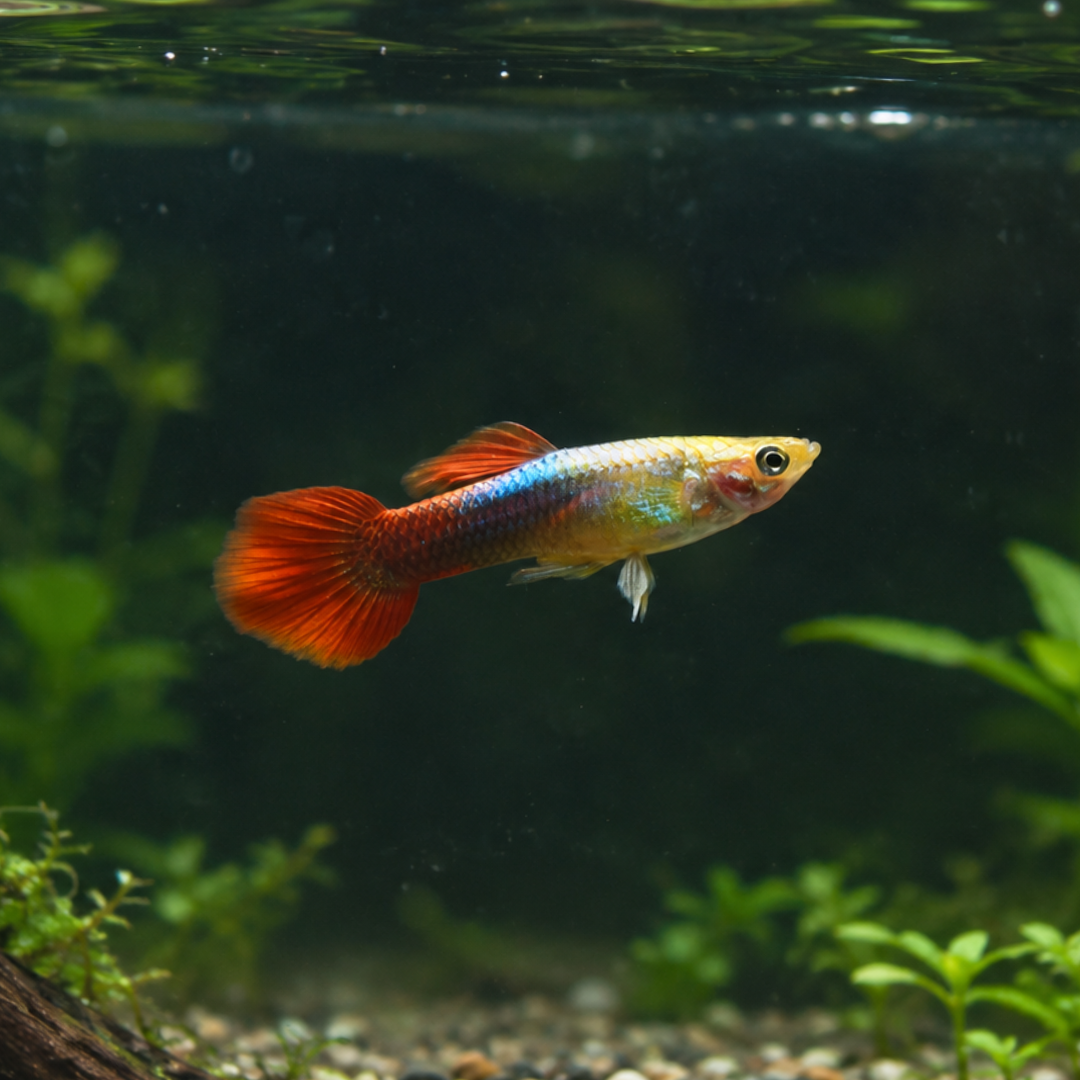
プラチナブロンドレッドタキシードグッピーは、グッピー(Poecilia reticulata)の観賞用改良品種のひとつです。明るい黄白色の「ブロンド(日本では慣習的にゴールデンとも呼ばれる体色)」を土台に、体の後半を暗色に染める「タキシード(欧米名ハーフブラック)」、背ビレと尾ビレを真紅に彩る「レッドテール」、肩口から体側にかけて金属光沢をのせる「プラチナ」という、それぞれ独立した4つの遺伝形質を1尾に重ね合わせています。プラチナの白銀の輝き、タキシード部の暗色、ヒレの赤がつくる三段のコントラストは遠目にもよく目立ち、水槽の中でひときわ華やかな存在感を放ちます。いわゆる「ブロタキ(ブロンドレッドタキシード)」にプラチナを加え、さらに華やかさを増した品種と位置づけられています。国内で流通している個体の多くはスリランカやシンガポールなどの養殖場から輸入される外国産グッピーで、主にオス単体として手頃な価格で店頭に並びます。そのため、日本の軟水への慣らし方と、国産グッピーとの防疫上の住み分けを理解しておくことが、この美しさを長く楽しむための鍵になります。 The Platinum Blond Red Tuxedo guppy is an ornamental strain of the guppy (Poecilia reticulata). On a bright, yellowish-white “blond” base color (customarily called “golden” in Japan), it stacks four independent genetic traits into one fish: the “tuxedo” pattern (known in the West as half black) that darkens the rear half of the body, the “red tail” that colors the dorsal and caudal fins crimson, and the “platinum” trait that lays a metallic sheen over the shoulders and flanks. The three-tiered contrast of silvery platinum, dark tuxedo and red fins is striking even from a distance, giving the fish a vivid presence in the aquarium. It is regarded as a Blond Red Tuxedo with platinum added for even more brilliance. Most fish sold in Japan are imported from farms in Sri Lanka, Singapore and elsewhere, and they usually appear in shops as individually sold males at affordable prices. Understanding how to acclimate them to Japan’s soft water, and how to keep them apart from domestically bred guppies for disease control, is the key to enjoying their beauty for a long time.
基本情報 / Basic Information
| 学名 / Scientific Name | Poecilia reticulata Peters, 1859 |
|---|---|
| 通称 / Common Name | プラチナブロンドレッドタキシード、プラチナブロタキ(近縁の表記としてゴールデンプラチナレッドテールタキシードなど)Platinum Blond Red Tuxedo, Platinum Blond Tuxedo (related names include Golden Platinum Red Tail Tuxedo) |
| 分類 / Family | カダヤシ目 カダヤシ科 ポエキリア属(改良品種)Cyprinodontiformes, Poeciliidae, genus Poecilia (ornamental strain) |
| 英名 / English Name | Platinum Blond Red Tuxedo Guppy / Golden Tuxedo Guppy / Platinum Blond Half Black Red Guppy |
| 分布 / Distribution | 改良品種のため、自然分布はありません。原種のグッピーはベネズエラ北部、ガイアナ、トリニダード・トバゴなど南米北東部とカリブ海南部の島々に分布し、現在は世界各地の熱帯・亜熱帯域に移入されています。本品種は主にスリランカ、シンガポール、タイなどの養殖場で生産されています。As an ornamental strain, it has no natural range. The wild guppy is native to northeastern South America, including northern Venezuela, Guyana, and Trinidad and Tobago, as well as islands of the southern Caribbean, and has been introduced to tropical and subtropical regions worldwide. This strain is mainly produced on fish farms in Sri Lanka, Singapore, Thailand and elsewhere. |
| 最大体長 / Max Size | オス約4cm前後、メス約5〜6cm(種全体の目安はオス1.5〜4cm、メス3〜6cm)Males about 4 cm, females about 5–6 cm (species-wide guideline: males 1.5–4 cm, females 3–6 cm) |
| 寿命 / Lifespan | 1〜2年程度です。水温が安定した良好な環境では、3年ほど生きることもあります。About 1–2 years. In a stable, well-kept environment, they may live around 3 years. |
飼育環境 / Aquarium Environment
| 水槽サイズ / Tank Size | オスのみを数尾鑑賞するなら、30cm規格水槽(約12L)から飼育できます。群泳の美しさを楽しみたい場合や、ペアで繁殖させたい場合は、45cm規格水槽(約32L)〜60cm規格水槽(約57L)がおすすめです。系統を維持する場合は、親魚用・稚魚用・雌雄分離用など複数の水槽を用意すると管理しやすくなります。A few males kept for display can be housed in a 30 cm standard tank (about 12 L). To enjoy them swimming as a group, or to breed pairs, a 45 cm standard tank (about 32 L) to a 60 cm standard tank (about 57 L) is recommended. For maintaining a line, preparing several tanks, such as for parents, fry and sex-separated juveniles, makes management easier. |
|---|---|
| 水温 / Temperature | 24〜27℃で安定させるのが理想です。18〜28℃程度でも生きられますが、低水温や昼夜の急な温度変化は尾ぐされ病などの引き金になりやすいため、ヒーターで一定に保ちましょう。 Ideally keep the temperature stable at 24–27°C. They can survive at roughly 18–28°C, but low temperatures and sudden day-night swings can easily trigger fin rot and other diseases, so use a heater to keep it steady. |
| 水質 / Water Quality | pH 6.8〜7.5の中性〜弱アルカリ性で、総硬度(GH)5〜15 dGH程度のやや硬めの水を好みます。日本の水道水は全国平均で約2.7〜2.8 dGHと、世界的に見てもかなりの軟水ですが、カルキを抜けば飼育の出発点として十分に使えます。大切なのは、理想の数値に無理に合わせることよりも、数値を急に変化させないことです。特に炭酸塩硬度(KH)の低い地域では、ろ過が進むにつれてpHが下がりやすく、短時間で0.5〜1.0下がるだけでも外国産の個体は調子を崩しがちです。pHが6.8を下回りやすい場合は、角の丸いサンゴ砂や貝殻をひとつかみほどろ過槽やネットに入れておくと、穏やかにpHの低下を抑えられます。水換えの前後にpHを測り、下がり始める前に少量ずつ、こまめに水換えを続けることが安定飼育のコツです。They prefer neutral to slightly alkaline water at pH 6.8–7.5 with moderately hard water of about 5–15 dGH general hardness (GH). Japanese tap water averages only about 2.7–2.8 dGH, which is quite soft by world standards, but once dechlorinated it is a perfectly good starting point. What matters more than forcing ideal values is avoiding sudden changes. In areas with low carbonate hardness (KH), pH tends to fall as biological filtration progresses, and imported fish can decline after a drop of just 0.5–1.0 in a short time. If pH tends to fall below 6.8, placing a handful of rounded coral sand or shell fragments in the filter or a mesh bag will gently curb the decline. Measure pH before and after water changes, and keep up small, frequent changes before it starts to fall. |
| レイアウト / Layout | 大きな尾ビレを傷めないよう強い水流は避け、スポンジフィルターなど穏やかなろ過を中心に組むと扱いやすくなります。暗色系の底床と黒いバックスクリーンを使うとタキシード部の黒が引き締まり、プラチナ光沢と赤いヒレのコントラストが際立ちます。反対に、白っぽい底砂や明るい背景では、もともと繊細なブロンド体色のタキシード部がさらに淡く見えやすくなります。アナカリスやウィローモスなどの水草を茂らせておけば、メスの休み場や稚魚の隠れ家にもなります。照明は落ち着いた明るさにし、点灯時間を一定に保ちましょう。To avoid damaging the large tail fin, avoid strong currents and build around gentle filtration such as a sponge filter. A dark substrate and a black background tighten the black of the tuxedo area and make the platinum sheen and red fins stand out. Conversely, pale sand or a bright background tends to make the already delicate tuxedo area of a blond fish look even lighter. Dense plants such as Egeria or willow moss provide resting spots for females and hiding places for fry. Keep the lighting at a calm intensity on a consistent schedule. |
| 注意点 / Precautions | 外国産の個体は、長距離輸送による消耗と水質の違いから、導入直後に体調を崩しやすい傾向があります。時間をかけた水合わせと、購入後2週間の丁寧な観察が何より重要です。また、国産グッピーとの混泳は厳禁です(詳しくは「病気と対策」を参照)。法令面では、2026年時点でグッピーは特定外来生物に指定されておらず、飼育や販売に法的な制限はありません。ただし、環境省・農林水産省の生態系被害防止外来種リストでは「その他の総合対策外来種」に選定されています。日本各地の温泉地などに定着した例もあるため、河川や池へは絶対に放さず、屋外で飼育する場合は大雨による溢水や逸出を防ぐ対策を講じてください。Imported fish are worn out by long-distance shipping and the difference in water chemistry, so they tend to become unwell right after introduction. Slow acclimation and careful observation for the first two weeks after purchase are essential. Never keep them together with domestically bred guppies (see “Diseases and Prevention”). Legally, as of 2026 the guppy is not designated as an invasive alien species in Japan, and there are no legal restrictions on keeping or selling it. However, it is listed as an “other species requiring comprehensive countermeasures” on the national list of alien species that may harm ecosystems. Because guppies have become established in places such as hot spring areas in Japan, never release them into rivers or ponds, and when keeping them outdoors, take measures to prevent overflow from heavy rain and escape. |
餌と給餌 / Feeding
| 餌の種類 / Diet | 雑食性で、グッピー用の顆粒やフレークなどの人工飼料をよく食べます。ヒレの赤色のもとになるカロテノイド色素は魚が体内で作り出せないため、アスタキサンチンを含むブラインシュリンプやミジンコ、色揚げ用の人工飼料を続けて与えると、深みのある赤を保ちやすくなります。また、体上部のプラチナ光沢には良質なタンパク質が役立つと考えられており、細かく刻んだ冷凍アカムシなども副食に適しています。They are omnivorous and readily accept prepared foods such as guppy granules and flakes. Because fish cannot produce the carotenoid pigments behind the red fins themselves, regularly feeding brine shrimp, daphnia and color-enhancing foods containing astaxanthin helps maintain a deep red. Good-quality protein is also thought to support the platinum sheen on the upper body, and finely chopped frozen bloodworms make a suitable supplement. |
|---|---|
| 給餌のポイント / Feeding Tips | 1日2〜3回、数分で食べきれる量を少しずつ与えるのが基本です。食べ残しは水質悪化を招き、尾ぐされ病の原因にもなるため注意しましょう。輸入直後の個体は輸送中に絶食させられていることが多く、消化機能が弱っている場合があります。導入後の数日はごく少量から始め、様子を見ながら量を戻していきましょう。稚魚には生まれた直後からブラインシュリンプの幼生や微粒子の稚魚用飼料を与えると、成長がそろいやすくなります。The basic rule is small portions two or three times a day, only as much as they can finish in a few minutes. Leftover food degrades water quality and can lead to fin rot. Newly imported fish have usually been fasted during shipping and their digestion may be weakened, so for the first few days start with very small amounts and increase gradually while watching their condition. Feeding fry newly hatched brine shrimp or fine fry food from birth helps them grow evenly. |
性格と混泳 / Temperament and Tank Mates
| 性格 / Temperament | 温和で、他の魚を攻撃することはほとんどありません。オスはメスを熱心に追いかけ、オス同士がヒレを広げて見せ合う姿もよく見られますが、深刻な争いになることはまれです。メスが少ないとオスの追尾が集中してメスが疲れてしまうため、繁殖させる場合はオス1尾に対してメス2〜3尾程度の比率が望ましいとされています。Peaceful, they rarely attack other fish. Males eagerly chase females and often display to each other with spread fins, but serious fights are rare. When females are few, the males’ chasing concentrates on them and tires them out, so for breeding a ratio of about one male to two or three females is considered desirable. |
|---|---|
| 混泳の相性 / Compatibility | 小型のカラシンやラスボラ、コリドラス、オトシンクルス、ミナミヌマエビなど、おとなしく同じくらいの大きさの生き物とは混泳しやすい品種です。一方、スマトラのようにヒレをかじる習性のある魚や、口に入る大きさの魚を食べてしまう中・大型魚との混泳は避けましょう。最も重要なのは、外国産である本品種と国産グッピーを同じ水槽で飼わないことです。同じ科のプラティにも感染症が移る可能性があるため、外国産と国産の住み分けは近縁の魚まで含めて考えておくと安心です。生まれた稚魚は多くの魚に食べられてしまうため、殖やしたい場合は別の水槽で育てましょう。They mix well with peaceful animals of similar size, such as small tetras and rasboras, Corydoras, Otocinclus and Neocaridina shrimp. Avoid fin-nippers such as tiger barbs, and medium to large fish that will eat anything that fits in their mouths. Most importantly, never keep this imported strain in the same tank as domestically bred guppies. Since infections can also spread to platies of the same family, it is safest to extend the imported/domestic separation to related fish as well. Fry are eaten by many fish, so raise them in a separate tank if you want to breed them. |
病気と対策 / Diseases and Prevention
| かかりやすい病気 / Common Diseases | 最も多いのは尾ぐされ病(カラムナリス症)です。水質の悪化で免疫が落ちたことをきっかけに発症し、ヒレの先が白く濁った後、裂けたり溶けたりするように進行します。外国産グッピーで特に警戒したいのが、通称「グッピーエイズ」と呼ばれる致死性の高い感染症です。カラムナリス系の細菌性感染症の一つと言われ、外国産の個体は見た目が健康でも、症状を出さずに病原体を保有していることがあると考えられています。抵抗力を持たない国産グッピーと同居させると、国産の個体がヒレを閉じてふらつき始め、短期間で全滅してしまうこともあります。もう一つ注意したいのが、繊毛虫という微小な寄生虫によるテトラヒメナ症で、東南アジアの養殖場で大きな被害を出しています。体表から侵入して内臓や脳、眼にまで広がりますが、体内で炎症反応が起きにくいため異変に気づきにくいという厄介な性質があります。全身に広がった段階では市販薬がほとんど効かず、有効な治療法が確立されていない難病とされています。このほか、白点病や水カビ病、稚魚の尾ビレが針のようにすぼまるハリ病にも注意が必要です。The most common is fin rot (columnaris disease). It develops when immunity is weakened by poor water quality and progresses from clouding at the fin tips to splitting and dissolving fins. A particular concern with imported guppies is a highly lethal infection commonly called “guppy AIDS” in Japan. It is said to be a columnaris-type bacterial infection, and imported fish are thought to sometimes carry the pathogen without showing symptoms even when they look healthy. When housed with domestic guppies that lack resistance, the domestic fish begin clamping their fins and swimming unsteadily, and the whole group can die within a short time. Another disease to watch for is tetrahymenosis, caused by a tiny ciliate parasite, which has caused serious losses on Southeast Asian farms. It invades through the skin and spreads to internal organs, the brain and eyes, but because it provokes little inflammatory response, the problem is hard to notice. Once the infection has spread throughout the body, commercial medications are largely ineffective, and it is regarded as a disease with no established treatment. Also watch for white spot disease, fungal infections and “needle disease,” in which fry’s tail fins pinch into a needle shape. |
|---|---|
| 対策と予防 / Prevention | 外国産の個体が「国産より弱い」と感じられやすいのは、魚本来の体質よりも、長距離輸送による消耗や水質の違い、導入後2週間の管理によるところが大きいと考えられています。購入後は時間をかけて水合わせを行い、2週間は別の水槽で様子を見るトリートメント期間を設けましょう。東南アジアの養殖池では塩分を含む水で育てられている場合もあるため、導入初期に0.3〜0.5%程度の塩水で数日〜1週間ほど休ませ、水換えを通じて徐々に真水へ慣らす方法も有効です。外国産と国産のグッピーを両方飼う場合は、水槽を分けるだけでは不十分です。水槽、網やホースなどの器具、メンテナンスの作業順、排水ルート、ろ過システムの5点すべてを完全に分けましょう。器具を共用すると、せっかく分けた意味がなくなってしまいます。尾ぐされ病は、ヒレが白く濁った初期段階であれば、隔離水槽での0.5%塩水浴(約1週間)で回復が見込めることもあります。ヒレが裂け始めたら、速やかにグリーンFゴールド顆粒や観パラD、重症の場合はエルバージュエースなどの魚病薬に切り替えるのが一般的です。カラムナリス菌は水温27〜28℃前後でかえって活発になるとされるため、白点病と同じ感覚で水温を上げるのは避け、きれいな水を安定して保つことを優先しましょう。Imported fish often seem “weaker than domestic ones,” but this is thought to stem less from their constitution than from exhaustion during shipping, differences in water chemistry and how they are handled in the first two weeks. Acclimate them slowly after purchase and keep them in a separate tank for a two-week quarantine. Since some Southeast Asian farm ponds use water containing salt, a helpful technique is to rest new arrivals in water with about 0.3–0.5% salt for several days to a week, then gradually shift them to fresh water through water changes. If you keep both imported and domestic guppies, separate tanks alone are not enough: completely separate all five of the following—tanks, tools such as nets and hoses, the order of maintenance work, drainage routes and filtration systems. Sharing tools defeats the purpose of separation. Fin rot caught at the early clouding stage may recover with about a week of 0.5% salt bath in a hospital tank. Once fins begin to split, it is standard to switch promptly to fish medications such as Green F Gold granules or Kanpara D, or Elbajou Ace in severe cases. Because columnaris bacteria are said to become more active at around 27–28°C, avoid raising the temperature as you would for white spot, and prioritize keeping the water clean and stable. |
増やし方(繁殖) / Breeding
| 雌雄の判別 / Sexing | オスは体が小さくスマートで、尻ビレが「ゴノポディウム」と呼ばれる細長い交接器に変化しています。プラチナ光沢やタキシード、赤いヒレがはっきり発色するのもオスです。メスはオスより大柄でふっくらしており、尻ビレは扇形のままです。ブロンドタキシードのメスは、オスに比べて体色もタキシード斑も淡く灰色がかって見えるのが一般的で、尾ビレの赤みも控えめです。稚魚は、早ければ生後1ヶ月前後から尻ビレの形で性別を見分けられるようになります。Males are smaller and slimmer, with the anal fin modified into a slender copulatory organ called the gonopodium. It is also the males that show the full platinum sheen, tuxedo and red fins. Females are larger and plumper, with an unmodified fan-shaped anal fin. Blond tuxedo females typically look paler and grayish in both body color and tuxedo patch compared with males, and the red in the tail is modest. Fry can be sexed by the shape of the anal fin from about one month of age at the earliest. |
|---|---|
| 繁殖形態 / Reproduction | 卵胎生で、メスの体内で受精・成長した稚魚がそのままの姿で生まれてきます。水温25℃前後では約4週間ごとに出産し、1回に数尾から数十尾の稚魚を産みます。メスは1回の交尾で得た精子を長期間体内に蓄えておけるため、オスがいなくても続けて出産することがあります。They are livebearers: eggs are fertilized and develop inside the female, and fully formed fry are born. At around 25°C, females give birth about every four weeks, producing anywhere from a few to several dozen fry at a time. Because a female can store sperm from a single mating for a long period, she may continue giving birth even without a male present. |
| 繁殖のポイント / Breeding Tips | 国内ではオス単体での流通が多いため、純系を立ち上げるには、ブロンド体色(bb)やタキシード形質を持つメス(ブロンドレッドタキシード、ゴールデンレッドテールタキシード、ゴールデンプラチナレッドテール系など)を確保するのが確実です。ブロンドは常染色体上の劣性遺伝のため、グレー体色(BB)のメスと掛け合わせた第1世代はすべてグレー体色になります。それでも、第1世代同士を交配させる(第2世代の約25%がブロンド)か、第1世代のメスを親のオスと戻し交配させる(約50%がブロンド)ことで、ブロンド体色を取り戻せます。プラチナの因子は多くの系統でY染色体に乗って父から息子へ受け継がれるため、オスの選び方が光沢の質を大きく左右します。稚魚は生後1ヶ月前後で雌雄を分けて未交尾のメスを確保し、生後6〜10週で二度目の選別を行います。最終的な色やヒレの評価は、赤系なら生後3ヶ月前後まで待つと、成長してから美しくなる優良個体を見落としにくくなります。目指す形質がきょうだいの7〜8割以上にそろうまでには、通常3〜5世代かかるとされます。少数のきょうだい同士で交配を繰り返すと、近親交配による弱体化で成長の遅れや背骨の曲がり、ヒレの奇形が出やすくなります。各世代でオス2〜3尾・メス4〜6尾の種親を残し、3〜4世代に1回は別の血統を取り入れるとよいでしょう。外国産のオスと国産のメスを交配させる場合は、前述の感染リスクを踏まえた厳重な検疫が前提となります。Because males are usually sold individually in Japan, the surest way to start a pure line is to obtain females carrying the blond (bb) color and tuxedo traits, such as Blond Red Tuxedo, Golden Red Tail Tuxedo or Golden Platinum Red Tail females. Blond is an autosomal recessive trait, so crossing with a gray (BB) female produces an all-gray first generation. The blond color can still be recovered by crossing first-generation siblings (about 25% blond in the second generation) or by backcrossing first-generation females to the original male (about 50% blond). In many strains the platinum factor is carried on the Y chromosome and passed from father to son, so the choice of male strongly shapes the quality of the sheen. Separate the sexes at around one month to secure virgin females, and carry out a second selection at 6–10 weeks. For red strains, waiting until about three months before the final evaluation of color and fins helps avoid overlooking fine fish that develop their beauty later. It usually takes 3–5 generations before the target traits appear uniformly in 70–80% or more of siblings. Repeated mating among a few siblings tends to cause inbreeding depression, with slower growth, curved spines and malformed fins. Keep 2–3 males and 4–6 females as breeders each generation, and introduce a different bloodline every 3–4 generations. If crossing imported males with domestic females, strict quarantine based on the infection risks described above is essential. |
雑学と豆知識 / Trivia and Fun Facts
| 1. 「ブロンド」と「ゴールデン」の名前のねじれ / 1. The Tangled Names “Blond” and “Golden” | 海外のグッピー情報に触れた愛好家の多くが戸惑うのが、「ブロンド」と「ゴールデン」という呼び名の食い違いです。日本では、黒い色素が抑えられて全身が明るい黄色味を帯びる定番の体色を、昔から「ゴールデン」と呼んできました。ところが欧州のブリーダーや学術論文では、この形質は「ブロンド(Blond)」と呼ばれ、遺伝子記号にもその頭文字である b が使われています。2015年の研究では、このブロンド形質がアデニル酸シクラーゼ5(adcy5)という遺伝子の変異によって生じることが報告されました。興味深いのは、ブロンドの個体でも黒い色素を持つ細胞(黒色色素胞)が消えているわけではない点です。細胞の数はグレー体色とあまり変わらない一方で、一つひとつが極端に小さくなるため黒みが薄れ、透明感のある黄白色の地肌が現れると考えられています。では、欧米で「ゴールデン(g)」と呼ばれるのはどんな形質かというと、日本で「タイガー」と呼ばれることのある別の突然変異で、kita という遺伝子の働きが失われたものとされています。こちらは黒色色素胞の数が大きく減る代わりに、残った細胞が大きくなって鱗の縁に集まるため、鱗が黒く縁取られた独特の模様になります。二つは別々の遺伝子によるものなので、両方を併せ持つと黒色色素胞がさらに大きく減り、「クリーム」と呼ばれるごく淡い体色になります。本品種の名前に「ゴールデン」ではなく「ブロンド」が使われているのは、欧米の流通名の影響を受けた輸入品種として定着したためと考えられています。名前の違いに惑わされず、土台にある遺伝子で整理することが、品種を理解する近道です。Many hobbyists who encounter guppy information from overseas are confused by the mismatch between “blond” and “golden.” In Japan, the classic body color in which black pigment is suppressed and the whole fish looks bright yellowish has long been called “golden.” European breeders and scientific papers, however, call this trait “blond,” and its gene symbol is the initial b. A 2015 study reported that the blond trait arises from a mutation in a gene called adenylate cyclase 5 (adcy5). Interestingly, blond fish have not lost their black pigment cells (melanophores). Their number is thought to be little different from that of gray fish, but each cell becomes extremely small, so the darkness fades and a translucent yellowish-white skin appears. The trait called “golden” (g) in the West is a different mutation, sometimes called “tiger” in Japan, and is attributed to a loss of function in a gene called kita. In this case the number of melanophores drops sharply, while the remaining cells enlarge and gather along the scale edges, creating a distinctive pattern of black-rimmed scales. Because the two traits come from different genes, a fish carrying both loses even more melanophores, resulting in a very pale color called “cream.” The use of “blond” rather than “golden” in this strain’s name is thought to reflect its establishment as an imported strain influenced by Western trade names. Sorting strains by the underlying gene rather than the name is the quickest way to understand them. |
|---|---|
| 2. ブロンドとタキシードの相反を補うプラチナの輝き / 2. Platinum Shine Balancing the Blond–Tuxedo Trade-off | 本品種の鑑賞で通好みとされるのが、ブロンド体色とタキシードの間にある遺伝的な駆け引きです。ハーフブラックレッド系にブロンドを取り入れると、尾ビレや背ビレに混じりがちな黒い濁りが消え、純度の高い鮮やかな赤を引き出しやすくなります。ところが、同じブロンド遺伝子は体の黒色色素胞も小さくしてしまうため、グレー体色のタキシードが持つ漆黒の尾筒に比べると、タキシード部の黒は灰色から暗い青黒色寄りに和らぎがちです。つまり、赤の純度を高めると黒が柔らかくなるという関係にあるのです。この弱点を見た目の上で補っているのが、プラチナの金属光沢です。プラチナは、虹色素胞と呼ばれる細胞の中に並んだグアニンの結晶板が光を反射して生まれる「構造色」で、色素そのものの色ではありません。明るいブロンドの前半身に白銀から淡い金色の輝きが加わることで、暗色の後半部や深紅のヒレとの三段のコントラストが一層引き立ちます。結晶板の角度や光の当たり方によって、シルバーにもゴールドにも見え方が変わるのも構造色ならではの面白さです。なお、プラチナの遺伝の仕方は系統によって異なり、ドイツ起源の古典的な系統ではY染色体に乗って父から息子へ伝わるのが基本とされる一方、アジアで流通する改良系統ではX染色体上に因子を持つ例も報告されています。Connoisseurs especially appreciate the genetic tug-of-war between blond color and the tuxedo. Introducing blond into half black red strains removes the dark muddiness that tends to creep into the tail and dorsal fins, making it easier to bring out a pure, vivid red. Yet the same blond gene also shrinks the melanophores on the body, so compared with the jet-black peduncle of a gray tuxedo, the tuxedo area tends to soften toward gray or dark bluish-black. In other words, purer red comes at the cost of softer black. The metallic platinum sheen visually compensates for this weakness. Platinum is a “structural color” created when plates of guanine crystals inside cells called iridophores reflect light, rather than the color of a pigment itself. Adding a silvery to pale-gold shine to the bright blond front half further heightens the three-tiered contrast with the dark rear and the crimson fins. Its appearance shifting between silver and gold depending on the crystal angle and lighting is a charm unique to structural color. The inheritance of platinum varies by strain: in classic lines of German origin it is generally passed on the Y chromosome from father to son, while some improved strains circulating in Asia have been reported to carry the factor on the X chromosome. |
| 3. 欧州の古典系統からアジアの養殖場へ / 3. From Classic European Lines to Asian Fish Farms | グッピーは1859年にドイツの動物学者ペータースによって記載されました。一般名の「グッピー」は、トリニダード島で標本を採集して英国へ送った博物学者ロバート・ジョン・レクメア・グッピーにちなんでいます。20世紀に入ると性染色体や体色の遺伝の研究が進み、それと並行して欧米のブリーダーたちが観賞用改良品種の礎を築いていきました。本品種を形づくる要素の歴史をたどると、1938年から1944年にかけてブロンドやゴールデンの体色が学術的に記載され、1940〜1950年代にはドイツのブリーダーによって大型の尾ビレを持つ系統やハーフブラック系統が確立されたと記録されています。ハーフブラックについては1947年に最初の学術的な記載が行われ、1959年には現在のタキシード系統の主流とされるタイプが体系的に整理されました。プラチナの金属光沢もドイツで確立された系統に起源を持ち、やがてさまざまな尾ビレの形やタキシード系へと取り入れられていきます。ただし、「プラチナブロンドレッドタキシード」という特定の組み合わせについては、作出者や最初に登場した年を断定できる記録は見つかっていません。欧米でそれぞれ確立された4つの要素が、戦後の国際的な熱帯魚の流通を通じてシンガポールやスリランカ、タイなどの大規模な養殖拠点に集まり、見栄えのする商業品種として定着したものと考えられています。The guppy was described in 1859 by the German zoologist Peters. Its common name honors Robert John Lechmere Guppy, a naturalist who collected specimens on Trinidad and sent them to Britain. In the 20th century, research on sex chromosomes and color inheritance advanced, while breeders in Europe and North America laid the foundations of ornamental strains. Tracing the history of this strain’s components, blond and golden body colors were scientifically described between 1938 and 1944, and in the 1940s–1950s German breeders are recorded as having established large-finned lines and half black lines. Half black was first scientifically described in 1947, and in 1959 the type considered the mainstream of today’s tuxedo lines was systematically organized. The metallic platinum sheen also originated in lines established in Germany and was later incorporated into various tail shapes and tuxedo strains. However, no record has been found that pinpoints the creator or the year of first appearance of the specific “Platinum Blond Red Tuxedo” combination. It is thought that four elements developed separately in the West came together at large farming hubs such as Singapore, Sri Lanka and Thailand through the postwar international tropical fish trade, becoming established as an eye-catching commercial strain. |
| 4. 日本のグッピー文化と国産・外国産の二層構造 / 4. Japanese Guppy Culture and the Domestic–Imported Divide | 日本にグッピーが伝わったのは1920年頃とされ、当時米国へ輸出していた金魚やメダカなどと引き換えに持ち込まれたと伝えられています。1930年頃には東京の一等地の百貨店や老舗に並ぶ高級な舶来魚で、庶民にはとても手の届かない存在でした。戦後は1965〜1970年頃と1985〜1995年頃の2度にわたって大きなブームが訪れます。最初のブームのさなかの1967年には日本で最初期の専門書が刊行され、全国でコンテストが開かれるようになりました。2度目のブームでは数多くの品種が輸入されると同時に、日本独自の繊細な改良技術が花開きます。その流れを大きく変えたのが、1990年代に流行した「グッピーエイズ」です。東南アジアからの輸入個体を介して持ち込まれたとされる強毒の感染症が、抵抗力を持たない国内繁殖の個体群に壊滅的な被害をもたらしました。この経験を経て、日本では「海外で大量に養殖された手頃な外国産グッピー」と、「国内のブリーダーが清潔な環境で系統を守り、繊細なヒレと血統を保証する国産グッピー」という、はっきりとした二層構造が生まれました。本品種は現在、主に外国産ラインナップの花形として親しまれていますが、日本には国産のタキシード系やプラチナレッドテールタキシードといった高度な国産タキシード文化も根づいており、両者をつなぐ存在としても興味深い品種です。Guppies are said to have reached Japan around 1920, reportedly brought in exchange for goldfish, medaka and other aquatic animals then being exported to the United States. Around 1930 they were luxury imports displayed at prestigious Tokyo department stores, far beyond the reach of ordinary people. After the war, two major booms followed, around 1965–1970 and 1985–1995. In 1967, during the first boom, some of Japan’s earliest specialist books were published, and contests began to be held nationwide. During the second boom, a vast range of strains was imported while uniquely Japanese refined breeding techniques flourished. What changed the landscape was the outbreak of “guppy AIDS” in the 1990s. A highly virulent infection, thought to have arrived via imported fish from Southeast Asia, devastated domestically bred populations that had no resistance. Since then, Japan has had a clear two-tier structure: affordable imported guppies mass-farmed overseas, and domestic guppies whose lines are maintained by Japanese breeders in clean conditions, guaranteeing refined fins and pedigree. This strain is now popular mainly as a star of the imported lineup, yet Japan also has a sophisticated domestic tuxedo culture, including domestic tuxedo and platinum red tail tuxedo lines, making this fish an interesting link between the two worlds. |
| 5. 国際コンテスト基準から見た美しさの物差し / 5. Measuring Beauty by International Show Standards | 一尾の良し悪しを客観的に見極めたいとき、世界の審査団体が定める基準はよい物差しになります。北米の国際ファンシーグッピー協会(IFGA)では、尾ビレの開きの角度によってデルタテールとベールテールを区別した上で、オスのハーフブラック部門を尾ビレの色ごとに複数のクラスに分けています。ハーフブラックと認められるには、背ビレの付け根から尾筒までの少なくとも半分以上が黒いことが求められるとされ、背ビレと尾ビレはムラや透明な縁のない、同じ濃い色でそろっていることが理想です。欧州の基準では100点満点の採点表が使われ、ハーフブラックは体の模様の一つとして扱われています。日本でもタキシード部門を含む独自の部門構成でコンテストが行われ、繊細な美意識が重視されてきました。輸入されたばかりの外国産個体は色の鮮やかさに優れる一方で、ヒレの大きさや背ビレと尾ビレの色の一致、雌雄のそろい具合では基準に届かないことも少なくありません。裏を返せば、強いプラチナ光沢と鮮やかな赤という輸入個体の長所を生かしながら、体長の8割ほどに達するとされる大きな尾ビレと背ビレの調和へと磨き上げていくことは、ブリーダーにとって大きなやりがいのある改良テーマと言えるでしょう。When judging a fish objectively, the standards set by international judging bodies make a good yardstick. The International Fancy Guppy Association (IFGA) in North America distinguishes delta tails from veil tails by the spread angle of the tail fin, and divides the male half black class into several classes by tail color. To qualify as half black, at least half of the area from the base of the dorsal fin to the caudal peduncle is said to need to be black, and ideally the dorsal and caudal fins share the same deep color without blotches or clear edges. European standards use a 100-point score sheet, treating half black as one type of body pattern. Japan also holds contests with its own class structure, including a tuxedo class, valuing a refined aesthetic. Freshly imported fish excel in vivid color but often fall short on fin size, matching dorsal and caudal color, and uniformity between sexes. Turned around, building on the imported fish’s strengths—strong platinum sheen and vivid red—while refining it toward a harmonious large tail and dorsal fin, with the tail said to reach about eight-tenths of body length, is a richly rewarding breeding goal. |
| 6. 空輸運賃の大半は「水」に払われている / 6. Most of the Airfreight Goes to Paying for Water | 日本に輸入される観賞魚は年間およそ3,000万匹にのぼるとされますが、公的な貿易統計ではグッピーの品種ごとの数までは分けられていないため、本品種だけの輸入数は分かっていません。国内の大手問屋では、毎週数万匹規模の外国産グッピーを輸入して全国の店舗へ届けているとされます。その裏側で見落とされがちなのが、空輸の運賃の大部分は魚ではなく、水の重さに対して支払われているという事実です。袋の中では、魚そのものに比べて輸送用の水のほうがはるかに重いためです。そこで輸出元では、1箱に入れる数を増やして1尾あたりの運賃を抑える工夫がとられています。梱包の際には、輸送中にアンモニアがたまるのを防ぐための絶食、水漏れを防ぐ二重のビニール袋、季節に応じてカイロや保冷剤を添えた断熱箱といった手順が用いられます。一方で、輸出業者によって衛生管理や梱包技術にばらつきがあることも指摘されており、同じ産地でも入荷のたびに状態が大きく異なることがあります。店頭で出会う一尾は、こうした長い旅を経てたどり着いた魚です。導入直後のいたわりが欠かせない理由も、ここにあります。Japan is said to import around 30 million ornamental fish a year, but official trade statistics do not break guppies down by strain, so the import volume for this strain alone is unknown. Major domestic wholesalers are said to import tens of thousands of guppies every week and deliver them to shops nationwide. An often overlooked fact behind this is that most of the airfreight cost is paid for the weight of water, not fish, because the shipping water in each bag is far heavier than the fish themselves. Exporters therefore pack more fish per box to lower the cost per fish. Packing procedures include fasting to prevent ammonia buildup during transport, double plastic bags to prevent leaks, and insulated boxes with heat packs or ice packs depending on the season. At the same time, hygiene and packing skills are said to vary among exporters, so condition can differ greatly from shipment to shipment even from the same origin. Each fish you meet in a shop has made this long journey, which is exactly why care right after introduction is so important. |
| 7. メスの長期貯精と「新鮮な精子」が勝つ仕組み / 7. Long-Term Sperm Storage and Why Fresh Sperm Wins | 「メスを1尾買っただけで水槽がいっぱいになった」という話はグッピーでよく聞かれますが、その背景には、卵胎生の魚ならではの精子を蓄える仕組みがあります。近年の研究で、メスの卵巣の中には精子を生かしたまま蓄えておく特殊な袋状の構造があることが明らかになっており、1回の交尾で4〜8ヶ月、古い観察記録では10ヶ月以上も精子を保持できるとされています。さらに興味深いのが、精子の鮮度にまつわる研究結果です。長期間精子を蓄えられるにもかかわらず、メスが新たなオスと交尾すると、後から受け取った新鮮な精子が古い精子を上回り、生まれる稚魚の多くの父親になる傾向があるといいます。また、オスの体内に長くとどまって古くなった精子は泳ぐ速さが落ち、受精の競争に負けやすくなるだけでなく、その精子から生まれた息子の精子の質にまで影響が及ぶことが実験で示されています。これを飼育の場面に置き換えると、店頭の混泳水槽から迎えたメスは、どんなオスかも分からない相手とすでに交尾している可能性が高い、ということになります。純系を目指すなら、生後1ヶ月前後で雌雄を分けて未交尾のメスを育てることが欠かせないのは、このためです。With guppies, you often hear that “buying just one female filled the tank,” and behind this lies the sperm storage system unique to livebearers. Recent research has revealed special pouch-like structures in the female’s ovary that keep sperm alive, and a single mating is said to supply sperm for 4–8 months, or more than 10 months according to older observations. Even more intriguing are research findings on sperm freshness. Despite this long-term storage, when a female mates with a new male, the fresh sperm received later tends to outcompete the stored sperm and father most of the young. Experiments have also shown that sperm that lingers and ages inside the male swims more slowly, making it more likely to lose the fertilization race, and that the effects even extend to the sperm quality of the sons it produces. Translated to fishkeeping, a female bought from a mixed display tank has most likely already mated with an unknown male. This is why raising virgin females, separated by sex at around one month of age, is essential for producing a pure line. |
| 8. 背景に合わせた体色変化はエネルギーを使う / 8. Changing Color to Match the Background Costs Energy | 底砂や背景を暗い色から明るい色に変えると魚の体色が薄くなるのは、目の錯覚ではなく、「背景適応」と呼ばれる体の反応です。魚の仲間では、ホルモンや神経の働きによって色素胞の中の色素の粒が集まったり広がったりすることで体色が調節されることが知られており、グッピーでも暗い背景と明るい背景に応じて体色が変わることが確かめられています。さらにグッピーを使った研究では、背景に合わせて体色を変えること自体にエネルギーが使われ、体色の変化を強いられた個体はその分を補うように多く餌を食べるようになることが示されています。頻繁な水槽の移動や、周囲の明るさが激しく変わる環境は、見た目の美しさを損なうだけでなく、魚に余計な負担をかけることにもつながります。落ち着いた暗色の背景と規則正しい照明は、発色の面でも健康の面でも理にかなった選択と言えそうです。When you switch the substrate or background from dark to light and a fish’s color fades, it is not an optical illusion but a bodily response called background adaptation. In fish, body color is known to be regulated by hormones and nerves that gather or spread pigment granules within pigment cells, and guppies have been confirmed to change color in response to dark and light backgrounds. Research on guppies has further shown that changing color to match the background itself uses energy, and fish forced to change color eat more to make up for it. Frequent tank moves or surroundings with sharply changing light levels not only spoil their beauty but also place an extra burden on the fish. A calm, dark background and a regular lighting schedule appear to be a sensible choice for both coloration and health. |
| 9. 日本の温泉地と沖縄に暮らす野生化グッピー / 9. Feral Guppies in Japanese Hot Springs and Okinawa | 熱帯魚であるグッピーは寒さに弱く、冬に水温が大きく下がる日本の一般的な河川では冬を越せません。しかし、観賞用に輸入された個体が放流されたり逃げ出したりしたことで、1955年頃から本州から九州にかけての各地の温泉地や、温かい排水が流れ込む水路に定着した例が知られています。寒さの厳しい北海道でさえ、温泉の熱で温められた湯の滝に定着していた時期があり、2019年にようやく根絶が確認されたと報告されています。一年を通じて水温の高い沖縄や小笠原諸島では、1960年代頃から農業用水路や河川に広く定着しました。琉球大学の研究グループが水中に残された生き物のDNAを調べた研究では、沖縄のグッピーは原産地の南米に比べてはるかに少ない種類の捕食者にしか出会っていない、つまり天敵の少ない「生態的解放」と呼ばれる状態にあることが示されています。野生のグッピーでは、捕食者に狙われる危険と、赤やオレンジの斑紋を持つオスを好むメスの好みとのせめぎ合いの中で、オスの派手な体色が進化してきたと考えられています。本品種のような改良品種も、汚れた水や塩分に強い種本来のたくましさを受け継いでいる可能性があり、だからこそ日本の自然にとっては生態系を乱す要因になり得ます。美しい改良品種を次の世代へつなぐ楽しみは、自然から切り離された水槽の中でこそ、責任ある観賞魚文化として成り立つものです。As a tropical fish, the guppy is vulnerable to cold and cannot survive the winter in typical Japanese rivers, where water temperatures drop sharply. However, through releases and escapes of imported ornamental fish, guppies are known to have become established since around 1955 in hot spring areas from Honshu to Kyushu and in channels receiving warm effluent. Even in frigid Hokkaido, they were once established in a waterfall warmed by hot spring water, and their eradication was reportedly confirmed only in 2019. In Okinawa and the Ogasawara Islands, where water stays warm year-round, they have been widely established in irrigation channels and rivers since around the 1960s. A study by a University of the Ryukyus research group, which examined DNA left in the water by living things, showed that guppies in Okinawa encounter far fewer kinds of predators than in their native South America—in other words, they are in a state of “ecological release” with few natural enemies. In wild guppies, the showy coloration of males is thought to have evolved through the tension between the risk of being targeted by predators and the female preference for males with red and orange markings. Ornamental strains like this one may also inherit the species’ natural toughness against polluted or salty water, which is exactly why they could disturb Japan’s natural ecosystems. The joy of passing beautiful strains on to the next generation stands as a responsible aquarium culture only within tanks kept apart from nature. |
まとめ / Conclusion
プラチナブロンドレッドタキシードグッピーは、ブロンド、タキシード、レッドテール、プラチナという4つの形質が1尾の中で重なり合い、白銀の輝き、深い暗色、真紅のヒレが描く三段のコントラストで見る人を惹きつけます。遠い養殖場から長い旅を経てやってくる魚だからこそ、導入直後の丁寧な水合わせと2週間の見守り、日本の軟水に合わせた穏やかな水質管理が、その華やかさを長く保つ土台になります。 The Platinum Blond Red Tuxedo guppy combines four traits—blond, tuxedo, red tail and platinum—within a single fish, captivating viewers with a three-tiered contrast of silvery shine, deep darkness and crimson fins. Because these fish arrive after a long journey from distant farms, careful acclimation, two weeks of attentive observation and gentle water management suited to Japan’s soft water form the foundation for preserving their brilliance over time.
暗色の背景の前でプラチナが光を受け、赤い尾ビレがゆったりと広がる姿は、かけた手間にしっかりと応えてくれる喜びを感じさせてくれます。遺伝の仕組みを知り、自らの手で系統をつないでいけば、1尾の観賞魚との付き合いは、世代を重ねて美しさを磨き上げていく奥深い楽しみへと広がっていくことでしょう。 The sight of platinum catching the light against a dark background as the red tail fans out gracefully brings the joy of seeing your care truly rewarded. And once you understand the genetics and carry the line forward with your own hands, keeping a single ornamental fish can grow into the deep pleasure of refining its beauty across generations.

困りごとの解決から、用品えらび、水槽づくり、生き物えらびまで。飼育に役立つ案内です。
分布マップ / Distribution Map
プラチナブロンドレッドタキシードは改良品種のため自然分布はありません。地図には、原種であるグッピー(Poecilia reticulata)の自然分布域である、ベネズエラ北部、ガイアナ、トリニダード・トバゴなど南米北東部とカリブ海南部の島々の周辺を示しています。グッピーは現在、世界各地の熱帯・亜熱帯域に移入されており、本品種は主にスリランカ、シンガポール、タイなどの養殖場で生産されています。 As an ornamental strain, the Platinum Blond Red Tuxedo has no natural range. The map shows the area around the native range of the wild guppy (Poecilia reticulata): northeastern South America, including northern Venezuela, Guyana, and Trinidad and Tobago, and islands of the southern Caribbean. The guppy has since been introduced to tropical and subtropical regions worldwide, and this strain is mainly produced on fish farms in Sri Lanka, Singapore, Thailand and elsewhere.
Google Earthで開くOpen in Google Earth
※地図は原種の自然分布域をおおまかに示した概略表示であり、正確な生息範囲を表すものではありません。マーカーは分布域の目安として置いた代表地点(トリニダード島付近)で、実際の採集地点ではありません。移入先や養殖地は地図に含めていません。 Note: This map is an approximate display of the wild species’ native range and does not represent the exact habitat area. The marker is a representative point placed as a guide to the range (near Trinidad) and is not an actual collection site. Introduced ranges and farming locations are not included on the map.
参考文献 / References
分類・分布・基本情報 / Taxonomy, Distribution and Basic Data
- Peters, W. (1859). Eine neue vom Herrn Jagor im atlantischen Meere gefangene Art der Gattung Leptocephalus, und über einige andere neue Fische des Zoologischen Museums. Monatsberichte der Königlichen Preussischen Akademie der Wissenschaften zu Berlin, 1859: 411–413.
- Froese, R. & Pauly, D. (eds.). Poecilia reticulata Peters, 1859. FishBase. https://www.fishbase.se/summary/3228
- Global Invasive Species Database. Species profile: Poecilia reticulata. IUCN SSC Invasive Species Specialist Group. https://www.iucngisd.org/gisd/species.php?sc=683
国内の定着状況・外来種としての扱い / Establishment in Japan and Legal Status
- 国立環境研究所. 侵入生物データベース:グッピー Poecilia reticulata. https://www.nies.go.jp/biodiversity/invasive/DB/detail/50240e.html
- 環境省. 特定外来生物等一覧. https://www.env.go.jp/nature/intro/2outline/list.html
- 鹿児島県(2017). 鹿児島県侵略的外来種カルテ:グッピー. https://www.pref.kagoshima.jp/ad04/documents/58074_20170401121723-1.pdf
体色の遺伝 / Genetics of Coloration
- Kottler, V. A., Fadeev, A., Weigel, D. & Dreyer, C. (2013). Pigment pattern formation in the guppy, Poecilia reticulata, involves the Kita and Csf1ra receptor tyrosine kinases. Genetics, 194(3), 631–646. https://doi.org/10.1534/genetics.113.151738
- Kottler, V. A., Künstner, A., Koch, I., Flötenmeyer, M., Langenecker, T., Hoffmann, M., Sharma, E., Weigel, D. & Dreyer, C. (2015). Adenylate cyclase 5 is required for melanophore and male pattern development in the guppy (Poecilia reticulata). Pigment Cell & Melanoma Research, 28(5), 545–558. https://doi.org/10.1111/pcmr.12386
繁殖・精子の貯蔵 / Reproduction and Sperm Storage
- Gasparini, C., Kelley, J. L. & Evans, J. P. (2014). Male sperm storage compromises sperm motility in guppies. Biology Letters, 10(11), 20140681. https://doi.org/10.1098/rsbl.2014.0681
- Gasparini, C., Dosselli, R. & Evans, J. P. (2017). Sperm storage by males causes changes in sperm phenotype and influences the reproductive fitness of males and their sons. Evolution Letters, 1(1), 16–25. https://doi.org/10.1002/evl3.2
病気 / Diseases
- Imai, S., Tsurimaki, S., Goto, E., Wakita, K. & Hatai, K. (2000). Tetrahymena infection in guppy, Poecilia reticulata. Fish Pathology, 35(2), 67–72. https://www.jstage.jst.go.jp/article/jsfp1966/35/2/35_2_67/_article
- Hatai, K., Chukanhom, K., Lawhavinit, O., Hanjavanit, C., Kunitsune, M. & Imai, S. (2001). Some biological characteristics of Tetrahymena corlissi isolated from guppy in Thailand. Fish Pathology, 36(4), 195–199. https://www.jstage.jst.go.jp/article/jsfp1966/36/4/36_4_195/_article
- Leibowitz, M. P. & Zilberg, D. (2009). Tetrahymena sp. infection in guppies, Poecilia reticulata Peters: parasite characterization and pathology of infected fish. Journal of Fish Diseases, 32(10), 845–855.





コメント