

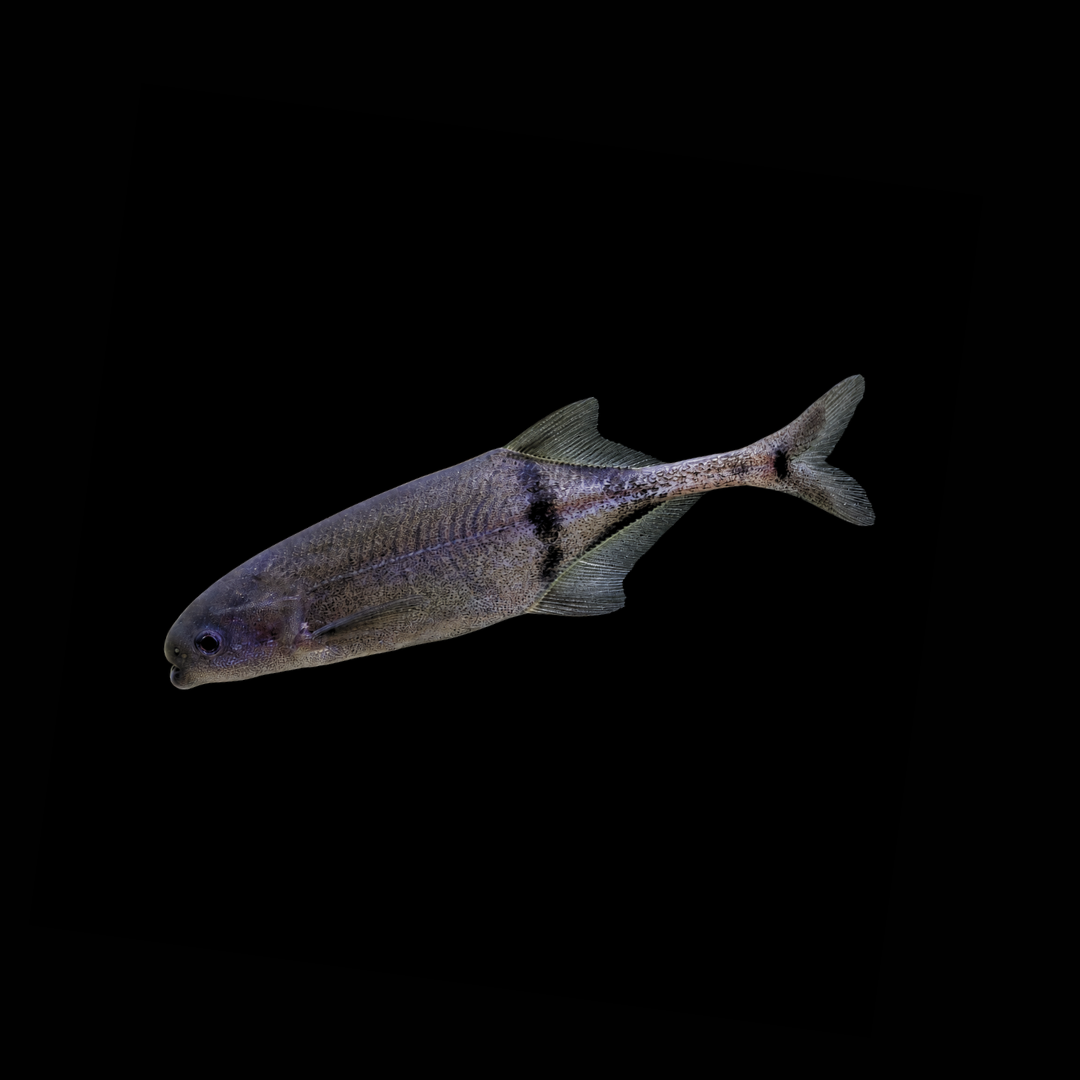
解説 / Description
マルクセニウス・モーリーは、西中部アフリカの淡水域に分布するモルミルス科の弱電気魚です。尾柄部にある発電器官から微弱な電気器官放電を発し、その電場が周囲の物体によってどのように変化するかを体表の電気受容器で読み取ります。この仕組みによって、視界の利きにくい水中や暗い時間帯でも、障害物や餌の位置を探ることができます。吻は短く、下顎には小さな肉質の膨らみがあり、細かな鱗に覆われた体は茶褐色から暗灰色を基調とします。華やかな色彩で目を引く魚ではありませんが、周囲を確かめるように泳ぐ夜間の行動には、弱電気魚ならではの奥深い魅力があります。飼育では、落ち着ける隠れ家と刺激の少ない環境を整え、動物質の餌を確実に食べられるよう管理することが大切です。 Marcusenius moorii is a weakly electric mormyrid fish from freshwater habitats in western and central Africa. An electric organ in the caudal peduncle produces weak electric organ discharges, while electroreceptors in the skin detect how nearby objects distort the resulting field. This sensory system helps the fish investigate obstacles and locate food even in darkness or visually difficult water. The species has a short snout, a small fleshy swelling on the lower jaw, fine scales, and a subdued brown to dark gray coloration. Its appeal lies less in bright color than in the careful nocturnal exploration typical of weakly electric fishes. In captivity, success depends on secure shelters, a low-stress environment, and reliable access to suitable animal-based foods.
基本情報 / Basic Information
| 学名 / Scientific Name | Marcusenius moorii (Günther, 1867) |
|---|---|
| 通称 / Common Name | マルクセニウス・モーリーMarcusenius moorii |
| 分類 / Family | アロワナ目・モルミルス科・マルクセニウス属Order Osteoglossiformes, Family Mormyridae, Genus Marcusenius |
| 英名 / English Name | No widely standardized English common name |
| 分布 / Distribution | ガボンからコンゴ共和国にかけてのオゴウェ川・クイル=ニアリ水系、チロアンゴ川水系、およびカメルーン、コンゴ共和国、コンゴ民主共和国、アンゴラにまたがるコンゴ川流域The Ogowe and Kouilou-Niari systems of Gabon and the Republic of the Congo, the Chiloango system, and the Congo River basin across Cameroon, the Republic of the Congo, the Democratic Republic of the Congo, and Angola |
| 最大体長 / Max Size | 標準体長約21.4cmAbout 21.4 cm standard length |
| 寿命 / Lifespan | 本種について、信頼できる飼育下寿命のまとまった記録は確認されておらず、明確な年数は不明です。A well-supported species-specific lifespan in captivity has not been established. |
飼育環境 / Aquarium Environment
| 水槽サイズ / Tank Size | 単独飼育では60cm規格水槽以上をひとつの目安とし、成魚の体長や隠れ家を十分に確保するなら90cm規格水槽がより扱いやすくなります。混泳させる場合は、魚同士が距離を取れるよう、さらに余裕のある底面積を確保します。For a single fish, a standard 60 cm aquarium can serve as a practical minimum, while a standard 90 cm aquarium gives more room for an adult and its shelters. Community setups should provide an even larger footprint so fish can maintain distance from one another. |
|---|---|
| 水温 / Temperature | 飼育上は24〜28℃前後を目安にし、短時間で大きく変化させないよう安定を優先します。本種に限定した詳細な温度耐性データは乏しいため、上限・下限を試すような管理は避けます。 A practical aquarium range is about 24–28°C, with stability more important than testing extremes. Detailed species-specific thermal tolerance data are limited. |
| 水質 / Water Quality | 飼育上は弱酸性から中性付近、目安としてpH6.5〜7.5程度の安定した水を用います。数値を細かく追うよりも、アンモニアと亜硝酸を検出させず、急激なpH変化や水温差を避けることを優先します。In aquaria, stable slightly acidic to near-neutral water around pH 6.5–7.5 is a practical target. More important than chasing an exact value is keeping ammonia and nitrite at zero and avoiding abrupt changes in pH or temperature. |
| レイアウト / Layout | 流木、土管、塩ビパイプなどを組み合わせ、日中に体を落ち着けられる暗がりを作ります。底床には角の取れた細かな砂を用いると、底を探る行動を妨げにくく、吻や下顎を擦る危険も抑えられます。照明は強すぎない方が落ち着きやすく、明るい場所と暗い場所の両方を作ると行動を観察しやすくなります。Use driftwood, caves, or PVC tubes to create shaded daytime retreats. Fine, smooth sand suits its bottom-searching behavior and reduces the risk of abrasion around the snout and lower jaw. Moderate lighting with both bright and shaded zones is preferable. |
| 注意点 / Precautions | 導入直後は輸送の影響で落ち着かないことがあるため、水温と水質の急変を避け、購入元の水との違いを確認しながら慎重に水合わせを行います。本種は「無鱗魚」ではなく細かな円鱗を持ちますが、輸送時の擦れや外傷には注意が必要です。また、同種や近縁のモルミルス科魚類では追尾や縄張り争いが起こる可能性があるため、十分な飼育経験がない場合は単独飼育が安全です。Newly imported fish may be unsettled after transport. Avoid sudden changes in temperature and water chemistry, and acclimate according to the actual difference between transport water and aquarium water. This species is not scaleless; it has fine cycloid scales, although abrasion and transport injuries still require attention. Conspecifics and related mormyrids may chase or compete with one another, so solitary maintenance is the safer choice for most keepers. |
餌と給餌 / Feeding
| 餌の種類 / Diet | 冷凍アカムシを中心に、活イトミミズなどの小型無脊椎動物を状態に応じて与えます。輸入直後の個体では人工飼料への反応が鈍いことがあるため、まず確実に食べる餌で体力を維持し、その後に沈下性の人工飼料などを少量ずつ試す方法が現実的です。Frozen bloodworms are a useful staple, with live tubifex worms and other small invertebrate foods offered as needed. Newly imported fish may respond poorly to prepared diets, so it is sensible to establish reliable feeding first and then gradually test suitable sinking prepared foods. |
|---|---|
| 給餌のポイント / Feeding Tips | 暗い時間帯に活動しやすいため、消灯後や照明を落とした直後の給餌が向いています。スポイトや給餌管で隠れ家の近くまで餌を届けると、導入直後の個体でも食べやすくなります。混泳水槽では、すばやい魚に餌を取られていないかを確認し、腹部の張りや背肉の落ち方を日常的に観察します。Feeding after lights-out or shortly after dimming the aquarium often matches its activity pattern. A pipette or feeding tube can place food close to the shelter of a shy new arrival. In a community aquarium, confirm that faster fish are not taking all the food, and monitor body condition regularly. |
性格と混泳 / Temperament and Tank Mates
| 性格 / Temperament | 普段は物陰で静かに過ごし、暗くなると底付近を探るように動き回ります。異種に対しては比較的穏やかに見えることがありますが、同種や近縁種に対しては縄張り性が表れる場合があります。弱電気魚同士では電気信号によるコミュニケーションも行われますが、水槽内の争いを単純に「電気信号の干渉」だけで説明することはできません。個体差と飼育空間を含めて判断する必要があります。The fish commonly rests in shelter by day and becomes more active near the bottom in darker conditions. It may appear peaceful toward unrelated species but can show territorial behavior toward conspecifics and close relatives. Weakly electric fishes also communicate electrically, but aquarium aggression should not be attributed to electrical interference alone; individual temperament and available space matter as well. |
|---|---|
| 混泳の相性 / Compatibility | 混泳させるなら、本種を捕食せず、反対に本種の口にも入らない大きさで、攻撃性が低く、餌を独占しにくい魚が候補になります。主に中層から上層を泳ぐ温和な魚は比較的合わせやすい一方、エレファントノーズフィッシュを含む他のモルミルス科魚類、強い縄張り性を持つ魚、極端に活発な魚との同居は避けるのが無難です。Suitable tank mates should be peaceful, too large to be swallowed, unable to prey on this species, and not prone to monopolizing food. Calm midwater or upper-water fishes are generally more suitable than other mormyrids, including elephantnose fishes, strongly territorial species, or very aggressive feeders. |
病気と対策 / Diseases and Prevention
| かかりやすい病気 / Common Diseases | 本種だけに特有の代表的な疾病が確立されているわけではありませんが、輸入・移動後のストレスが大きい個体では、白点病などの外部寄生虫症や、擦れ傷に続く二次感染に注意が必要です。暗い体色では小さな異常を見落としやすいため、白点の有無だけでなく、呼吸の速さ、体を物にこすりつける動き、食欲の低下、体表の濁りも観察します。There is no single disease uniquely characteristic of this species, but fish stressed by import or transport may be vulnerable to external parasites such as ich and to secondary infections following abrasions. Because small lesions can be difficult to see on a dark fish, also watch breathing rate, flashing, appetite, and changes in skin appearance. |
|---|---|
| 対策と予防 / Prevention | 購入時には痩せ、外傷、呼吸状態を確認し、可能であれば隔離水槽で状態を整えてから本水槽へ移します。予防の基本は、安定した水質、十分な酸素供給、適切な給餌、急変を避けた導入です。治療薬を使用する場合は、本種に対する薬剤感受性を示す十分な定量データが乏しいため、「規定量の何分の一」といった一律の自己流調整や、過度な加温だけに頼る治療は避けます。製品の適用魚種と用法を確認し、必要に応じて魚病に詳しい専門家へ相談してください。Inspect new fish for emaciation, injuries, and abnormal respiration, and use quarantine when practical. Stable water quality, adequate oxygenation, appropriate feeding, and careful acclimation are the foundations of prevention. Quantitative drug-sensitivity data for this species are limited, so avoid improvised fractional dosing or relying on excessive heat as a universal treatment. Follow the medication’s stated indications and directions and seek specialist advice when needed. |
増やし方(繁殖) / Breeding
| 雌雄の判別 / Sexing | 一般的な観賞魚飼育の範囲で、外見だけから本種の雌雄を確実に判別する方法は確立されていません。モルミルス科の一部では成熟や繁殖状態に伴って電気器官放電に性差が生じますが、その知見を本種へそのまま当てはめることはできません。A reliable visual method for sexing this species has not been established for routine aquarium use. Some mormyrids develop sex-related differences in electric organ discharge with maturity or reproductive condition, but those findings should not automatically be applied to Marcusenius moorii. |
|---|---|
| 繁殖形態 / Reproduction | モルミルス科は卵生です。ただし、マルクセニウス・モーリーについては、野外での産卵行動や繁殖期、卵・仔魚の発生を飼育条件と結びつけて詳しく示した情報が限られています。近縁種の知見から季節的な環境変化が繁殖に関与する可能性はありますが、本種で同じ条件が必要だと断定はできません。Mormyrids are egg-laying fishes. For Marcusenius moorii, however, detailed information linking wild spawning behavior, breeding season, egg development, and larval development to captive conditions remains limited. Seasonal environmental cues may be important, as in related species, but the exact requirements for this species are not established. |
| 繁殖のポイント / Breeding Tips | 家庭の水槽で安定して繁殖させる方法は確立されておらず、繁殖難易度は高いと考えられます。成熟個体の確保に加え、同種間の攻撃性を抑えられる広さ、産卵に適した環境、季節変化を再現する水質・水位管理など、複数の条件を検討する必要があります。繁殖を目指す場合は、近縁種の繁殖研究を参考にしつつ、本種について未解明な点が多いことを前提に慎重に取り組みます。There is no established method for reliably breeding this species in a typical home aquarium, and it should be regarded as difficult. Mature fish, enough space to control aggression, suitable spawning habitat, and carefully managed seasonal changes in water conditions or water level may all be relevant. Any breeding attempt should draw on research in related species while recognizing that the requirements of Marcusenius moorii remain poorly known. |
雑学と豆知識 / Trivia and Fun Facts
| 1. 現在も有効な学名と、19世紀に始まった命名の歴史 / 1. A valid name with roots in nineteenth-century natural history | 本種は1867年に Albert Günther によって Mormyrus moorii として記載され、現在は Marcusenius moorii が有効名として扱われています。属名 Marcusenius は魚類学者・動物学者 Johann Andreas Marcusen にちなみ、種小名 moorii は英国の博物館学芸員 Thomas John Moore への献名です。標本が集められ、博物館で比較され、分類体系が少しずつ組み立てられていった19世紀の博物学の歴史が、現在の学名にも刻まれています。The species was described by Albert Günther in 1867 as Mormyrus moorii and is currently accepted as Marcusenius moorii. The genus name honors the ichthyologist and zoologist Johann Andreas Marcusen, while the species epithet moorii commemorates British museum curator Thomas John Moore. Its name preserves part of the nineteenth-century history of specimen collecting and museum-based taxonomy. |
|---|---|
| 2. 似た魚を分け直した2020年の分類学的再検討 / 2. A 2020 revision separated look-alike species | コンゴ盆地では、長い間マルクセニウス・モーリーにまとめられてきた標本の中に、別種が混在していました。2020年に発表された形態とミトコンドリアDNAを組み合わせた研究では、Marcusenius lambouri が再び有効種として認められ、Marcusenius verheyenorum が新種として記載されました。M. lambouri は側線鱗数が44〜46枚であるのに対し、再検討された M. moorii は40〜43枚とされ、胸鰭の長さや体高にも差が示されています。見た目がよく似た魚でも、標本の計測と遺伝情報を重ねることで、コンゴ盆地に隠れていた多様性が浮かび上がった例です。In the Congo Basin, specimens long grouped under Marcusenius moorii included more than one species. A 2020 integrative study combining morphology and mitochondrial DNA revalidated Marcusenius lambouri and described Marcusenius verheyenorum as a new species. The revised M. moorii was reported with 40–43 lateral-line scales, compared with 44–46 in M. lambouri, alongside differences in pectoral-fin length and body depth. The study shows how measurements and genetic evidence can reveal hidden diversity among outwardly similar fishes. |
| 3. 電気は獲物をしびれさせるためではなく、周囲を読むために使う / 3. Its electricity is mainly a sensory and communication tool | モルミルス科の電気器官放電は、デンキウナギの強力な放電とは性質が異なり、主に電気定位とコミュニケーションに用いられます。自分で作った電場の変化をモルミロマストが受け取り、物体の存在を探るのが能動的電気定位です。一方、クノレン器官は他個体が発する電気器官放電の検出に特化し、膨大部型の受容器は外界に生じる低周波の微弱な電場を感知します。ひとつの「電気感覚」に見えても、実際には役割の異なる受容器が情報を分担しています。Mormyrid electric organ discharges differ fundamentally from the powerful shocks of electric eels and are used mainly for electrolocation and communication. Mormyromasts detect distortions of the fish’s self-generated field for active electrolocation, Knollenorgans specialize in detecting electric organ discharges from other fish, and ampullary receptors respond to weak low-frequency external electric fields. What appears to be a single electric sense is therefore divided among receptor systems with different functions. |
| 4. 下顎の小さな膨らみも、感覚器官として見ると印象が変わる / 4. The small lower-jaw swelling belongs to a remarkable sensory design | モルミルス科では、吻や下顎の突起に電気受容器が高密度に集まる例が知られています。特にエレファントノーズフィッシュ Gnathonemus petersii の長い下顎突起は、電気感覚における「中心窩」のような高感度領域として詳しく研究されてきました。マルクセニウス属の一部に見られる短い下顎の膨らみにも電気受容器が多いことが示されており、こうした軟らかな吻部構造は、単なる飾りではなく探索行動に関わる感覚面として進化してきた可能性があります。ただし、M. moorii の小さな膨らみについて機能を直接検証した研究は限られています。In mormyrids, rostral and lower-jaw appendages can carry high densities of electroreceptors. The elongated chin appendage of Gnathonemus petersii is especially well studied as an electrosensory fovea. High receptor densities have also been demonstrated on shorter rostral structures in some other mormyrids, suggesting that these soft-tissue features can serve sensory rather than merely ornamental roles. Direct functional evidence for the small swelling of M. moorii itself, however, remains limited. |
| 5. 「脳が全身の酸素の60%を使う」は、本種そのものの測定値ではない / 5. The famous 60% brain-energy figure was not measured in this species | モルミルス科は、小脳系、とりわけ小脳弁が非常に発達した魚として知られています。小脳弁は脳の背面を大きく覆い、独特で規則的な神経回路を形成します。「脳が全身の酸素消費量の約60%を占める」という有名な数値は、近縁の Gnathonemus petersii で測定されたものです。マルクセニウス・モーリーで同じ値が実測されたわけではないため、種を越えてそのまま数値を当てはめるのは適切ではありません。また、脳が大きいことだけを根拠に「哺乳類より知能が高い」と評価することもできません。重要なのは、弱電気魚が高度に特殊化した感覚処理系を進化させているという点です。Mormyrids are known for an exceptionally developed cerebellar system, especially the valvula cerebelli, which extends over much of the dorsal brain and contains highly organized circuitry. The famous estimate that the brain accounts for about 60% of total body oxygen consumption was measured in the related Gnathonemus petersii, not in Marcusenius moorii. The value should therefore not be transferred directly between species, and a large brain alone does not justify claims of greater intelligence than mammals. The important point is the remarkable specialization of sensory processing in weakly electric fishes. |
| 6. 電気信号の違いは、種を見分ける仕組みと進化にも関わる / 6. Electric signal diversity is linked to recognition and evolutionary diversification | モルミルス類の電気器官放電は、種によって波形や持続時間が異なります。受信側では、中脳の外側核などが信号の時間情報を処理し、一部の系統では外側核が前部と後部に分化して、より細かな波形差を検出する能力が発達しました。電気信号を配偶相手の認識に利用する種では、信号の違いが同類交配を促し、生殖隔離や種分化に結びつく可能性も示されています。電気は暗闇を探る感覚であると同時に、仲間を識別するための情報にもなっています。Mormyrid electric organ discharges vary among species in waveform and duration. On the receiving side, midbrain regions including the exterolateral nucleus process temporal signal features, and in some lineages this nucleus has become divided into anterior and posterior regions associated with finer waveform discrimination. In species that use electric signals during mate recognition, signal differences can promote assortative mating and may contribute to reproductive isolation and diversification. Electricity therefore carries both environmental and social information. |
| 7. 繁殖期に「声変わり」のような変化を見せる近縁種もいる / 7. Related species can show voice-like seasonal changes in electric signals | 南アフリカ産の近縁種 Marcusenius pongolensis では、成熟したオスの電気器官放電の持続時間が体サイズや社会条件、繁殖状態に応じて変化することが研究されています。人の「声変わり」にたとえると親しみやすい現象ですが、実際には発電器官を構成する細胞と、その働きを調節する生理機構の変化です。こうした現象が M. moorii でも同じ形で起こるとは限りません。それでも、モルミルス類の電気信号が固定された単純なパルスではなく、個体の状態を映す柔軟なコミュニケーション手段であることをよく示しています。In the South African relative Marcusenius pongolensis, the duration of male electric organ discharges can change with body size, social conditions, and reproductive state. Comparing this with a human voice change is a useful analogy, although the underlying mechanism involves physiological changes in the electric organ and its control. The same pattern has not been demonstrated for M. moorii, but the research shows that mormyrid electric signals can be flexible indicators of biological and social state rather than fixed pulses. |
まとめ / Conclusion
マルクセニウス・モーリーの魅力は、派手な体色ではなく、目には見えない電場を手掛かりに周囲を読み取る独特の暮らし方にあります。短い吻と控えめな下顎の膨らみ、物陰を好む慎重な姿からは想像しにくいものの、その体内では発電器官と複数の電気受容器、発達した神経系が連携し、暗い水中の情報を絶えず処理しています。分類学的にも、よく似た近縁種が長く一種にまとめられてきた歴史を持ち、現在もアフリカ淡水魚の多様性を考えるうえで興味深い存在です。 The appeal of Marcusenius moorii lies not in bright coloration but in a way of life built around an invisible electric field. Behind its short snout, modest lower-jaw swelling, and cautious sheltering behavior is an integrated system of electric organ, multiple electroreceptors, and specialized neural processing that continually interprets information from dark water. Its taxonomic history is equally revealing: closely similar relatives were long grouped together, making the species part of a broader story about the hidden diversity of African freshwater fishes.
水槽では、その特殊な感覚を十分に発揮できるよう、静かな環境、落ち着ける隠れ家、滑らかな底床、確実な給餌を用意することが何より大切です。とくに導入直後は、餌を食べているか、体型を維持できているか、呼吸や体表に異常がないかを丁寧に見守ります。環境に慣れた個体が消灯後にゆっくりと泳ぎ出し、底や流木の周囲を確かめるように探索する姿は、アフリカの河川で磨かれてきた電気感覚という進化の工夫を、水槽の中で静かに伝えてくれます。 In the aquarium, the priority is to provide conditions in which this sensory specialization can function without unnecessary stress: quiet surroundings, secure shelters, smooth substrate, and dependable feeding. Newly introduced fish should be watched closely for feeding, body condition, respiration, and skin problems. Once settled, a fish that emerges after dark and slowly investigates the substrate and driftwood offers a quiet but remarkable view of an electrosensory adaptation refined in African rivers.
分布マップ
マルクセニウス・モーリーは、ガボンからコンゴ共和国にかけてのオゴウェ川・クイル=ニアリ水系、チロアンゴ川水系、およびカメルーン、コンゴ共和国、コンゴ民主共和国、アンゴラにまたがるコンゴ川流域に分布します。地図では、この広い分布域を把握するための概略代表地点を示しています。
※このプロットは、記事の分布記載から分布イメージをつかむために設定した概略代表地点です。実際の採集地点や厳密な生息範囲を示すものではありません。
参考文献・出典
マルクセニウス・モーリーの分類、分布、生息環境、飼育管理、繁殖、疾病予防に関する記述の裏付けとして、査読論文、継続更新される魚類学データベース、大学・獣医学系の専門資料から選定しています。本種を直接扱う資料を優先し、本種で十分な研究がない飼育・繁殖・疾病分野についてのみ、モルミルス科やマルクセニウス属の研究、および観賞魚の獣医学資料を補助的に用いています。
記事中の「60cm規格水槽以上」「24〜28℃」「pH6.5〜7.5」などは、Marcusenius moorii を対象とした比較飼育試験によって規格化された数値ではなく、野生下の環境記録と近縁モルミルス類の飼育研究を踏まえた実用上の目安です。また、本種固有の薬剤感受性を定量化した信頼できる資料は確認できないため、特定薬剤の一律減量や高温処置を本種固有の標準治療として裏付ける文献は採用していません。
-
Mambo Baba, T., Kisekelwa, T., Danadu Mizani, C., Decru, E. & Vreven, E. (2020).Hidden species diversity in Marcusenius moorii (Teleostei: Mormyridae) from the Congo Basin. Journal of Fish Biology, 96(5), 1100–1122.主に支える内容:現在の種概念、M. lambouri の再有効化、M. verheyenorum の記載、側線鱗数などの識別形質、コンゴ盆地における分布の再検討。
-
Fricke, R., Eschmeyer, W. N. & van der Laan, R. (eds.) (2026).Eschmeyer's Catalog of Fishes: Genera, Species, References. California Academy of Sciences. Electronic version, accessed 25 July 2026.主に支える内容:学名の現在の有効性、原記載、タイプ産地、命名者、分類学上の扱い、広域分布の確認。
-
Froese, R. & Pauly, D. (eds.). FishBase.Marcusenius moorii species summary. Electronic database, accessed 25 July 2026.主に支える内容:淡水・底生性という生態区分、オゴウェ川・クイル=ニアリ水系・チロアンゴ水系・コンゴ川流域の分布、最大標準体長約21.4cm、背鰭・臀鰭の計数形質。
-
Mputu, A., Willén, E., Wilander, A., Drakare, S., Bishop, K. & Inogwabini, B.-I. (2022).Fish populations and biomass in headwater streams of the Lake Tumba Landscape, DR Congo, 2007–2011. Acta Ichthyologica et Piscatoria, 52(3), 195–208.主に支える内容:コンゴ盆地の源流域での実際の採集記録、生息する褐色・腐植質水域、低pH環境への出現記録。本種の自然環境が単一の中性域に限定されないことを示す直接資料。
-
Sommer, G. M., Njom, S. D., Indermaur, A., Nyom, A. R. B., Jandová, K., Kukla, J., Petrtýl, M., Horká, P. & Musilova, Z. (2024).Trophic ecology of the African riverine elephant fishes (Mormyridae). Ecology and Evolution, 14, e70173.主に支える内容:モルミルス科の食性・栄養生態。多くのモルミルス類が主として無脊椎動物を利用することを示し、動物質中心の給餌方針を科レベルで補助する資料。本研究の対象種に M. moorii 自体は含まれないため、直接的な餌組成資料としては扱いません。
-
Ntumba Mabedi, J. M., Mbadu Zebe, V., Michaux, J. & Micha, J.-C. (2022).Biologie de la reproduction des Marcusenius (M. monteiri, M. stanleyanus, M. schilthuisiae et M. macrolepidotus) du Pool Malebo, fleuve Congo, Kinshasa. International Journal of Biological and Chemical Sciences, 16(2), 564–580.主に支える内容:コンゴ川のマルクセニウス属近縁種における繁殖期、増水・冠水域と繁殖の関係、産卵場への移動。本種固有の繁殖条件ではなく、属内比較の補助資料。
-
Korniienko, Y., Nzimora, K. C., Vater, M., Tiedemann, R. & Kirschbaum, F. (2022).Intergenus F1-hybrids of African weakly electric fish (Mormyridae: Gnathonemus petersii ♂ × Campylomormyrus compressirostris ♀) are fertile. Journal of Comparative Physiology A, 208, 355–371.主に支える内容:モルミルス科魚類の飼育下繁殖研究。繁殖刺激として雨季を模した導電率低下を用いたこと、飼育・繁殖水槽で23〜27℃、pH5.2〜7が用いられたことを示す。ただし対象は別属であり、M. moorii の最適値を直接示す資料ではありません。
-
Petty, B. D., Francis-Floyd, R. & Yanong, R. P. E. (2024 update).Management of Aquarium Fish. Merck Veterinary Manual, Professional Version.主に支える内容:観賞魚の隔離・バイオセキュリティ、水質管理、アンモニア・亜硝酸対策、急激なpH変化の危険性、薬剤使用時に魚種・水質・用量を考慮すべきという一般的な獣医学的管理原則。
-
Francis-Floyd, R., Yanong, R. & Pouder, D. (2023 revision).Ichthyophthirius multifiliis (White Spot) Infections in Fish. UF/IFAS Extension, CIR920.主に支える内容:淡水魚の白点病の原因・症状・生活環、輸送やハンドリング後に発症が表面化しうること、新規導入魚の隔離、治療時に魚種の耐性や水質条件を確認する必要性。M. moorii 固有の薬剤感受性を示す資料ではありません。
参考文献の最終確認日:2026年7月25日。分類学上の現在の有効名については、継続更新される Eschmeyer's Catalog of Fishes と2020年の再検討論文を優先しています。




コメント