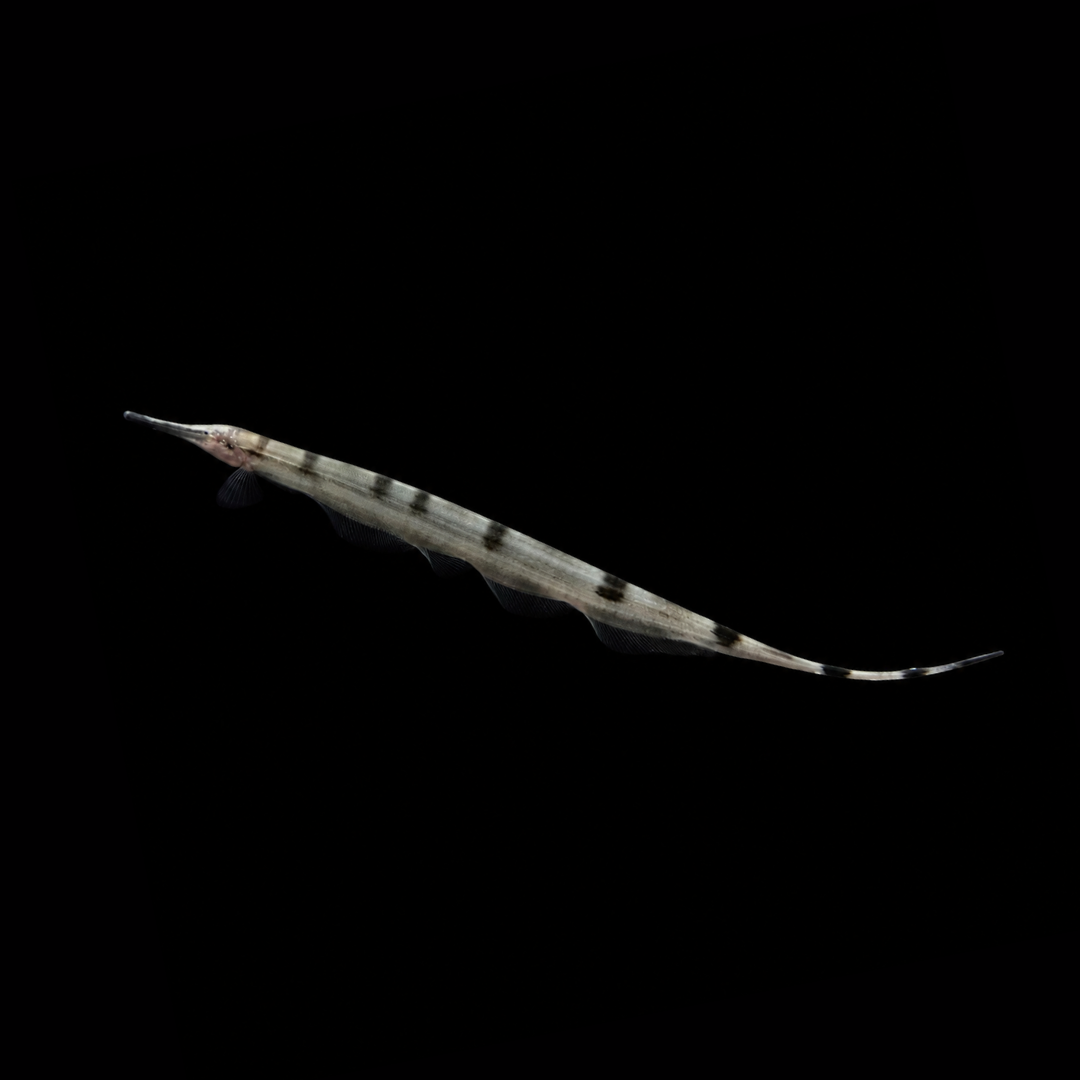
ジャイアントグラストランペットナイフは、南米の河川に暮らす弱電気魚、Gymnorhamphichthys属の魚が日本で流通する際に使われる名称です。半透明の細長い体、管のように伸びた吻、長い尻鰭を波打たせて前後へ滑るように泳ぐ姿が大きな魅力です。昼間は細かな砂へ潜って休み、暗くなると姿を現して底生昆虫の幼虫などを探します。販売名だけでは種を確定できない場合が多いため、飼育では特定の一種と決めつけず、属全体に共通する性質を基準に環境を整えることが大切です。Giant Glass Trumpet Knifefish is a Japanese aquarium trade name applied to weakly electric fishes of the South American genus Gymnorhamphichthys. Its appeal lies in a slender translucent body, an elongated tubular snout, and a long anal fin that produces smooth forward and backward movement. During the day it rests buried in fine sand, emerging after dark to search for insect larvae and other small bottom-dwelling prey. Because specimens are often sold without a reliable species identification, husbandry should be based on the shared needs of the genus rather than assumptions about a single species.
デンキウナギ目・ラムピクティス科・Gymnorhamphichthys属Order Gymnotiformes, family Rhamphichthyidae, genus Gymnorhamphichthys
英名 / English Name
Mousetail Knifefish, Thermometer Knifefish
分布 / Distribution
アマゾン川、オリノコ川、パラナ・パラグアイ川水系など南米の淡水域。種によって分布域が異なります。Fresh waters of South America, including the Amazon, Orinoco, and Paraná-Paraguay river systems. The exact range differs among species.
最大体長 / Max Size
種により全長約15〜23cm。流通個体では種名が不確かなことも多く、20cmを超える前提で設備を用意すると安心です。Approximately 15 to 23 cm total length depending on species. Because trade specimens may be unidentified, planning for an adult exceeding 20 cm is prudent.
寿命 / Lifespan
信頼できる飼育記録が少なく、明確な寿命は不明です。長期飼育には安定した水質、十分な給餌、尾部を傷つけない環境が欠かせません。A dependable lifespan figure is not established because long-term captive records are scarce. Stable water quality, adequate feeding, and protection of the delicate tail are essential for longevity.
飼育環境 / Aquarium Environment
水槽サイズ / Tank Size
10〜15cmほどの若魚は60cm規格水槽から飼育できますが、20cm前後まで成長する個体の長期飼育には90cm規格水槽を推奨します。高さよりも底面積を優先してください。Juveniles of about 10 to 15 cm can be kept in a standard 60 cm aquarium, while a standard 90 cm aquarium is recommended for long-term care of specimens approaching 20 cm. Floor area is more important than height.
水温 / Temperature
22〜28℃を目安とし、24〜27℃前後で安定させます。30℃を超える高水温や急変を避け、夏は冷却ファンや水槽用クーラーも検討します。Maintain 22 to 28°C, ideally stable around 24 to 27°C. Avoid temperatures above 30°C and rapid fluctuations; aquarium fans or a chiller may be needed in summer.
水質 / Water Quality
弱酸性から中性のpH6.0〜7.5を目安に、アンモニアと亜硝酸を検出しない清浄な水を保ちます。原産地には非常に軟らかく導電率の低い水域もありますが、数値を急に合わせるより、導入時の水質から時間をかけて安定させることが重要です。Aim for clean, slightly acidic to neutral water at pH 6.0 to 7.5, with no detectable ammonia or nitrite. Some natural habitats are extremely soft and low in conductivity, but gradual acclimation and stability are more important than forcing exact values quickly.
レイアウト / Layout
角のない細かな田砂やボトムサンドを3〜5cm以上敷き、全身を潜らせられる場所を確保します。流木や土管、塩ビパイプなどで暗い隠れ家を作り、強い照明と強水流は避けます。吸水口にはスポンジを装着し、砂や魚体を吸い込まないようにします。Provide at least 3 to 5 cm of smooth, fine sand deep enough for complete burial. Add shaded shelters with driftwood, ceramic tubes, or PVC pipes, and avoid intense lighting and strong current. Fit a sponge guard to filter intakes to prevent sand or the fish from being drawn in.
注意点 / Precautions
細砂のないベアタンクは本来の休息行動を妨げ、慢性的なストレスにつながります。輸入直後は吻や尾が擦れていることがあるため、傷、白濁、呼吸の速さ、痩せをよく観察してください。水合わせは時間をかけ、急なpHや水温の変化を避けます。A bare-bottom tank prevents normal resting behavior and can cause chronic stress. Newly imported fish may have abrasions on the snout or tail, so inspect closely for wounds, cloudiness, rapid breathing, and weight loss. Acclimate slowly and avoid sudden changes in pH or temperature.
餌と給餌 / Feeding
餌の種類 / Diet
冷凍アカムシ、イトミミズ、細かくしたミミズ、小型の水生昆虫や甲殻類など、柔らかく沈む動物質の餌を中心に与えます。個体によっては沈下性の肉食魚用人工飼料にも慣れますが、導入直後は冷凍餌や生餌の方が反応しやすい傾向があります。Offer soft, sinking animal-based foods such as frozen bloodworms, tubifex worms, finely chopped earthworms, and small aquatic insects or crustaceans. Some individuals accept sinking carnivore pellets, but newly imported fish often respond more readily to frozen or live foods.
給餌のポイント / Feeding Tips
消灯後、魚が砂から出てきたことを確認してから、底へ静かに餌を届けます。ピンセットやスポイトを使うと確実です。腹部が極端にへこまない程度を目安に少量ずつ与え、残餌は翌朝まで残さず回収します。混泳時は餌を奪われやすいため、個体ごとの摂餌確認が必要です。Feed after lights-out once the fish has emerged from the sand, placing food gently near the bottom. Long tweezers or a feeding pipette improve accuracy. Offer small portions sufficient to prevent a sunken abdomen, remove leftovers before they spoil, and confirm that each fish eats when tank mates are present.
性格と混泳 / Temperament and Tank Mates
性格 / Temperament
おおむね温和で臆病な夜行性魚です。歯を持たず、大きな魚を積極的に襲うタイプではありません。ただし、狭い環境や繁殖期には同種間で距離を取りたがる可能性があり、十分な砂地と隠れ場所が必要です。Generally peaceful, shy, and nocturnal. It lacks teeth and is not an active predator of larger fishes. However, individuals may require personal space in confined quarters or during reproductive periods, so provide ample sand and multiple retreats.
混泳の相性 / Compatibility
餌を奪わず、尾や吻をつつかない穏やかな中層魚が候補になります。攻撃的なシクリッド、大型肉食魚、活発な底生魚、夜間に餌を独占する魚は避けます。他の電気魚との混泳は電気的干渉や生活場所の競合を判断しにくいため、十分な経験と広い水槽がない限り単独飼育が無難です。Suitable companions are calm midwater fishes that neither outcompete it for food nor nip its snout or tail. Avoid aggressive cichlids, large predators, active bottom dwellers, and nocturnal feeders that monopolize food. Housing with other electric fishes may create electrical and spatial competition, so solitary care is safest unless the aquarist has ample space and experience.
病気と対策 / Diseases and Prevention
かかりやすい病気 / Common Diseases
吻や尾の擦り傷から起こる細菌感染、水カビ、尾ぐされ症状に特に注意します。痩せ、拒食、体表の白濁、尾端の欠損が進む場合は、水質悪化や輸送傷だけでなく内部寄生虫なども疑われます。Watch especially for bacterial infection, fungal growth, and fin or tail erosion following abrasions to the snout or tail. Progressive weight loss, refusal to feed, cloudy skin, or continuing tail damage may also indicate poor water quality, shipping injury, or internal parasites.
対策と予防 / Prevention
滑らかな細砂、穏やかな混泳相手、清浄な水を保つことが最良の予防です。異常個体は早めに隔離し、水質と水温を確認します。鱗の少ない電気魚は薬剤に敏感な可能性があるため、薬浴は製品の対象魚と用法を確認し、必要に応じて魚病に詳しい専門店や獣医師へ相談してください。自己判断による強い薬浴や急な塩分変更は避けます。Smooth fine sand, peaceful tank mates, and clean stable water provide the best prevention. Isolate affected fish early and verify water quality and temperature. Weakly scaled electric fishes may be medication-sensitive, so confirm that a treatment is suitable for the species and follow its directions, consulting an experienced aquatic veterinarian or specialist shop when necessary. Avoid aggressive medication or sudden salinity changes.
増やし方(繁殖) / Breeding
雌雄の判別 / Sexing
外見だけでの確実な判別は困難です。G. rondoniでは雄の吻がやや長く、尾柄が細い傾向が報告されていますが、流通個体は種の同定自体が不確かな場合があり、一般的な判別法としては使えません。Reliable visual sexing is difficult. Males of G. rondoni have been reported to show a somewhat longer snout and a more slender caudal region, but trade specimens may not be correctly identified, so these traits are not dependable for routine aquarium sexing.
繁殖形態 / Reproduction
繁殖期に少数の卵を複数回に分けて産む多回産卵型と考えられています。卵は細かな底質へ散らされ、親による保護は行われないとされています。They are considered fractional spawners, releasing small batches of eggs repeatedly during the breeding season. Eggs are scattered into fine substrate and are not believed to receive parental care.
繁殖のポイント / Breeding Tips
飼育下での計画的な繁殖方法は確立されていません。自然界では雨季に伴う水位上昇、導電率の低下、光周期の変化などが刺激になる可能性があります。再現を試みる場合も、親魚を十分に成熟させ、極めて安定した軟水環境と細砂、卵を親から分離できる仕組みを用意する必要があります。A reliable captive breeding method has not been established. In nature, rising water levels, decreasing conductivity, and changing day length associated with the rainy season may act as triggers. Any breeding attempt would require mature, well-conditioned adults, exceptionally stable soft water, fine sand, and a way to protect eggs from the adults.
雑学と豆知識 / Trivia and Fun Facts
1. 砂の中で昼を過ごす魚 / 1. A Fish That Spends the Day Under Sand
この魚にとって細砂は飾りではなく、昼間の寝床そのものです。明るくなると体をひねるように砂へ入り、夕方になるまで静かに休みます。水槽内で姿が見えない時間が長くても、適切な砂へ潜っているなら異常とは限りません。むしろ毎日安心して潜れることが、落ち着いた行動と安定した摂餌につながります。Fine sand is not decoration for this fish but its daytime bed. As light increases, it twists into the substrate and remains quiet until evening. Long periods out of sight are not necessarily a problem when the fish is buried normally. Being able to hide securely each day supports calm behavior and reliable feeding.
2. 暗闇を照らす代わりに電気で感じる / 2. Sensing With Electricity Instead of Light
Gymnorhamphichthys属は、筋肉由来の電気器官からごく弱い電気信号を発し、その電場のゆがみを読み取って周囲を把握します。小さな目だけに頼らず、砂粒、流木、近くの魚、餌となる小動物の位置を暗闇でも探れる仕組みです。昼の休息時には放電頻度が低く、夜の活動時に高くなることが知られ、電気のリズムそのものが生活の切り替えを映しています。Members of Gymnorhamphichthys emit very weak electrical signals from a muscle-derived electric organ and detect distortions in the resulting field. This allows them to locate sand grains, wood, nearby fishes, and small prey in darkness without relying on their tiny eyes. Their discharge rate is known to be lower during daytime rest and higher during nocturnal activity, making the electrical rhythm a reflection of their daily cycle.
3. 温度計ナイフと呼ばれる理由 / 3. Why It Is Called a Thermometer Knifefish
若い個体では体の色素が少なく、光の当たり方によって内部の赤い血管や神経の線、規則的に並ぶ肋骨の影が透けて見えます。その姿が、赤い液柱と目盛りを持つ昔ながらの温度計を思わせることから、英語圏ではThermometer Knifefishという呼び名が生まれました。強い照明を当て続けるのは避けつつ、薄暗い環境で見せる繊細な透明感を楽しみたい魚です。Young specimens contain little pigment, so suitable lighting may reveal red blood vessels or nerve lines and the evenly spaced shadows of the ribs. The image resembles an old-style thermometer with a red column and scale, inspiring the English name Thermometer Knifefish. Its delicate transparency is best appreciated under subdued light rather than prolonged bright illumination.
4. 学名に刻まれた裸の吻 / 4. The Naked Snout Written Into Its Name
属名Gymnorhamphichthysは、裸を意味するgymnos、くちばしを意味するrhamphos、魚を意味するichthysに由来します。体の前半に鱗が乏しく、長い管状の吻を持つ特徴が、そのまま一つの名前に組み込まれています。細長い吻には歯がなく、砂や泥の中にいる小さな獲物を吸い込むように捕らえます。The genus name Gymnorhamphichthys combines Greek roots meaning naked, beak, and fish. It captures the animal’s reduced scaling on the front of the body and its long tubular snout. The elongated mouth lacks teeth and is used to draw tiny prey from sand or mud by suction.
5. 尾を失っても再生できる / 5. A Tail With Remarkable Regenerative Ability
ナイフフィッシュの仲間には、捕食や事故で失った尾部を再生する能力があります。細長い体にとって尾は傷つきやすい一方、再生という仕組みが生存の助けになってきたと考えられます。ただし水槽では、再生を期待して傷を放置してよいわけではありません。新しい組織は感染に弱いため、尾端の白濁や崩れを見つけたら水質と混泳環境をすぐに見直す必要があります。Knifefishes possess a notable ability to regenerate tail tissue lost through predation or injury. Their elongated form makes the tail vulnerable, and regeneration is thought to improve survival. In an aquarium, however, this is not a reason to ignore damage. New tissue is susceptible to infection, so cloudiness or erosion at the tail tip calls for immediate review of water quality and tank mates.
6. 流通名の奥に複数の種がいる / 6. One Trade Name May Hide Several Species
日本でジャイアントグラストランペットナイフとして販売される魚は、G. rondoniだけとは限りません。産地情報や模様、吻の長さ、尻鰭条数などを詳しく調べなければ、G. hypostomus、G. britskii、近似種を区別できないことがあります。成魚サイズや模様の現れ方が予想と違っても、単なる個体差ではなく別種である可能性が残ります。販売名を入口にしつつ、形態と産地を観察することも、この魚を飼う面白さの一つです。Fish sold in Japan as Giant Glass Trumpet Knifefish are not necessarily G. rondoni. Without detailed locality data and examination of pattern, snout proportions, and anal-fin ray counts, specimens may be difficult to distinguish from G. hypostomus, G. britskii, or related forms. Unexpected adult size or markings may therefore reflect a different species rather than simple individual variation. Observing morphology and origin beyond the trade name is part of the fascination of keeping this fish.
まとめ / Conclusion
ジャイアントグラストランペットナイフを健やかに飼う鍵は、全身を預けられる細砂、落ち着ける暗い場所、安定した水質、そして消灯後に確実に届く餌です。姿が見えない昼間も砂の下では本来の時間が流れており、夕暮れとともに静かに現れる瞬間に、この魚ならではの生活リズムを感じられます。Healthy care of a Giant Glass Trumpet Knifefish depends on fine sand deep enough for complete burial, shaded retreats, stable water, and food delivered reliably after dark. Even when hidden during the day, it is following its natural rhythm beneath the sand, making its quiet emergence at dusk one of the most rewarding moments of keeping the species.
透明な体と微弱な電気、管状の吻、砂へ消える習性は、どれも南米の薄暗い川底で磨かれた適応です。目立つ魚ではありませんが、環境を丁寧に整えた水槽では、静かな動きの一つ一つが深い存在感を持ち、飼育者に夜の川をのぞき込むような特別な観察体験を与えてくれます。Its translucent body, weak electric sense, tubular snout, and sand-burying behavior are all adaptations shaped on dim South American riverbeds. It is not a showy fish, yet in a carefully prepared aquarium every quiet movement carries presence, offering the keeper an unusual glimpse into the life of a nocturnal river.
分類・命名 Fricke, R., Eschmeyer, W. N. & van der Laan, R. (eds.).Eschmeyer’s Catalog of Fishes: Genera, Species, References. California Academy of Sciences.
データベースを開く
Gymnorhamphichthys属各種の有効名、異名、原記載、分布記録の確認に使用。
分類・分布 Mago-Leccia, F. (1994).Electric Fishes of the Continental Waters of America: Classification and Catalogue of the Electric Fishes of the Order Gymnotiformes. FUDECI, Caracas, 206 pp.
書誌情報を開く
デンキウナギ目の分類体系、属・種の分布、形態学的背景を確認するための専門モノグラフ。
生態・繁殖 Schwassmann, H. O. (1976).
Ecology and taxonomic status of different geographic populations of Gymnorhamphichthys hypostomus Ellis.
Biotropica, 8(1), 25–40.
DOI
地域個体群の生態と分類、昼夜の潜砂行動、多回産卵の可能性、約65卵という抱卵数記録の基礎資料。
分類・識別 Carvalho, T. P., Ramos, C. S. & Albert, J. S. (2011).
A new species of Gymnorhamphichthys (Gymnotiformes: Rhamphichthyidae) from the Paraná–Paraguay Basin.
Copeia, 2011(3), 400–406.
DOI
G. britskiiの記載、斑紋、吻の比率、尻鰭条数など、属内種の識別と分布差を支える資料。
砂底生態 Zuanon, J., Bockmann, F. A. & Sazima, I. (2006).
A remarkable sand-dwelling fish assemblage from central Amazonia, with comments on the evolution of psammophily in South American freshwater fishes.
Neotropical Ichthyology, 4(1), 107–118.
DOI
細砂への依存、潜砂、砂底での採餌など、砂潜り魚としての生態と飼育レイアウトの根拠。
生息環境・水質 Escamilla-Pinilla, C., Mojica, J. I. & Molina, J. (2019).
Spatial and temporal distribution of Gymnorhamphichthys rondoni in a long-term study of an Amazonian terra firme stream, Leticia, Colombia.
Neotropical Ichthyology, 17(3), e190006.
DOI
砂を備えた休息場所、ブラックウォーターのpH・水温・導電率・溶存酸素、季節変動を示す野外研究。
食性・微小生息地 Virgilio, L. R., Gomes, R. S., Suçuarana, M. S. & Vieira, L. J. S. (2019).
Analysis of the use of microhabitats, spatial distribution and diet of Gymnorhamphichthys rondoni in low-order streams in western Amazon.
Biotemas, 32(1), 65–76.
DOI
砂質基質の選択、双翅目・鞘翅目幼虫を中心とする底生無脊椎動物食を支える資料。
雌雄判別 Garcia, E. Q. & Zuanon, J. (2019).
Sexual dimorphism in the electric knifefish, Gymnorhamphichthys rondoni (Rhamphichthyidae: Gymnotiformes).
Acta Amazonica, 49(3), 213–220.
DOI
成熟個体の頭部比率と泌尿生殖乳頭にみられる性的二形を確認する資料。
水質・疾病予防 Merck Veterinary Manual.
Environmental Diseases of Aquatic Animals in Aquatic Systems.
資料を開く






コメント