

解説 / Description
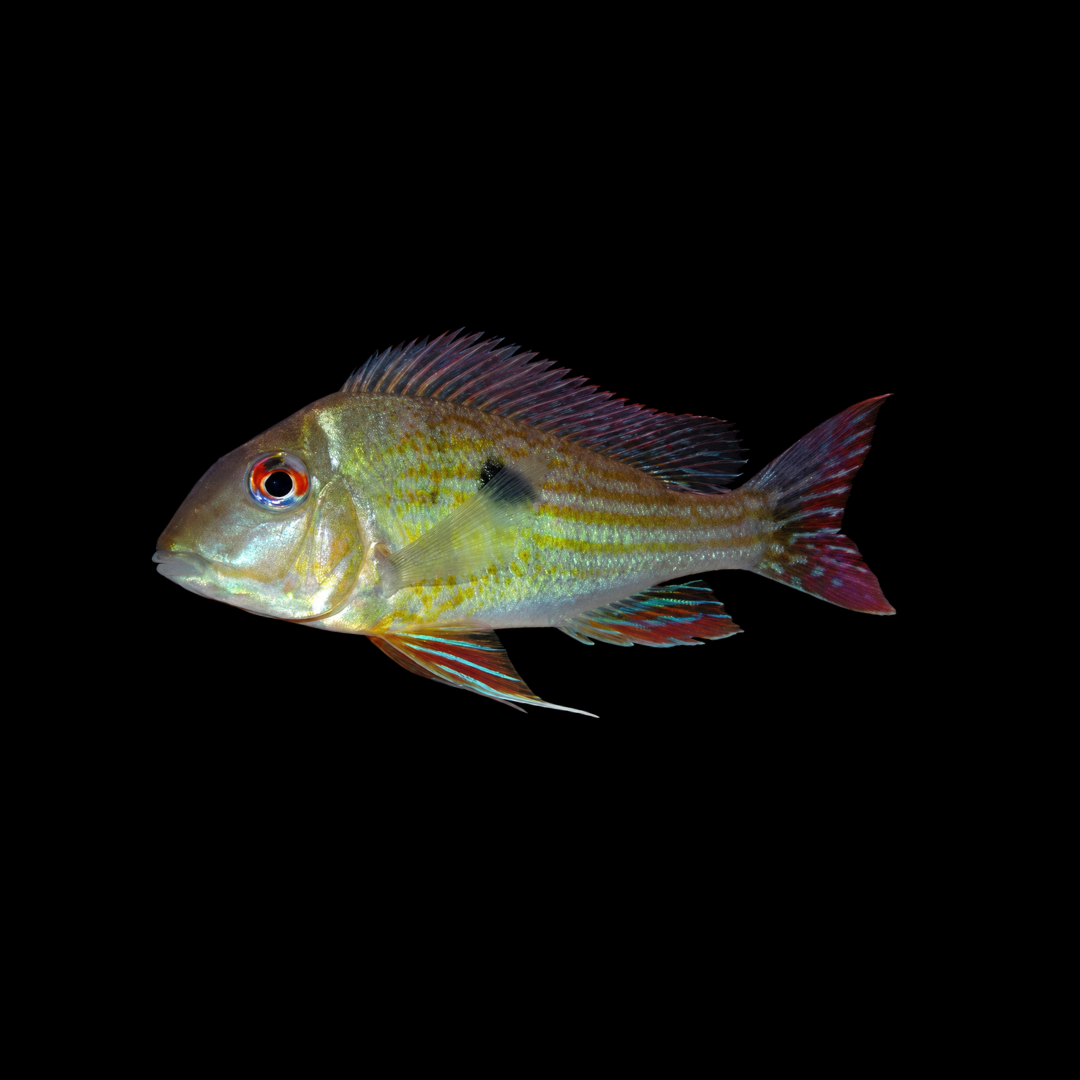
ゲオファーガス・アバリオスは、南米北部のオリノコ川水系を中心に、ベネズエラとコロンビアで記録されている中型のシクリッドです。底床の砂や泥を口に含み、口腔内で餌となる粒子を選り分けて不要な底質を吐き出す「アースイーター」らしい摂食行動を見せます。成魚は緑灰色を基調に虹色の青い模様を帯び、繁殖期には各ヒレや胸部の色彩も強まります。分類上は前鰓蓋骨の黒斑を欠くことが重要で、保存標本では体側に6本の縦帯があり、前方3本が中央付近で分断されて見えることなどが近縁種との識別点になります。飼育では、砂をふるい分ける行動を妨げない細かな底床と、十分な底面積、安定した清浄な水を用意することが基本です。 Geophagus abalios is a medium-sized cichlid recorded from northern South America, principally in the Orinoco system of Venezuela and Colombia. It is a characteristic “eartheater,” taking sediment into the mouth, sorting edible particles within the oral cavity, and expelling unwanted material. Adults have a greenish-gray ground color with iridescent blue markings, while breeding fish develop stronger coloration on the fins and chest. Taxonomically, the absence of a dark preopercular mark is important; in preserved specimens, six vertical flank bars are present, with the anterior three appearing medially divided, helping distinguish the species from close relatives. In captivity, fine substrate that permits normal sifting behavior, ample floor space, and consistently clean, stable water are the main priorities.
基本情報 / Basic Information
| 学名 / Scientific Name | Geophagus abalios |
|---|---|
| 通称 / Common Name | ゲオファーガス・アバリオス、アバリオス。古い資料や流通名では、外見の似た近縁種とともに「ゲオファーガス・サリナメンシス」などの名で扱われた経緯があります。Geophagus abalios, Abalios eartheater. In older literature and aquarium-trade usage, similar species were sometimes grouped under names such as “Geophagus surinamensis.” |
| 分類 / Family | シクリッド科(Cichlidae)ゲオファーガス亜科(Geophaginae)ゲオファーガス属(Geophagus)Family Cichlidae, subfamily Geophaginae, genus Geophagus |
| 英名 / English Name | Abalios Eartheater |
| 分布 / Distribution | 南米北部のベネズエラおよびコロンビア。オリノコ川水系とアマゾン川水系に記録があります。原記載では、ベネズエラのアプレ川、シナルコ川・カパナパロ川、アグアロ川・グアリキト川、カウラ川、ベンタウリ川、マバカ川、カシキアレ川などから報告されています。Northern South America in Venezuela and Colombia, with records from the Orinoco and Amazon river basins. The original description documented the species from Venezuelan drainages including the Apure, Cinaruco-Capanaparo, Aguaro-Guariquito, Caura, Ventuari, Mavaca, and Casiquiare systems. |
| 最大体長 / Max Size | 原記載に用いられた標本には標準体長192mmの個体が含まれています。全長では20cmを超えるサイズを見込んで飼育設備を選ぶのが安全です。The type series includes specimens up to 192 mm standard length. Aquarium planning should therefore allow for a fish exceeding 20 cm in total length. |
| 寿命 / Lifespan | 種固有の寿命を示す信頼できる具体的なデータは確認されていません。No reliable species-specific lifespan figure has been established. |
飼育環境 / Aquarium Environment
| 水槽サイズ / Tank Size | 終生飼育では120cm規格水槽相当(実水量200L前後以上)を下限の目安とし、複数飼育ではさらに広い底面積と水量を確保します。原記載の標本には標準体長192mmの個体が含まれ、底面を広く使って採餌するため、水槽の横幅と奥行きを重視します。For long-term care, a Japanese 120 cm standard-class aquarium, with roughly 200 L or more of usable water, is a practical minimum guideline; larger groups require substantially more floor area and water volume. The type series includes specimens up to 192 mm standard length, and the fish uses a broad area of substrate while feeding, so tank length and depth are important. |
|---|---|
| 水温 / Temperature | 26〜28℃を目安に安定させます。 Maintain a stable temperature of approximately 26–28°C. |
| 水質 / Water Quality | 弱酸性〜中性を中心に、急激な変化を避けた清浄な水を維持します。pH 5.5〜7.0は飼育上の目安です。アンモニアと亜硝酸は検出されない状態を保ち、硝酸塩もできるだけ低く維持します。自然下ではブラックウォーターだけでなくクリアウォーターや季節性のラグーンにも見られるため、強く着色したブラックウォーターの再現を必須条件と考える必要はありません。Maintain clean, stable water, generally in the slightly acidic to neutral range; pH 5.5–7.0 is a practical aquarium target. Ammonia and nitrite should remain undetectable, and nitrate should be kept as low as reasonably possible. In nature the species occurs not only in blackwater but also in clear-water and seasonal lagoon habitats, so strongly tinted blackwater is not a requirement for successful maintenance. |
| レイアウト / Layout | 底床には、角がなく口に含みやすい細砂を敷きます。沈木や丸みのある石で視線を遮る場所を作りつつ、砂を口に含んで選別できる広い開放部を残すのが基本です。底砂を掘り返すため、根を張る水草は抜かれやすくなります。水草を使う場合は、シダ類やアヌビアス類を流木や石に活着させる方法や、根元を保護して配置する方法が扱いやすいでしょう。Use fine, smooth sand that can be taken into the mouth without sharp edges. Driftwood and rounded rocks can provide visual barriers, while broad open areas should remain available for sediment sifting. Rooted plants may be disturbed as the fish works the substrate. If plants are used, ferns or Anubias attached to wood or rock, or plants with protected root zones, are generally easier to maintain. |
| 注意点 / Precautions | 粗く角張った砂利や大粒の底床は避け、長期飼育では砂を口に含んで吐き出す本来の摂食行動を行える環境を用意します。底砂の攪拌によって微細なゴミが舞いやすいため、物理ろ過を含めた十分なろ過能力を確保します。一方で、水流を必要以上に強くする必要はありません。複数飼育では個体間の追尾や順位争いを観察し、特定の個体が継続して追われる場合は、逃げ場や飼育スペースを見直します。Avoid coarse, angular gravel and provide a long-term setup in which the fish can perform its natural behavior of taking in and expelling sediment. Fine debris can become suspended as the substrate is worked, so adequate filtration with good mechanical capacity is useful, but excessively strong current is unnecessary. In groups, watch for persistent chasing or dominance pressure; if one fish is repeatedly targeted, reassess available space and visual refuges. |
餌と給餌 / Feeding
| 餌の種類 / Diet | 沈下性のシクリッド用人工飼料を主食にし、冷凍アカムシ、ブラインシュリンプなどを補助的に組み合わせます。食性研究では、底生性の餌が大きな割合を占める一方、デトリタスなど複数の餌資源も利用することが示されており、単一の餌だけに偏らせないことが大切です。Use sinking cichlid foods as the staple diet, supplemented with items such as frozen bloodworms and brine shrimp. Dietary research shows a substantial benthic component while also recording detrital and other food categories, so a varied diet is preferable to reliance on a single food type. |
|---|---|
| 給餌のポイント / Feeding Tips | 一度に大量に与えるのではなく、食べ切れる少量を複数回に分けて与えます。餌の一部が底床へ自然に落ちるようにすると、砂とともに口へ含んで選別する行動を引き出しやすくなります。底棲魚を混泳させる場合は餌場が重なるため、必要に応じて沈下性タブレットやスポイトなどを使い、すべての個体に餌が届いていることを確認します。Offer small portions that can be consumed promptly rather than a single large feeding. Allow some food to reach the substrate so the fish can express its natural sediment-sifting behavior. When bottom-dwelling tank mates are present, feeding zones overlap, so use sinking tablets or targeted delivery when necessary and confirm that all fish receive food. |
性格と混泳 / Temperament and Tank Mates
| 性格 / Temperament | アメリカンシクリッドの中では比較的穏やかな部類ですが、同種間には順位関係が生じ、繁殖期のペアは産卵場所の周囲で縄張り性を強めます。十分な遊泳空間と視線を遮る場所を設け、特定個体への追尾や攻撃が続かないか観察します。It is relatively calm for an American cichlid, but social hierarchies can develop among conspecifics and breeding pairs become more territorial around the spawning site. Provide ample swimming space and visual barriers, and watch for persistent chasing or aggression directed at a particular fish. |
|---|---|
| 混泳の相性 / Compatibility | 口に入らない大きさで、極端に攻撃的でない中層魚とは合わせやすい傾向があります。中型カラシンや比較的穏やかなシクリッドが候補になります。一方、コリドラスやクーリーローチなどの底棲魚とは餌場が重なりやすいため、混泳する場合は底棲魚にも十分な餌が届いているかを個別に確認します。It generally combines best with midwater fishes too large to swallow and not excessively aggressive, including suitable medium-sized characins and relatively peaceful cichlids. Bottom dwellers such as Corydoras and kuhli loaches share the feeding zone, so if they are kept together, make sure the bottom-dwelling fish are receiving adequate food. |
病気と対策 / Diseases and Prevention
| かかりやすい病気 / Common Diseases | 本種に特異的に多発する疾病は確認されていません。シクリッド類では、頭部や側線周辺に陥没性の病変が現れる頭部穴あき症状が知られているほか、水質悪化時には一般的なエラ障害や二次感染にも注意が必要です。頭部穴あき症状の原因は単一に確定されておらず、Spironucleusなどの鞭毛虫が病変から検出された報告はあるものの、栄養状態や飼育環境を含む複数の要因が検討されています。No disease has been established as uniquely common in this species. Cichlids can develop hole-in-the-head-type erosive lesions around the head and lateral-line region, while poor water conditions can also contribute to general gill problems and secondary infections. The cause of hole-in-the-head disease is not considered a single settled factor: flagellates such as Spironucleus have been isolated from lesions, but nutritional and environmental factors have also been investigated. |
|---|---|
| 対策と予防 / Prevention | 予防の基本は、安定した水質、十分なろ過、過密を避けた飼育、定期的な換水、偏りの少ない給餌です。異常が見られた場合は、まずアンモニア、亜硝酸、pH、水温などを確認し、水質に問題があれば適切な量を換水して環境を立て直します。薬浴が必要な場合は、症状だけで薬剤を決めつけず、原因をできるだけ絞ったうえで観賞魚用医薬品の用法を守って使用します。Prevention begins with stable water quality, adequate filtration, avoiding overcrowding, regular water changes, and a balanced diet. If abnormal signs appear, first check ammonia, nitrite, pH, temperature, and other basic conditions, and correct water-quality problems with an appropriate partial water change. If medication is necessary, avoid choosing a drug solely from a visible symptom; narrow down the likely cause as far as possible and follow the directions for approved aquarium medications. |
増やし方(繁殖) / Breeding
| 雌雄の判別 / Sexing | 原記載では雌雄は外見上ほぼ同形とされており、通常時の外部形態だけで確実に判別するのは困難です。繁殖期には生殖突起や実際の産卵行動を確認することが、判別の手掛かりになります。The original description notes that the sexes appear externally isomorphic, so reliable sexing from ordinary external appearance is difficult. During breeding, the genital papilla and observed spawning behavior can provide useful clues. |
|---|---|
| 繁殖形態 / Reproduction | 基質上に産卵した後、親が口内保育へ移行する両親型のマウスブリーダーです。口内へ取り込む段階については、卵を口に含むとする飼育記録と、孵化後の仔魚を口内保育するとする記述があり、開始時期を一つに限定するのは避けた方が適切です。飼育上は、基質への産卵とその後の口内保育を組み合わせる繁殖型として考えます。This species is a biparental mouthbrooder that begins with substrate spawning and then shifts to oral brood care. Accounts differ on whether the brood is taken into the mouth at the egg stage or after hatching, so the timing should not be stated more narrowly than the evidence allows. For husbandry purposes, the key point is that substrate spawning is followed by parental mouthbrooding. |
| 繁殖のポイント / Breeding Tips | 雌雄判別が難しいため、若魚を複数匹から育て、自然なペア形成を待つ方法が現実的です。良質な餌と安定した水質を保ち、平らな石や流木、細砂など産卵場所として利用できる面を用意します。産卵前後はペアの縄張り性が強くなるため、他魚が退避できる空間を確保します。口内保育が始まった後は、過度な捕獲や大きなレイアウト変更を避け、親魚が落ち着いて子育てできる環境を維持します。Because the sexes are difficult to distinguish, raising several juveniles and allowing a pair to form naturally is a practical approach. Maintain good nutrition and stable water quality, and provide usable spawning surfaces such as flat stones, driftwood, or areas of fine sand. Territorial behavior increases around spawning, so other fish need room to retreat. Once mouthbrooding begins, avoid unnecessary catching or major rearrangement so the parents can continue brood care with minimal disturbance. |
雑学と豆知識 / Trivia and Fun Facts
| 1. 「斑点がない」ことから生まれた種名 / 1. A Species Name Built Around the Absence of a Spot | 種小名の「abalios」は、ギリシャ語で「ない」を意味する「a」と、「斑点のある」を意味する「balios」に由来します。原記載では、前鰓蓋骨の黒い斑紋を欠くことにちなむ名前と明記されています。近縁種との識別で重要な特徴が、そのまま種名に刻まれているわけです。The specific name “abalios” derives from the Greek “a,” meaning not or without, and “balios,” meaning spotted. The original description explicitly links the name to the absence of a preopercular marking. One of the species’ key identification features is therefore preserved directly in its scientific name. |
|---|---|
| 2. 「サリナメンシス」と一括されてきた歴史 / 2. The Historical “Surinamensis” Catch-All | 南米北部のゲオファーガスには外見のよく似た種類が多く、古い標本や文献では複数の個体群が「G. surinamensis」や「G. altifrons」として扱われていました。2004年にアバリオス、ディクロゾスター、ウィネミレリが新種として記載されたことで、この地域のゲオファーガスを見分ける基準が整理されました。古い名称を見かけたときは、現在の種同定と必ずしも一致しない可能性を意識すると理解しやすくなります。Many northern South American Geophagus look very similar, and older collections and literature often referred to multiple populations as “G. surinamensis” or “G. altifrons.” The 2004 descriptions of G. abalios, G. dicrozoster, and G. winemilleri clarified diagnostic criteria for these fishes. As a result, older names do not always correspond directly to current species identifications. |
| 3. 6本のバーは保存標本で重要な識別点 / 3. Six Bars Are an Important Character in Preserved Specimens | 原記載では、頭部に黒い斑紋を持たないゲオファーガスの中で、保存標本に見られる6本の平行な縦帯がアバリオスを見分ける重要な手掛かりとされています。さらに前方3本は中央の色が薄く、1本の帯が上下に分かれたように見え、第6の帯は尾柄の背側半分に限られます。生体では体色やストレスで模様の見え方が変わるため、縞模様だけで断定せず、頭部斑や鱗列など複数の特徴を合わせて見ることが大切です。In the original description, six parallel vertical bars in preserved specimens are an important clue for distinguishing G. abalios from other Geophagus lacking dark head markings. The first three are interrupted by a paler central area, giving a divided appearance, while the sixth is restricted to the dorsal half of the caudal peduncle. In live fish, pattern intensity can vary with condition and stress, so identification should not rely on the bars alone; head markings, squamation, and other characters should be considered together. |
| 4. 「土を食べる魚」の本質は、底質を選別すること / 4. “Eartheater” Means Sorting Food From Sediment | ゲオファーガス属は、砂や泥ごと餌を取り込み、口腔内で食べられるものと底質を選別することに特化しています。アバリオスを含む底質ふるい分け型のゲオファーガス類には上鰓葉と呼ばれる特徴的な構造があり、底生食やマウスブリーディングとの関連が研究されています。ただし、この構造が実際にどのような役割を果たすかは完全には解明されていません。飼育下で細砂を用意する意味は、こうした自然な採餌行動を無理なく行える環境を作ることにあります。Geophagus are specialized for taking in sand or mud together with food and sorting edible material from sediment within the mouth. Sediment-sifting geophagines, including G. abalios, possess a distinctive epibranchial lobe that has been studied for its association with benthic feeding and mouthbrooding. Its precise functional role, however, has not been fully resolved. In aquaria, providing fine sand is therefore important because it allows the fish to perform its natural feeding behavior without obstruction. |
| 5. 生息地は雨季と乾季で大きく姿を変える / 5. Its Habitat Changes Dramatically With the Seasons | アバリオスが分布するオリノコのリャノ地域には、雨季と乾季が明瞭な氾濫原河川があります。水位は季節によって大きく変わり、砂州、河道、背水域、ラグーンなど利用できる環境そのものが入れ替わります。本種について季節ごとの移動経路まで詳しく分かっているわけではありませんが、一定の水景だけに依存する魚ではなく、季節変動の大きな河川環境の中で暮らす種類であることは、飼育下で「安定した水質」と「行動できる空間」の両方が重要である理由を理解する手掛かりになります。The Orinoco Llanos inhabited by G. abalios includes floodplain rivers with pronounced wet and dry seasons. Water levels change greatly through the year, altering the availability of sand banks, channels, backwaters, and lagoons. Detailed seasonal movement routes are not established for this species, but it clearly inhabits a river system characterized by major hydrological change. This helps explain why captive care should emphasize both stable water quality and enough physical space for normal behavior. |
| 6. 基質産卵と口内保育を組み合わせる / 6. Reproduction Combines Substrate Spawning and Mouthbrooding | 原記載では野外観察からアバリオスがマウスブリーダーであることが報告され、その後の飼育記録でも口内保育が確認されています。一方、親が口へ取り込む時期については卵段階と仔魚段階の両方の記述があるため、どちらか一方だけを本種の決まった型として断定するのは適切ではありません。重要なのは、基質に産卵した後も繁殖が終わらず、親が口内保育へ移行して子を守るという二段階の繁殖戦略を持つことです。The original species account reports mouthbrooding from field observations, and later aquarium records also document oral brood care. However, accounts differ on whether the parents take the brood into the mouth as eggs or after hatching, so one stage should not be presented as the only fixed pattern for the species. The consistent point is the two-stage reproductive strategy: spawning first occurs on a substrate, after which parental care continues through mouthbrooding. |
| 7. 近縁種との識別は一つの模様だけでは決まらない / 7. Identification Requires More Than One Visible Mark | アバリオスとディクロゾスターなどの近縁種は同じ地域に分布し、体形もよく似ています。原記載では、前鰓蓋骨斑の有無だけでなく、体側バー、鱗列、上顎歯列など複数の形質を組み合わせて区別しています。とくに幼魚や体色が薄い個体では、観賞魚として見える模様だけで確実に同定できない場合があります。名前だけを先に決めるのではなく、成長に伴って複数の特徴を見比べることが、本種を理解する近道です。G. abalios and close relatives such as G. dicrozoster occur in the same broad region and can look very similar. The original description distinguishes them using a combination of characters, including the presence or absence of a preopercular mark, flank bars, squamation, and upper-jaw dentition. Juveniles or pale, stressed fish may therefore be difficult to identify from aquarium-visible color pattern alone. Comparing several characters as the fish develops is more reliable than relying on a single mark or label. |
まとめ / Conclusion
ゲオファーガス・アバリオスは、虹色の青い模様を帯びた落ち着いた体色と、砂を口に含んで餌を選り分ける独特の行動を楽しめる中型シクリッドです。長期飼育では120cm規格水槽相当以上を目安に十分な底面積を確保し、角のない細砂、適切なろ過、安定した清浄な水を用意します。とくに底床は見た目のための装飾ではなく、本種の摂食行動を支える生活環境の一部として考えることが大切です。 Geophagus abalios is a medium-sized cichlid valued for its subdued coloration with iridescent blue markings and its distinctive habit of taking sediment into the mouth to sort out food. For long-term care, provide at least the space of a Japanese 120 cm standard-class aquarium as a practical guideline, together with generous floor area, smooth fine sand, adequate filtration, and consistently clean, stable water. The substrate is not merely decorative; it is part of the environment that supports the species’ normal feeding behavior.
十分なスペースの中で同種間の関係が落ち着き、ペアが形成されれば、基質への産卵から口内保育へと続く繁殖行動を観察できる可能性があります。普段は砂をふるいながら静かに餌を探し、繁殖期には親として子を守る姿を見せるという行動の幅広さが、アバリオスを長く観察するほど魅力の増す魚にしています。 When social relationships settle and a pair forms in a suitably spacious aquarium, the fish may display its reproductive sequence from substrate spawning to mouthbrooding. The contrast between its quiet everyday sediment-sifting and the parental care shown during breeding gives the species a behavioral depth that becomes more rewarding with long-term observation.

気になる道具や飼い方を見つけてみませんか?
 アイのアクアグッズ案内グッピー・プラティ・モーリーを親子で楽しむ飼育用品|水槽・稚魚保護・ろ過・餌・水草道具の特徴や使い方、選ぶときのポイントをアイが紹介します。記事はコチラ →
 アイのアクアグッズ案内水合わせの道具とやり方|魚を迎える前にそろえたい容器・点滴キット・ネット買ってきた魚はすぐ水槽に入れていい? 水温合わせと水合わせの違いから、透明ケース・点滴キット・ネットの選び方、時間をかけすぎない注意点まで、アイとコタロウが紹介します。記事はコチラ →
 アイのアクアグッズ案内プレコ飼育に必要なもの|餌・流木・ろ過・隠れ家・掃除用品道具の特徴や使い方、選ぶときのポイントをアイが紹介します。記事はコチラ →
 アイのアクアグッズ案内おとひめ物語|養殖生まれの餌を、わが家の魚に合う一粒へ道具の特徴や使い方、選ぶときのポイントをアイが紹介します。記事はコチラ →
さまざまな飼育テーマをご紹介。リンク先の記事には広告・商品紹介が含まれます。
案内・紹介記事一覧へ →分布マップ
Geophagus abalios は、南米北部のベネズエラおよびコロンビアに分布し、オリノコ川水系とアマゾン川水系から記録されています。以下の地図では、その分布地域を大まかに確認できる範囲を表示しています。
※この地図は、記事に記載されたベネズエラ・コロンビアおよびオリノコ川水系・アマゾン川水系の分布情報をもとにした概略表示です。マーカーは分布地域を把握しやすくするために設定した代表地点であり、実際の採集地点や個体の確認地点を示すものではありません。
参考文献
-
López-Fernández, H. & Taphorn, D. C. (2004)Geophagus abalios, G. dicrozoster and G. winemilleri (Perciformes: Cichlidae), three new species from Venezuela. Zootaxa, 439, 1–27.分類・原記載・形態的識別点・学名の背景・オリノコ川およびカシキアレ川水系の分布を支える主要文献。
-
Ximenes, A. M., Bittencourt, P. S., Machado, V. N., Hrbek, T. & Farias, I. P. (2021)Mapping the hidden diversity of the Geophagus sensu stricto species group (Cichlidae: Geophagini) from the Amazon basin. PeerJ, 9, e12443.ゲオファーガス属の分類学的背景、Geophagus sensu stricto とサリナメンシス種群をめぐる近年の系統・種多様性研究を支える文献。
-
López-Fernández, H., Honeycutt, R. L. & Winemiller, K. O. (2005)Molecular phylogeny and evidence for an adaptive radiation of geophagine cichlids from South America (Perciformes: Labroidei). Molecular Phylogenetics and Evolution, 34(1), 227–244.Geophaginaeの系統関係、適応放散、底生無脊椎動物を砂泥から選別する食性、繁殖様式の多様化に関する背景資料。
-
Layman, C. A. & Winemiller, K. O. (2005)Patterns of habitat segregation among large fishes in a Venezuelan floodplain river. Neotropical Ichthyology, 3(1), 103–109.本種の主要産地を含むベネズエラ・リャノのシナルコ川における、低pHのブラックウォーター、砂質環境、氾濫原河川の季節変動と生息環境を支える資料。
-
López-Fernández, H., Winemiller, K. O., Montaña, C. & Honeycutt, R. L. (2012)Diet-Morphology Correlations in the Radiation of South American Geophagine Cichlids (Perciformes: Cichlidae: Cichlinae). PLOS ONE, 7(4), e33997.上鰓葉、底生食、砂泥を口内で選別するウィノウィング、マウスブリーディングとの形態学的関連を支える資料。
-
López-Fernández, H., Arbour, J., Willis, S., Watkins, C., Honeycutt, R. L. & Winemiller, K. O. (2014)Morphology and Efficiency of a Specialized Foraging Behavior, Sediment Sifting, in Neotropical Cichlid Fishes. PLOS ONE, 9(3), e89832.砂中の底生餌を探索する行動、砂を取り込んで口腔・咽頭部で選別する機能形態を実験的に扱っており、細砂を用いる飼育環境の生物学的根拠となる資料。
-
Weidner, T. (2000)South American Eartheaters. Cichlid Press, El Paso, Texas. 336 pp. ISBN 0-9668255-1-9.ゲオファーガスを含む南米産アースイーター類の自然環境、飼育設備、給餌、社会行動、繁殖管理を体系的に扱う専門モノグラフ。
-
FishBaseGeophagus abalios López-Fernández & Taphorn, 2004.分類、淡水性・底中層性という生態区分、オリノコ川・カシキアレ川水系の分布、保全状況などを確認するための魚類学データベース。
-
Francis-Floyd, R., Yanong, R. P. E. & Petty, B. D. (MSD Veterinary Manual)Environmental Diseases of Aquatic Animals in Aquatic Systems.アンモニア、亜硝酸、硝酸塩、pH、温度などの水質管理と、劣悪な水質が魚の疾病リスクを高めることを支える獣医学資料。
-
Paull, G. C. & Matthews, R. A. (2001); Amesberger-Freitag, A., Tichy, A., El-Matbouli, M. & Lewisch, E. (2019)Spironucleus vortens, a possible cause of hole-in-the-head disease in cichlids. Diseases of Aquatic Organisms, 45(3), 197–202. / Hole-in-the-head disease in discus fish, Symphysodon (Heckel, 1840): Is it a consequence of a dietary Ca/P imbalance? Journal of Fish Diseases, 42(8), 1133–1142.シクリッド類の頭部穴あき症状とSpironucleusの関連、および病因が単一要因として確定していないことを扱う疾病研究。





コメント