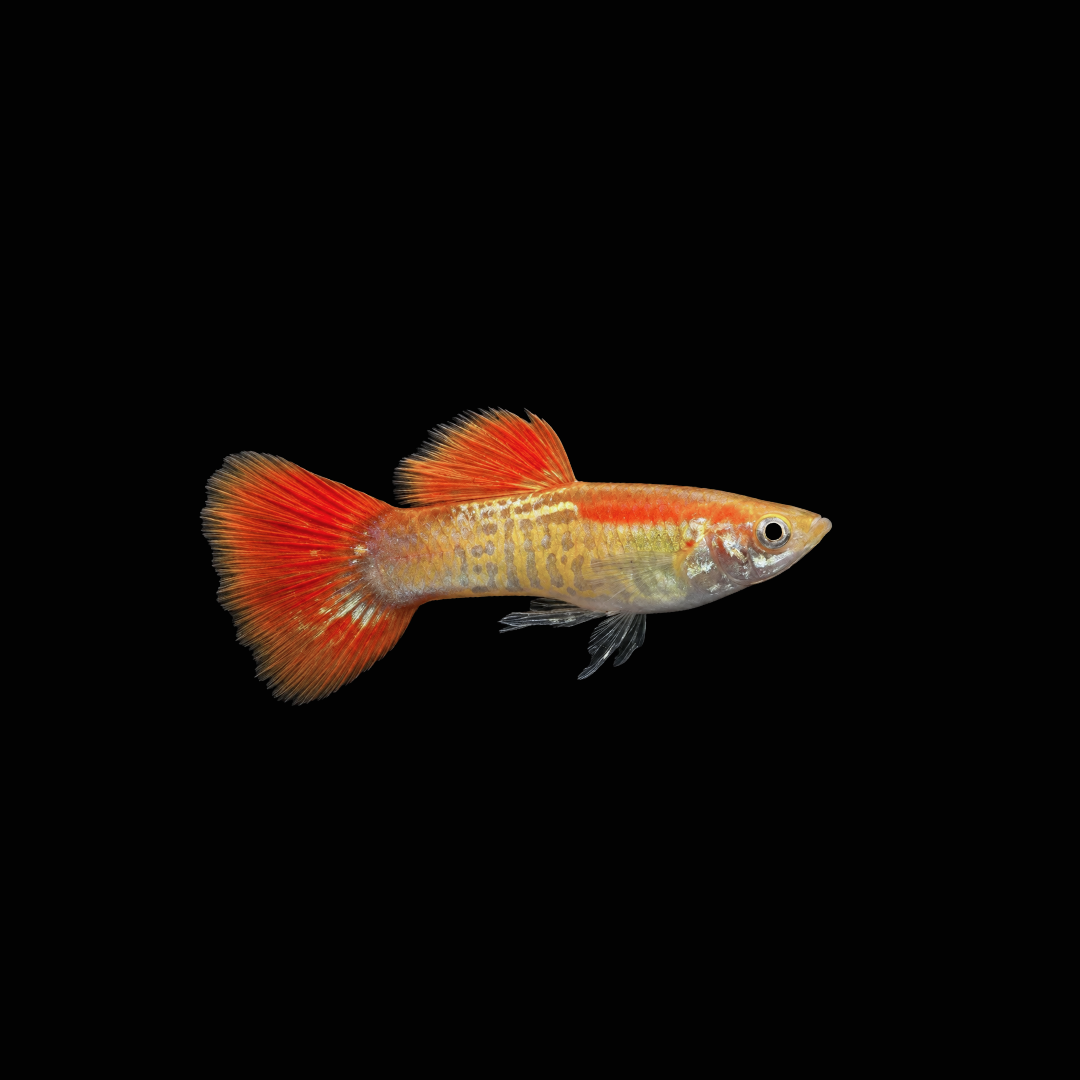
ブロンズコブラグッピーは、赤系の尾ビレを持つレッドキングコブラを、ブロンド遺伝子(bb)によってゴールデン体色にした改良品種です。ブロンド遺伝子は常染色体上の劣性遺伝子で、両親の双方から受け継いだ場合にだけ体色に表れます。英名は「Blonde Cobra guppy(ブロンドコブラグッピー)」で、この「ブロンド」が日本で呼び名として定着する過程で「ブロンズ」に変わったと考えられています。ノーマル体色のコブラは黒色素が濃く重厚な印象ですが、本品種は黄色味を帯びた明るい地色のおかげで、体側の繊細な網目模様と赤い発色がくっきりと浮かび上がります。とくに肩口(体側の前方)に赤みが強く乗る個体は、観賞価値が高いとされています。日本では主にシンガポールやスリランカなど東南・南アジアの養殖場からオスだけが輸入される形で流通しており、国産ペアの安定した供給は限られています。そのため長く楽しむには、海外の養殖場との水質の違いへの配慮や、国産グッピーとの隔離といった、外国産グッピーならではの心構えが大切です。The Bronze Cobra Guppy is a domestic strain created by giving the Red King Cobra, which has a red-based tail, a golden body color through the blond gene (bb). The blond gene is a recessive gene on an autosome, so it shows in body color only when inherited from both parents. Its English name is “Blonde Cobra guppy,” and it is thought that “blonde” turned into “bronze” as the name took hold in Japan. Normal-bodied cobras have dense black pigment and look heavy, but in this strain the bright, yellowish base color makes the delicate reticulated pattern on the flanks and the red coloration stand out clearly. Individuals with strong red on the shoulder area (the front of the flank) are considered especially attractive. In Japan, the fish are mainly imported as males only from farms in Southeast and South Asia, such as Singapore and Sri Lanka, and a stable supply of domestically bred pairs is limited. To enjoy them for a long time, it is important to keep in mind issues specific to imported guppies, such as differences in water chemistry from the farms and separation from domestically bred guppies.
カダヤシ目 カダヤシ科 ポエキリア属Order Cyprinodontiformes, Family Poeciliidae, Genus Poecilia
英名 / English Name
Blonde Cobra Guppy
分布 / Distribution
改良品種のため自然分布はない。原種は南米北部(ベネズエラ、トリニダード・トバゴなど)が原産。流通している個体は、主にシンガポールやスリランカなどの養殖場で生産されているAs a domestic strain, it has no natural range. The wild species is native to northern South America (Venezuela, Trinidad and Tobago, etc.). Traded individuals are mainly produced on farms in Singapore, Sri Lanka, and elsewhere.
最大体長 / Max Size
オスで全長約4cm前後。メスはオスよりひと回り大きく育つMales reach about 4 cm in total length. Females grow somewhat larger than males.
寿命 / Lifespan
一般に1〜2年程度。環境がよければ2年以上生きることもあるGenerally about 1 to 2 years. Under good conditions they may live longer than 2 years.
飼育環境 / Aquarium Environment
水槽サイズ / Tank Size
数匹を観賞するだけなら30cm規格水槽(約20L)から飼育できる。水質が安定しやすく、繁殖や群泳も楽しめる45cm規格水槽(約35L)〜60cm規格水槽(約57L)がおすすめ。新しく迎えた個体のトリートメント用に、小型の隔離水槽を別に用意しておくと安心A few fish for display can be kept in a 30 cm standard tank (about 20 L). A 45 cm standard tank (about 35 L) to a 60 cm standard tank (about 57 L) is recommended, as water quality is more stable and breeding and group display are easier. It is also wise to prepare a separate small quarantine tank for newly acquired fish.
水温 / Temperature
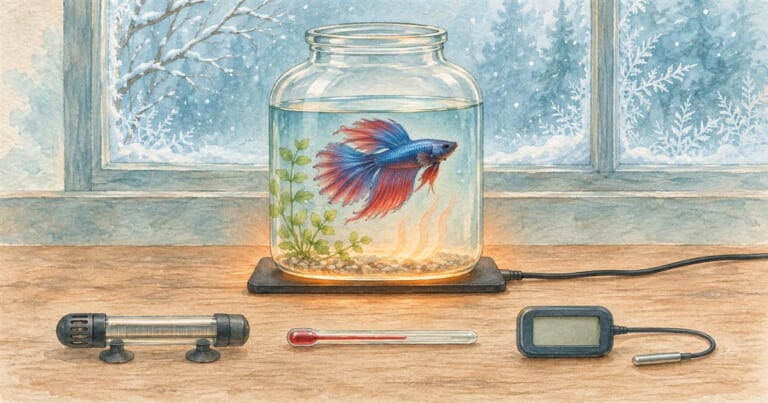
25〜26℃が最適で、許容範囲は23〜28℃程度。冬は20℃を下回ると免疫力が落ちやすいため、ヒーターが欠かせない。夏に30℃を超えると酸欠や水質悪化が一気に進むため、冷却ファンや水槽用クーラーで水温を下げる25 to 26°C is ideal, with an acceptable range of about 23 to 28°C. A heater is essential in winter, as immunity tends to drop below 20°C. In summer, temperatures above 30°C quickly lead to oxygen shortage and deteriorating water quality, so lower the temperature with a cooling fan or aquarium chiller.
水質 / Water Quality
pH7.0〜7.5の中性〜弱アルカリ性、総硬度(GH)10〜20程度が目安。アンモニアと亜硝酸塩は検出されない状態を保ち、硝酸塩もできるだけ低く抑える。日本の水道水の大半は軟水だが、海外の養殖場では硬度やpHの高い水で育てられることが多いとされる。そのため輸入直後の個体は、軟水や酸性に傾いた水に入れるとヒレを傷めやすい。カルシウムやマグネシウムなどのミネラル分を適度に補い、定期的な換水で水が酸性に傾かないようにすることが大切Aim for neutral to slightly alkaline water at pH 7.0 to 7.5 with a general hardness (GH) of around 10 to 20. Keep ammonia and nitrite undetectable and nitrate as low as possible. Most Japanese tap water is soft, whereas overseas farms are said to raise fish in harder, higher-pH water in many cases. As a result, newly imported fish tend to suffer fin damage when placed in soft or acidic water. Supplement minerals such as calcium and magnesium in moderation, and use regular water changes to keep the water from becoming acidic.
レイアウト / Layout
オスは大きく広がる尾ビレを持つため、強い水流の中では体力を消耗してしまう。スポンジフィルターや吐出口の勢いを弱めたフィルターで穏やかな流れを作り、水草を適度に植えて休み場所や稚魚の隠れ家を用意する。自然光に近いスペクトルの照明を使うと、模様の光沢や赤・黄の発色が引き立ちやすい。驚いたときの飛び出しを防ぐため、フタは隙間なく設置するMales have large, spreading tails and tire quickly in strong currents. Create a gentle flow with a sponge filter or a filter with a softened outlet, and plant moderate amounts of aquatic plants to provide resting spots and hiding places for fry. Lighting with a spectrum close to natural light tends to bring out the sheen of the pattern and the red and yellow colors. Fit a lid with no gaps to prevent fish from jumping out when startled.
注意点 / Precautions
「グッピーは丈夫」という通説は、日本の水に慣れた国産系統には当てはまるものの、輸入直後の外国産個体には必ずしも当てはまらない。外国産個体は、病原体を持ちながら発症していない可能性があるとされる。そのため、国産グッピーや別の入手先のグッピー、プラティやモーリーなどとの混泳や器具の共用は避けることが推奨される。また、グッピーは環境省の生態系被害防止外来種リストに掲載されている。飼育や販売は認められているが、野外への放流は絶対に行わず、最後まで責任を持って飼育することが求められるThe common belief that guppies are hardy applies to domestic strains accustomed to Japanese water, but not necessarily to newly imported fish. Imported fish are said to possibly carry pathogens without showing symptoms. For this reason, it is recommended not to house them with or share equipment with domestic guppies, guppies from other sources, or platies and mollies. In addition, the guppy is on the Japanese Ministry of the Environment’s list of invasive alien species that may damage ecosystems. Keeping and selling them is permitted, but they must never be released into the wild, and owners are expected to care for them responsibly for their entire lives.
餌と給餌 / Feeding
餌の種類 / Diet
雑食性。グッピー用の粒の細かい人工飼料やフレークを主食にする。スピルリナ配合のフードや色揚げ成分入りの餌を取り入れると、黄金色や赤みの発色を保ちやすい。補助としてブラインシュリンプ、ミジンコ、アカムシなどの冷凍餌や生き餌を交代で与えるOmnivorous. Use fine-grained guppy pellets or flakes as the staple. Adding spirulina-based or color-enhancing foods helps maintain golden and red coloration. Supplement with frozen or live foods such as brine shrimp, daphnia, and bloodworms on a rotating basis.
給餌のポイント / Feeding Tips
胃が小さく代謝が高いため、1日2回を目安に、数分で食べ切れる量をこまめに与える。同じ餌ばかりが続くと、赤や黄色のもとになるカロテノイドが不足して色が褪せやすい。複数の餌を組み合わせることは、発色と健康維持の両面で効果的とされる。食べ残しは水質悪化の原因になるため、与えすぎには注意するBecause they have small stomachs and high metabolism, feed about twice a day in amounts they can finish within a few minutes. A monotonous diet can lead to a shortage of carotenoids, the pigments behind red and yellow, causing colors to fade. Combining several foods is considered effective for both coloration and health. Avoid overfeeding, as leftovers degrade water quality.
性格と混泳 / Temperament and Tank Mates
性格 / Temperament
温和で活発。オスはメスを追いかけて盛んに求愛する。大きな尾ビレを持つオスはゆったりと泳ぐため、ヒレをつつかれるとストレスを受けやすいPeaceful and active. Males actively chase and court females. Males with large tails swim slowly and are easily stressed if their fins are nipped.
混泳の相性 / Compatibility
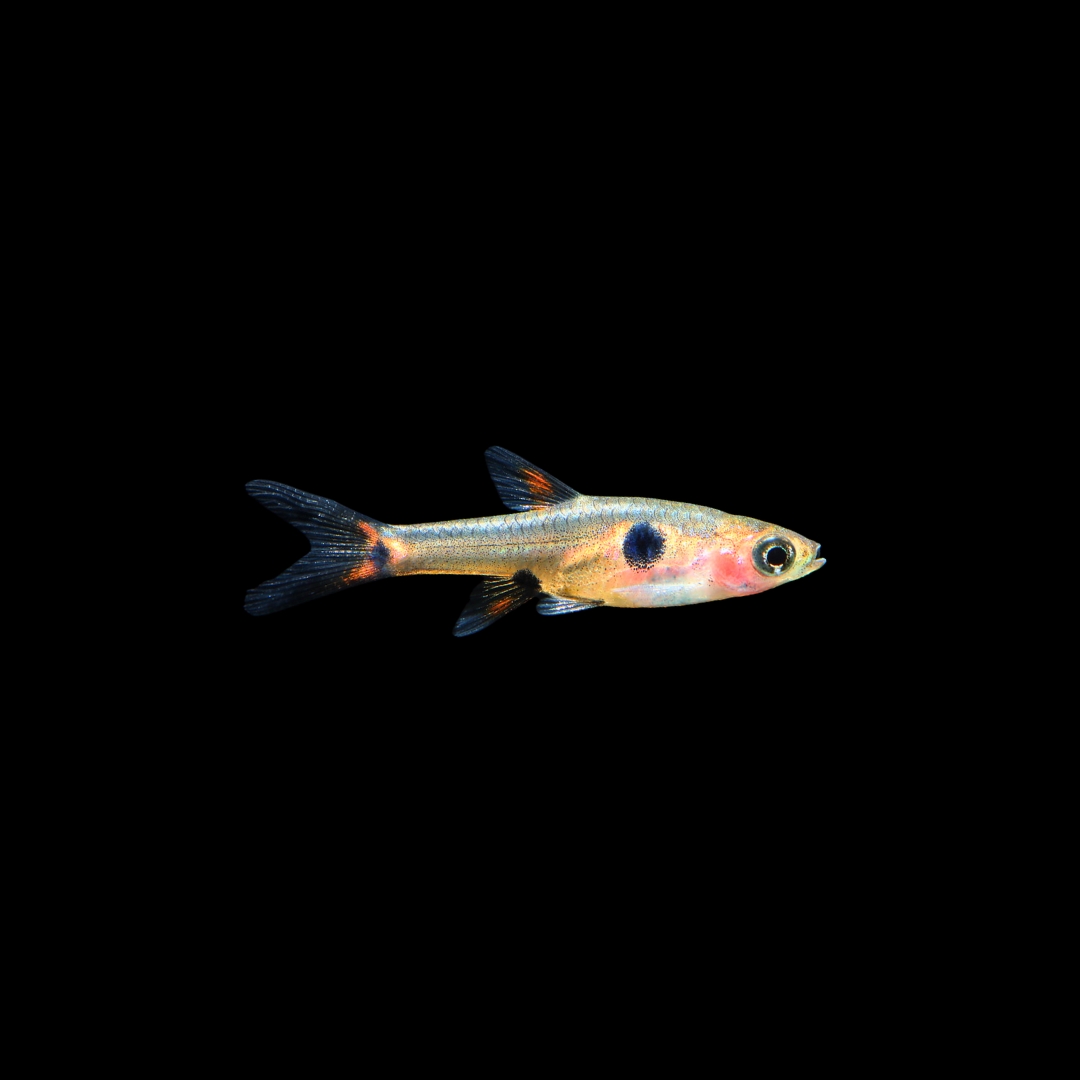
性格の面では、ネオンテトラなどの小型カラシン、ラスボラ類、コリドラス、ミナミヌマエビといった温和な小型種と混泳させやすい。一方、スマトラのようにヒレをかじる魚や、口に入る大きさの魚を食べてしまう中〜大型魚との混泳は避ける。病気の観点からは、外国産個体を国産グッピーや他の卵胎生メダカと分けて飼育することが推奨されるIn terms of temperament, they can be kept easily with peaceful small species such as small tetras like neon tetras, rasboras, Corydoras, and cherry shrimp. Avoid fin-nipping fish such as tiger barbs and medium to large fish that eat anything small enough to fit in their mouths. From a disease standpoint, it is recommended to keep imported individuals separately from domestic guppies and other livebearers.
病気と対策 / Diseases and Prevention
かかりやすい病気 / Common Diseases
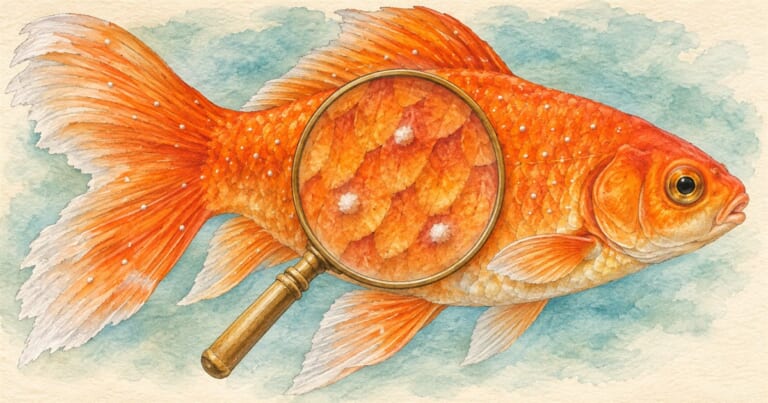
ヒレの縁が白く濁って溶けていく尾ぐされ病(カラムナリス菌)、白点病、エロモナス菌による穴あき病・松かさ病・腹水病など。いわゆる「グッピーエイズ」は1990年代に国内で流行した致死率の高い病気で、細菌性感染症の一種といわれている。稚魚期には、水質悪化や栄養不足から尾ビレをたたんで針のように細くなる「ハリ病」も起こりやすいFin rot (Columnaris), in which fin edges turn cloudy white and gradually dissolve; white spot disease; and Aeromonas infections such as ulcer disease, pinecone disease (dropsy), and abdominal swelling. The so-called “guppy AIDS,” a highly lethal disease that spread in Japan in the 1990s, is said to be a type of bacterial infection. Fry are also prone to “needle disease,” in which they fold their tails and become needle-thin due to poor water quality or malnutrition.
対策と予防 / Prevention
新しく迎えた個体は本水槽に直接入れず、最低1週間は隔離水槽で様子を見る。水温合わせと水合わせを済ませたら魚だけを網ですくって移し、輸送袋の水は水槽に入れない。隔離中は、水1Lあたり食塩3〜5gを溶かした0.3〜0.5%の塩水浴でストレスを和らげる。尾ぐされ病やエロモナス症の初期には、グリーンFゴールドや観賞魚用パラザンDなどの魚病薬と塩水浴を併用する。白点病には、水温を28〜30℃まで段階的に上げたうえで、マラカイトグリーン系の薬剤を使う。松かさ病や腹水病は進行すると治療がきわめて難しいため、過密を避け、定期的な換水で水質を安定させる日々の管理が何よりの予防になるDo not place new fish directly into the main tank; observe them in a quarantine tank for at least one week. After matching temperature and acclimating them to the water, transfer only the fish with a net and never add the shipping bag water to the tank. During quarantine, a 0.3 to 0.5% salt bath (3 to 5 g of salt per liter) helps relieve stress. For early fin rot or Aeromonas infections, combine fish medications such as nifurstyrenate- or oxolinic acid-based treatments with a salt bath. For white spot, gradually raise the temperature to 28 to 30°C and then use a malachite green-based medication. Pinecone disease and abdominal swelling are extremely difficult to treat once advanced, so daily care that avoids overcrowding and keeps water quality stable through regular water changes is the best prevention.
増やし方(繁殖) / Breeding
雌雄の判別 / Sexing
オスは体が小さく、大きく広がる尾ビレと鮮やかなコブラ模様を持ち、尻ビレが交接器(ゴノポジウム)に変化している。メスは体が大きく、色彩は控えめで、腹部に妊娠斑が見られる。コブラ模様は主にオスに現れるため、メスには明瞭な網目模様が出ないのが普通。生後1〜2ヶ月ほどで見分けられるようになるMales are smaller, with large spreading tails and vivid cobra patterns, and their anal fin is modified into a copulatory organ (gonopodium). Females are larger, more subdued in color, and show a gravid spot on the abdomen. Because the cobra pattern appears mainly in males, females usually lack a distinct reticulated pattern. The sexes can be told apart at about 1 to 2 months of age.
繁殖形態 / Reproduction
卵胎生。メスは体内で卵をふ化させ、稚魚の姿で産む。一度の交尾で精子を体内に蓄えられるため、オスがいなくても続けて何度か出産できる。オスの体色は生まれてすぐに完成するわけではなく、交接器ができ始める生後54日頃から段階的に現れ、約4ヶ月で成魚の色彩がそろうという研究報告があるLivebearing. Females hatch eggs inside their bodies and give birth to free-swimming fry. Because a single mating allows sperm to be stored internally, females can give birth several times in succession even without a male present. Male coloration is not complete at birth; research reports that it appears in stages from about day 54, when the gonopodium begins to form, and reaches adult coloration at about 4 months.
繁殖のポイント / Breeding Tips
体色はブロンド遺伝子(bb)が、コブラ模様は主にY染色体上の遺伝子が担っている。つまり体色は両親から、模様は主に父親から息子へと受け継がれる。オスだけを入手して系統を作る場合、ゴールデン体色(bb)の処女メスと交配すれば、最初の世代から体色がそろう。ノーマル体色のメスと交配すると、子はすべてノーマル体色に戻るが、ブロンド遺伝子を1つずつ隠し持っている(Bb)。その娘を処女のうちに元のオスと交配すれば、次の世代の約半数がゴールデン体色になる。理想の姿が安定するまでには一般に3〜5世代の選別が必要とされる。また、劣性の体色を持つ系統は近親交配を続けると体が弱くなりやすいため、数世代おきに丈夫な個体の血を入れる工夫も有効とされる。稚魚には、ふ化したてのブラインシュリンプや稚魚用のパウダーフードを1日3〜5回に分けて少しずつ与える。雌雄が見分けられるようになったら早めにオスとメスを分け、意図しない交配を防いで処女メスを確保するBody color is governed by the blond gene (bb), and the cobra pattern mainly by genes on the Y chromosome. In other words, body color comes from both parents, while the pattern passes mainly from father to son. When building a line from a male alone, mating him with a virgin golden (bb) female produces uniformly colored offspring from the first generation. Mating with a normal-colored female produces offspring that all look normal but each carry one hidden copy of the blond gene (Bb). If those daughters are mated back to the original male while still virgins, about half of the next generation will be golden. Stabilizing the ideal appearance is generally said to take 3 to 5 generations of selection. Also, because strains with recessive colors tend to weaken with continued inbreeding, introducing vigorous fish every few generations is considered effective. Feed fry newly hatched brine shrimp or fry powder in small amounts 3 to 5 times a day. As soon as the sexes can be told apart, separate males and females to prevent unplanned matings and secure virgin females.
雑学と豆知識 / Trivia and Fun Facts
1. 「ブロンズ」という名前のねじれ / 1. The Tangled Meaning of “Bronze”
海外の資料を読むとき、まず戸惑いやすいのが名前の問題です。日本で「ブロンズコブラ」と呼ばれる魚は、遺伝学的にはブロンド遺伝子(bb)を持つ、日本でいう「ゴールデン」体色の品種です。ところが米国の国際ファンシーグッピー協会(IFGA)のコンテストで「Bronze(ブロンズ)」といえば、日本で「タイガー」と呼ばれる別の劣性遺伝子(gg)による体色を指します。欧州や台湾でも呼び方はそれぞれ異なり、同じ言葉がまったく別の遺伝子を指すことがあるのです。1944年のGoodrichらによる顕微鏡観察を紹介した解説によれば、ブロンド(bb)では黒色素をつくる細胞(黒色素胞)の数は野生型とほとんど変わらず、一つひとつの細胞が小さくなっているだけだとされます。つまり黒い色の土台そのものは残っているため、黒色素を骨組みとするコブラ模様が消えることなく、明るい地色の上に繊細なコントラストを描けるのです。一方のタイガー(gg)では、鱗の中央から黒色素胞が抜けて縁に偏るため、日本では尾ビレの柄が乱れやすいと評価され、流通も多くありません。名前の由来ひとつをたどるだけでも、色を生み出す細胞の物語が見えてきます。When reading overseas sources, the first thing likely to cause confusion is the name. The fish called “Bronze Cobra” in Japan is genetically a blond (bb) strain, the body color known in Japan as “golden.” In the contests of the International Fancy Guppy Association (IFGA) in the United States, however, “Bronze” refers to the body color produced by a different recessive gene (gg), which in Japan is called “Tiger.” Naming also differs in Europe and Taiwan, so the same word can point to entirely different genes. According to explanations of the 1944 microscopic study by Goodrich and colleagues, blond (bb) fish have nearly the same number of pigment cells that produce black (melanophores) as wild-type fish, but each cell is smaller. In other words, because the foundation of black color remains, the melanin-based cobra pattern does not disappear and can draw a delicate contrast over the bright base color. In Tiger (gg), by contrast, melanophores disappear from the center of each scale and gather at the edges, which in Japan is considered to disrupt tail patterns, so these fish are rarely traded. Tracing the origin of a single name reveals a story about the cells that create color.
2. コブラ、スネークスキン、レースの関係 / 2. Cobra, Snakeskin, and Lace
体側を覆う網目や波線の模様は、地域や文脈によって「スネークスキン」「コブラ」「キングコブラ」「レース」「フィリグラン」などさまざまな名前で呼ばれています。遺伝学的には、スネークスキンとコブラは本質的に同じヘビ皮のような模様の仲間と考えられていますが、愛好家のあいだでは模様の細かさで呼び分ける傾向があります。網目がきわめて細かく密に絡み合うものを「レース」、鎖状の模様がやや大きく力強いものを「コブラ」と呼び、体側に黒い眼状の斑点を伴うタイプには「キングコブラ」の名が当てられることもあります。この模様は、主にY染色体上で隣り合う2つの優性遺伝子、体の模様を担うSsbと尾ビレの模様を担うSstによって表れるとされます。Y染色体はオスだけが持つため、模様は原則として父から息子へと受け継がれます。ただし交配実験では、X染色体とY染色体のあいだで遺伝子の一部が入れ替わり、これらの遺伝子がX染色体に移った例も確認されています。ブロンズコブラの姿は、体色の遺伝子と模様の遺伝子が重なり合って生まれる、いわば遺伝の重ね塗りによる作品なのです。The reticulated, wavy patterns covering the flanks go by many names depending on region and context, including “snakeskin,” “cobra,” “king cobra,” “lace,” and “filigran.” Genetically, snakeskin and cobra are thought to be essentially the same kind of snake-skin-like pattern, but hobbyists tend to distinguish them by how fine the pattern is. Very fine, densely interwoven patterns are called “lace,” somewhat larger and bolder chain-like patterns are called “cobra,” and types with black eye-like spots on the flank are sometimes called “king cobra.” The pattern is thought to be expressed mainly by two neighboring dominant genes on the Y chromosome: Ssb for the body pattern and Sst for the tail pattern. Because only males have a Y chromosome, the pattern in principle passes from father to son. However, breeding experiments have confirmed cases in which part of the genetic material was exchanged between the X and Y chromosomes, moving these genes onto the X chromosome. The appearance of the Bronze Cobra is, so to speak, a work created by layering color genes and pattern genes on top of each other.
3. 学名に刻まれた「網目」 / 3. The “Net” Written into the Scientific Name
グッピーの野生種は、1858年頃にベネズエラのカラカス近郊を流れるグアイレ川で採集された標本をもとに、1859年にドイツの動物学者ヴィルヘルム・ペータースによって Poecilia reticulata として記載されました。属名 Poecilia はギリシャ語で「まだら模様の」、種小名 reticulata はラテン語で「網目状の」という意味です。ブロンズコブラが誇る繊細な網目模様は、この魚が名付けられたときから備えていた特徴を、人の手で磨き上げた姿ともいえます。その後1866年、トリニダードに住んでいた英国の博物学者ロバート・ジョン・レッチミア・グッピーが大英博物館へ標本を送り、アルベルト・ギュンターが彼の名にちなんで Girardinus guppii と命名しました。ペータースの記載が先にあったため、この学名は無効になりましたが、「グッピー」という呼び名は世界共通の愛称として残りました。The wild guppy was described as Poecilia reticulata in 1859 by the German zoologist Wilhelm Peters, based on specimens collected around 1858 from the Guaire River near Caracas, Venezuela. The genus name Poecilia means “mottled” in Greek, and the species name reticulata means “net-like” in Latin. The delicate reticulated pattern of the Bronze Cobra can be seen as a trait the fish had from the moment it was named, refined by human hands. Later, in 1866, the British naturalist Robert John Lechmere Guppy, who lived in Trinidad, sent specimens to the British Museum, and Albert Günther named them Girardinus guppii in his honor. Because Peters’ description came first, this name became invalid, but “guppy” remained as a common name used around the world.
4. 日本への伝来とコブラ系統の歩み / 4. Arrival in Japan and the History of Cobra Strains
グッピーが日本に伝わったのは1920年(大正9年)頃とされ、1930年頃に三越日本橋本店や銀座千疋屋に並べられたことをきっかけに、広く知られるようになったといわれています。網目模様は野生の個体群にも古くから見られる特徴で、近縁のエンドラーズにも現れますが、観賞魚として本格的に注目されたのは1950年代に入ってからでした。1959年には、研究者M. ツヴィロによってスネークスキン模様の遺伝の仕組みが調べられています。キングコブラの原型はドイツにあったともいわれ、1965年にアメリカで発表されたのち、1968年に日本へ初めて輸入されたと伝えられています。それから半世紀以上、コブラ系統はブルーグラスやドイツイエロータキシードと並ぶ定番として、レッド、グリーン、ゴールデン、そしてブロンズコブラといった多彩なバリエーションを生み出してきました。Guppies are thought to have reached Japan around 1920 and are said to have become widely known after being displayed around 1930 at the Mitsukoshi Nihonbashi department store and Ginza Sembikiya. The reticulated pattern is a long-standing trait in wild populations and also appears in the closely related Endler’s livebearer, but it did not attract serious attention in the aquarium hobby until the 1950s. In 1959, researcher M. Dzwillo studied how the snakeskin pattern is inherited. The King Cobra is said to have originated in Germany, been introduced in the United States in 1965, and first imported into Japan in 1968. For more than half a century since, cobra strains have stood alongside Blue Grass and German Yellow Tuxedo as classics, producing diverse variations including red, green, golden, and Bronze Cobra.
5. 日米欧で異なる審査の美学 / 5. Different Judging Aesthetics in Japan, the US, and Europe
グッピーの品種改良は、各地の愛好団体が定めたコンテストの基準によって方向づけられてきました。日本グッピー協会(JGA)には、同じ品種のオス3匹とメス1匹をそろえて出品するブリーダーズ部門があります。偶然きれいに育った1匹ではなく、系統として同じ姿を安定して生み出せるかどうかが問われる仕組みです。また、維持の難しい品種に難易度を加味する考え方は、定番品種に偏らず、ブロンズコブラのような多彩な品種が日本で発展する原動力になってきたと考えられています。米国のIFGAは体色や柄ごとの細かな部門が充実しており、スネークスキンの部門では体表の大部分が標準的な模様で覆われていることが求められるとされます。欧州のIKGHは尾ビレの標準形を厳密に定め、体長に対するヒレの比率や最低体長まで細かく規定しています。同じ魚を前にしても、評価のまなざしは国ごとに少しずつ異なるのです。Guppy breeding has been shaped by the contest standards of hobbyist organizations in each region. The Japan Guppy Association (JGA) has a breeders’ class in which three males and one female of the same strain are entered together. Rather than rewarding a single fish that happened to grow beautifully, it tests whether the strain can reliably produce the same appearance. The idea of giving extra credit to strains that are hard to maintain is also thought to have helped diverse strains like the Bronze Cobra develop in Japan, rather than leaving breeders focused only on popular ones. The American IFGA offers finely divided classes by color and pattern, and its snakeskin class is said to require that most of the body be covered by a standard pattern. The European IKGH strictly defines standard tail shapes and specifies fin-to-body ratios and minimum body lengths in detail. Even looking at the same fish, the eye of evaluation differs slightly from country to country.
6. 背景色で変わる体色 / 6. Body Color That Changes with the Background
グッピーには、水槽の背景の色に合わせて体色の濃さを変える性質があります。黒や濃紺など暗い背景を使うと色のコントラストが際立って見えますが、体色を変えること自体が魚にとってエネルギーを使う行為だとも考えられています。透明な水槽で育てたほうが、色付きの水槽で育てた場合よりも成長がよく、体内のカロテノイドも多かったとする研究報告もあります。つまり、若いうちは明るい環境で成長と色素の蓄えを優先し、成魚になってから観賞や撮影のときに暗い背景へ切り替えるという方法は、こうした知見に沿った理にかなったやり方といえそうです。Guppies can change the intensity of their body color to match the color of the tank background. A dark black or navy background makes color contrast stand out, but changing body color is also thought to cost the fish energy. One study reported that fish raised in clear tanks grew better and had more carotenoids in their bodies than those raised in colored tanks. In other words, prioritizing growth and pigment storage in a bright environment while the fish are young, then switching to a dark background for viewing or photography once they mature, appears to be a reasonable approach in line with these findings.
7. 虹目高と百万魚、そして不思議な染色体 / 7. Rainbow Fish, Million Fish, and Curious Chromosomes
グッピーは、その多彩な色から英語圏で「Rainbow fish」、次々と稚魚を産む繁殖力から「Million fish(ドイツ語でMillionenfisch)」と呼ばれてきました。これを訳したものが、日本の古い別名「ニジメダカ(虹目高)」と「百万魚」です。遺伝学の世界でも、グッピーは1920年代から重要な研究対象であり続けています。人間と同じく23対の染色体を持ちますが、哺乳類と大きく違うのは、YYという組み合わせを持つオスが生きて繁殖でき、そのYYオスとメスのあいだに生まれる子がすべてオスになるという点です。近年の欧州の研究では、グッピーのY染色体は比較的新しく進化したものと考えられており、オスの派手な色彩の遺伝子がY染色体に集まっていく過程を解き明かす手がかりとして注目されています。ブロンズコブラの模様がオスに受け継がれる仕組みも、こうした進化の流れの中に位置づけられるのです。Because of its many colors, the guppy has been called the “Rainbow fish” in English, and because of its prolific breeding, the “Million fish” (Millionenfisch in German). Translations of these names became the old Japanese names “Niji-medaka” (rainbow killifish) and “Hyakuman-gyo” (million fish). In genetics, too, the guppy has remained an important research subject since the 1920s. Like humans, it has 23 pairs of chromosomes, but unlike mammals, males with a YY combination can survive and reproduce, and all offspring of such a YY male and a female are male. Recent European research suggests that the guppy’s Y chromosome evolved relatively recently, and it is attracting attention as a clue to how genes for flashy male coloration gather on the Y chromosome. The way the Bronze Cobra’s pattern is passed down to males also fits within this evolutionary story.
8. 求愛と生存のあいだで生まれた模様 / 8. A Pattern Born Between Courtship and Survival
コブラ模様の原型となった野生グッピーの斑点は、自然界での「求愛」と「生存」のせめぎ合いから生まれたものです。進化生物学者ジョン・エンドラーによる長期の実験や、動物の見え方を調べる研究によれば、オスの斑点や網目模様は、メスを惹きつけるための派手さと、川底のカラフルな小石に紛れて天敵から身を守るための目立たなさ、その両方の折り合いの中で進化したと考えられています。さらに、求愛が盛んになる日の出後や日没前の光の下では、模様がメスの目には鮮やかに映る一方、天敵からは見つかりにくくなっていることも示唆されています。水槽で揺れるブロンズコブラの網目模様の奥には、何世代にもわたる自然界の駆け引きが息づいているのです。The spots of wild guppies, the origin of the cobra pattern, arose from the tug-of-war between courtship and survival in nature. According to long-term experiments by evolutionary biologist John Endler and studies of how animals see, male spots and reticulated patterns are thought to have evolved as a compromise between being showy enough to attract females and inconspicuous enough to blend in among colorful riverbed pebbles and avoid predators. It has also been suggested that under the light just after sunrise and before sunset, when courtship is most active, the patterns look vivid to females while being harder for predators to spot. Behind the reticulated pattern of a Bronze Cobra swaying in an aquarium lives a contest of nature that has played out over many generations.
9. 人の暮らしとの光と影 / 9. Light and Shadow in Its Relationship with People
グッピーはボウフラ(蚊の幼虫)を好んで食べるため、かつてアジアやアフリカの各地でマラリアやデング熱の対策として大量に放流された歴史があります。しかし、その高い適応力と汚れた水への強さは、現代では外来種問題へと姿を変えました。日本でも沖縄県の都市河川などで在来メダカへの脅威になっていると指摘されているほか、冬の厳しい北海道でさえ、温泉の排水が流れ込む水域で野生化が確認されています。美しく改良されたブロンズコブラも、野外に放たれれば生態系を乱し、世代を重ねるうちに野生型に近い姿へ戻っていくと考えられています。この魚を楽しむことは、その一生に最後まで責任を持つことと切り離せないのです。Because guppies readily eat mosquito larvae, they were once released in large numbers across Asia and Africa to combat malaria and dengue fever. Today, however, their high adaptability and tolerance of polluted water have turned into an invasive species problem. In Japan, they have been pointed out as a threat to native medaka in places such as urban rivers in Okinawa, and even in Hokkaido, with its harsh winters, feral populations have been confirmed in waters fed by hot-spring drainage. Even a beautifully bred Bronze Cobra, once released into the wild, would disturb ecosystems and is thought to revert toward a wild-type appearance over generations. Enjoying this fish cannot be separated from taking responsibility for it throughout its life.
まとめ / Conclusion
ブロンズコブラグッピーは、明るい黄金色の地に網目模様がきらめき、肩口の赤みが彩りを添える、コブラ系グッピーの中でもひときわ華やかな存在です。その姿は、体色を明るくするブロンド遺伝子と、父から息子へ受け継がれる模様の遺伝子が重なり合うことで生まれています。The Bronze Cobra Guppy is one of the most striking cobra guppies, with a shimmering reticulated pattern over a bright golden base and red on the shoulders adding a touch of color. Its appearance arises from the overlap of the blond gene, which brightens the body color, and pattern genes passed from father to son.
海を越えてやってくる個体が多いからこそ、水質へのこまやかな配慮と丁寧なトリートメントが、元気な姿を長く楽しむための鍵になります。穏やかな流れの中で大きな尾ビレをなびかせ、メスを追って泳ぐオスの姿は、日々の水槽に確かな華やぎをもたらしてくれるでしょう。手をかけた分だけ美しさで応えてくれるこの魚は、飼育者にとって長く付き合っていきたい存在となるはずです。Because many individuals come from across the sea, careful attention to water chemistry and thorough quarantine are the keys to enjoying them in good health for a long time. The sight of males trailing their large tails in a gentle current as they chase females is sure to bring a lasting brilliance to the everyday aquarium. This fish, which repays every bit of care with its beauty, will surely become a companion keepers want to stay with for years.
Peters, W. (1859). Eine neue vom Herrn Jagor im atlantischen Meere gefangene Art der Gattung Leptocephalus, und über einige andere neue Fische des Zoologischen Museums. Monatsberichte der Königlichen Preussischen Akademie der Wissenschaften zu Berlin, 1859, 411–413.
Günther, A. (1866). Catalogue of the Fishes in the British Museum, Vol. 6. London: Trustees of the British Museum.
Magurran, A. E. (2005). Evolutionary Ecology: The Trinidadian Guppy. Oxford: Oxford University Press.
Winge, Ö. (1922). One-sided masculine and sex-linked inheritance in Lebistes reticulatus. Journal of Genetics, 12, 145–162.
Goodrich, H. B., Josephson, N. D., Trinkaus, J. P. & Slate, J. M. (1944). The cellular expression and genetics of two new genes in Lebistes reticulatus. Genetics, 29(6), 584–592. https://doi.org/10.1093/genetics/29.6.584
Dzwillo, M. (1959). Genetische Untersuchungen an domestizierten Stämmen von Lebistes reticulatus (Peters). Mitteilungen aus dem Hamburgischen Zoologischen Museum und Institut, 57, 143–186.
Lindholm, A. & Breden, F. (2002). Sex chromosomes and sexual selection in poeciliid fishes. The American Naturalist, 160(S6), S214–S224. https://doi.org/10.1086/342898
Wright, A. E., Darolti, I., Bloch, N. I., Oostra, V., Sandkam, B., Buechel, S. D., Kolm, N., Breden, F., Vicoso, B. & Mank, J. E. (2017). Convergent recombination suppression suggests role of sexual selection in guppy sex chromosome formation. Nature Communications, 8, 14251. https://doi.org/10.1038/ncomms14251
Endler, J. A. (1991). Variation in the appearance of guppy color patterns to guppies and their predators under different visual conditions. Vision Research, 31(3), 587–608. https://doi.org/10.1016/0042-6989(91)90109-I
Noga, E. J. (2010). Fish Disease: Diagnosis and Treatment (2nd ed.). Ames: Wiley-Blackwell.
Deacon, A. E., Ramnarine, I. W. & Magurran, A. E. (2011). How reproductive ecology contributes to the spread of a globally invasive fish. PLoS ONE, 6(9), e24416. https://doi.org/10.1371/journal.pone.0024416









コメント