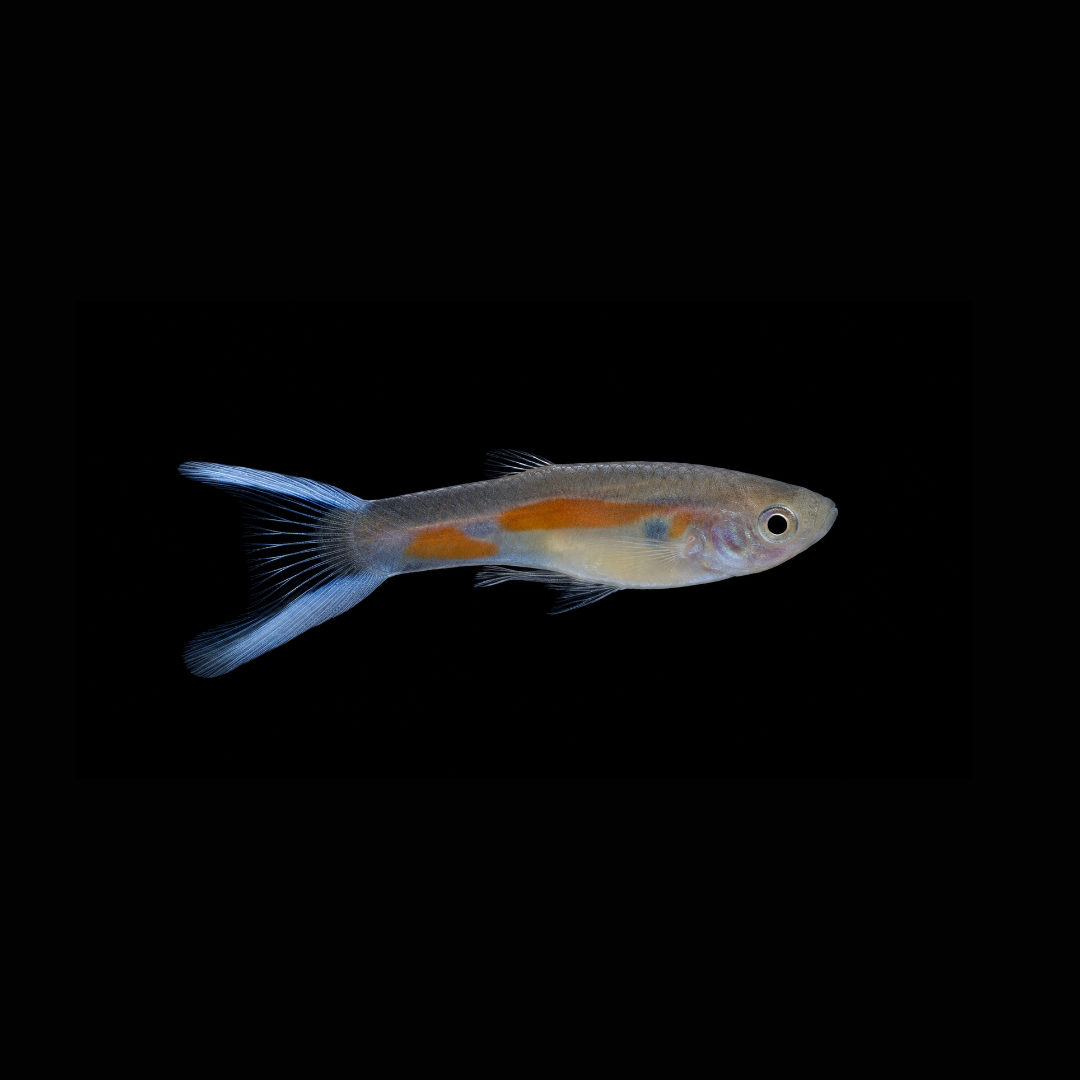
ブルーライヤーテールグッピーは、青く輝く体とヒレに、ライヤーテールと呼ばれる尾型を組み合わせた改良グッピーです。ライヤーテールの名は古代ギリシャの竪琴(ライヤー)に由来し、尾ビレの上下の端が外側へ反りながら伸びて、竪琴の枠のような形を描きます。日本で一般に見かけるのは、シンガポールやスリランカ、台湾などの養殖場で殖やされた外国産の個体で、「ブルーライヤーテール」「ネオンブルーライヤーテール」といった名前で、手頃な価格でショップに並んでいます。入荷のたびに色合いや尾の形に多少の個体差があるのも、この魚を選ぶ楽しみのひとつです。国際的な審査規格では、ライヤーテールは上下の剣がまっすぐ伸びるダブルソードとは別の規格として扱われていますが、店頭では両者が混同されることも少なくありません。大きな尾ビレを持つデルタテールに比べて水の抵抗を受けにくく、体力を消耗しにくいため、丈夫で泳ぎも軽快です。きびきびと泳ぎ回るたびに、反り返った尾の先と青い光沢が水中できらめきます。The Blue Lyretail Guppy is a fancy guppy that combines a shimmering blue body and fins with the tail shape known as the lyretail. The name comes from the lyre of ancient Greece: the upper and lower edges of the caudal fin extend while curving outward, tracing a shape like the frame of a lyre. The fish most commonly seen in Japan are imported stock bred on farms in Singapore, Sri Lanka, Taiwan and elsewhere, sold inexpensively in shops under names such as “Blue Lyretail” or “Neon Blue Lyretail.” Each shipment shows some variation in color and tail shape, which is part of the fun of choosing one. International show standards treat the lyretail as a category separate from the double sword, whose upper and lower swords extend straight, but the two are often confused in shops. Compared with the large-finned delta tail, the lyretail meets less water resistance and tires less easily, making it a hardy and lively swimmer. As it darts about briskly, the curved tips of its tail and its blue sheen sparkle in the water.
基本情報 / Basic Information
学名 / Scientific Name
Poecilia reticulata
通称 / Common Name
ブルーライヤーテールグッピー、ブルーライヤーテール、ネオンブルーライヤーテールBlue Lyretail Guppy, Blue Lyretail, Neon Blue Lyretail
分類 / Family
カダヤシ目 カダヤシ科 ポエキリア属(改良品種)Order Cyprinodontiformes, Family Poeciliidae, Genus Poecilia (ornamental variety)
英名 / English Name
Blue Lyretail Guppy
分布 / Distribution
原種はベネズエラ、トリニダード・トバゴ、ガイアナ、スリナム、ブラジル北部など、南米北部に分布します。本品種は人の手で作られた改良品種のため、自然の生息地はありません。流通個体の多くは東南アジア各地の養殖場で繁殖されています。The wild species is native to northern South America, including Venezuela, Trinidad and Tobago, Guyana, Suriname and northern Brazil. As a man-made ornamental variety, this form has no natural habitat; most fish in the trade are bred on farms across Southeast Asia.
最大体長 / Max Size
オスは約3〜3.5cm(尾ビレを除く)、メスは約5〜6cmMales about 3–3.5 cm (excluding the tail), females about 5–6 cm
寿命 / Lifespan
約1〜2年。良い状態で飼えば、3年ほど生きる個体もいます。About 1–2 years; individuals kept in good condition may live around 3 years.
飼育環境 / Aquarium Environment
水槽サイズ / Tank Size
数匹であれば30cm規格水槽(約12L)から飼えます。繁殖させて世代を重ねるなら、45cm規格水槽(約35L)〜60cm規格水槽(約57L)が向いています。尾型を維持しながら殖やす場合は、オス用、メス用、稚魚用と水槽を分けて用意すると管理しやすくなります。A few fish can be kept in a standard 30 cm tank (about 12 L). For breeding over generations, a standard 45 cm tank (about 35 L) to a standard 60 cm tank (about 57 L) is suitable. When breeding while preserving the tail shape, separate tanks for males, females and fry make management much easier.
水温 / Temperature
23〜27℃(理想は25〜26℃前後)。秋から春にかけては、サーモスタット付きのヒーターで20℃を下回らないようにします。近年の日本の夏は室温が35℃前後に達することもあり、水温が30℃を超えると危険です。冷却ファンでは冷やしきれない環境では、エアコンで室温を管理するか、水槽用クーラーを使ってください。冷房で水が冷えすぎることもあるため、ヒーターは一年を通して入れておくと安心です。23–27°C (ideally around 25–26°C). From autumn to spring, use a thermostat-controlled heater to keep the water from dropping below 20°C. Recent Japanese summers can bring room temperatures to around 35°C, and water above 30°C is dangerous. Where a cooling fan cannot keep up, control the room temperature with air conditioning or use an aquarium chiller. Because air conditioning can overcool the water, it is safest to keep the heater installed year-round.
水質 / Water Quality
中性〜弱アルカリ性(pH 7.0〜7.6前後)、中程度の硬度(GH 8〜18程度)が適しています。日本の水道水は、カルキを抜けばおおむねそのまま使えます。ただし外国産の個体は、弱アルカリ性で硬度の高い水で育っていることが多いため、迎え入れるときは時間をかけて水合わせをしてください。グッピーは急なpHの変化に弱いので、理想の数値を追うよりも、水質を安定させることを優先しましょう。改良品種は水の汚れに敏感だといわれているため、こまめに換水して硝酸塩をためないようにします。Neutral to slightly alkaline water (around pH 7.0–7.6) with moderate hardness (GH roughly 8–18) is suitable. Japanese tap water can generally be used as is once dechlorinated. Imported fish, however, are often raised in slightly alkaline, harder water, so acclimate them slowly when bringing them home. Guppies are vulnerable to sudden pH swings, so prioritize stable water over chasing ideal numbers. Ornamental strains are said to be sensitive to dirty water, so change water regularly to keep nitrate from building up.
レイアウト / Layout
底床には大磯砂や麦飯石が使いやすく、軟水の地域ではサンゴ砂を少量混ぜるとpHが安定しやすくなります。ただしサンゴ砂は水をアルカリ性に傾ける力が強いので、様子を見ながら少しずつ加えてください。ソイルは水を酸性・軟水寄りにするうえ、時間がたつと崩れやすいため、長く繁殖を続ける水槽には向きません。ろ過には、水流の穏やかなスポンジフィルターや底面フィルターが最適です。メスや稚魚が隠れられるよう、ウィローモスやマツモ、浮き草を入れておきましょう。黒など濃い色のバックスクリーンを貼ると、青い輝きがいっそう引き立ちます。Oiso gravel or bakuhan-seki (maifan stone) work well as substrate, and in soft-water areas mixing in a little coral sand helps stabilize pH. Coral sand strongly pushes water toward alkalinity, however, so add it gradually while watching the results. Aquarium soil makes water more acidic and soft and also breaks down over time, so it is not suited to tanks used for long-term breeding. Gently flowing sponge filters or undergravel filters are ideal. Add willow moss, hornwort and floating plants so females and fry have places to hide. A black or other dark background makes the blue shimmer stand out even more.
注意点 / Precautions
外へ反った尾ビレの先は繊細で、強い水流や、とがった流木・石にこすれて傷みやすいので注意してください。外掛け式フィルターを使う場合は水流を弱め、排水を水槽の壁面に当てて流れを和らげます。また、輸入されたばかりの個体は長い輸送で体力を消耗していることが多く、見た目が健康でも病原体を持っている場合があります。すでに国内で殖やされたグッピーを飼っている場合は、いきなり同じ水槽に入れず、別の水槽でしばらく様子を見てください。よく跳ねる魚なので、フタも必ず付けましょう。The outward-curving tips of the tail are delicate and easily damaged by strong currents or by rubbing against sharp driftwood and rocks. When using a hang-on filter, reduce the flow and direct the outflow against the glass to soften the current. Newly imported fish are also often worn out from long transport, and even healthy-looking fish may carry pathogens. If you already keep guppies bred in Japan, do not add new arrivals straight to the same tank; observe them in a separate tank for a while first. Guppies also jump readily, so always use a lid.
餌と給餌 / Feeding
餌の種類 / Diet
雑食性で、グッピー用のフレークや顆粒の人工飼料をよく食べます。冷凍アカムシや冷凍ブラインシュリンプ、孵化させたばかりのブラインシュリンプも喜んで食べます。スピルリナを配合した飼料を取り入れると、栄養のバランスが整います。Guppies are omnivorous and readily accept guppy flakes and granules. They also relish frozen bloodworms, frozen brine shrimp and newly hatched brine shrimp. Including foods formulated with spirulina helps balance their nutrition.
給餌のポイント / Feeding Tips
1日2〜3回、数分で食べきれる量を与えます。この魚の青は、赤や黄色のように色素で生まれる色ではありません。虹色素胞という細胞が光を反射・干渉させて見せる「構造色」が主な正体です。そのため、アスタキサンチンなどの色揚げ飼料をたくさん与えても、青そのものが大きく濃くなるわけではないと考えられています。栄養のバランスで体調を整え、濃い色の背景で青を引き立てるほうが効果的です。食べ残しは水を汚す原因になるので、与えすぎには注意しましょう。Feed two to three times a day, giving only what can be eaten within a few minutes. The blue of this fish is not produced by pigment, as reds and yellows are. It is mainly “structural color,” created when cells called iridophores reflect light and make it interfere. For this reason, feeding large amounts of color-enhancing foods containing astaxanthin is not thought to deepen the blue itself very much. It is more effective to keep the fish in good condition with balanced nutrition and to set off the blue against a dark background. Leftover food fouls the water, so be careful not to overfeed.
性格と混泳 / Temperament and Tank Mates
性格 / Temperament
温和で、群れになってよく泳ぐ魚です。オスはメスを熱心に追いかけ続けるため、オスが多すぎるとメスが疲れて弱ってしまうことがあります。オス1匹に対してメス2〜3匹の割合で飼うのが基本です。Peaceful fish that swim actively in groups. Males chase females persistently, and too many males can tire and weaken the females. The basic ratio is one male to two or three females.
混泳の相性 / Compatibility
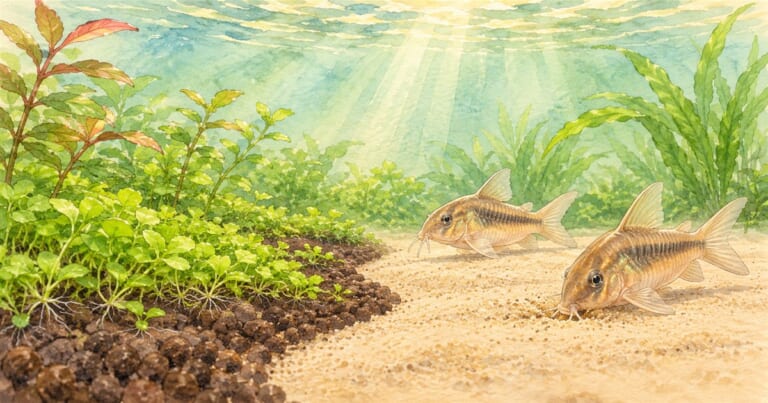
コリドラスやオトシンクルス、温和な小型カラシン、ラスボラなどとは一緒に飼いやすい魚です。スマトラやタイガーバルブのようにヒレをかじる魚や、小魚を口に入れてしまう中型以上の魚とは混泳させないでください。ミナミヌマエビなどの小型エビとも同居できますが、生まれたばかりの稚エビは食べられることがあります。尾型を守りたい場合は、ほかのグッピー品種と同じ水槽に入れないようにしましょう。交雑して尾の形が崩れるのを防げます。They are easy to keep with Corydoras, Otocinclus, peaceful small tetras and rasboras. Do not house them with fin-nippers such as tiger barbs, or with medium-sized or larger fish that will swallow small fish. Small shrimp such as Neocaridina species can live with them, though newborn shrimplets may be eaten. To preserve the tail shape, keep them apart from other guppy varieties; this prevents crossbreeding from spoiling the tail.
病気と対策 / Diseases and Prevention
かかりやすい病気 / Common Diseases
白点病、尾ぐされ病、ウーディニウム病(ベルベット病)がよく見られます。テトラヒメナ症は、治療が難しい病気として知られています。国内では「グッピーエイズ」と俗に呼ばれる致死性の症状も知られていますが、原因は一つに特定されておらず、ウイルスや細菌、原虫など複数の要因が関わっていると考えられています。また、近親交配を重ねると、背骨の曲がりや体の小型化、免疫力の低下が起こりやすくなります。White spot disease (ich), fin rot and velvet disease (Oodinium) are common. Tetrahymena infection is known as a difficult disease to treat. In Japan there is also a fatal condition popularly called “guppy AIDS”; its cause has not been pinned down to a single agent, and several factors such as viruses, bacteria and protozoa are thought to be involved. Repeated inbreeding also makes spinal curvature, smaller size and weakened immunity more likely.
対策と予防 / Prevention
新しく迎えた個体は、照明を落として時間をかけて水合わせをし、袋の水は水槽に入れないでください。最初の2週間ほどは別の水槽で様子をよく観察します。すでに国内で殖やされたグッピーを飼っている場合は、水槽もフィルターも分け、網やホース、バケツ、スポイトもそれぞれ専用にして使い回さないようにしましょう。手入れは先からいる魚の水槽を先に、新しく迎えた魚の水槽を後に行い、作業の合間には手を洗います。病気の兆しが見えたら早めに隔離し、塩浴やグリーンFゴールドリキッドなどの魚病薬を規定量使って、個別に治療します。いきなり本水槽に薬を入れるのは避けましょう。Acclimate new arrivals slowly with the lights dimmed, and do not pour the shipping water into the tank. Observe them closely in a separate tank for the first two weeks or so. If you already keep guppies bred in Japan, keep tanks and filters separate and give each group its own nets, hoses, buckets and pipettes, never sharing them. Service the tanks of established fish first and those of newcomers last, washing your hands between tasks. At the first sign of illness, isolate the fish promptly and treat them individually with a salt bath or an aquarium medication such as Green F Gold Liquid at the specified dose. Avoid dosing the main tank right away.
増やし方(繁殖) / Breeding
雌雄の判別 / Sexing
オスは体が小さく、青い発色とライヤーテールの尾がはっきり表れます。尻ビレは、棒状の交接器(ゴノポディウム)に変化しています。メスは体が大きく、色は控えめで、尾ビレも短めです。妊娠が進むと、肛門の近くにある黒い妊娠斑が濃く目立つようになります。外国産はオスだけで販売されることも多いため、殖やしたい場合はメスがそろっているか確認して入手しましょう。Males are smaller and clearly show blue coloration and the lyretail fin. Their anal fin is modified into a rod-like mating organ called the gonopodium. Females are larger, more subdued in color and shorter-finned. As pregnancy advances, the dark gravid spot near the vent becomes more prominent. Imported fish are often sold as males only, so if you want to breed them, make sure females are available when you buy.
繁殖形態 / Reproduction
体内で受精する卵胎生です。交尾から約1か月で、1回に20匹前後の稚魚を産みます。メスは1回の交尾で受け取った精子を体内にたくわえ、何度も出産することができます。Guppies are livebearers with internal fertilization. About a month after mating, a female gives birth to around 20 fry at a time. Females can store sperm from a single mating and give birth several times.
繁殖のポイント / Breeding Tips
生まれたばかりの稚魚の尾は丸く、成長とともにライヤーテールらしく伸びて反っていきます。生後30日ほどまでは、孵化させたブラインシュリンプと稚魚用飼料を1日3〜4回、少しずつ与えます。週1〜2回、水量の1/4〜1/3ほどを換水しましょう。生後1か月ほどで雌雄を見分けられるようになったら、すぐにオスとメスを分けて、まだ交尾していないメスを確保します。生後2か月で背骨の曲がった個体や左右の形が極端にそろわない個体を外し、生後3か月以降に上位2〜3割の中から親魚を選びます。尾ビレは長さよりも、上下の長さがそろっているか、反りが左右対称でくっきりしているか、背ビレの先も外へ反っているかを重視して選ぶのがコツです。デルタテール系と掛け合わせると、子のオスは尾ビレの間が埋まってデルタテールになりやすいとされるため、尾型を守るにはデルタテール系の血が入っていないメスを選ぶとよいでしょう。近親交配による弱体化を防ぐには、3〜5本の系統を並行して維持し、数世代ごとに系統どうしを掛け合わせる方法が広く用いられています。Newborn fry have rounded tails that gradually lengthen and curve into the lyretail shape as they grow. For the first 30 days or so, feed hatched brine shrimp and fry food in small portions three to four times a day, and change one quarter to one third of the water once or twice a week. Once the sexes can be told apart at about one month old, separate males and females right away to secure females that have not yet mated. At two months, remove fish with curved spines or markedly uneven shapes, and from three months on choose breeders from the top 20–30%. When selecting, look less at length than at whether the upper and lower extensions are equal, whether the curve is clear and symmetrical, and whether the tip of the dorsal fin also curves outward. Crossing with delta-tail lines is said to make male offspring likely to develop filled-in delta tails, so to preserve the tail shape, choose females with no delta-tail blood. To avoid weakening from inbreeding, a widely used method is to maintain three to five parallel lines and cross between them every few generations.
雑学と豆知識 / Trivia and Fun Facts
1. 学名が二度つけられた魚と、残った「グッピー」の名前 / 1. A Fish Named Twice, and the Name “Guppy” That Stuck
グッピーの標本が学術的に調べられたのは1850年代後半のことで、ベネズエラのカラカス近くを流れるグアイレ川で採集されたものでした。1859年、ドイツの博物学者ヴィルヘルム・ペータースがこの魚にPoecilia reticulataという学名をつけます。属名はギリシャ語で「色とりどりの」、種小名はラテン語で「網目模様の」という意味です。ところが7年後の1866年、大英博物館のアルベルト・ギュンターが、トリニダード島に住む英国人ロバート・ジョン・レチメア・グッピーから届いた標本を新種と考え、送り主の名をとってGirardinus guppiiと名づけてしまいました。学名は先に発表されたものが優先されるため、ギュンターの学名は無効になります。それでも「グッピー」という呼び名は英語名として世界に広まり、標本を送った人物の名前は、今も魚とともに語り継がれています。ヨーロッパに入ってきたばかりの頃には、色の豊かさから「レインボーフィッシュ」、驚くほどの繁殖力から「ミリオンフィッシュ」とも呼ばれていました。Guppy specimens were first studied scientifically in the late 1850s; they had been collected in the Guaire River near Caracas, Venezuela. In 1859 the German naturalist Wilhelm Peters gave the fish the scientific name Poecilia reticulata: the genus name comes from the Greek for “many-colored” and the species name from the Latin for “net-patterned.” Seven years later, in 1866, Albert Günther of the British Museum took specimens sent by Robert John Lechmere Guppy, an Englishman living in Trinidad, to be a new species and named them Girardinus guppii after the sender. Because the earlier published name takes priority, Günther’s name became invalid. Even so, “guppy” spread around the world as the fish’s English name, and the man who sent the specimens is still remembered along with the fish. When the species first reached Europe, it was also called the “rainbow fish” for its colors and the “millions fish” for its astonishing fertility.
2. ヨーロッパの剣尾文化が育てたライヤーテール / 2. The Lyretail, a Product of Europe’s Sword-Tail Culture
尾ビレの上下が剣のように伸びる性質は、野生の個体にもわずかに見られることがあるといわれます。グッピーの改良の歴史の中で、この剣尾の性質は古くから知られていました。現在主流のデルタテールやファンテールのような大きな尾も、剣尾の性質に別の遺伝子が加わって上下の剣の間が埋まったことで生まれたと考えられています。アメリカや日本で大きなデルタテールが人気を集める一方、ドイツやオーストリアなどでは、野生らしい躍動感と幾何学的な美しさを持つ剣尾系の育種が受け継がれてきました。その代表とされるのが、ドイツのブリーダー、シュメルペニヒ氏が作出した系統で、今もライヤーテールの手本として名前が挙がります。左右対称に外へ反る形を固定するのはとても難しく、ライヤーテールは剣尾系の中でも特に珍しい規格とされています。手頃な価格で出回るブルーライヤーテールも、こうした剣尾文化の流れをくむ尾型を受け継いでいるのです。The trait of upper and lower caudal extensions growing like swords is said to appear occasionally, if faintly, even in wild fish. This sword trait has been known since early in the history of guppy breeding. The large tails that dominate today, such as the delta and fantail, are also thought to have arisen when another gene combined with the sword trait and filled in the space between the swords. While large delta tails gained popularity in America and Japan, breeders in Germany, Austria and elsewhere carried on a tradition of sword-tail breeding prized for wild vigor and geometric beauty. A line created by the German breeder Schimmelpennig is regarded as its emblem and is still cited as a model lyretail. Fixing a symmetrical outward curve is very difficult, and the lyretail is considered one of the rarest categories among sword-tail guppies. Even the affordably priced Blue Lyretail carries a tail shape descended from this sword-tail tradition.
3. 父から息子へだけ伝わる色 / 3. Colors Passed Only from Father to Son
グッピーは遺伝学の歴史にも名前を残している魚です。オスの体やヒレの色を決める遺伝子の多くは性染色体にあり、そのうち一部はオスだけが持つY染色体にのっています。Y染色体にある色の遺伝子は、父から息子へだけ受け継がれ、娘には伝わりません。グッピーは、こうした「Y染色体連鎖」の遺伝が早い時期に確かめられた生き物として知られています。オスばかりが鮮やかで、メスが地味な色をしているのも、色の遺伝子の多くがオス側で働く仕組みと深く関わっていると考えられています。つまり、美しいオスを選んで親にすることは、その色を息子たちへ引き継ぐうえで大きな意味を持つのです。The guppy has also left its name in the history of genetics. Many of the genes that determine the color of a male’s body and fins lie on the sex chromosomes, and some sit on the Y chromosome, which only males carry. Color genes on the Y chromosome pass only from father to son and never to daughters. The guppy is known as one of the creatures in which this kind of Y-linked inheritance was confirmed early on. The fact that males are brilliantly colored while females are plain is also thought to be closely tied to the way many color genes act on the male side. In other words, choosing a beautiful male as a parent matters greatly in passing that color on to his sons.
4. 同じ「ライヤーテール」でも繁殖のしやすさは違う / 4. Same “Lyretail” Name, Different Breeding Stories
ライヤーテールと呼ばれる品種はグッピーだけでなく、同じカダヤシ科のソードテールにもいます。ところがソードテールのライヤーテールでは、尾ビレだけでなくオスの交接器まで長く伸びてしまうため、自然に交配することがほとんどできません。そのため、ヒレの短いオスを使ったり人工授精を行ったりといった工夫が必要になります。グッピーでも、交接器が長く伸びやすいリボン系のオスは繁殖が難しいことで知られています。一方、ライヤーテールのグッピーは交接器が普通の形のまま保たれるため、自然に交配して増やすことができます。美しい尾型を楽しみながら、自分の手で世代をつないでいけるのは、ライヤーテールのグッピーならではの魅力です。Varieties called lyretail exist not only in guppies but also in swordtails of the same family. In lyretail swordtails, however, the trait lengthens not just the tail but also the male’s mating organ, so natural mating is almost impossible; breeders must use short-finned males or even resort to artificial insemination. Among guppies, ribbon-type males, whose gonopodium tends to grow long, are likewise known to be hard to breed. Lyretail guppies, by contrast, keep a normally shaped gonopodium and can be bred by natural mating. Being able to enjoy a beautiful tail shape while carrying the line forward with your own hands is a charm unique to the lyretail guppy.
5. 温泉街で暮らすグッピーと、まぎらわしい近縁種 / 5. Hot-Spring Guppies and a Confusing Relative
グッピーは熱帯の魚なので寒さに弱く、日本の一般的な川では冬を越せません。それでも汚れた水や流れのない水には強いため、各地の温泉街の用水路や、工場から温かい排水が流れ込む場所では、古くから野生化した群れが確認されてきました。北海道の温泉地で定着した例も報告されており、一年中水温の高い沖縄では、川や水路に広く住みついています。こうした状況から、グッピーは環境省の外来種リストで、対策が必要な外来種の一つに挙げられています。日本の川で特に気をつけたいのが、近い仲間のカダヤシです。カダヤシは、蚊の幼虫(ボウフラ)を退治する目的で持ち込まれたことから「蚊絶やし」と名づけられました。現在は特定外来生物に指定され、許可なく飼ったり運んだりすることが法律で禁じられています。野外で見つけた魚をメダカやグッピーだと思って持ち帰らないよう、注意が必要です。また、飼っているグッピーを川や池に放すことは絶対にやめましょう。As a tropical fish, the guppy cannot tolerate cold and cannot overwinter in ordinary Japanese rivers. Because it copes well with polluted and still water, however, feral groups have long been recorded in hot-spring town channels and in places where warm factory water flows out. Cases of establishment have been reported even at hot springs in Hokkaido, and in Okinawa, where water stays warm all year, guppies are widely settled in rivers and channels. For these reasons, the guppy is listed on the Ministry of the Environment’s alien species list as one requiring countermeasures. A particular concern in Japanese waters is a close relative, the mosquitofish, whose Japanese name “kadayashi” means “mosquito exterminator” because it was introduced to eat mosquito larvae. It is now designated an Invasive Alien Species, and keeping or transporting it without permission is prohibited by law. Take care not to bring home a wild-caught fish believing it to be a medaka or a guppy, and never release pet guppies into rivers or ponds.
6. 潜水艦から貨物機、ネットスラングまで / 6. From Submarines and Cargo Planes to Internet Slang
「グッピー」の名前は、水槽の外にも広がっています。アメリカ海軍が進めた潜水艦の性能向上計画は略して「GUPPY」と呼ばれ、胴体の大きくふくらんだ貨物機には「プレグナント・グッピー(妊娠したグッピー)」という名前がつけられました。日本のインターネットでは、ちょっとした変化にも耐えられない弱さをからかう言い回しとして「グッピーなら死んでる」という表現が使われています。けれども原種のグッピーは、温泉の排水の中でも増えるほどたくましい魚です。この言葉はむしろ、改良と近親交配を重ねた観賞用の品種が、急な水質の変化や外から持ち込まれる病原体に弱いという、今の飼育の現実を図らずも映しているのかもしれません。The name “guppy” reaches beyond the aquarium. A U.S. Navy program to improve submarine performance was abbreviated “GUPPY,” and a cargo aircraft with a greatly bulging fuselage was named the “Pregnant Guppy.” On the Japanese internet, the phrase “a guppy would be dead” is used to tease anyone who cannot cope with small changes. Yet the wild guppy is tough enough to multiply even in hot-spring outflows. If anything, the phrase may unintentionally reflect a reality of modern fishkeeping: ornamental varieties refined through selective breeding and inbreeding are vulnerable to sudden changes in water quality and to pathogens brought in from outside.
まとめ / Conclusion
ブルーライヤーテールグッピーは、南米の小さな原種から生まれ、剣尾の美しさを受け継いで改良されてきた魚です。竪琴のように反り返った尾と、光の当たり方で表情を変える青い輝きは、ほかの尾型にはない凛とした美しさを水槽にもたらします。手に入れやすく、尾ビレが大きすぎないため体力も消耗しにくいので、初めてグッピーを飼う人にもなじみやすい丈夫さを備えています。The Blue Lyretail Guppy descends from a small wild fish of South America and has been refined while inheriting the beauty of the sword tail. Its lyre-like curved tail and its blue shimmer, which changes with the way the light falls, bring a crisp elegance to the aquarium that no other tail type quite matches. Easy to obtain, and with a tail not so large that it drains the fish’s stamina, it is hardy enough to suit first-time guppy keepers.
その一方で、左右対称の反りを次の世代へ受け継ぐには、親魚選びに根気が必要です。迎え入れるときの水合わせや、病気を持ち込まないための心配りも欠かせません。日本の水と季節に合わせて環境を整え、生まれた稚魚の尾が少しずつ竪琴の形へ伸びていく様子を見守る時間は、この魚と暮らす大きな楽しみです。小さな体に込められた歴史に思いをはせながら、青い輝きをじっくりと育ててみてください。At the same time, passing a symmetrical curve on to the next generation takes patience in choosing breeders, and careful acclimation and precautions against bringing in disease are essential. Arranging the tank to suit Japan’s water and seasons, then watching the tails of newborn fry gradually stretch into the shape of a lyre, is one of the great pleasures of living with this fish. Take your time nurturing its blue shimmer while reflecting on the history carried in its small body.
分類・学名・分布 / Taxonomy, Nomenclature and Distribution
Peters, W. (1859). Eine neue vom Herrn Jagor im atlantischen Meere gefangene Art der Gattung Leptocephalus, und über einige andere neue Fische des Zoologischen Museums. Monatsberichte der Königlichen Preussischen Akademie der Wissenschaften zu Berlin, 1859.
Günther, A. (1866). Catalogue of the Fishes in the British Museum, Vol. 6. Trustees of the British Museum, London.
Schmidt, J. (1920). The genetic behaviour of a secondary sexual character. Comptes Rendus des Travaux du Laboratoire Carlsberg, 14(8).
Winge, Ö. (1922). One-sided masculine and sex-linked inheritance in Lebistes reticulatus. Journal of Genetics, 12, 145–162. https://doi.org/10.1007/BF02983078
Winge, Ö. (1927). The location of eighteen genes in Lebistes reticulatus. Journal of Genetics, 18, 1–43. https://doi.org/10.1007/BF03052599
Winge, Ö. & Ditlevsen, E. (1947). Colour inheritance and sex determination in Lebistes. Heredity, 1, 65–83. https://doi.org/10.1038/hdy.1947.4
病気 / Diseases
Imai, S., Tsurimaki, S., Goto, E., Wakita, K. & Hatai, K. (2000). Tetrahymena infection in guppy, Poecilia reticulata. Fish Pathology, 35(2), 67–72. https://doi.org/10.3147/jsfp.35.67
Leibowitz, M. P. & Zilberg, D. (2009). Tetrahymena sp. infection in guppies, Poecilia reticulata Peters: parasite characterization and pathology of infected fish. Journal of Fish Diseases, 32(10), 845–855.
Hoffman, G. L., Landolt, M., Camper, J. E., Coats, D. W., Stookey, J. L. & Burek, J. D. (1975). A disease of freshwater fishes caused by Tetrahymena corlissi Thompson, 1955, and a key for identification of holotrich ciliates of freshwater fishes. Journal of Parasitology, 61(2), 217–223. https://doi.org/10.2307/3278995
国内の野生化・外来種制度 / Feral Populations and Invasive Species Regulation in Japan






コメント