
解説 / Description
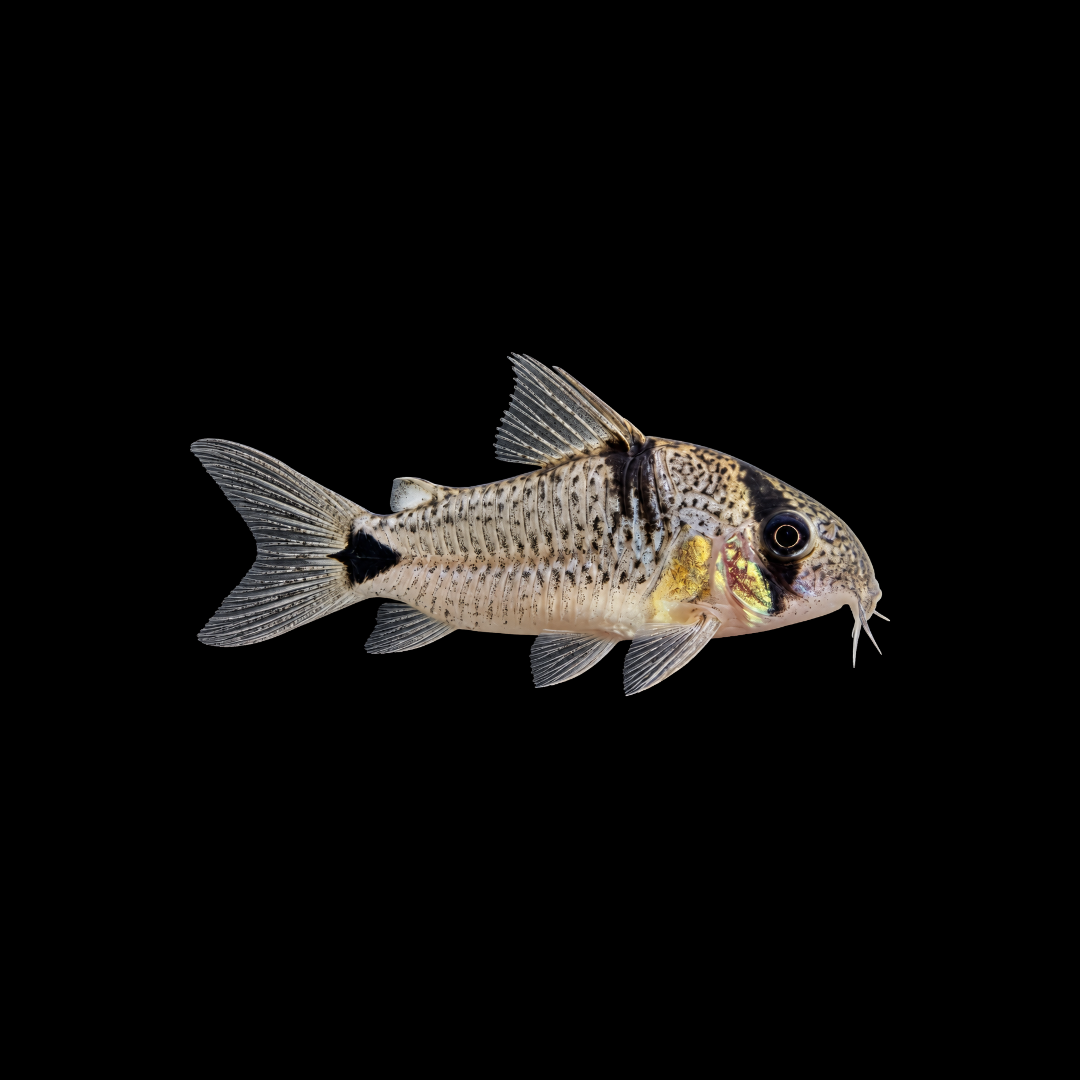
コリドラス・旧アルマータスは、ペルー北東部ロレト県を流れるナナイ川水系に生息するとされる、まだ正式な学名が与えられていないコリドラスの仲間です。国際的には「C096」「CW081」というコード番号で知られ、2024年に発表された分類の大きな見直しによって、現在はホプリソマ属(Hoplisoma)に含まれるグループとして扱われています。最大の魅力は、帆のように高く伸びる背鰭と、背鰭の付け根から腹部へと走る暗色のバンド模様です。明るい灰白色からベージュの地色には細かな黒褐色の斑点や網目模様が散りばめられており、落ち着いたモノトーンの中に凛とした気品が感じられます。長らく「コリドラス・アルマータス」の名で流通していましたが、のちに本来のアルマータスが輸入されるようになり、両者を区別するために「旧」の字が付けられたという、少し変わった経歴を持つ魚でもあります。性質は非常に温和で、群れで底砂を探りながら泳ぐ姿は、水槽の下層に穏やかな動きと奥行きを与えてくれます。 The “Old Armatus” Corydoras is a member of the corydoras group that has not yet been given a formal scientific name, and it is believed to inhabit the Río Nanay system in the Loreto region of northeastern Peru. Internationally it is known by the code numbers C096 and CW081, and following a major taxonomic revision published in 2024 it is now treated as part of the genus Hoplisoma. Its greatest charm lies in its tall, sail-like dorsal fin and a dark band running from the base of the dorsal fin down toward the belly. Fine blackish-brown spots and reticulated markings are scattered over a pale grey to beige base color, giving the fish a calm, monochrome elegance. It also has an unusual history: it was long traded as “Corydoras armatus,” and when the true armatus later began to be imported, the prefix “Old” was added to tell the two apart. Very peaceful by nature, a group of these fish sifting through the sand brings gentle movement and depth to the lower layer of the aquarium.
基本情報 / Basic Information
| 学名 / Scientific Name | Hoplisoma sp. (C096 / CW081) |
|---|---|
| 通称 / Common Name | コリドラス・旧アルマータス、旧アルマートゥス、コリドラス sp. C096Old Armatus Cory, Corydoras sp. C096, Corydoras sp. aff. armatus |
| 分類 / Family | ナマズ目 カリクティス科 コリドラス亜科 ホプリソマ属(旧コリドラス属)Siluriformes, Callichthyidae, Corydoradinae, genus Hoplisoma (formerly Corydoras) |
| 英名 / English Name | Corydoras sp. C096 / CW081 (aff. armatus) |
| 分布 / Distribution | 南米ペルー、ロレト県のナナイ川水系。ナナイ川はイキトス近郊でアマゾン本流に合流する支流で、本種は現在のところ、この水系を中心とした限られた範囲に分布すると考えられている。The Río Nanay system in the Loreto region of Peru, South America. The Nanay is a tributary that joins the main Amazon near Iquitos, and at present this species is thought to be restricted to a limited range centered on this river system. |
| 最大体長 / Max Size | オスで約4.5cm、メスで約5cm。メスの方がひと回り大きくなる。About 4.5 cm for males and about 5 cm for females; females grow slightly larger. |
| 寿命 / Lifespan | 飼育下では5年前後がひとつの目安とされ、環境が安定していればそれ以上生きる例もあると考えられている。Around 5 years is a general guideline in captivity, and individuals kept in stable conditions are thought to live longer. |
飼育環境 / Aquarium Environment
| 水槽サイズ / Tank Size | 群れで飼育することや、底面を活発に泳ぎ回る性質を考えると、60cm規格水槽(約57L)以上がおすすめです。水量に余裕があるほど水質が安定し、群れの自然な行動も観察しやすくなります。底面積の広い60cmワイド水槽や90cm規格水槽(約157L)であれば、より大きな群れでの飼育も楽しめます。Because this species is kept in groups and actively roams the bottom, a standard Japanese 60 cm tank (about 57 L) or larger is recommended. The more water volume you have, the more stable the water quality and the easier it is to observe natural group behavior. A 60 cm wide tank or a 90 cm standard tank (about 157 L), with more floor space, allows you to enjoy an even larger group. |
|---|---|
| 水温 / Temperature | 22〜26℃程度が適温です。一時的であれば28℃前後にも耐えますが、日本の夏に30℃を超える状態が続くと体調を崩しやすいため、水槽用クーラーや冷却ファンで水温の上昇を抑えましょう。 The ideal range is about 22–26°C. The fish can tolerate around 28°C for short periods, but prolonged temperatures above 30°C during Japanese summers can easily cause health problems, so use an aquarium chiller or cooling fan to keep the temperature down. |
| 水質 / Water Quality | 弱酸性〜中性(pH6.0〜7.2程度)、総硬度は軟水〜中硬水(2〜12dGH程度)が目安です。原産地のナナイ川はpHが低く、ミネラル分が極めて少ないブラックウォーターですが、飼育下では水道水をもとにした中性付近の水にも順応します。ただし、輸入直後の野生個体はデリケートなため、導入初期はブラックウォーター系の添加剤やヤシャブシの実などでpHをやや低め(5.5〜6.5程度)に整えると落ち着きやすいとされています。Slightly acidic to neutral water (around pH 6.0–7.2) with soft to moderately hard water (about 2–12 dGH) is a good guideline. Its native Río Nanay is a blackwater river with low pH and extremely low mineral content, but in captivity the fish adapts to near-neutral water based on tap water. However, freshly imported wild fish are delicate, and lowering the pH slightly (around 5.5–6.5) with blackwater conditioners or alder cones during the initial period is said to help them settle. |
| レイアウト / Layout | 底砂には、角のない極細目の砂(田砂やボトムサンドなど)を薄めに敷くのが最適です。ひげを傷つけにくいうえ、砂に口先を潜らせて餌を探す自然な行動も楽しめます。流木や落ち葉を配置して原産地のような薄暗い隠れ家を作ると、警戒心が和らぎ、姿を見せる時間が増えていきます。水草はアヌビアスやミクロソリウムなどの丈夫な種類が合わせやすく、前景には泳ぎ回れる開けた砂地を残しておくとよいでしょう。The best substrate is a thin layer of fine, rounded sand. It is gentle on the barbels and also lets you enjoy the natural behavior of the fish probing the sand for food. Adding driftwood and leaf litter to create dim hiding places like those in the wild eases their wariness, and they will gradually spend more time in view. Hardy plants such as Anubias and Java fern are easy companions, and leaving an open sandy area in the foreground for swimming is recommended. |
| 注意点 / Precautions | 流通している個体のほとんどは野生採集個体のため、購入直後は環境の変化に敏感です。水合わせは時間をかけて丁寧に行いましょう。急激な水質変化を避けるため、水換えは一度に大量に行うのではなく、週に20〜30%程度を目安にこまめに行うのが安心です。大磯砂のような角のある砂や、ソイルの厚敷きは、ひげの欠損や底床の汚れの原因になりやすいため避けるのが無難です。また、ロレトエンシスなどの似た種類と混同されることがあるため、購入時には体高や背鰭の形、体側のバンド模様をよく確認することをおすすめします。Most fish on the market are wild-caught, so they are sensitive to environmental changes right after purchase. Take time to acclimate them carefully. To avoid sudden changes in water chemistry, it is safest to make frequent partial water changes of about 20–30% per week rather than large ones. Sharp gravel and thick layers of aqua soil can easily cause barbel erosion and a dirty substrate, so they are best avoided. Because this species is sometimes confused with similar ones such as the loretoensis cory, it is advisable to check body depth, dorsal fin shape, and the lateral band carefully when buying. |
餌と給餌 / Feeding
| 餌の種類 / Diet | 水底で餌を探す雑食性の魚です。主食には沈下性のコリドラス用タブレットなど、質の良い人工飼料を与えます。副食として冷凍アカムシ、イトミミズ、ブラインシュリンプ、マイクロワームなどを週に数回加えると、体色が整い、メスの抱卵も促されると考えられています。This is an omnivore that forages on the bottom. Feed a high-quality sinking food such as corydoras tablets as the staple. Adding frozen bloodworms, tubifex worms, brine shrimp, or microworms several times a week as supplements is thought to improve coloration and encourage females to develop eggs. |
|---|---|
| 給餌のポイント / Feeding Tips | 「残り餌の掃除役」として扱われがちですが、健康に育てるには本種のための給餌が欠かせません。暗い時間帯に活発になる傾向があるため、消灯前や照明を落とした時間帯に与えると、中層を泳ぐ素早い魚に餌を奪われにくく、確実に食べさせることができます。食べ残しは底砂の汚れにつながるため、数分から十数分で食べきれる量を目安にしましょう。Although often treated as a “cleanup crew,” feeding specifically for this species is essential to keep it healthy. It tends to become more active in the dark, so feeding just before lights-out or after dimming the lights prevents faster midwater fish from stealing the food and ensures the corydoras actually eat. Leftover food fouls the substrate, so give only what can be eaten within several to around fifteen minutes. |
性格と混泳 / Temperament and Tank Mates
| 性格 / Temperament | 非常に温和で、他の魚に危害を加えることはまずありません。本来は群れで暮らす社会性の高い魚のため、単独ではなく同種を4〜6匹以上で飼育すると落ち着き、自然な行動を見せてくれるようになります。Extremely peaceful, it practically never harms other fish. Being a highly social schooling species by nature, it settles down and shows natural behavior when kept in a group of at least four to six of its own kind rather than alone. |
|---|---|
| 混泳の相性 / Compatibility | ネオンテトラやエンバーテトラなどの小型カラシン、ラスボラなどの小型コイ科、オトシンクルスなどの小型ナマズ、ビーシュリンプなどとの混泳に向いています。一方、縄張り意識の強いシクリッド類や、底を占有する気の強いプレコ類との混泳は、ストレスやヒレの傷み、餌を食べられなくなる原因となるため避けましょう。It is well suited to tanks with small characins such as neon and ember tetras, small cyprinids such as rasboras, small catfish such as Otocinclus, and dwarf shrimp. On the other hand, avoid territorial cichlids and aggressive plecos that dominate the bottom, as they cause stress, fin damage, and difficulty feeding. |
病気と対策 / Diseases and Prevention
| かかりやすい病気 / Common Diseases | 底砂の汚れや物理的な傷をきっかけに、エロモナス菌などの細菌に感染し、ひげが短くなったり失われたりする症状(いわゆる「ひげ溶け」)が起こりやすいとされています。また、輸送や環境変化のストレスで体力が落ちている導入直後は、白点病や尾ぐされ病にも注意が必要です。Barbel erosion, in which the barbels shorten or disappear due to bacterial infections such as Aeromonas, is said to occur easily, often triggered by a dirty substrate or physical injury. In addition, white spot disease and fin rot require attention right after introduction, when the fish are weakened by the stress of transport and environmental change. |
|---|---|
| 対策と予防 / Prevention | 最も大切なのは、角のない細かな砂を使い、底砂を清潔に保つことです。定期的な底砂の掃除とこまめな水換えで、アンモニアや硝酸塩の蓄積を防ぎましょう。野生個体は、可能であれば別水槽でしばらく様子を見てから本水槽に移すと、病気の持ち込みを防ぎやすくなります。コリドラスの仲間は薬に弱い傾向があるため、薬浴を行う場合は規定量より控えめな濃度から始めるなど、慎重に対応しましょう。Most important is using fine, rounded sand and keeping the substrate clean. Prevent the buildup of ammonia and nitrate with regular substrate cleaning and frequent water changes. If possible, observe wild-caught fish in a separate quarantine tank for a while before moving them to the main tank to avoid introducing disease. Corydoradine catfish tend to be sensitive to medications, so if treatment is needed, proceed carefully, for example by starting at a lower concentration than the standard dose. |
増やし方(繁殖) / Breeding
| 雌雄の判別 / Sexing | 上から見下ろすように観察すると判別しやすくなります。メスはオスよりひと回り大きく、成熟して卵を持つと腹部が左右にふっくらと張り出します。オスは細身で直線的なシルエットをしており、背鰭がよりシャープに尖る傾向があります。Sexing is easiest when viewing the fish from above. Females grow slightly larger than males, and when mature and carrying eggs their bellies bulge out to the sides. Males have a slimmer, straighter silhouette and tend to have a more sharply pointed dorsal fin. |
|---|---|
| 繁殖形態 / Reproduction | 卵生で、粘着性のある卵をガラス面や水草の葉などに産み付けます。産卵の際には、コリドラスの仲間に特有の「Tポジション」と呼ばれる交尾行動が見られます。メスは腹鰭を合わせて作ったポケットに数粒ずつ卵を抱えて受精させ、それをあちこちに産み付けていきます。この行動は数時間にわたって繰り返されます。卵は水温にもよりますが、おおむね5〜7日前後で孵化します。It is an egg-layer that attaches adhesive eggs to the glass or plant leaves. During spawning, the distinctive mating behavior of corydoradine catfish known as the “T-position” can be observed. The female holds a few eggs at a time in a pouch formed by her pelvic fins, fertilizes them, and then attaches them here and there. This behavior is repeated over several hours. Depending on temperature, the eggs hatch in roughly 5–7 days. |
| 繁殖のポイント / Breeding Tips | 普及種に比べると飼育下での繁殖例は少ないものの、国内では産卵・孵化に成功した例も報告されています。オス2〜3匹に対してメス1〜2匹の割合で群れを作り、産卵を狙う2週間ほど前から冷凍アカムシなどの高タンパクな餌を十分に与えて、メスに卵を持たせます。そのうえで、水換えの際に飼育水より2〜3℃低い水を注いで雨季の到来を再現すると、産卵のきっかけになりやすいとされています。低気圧が近づくタイミングに合わせると効果的だという飼育者の経験談もあります。産み付けられた卵は親魚に食べられることがあるため、指やスポイトで優しく回収し、エアレーションを効かせた別容器に移しましょう。水カビの予防には、メチレンブルーを微量加えるのが一般的です。孵化した稚魚にはお腹の栄養袋(ヨークサック)が吸収されてから、インフゾリアや細かく砕いた人工飼料、孵化させたばかりのブラインシュリンプを与えます。稚魚は水質の悪化に非常に弱いため、ごく薄い砂敷きか砂を敷かない水槽で、毎日スポイトを使って残り餌やフンを取り除き、少量ずつ水を換えることが育成成功の鍵になります。Captive breeding is less common than with widespread species, but successful spawning and hatching have been reported among hobbyists in Japan. Form a group of two to three males for every one to two females, and from about two weeks before you attempt spawning, feed plenty of high-protein foods such as frozen bloodworms so the females develop eggs. Then, during a water change, adding water 2–3°C cooler than the tank water to simulate the arrival of the rainy season is said to readily trigger spawning. Some keepers report that timing this with an approaching low-pressure system is effective. Because the parents may eat the eggs, gently collect them with a finger or pipette and move them to a separate container with good aeration. Adding a small amount of methylene blue to prevent fungus is common practice. Once the fry have absorbed their yolk sacs, feed infusoria, finely crushed dry food, and newly hatched brine shrimp. Fry are extremely vulnerable to poor water quality, so keeping them on a very thin layer of sand or in a bare-bottom tank, removing leftover food and waste with a pipette every day, and making small water changes are the keys to successful rearing. |
雑学と豆知識 / Trivia and Fun Facts
| 1. 「旧」の一文字に込められた歴史 / 1. The History Behind the Word “Old” | 本来のアルマータスは、1868年に動物学者アルベルト・ギュンターが、ペルーのワジャガ川上流域などで得られた標本をもとにCallichthys armatusとして記載した魚です。種小名の「armatus」はラテン語で「武装した」を意味し、長く伸びる背鰭の棘や、体側を覆う骨質の板にちなんだ名前だと考えられています。ところが観賞魚の流通が盛んになった20世紀後半、ナナイ川周辺で採集されたよく似た別の魚が、「コリドラス・アルマータス」の名で長く輸出されるようになりました。やがて本来のアルマータスも日本に入ってくるようになると、店頭には二種類の「アルマータス」が並ぶことになります。そこで国内の問屋や専門店は、古くから親しまれてきたナナイ川の魚を「旧アルマータス」、のちに入ってきた本来の種を「真アルマータス」や「ハイフィンアルマータス」と呼び分けるようになりました。「旧」の一文字には、取り違えから始まった流通の歴史と、二つの魚を見分けてきた愛好家たちの積み重ねが静かに刻まれているのです。The true armatus was described as Callichthys armatus in 1868 by zoologist Albert Günther, based on specimens from the upper Río Huallaga in Peru and elsewhere. The species name “armatus” is Latin for “armed,” and is thought to refer to the long dorsal spine and the bony plates covering the flanks. However, in the late 20th century, as the ornamental fish trade flourished, a similar but different fish collected around the Río Nanay came to be exported for many years under the name “Corydoras armatus.” When the true armatus later began arriving in Japan, two kinds of “armatus” ended up side by side in shops. Japanese wholesalers and specialist stores therefore began calling the long-familiar Nanay fish the “Old Armatus” and the later-arriving true species the “True Armatus” or “High-fin Armatus.” The single word “Old” quietly records a trade history that began with a mix-up, and the accumulated efforts of hobbyists who learned to tell the two fish apart. |
|---|---|
| 2. 名前のない名魚を支えたコード番号 / 2. The Code Numbers Behind a Nameless Classic | 学名が決まっていない南米のナマズ類を整理するため、ドイツの観賞魚雑誌『DATZ』でハンス・ゲオルク・エバーズらが提唱したのが「Cナンバー」制度です。旧アルマータスは2003年に「C096」の番号を与えられ、これによって世界中の愛好家や輸出業者が、同じ魚を同じ呼び名で語れるようになりました。その後、Corydoras Worldによる「CWナンバー」でも「CW081」という番号が付けられましたが、検証の結果、二つの番号は同じ種を指すことが確認されています。正式な論文の発表を待たずに仮の名前を与えるこの仕組みは、未記載種が次々と見つかるコリドラスの世界で、流通と研究をつなぐ共通言語として大きな役割を果たしてきました。つまり旧アルマータスは、学名を持たないまま、番号によって世界中で同じ魚として認識されてきた「名前のない名魚」なのです。The “C-number” system was proposed by Hans-Georg Evers and colleagues in the German aquarium magazine DATZ to organize South American catfish without scientific names. The Old Armatus received the number C096 in 2003, which allowed hobbyists and exporters worldwide to refer to the same fish by the same name. It was later also assigned CW081 under the “CW-number” system run by Corydoras World, but examination confirmed that both numbers refer to the same species. By giving provisional names without waiting for formal scientific papers, these systems have served as a common language linking trade and research in the corydoras world, where undescribed species keep turning up. In other words, the Old Armatus is a “nameless classic,” recognized around the world as one and the same fish through its numbers, despite having no scientific name. |
| 3. コリドラス属からホプリソマ属へ / 3. From Corydoras to Hoplisoma | 2024年、Diasらの研究チームは、遺伝子を用いた系統解析と体の形態の比較を組み合わせて、それまで一つにまとめられていた広い意味でのコリドラス属が、実は進化の道筋が異なる複数のグループの寄せ集めであることを示しました。この研究にもとづいてコリドラス亜科は複数の属に分け直され、吻の短い「ショートノーズ」タイプを中心とするグループには、かつて提唱されていたホプリソマ属の名前が再び使われることになりました。旧アルマータスもこのグループに含まれるため、現在はHoplisoma sp. (C096)と表記するのが分類学的には適切とされています。つまり、魚そのものが変わったわけではなく、近縁関係がより正確にわかったことで、所属する「名字」が変わったということです。面白いのは、新しい属名がラテン語の文法上「中性」の名詞であるため、種小名もそれに合わせて語尾を変える必要が生じた点です。たとえば本来のアルマータスは、Hoplisoma armatumと綴られるようになりました。もし将来、旧アルマータスが新種として正式に記載される日が来れば、その名前にも同じ規則が当てはめられることになります。In 2024, a research team led by Dias combined genetic phylogenetic analysis with comparisons of body morphology and showed that the broad genus Corydoras, long treated as a single unit, was in fact a mixture of several groups with different evolutionary paths. Based on this research, the subfamily Corydoradinae was divided into several genera, and the group centered on short-snouted species was once again given the previously proposed name Hoplisoma. Because the Old Armatus belongs to this group, Hoplisoma sp. (C096) is now considered the taxonomically appropriate designation. In other words, the fish itself has not changed; rather, a clearer understanding of its relationships has given it a new “family name.” Interestingly, because the new genus name is grammatically neuter in Latin, species names had to change their endings to match; the true armatus, for example, is now spelled Hoplisoma armatum. If the Old Armatus is one day formally described as a new species, the same rule will apply to its name. |
| 4. 「混じり抜き」で出会える楽しみ / 4. The Thrill of Finding “Stowaways” | 日本のコリドラス愛好家の間には、大量に入荷した普及種の群れの中から、わずかに紛れ込んだ別種を探し出す「混じり抜き」という楽しみ方があります。旧アルマータスは単独のロットとしてまとまって輸入されることもあれば、同じナナイ川水系に暮らすロレトエンシスの輸入便に、数匹だけ混ざって届くこともあるといわれています。幼魚のうちは両者がよく似ていますが、成長するにつれて旧アルマータスは体高が増し、背鰭はやや後ろへ湾曲しながら高く伸び、体側には目立つバンド模様が現れてきます。一方のロレトエンシスは体高が低く前後に細長い体つきで、背鰭も短めです。問屋や専門店の水槽を覗き込み、こうした違いに目を凝らす時間は、まさに宝探しのような楽しさに満ちています。Among Japanese corydoras enthusiasts there is a pastime called “majiri-nuki”: searching through large shipments of common species for the occasional different species mixed in. The Old Armatus is said to sometimes arrive as a shipment of its own, and sometimes as just a few fish mixed into shipments of the loretoensis cory, which shares the Río Nanay system. As juveniles the two look alike, but as the Old Armatus grows its body deepens, its dorsal fin grows tall with a slight backward curve, and a prominent band appears on its flank. The loretoensis cory, by contrast, has a shallower, more elongated body and a shorter dorsal fin. Peering into wholesaler and shop tanks and scrutinizing these differences is a pleasure much like a treasure hunt. |
| 5. 紅茶色の川、ナナイ川 / 5. The Tea-Colored Río Nanay | ふるさとのナナイ川は、アマゾン本流に注ぐ典型的なブラックウォーターの川です。周囲の熱帯雨林から流れ込んだ落ち葉や倒木がゆっくりと分解され、溶け出したフミン酸やタンニンによって、水は透明感のある紅茶のような色に染まっています。調査記録によれば、乾季のpHは5〜6台、電気伝導度は数十µS/cm程度と報告されています。電気伝導度は水に溶けているミネラルの量の目安で、この値は水道水よりはるかに低く、純水に近い水であることを意味します。川底は白く細かな砂で、水草はほとんど見られない代わりに、水没した枝や厚く積もった落ち葉が小さな魚たちの隠れ家と餌場になっています。旧アルマータスが細かな砂を好み、落ち葉の多い薄暗い環境で落ち着くのは、こうした故郷の風景を映しているのかもしれません。雨季には水位が数メートルも上がって森が水没し、乾季になると魚たちは残された深みや水たまりへと集まります。現地の漁師が観賞魚を採集するのは主にこの乾季で、捕らえられた魚はイキトスの輸出業者を経て、長い空の旅の末に日本へと届けられます。Its home, the Río Nanay, is a classic blackwater river flowing into the main Amazon. Leaves and fallen trees from the surrounding rainforest slowly decompose, releasing humic acids and tannins that stain the water a clear, tea-like color. Survey records report a dry-season pH in the 5–6 range and an electrical conductivity of only a few tens of µS/cm. Conductivity is an indicator of how many minerals are dissolved in the water, and such a value, far lower than that of tap water, means the water is close to pure. The riverbed is fine white sand, and while aquatic plants are scarce, submerged branches and thick leaf litter provide shelter and feeding grounds for small fish. The Old Armatus’s fondness for fine sand and its calm in dim, leaf-strewn settings may well reflect this native landscape. In the rainy season the water rises by several meters and floods the forest, while in the dry season the fish gather in the remaining deep channels and pools. Local fishermen collect ornamental fish mainly during this dry season, and the fish pass through exporters in Iquitos before a long journey by air brings them to Japan. |
| 6. 不思議な交尾「Tポジション」と腸で行う呼吸 / 6. The Curious “T-Position” and Intestinal Breathing | コリドラスの仲間の繁殖で特に興味深いのが「Tポジション」です。オスがメスの進行方向をふさぐように直角に止まり、メスがオスの腹部に口を押し当てるため、上から見るとT字のような形になります。このときメスは精子を口から取り込み、それが体内を通って排出されることで、腹鰭のポケットに抱えた卵が受精する仕組みだと考えられています。脊椎動物の中でも珍しい受精の方法として、研究者の関心を集めてきました。また、水槽の中では、ときおり水面まで一気に泳ぎ上がり、すぐに底へ戻る姿を見かけることがあります。これは水面で空気を飲み込み、血管の発達した腸で酸素を取り込む「腸呼吸」と呼ばれる行動です。酸素が不足しがちな温かい水域でも生きていけるように身につけた能力と考えられており、ときどき見られる程度であれば、健康な個体の自然なしぐさです。One especially fascinating aspect of corydoradine reproduction is the “T-position.” The male stops at a right angle across the female’s path, and the female presses her mouth against his belly, so the pair forms a T shape when viewed from above. It is thought that the female takes in sperm through her mouth, which then passes through her body and fertilizes the eggs held in her pelvic-fin pouch. This rare method of fertilization among vertebrates has attracted researchers’ interest. In the aquarium you may also occasionally see the fish dart up to the surface and immediately return to the bottom. This is called intestinal breathing: the fish gulps air at the surface and absorbs oxygen through its well-vascularized gut. It is thought to be an ability acquired for surviving in warm waters where oxygen often runs low, and as long as it is seen only occasionally, it is a natural behavior of healthy fish. |
まとめ / Conclusion
コリドラス・旧アルマータスは、帆のように高くそびえる背鰭と、体側をすっと横切るバンド模様が印象的な、気品あるショートノーズのコリドラスです。長く別の名前で親しまれ、番号で呼ばれ続け、近年になって新たな属に位置づけられたその歩みは、観賞魚の世界と分類学が重ねてきた時間そのものを映しています。 The Old Armatus Corydoras is an elegant short-snouted cory, striking for its tall, sail-like dorsal fin and the band that cuts cleanly across its flank. Long loved under another name, known for years only by its numbers, and recently placed in a new genus, its journey reflects the very time that the aquarium world and taxonomy have spent together.
細かな砂と穏やかな水を用意してあげれば、温和な群れは底砂をつつきながら、ゆったりと水槽の下層を彩ってくれます。仲間同士で寄り添い、ときに背鰭をすっと立てて泳ぐその姿は、長く付き合うほどに味わいを増していくことでしょう。 Given fine sand and gentle water, a peaceful group will leisurely grace the lower layer of the tank as they probe the sand. Their habit of staying close to one another, occasionally raising that tall dorsal fin as they swim, is a sight that grows ever more rewarding the longer you keep them.
気になる道具や飼い方を見つけてみませんか?
 アイのアクアグッズ案内エビのおうち、食べちゃっていいの!? コタロウと探る、不思議なエビのごはん道具の特徴や使い方、選ぶときのポイントをアイが紹介します。記事はコチラ →
 アイのアクアグッズ案内水草水槽のCO₂添加|3つの方式の選び方とおすすめ用品道具の特徴や使い方、選ぶときのポイントをアイが紹介します。記事はコチラ →
さまざまな飼育テーマをご紹介。リンク先の記事には広告・商品紹介が含まれます。
案内・紹介記事一覧へ →分布マップ
南米ペルー北東部、ロレト県を流れるナナイ川水系に分布すると考えられています。ナナイ川はアマゾン川の支流で、イキトス近郊で本流に合流するブラックウォーターの河川です。
※地図は分布域のおおよその範囲を示す概略表示です。マーカーはナナイ川下流域付近に置いた目安の代表地点であり、実際の採集地点や生息地点を示すものではありません。
参考文献
分類・学名
- Dias, A. C., Tencatt, L. F. C., Roxo, F. F., Silva, G. S. C., Santos, S. A., Britto, M. R., Taylor, M. I. & Oliveira, C. (2024). Phylogenomic analyses in the complex Neotropical subfamily Corydoradinae (Siluriformes: Callichthyidae) with a new classification based on morphological and molecular data. Zoological Journal of the Linnean Society, zlae053. https://doi.org/10.1093/zoolinnean/zlae053
- Alexandrou, M. A., Oliveira, C., Maillard, M., McGill, R. A. R., Newton, J., Creer, S. & Taylor, M. I. (2011). Competition and phylogeny determine community structure in Müllerian co-mimics. Nature, 469, 84–88. https://doi.org/10.1038/nature09660
- Günther, A. (1868). Descriptions of freshwater fishes from Surinam and Brazil. Proceedings of the Zoological Society of London, 1868, 229–247. https://www.biodiversitylibrary.org/part/67409
- Fricke, R., Eschmeyer, W. N. & Van der Laan, R. (eds.). Eschmeyer’s Catalog of Fishes: Genera, Species, References. California Academy of Sciences.(Callichthys armatus / Hoplisoma armatum の項)https://research.calacademy.org/research/Ichthyology/catalog/fishcatget.asp?spid=4821
種の識別・分布・飼育情報
- Fuller, I. A. M. & Evers, H.-G. (2005). Identifying Corydoradinae Catfish: Aspidoras, Brochis, Corydoras, Scleromystax & C-numbers. Ian Fuller Enterprises / A.C.S. GmbH.
- Planet Catfish. Cat-eLog: Corydoras sp. (C096). https://www.planetcatfish.com/C096
- Planet Catfish. Cat-eLog: Hoplisoma armatum (Günther, 1868). https://www.planetcatfish.com/Corydoras%20armatus
- ScotCat. Hoplisoma sp. (C096). https://www.scotcat.com/callichthyidae/hoplisoma_sp_c96.htm
- ScotCat. Hoplisoma loretoense (Nijssen & Isbrücker, 1986). https://www.scotcat.com/factsheets/hoplisoma_loretoense.htm
- Seriously Fish. Corydoras armatus. https://www.seriouslyfish.com/species/corydoras-armatus
繁殖行動・生理
- Kohda, M., Tanimura, M., Kikue-Nakamura, M. & Yamagishi, S. (1995). Sperm drinking by female catfishes: a novel mode of insemination. Environmental Biology of Fishes, 42, 1–6. https://doi.org/10.1007/BF00002344
- Zarske, A. & Greven, H. Twenty years “sperm drinking” by female catfishes – and still nothing new? Bulletin of Fish Biology, 15, 9–31. https://www.ichthyologie.de/volume-15/
- Kramer, D. L. & McClure, M. (1980). Aerial respiration in the catfish, Corydoras aeneus (Callichthyidae). Canadian Journal of Zoology, 58, 1984–1991.



コメント