

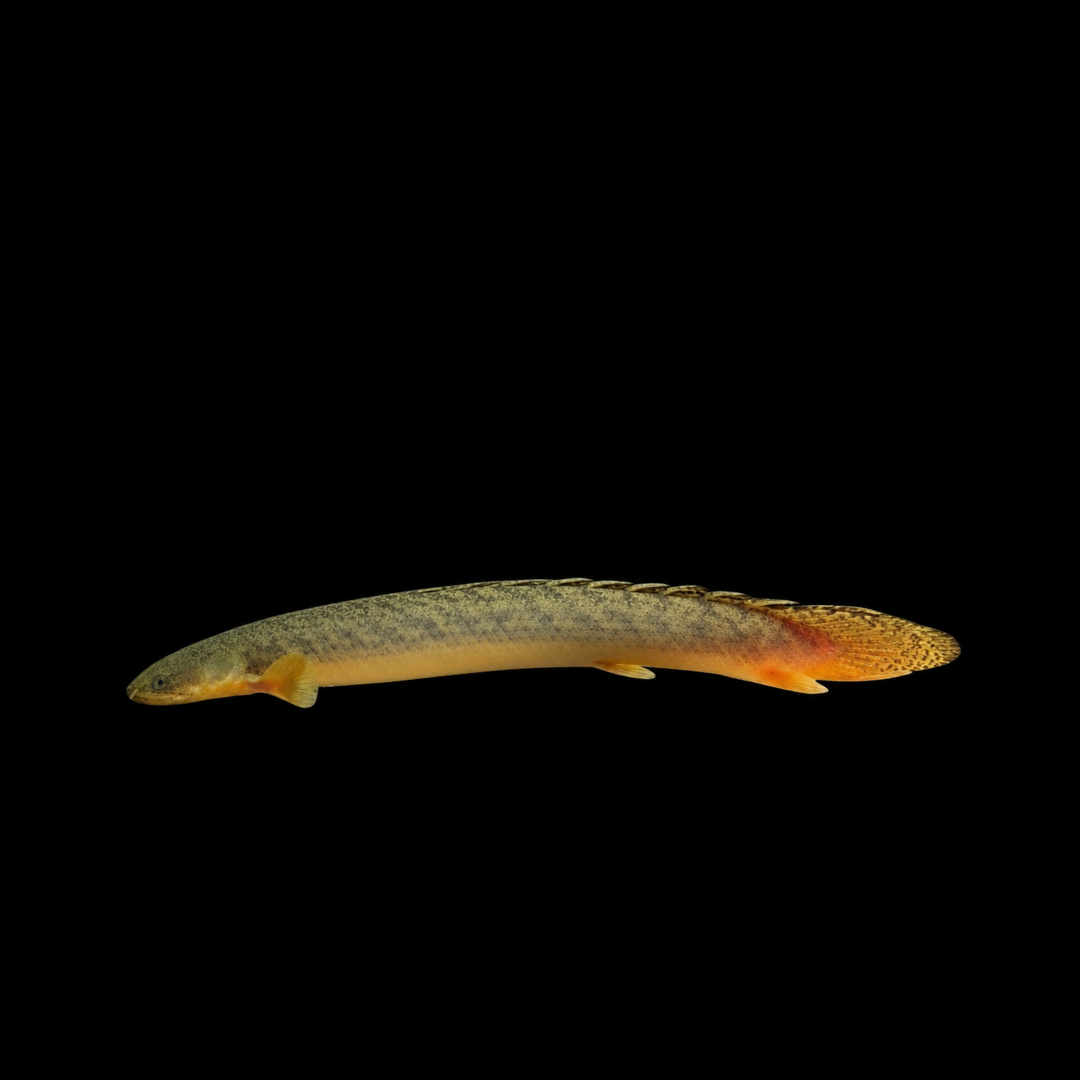
解説 / Description
ポリプテルス・パルマス「ブティコフェリー」は、西アフリカに分布するポリプテルス・パルマスのうち、観賞魚の流通で古くから「ブティコフェリー」や「ゴールドダスト・ビチャー」と呼ばれてきたタイプです。黄褐色から黄金色を帯びる体色と暗色の帯模様がよく知られていますが、模様には個体差や地域差があり、色彩だけで分類学的に区別できるわけではありません。現行の分類では、1891年に記載された Polypterus buettikoferi は独立種ではなく、Polypterus palmas の新参異名として扱われています。硬いガノイン鱗、背中に並ぶ小離鰭、空気呼吸に用いる肺など、ポリプテルス類ならではの特徴を観察できる一方、成魚では30cmを超えるため、十分な底面積と確実な飛び出し対策が欠かせません。 Polypterus palmas “buettikoferi” is the aquarium-trade form of the West African bichir Polypterus palmas traditionally sold as “Buettikoferi” or the Gold Dust Bichir. It is well known for a yellow-brown to golden ground color with darker bands, although pattern and coloration vary among individuals and local populations and are not reliable taxonomic characters on their own. Under current taxonomy, Polypterus buettikoferi, described in 1891, is treated as a junior synonym of Polypterus palmas rather than a separate species. Its ganoid scales, separate dorsal finlets, and lungs used for aerial respiration make it a distinctive bichir, but adults can exceed 30 cm and therefore require generous floor space and secure escape prevention.
基本情報 / Basic Information
| 学名 / Scientific Name | Polypterus palmas Ayres, 1850 Polypterus buettikoferi Steindachner, 1891 は現在、新参異名として扱われます。Polypterus buettikoferi Steindachner, 1891 is currently treated as a junior synonym. |
|---|---|
| 通称 / Common Name | ブティコフェリー、パルマス・ブティコフェリー、ゴールドダスト・ビチャー、ローウェイ(旧来の流通名)Buettikoferi, Palmas Buettikoferi, Gold Dust Bichir; “lowei” is also encountered as an older aquarium-trade name |
| 分類 / Family | 条鰭類・分岐鰭類(Cladistia)・ポリプテルス目・ポリプテルス科・ポリプテルス属Ray-finned fishes; Cladistia; Polypteriformes; Polypteridae; Polypterus |
| 英名 / English Name | Gold Dust Bichir, Shortfin Bichir |
| 分布 / Distribution | 現行種 Polypterus palmas は、西アフリカの上ギニア地域に分布します。主な範囲はセネガルのカザマンス川水系からコートジボワールのカヴァリ川上流域までで、ギニアビサウ、ギニア、シエラレオネ、リベリアなどから記録されています。かつて「ブティコフェリー」とされた個体群も、この分布域の中に含めて扱われています。The currently recognized species Polypterus palmas occurs in the Upper Guinea region of West Africa, broadly from the Casamance drainage in Senegal to the upper Cavally system in Côte d’Ivoire, with records from Guinea-Bissau, Guinea, Sierra Leone, and Liberia. Populations historically called “buettikoferi” are now included within this species. |
| 最大体長 / Max Size | 最大35.3cm標準体長の記録があります。観賞魚としては30〜35cm程度を想定し、成魚時の体幅と旋回スペースまで考えて水槽を選ぶのが安全です。The recorded maximum is 35.3 cm standard length. In aquarium planning, an adult size of roughly 30–35 cm should be expected, with enough width for comfortable turning as well as sufficient length. |
| 寿命 / Lifespan | 飼育下では10年前後からそれ以上の長期飼育が期待される魚です。ただし、ブティコフェリー型だけを対象にした最大寿命の学術データは十分ではないため、具体的な年数は目安として考えます。A lifespan around a decade or longer is a reasonable aquarium expectation, although a well-established scientific maximum specifically for the “buettikoferi” form is not available. Treat exact lifespan figures as husbandry estimates rather than a fixed biological limit. |
飼育環境 / Aquarium Environment
| 水槽サイズ / Tank Size | 成魚の単独飼育では、90cm規格水槽(90×45×45cm、名目約182L)以上を下限の目安にします。余裕を持って飼うなら120cm規格水槽(120×45×45cm、名目約243L)以上が適しています。60cm規格水槽は幼魚期の育成や一時的な管理には使えますが、30cmを超える成魚の終生飼育には手狭です。複数飼育や混泳では、さらに広い底面積を確保してください。For an adult kept alone, a standard 90 cm aquarium measuring 90 × 45 × 45 cm, about 182 L nominal volume, should be regarded as a practical lower limit. A standard 120 cm aquarium measuring 120 × 45 × 45 cm, about 243 L, or larger provides more suitable long-term space. A 60 cm tank may be useful for juveniles or temporary holding, but it is too restrictive for lifelong housing of an adult exceeding 30 cm. Groups and community setups require still more floor area. |
|---|---|
| 水温 / Temperature | 26〜28℃を目安にします。数値を細かく上下させるよりも、日内変動や換水時の急変を避け、安定した水温を保つことが重要です。 A practical reference range is 26–28°C. Stability is more important than repeatedly adjusting within a narrow range, so avoid abrupt daily or water-change temperature swings. |
| 水質 / Water Quality | 弱酸性から中性の水を基本とし、軟水から中程度の硬度で安定させます。特定のpH値へ無理に合わせるより、アンモニアと亜硝酸を検出させず、硝酸塩や有機物の蓄積を抑えることを優先します。定期的な換水と底床清掃を行い、急激な水質変化を避けてください。Slightly acidic to neutral water with soft to moderate hardness is a suitable general target. Rather than forcing the aquarium toward an exact pH, prioritize undetectable ammonia and nitrite, controlled nitrate and organic waste, regular water changes, and stable conditions without sudden shifts. |
| レイアウト / Layout | 底層を移動しやすい広いスペースを残しながら、土管、岩組み、しっかり固定した流木などで落ち着ける隠れ家を設けます。底床を使う場合は、体表を傷つけにくい細かく滑らかな素材が扱いやすいでしょう。ポリプテルス類は水面で空気を取り込むため、水面へ自由に上がれる経路と、水面と蓋の間の空気層を確保します。Leave broad open floor space while providing secure shelters with ceramic tubes, stable rockwork, or firmly anchored driftwood. If substrate is used, fine and smooth material is easier on the body. Because bichirs take atmospheric air at the surface, maintain an unobstructed route upward and an air space between the water surface and the lid. |
| 注意点 / Precautions | 最も注意したいのは飛び出しです。体が細長く力も強いため、配管やコード周りの小さな隙間から出ることがあります。蓋は隙間なく固定し、必要に応じて持ち上がらないよう対策します。ただし、水位を蓋いっぱいまで上げず、空気呼吸に使える空間は必ず残してください。水面を浮き草で全面的に塞ぐ配置も避けます。Escape prevention is the most important physical precaution. The elongated, muscular body can exploit surprisingly small gaps around pipes and cables, so the lid should be secure and all openings closed. At the same time, do not fill the aquarium to the lid; always retain an air space for aerial respiration and avoid completely sealing the surface with floating plants. |
餌と給餌 / Feeding
| 餌の種類 / Diet | 肉食傾向が強く、自然下では水生無脊椎動物などを利用します。飼育下では、沈下性の肉食魚用人工飼料を主食にし、冷凍エビ、冷凍アカムシ、ミミズなどを補助的に組み合わせると管理しやすくなります。生きた小魚を常用する必要はなく、衛生面や栄養の偏りを考えると人工飼料と冷凍餌を中心にする方法が安定しています。It is strongly carnivorous and feeds on aquatic invertebrates and other animal prey in nature. In captivity, sinking carnivore pellets make a practical staple, supplemented with foods such as frozen shrimp, frozen bloodworms, and earthworms. Live feeder fish are not necessary for routine maintenance; prepared and frozen foods generally provide better control over hygiene and nutritional consistency. |
|---|---|
| 給餌のポイント / Feeding Tips | 底付近で餌を探すため、沈下性の餌を使い、実際に食べられているかを確認します。嗅覚を使って餌を探すので、投入直後に反応しなくても少し時間を置いて見守るとよいでしょう。食べ残しは早めに回収し、腹部が常に大きく膨らむほど与え続けないよう、成長段階と体型を見ながら量を調整します。Use sinking foods and confirm that the fish actually finds and consumes them near the bottom. Bichirs locate food heavily by scent, so an immediate feeding response is not always necessary. Remove leftovers promptly and adjust portions to growth stage and body condition rather than feeding until the abdomen remains continuously distended. |
性格と混泳 / Temperament and Tank Mates
| 性格 / Temperament | ポリプテルス類の中では比較的落ち着いた性質として扱われますが、捕食者であることに変わりはありません。薄暗い時間帯や消灯後に動きが活発になることがあり、口に入る大きさの魚やエビは捕食対象になります。攻撃性だけでなく「飲み込めるかどうか」を基準に混泳相手を選ぶことが大切です。It is generally considered relatively calm for a bichir, but it remains a predator. Activity often increases in dim conditions or after lights-out, and fish or shrimp small enough to swallow may become prey. Tank-mate selection should therefore be based not only on aggression but also on whether another animal can physically fit into the bichir’s mouth. |
|---|---|
| 混泳の相性 / Compatibility | 同程度の大きさのポリプテルス類や、口に入らないサイズで過度に攻撃的ではない魚とは混泳できる場合があります。一方、ネオンテトラやメダカなどの小型魚、細身で丸呑みできそうな魚は避けます。ヒレを執拗につつく魚や餌を独占する魚も不向きです。プレコなど吸盤状の口を持つ魚は、個体によっては他魚の体表に吸い付くことがあるため、組み合わせる場合は体表の傷や粘液の乱れがないか慎重に観察します。Compatibility is possible with similarly sized bichirs and other fish that are too large to swallow and not excessively aggressive. Small species such as neon tetras or medaka, as well as slender fish that may be swallowed, should be avoided. Persistent fin-nippers and highly competitive feeders are also poor choices. Suckermouth catfishes such as plecos require particular observation because some individuals may attach to the bodies of tank mates and disturb the skin or mucus layer. |
病気と対策 / Diseases and Prevention
| かかりやすい病気 / Common Diseases | 特定の病気だけに極端に弱い魚ではありませんが、ワイルド個体の導入時には外部寄生虫を警戒します。ポリプテルス類では単生類の Macrogyrodactylus polypteri が知られており、Polypterus palmas でも単生類寄生の症例報告があります。体表の異常な粘液、こすりつけ行動、食欲低下、ヒレや皮膚の傷みが見られた場合は、寄生虫だけでなく水質悪化や外傷も含めて原因を確認します。This is not a species known for one uniquely dominant disease, but external parasites deserve attention when introducing wild-caught fish. The monogenean Macrogyrodactylus polypteri is well documented from polypterids, and monogenean parasitism has also been reported in Polypterus palmas. Excess mucus, rubbing, appetite loss, and skin or fin damage should prompt investigation of parasites, water quality, and physical injury rather than assumption of a single diagnosis. |
|---|---|
| 対策と予防 / Prevention | 新しく迎えた個体、とくにワイルド個体は、可能であれば隔離して数週間観察してから既存魚と合流させます。日常管理では、食べ残しや排泄物をためず、ろ過と換水で水質を安定させることが基本です。薬浴は薬剤の種類、濃度、対象となる病原体によって条件が大きく異なるため、「ポリプテルスは必ず規定量の3分の1〜2分の1にする」といった一律の減量ルールは設けません。症状を確認したうえで製品情報を読み、判断が難しい場合は魚類診療に対応できる獣医師や専門家へ相談します。When possible, quarantine new arrivals, especially wild-caught fish, for several weeks before adding them to an established aquarium. Routine prevention centers on stable filtration, regular water changes, and prompt removal of uneaten food and waste. Medication cannot be reduced safely by a universal rule such as “one-third to one-half dose for all bichirs,” because appropriate drug, concentration, and duration depend on the pathogen and product. Identify the problem first, follow product-specific information, and seek veterinary or experienced professional guidance when treatment is uncertain. |
増やし方(繁殖) / Breeding
| 雌雄の判別 / Sexing | 成熟したオスは尻ビレが幅広く肉厚になり、メスでは比較的細く小さく見えます。若い個体では差が分かりにくいため、ある程度成長してから尻ビレの幅と厚みを比較するのが基本です。Mature males develop a broader, thicker anal fin, while females generally have a narrower, less fleshy anal fin. The difference can be subtle in juveniles, so sexing is more reliable after the fish has matured sufficiently for the anal-fin shape to develop. |
|---|---|
| 繁殖形態 / Reproduction | 卵生です。ポリプテルス類では、オスが幅広い尻ビレをカップ状にしてメスの放出した卵を受け止め、その場で受精させる独特の繁殖行動が知られています。受精卵は水草や細かな基質に散らされます。ブティコフェリー型だけを対象にした繁殖研究は限られるため、孵化日数などの細かな条件は固定値として考えないほうが安全です。It is egg-laying. In bichirs, the male cups his enlarged anal fin beneath the female to receive freshly released eggs and fertilize them before the eggs are scattered among vegetation or fine substrate. Detailed breeding data specifically for the “buettikoferi” form are limited, so exact incubation times and triggering conditions should not be treated as fixed species-specific values. |
| 繁殖のポイント / Breeding Tips | 繁殖を狙う場合は、十分に成熟した雌雄を良好な栄養状態で維持し、卵を受け止めやすい細葉の水草や人工産卵床を用意します。ポリプテルス類の仔魚は孵化後に外鰓を持ち、卵黄を吸収した後はブラインシュリンプ幼生などの微小な生餌へ移行します。親魚や大きく育った仔魚による食害を避けるため、卵や仔魚を分けて管理できる環境を準備しておくと安心です。For breeding attempts, maintain fully mature adults in good nutritional condition and provide fine-leaved plants or artificial spawning material that can catch scattered eggs. Bichir larvae bear external gills after hatching and, once yolk reserves are absorbed, can be transitioned to very small live foods such as newly hatched brine shrimp. Separate management of eggs and larvae helps reduce losses from adults or larger siblings. |
雑学と豆知識 / Trivia and Fun Facts
| 1. 「ブティコフェリー」は現在の有効種名ではない / 1. “Buettikoferi” Is Not the Current Valid Species Name | この名前は1891年、フランツ・シュタインダハナーがリベリア産の標本をもとに Polypterus buettikoferi として記載したことに始まります。種小名は、標本を集めたヨハン・ビュティコファーにちなみます。その後は P. palmas の亜種として扱われた時期もありましたが、2019年のMoritz & Britzによるポリプテルス科の再検討では、P. buettikoferi を P. palmas の新参異名としました。現在の主要な魚類分類カタログもこの扱いを採用しています。それでも「ブティコフェリー」という呼び名は、観賞魚の世界では特定の色彩タイプを伝える便利な流通名として残っています。The name began in 1891, when Franz Steindachner described Liberian specimens as Polypterus buettikoferi, honoring collector Johann Büttikofer. It was later treated for a time as a subspecies of P. palmas. The 2019 revision of Polypteridae by Moritz and Britz placed P. buettikoferi in the synonymy of P. palmas, an arrangement followed by major current fish catalogues. The aquarium name “Buettikoferi” nevertheless remains useful in the trade for describing a familiar color form. |
|---|---|
| 2. 黄金色と黒帯は魅力だが、分類の決め手ではない / 2. Gold and Dark Bands Are Attractive, but Not Taxonomically Diagnostic | ブティコフェリーとして流通する個体は、黄金色を帯びた地色と暗い帯模様で人気があります。ただし、2019年の再検討では、かつて亜種を分ける根拠として使われた色彩パターンに重なりがあり、形態計測でも安定して分離できないことが問題とされました。そのため、見た目が「典型的なブティコフェリー」に見えても、それだけで独立した分類群だと判断することはできません。観賞魚名と学術上の種名を分けて理解すると、流通名の面白さも分類学の変遷も見えやすくなります。Fish sold as Buettikoferi are prized for a golden ground color with dark barring. However, the 2019 revision emphasized overlap in color patterns once used to separate subspecies and the inability to distinguish the forms consistently with morphometric data. A fish may therefore look “typically Buettikoferi” without representing a separate taxonomic species. Distinguishing aquarium-trade names from formal taxonomy makes both the hobby history and the scientific history easier to understand. |
| 3. 背中の小離鰭は7〜10本が目安 / 3. The Dorsal Finlets Usually Number About 7–10 | ポリプテルスの背中に並ぶ「小さな背ビレ」は、それぞれ独立した棘を持つ小離鰭です。現行種 Polypterus palmas では背鰭棘が7〜10本とされており、この数は近縁種を見分ける際の形態情報の一つになります。元資料で見られる11〜14本という数値は、少なくとも現在の P. palmas の標準的な記載とは一致しません。古い図鑑名や流通名だけでなく、こうした形態値も最新の分類に合わせて読むことが大切です。The row of small “dorsal fins” along a bichir’s back consists of separate finlets, each supported by its own spine. Current descriptions of Polypterus palmas give 7–10 dorsal spines, and this count is one of several morphological characters used in identification. A figure of 11–14, sometimes encountered in secondary material, does not match the standard current description for P. palmas. |
| 4. ガノイン鱗は「硬いのに曲がれる」装甲 / 4. Ganoid Scales Form Armor That Can Still Bend | ポリプテルス類の体表を覆うガノイン鱗は、硬い層を重ねた装甲のような構造を持ち、隣り合う鱗はペグ・アンド・ソケット状にかみ合います。それほど硬い鱗を持ちながら、ポリプテルスは細長い体を大きくくねらせて泳げます。生体力学研究では、体を曲げると鱗どうしの重なり方が大きく変化することが示されており、防御力と可動性を両立する仕組みが見えてきました。水槽の中で方向転換する何気ない動きにも、古い条鰭類ならではの精巧な構造が働いています。Bichir ganoid scales form a hard, multilayered armor whose neighboring scales interlock with peg-and-socket joints. Despite this rigidity, bichirs can bend their elongated bodies strongly during swimming. Biomechanical work has shown large changes in scale overlap as the body curves, revealing how the integument combines protection with flexibility. Even an ordinary turn in the aquarium is supported by this unusual mechanical design. |
| 5. 空気を吸う仕組みには「反動」が使われる / 5. Elastic Recoil Helps Draw Air into the Lungs | ポリプテルス類の空気呼吸には「反動吸引」と呼ばれる仕組みが知られています。研究では、息を吐く際に変形した硬い鱗を持つ体壁が元の形へ戻る反動によって体腔内に負圧が生じ、その力が吸気に利用されることが示されました。これはポリプテルス科を対象にした生理学的研究から分かった特徴で、ブティコフェリー型だけに限定された性質ではありません。水面へ上がる行動を単なる「空気の丸のみ」と考えるより、体全体が呼吸装置の一部として働いていると見ると、その特殊さがよく分かります。Polypterid aerial respiration includes a mechanism called recoil aspiration. Physiological studies showed that the stiff, scale-covered body wall deforms during expiration and then recoils, creating negative pressure that contributes to inhalation. This is a polypterid-level finding rather than a feature demonstrated only in the Buettikoferi form. The body wall itself therefore functions as part of the breathing mechanism, making a surface breath far more mechanically sophisticated than a simple gulp of air. |
| 6. 噴水孔から空気を取り込むポリプテルスもいる / 6. Some Bichirs Inhale Air Through Their Spiracles | ポリプテルスの頭頂部には、口腔へ通じる左右一対の噴水孔があります。4種のポリプテルスを調べた研究では、条件によって空気呼吸の最大93%が噴水孔を介して行われました。観察者が見える状況では口から吸う割合が増えたことも報告されており、呼吸方法が行動状態によって変わる点も興味深いところです。この93%という数字はポリプテルス属4種で得られた研究値であり、ブティコフェリー型そのものについて測定された固有値ではありません。Bichirs have a paired set of spiracles on the top of the head that open into the buccopharyngeal cavity. In a study of four Polypterus species, up to 93% of observed air breaths passed through the spiracles under some conditions. Mouth inhalation became more common when the fish could see an observer, suggesting that breathing mode can vary with behavior and stress. The 93% figure is therefore a result from four studied species, not a species-specific measurement for the Buettikoferi form. |
| 7. 肺は左右対称ではない / 7. The Lungs Are Asymmetrical | ポリプテルス類には、空気呼吸に使われる袋状の肺があります。その左右は同じ大きさではなく、非対称な構造をしています。組織学的には、肺の内面に薄いガス交換面と密な毛細血管網が発達し、粘液細胞や線毛細胞も存在します。外見だけを見ると「原始的な魚」という印象を受けやすいものの、呼吸器官の内部には、水中と空気の両方を利用する生活に適した高度な組織構造が備わっています。Bichirs possess sac-like lungs used for aerial respiration, and the two sides are not equal in size. Histological studies describe thin gas-exchange surfaces backed by dense capillary networks, together with mucus-producing and ciliated cells. Although bichirs are often described informally as “primitive” fishes, the internal organization of their respiratory organs is highly specialized for a life that uses both aquatic and aerial respiration. |
| 8. 仔魚は外鰓を持つ / 8. Bichir Larvae Bear External Gills | ポリプテルス類の仔魚は、頭部の左右に羽毛状の外鰓を持って孵化します。とくに Polypterus senegalus では発生過程が詳しく研究され、成長とともに外鰓が縮小し、幼魚期へ移るにつれて水面での空気呼吸が見られるようになることが記載されています。成魚のガノイン鱗や肺だけでなく、成長途中の姿にも独特の特徴が現れるため、ポリプテルス類は発生学の面からも興味深い魚です。Bichir larvae hatch with feathery external gills on either side of the head. Development has been studied in detail in Polypterus senegalus, where the external gills gradually regress and surface air breathing appears later as the fish enters the juvenile period. Bichirs are therefore notable not only for the ganoid scales and lungs of adults but also for their unusual developmental stages. |
| 9. 保全状況は「低懸念」 / 9. The Species Is Assessed as Least Concern | 現行種 Polypterus palmas はIUCNレッドリストで「低懸念(Least Concern)」と評価されています。これは現在の情報から絶滅リスクが比較的低いと判断されていることを示すもので、飼育個体の出自や採集圧を気にしなくてよいという意味ではありません。ワイルド個体を選ぶ場合は、産地情報や入荷状態を確認し、長期飼育できる環境を整えてから迎えることが望まれます。The currently recognized species Polypterus palmas is assessed as Least Concern on the IUCN Red List. This indicates a relatively low extinction risk under current information, but it does not make origin, collection pressure, or animal welfare irrelevant. When purchasing wild-caught fish, provenance and condition still matter, and the aquarium should be prepared for long-term care before acquisition. |
まとめ / Conclusion
ポリプテルス・パルマス「ブティコフェリー」は、現在の分類では Polypterus palmas に含まれながら、観賞魚の世界では黄金色の体色と暗い帯模様を持つ「ゴールドダスト・ビチャー」として親しまれてきました。色彩の美しさに加え、ガノイン鱗、小離鰭、肺を使う空気呼吸など、ポリプテルス類ならではの体のつくりを身近に観察できることが大きな魅力です。その一方で、成魚は30cmを超えるため、90cm規格以上の水槽を基本に、十分な底面積、隙間のない蓋、水面へ上がれる空間を確保する必要があります。 Polypterus palmas “buettikoferi” is now taxonomically included within Polypterus palmas, yet it remains familiar in the aquarium world as the golden, dark-banded Gold Dust Bichir. Beyond its coloration, it offers a close view of hallmark bichir features including ganoid scales, separate dorsal finlets, and aerial respiration using lungs. Because adults exceed 30 cm, long-term care should begin with at least a standard 90 cm aquarium, generous floor area, a completely secure lid, and unobstructed access to the water surface.
安定した水質を保ち、沈下性の餌を中心に無理のない給餌を続け、飲み込めない大きさの相手だけを慎重に選べば、落ち着いた姿を長く楽しめます。水面へ静かに上がって空気を取り込み、底を探りながら餌を見つけ、しなやかな体でゆっくり方向を変える姿には、数値だけでは伝わらない独特の存在感があります。長い分類史と古い系統の特徴を併せ持つこの魚は、派手さだけでなく、観察するほど新しい発見が増えていく奥深いポリプテルスです。 With stable water quality, sensible portions of sinking foods, and carefully chosen tank mates too large to swallow, this bichir can be maintained as a calm long-term aquarium resident. Its quiet rises to the surface, scent-guided searching along the bottom, and slow flexible turns give it a presence that cannot be reduced to measurements alone. The combination of a complicated taxonomic history and the distinctive biology of an ancient ray-finned lineage makes the Gold Dust form rewarding to observe over many years.
分布マップ
ポリプテルス・パルマスは、西アフリカの上ギニア地域に分布し、セネガルのカザマンス川水系からコートジボワールのカヴァリ川上流域にかけて、ギニアビサウ、ギニア、シエラレオネ、リベリアなどから記録されています。地図上の地点は、この広い分布域を把握するための概略代表地点であり、実際の採集地点や厳密な生息場所を示すものではありません。
※ この地図は記事中の分布記述をもとにした概略表示です。マーカーは分布域のおおよその位置関係を示す代表地点で、実際の採集地点、個体の確認地点、河川ごとの生息範囲、分布境界を示すものではありません。
分類、分布、生息環境、飼育条件、繁殖、疾病・衛生管理について、学術論文、公的機関・研究機関のデータベース、専門誌に掲載された症例報告を中心に選定しています。店舗・通販サイト、個人ブログ、一般的なまとめサイトは含めていません。
-
分類分布Moritz, T. & Britz, R. (2019). Revision of the extant Polypteridae (Actinopterygii: Cladistia).Ichthyological Exploration of Freshwaters, IEF-1094, 1–96. DOI: 10.23788/IEF-1094ポリプテルス科全体の現行分類を再検討した主要文献です。Polypterus buettikoferi を Polypterus palmas の新参異名とし、Upper Guinea地域における分布、形態、色彩変異も再評価しています。
-
分類Fricke, R., Eschmeyer, W. N. & van der Laan, R. (eds.) (2026). Eschmeyer’s Catalog of Fishes: Genera, Species, References.California Academy of Sciences. 2026年7月27日閲覧。魚類の学名・異名関係を確認するための国際的な標準データベースです。2026年7月版では P. buettikoferi の現行ステータスを P. palmas のシノニムとして掲載しています。
-
分類史形態・分布Hanssens, M. M., Teugels, G. G. & Thys van den Audenaerde, D. F. E. (1995). Subspecies in the Polypterus palmas complex (Brachiopterygii; Polypteridae) from West and Central Africa.Copeia, 1995(3), 694–705. DOI: 10.2307/1446767現在は分類体系が更新されていますが、P. palmas 複合群の標本比較、形態計測、分布、最大体長などを確認するうえで重要な基礎資料です。
-
分布・環境飼育条件Froese, R. & Pauly, D. (eds.). FishBase. Polypterus palmas Ayres, 1850.World Wide Web electronic publication. 2026年7月27日閲覧。西アフリカの分布、淡水・底生性、26〜28℃、軟水域の水質情報、最大35.3cm標準体長、背鰭棘数などをまとめて確認できます。水槽サイズを考える際の生物学的な基礎値として利用しています。
-
呼吸・飼育上の注意Magid, A. M. A. (1966). Breathing and function of the spiracles in Polypterus senegalus.Animal Behaviour, 14(4), 530–533. DOI: 10.1016/S0003-3472(66)80055-6ポリプテルスが水面へ上がって空気を取り込む行動と噴水孔の機能を実験的に調べた研究です。P. palmas 単独の研究ではありませんが、水面へのアクセスを妨げないという飼育上の注意を支えるポリプテルス属の生理学的根拠になります。
-
繁殖Holden, M. J. (1971). Significance of Sexual Dimorphism of the Anal Fin of Polypteridae.Nature, 232, 135–136. DOI: 10.1038/232135b0雌雄で尻ビレ形状が異なることと、オスが幅広い尻ビレをカップ状に使って産卵時の受精に関与することを扱った古典的研究です。記事内の雌雄判別と繁殖行動の根拠になります。
-
繁殖・発生Subamia, I. W., Nugraha, M. F. I. & Sugito, S. (2008). Embryonic Developmental Stages of Ikan Palmas (Polypterus senegalus senegalus).Indonesian Aquaculture Journal, 3(2), 119–124. DOI: 10.15578/iaj.3.2.2008.119-124飼育下での産卵と胚発生を観察した研究です。対象は P. senegalus であるため、ブティコフェリー型の孵化日数を直接示す資料ではありませんが、ポリプテルス属の卵生・初期発生を補強する資料として採用しています。
-
病気・薬剤Cardoso, P. H. M., Costa, A. R., Balian, S. C. & Pestelli, M. (2017). Relato de caso de parasitismo por Monogênea no peixe ornamental Polypterus palmas no Brasil.Revista de Educação Continuada em Medicina Veterinária e Zootecnia do CRMV-SP, 15(1), 30–36. DOI: 10.36440/recmvz.v15i1.36763輸入された P. palmas で単生類寄生が確認された症例報告です。体表粘液の異常、隔離治療、プラジクアンテル使用例に加え、トリクロルホンが一部魚種に毒性を示したことも記載されており、薬剤を一律濃度で扱わないという注意を直接支えます。
-
寄生虫Khalil, L. F. (1970). Further Studies on Macrogyrodactylus polypteri, a Monogenean on the African Freshwater Fish Polypterus senegalus.Journal of Helminthology, 44(3–4), 329–348. DOI: 10.1017/S0022149X00022008ポリプテルス類の体表・ヒレに寄生する Macrogyrodactylus polypteri の基礎資料です。宿主は主に P. senegalus ですが、記事内でポリプテルス類に知られる外部寄生虫として言及する際の根拠になります。
-
検疫・衛生管理Arthur, J. R., Bondad-Reantaso, M. G. & Subasinghe, R. P. (2008). Procedures for the quarantine of live aquatic animals: a manual.FAO Fisheries Technical Paper No. 502. Food and Agriculture Organization of the United Nations, Rome.生きた水生動物の移動に伴う疾病リスクと検疫の考え方をまとめたFAOの技術資料です。新規導入魚を既存個体と分けて観察するという衛生管理上の原則を支える資料として採用しています。




コメント